The global Renewable Methanol Market is poised to register a 51.3% CAGR from $945.3 Million in 2024 to $11339.7 Million in 2030.
The global Renewable Methanol Market Study analyzes and forecasts the market size across 6 regions and 24 countries for diverse segments -By Feedstock (Agriculture Waste, Municipal Waste, Renewable Energy, Others), By Application (Gasoline, Formaldehyde, MTBE, Dimethyl Ether, MTO, Acetic Acid, Others).
An Introduction to Global Renewable Methanol Market in 2024
The renewable methanol market is experiencing significant growth driven by the global transition towards sustainable energy sources and low-carbon fuels. Key trends shaping the future of the industry include advancements in renewable methanol production technologies, such as biomass gasification, carbon capture and utilization (CCU), and electrolysis of renewable electricity, which enable the synthesis of methanol from renewable feedstocks such as biomass, carbon dioxide, and green hydrogen. Moreover, the growing demand for renewable methanol as a versatile chemical feedstock, fuel blendstock, and energy carrier in applications ranging from transportation and power generation to chemical synthesis and industrial processes is driving investments in large-scale production facilities and distribution infrastructure. Additionally, regulatory mandates, carbon pricing mechanisms, and sustainability initiatives are incentivizing the adoption of renewable methanol as a low-carbon alternative to conventional fossil fuels and petrochemical feedstocks, further accelerating market growth. As stakeholders collaborate to scale up renewable methanol production capacity, improve production efficiency, and reduce production costs, the renewable methanol market is poised for sustained expansion as a key enabler of the global energy transition towards a carbon-neutral future.
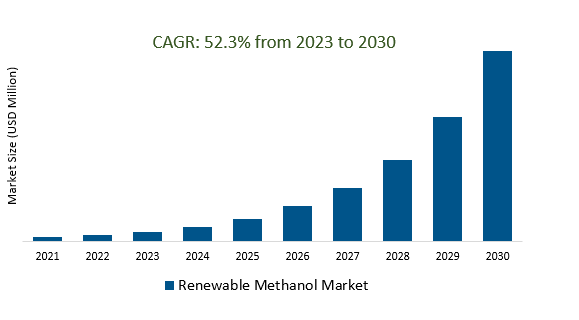
Renewable Methanol Market Competitive Landscape
The market report analyses the leading companies in the industry including Advanced Chemical Technologies, BASF SE, Carbon Recycling International, Enerkem, Fraunhofer, Innogy SE, Nordic Green AS, OCI N.V., Sodra, Uniper SE, Vertimass LLC.
Renewable Methanol Market Dynamics
Renewable Methanol Market Trend: Growing Demand for Sustainable Fuels
A prominent trend in the renewable methanol market is the growing demand for sustainable fuels. With increasing concerns about climate change and air pollution, there is a global shift towards renewable and low-carbon alternatives to conventional fossil fuels. Renewable methanol, produced from renewable sources such as biomass, industrial waste gases, or carbon dioxide captured from the atmosphere, offers a sustainable and environmentally friendly fuel option. It can be used as a drop-in replacement for traditional methanol in various applications such as transportation, power generation, and chemical manufacturing. The trend towards decarbonization and sustainability drives the adoption of renewable methanol as a clean energy solution, supporting market growth and investment in renewable fuel technologies.
Renewable Methanol Market Driver: Government Policies and Renewable Energy Mandates
A key driver for the renewable methanol market is government policies and renewable energy mandates. Governments worldwide are implementing regulations, incentives, and renewable energy targets to reduce greenhouse gas emissions and promote the use of renewable fuels. Renewable energy mandates, renewable fuel standards, carbon pricing mechanisms, and tax incentives create a favorable regulatory environment for renewable methanol producers and users. Additionally, initiatives such as carbon pricing, carbon offsetting, and carbon capture and utilization (CCU) programs provide economic incentives for the production and utilization of renewable methanol, driving market demand and investment in renewable fuel infrastructure.
Renewable Methanol Market Opportunity: Integration into Sustainable Transportation Solutions
An opportunity within the renewable methanol market lies in the integration into sustainable transportation solutions. With the transportation sector being a major contributor to greenhouse gas emissions, there is a growing need for renewable fuels that can decarbonize the transportation sector and reduce reliance on fossil fuels. Renewable methanol can be blended with gasoline or diesel fuels or used as a pure fuel in internal combustion engines, fuel cells, or methanol-powered vehicles. Additionally, renewable methanol can be utilized in fuel cells to generate electricity for electric vehicles, offering a versatile and sustainable energy carrier for transportation applications. By integrating renewable methanol into sustainable transportation solutions, stakeholders can reduce emissions, improve air quality, and contribute to the transition towards a cleaner and more sustainable transportation system.
Renewable Methanol Market Share Analysis: Renewable Energy segment generated the highest revenue in the industry
Renewable energy is the largest segment in the Renewable Methanol Market due to its significant role in providing sustainable feedstock for methanol production. Methanol, a versatile chemical building block, can be produced from various renewable energy sources such as biomass, wind, solar, and hydroelectric power. The increasing global focus on reducing carbon emissions and transitioning towards renewable energy sources has propelled the demand for renewable methanol as a low-carbon alternative to conventional fossil-based methanol. Renewable energy-derived methanol offers numerous environmental benefits, including reduced greenhouse gas emissions, lower carbon footprint, and enhanced energy security. In addition, advancements in renewable energy technologies, coupled with favorable government policies and incentives promoting renewable energy deployment, have bolstered the growth of the renewable energy segment in the renewable methanol market. As industries across sectors such as transportation, chemicals, and energy seek to decarbonize their operations, the demand for renewable methanol derived from sustainable energy sources is expected to continue expanding, solidifying the renewable energy segment's position as the largest segment in the renewable methanol market.
Renewable Methanol Market Share Analysis: Dimethyl Ether (DME) Segment is poised to register the fastest growth rate (CAGR) over the forecast period to 2030
Dimethyl Ether (DME) is the fastest-growing segment in the Renewable Methanol Market due to its versatile applications across various industries and its potential as a clean alternative fuel. DME, a clean-burning and sulfur-free alternative to diesel, is produced from renewable methanol through a dehydration process. With increasing concerns over air pollution and greenhouse gas emissions, there is a growing interest in DME as a transportation fuel, particularly in regions striving to reduce reliance on conventional diesel fuels. DME offers diverse advantages, including high cetane number, low emissions of particulate matter and nitrogen oxides, and compatibility with existing diesel engines and infrastructure. Additionally, DME can be used as a feedstock for the production of other valuable chemicals such as olefins and propylene, further expanding its market potential. As governments implement stringent emission regulations and incentivize the adoption of alternative fuels, the demand for renewable DME is expected to witness robust growth, driving the rapid expansion of the DME segment in the renewable methanol market.
Renewable Methanol Market Report Segmentation
By Feedstock
Agriculture Waste
Municipal Waste
Renewable Energy
Others
By Application
Gasoline
Formaldehyde
MTBE
Dimethyl Ether
MTO
Acetic Acid
Others
Regions Included
North America (US, Canada, Mexico)
Europe (Germany, UK, France, Spain, Italy, Russia, Rest of Europe)
Asia Pacific (China, India, Japan, South Korea, Australia, South East Asia, Rest of Asia)
South America (Brazil, Argentina, Rest of South America)
Middle East and Africa (Saudi Arabia, UAE, Rest of Middle East, South Africa, Egypt, Rest of Africa)
Renewable Methanol Companies Profiled in the Market Study
Advanced Chemical Technologies
BASF SE
Carbon Recycling International
Enerkem
Fraunhofer
Innogy SE
Nordic Green AS
OCI N.V.
Sodra
Uniper SE
Vertimass LLC
*- List Not Exhaustive
TABLE OF CONTENTS
1 Introduction to 2024 Renewable Methanol Market
1.1 Market Overview
1.2 Quick Facts
1.3 Scope/Objective of the Study
1.4 Market Definition
1.5 Countries and Regions Covered
1.6 Units, Currency, and Conversions
1.7 Industry Value Chain
2 Research Methodology
2.1 Market Size Estimation
2.2 Sources and Research Methodology
2.3 Data Triangulation
2.4 Assumptions and Limitations
3 Executive Summary
3.1 Global Renewable Methanol Market Size Outlook, $ Million, 2021 to 2030
3.2 Renewable Methanol Market Outlook by Type, $ Million, 2021 to 2030
3.3 Renewable Methanol Market Outlook by Product, $ Million, 2021 to 2030
3.4 Renewable Methanol Market Outlook by Application, $ Million, 2021 to 2030
3.5 Renewable Methanol Market Outlook by Key Countries, $ Million, 2021 to 2030
4 Market Dynamics
4.1 Key Driving Forces of Renewable Methanol Industry
4.2 Key Market Trends in Renewable Methanol Industry
4.3 Potential Opportunities in Renewable Methanol Industry
4.4 Key Challenges in Renewable Methanol Industry
5 Market Factor Analysis
5.1 Value Chain Analysis
5.2 Competitive Landscape
5.2.1 Global Renewable Methanol Market Share by Company (%), 2023
5.2.2 Product Offerings by Company
5.3 Porter’s Five Forces Analysis
5.4 Pricing Analysis and Outlook
6 Growth Outlook Across Scenarios
6.1 Growth Analysis-Case Scenario Definitions
6.2 Low Growth Scenario Forecasts
6.3 Reference Growth Scenario Forecasts
6.4 High Growth Scenario Forecasts
7 Global Renewable Methanol Market Outlook by Segments
7.1 Renewable Methanol Market Outlook by Segments, $ Million, 2021- 2030
By Feedstock
Agriculture Waste
Municipal Waste
Renewable Energy
Others
By Application
Gasoline
Formaldehyde
MTBE
Dimethyl Ether
MTO
Acetic Acid
Others
8 North America Renewable Methanol Market Analysis and Outlook To 2030
8.1 Introduction to North America Renewable Methanol Markets in 2024
8.2 North America Renewable Methanol Market Size Outlook by Country, 2021-2030
8.2.1 United States
8.2.2 Canada
8.2.3 Mexico
8.3 North America Renewable Methanol Market size Outlook by Segments, 2021-2030
By Feedstock
Agriculture Waste
Municipal Waste
Renewable Energy
Others
By Application
Gasoline
Formaldehyde
MTBE
Dimethyl Ether
MTO
Acetic Acid
Others
9 Europe Renewable Methanol Market Analysis and Outlook To 2030
9.1 Introduction to Europe Renewable Methanol Markets in 2024
9.2 Europe Renewable Methanol Market Size Outlook by Country, 2021-2030
9.2.1 Germany
9.2.2 France
9.2.3 Spain
9.2.4 United Kingdom
9.2.4 Italy
9.2.5 Russia
9.2.6 Norway
9.2.7 Rest of Europe
9.3 Europe Renewable Methanol Market Size Outlook by Segments, 2021-2030
By Feedstock
Agriculture Waste
Municipal Waste
Renewable Energy
Others
By Application
Gasoline
Formaldehyde
MTBE
Dimethyl Ether
MTO
Acetic Acid
Others
10 Asia Pacific Renewable Methanol Market Analysis and Outlook To 2030
10.1 Introduction to Asia Pacific Renewable Methanol Markets in 2024
10.2 Asia Pacific Renewable Methanol Market Size Outlook by Country, 2021-2030
10.2.1 China
10.2.2 India
10.2.3 Japan
10.2.4 South Korea
10.2.5 Indonesia
10.2.6 Malaysia
10.2.7 Australia
10.2.8 Rest of Asia Pacific
10.3 Asia Pacific Renewable Methanol Market size Outlook by Segments, 2021-2030
By Feedstock
Agriculture Waste
Municipal Waste
Renewable Energy
Others
By Application
Gasoline
Formaldehyde
MTBE
Dimethyl Ether
MTO
Acetic Acid
Others
11 South America Renewable Methanol Market Analysis and Outlook To 2030
11.1 Introduction to South America Renewable Methanol Markets in 2024
11.2 South America Renewable Methanol Market Size Outlook by Country, 2021-2030
11.2.1 Brazil
11.2.2 Argentina
11.2.3 Rest of South America
11.3 South America Renewable Methanol Market size Outlook by Segments, 2021-2030
By Feedstock
Agriculture Waste
Municipal Waste
Renewable Energy
Others
By Application
Gasoline
Formaldehyde
MTBE
Dimethyl Ether
MTO
Acetic Acid
Others
12 Middle East and Africa Renewable Methanol Market Analysis and Outlook To 2030
12.1 Introduction to Middle East and Africa Renewable Methanol Markets in 2024
12.2 Middle East and Africa Renewable Methanol Market Size Outlook by Country, 2021-2030
12.2.1 Saudi Arabia
12.2.2 UAE
12.2.3 Oman
12.2.4 Rest of Middle East
12.2.5 Egypt
12.2.6 Nigeria
12.2.7 South Africa
12.2.8 Rest of Africa
12.3 Middle East and Africa Renewable Methanol Market size Outlook by Segments, 2021-2030
By Feedstock
Agriculture Waste
Municipal Waste
Renewable Energy
Others
By Application
Gasoline
Formaldehyde
MTBE
Dimethyl Ether
MTO
Acetic Acid
Others
13 Company Profiles
13.1 Company Snapshot
13.2 SWOT Profiles
13.3 Products and Services
13.4 Recent Developments
13.5 Financial Profile
Advanced Chemical Technologies
BASF SE
Carbon Recycling International
Enerkem
Fraunhofer
Innogy SE
Nordic Green AS
OCI N.V.
Sodra
Uniper SE
Vertimass LLC
14 Appendix
14.1 Customization Offerings
14.2 Subscription Services
14.3 Related Reports
14.4 Publisher Expertise
By Feedstock
Agriculture Waste
Municipal Waste
Renewable Energy
Others
By Application
Gasoline
Formaldehyde
MTBE
Dimethyl Ether
MTO
Acetic Acid
Others
Countries Analyzed
North America (US, Canada, Mexico)
Europe (Germany, UK, France, Spain, Italy, Russia, Rest of Europe)
Asia Pacific (China, India, Japan, South Korea, Australia, South East Asia, Rest of Asia)
South America (Brazil, Argentina, Rest of South America)
Middle East and Africa (Saudi Arabia, UAE, Rest of Middle East, South Africa, Egypt, Rest of Africa)
