Market Overview: Hollow Fiber Ultrafiltration Market Expands with Advanced Water Purification, Industrial Reuse and Biopharmaceutical Processing
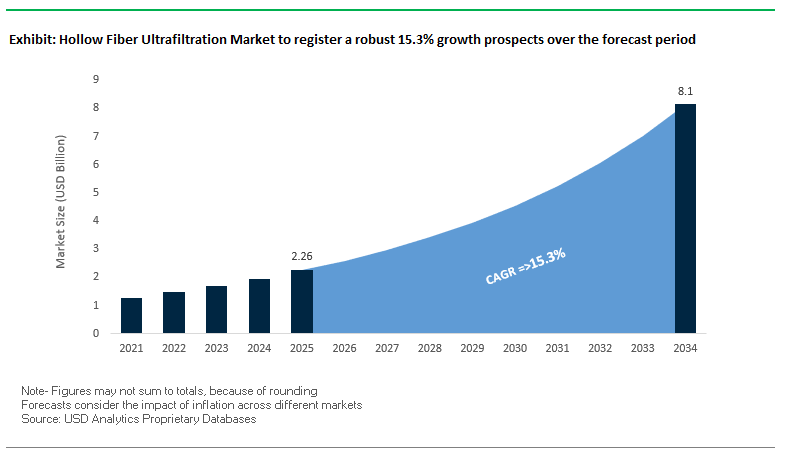
The global Hollow Fiber Ultrafiltration Market is projected to increase from USD 2.26 billion in 2025 to USD 8.1 billion by 2034, registering a CAGR of 15.3% during the forecast period. Market growth is supported by municipal drinking-water treatment, industrial wastewater recycling, desalination pretreatment and biopharmaceutical separation. Hollow fiber ultrafiltration (UF) membranes provide high filtration surface area within compact modules, supporting particulate and microbial reduction across municipal and industrial applications. Pressurized and submerged systems serve different treatment requirements, while inside-out and outside-in configurations accommodate variations in feedwater quality, hydraulic conditions and cleaning processes. Polymeric membranes, including PVDF, PES and polysulfone, dominate conventional applications, while ceramic and hybrid materials address specialized operating conditions.
Industrial water recovery and biopharmaceutical processing represent important sources of demand. Municipal utilities and industrial facilities use hollow fiber UF for wastewater reclamation, process-water preparation and reverse osmosis (RO) pretreatment. In biotechnology and pharmaceutical manufacturing, hollow fiber tangential flow filtration (TFF) supports protein concentration, buffer exchange, diafiltration and selected cell-processing applications. Food and beverage processing also utilizes UF for dairy ingredient processing, protein concentration and liquid clarification. Commercial demand is influenced by membrane throughput, filtration reliability, energy consumption and lifecycle costs. Membrane fouling, backwashing, chemical cleaning and replacement intervals influence operating expenditure, while single-use filtration modules and process validation are particularly relevant to biopharmaceutical applications.
Asia Pacific represents a significant regional market, supported by municipal water infrastructure, industrial wastewater recycling and manufacturing activity across China, India, Japan and Southeast Asia. North America maintains established demand from drinking-water treatment, semiconductor process-water preparation and biopharmaceutical manufacturing, while Europe contributes through municipal treatment upgrades, industrial filtration and regulated pharmaceutical processing. The Middle East supports hollow fiber UF deployment in seawater desalination pretreatment and industrial water purification. Competition includes membrane manufacturers, integrated water treatment companies and bioprocessing technology suppliers, with differentiation centered on membrane permeability, module configuration, fouling resistance, filtration integrity and lifecycle treatment economics.
Key Insights: Hollow Fiber Ultrafiltration Market
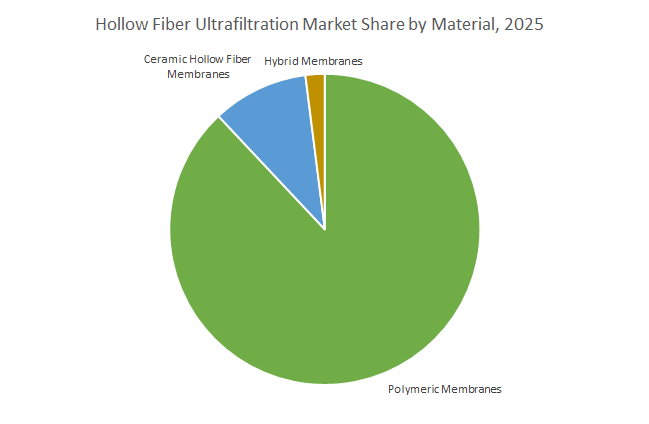
Polymeric Membranes Dominate Material Demand: Polymeric membranes account for 88% of the market in 2025, followed by ceramic hollow fibers at 10% and hybrid materials at 2%, reflecting different filtration and material-performance requirements.
Water and Wastewater Treatment Leads Applications: Water and wastewater treatment holds 65% market share in 2025, followed by biotechnology and pharmaceuticals at 15%, food and beverage at 12%, chemicals and petrochemicals at 5%, and other applications at 3%.
Inside-Out and Outside-In Configurations Support Diverse Applications: Inside-out and outside-in hollow fiber modules accommodate different feedwater conditions, solids loading, hydraulic requirements and cleaning arrangements across pressurized and submerged filtration systems.
Industrial Water Recovery Supports Membrane Demand: Power generation, chemicals, electronics and manufacturing contribute to hollow fiber UF demand through wastewater recycling, RO pretreatment, process-water purification and membrane replacement.
Membrane Fouling and Operating Costs Influence Competition: Energy consumption, membrane permeability, fouling control, backwashing, chemical cleaning and replacement intervals influence filtration performance and lifecycle treatment expenditure.
Bioprocessing Expands Specialized UF Applications: Hollow fiber tangential flow filtration supports protein concentration, diafiltration and biological processing, with single-use modules, membrane selectivity and product recovery influencing pharmaceutical filtration requirements.
Recent Developments in Hollow Fiber Ultrafiltration Membranes, Industrial Water Reuse and Advanced Separation Technologies
Recent developments in the Hollow Fiber Ultrafiltration Market reflect increasing commercialization of compact membrane modules, finer-pore filtration technologies and higher-efficiency industrial water treatment systems. In April 2026, DuPont launched Inge ultrafiltration modules incorporating an integrated pre-filter (iP-F) for drinking-water treatment and seawater desalination pretreatment. The design combines debris removal and ultrafiltration within a single module housing, reducing the need for a separate upstream prefiltration manifold. According to the DuPont integrated-prefilter ultrafiltration announcement, the new modules retain the membrane materials, dimensions and drinking-water certifications of the existing Inge product family. The development reflects increasing emphasis on installation footprint, equipment integration and capital costs in pressurized hollow fiber filtration systems.
Toray Industries announced another membrane development in April 2026, introducing its F-HFUG Series ultrafiltration module for wastewater reuse applications, with a planned market launch in May. The membrane incorporates a nominal pore size of 0.005 micrometers, developed through proprietary micropore-control technology to reduce the passage of biopolymers associated with downstream reverse osmosis biofouling. Toray had previously introduced the underlying high-removal membrane technology in February 2025 and completed additional mass-production and reliability evaluations before the 2026 product announcement. The Toray F-HFUG hollow fiber ultrafiltration development demonstrates increasing differentiation in membrane pore-size control and the integration of UF performance with wastewater recycling and RO operating requirements.
Industrial ultrafiltration products also progressed through portfolio expansion and commercialization. In October 2025, DuPont announced worldwide availability of its IntegraTec XTP 100 IG modules, incorporating PVDF hollow fiber membrane technology for industrial utility water, wastewater treatment and reuse. The product maintains an established module form factor while incorporating changes intended to improve space utilization and treatment economics. In August 2026, NX Filtration reported continued expansion of its ultrafiltration and microfiltration businesses alongside hollow fiber nanofiltration. The company's half-year disclosure identified UF and MF product lines as contributors to shorter sales-cycle applications and membrane replacement demand, reflecting the commercial importance of established hollow fiber filtration technologies alongside more selective membrane products.
Large-scale industrial projects provide additional evidence of hollow fiber UF deployment. In May 2025, Veolia announced a series of major water technology contracts, including a USD 550 million agreement covering the design, construction and 16-year operation of water and wastewater treatment infrastructure for a semiconductor manufacturing facility in the U.S. Midwest. The project incorporates ZeeWeed hollow fiber ultrafiltration and reverse osmosis technologies and is designed to recycle approximately 8,000 m³ of water per day. The Veolia semiconductor water recycling project announcement demonstrates the role of membrane pretreatment in high-purity industrial water systems, where water recovery, process reliability and downstream purification performance influence treatment infrastructure requirements.
Emerging Trends and Market Opportunities in the Hollow Fiber Ultrafiltration Market
Increasing Global Demand for Advanced Water and Wastewater Treatment
A dominant trend shaping the hollow fiber ultrafiltration market is the escalating demand for advanced water and wastewater treatment technologies. Municipalities and industries worldwide are under mounting pressure to comply with stringent drinking water standards and implement sustainable water reuse practices. Hollow fiber UF membranes are increasingly deployed as a pre-treatment step for reverse osmosis (RO) systems, particularly in municipal drinking water plants and industrial reuse applications. This trend is further fueled by rising water scarcity concerns and government mandates for wastewater recycling, making UF systems a cornerstone of modern water infrastructure.
Rising Adoption of High-Value Biopharmaceutical Applications
The biotechnology and pharmaceutical industries represent a rapidly expanding area for hollow fiber ultrafiltration technology. Hollow fiber UF is essential for critical processes such as protein purification, virus removal, and cell harvesting. The global surge in biologics production, including monoclonal antibodies and vaccines, has significantly expanded demand for high-performance UF membranes. Since this sector prioritizes regulatory compliance, sterility, and product purity over cost, manufacturers of UF membranes see strong growth opportunities in supplying validated, premium-grade solutions tailored to biopharmaceutical workflows.
Opportunities in Food, Beverage, and High-Performance Industrial Sectors
Another key opportunity lies in the food and beverage sector, where hollow fiber UF is increasingly applied for whey protein recovery, juice clarification, and alcohol stabilization. Unlike wastewater treatment, these applications generate direct economic value by enabling producers to recover valuable proteins and extend product shelf life while maintaining quality. Additionally, niche opportunities are emerging in the chemical, petrochemical, and power industries, where hollow fiber UF membranes provide reliable separation in oil-water processing, catalyst recovery, and pre-treatment for power plant boilers. While smaller in scale, these segments highlight the versatility of UF technology and its growing role in specialized industrial operations.
Market Share Analysis of the Hollow Fiber Ultrafiltration Market
Market Share by Material Composition
Polymeric membranes dominate the hollow fiber ultrafiltration market with an estimated 88% share by 2025, driven by their cost-effectiveness, versatility, and proven performance across large-scale water and wastewater treatment facilities. Materials such as PVDF and PES have become industry standards due to their balance of durability, manufacturability, and fouling resistance. Ceramic hollow fiber membranes, projected at 10% share, are the fastest-growing category, as industries requiring long lifespans, aggressive chemical cleaning, and high-temperature resistance increasingly favor them despite higher upfront costs. Hybrid membranes, still in an emerging stage at around 2% share, are attracting research and pilot projects for their ability to combine polymeric flexibility with ceramic-like durability and antifouling properties, positioning them as a future disruptive force.
Market Share by Application Areas
Water and wastewater treatment accounts for the largest share of the hollow fiber UF market at approximately 65% by 2025, fueled by the global push for water reuse, potable water quality compliance, and UF’s role as a critical pre-treatment for RO systems. Biotechnology and pharmaceutical applications, while smaller at 15%, represent the highest-value segment, as UF membranes are indispensable for purifying proteins, concentrating biologics, and ensuring regulatory compliance in drug manufacturing. The food and beverage sector, at 12%, is steadily expanding with applications in whey protein concentration, milk processing, and juice clarification, aligning with consumer demand for high-value nutritional products. Chemical and petrochemical processing, with a 5% share, leverages UF for oil-water separation and catalyst recovery, while the remaining 3% encompasses power, pulp and paper, and niche industrial uses, where UF membranes deliver consistent reliability in sidestream and process water treatment.
China’s hollow fiber ultrafiltration (UF) market is propelled by stringent regulatory frameworks, technological innovations, and rapid industrial and municipal growth. The Ministry of Ecology and Environment (MEE) enforces strict industrial wastewater discharge standards, pushing companies to adopt advanced hollow fiber ultrafiltration membranes to comply with environmental regulations. In 2024, Chinese researchers developed new UF membranes with enhanced antifouling properties, significantly improving the long-term efficiency and reducing maintenance costs of membrane bioreactors (MBRs), where microfiltration and ultrafiltration are key components. The country’s expanding wastewater treatment sector, including treatment of radioactive and heavy metal effluents, further drives demand for hollow fiber UF membranes in multi-stage water treatment systems. Additionally, government investments outlined in the 14th Five-Year Plan (2021-2025) to expand natural gas infrastructure are increasing adoption of ultrafiltration technologies in the oil and gas industry, positioning China as a crucial market for hollow fiber ultrafiltration solutions.
United States: Government Funding and Private Sector Initiatives Accelerating Market Growth
The United States hollow fiber ultrafiltration market is strengthened by substantial government funding, cutting-edge academic research, and private-sector innovation. The Bipartisan Infrastructure Law allocates over $50 billion to the Environmental Protection Agency (EPA) to modernize drinking water, wastewater, and stormwater infrastructure, including treatment of emerging contaminants like PFAS, which necessitates advanced ultrafiltration membranes. Research centers funded by the National Science Foundation (NSF) are developing next-generation hollow fiber UF membranes for water purification, chemical separations, and biopharmaceutical applications, providing continuous technological innovation. Private companies, such as Veolia Water Technologies, are deploying hollow fiber ultrafiltration systems as pretreatment steps to deliver safe water with regulated PFAS levels to over 140,000 Americans. The synergy between government support, academic research, and corporate deployment positions the U.S. as a leading market for hollow fiber ultrafiltration solutions.
India: Government Programs and Infrastructure Investments Fueling Hollow Fiber UF Adoption
India’s hollow fiber ultrafiltration market is witnessing robust growth driven by government programs, strategic infrastructure investments, and industrial adoption. The Jal Jeevan Mission, along with the Department of Science & Technology’s Water Technology Initiative, promotes R&D in advanced filtration technologies to ensure safe and affordable drinking water in rural areas. The Ghaziabad Nagar Nigam, India’s first Certified Green Municipal Bond issuer, raised ₹150 crore to develop a state-of-the-art Tertiary Sewage Treatment Plant (TSTP) utilizing hollow fiber UF membranes for wastewater reuse, reducing reliance on freshwater. Furthermore, VA TECH WABAG’s seven-year O&M contract for the 110 MLD SWRO Nemmeli Desalination Plant in Chennai, valued at INR 415 crores, highlights industrial-scale adoption of hollow fiber ultrafiltration technology, reinforcing India’s growing significance in the global UF membrane market.
Germany: Industrial Leadership and Technological Advancements in Ultrafiltration
Germany is a key market for hollow fiber ultrafiltration, driven by industrial wastewater treatment expertise and technological innovation. Companies such as PWT Wassertechnik specialize in ultrafiltration processes for industrial water reuse, ensuring compliance with stringent European environmental regulations. MANN+HUMMEL focuses on developing innovative hollow fiber UF membranes, filtration solutions, and digital technologies to address global water challenges, particularly in industrial and green energy applications. Germany’s integrated approach of regulatory compliance, industrial focus, and technological advancement positions it as a leader in the hollow fiber ultrafiltration sector.
Japan: Academic Research and Global Technological Leadership
Japan is a prominent player in hollow fiber ultrafiltration innovation, fueled by academic research and corporate technology development. Kobe University’s Membrane Engineering Group highlighted in 2024 its work on functional, biomimetic, and highly porous hollow fiber membranes for water and atmospheric applications. Toray Industries, a global leader in membrane technologies, continues to develop high-performance RO and ultrafiltration membranes for large-scale projects, including Saudi Arabian desalination plants where hollow fiber UF membranes are used as pretreatment. Japan’s focus on research excellence and global deployment underscores its pivotal role in advancing hollow fiber ultrafiltration technologies worldwide.
Australia: Water Recycling and Academic Research Driving Sustainable UF Solutions
Australia, a country facing significant water stress, is leveraging hollow fiber ultrafiltration in water recycling and reuse initiatives. The Sydney Water Wollongong Water Resource Recovery Facility employs a combination of microfiltration and ultrafiltration alongside reverse osmosis to treat wastewater for irrigation and industrial reuse. Academic research at the Institute for Sustainable Industries and Liveable Cities (ISILC), Victoria University, focuses on enhancing water recovery from desalination and mitigating membrane fouling and scaling, addressing critical challenges in sustainable water treatment. These efforts position Australia as a strategic adopter of hollow fiber ultrafiltration solutions for resilient and efficient water management.
Regulatory Framework and E-E-A-T: Drinking Water Quality, Membrane Integrity Testing and Hollow Fiber UF Performance Standards
Regulatory requirements affecting hollow fiber ultrafiltration depend on water source, treatment objectives, microbial risk and intended use. In the European Union, the Drinking Water Directive (EU) 2020/2184 establishes a risk-based framework for drinking-water quality, monitoring and materials in contact with water intended for human consumption. The directive entered into force on January 12, 2021, with most provisions applicable from January 12, 2023. Hollow fiber UF can contribute particulate and microbial reduction, although final drinking-water compliance depends on the complete treatment process.
The revised Urban Wastewater Treatment Directive (EU) 2024/3019 entered into force on January 1, 2025. It strengthens requirements concerning wastewater treatment, nutrient removal, micropollutants and resource recovery, with national transposition required by July 31, 2027. Implementation schedules differ across individual obligations. The directive is technology-neutral and does not mandate hollow fiber ultrafiltration or membrane bioreactors as universal treatment methods.
In the United States, the Environmental Protection Agency's Long Term 2 Enhanced Surface Water Treatment Rule establishes Cryptosporidium-related requirements for qualifying drinking-water systems. Membrane filtration treatment credit involves product-specific challenge testing, direct integrity testing and applicable operational monitoring. Nominal membrane pore size alone does not establish validated pathogen-removal performance, particularly for viruses with different sizes and retention characteristics.
Drinking-water-contact materials are also assessed under NSF/ANSI/CAN 61, which addresses potential chemical contaminants released from components and filtration materials. Certification under this standard does not independently validate contaminant-removal performance. Hollow fiber UF primarily separates suspended particles, colloids and microorganisms according to membrane characteristics and demonstrated integrity. Dissolved salts and most dissolved PFAS generally require complementary treatment, while biopharmaceutical UF applications involve separate product-specific process validation and quality requirements.
Competitive Landscape: Global Hollow Fiber Ultrafiltration Market
The global Hollow Fiber Ultrafiltration Market competitive landscape includes membrane manufacturers, integrated water technology providers, filtration-system suppliers and specialized bioprocessing companies. Veolia participates through ZeeWeed hollow fiber membranes used in municipal water treatment, wastewater reclamation and industrial process-water purification. DuPont de Nemours, Inc. supplies Inge Multibore ultrafiltration membranes, IntegraTec PVDF hollow fiber modules and associated pressurized and submerged filtration systems. Toray Industries, Inc. competes through hollow fiber UF technologies for municipal and industrial water treatment, including its HFU and F-HFUG product families, with product development centered on filtration selectivity, mechanical durability and downstream reverse osmosis compatibility.
Industrial membrane technology suppliers maintain established positions through modular filtration equipment and application-specific membrane construction. Pentair plc, through X-Flow, supplies Xiga, Aquaflex and X-Line hollow fiber UF technologies for drinking-water purification, seawater desalination pretreatment and industrial reuse. Asahi Kasei Corporation provides Microza hollow fiber membranes for water purification, wastewater recycling, pharmaceutical water systems and industrial liquid separation. Kovalus Separation Solutions, formerly Koch Separation Solutions, participates through TARGA II hollow fiber ultrafiltration cartridges and associated water treatment technologies, alongside its broader industrial membrane separation portfolio.
Specialized membrane manufacturers compete through module design, polymer chemistry and filtration performance. MANN+HUMMEL, through MICRODYN-NADIR, supplies PureULTRA hollow fiber UF modules for municipal and industrial water treatment applications. NX Filtration provides NX Ultra hollow fiber ultrafiltration membranes, complementing its nanofiltration and microfiltration product lines for drinking-water treatment and industrial separation. Mitsubishi Chemical Group Corporation supplies STERAPORE hollow fiber membrane products, including PVDF ultrafiltration configurations used in wastewater treatment, membrane bioreactors and municipal purification systems.
Integrated filtration companies participate through water treatment equipment, industrial process technology and specialized membrane systems. Xylem Inc., incorporating Evoqua Water Technologies, supplies Vantage ultrafiltration systems for industrial process-water treatment and wastewater applications. Danaher Corporation, through Pall, provides Aria hollow fiber filtration systems for drinking-water treatment, industrial water purification and high-purity process applications. SUEZ participates through Aquasource ultrafiltration systems and integrated municipal water treatment infrastructure, including modular filtration configurations combining membrane separation, automatic backwashing and process monitoring.
The biopharmaceutical segment incorporates suppliers with specialized hollow fiber ultrafiltration and tangential flow filtration capabilities. Sartorius AG supplies reusable and single-use hollow fiber TFF modules for concentration and diafiltration of biological materials, with product configurations spanning laboratory and manufacturing scales. Repligen Corporation supplies Spectrum hollow fiber filters and KrosFlo tangential flow filtration systems for biopharmaceutical ultrafiltration, buffer exchange and process development. Aquatech International, through its QUA technology portfolio, supplies Q-SEP hollow fiber ultrafiltration membranes for drinking-water treatment, industrial wastewater recovery and desalination pretreatment, with integrated membrane-system capabilities extending into high-purity water and industrial reuse applications.
Hollow Fiber Ultrafiltration Market Report Scope
Hollow Fiber Ultrafiltration Market
Parameter
Details
Market Size (2025)
$2.26 Billion
Market Size (2034)
$8.1 Billion
Market Growth Rate
15.3%
Segments
By Material (Polymeric Membranes, Ceramic Hollow Fiber Membranes, Hybrid), By Module Design (Inside-Out Filtration, Outside-In Filtration), By Application (Water & Wastewater Treatment, Food & Beverage Processing, Biotechnology & Pharmaceutical Processing, Chemical & Petrochemical Processing, Power Generation, Pulp & Paper Industry, Others), By End-User (Municipal Utilities, Industrial, Commercial, Residential)
Study Period
2020- 2025 and 2026-2034
Units
Revenue (USD)
Qualitative Analysis
Porter’s Five Forces, SWOT Profile, Market Share, Scenario Forecasts, Market Ecosystem, Company Ranking, Market Dynamics, Industry Benchmarking
Companies
Veolia, DuPont de Nemours, Inc., SUEZ, Toray Industries, Inc., Pentair plc, Xylem Inc., Asahi Kasei Corporation, Koch Industries, Kubota Corporation, The Dow Chemical Company, MANN+HUMMEL, Evoqua Water Technologies, LG Chem, W. L. Gore & Associates, Inc., Merck KGaA
Countries
US, Canada, Mexico, Germany, France, Spain, Italy, UK, Russia, China, India, Japan, South Korea, Australia, South East Asia, Brazil, Argentina, Middle East, Africa
Hollow Fiber Ultrafiltration Market Segmentation
By Material
Polymeric Membranes
Polyvinylidene Fluoride
Polyethersulfone
Polysulfone
Cellulose Acetate
Ceramic Hollow Fiber Membranes
Hybrid
By Module Design
Inside-Out Filtration
Outside-In Filtration
By Application
Water & Wastewater Treatment
Food & Beverage Processing
Biotechnology & Pharmaceutical Processing
Chemical & Petrochemical Processing
Power Generation
Pulp & Paper Industry
Others
By End-User
Municipal Utilities
Industrial
Commercial
Residential
Countries Analyzed
North America (US, Canada, Mexico)
Europe (Germany, UK, France, Spain, Italy, Russia, Rest of Europe)
Asia Pacific (China, India, Japan, South Korea, Australia, South East Asia, Rest of Asia)
South America (Brazil, Argentina, Rest of South America)
Middle East and Africa (Saudi Arabia, UAE, Rest of Middle East, South Africa, Egypt, Rest of Africa)
Leading Companies in the Hollow Fiber Ultrafiltration Market
This report investigates the hollow fiber ultrafiltration (UF) market, delivering analysis reviews on demand shifts from safe drinking water and industrial reuse to high-purity bioprocessing. It highlights breakthroughs in PVDF/PES module engineering, outside-in/inside-out flow optimization, and digital design tools that lower energy use, cleaning frequency, and footprint while safeguarding downstream RO and critical biologics steps. The study further highlights how aging municipal assets, microplastics awareness, and pathogen/PFAS compliance are pulling UF into the core of new build and retrofit programs across North America, Europe, and fast-growing Asian markets. Mapping project pipelines, module preferences, and end-user qualification criteria, USDAnalytics provides decision-grade evidence on cost curves, reliability metrics, and validation practices making this report an essential resource for utilities, EPCs, membrane OEMs, and bioprocess leaders planning scalable, regulation-ready UF deployments. Scope Includes-
Segmentation: By Material (Polymeric: PVDF, PES, PS, Cellulose Acetate; Ceramic Hollow Fiber; Hybrid), By Module Design (Inside-Out Filtration, Outside-In Filtration), By Application (Water & Wastewater Treatment; Food & Beverage Processing; Biotechnology & Pharmaceutical Processing; Chemical & Petrochemical Processing; Power Generation; Pulp & Paper; Others), By End-User (Municipal Utilities; Industrial; Commercial; Residential)
Geographic Scope: Analysis spans 25+ countries across North America, Europe, Asia Pacific, Latin America, the Middle East & Africa.
Time Frame: Historic 2021–2024; Forecast 2025–2034.
Companies: Profiles of 15+ companies
Methodology
USDAnalytics evaluates the global Hollow Fiber Ultrafiltration Market through a combined top-down and bottom-up market-sizing framework covering polymeric, ceramic and hybrid membrane materials; inside-out and outside-in module configurations; municipal water treatment, industrial wastewater reuse, food and beverage processing, biotechnology, pharmaceutical processing and other industrial applications. The research combines primary interviews with municipal utilities, engineering and procurement contractors, membrane original equipment manufacturers, bioprocess engineers and quality-assurance specialists with secondary validation using company disclosures, regulatory publications, technical literature and infrastructure project information.
Market estimates are triangulated using membrane module demand, installed ultrafiltration capacity, municipal and industrial treatment projects, membrane replacement cycles and application-specific equipment requirements. The assessment incorporates membrane surface area, filtration flux, transmembrane pressure, fouling characteristics, cleaning intervals, membrane integrity testing and lifecycle operating costs. The 2025–2034 forecast reflects water treatment infrastructure development, industrial wastewater recycling, desalination pretreatment demand, bioprocessing activity, membrane material developments and regional regulatory requirements, with competitive benchmarking focused on membrane chemistry, module geometry, application coverage, system integration and operating performance.
Deliverables:
Comprehensive Market Research Report (PDF and Excel) with detailed tables, charts, and interactive visualizations.
Country-Specific Forecasts & Analysis.
Segment-Wise Revenue Forecasts (2025–2034).
Competitive Analysis, Benchmarking, and SWOT Profiles.
Recent Developments & Innovation Tracker.
Executive Summary & Analyst Commentary.
Post-Purchase Analyst Support for Client-Specific Questions and Custom Data Requirements.
Table of Contents: Hollow Fiber Ultrafiltration Market
1. Executive Summary
1.1. Market Highlights
1.2. Key Insights for Stakeholders
1.3. Global Market Snapshot
2. Hollow Fiber Ultrafiltration Market Outlook (2025–2034)
2.1. Introduction: Growth Drivers and Industry Transformation
2.2. Market Valuation and Growth Projections (2025–2034)
Hollow fiber UF provides a physical barrier for turbidity, pathogens, and microplastics, delivering stable effluent quality even with variable raw water. Compared with coagulation-sedimentation-sand filters, UF achieves consistent log-removal, smaller footprint, and fewer upsets during storms or algal blooms. As infrastructure ages, utilities use UF to de-risk RO and meet evolving drinking-water standards with predictable O&M.
Outside-in modules tolerate higher solids and enable easier backwash/air-scour, suiting surface waters, MBRs, and reuse. Inside-out designs can reduce fouling in cleaner feeds and simplify integrity testing for high-purity duties. Selection hinges on feed variability, target SDI/turbidity, cleaning strategy, and footprint vs. flux trade-offs in new build or retrofit constraints.
PVDF offers strong chemical/oxidant resistance and mechanical robustness, ideal for harsh, variable feeds and frequent cleaning. PES/PS membranes deliver excellent permeability and tight cut-offs for high-purity or temperature-sensitive streams. Many operators pair polymer choice with module hydraulics to balance fouling control, cleaning windows, and lifecycle cost per m³ treated.
In biotechnology and pharmaceuticals, UF supports protein concentration, virus safety steps, and buffer/media preparation under GMP with validated integrity tests. In food & beverage, UF enables cold stabilization/clarification (e.g., whey protein, juices, brewing) to extend shelf life while protecting flavor and nutrients. These workflows value product yield and compliance over minimal capex, lifting UF’s strategic ROI.
Focus on normalized permeability (LMH/bar), fouling rate and clean-in-place recovery, integrity pressure/air-hold tests, chemical/thermal envelopes, and guaranteed SDI/turbidity at design loading. Also assess skid design (footprint, automation), backwash/chem-clean frequency, and digital tools for condition-based maintenance. A lifecycle view cost per 1,000 m³ treated or per validated batch prevents underestimating O&M.