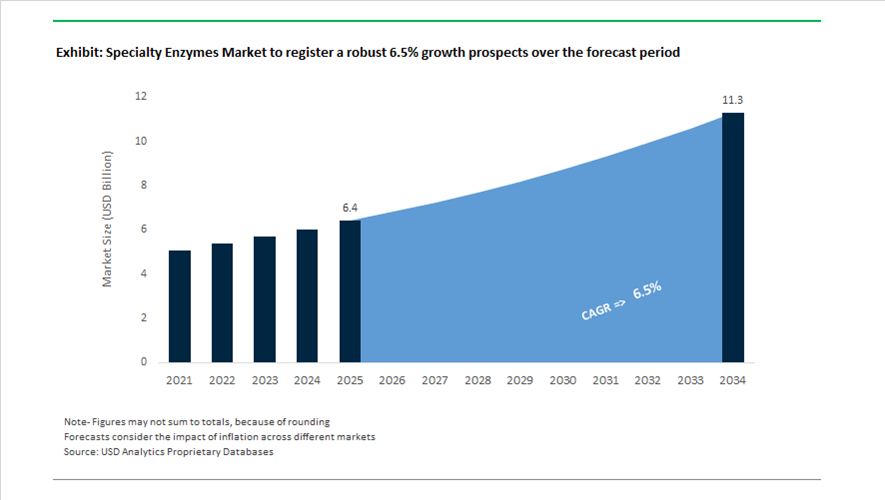
Specialty Enzymes Market Valuation 2025–2034: $6.4 Billion to $11.3 Billion at 6.5% CAGR Driven by Biotech Consolidation, RNA Therapeutics, and Advanced Dairy Enzymes
The global specialty enzymes market is valued at $6.4 billion in 2025 and is projected to reach $11.3 billion by 2034, expanding at a CAGR of 6.5%. Growth is anchored in high-value enzyme applications across food processing, animal nutrition, pharmaceutical manufacturing, RNA therapeutics, plant-based dairy, and home and personal care formulations. Specialty enzymes command premium pricing due to their specificity, biocatalytic efficiency, regulatory compliance requirements, and intellectual property intensity. Demand acceleration is linked to sustainable bioprocessing, enzymatic API synthesis, feed efficiency optimization, lactose-free dairy expansion, and fermentation-based ingredient innovation.
A structural shift occurred in January 2024 when Novozymes and Chr. Hansen completed their merger to form Novonesis, creating one of the most influential global players in specialty enzymes and microbial cultures. The consolidation strengthened scale in food enzymes, feed enzymes, and industrial biosolutions. In early 2024, Kerry Group finalized the €150 million acquisition of the global lactase enzyme business divested as part of the merger conditions, reinforcing its lactose-free dairy enzyme platform. In March 2024, Novus International acquired BioResource International, adding proprietary enzyme technologies for animal nutrition. During 2024 and early 2025, Codexis validated its ECO Synthesis™ platform, successfully demonstrating enzymatic synthesis of full-length siRNA oligonucleotides, marking a shift toward sustainable biocatalytic pharmaceutical manufacturing. In May 2024, Codexis launched RNA Ligase Screening and Optimization Services to support scalable RNAi therapeutic production.
Strategic portfolio optimization intensified in 2025. In March 2025, dsm-firmenich introduced Maxiren®EVO, an advanced coagulant enzyme engineered to enhance cheese yield, texture, and flavor performance. In June 2025, Novonesis agreed to acquire dsm-firmenich’s stake in their Feed Enzyme Alliance for €1.5 billion, consolidating R&D and commercial feed enzyme operations under a unified structure. In September 2025, dsm-firmenich launched Dairy Safe™ all-in-one cultures to improve microbial stability and shelf life in semi-hard cheeses. In October 2025, BASF and International Flavors & Fragrances (IFF) announced a strategic enzyme collaboration to accelerate Designed Enzymatic Biomaterials™ for home and personal care applications. The same month, dsm-firmenich opened its Global Food Innovation Center in Delft, dedicated to enzymatic solutions for plant-based dairy alternatives and sugar reduction.
The animal nutrition segment is undergoing structural repositioning. In February 2026, dsm-firmenich announced the divestment of its Animal Nutrition & Health business to CVC Capital Partners for €2.2 billion, reflecting a broader industry shift toward human-centric biotechnology and high-margin food and pharma enzymes. These consolidations, RNA enzyme innovations, feed enzyme realignments, dairy coagulant advancements, and enzyme-driven sugar reduction technologies are redefining competitive intensity and innovation cycles in the specialty enzymes market through 2034.
Key Trends and High-Growth Opportunities in the Specialty Enzymes Market
Enzymatic Attenuation Enabling Low-Calorie and Gluten-Free Beverage Reformulation
The specialty enzymes market is experiencing accelerated adoption in beverage manufacturing as global brewers reposition portfolios toward low-calorie, low-carbohydrate, and gluten-reduced products. This shift is no longer experimental. It is a margin-protective strategy driven by changing consumption patterns, excise tax pressure, and premiumization of “better-for-you” alcoholic and non-alcoholic beverages.
Leading brewers such as AB InBev and Heineken are deploying specialty enzyme systems to precisely control carbohydrate breakdown during fermentation. In late 2025, biosolutions leader Novonesis reported that its Attenuzyme Pro platform enables accelerated starch-to-sugar conversion through synergistic glucoamylase and pullulanase activity. This allows brewers to achieve high attenuation with up to 30% fewer calories per serving while simultaneously shortening mash and fermentation cycles.
Beyond formulation benefits, enzymatic attenuation is improving asset productivity. Reduced reaction times increase brewhouse throughput, allowing brewers to scale low-calorie and gluten-reduced SKUs without incremental capital expenditure. This operational leverage is particularly important as non-alcoholic and light beer volumes increasingly outperform traditional lagers across Europe and North America. The strategic use of enzymes is therefore evolving from a formulation aid into a capacity-optimization tool that directly supports profitability in a structurally changing beverage market.
ESG-Mandated Adoption of Enzymes in Textile Wet Processing
Sustainability mandates in the global apparel industry have transformed enzyme adoption in textile processing from a voluntary efficiency upgrade into a contractual compliance requirement. Major fashion retailers are embedding enzymatic processing into supplier codes of conduct to meet 2030 decarbonization targets, fundamentally reshaping demand dynamics for specialty enzymes.
Enzymatic scouring, bleaching, and finishing are now preferred alternatives to caustic soda and oxidative chemicals. According to data disclosed in the 2024 Do More Good report published by International Flavors & Fragrances, enzymatic textile solutions can reduce water consumption by up to 40% and energy use by approximately 30% by enabling processing at 40 to 60 degrees Celsius rather than traditional high-temperature chemical treatments. These reductions directly address Scope 3 emissions, which dominate the carbon footprint of apparel brands.
Retailers such as Inditex are actively scaling enzymatic denim finishing and bio-polishing across their global supply chains. By December 2025, Inditex linked the deployment of sustainable processing technologies to its ability to maintain a 62.2% gross margin despite inflationary pressure. Enzymes are therefore becoming integral to cost control, regulatory compliance, and brand credibility in the textile value chain, reinforcing long-term structural demand growth.
Industrial-Scale Enzymatic Biorecycling of Synthetic Fibers
One of the most transformative opportunities in the specialty enzymes market lies in enzymatic depolymerization of synthetic fibers, particularly PET. Mechanical recycling routes degrade polymer quality over successive cycles, limiting their contribution to a true circular economy. Enzymatic biorecycling addresses this limitation by converting waste textiles and packaging back into virgin-grade monomers.
A critical commercialization milestone was confirmed in September 2025 by Carbios, which announced progress toward commissioning its first industrial PET biorecycling plant in Longlaville. Backed by €42.5 million in public funding, including support from ADEME, the facility is designed to process 50,000 tons of PET waste annually using engineered enzymes. The output will supply virgin-quality recycled PET to brand partners including L’Oréal, Nestlé Waters, and PepsiCo.
Strategic expansion into Asia further amplifies this opportunity. In December 2025, Carbios signed a definitive agreement with Wankai New Materials to deploy enzymatic recycling technology in China. This licensing-led model targets the region’s massive textile waste stream and positions specialty enzymes as foundational infrastructure for global polymer circularity.
Biofilm-Eradicating Enzymes for Healthcare and Clinical Sanitation
Healthcare-associated infections remain a persistent and costly challenge, largely due to the resilience of microbial biofilms that shield pathogens from conventional disinfectants. This creates a high-value opportunity for specialty enzymes capable of disrupting the extracellular polymeric substance matrix that protects biofilms.
The urgency of this opportunity is underscored by the 2025 Global AMR Surveillance Report from the World Health Organization, which identifies antimicrobial resistance as a critical global health threat. Up to 80% of chronic and device-related infections are now associated with biofilms, highlighting the limitations of purely chemical sanitation regimes.
Recent peer-reviewed research published in 2025 demonstrates that enzyme-based cleaners containing targeted proteases and DNases can increase the penetration of downstream disinfectants by an order of magnitude. By weakening biofilm structures prior to chemical disinfection, these enzymatic systems significantly improve sanitation efficacy in hospitals, pharmaceutical cleanrooms, and medical device reprocessing facilities. This positions biofilm-disrupting enzymes as a strategic growth segment within specialty enzymes, aligned with infection control, patient safety, and long-term healthcare cost containment.
Specialty Enzymes Market Share and Segmentation Insights
Carbohydrases Lead the Specialty Enzymes Market with Broad Applications in Biotechnology and Food Processing
Carbohydrases accounted for 28.40% of the specialty enzymes market in 2025, making them the most widely used enzyme class across biotechnology, pharmaceutical, and food processing applications. This group includes enzymes such as amylases, cellulases, pectinases, and lactases, which catalyze the breakdown or modification of complex carbohydrates. Their ability to modify carbohydrate structures supports diverse uses including lactose-free dairy production, pharmaceutical excipient development, biomass processing, and biochemical research. A major 2025 scientific advancement driving demand is the growing focus on glycobiology research, where specialized carbohydrases are used in glycoprotein analysis, glycan sequencing, and development of carbohydrate-based therapeutics, requiring highly specific enzymes with precisely defined catalytic activities.
Research & Biotechnology Sector Drives Global Demand for Specialty Enzymes
Research and biotechnology represent the largest application segment in the specialty enzymes market, accounting for 32.80% of global demand in 2025 due to the extensive use of enzymes in molecular biology and life science research. Specialty enzymes are fundamental tools in genomics, proteomics, synthetic biology, and cell biology, supporting techniques such as DNA amplification, gene sequencing, and protein analysis. Enzymes including polymerases, nucleases, ligases, and proteases are widely used in laboratory and industrial biotechnology applications. A key 2025 industry trend is the rapid expansion of CRISPR and gene editing technologies, where specialized enzymes such as Cas9 and engineered nuclease variants enable precise genome editing, accelerating research and therapeutic development in fields including genetic medicine and agricultural biotechnology.
Specialty Enzymes Market Competitive Landscape
The global specialty enzymes market in 2026 is driven by protein engineering, microbial fermentation, and clean-label biosolutions. Industry leaders are advancing directed evolution, high-purity enzyme systems, and integrated microbe-enzyme platforms to meet low-carbon, sustainable, and high-performance requirements across food, pharma, and industrial applications.
Novonesis Scales Integrated Biosolutions Platform with €200 Million Synergy Target and Carbon-Capture Enzyme Innovation
Novonesis is leading the specialty enzymes market following the Novozymes–Chr. Hansen merger, targeting €200 million in annual synergies by 2026 through integrated enzyme-microbe solutions. The company reported an EBIT margin of ~29% in 2025, supported by strong organic growth in functional foods and biosolutions. Its Planetary Health portfolio includes next-generation carbon-capture enzymes for industrial emissions reduction. With over 10,000 employees, Novonesis operates one of the largest R&D platforms in industrial biotechnology. The company’s integrated technology stack accelerates innovation while reducing development risk. Its focus on high-purity enzymes and sustainability-driven applications strengthens its leadership in global biosolutions.
dsm-firmenich Strengthens Human-Centric Enzyme Portfolio Through €2.2 Billion ANH Divestment and Global Innovation Expansion
dsm-firmenich is repositioning its specialty enzymes portfolio by divesting its Animal Nutrition & Health business for €2.2 billion while retaining a minority stake. The company reported €12.52 billion in 2025 sales and €2.28 billion EBITDA, reflecting strong performance in nutrition and health solutions. Its Global Food Innovation Center in Delft focuses on enzymatic solutions for plant-based proteins and dietary transformation. Over 90% of its innovation pipeline is aligned with sustainability and circularity goals. EcoVadis Platinum certification underscores its leadership in ESG performance. The company’s strategic shift toward human-centric biosolutions enhances its competitive positioning.
DuPont Expands Enzyme Applications in Healthcare and Water Treatment Through Portfolio Realignment and Membrane Integration
DuPont is strengthening its specialty enzymes business through structural reorganization into Healthcare & Water Technologies and Diversified Industrials segments. Its AmberLite™ FPA57 resin enhances enzyme-assisted purification processes in bio-based chemical production. Expansion into China’s industrial water sector integrates enzyme-based membrane cleaning technologies with reverse osmosis systems. The Healthcare segment achieved a 31.1% EBITDA margin, driven by demand in bioprocessing and medical applications. DuPont’s focus on high-margin, application-specific enzyme solutions supports growth in advanced industrial and healthcare markets. Its integrated approach to enzymes and materials strengthens its competitive advantage.
Kerry Group Accelerates Clean-Label Enzyme Innovation with €314 Million R&D Investment and Biotechnology Expansion
Kerry Group is leveraging enzymes as a core technology for clean-label food reformulation, supported by €314 million in R&D investment in 2025. Its Tastesense platform utilizes fermentation-derived enzymes to reduce sugar and salt while maintaining flavor integrity. Expansion of biotechnology facilities in Germany and Ireland enhances production capacity for specialty enzymes. The company reported 3% volume growth and EBITDA margin expansion to 17.9% following portfolio optimization. Its KerryXperience platform integrates enzymatic solutions into plant-based and snack applications. Kerry’s focus on taste, nutrition, and functional enzymes strengthens its position in food biosolutions.
AB Enzymes Expands Industrial Biotech Applications with AI-Driven Protein Engineering and Specialized Bakery Solutions
AB Enzymes, part of ABF Ingredients, is advancing specialty enzymes through digital R&D and AI-powered protein engineering under its Accelerate program. Its VERON® POLARUM enzyme enables cost-efficient bakery formulations while maintaining product quality and shelf life. The company is targeting a 30% reduction in time-to-market for new enzyme solutions by 2027. Relocation of its Brazil headquarters enhances access to Latin American agro-processing markets. Its enzymes support energy-efficient processing in pulp, paper, and textile industries through cold-water applications. AB Enzymes’ niche expertise in industrial biotech strengthens its competitive positioning.
Codexis Advances Enzymatic Manufacturing and Licensing Model Through CodeEvolver® Platform and RNAi Synthesis Innovation
Codexis is driving innovation in specialty enzymes through its CodeEvolver® platform, enabling customized enzyme engineering for pharmaceutical manufacturing. Its $37.8 million agreement with Merck validates its role in enzymatic synthesis for small-molecule drugs. The ECO Synthesis® platform supports scalable production of RNAi therapeutics, reducing waste compared to traditional chemical methods. Following strategic restructuring, the company achieved strong revenue growth and profitability in late 2025. Codexis is transitioning toward a high-margin licensing and royalty model, with projected 2026 revenue of $72–$76 million. Its focus on advanced biocatalysis and pharmaceutical applications positions it at the forefront of enzyme innovation.
Denmark Specialty Enzymes Market Anchored by Biosolutions Consolidation
Denmark has reinforced its position as the global nerve center of the specialty enzymes industry following the completion of the landmark merger between Novozymes and Chr. Hansen, creating Novonesis in early 2024. This structural transformation consolidated more than 10,000 employees under a unified biosolutions platform with an estimated annual revenue base of €3.7 billion, spanning food enzymes, microbial solutions, and industrial biocatalysts. The merger has materially shifted competitive dynamics by integrating deep protein engineering capabilities with large-scale fermentation and application expertise, allowing Denmark-based operations to serve as global reference hubs for enzyme-enabled decarbonization across food, agriculture, and industrial processing.
Sustainability has become a core operating constraint rather than a positioning statement. Novonesis has committed to carbon neutrality by 2050, supported by an interim target to reduce absolute operational CO2 emissions by 75% by 2030. This commitment is directly influencing enzyme R&D priorities, accelerating the replacement of energy-intensive chemical reactions with low-temperature, enzyme-driven processes. To address EU antitrust requirements linked to the merger, Kerry Group acquired Novozymes’ lactase production and distribution business for €150 million in mid-2024. This divestment has sharpened competitive segmentation in lactose-free dairy enzymes while enabling Novonesis to focus capital on higher-margin biosolutions platforms.
United States Specialty Enzymes Market Driven by Pharma, Diagnostics, and Alternative Proteins
The United States specialty enzymes market is increasingly defined by pharmaceutical manufacturing, advanced diagnostics, and plant-based formulation stability. In May 2025, Codexis demonstrated the scalability of its ECO Synthesis platform at TIDES USA, highlighting enzymatic manufacturing routes for siRNA therapeutics that significantly reduce solvent use, waste generation, and energy intensity compared with phosphoramidite chemistry. This capability aligns with growing regulatory and ESG scrutiny on pharmaceutical supply chains, positioning enzymatic synthesis as a strategic enabler rather than a niche alternative.
Commercial validation has followed technological progress. In October 2025, Codexis signed a $37.8 million supply assurance agreement with Merck (MSD outside the US and Canada), securing long-term demand for proprietary enzymes across Merck’s manufacturing pipelines. Capacity expansion has also accelerated in food and beverage applications. Amano Enzyme expanded its Elgin, Illinois facility in 2025 to produce non-GMO microbial enzymes that stabilize proteins in plant-based milks, addressing curdling challenges in high-heat coffee applications. In research markets, New England Biolabs launched the NEBNext Enzymatic 5hmC-seq Kit in early 2024, reinforcing U.S. leadership in ultra-high-purity diagnostic enzymes for low-input genomic analysis.
Germany Specialty Enzymes Market Aligned with Energy Efficiency and Clean-Label Reformulation
Germany’s specialty enzymes sector is increasingly aligned with regulatory-driven efficiency and clean-label reformulation. In July 2025, BASF expanded its Lavergy portfolio with new liquid lipase, cellulase, and amylase enzymes optimized for low-temperature washing. These formulations directly support EU energy reduction objectives by enabling effective stain removal at lower wash temperatures, strengthening enzyme penetration in household and industrial detergents.
Cross-industry collaboration is reshaping innovation pathways. In October 2025, BASF and IFF announced a strategic partnership to accelerate IFF’s Designed Enzymatic Biomaterials platform, combining BASF’s process scale with advanced protein engineering. In food applications, AB Enzymes, part of Associated British Foods, reported double-digit growth in late 2024, driven by VERON GMS+ baking enzymes. These products function as biological replacements for synthetic emulsifiers, aligning German enzyme output with clean-label mandates and reformulation pressure across bakery value chains.
India Specialty Enzymes Market Accelerated by Nutrition, Policy, and Renewable Integration
India’s specialty enzymes market is transitioning from contract manufacturing toward regulated, high-value applications, particularly in nutrition and pharmaceuticals. In April 2025, dsm-firmenich received regulatory approval for its GLYCARE 2FL human milk oligosaccharide, marking a milestone for enzymatically produced specialty ingredients in early-life nutrition. This approval underscores India’s growing role as both a consumption and regulatory validation market for advanced enzyme-derived ingredients.
Policy support is reinforcing domestic capability. The BioE3 Policy launched in August 2024 prioritizes bio-foundries and provides capital backing for enzyme manufacturers focused on high-value biocatalysts for pharmaceuticals and biofuels. Operational sustainability is also improving. AB Mauri, part of Associated British Foods, reported that its Indian facilities reached 56% renewable electricity usage in 2025, leveraging on-site solar and biogas from biological wastewater treatment. This integration strengthens India’s positioning as a cost-competitive yet sustainability-aligned enzyme production base.
China Specialty Enzymes Market Integrating Chemical and Enzymatic Platforms
China’s specialty enzymes landscape is evolving through integration with advanced materials, electronics, and nutrition. In early 2025, DuPont began construction of a specialty manufacturing facility in Zhangjiagang, scheduled for operation in 2027. While primarily focused on MOLYKOTE lubricants, the site incorporates chemical-enzymatic stabilization technologies to meet performance requirements in EV and electronics applications, reflecting China’s convergence of enzymatic and materials science capabilities.
Regulatory expansion is unlocking nutrition-focused demand. In June 2025, dsm-firmenich expanded its Asia-Pacific footprint after receiving safety clearances in China for its 2'-FL HMO ingredients. This approval supports the rapid growth of functional gut health and infant nutrition markets, positioning China as a critical volume and innovation destination for enzyme-enabled specialty ingredients.
Comparative Snapshot: Specialty Enzymes Industry by Country
Specialty Enzymes Market County Level Snapshot
Country
Strategic Focus
Key Industry Drivers
Structural Outcome
Denmark
Biosolutions consolidation
Novonesis merger, carbon targets
Global innovation leadership
United States
Pharma and diagnostics
Enzymatic RNA synthesis, diagnostics
High-margin specialization
Germany
Energy efficiency, clean label
Low-temp detergents, baking enzymes
Regulatory-aligned growth
India
Nutrition and bio-foundries
HMO approvals, BioE3 incentives
Rapid value-chain upgrade
China
Integrated materials and nutrition
Enzymatic stabilization, HMOs
Scale with application diversity
Specialty Enzymes Market Report Scope
Specialty Enzymes Market
Parameter
Details
Market Size (2025)
$6.4 Billion
Market Size (2034)
$11.3 Billion
Market Growth Rate
6.5%
Segments
By Enzyme Type (Carbohydrases, Proteases, Lipases, Polymerases & Nucleases, Oxidoreductases, Other Enzymes), By Source (Microbial, Plant-Derived, Animal-Derived), By Application (Pharmaceuticals, Diagnostics, Research & Biotechnology, Biocatalysts, Specialty Food & Beverage)
Study Period
2019- 2025 and 2026-2034
Units
Revenue (USD)
Qualitative Analysis
Porter’s Five Forces, SWOT Profile, Market Share, Scenario Forecasts, Market Ecosystem, Company Ranking, Market Dynamics, Industry Benchmarking
Companies
Novonesis, International Flavors & Fragrances Inc., DSM-Firmenich, BASF SE, Kerry Group, Associated British Foods plc, Codexis Inc., Amano Enzyme Inc., DuPont de Nemours Inc., Dyadic International Inc., Biocatalysts Ltd, New England Biolabs, Advanced Enzyme Technologies, Kalsec Inc., Aumgene Biosciences
Countries
US, Canada, Mexico, Germany, France, Spain, Italy, UK, Russia, China, India, Japan, South Korea, Australia, South East Asia, Brazil, Argentina, Middle East, Africa
Specialty Enzymes Market Segmentation
By Enzyme Type
Carbohydrases
Proteases
Lipases
Polymerases & Nucleases
Oxidoreductases
Other Enzymes
By Source
Microbial
Plant-Derived
Animal-Derived
By Application
Pharmaceuticals
Diagnostics
Research & Biotechnology
Biocatalysts
Specialty Food & Beverage
By Region
North America (United States, Canada, Mexico)
Europe (Germany, France, United Kingdom, Spain, Italy, Rest of Europe)
Asia Pacific (China, India, Japan, South Korea, Australia, Rest of APAC)
South and Central America (Brazil, Argentina, Rest of SCA)
Middle East and Africa (Saudi Arabia, UAE, South Africa, Rest of Middle East, Rest of Africa)
2. Specialty Enzymes Market Landscape & Outlook (2025–2034)
2.1. Introduction to Specialty Enzymes Market
2.2. Market Valuation and Growth Projections (2025–2034)
2.3. Demand Drivers: Biotech Consolidation, RNA Therapeutics, and Dairy Enzyme Innovation
2.4. Strategic Developments: Mergers, Acquisitions, and Platform Expansion
2.5. Market Dynamics: Sustainable Bioprocessing, Enzymatic API Synthesis, and Fermentation Innovation
3. Innovations Reshaping the Specialty Enzymes Market
3.1. Trend: Enzymatic Attenuation in Beverage Reformulation
3.2. Trend: ESG-Driven Enzyme Adoption in Textile Processing
3.3. Opportunity: Industrial-Scale Enzymatic Biorecycling of Synthetic Fibers
3.4. Opportunity: Biofilm-Eradicating Enzymes for Healthcare Applications
4. Competitive Landscape and Strategic Initiatives
4.1. Mergers and Acquisitions
4.2. R&D and Material Innovation
4.3. Sustainability and ESG Strategies
4.4. Market Expansion and Regional Focus
5. Market Share and Segmentation Insights: Specialty Enzymes Market
5.1. By Enzyme Type
5.1.1. Carbohydrases
5.1.2. Proteases
5.1.3. Lipases
5.1.4. Polymerases & Nucleases
5.1.5. Oxidoreductases
5.1.6. Other Enzymes
5.2. By Source
5.2.1. Microbial
5.2.2. Plant-Derived
5.2.3. Animal-Derived
5.3. By Application
5.3.1. Pharmaceuticals
5.3.2. Diagnostics
5.3.3. Research & Biotechnology
5.3.4. Biocatalysts
5.3.5. Specialty Food & Beverage
5.4. By Region
5.4.1. North America
5.4.2. Europe
5.4.3. Asia Pacific
5.4.4. South and Central America
5.4.5. Middle East and Africa
6. Country Analysis and Outlook of Specialty Enzymes Market
6.1. United States
6.2. Canada
6.3. Mexico
6.4. Germany
6.5. France
6.6. Spain
6.7. Italy
6.8. UK
6.9. Russia
6.10. China
6.11. India
6.12. Japan
6.13. South Korea
6.14. Australia
6.15. South East Asia
6.16. Brazil
6.17. Argentina
6.18. Middle East
6.19. Africa
7. Specialty Enzymes Market Size Outlook by Region (2025–2034)
7.1. North America Specialty Enzymes Market Size Outlook to 2034
7.1.1. By Enzyme Type
7.1.2. By Source
7.1.3. By Application
7.1.4. By Region
7.2. Europe Specialty Enzymes Market Size Outlook to 2034
7.2.1. By Enzyme Type
7.2.2. By Source
7.2.3. By Application
7.2.4. By Region
7.3. Asia Pacific Specialty Enzymes Market Size Outlook to 2034
7.3.1. By Enzyme Type
7.3.2. By Source
7.3.3. By Application
7.3.4. By Region
7.4. South America Specialty Enzymes Market Size Outlook to 2034
7.4.1. By Enzyme Type
7.4.2. By Source
7.4.3. By Application
7.4.4. By Region
7.5. Middle East and Africa Specialty Enzymes Market Size Outlook to 2034
7.5.1. By Enzyme Type
7.5.2. By Source
7.5.3. By Application
7.5.4. By Region
8. Company Profiles: Leading Players in the Specialty Enzymes Market
8.1. Novonesis
8.2. International Flavors & Fragrances Inc.
8.3. DSM-Firmenich
8.4. BASF SE
8.5. Kerry Group
8.6. Associated British Foods plc
8.7. Codexis Inc.
8.8. Amano Enzyme Inc.
8.9. DuPont de Nemours Inc.
8.10. Dyadic International Inc.
8.11. Biocatalysts Ltd
8.12. New England Biolabs
8.13. Advanced Enzyme Technologies
8.14. Kalsec Inc.
8.15. Aumgene Biosciences
9. Methodology
9.1. Research Scope
9.2. Market Research Approach
9.3. Market Sizing and Forecasting Model
9.4. Research Coverage
9.5. Data Horizon
9.6. Deliverables
10. Appendix
10.1. Acronyms and Abbreviations
10.2. List of Tables
10.3. List of Figures
Specialty Enzymes Market Segmentation
By Enzyme Type
Carbohydrases
Proteases
Lipases
Polymerases & Nucleases
Oxidoreductases
Other Enzymes
By Source
Microbial
Plant-Derived
Animal-Derived
By Application
Pharmaceuticals
Diagnostics
Research & Biotechnology
Biocatalysts
Specialty Food & Beverage
By Region
North America (United States, Canada, Mexico)
Europe (Germany, France, United Kingdom, Spain, Italy, Rest of Europe)
Asia Pacific (China, India, Japan, South Korea, Australia, Rest of APAC)
South and Central America (Brazil, Argentina, Rest of SCA)
Middle East and Africa (Saudi Arabia, UAE, South Africa, Rest of Middle East, Rest of Africa)
The specialty enzymes market is valued at $6.4 billion in 2025 and is projected to reach $11.3 billion by 2034, growing at a CAGR of 6.5%. Growth is driven by high-value applications in pharmaceuticals, food processing, and biotechnology. RNA therapeutics, sustainable bioprocessing, and plant-based formulations are key long-term growth drivers. The market outlook remains strong due to increasing demand for precision biocatalysis and regulatory-compliant solutions.
The formation of Novonesis through the Novozymes–Chr. Hansen merger represents a major structural shift, consolidating global enzyme and microbial capabilities. This integration enhances R&D scale, product innovation, and market reach. Acquisitions by Kerry Group and Novus International further reflect consolidation in niche enzyme segments. These moves are intensifying competition while accelerating innovation cycles in food, feed, and pharma enzymes.
RNA therapeutics are emerging as a high-growth segment, with enzymes enabling scalable and sustainable synthesis of siRNA and oligonucleotides. Platforms like Codexis’ ECO Synthesis are reducing waste and improving efficiency compared to traditional chemical methods. Enzymatic API manufacturing is gaining traction due to regulatory and ESG advantages. This positions enzymes as critical tools in next-generation pharmaceutical production.
Carbohydrases lead the market with 28.4% share, driven by applications in food processing, biotechnology, and lactose-free dairy. Research and biotechnology represent the largest application segment at 32.8%, supported by genomics and gene-editing technologies. Additional high-growth areas include plant-based dairy enzymes, textile processing, and enzymatic recycling of PET. These segments reflect the shift toward sustainable and precision-driven industrial processes.
Key players include Novonesis, DSM-Firmenich, BASF SE, DuPont, Kerry Group, and Codexis Inc. These companies focus on protein engineering, microbial fermentation, and high-purity enzyme systems. Strategies include mergers, licensing models, and expansion into pharmaceutical and sustainable applications. Investments in RNA synthesis, clean-label food solutions, and enzyme-enabled biomaterials are strengthening competitive positioning.