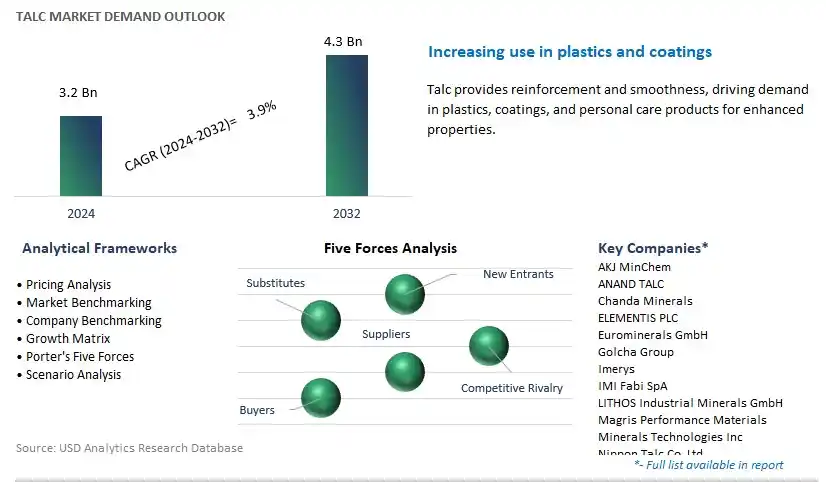
Global Talc Market Size is valued at $3.2 Billion in 2024 and is forecast to register a growth rate (CAGR) of 3.9% to reach $4.3 Billion by 2032.
The global Talc Market Study analyzes and forecasts the market size across 6 regions and 24 countries for diverse segments -By Deposit (Talc Chlorite, Talc Carbonate), By End-User (Ceramic, Food and Beverage, Paints and Coatings, Personal Care, Plastics and Rubber, Pulp and Paper, Others).
An Introduction to Talc Market in 2024
Talc, a naturally occurring mineral composed of hydrated magnesium silicate, s to find widespread applications in industries ranging from cosmetics and pharmaceuticals to plastics and ceramics in 2024. This versatile mineral offers properties such as softness, lubricity, and chemical inertness, making it suitable for various industrial and consumer applications. In the cosmetics and personal care industry, talc is utilized in products such as baby powder, makeup, and skincare formulations for its absorbent and mattifying properties. Further, in pharmaceuticals, talc serves as an excipient in tablet formulations, aiding in powder flow and preventing caking during manufacturing. Additionally, talc finds applications as a reinforcing filler in plastics, a lubricant in ceramics production, and a functional additive in paints and coatings. With ongoing research into talc's properties and applications, as well as efforts to ensure its safety and sustainability, the market for talc s to evolve, offering innovative solutions for diverse industries and consumer needs.
Talc Market Competitive Landscape
The market report analyses the leading companies in the industry including AKJ MinChem, ANAND TALC, Chanda Minerals, ELEMENTIS PLC, Eurominerals GmbH, Golcha Group, Imerys, IMI Fabi SpA, LITHOS Industrial Minerals GmbH, Magris Performance Materials, Minerals Technologies Inc, Nippon Talc Co. Ltd, and others.
Talc Market Dynamics
Market Trend: Growing Demand for Talc in Cosmetics and Personal Care Products
A significant trend in the talc market is the growing demand for talc in cosmetics and personal care products. Talc, known for its softness, smoothness, and ability to absorb moisture, is a key ingredient in a wide range of cosmetics and personal care formulations, including baby powders, face powders, body powders, eye shadows, blushes, and deodorants. With consumers increasingly seeking products that offer skin-friendly, non-irritating, and mattifying properties, talc continues to be a preferred choice for formulators looking to enhance product texture, spreadability, and oil absorption. Additionally, talc's natural origin and perceived safety make it an attractive option for brands aiming to develop clean-label and natural cosmetics, driving its inclusion in formulations targeting eco-conscious consumers. As the demand for cosmetics and personal care products continues to grow, fueled by beauty trends, lifestyle changes, and demographic shifts, the market for talc in cosmetics and personal care applications is expected to expand further.
Market Driver: Increased Usage of Talc in Polymer Compounding and Automotive Plastics
The primary driver for the talc market is the increased usage of talc in polymer compounding and automotive plastics. Talc, with its unique combination of properties such as stiffness, reinforcement, dimensional stability, and heat resistance, finds extensive use as a filler and reinforcing agent in polymer matrices, particularly in automotive components and interior parts. Talc-filled plastics offer advantages such as weight reduction, improved mechanical properties, reduced shrinkage, and enhanced surface finish, making them suitable for applications such as dashboards, door panels, bumpers, and under-the-hood components. With automotive manufacturers seeking lightweight materials that meet stringent performance, safety, and regulatory requirements, talc-filled plastics offer a cost-effective solution for achieving design flexibility, part consolidation, and fuel efficiency in vehicle production. As the automotive industry continues to innovate and transition towards electric and autonomous vehicles, the demand for talc in polymer compounding and automotive plastics is expected to rise, driven by the need for materials that offer lightweighting, sustainability, and recyclability.
Market Opportunity: Expansion of Talc Applications in Healthcare and Pharmaceutical Industries
A significant opportunity for the talc market lies in the expansion of talc applications in the healthcare and pharmaceutical industries. Talc, with its inert nature, high purity, and pharmaceutical-grade specifications, finds diverse uses in pharmaceutical formulations, medical devices, and healthcare products. In pharmaceuticals, talc is used as a lubricant, glidant, and anti-sticking agent in tablet manufacturing, aiding in the compression, flowability, and release of active ingredients. Additionally, talc is employed in topical formulations such as ointments, creams, and powders for its soothing, drying, and anti-chafing properties. In medical devices, talc serves as a release agent in the production of latex gloves and other elastomeric products, facilitating their removal from molds and preventing sticking. Furthermore, talc is utilized in wound care products, antiperspirants, and body powders for its absorbent and moisture-wicking properties. By leveraging its established presence in healthcare and pharmaceutical applications and exploring new opportunities in areas such as drug delivery, medical textiles, and regenerative medicine, the talc industry can diversify its product portfolio, expand market reach, and create value-added solutions that address unmet needs in the healthcare sector.
Talc Market Share Analysis: Talc Carbonate segment generated the highest revenue in 2024
Among the different types of deposits in the talc market, the Talc Carbonate segment is the largest and most dominant player. This leadership position can be attributed to talc carbonate deposits typically exhibit higher purity levels and are more abundant compared to talc chlorite deposits, making them a preferred choice for various industrial applications. Talc carbonate is known for its excellent properties such as softness, lubricity, chemical inertness, and thermal stability, which make it highly desirable for use in industries such as plastics, cosmetics, ceramics, and pharmaceuticals. Moreover, talc carbonate deposits are often easier to mine and process, resulting in lower production costs and higher availability compared to talc chlorite deposits. Additionally, the versatility of talc carbonate extends to its use as a filler and reinforcing agent in polymer composites, improving mechanical properties and reducing production costs for manufacturers. With its widespread applications and favorable properties, the Talc Carbonate segment is poised to maintain its dominance and drive continued growth in the talc market.
Talc Market Share Analysis: Plastics and Rubber segment is poised to register the fastest CAGR over the forecast period
Among the diverse end-users in the talc market, the Plastics and Rubber segment is the fastest-growing segment. In particular, talc serves as a versatile additive in plastics and rubber applications, where it functions as a reinforcing filler, enhancing stiffness, dimensional stability, and impact resistance of the final products. With the increasing demand for lightweight and high-performance materials in industries such as automotive, construction, and consumer goods, the adoption of talc-filled plastics and rubber compounds is on the rise. Moreover, talc's ability to improve processing characteristics such as melt flow, mold release, and surface finish further drives its utilization in plastics and rubber manufacturing. Additionally, the growing focus on sustainability and cost reduction in the plastics and rubber industries prompts manufacturers to replace traditional fillers like glass fibers and mineral fillers with talc, which offers comparable performance at a lower cost and environmental footprint. With its significant contributions to product performance, processing efficiency, and cost optimization, the Plastics and Rubber segment is poised to sustain its rapid growth trajectory in the talc market.
Talc Market
By Deposit
Talc Chlorite
Talc Carbonate
By End-User
Ceramic
Food and Beverage
Paints and Coatings
Personal Care
Plastics and Rubber
Pulp and Paper
Others
Countries Analyzed
North America (US, Canada, Mexico)
Europe (Germany, UK, France, Spain, Italy, Russia, Rest of Europe)
Asia Pacific (China, India, Japan, South Korea, Australia, South East Asia, Rest of Asia)
South America (Brazil, Argentina, Rest of South America)
Middle East and Africa (Saudi Arabia, UAE, Rest of Middle East, South Africa, Egypt, Rest of Africa)
Talc Companies Profiled in the Study
AKJ MinChem
ANAND TALC
Chanda Minerals
ELEMENTIS PLC
Eurominerals GmbH
Golcha Group
Imerys
IMI Fabi SpA
LITHOS Industrial Minerals GmbH
Magris Performance Materials
Minerals Technologies Inc
Nippon Talc Co. Ltd
*- List Not Exhaustive
TABLE OF CONTENTS
1 Introduction to 2024 Talc Market
1.1 Market Overview
1.2 Quick Facts
1.3 Scope/Objective of the Study
1.4 Market Definition
1.5 Countries and Regions Covered
1.6 Units, Currency, and Conversions
1.7 Industry Value Chain
2 Research Methodology
2.1 Market Size Estimation
2.2 Sources and Research Methodology
2.3 Data Triangulation
2.4 Assumptions and Limitations
3 Executive Summary
3.1 Global Talc Market Size Outlook, $ Million, 2021 to 2032
3.2 Talc Market Outlook by Type, $ Million, 2021 to 2032
3.3 Talc Market Outlook by Product, $ Million, 2021 to 2032
3.4 Talc Market Outlook by Application, $ Million, 2021 to 2032
3.5 Talc Market Outlook by Key Countries, $ Million, 2021 to 2032
4 Market Dynamics
4.1 Key Driving Forces of Talc Industry
4.2 Key Market Trends in Talc Industry
4.3 Potential Opportunities in Talc Industry
4.4 Key Challenges in Talc Industry
5 Market Factor Analysis
5.1 Value Chain Analysis
5.2 Competitive Landscape
5.2.1 Global Talc Market Share by Company (%), 2023
5.2.2 Product Offerings by Company
5.3 Porter’s Five Forces Analysis
5.4 Pricing Analysis and Outlook
6 Growth Outlook Across Scenarios
6.1 Growth Analysis-Case Scenario Definitions
6.2 Low Growth Scenario Forecasts
6.3 Reference Growth Scenario Forecasts
6.4 High Growth Scenario Forecasts
7 Global Talc Market Outlook by Segments
7.1 Talc Market Outlook by Segments, $ Million, 2021- 2032
By Deposit
Talc Chlorite
Talc Carbonate
By End-User
Ceramic
Food and Beverage
Paints and Coatings
Personal Care
Plastics and Rubber
Pulp and Paper
Others
8 North America Talc Market Analysis and Outlook To 2032
8.1 Introduction to North America Talc Markets in 2024
8.2 North America Talc Market Size Outlook by Country, 2021-2032
8.2.1 United States
8.2.2 Canada
8.2.3 Mexico
8.3 North America Talc Market size Outlook by Segments, 2021-2032
By Deposit
Talc Chlorite
Talc Carbonate
By End-User
Ceramic
Food and Beverage
Paints and Coatings
Personal Care
Plastics and Rubber
Pulp and Paper
Others
9 Europe Talc Market Analysis and Outlook To 2032
9.1 Introduction to Europe Talc Markets in 2024
9.2 Europe Talc Market Size Outlook by Country, 2021-2032
9.2.1 Germany
9.2.2 France
9.2.3 Spain
9.2.4 United Kingdom
9.2.4 Italy
9.2.5 Russia
9.2.6 Norway
9.2.7 Rest of Europe
9.3 Europe Talc Market Size Outlook by Segments, 2021-2032
By Deposit
Talc Chlorite
Talc Carbonate
By End-User
Ceramic
Food and Beverage
Paints and Coatings
Personal Care
Plastics and Rubber
Pulp and Paper
Others
10 Asia Pacific Talc Market Analysis and Outlook To 2032
10.1 Introduction to Asia Pacific Talc Markets in 2024
10.2 Asia Pacific Talc Market Size Outlook by Country, 2021-2032
10.2.1 China
10.2.2 India
10.2.3 Japan
10.2.4 South Korea
10.2.5 Indonesia
10.2.6 Malaysia
10.2.7 Australia
10.2.8 Rest of Asia Pacific
10.3 Asia Pacific Talc Market size Outlook by Segments, 2021-2032
By Deposit
Talc Chlorite
Talc Carbonate
By End-User
Ceramic
Food and Beverage
Paints and Coatings
Personal Care
Plastics and Rubber
Pulp and Paper
Others
11 South America Talc Market Analysis and Outlook To 2032
11.1 Introduction to South America Talc Markets in 2024
11.2 South America Talc Market Size Outlook by Country, 2021-2032
11.2.1 Brazil
11.2.2 Argentina
11.2.3 Rest of South America
11.3 South America Talc Market size Outlook by Segments, 2021-2032
By Deposit
Talc Chlorite
Talc Carbonate
By End-User
Ceramic
Food and Beverage
Paints and Coatings
Personal Care
Plastics and Rubber
Pulp and Paper
Others
12 Middle East and Africa Talc Market Analysis and Outlook To 2032
12.1 Introduction to Middle East and Africa Talc Markets in 2024
12.2 Middle East and Africa Talc Market Size Outlook by Country, 2021-2032
12.2.1 Saudi Arabia
12.2.2 UAE
12.2.3 Oman
12.2.4 Rest of Middle East
12.2.5 Egypt
12.2.6 Nigeria
12.2.7 South Africa
12.2.8 Rest of Africa
12.3 Middle East and Africa Talc Market size Outlook by Segments, 2021-2032
By Deposit
Talc Chlorite
Talc Carbonate
By End-User
Ceramic
Food and Beverage
Paints and Coatings
Personal Care
Plastics and Rubber
Pulp and Paper
Others
13 Company Profiles
13.1 Company Snapshot
13.2 SWOT Profiles
13.3 Products and Services
13.4 Recent Developments
13.5 Financial Profile
AKJ MinChem
ANAND TALC
Chanda Minerals
ELEMENTIS PLC
Eurominerals GmbH
Golcha Group
Imerys
IMI Fabi SpA
LITHOS Industrial Minerals GmbH
Magris Performance Materials
Minerals Technologies Inc
Nippon Talc Co. Ltd
14 Appendix
14.1 Customization Offerings
14.2 Subscription Services
14.3 Related Reports
14.4 Publisher Expertise
By Deposit
Talc Chlorite
Talc Carbonate
By End-User
Ceramic
Food and Beverage
Paints and Coatings
Personal Care
Plastics and Rubber
Pulp and Paper
Others
Countries Analyzed
North America (US, Canada, Mexico)
Europe (Germany, UK, France, Spain, Italy, Russia, Rest of Europe)
Asia Pacific (China, India, Japan, South Korea, Australia, South East Asia, Rest of Asia)
South America (Brazil, Argentina, Rest of South America)
Middle East and Africa (Saudi Arabia, UAE, Rest of Middle East, South Africa, Egypt, Rest of Africa)
