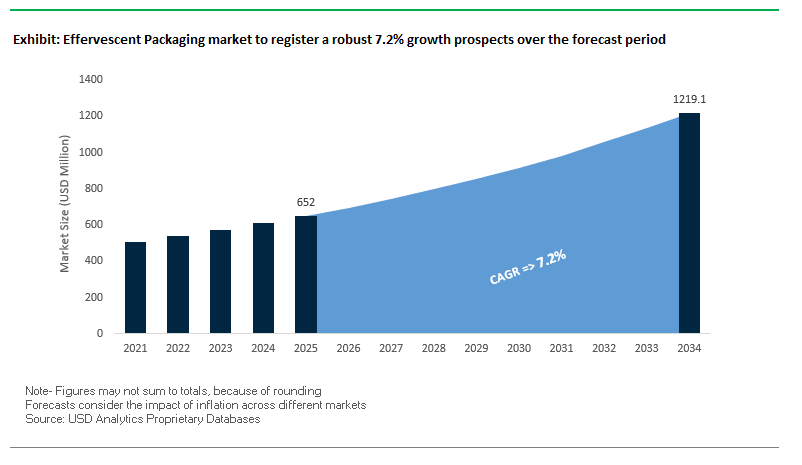
The global Effervescent Packaging Market is valued at USD 652 million in 2025 and is projected to reach USD 1.219 billion by 2034, expanding at a CAGR of 7.2%. Effervescent tubes account for approximately 40% of market demand by product type, blister packs represent around 35%, nutraceuticals account for approximately 45% of end-use demand, and pharmaceuticals represent around 30%. The market covers tubes, blister packs, sachets, bottles and other formats manufactured from plastics, aluminum, multilayer laminates, glass and other materials.
Effervescent packaging encompasses moisture-protective systems used for effervescent tablets, powders and granules across pharmaceuticals, nutraceuticals, functional food and beverage products and selected personal-care applications. Unlike conventional oral solid products, effervescent formulations contain components designed to react rapidly in the presence of water. Uncontrolled humidity exposure can therefore initiate premature reaction, alter tablet hardness or appearance, increase degradation and affect dissolution characteristics before intended use.
Packaging performance is consequently closely associated with water-vapor transmission, closure tightness, headspace humidity, desiccant capacity, seal integrity and mechanical protection. Multi-dose tubes commonly combine polypropylene or other rigid polymer bodies with desiccant-containing closures, while blister and strip packs isolate individual doses within high-barrier structures. Sachets provide another route for powders and granules, where seal integrity and film barrier characteristics determine resistance to environmental moisture.
Current market development is concentrated around desiccant-integrated closures, tighter moisture-control systems, recyclable-oriented PP/PE structures, bio-based tube materials, child-resistant configurations and packaging machinery designed for hygroscopic and mechanically fragile tablets. These technical characteristics differentiate the market from broader pharmaceutical or nutraceutical packaging categories, where moisture management is important but does not necessarily define the entire package architecture.
Recent Developments Effervescent Packaging
Sanner Establishes U.S. Desiccant Packaging Production in North Carolina
In June 2025, Sanner Group began manufacturing at its first U.S. production facility in Greensboro, North Carolina, followed by the formal opening in July. The 60,500-square-foot facility incorporates ISO Class 7 and ISO Class 8 cleanroom areas and produces injection-molded components for pharmaceutical packaging and medical devices together with desiccant solutions. Sanner identifies the site as its first North American injection-molding and pharmaceutical-desiccant-packaging operation.
The expansion is directly relevant to effervescent packaging because Sanner's established portfolio includes desiccant closures and tube systems for moisture-sensitive tablets. The U.S. site extends local production capability for controlled-moisture packaging components within a market where nutraceutical and pharmaceutical products form the dominant end-use categories.
Sanner Introduces Tethered Cap for Effervescent Tablet Tubes
At Pharmapack 2026, Sanner introduced a new Tethered Cap specifically for effervescent tablet packaging. The tamper-evident safety ring remains connected to the cap after opening, keeping the closure and tube together through use and disposal. The company positions the development alongside its existing BioBase effervescent packaging platform.
The development retains conventional opening and reclosing functionality while changing the relationship between the tube and closure at end of life. It represents a material-efficiency and package-component-management trend within rigid effervescent packaging rather than a change to the underlying moisture-protection principle.
Sanner Updates TabTec CR with Integrated Desiccant and Child-Resistant Functionality
In May 2025, Sanner launched an updated version of its TabTec CR oral-solid container-closure system. The package incorporates a patented child-resistant push-and-flip mechanism and integrated desiccant technology for moisture-sensitive tablets and capsules.
TabTec CR is not limited to effervescent products, but it provides current evidence of development around the combination of closure tightness, moisture management and child-resistant functionality in oral-solid packaging. Sanner had previously indicated that the updated system incorporated improved tightness and tailored desiccant configurations for sensitive active ingredients.
Romaco Extends High-Speed Tube and Strip Processing for Fragile Effervescent Tablets
Romaco Siebler's current effervescent packaging platform addresses both rigid tubes and strip packs. The STF 120 rigid-tube system operates at up to 120 tubes per minute and uses a rotary feeding principle and controlled pick-and-place transfer to limit mechanical stress on tablets. The HM 1E strip-packaging platform handles up to 3,000 tablets per minute and uses controlled sealing and tablet handling for hygroscopic and fragile products.
Romaco's 2025 technical material continues to identify hygroscopicity and mechanical fragility as the defining processing characteristics of effervescent tablets. This gives filling-line compatibility a direct connection with packaging design because high-speed handling, tube loading and heat sealing occur around products that are simultaneously moisture sensitive and susceptible to breakage.
Colorcon Maintains Controlled-Atmosphere Packaging Through Airnov Functional Packaging
Colorcon currently operates the former Airnov Healthcare Packaging business as part of its functional packaging portfolio. Airnov provides desiccant canisters and packets, integrated desiccant systems and oxygen-barrier plastic packaging for pharmaceutical, diagnostic and nutritional applications. Colorcon completed the acquisition in March 2023, and its current corporate materials continue to identify moisture-, oxygen- and odor-management technologies as part of the business.
The corporate change is relevant to the competitive landscape because Airnov traces back to the former Clariant Healthcare Packaging business. Current controlled-atmosphere packaging activities should therefore be associated with Colorcon/Airnov rather than with Clariant as an operating healthcare-packaging business.
Effervescent Packaging Market Share Insights
Effervescent Tubes Account for Approximately 40% of Product-Type Demand
Effervescent tubes account for approximately 40% of the Effervescent Packaging Market in 2025, representing the largest product-type segment. Blister packs follow with approximately 35% share.
Tubes are particularly suited to multi-dose products because the package combines rigid mechanical protection, repeated opening and reclosing, and integrated moisture control. Desiccant closures can use silica gel, molecular sieve or other sorbent systems to reduce humidity within the tube headspace between opening cycles. Spiral or spring-like closure components can additionally limit tablet movement and reduce mechanical damage during transport.
Blister packs provide a different architecture. Individual tablets remain isolated until use, limiting the exposure of remaining doses after one cavity is opened. Aluminum-containing and high-barrier polymer structures can provide strong moisture protection, while strip packaging seals tablets individually between flexible webs. Sachets are more prominent in powdered effervescent products and single-use nutritional formulations.
The coexistence of tubes and blisters reflects different dose presentation, barrier and handling requirements rather than a universal migration toward one packaging format.
Nutraceuticals Represent 45% of End-Use Demand
Nutraceuticals account for 45% of market demand in 2025, while pharmaceuticals represent around 30%. Nutraceutical applications include vitamins, minerals, electrolytes and other nutritional products supplied in effervescent tablet or powder formats. Their packaging frequently uses rigid tubes, blister packs and single-dose sachets, with moisture protection remaining central because the underlying acid-carbonate reaction system is humidity sensitive.
Pharmaceutical packaging applications include OTC and prescription oral products where effervescence supports a dissolved dosage presentation. These packages operate within pharmaceutical container-closure and quality frameworks and can additionally incorporate tamper-evident or child-resistant functionality where the specific product and jurisdiction require it.
Regulatory and Quality Framework for Effervescent Packaging
Effervescent packaging spans pharmaceuticals, dietary supplements and food-related products, so regulatory treatment varies by product category. Pharmaceutical tubes and blisters can fall within medicinal-product container-closure requirements, while nutraceutical and functional-food products operate under food and dietary-supplement rules. Child-resistant requirements are similarly product-specific rather than universal across all effervescent packages.
FDA Container-Closure Evaluation Applies to Pharmaceutical Effervescent Products
In August 2026, FDA issued draft guidance on container-closure systems used with human drugs and biological products. The document covers principles for evaluating packaging-system quality, including protection, material characteristics, compatibility and suitability. It remains draft guidance, is not for implementation and contains non-binding recommendations as of September 2026.
For pharmaceutical effervescent tablets, container-closure performance is particularly relevant because environmental moisture can affect the dosage form before administration.
ISO 15378 Provides a GMP-Oriented Framework for Pharmaceutical Primary Packaging Materials
ISO 15378:2017 applies ISO 9001-based quality-management requirements together with Good Manufacturing Practice principles to organizations designing, manufacturing and supplying primary packaging materials for medicinal products. The standard was confirmed in 2023 and amended in 2024.
Its scope makes it relevant to pharmaceutical effervescent tubes, closures, blister materials and other primary packaging components, while nutraceutical and food-contact packages operate under separate applicable requirements.
Child-Resistant Packaging Requirements Apply to Specified Products Rather Than All Effervescent Packs
The U.S. Poison Prevention Packaging Act requires specified household substances, including certain drugs, to use special packaging. CPSC defines such packaging as significantly difficult for children under five to open within a reasonable time while remaining usable by normal adults.
This framework does not mean that every vitamin, supplement or pharmaceutical effervescent product automatically requires child-resistant packaging. Applicability depends on the substance and applicable regulation. Where special packaging is required, adult accessibility forms part of the performance framework alongside child resistance.
U.S. Dietary-Supplement CGMP Covers Packaging and Labeling Operations
Nutraceuticals represent the largest end-use segment, making dietary-supplement regulation directly relevant. FDA's dietary-supplement CGMP requirements are contained in 21 CFR Part 111, covering manufacturing, packaging, labeling and holding operations for dietary supplements.
For effervescent supplements, the package consequently sits within a quality framework covering the packaged product as well as required labeling. The regulatory basis differs from pharmaceutical container-closure assessment even when both product categories use similar tubes or blister structures.
EU PPWR Contains Specific Pharmaceutical Packaging Exemptions
Regulation (EU) 2025/40 introduces packaging circularity, recyclability and recycled-content provisions but explicitly excludes defined medicinal-product packaging from several requirements. Immediate medicinal-product packaging and certain outer packaging needed to preserve medicine quality are excluded from specified recyclability and minimum recycled-content obligations.
This distinction is particularly important in the Effervescent Packaging Market because pharmaceutical and nutraceutical products can use similar tube or blister formats while falling under different regulatory treatment.
Desiccant-Integrated Tubes and Closures Control Moisture in Multi-Dose Effervescent Packaging
Rigid pharmaceutical packaging tubes are closely associated with effervescent tablets because they combine mechanical protection with repeated access and active humidity control. Unlike a unit-dose blister, opening a tube exposes the remaining tablets to ambient air, making closure resealing and headspace moisture management important throughout the period of use.
Desiccant closures commonly incorporate silica gel or molecular sieve within a cap, cartridge or closure component. These materials adsorb water from the package headspace, helping maintain low internal humidity despite moisture permeation through the package wall or humidity introduced during opening. Desiccant selection and quantity interact with package dimensions, material permeability, initial product moisture, intended shelf life and climatic exposure.
Sanner's current effervescent portfolio includes more than 200 tube-and-closure combinations, different desiccant types and volumes, spiral and non-spiral configurations and tamper-evident variants. The company also identifies PP/PE mono-material configurations within its current rigid effervescent packaging portfolio.
Spiral or spring components inside closures perform a separate mechanical function. They exert controlled pressure on the tablet stack, reducing movement and impact between tablets during distribution. This is particularly relevant because effervescent tablets can be relatively large and mechanically brittle.
The tube therefore operates as a combined system consisting of the rigid body, closure, desiccant and tablet-retention element. Moisture performance cannot be attributed to the plastic wall or desiccant alone.
Blister, Strip and Sachet Formats Provide Unit-Dose Moisture Protection
Blister and strip packaging provide an alternative unit-dose packaging approach by isolating individual doses. Once one cavity or unit is opened, remaining tablets can remain sealed, reducing repeated package-wide exposure to atmospheric humidity.
High-barrier pharmaceutical blister packaging structures can combine polymer forming webs with aluminum lidding or use aluminum-intensive cold-form structures where very low water-vapor transmission is required.. Strip packaging seals a tablet between two webs, with barrier performance determined by film or foil construction and the integrity of the peripheral heat seal.
The 35% proprietary blister share reflects the format's relevance in pharmaceutical and selected nutraceutical applications. Aluminum and multilayer laminates remain important where strong moisture resistance is required, while polymer-oriented structures are being developed for applications where their barrier performance is compatible with product stability.
Sachets occupy a related but distinct role. They are particularly relevant to powders, granules and single-dose drink mixes. Film stiffness, puncture resistance, seal strength and water-vapor transmission determine whether the sachet maintains the intended product environment through distribution.
Current equipment development illustrates the persistence of multiple formats. Romaco's HM 1E specifically processes effervescent tablets in heat-sealed strip formats at up to 3,000 tablets per minute, while its rigid-tube systems address high-volume multi-dose products.
The market therefore remains segmented by dose presentation and barrier requirement rather than moving uniformly from foil-based structures to a single polymer architecture.
Filling-Line Compatibility and Tablet Fragility Influence Effervescent Package Design
Effervescent packaging performance is closely connected with manufacturing conditions because tablets can be both hygroscopic and mechanically fragile. Product exposure to humid air during compression, transport and package filling can begin before the container is closed, while aggressive feeding or transfer can create chipped or broken tablets.
Rigid-tube systems use controlled feeding and stacking mechanisms to reduce impact. Romaco's STF 120 employs a rotary feeding principle and controlled tube transfer and can process up to 100,000 tablets per hour or 120 tubes per minute.
Strip-packaging systems address a different set of process variables. Heat-seal temperature, pressure, speed and film handling affect both barrier integrity and tablet protection. Romaco's HM 1E stores sealing parameters by format and uses continuous controlled movement to reduce mechanical damage to fragile tablets.
Dust is another processing characteristic because effervescent formulations can generate particulate material during handling. Current tube-filling systems include dust extraction and controlled-transfer functions between tablet compression, filling and downstream cartoning.
Packaging-line compatibility therefore extends beyond machine throughput. Tube diameter, cap configuration, tablet dimensions, tablet hardness, film width and seal characteristics interact with the final package format and the integrity of the finished product.
Child-Resistant, Tamper-Evident and Senior-Friendly Closures Expand Package Functionality
Effervescent closure systems increasingly combine moisture management with opening-control and evidence-of-opening features. Tamper-evident rings are common in rigid tubes because they provide a visible indication that the original closure configuration has been disturbed.
Child-resistant functionality is more application-specific. Pharmaceutical products subject to special-packaging regulation can require mechanisms designed to resist opening by young children while remaining accessible to adults. CPSC's U.S. framework explicitly combines these two performance objectives.
Recent product development shows integration rather than addition of separate components. Sanner's TabTec CR combines desiccant functionality with a push-and-flip child-resistant mechanism in one oral-solid container-closure architecture.
For conventional effervescent tubes, flip-top and press-fit closure formats continue to support rapid opening and reclosing. Sanner's 2026 Tethered Cap adds another configuration in which the tamper-evident ring remains attached to the closure after opening.
These developments show that opening behavior, tamper evidence, moisture protection and package-component retention increasingly coexist within the closure system rather than being treated as separate package features.
Material-Efficient and Recyclable Effervescent Packaging Develops Across PP, PE and Bio-Based Platforms
Material development in rigid effervescent packaging is increasingly concentrated around simplified polymer families, lower material consumption and renewable-feedstock approaches rather than a single universal sustainability technology.
Sanner's current portfolio includes PP/PE mono-material effervescent packaging, while its BioBase platform is produced with more than 90% bio-based material derived from renewable feedstocks. The company states that the BioBase architecture retains the functional properties required for effervescent packaging, including water-vapor barrier performance.
The 2026 Tethered Cap development addresses another aspect of material handling by keeping the cap and tamper-evident ring connected through use and disposal. Sanner has separately disclosed development work involving post-consumer recycled material for effervescent packaging; this remains a development program rather than evidence that PCR content has become standard across pharmaceutical effervescent tubes.
Flexible and unit-dose formats follow a different pathway. Polyolefin-based strip structures and paper-containing formats are technically possible in selected applications, but their adoption remains connected to moisture barrier, seal performance and shelf-life requirements.
Pharmaceutical uses also require careful distinction from nutraceutical packaging because EU PPWR contains exemptions for immediate medicinal-product packaging from certain recycled-content and recyclability provisions. Material simplification is therefore developing alongside product-specific quality constraints rather than through one mandatory transition schedule.
Effervescent Packaging Market Analysis by Country and Region
United States: Domestic Desiccant Capacity and Nutraceutical Packaging Define Current Activity
The United States combines a large dietary-supplement market with pharmaceutical oral-solid packaging demand. Effervescent vitamins, minerals and electrolyte products support extensive use of rigid tubes, blister packs and sachets, while pharmaceutical products operate within FDA container-closure and product-specific safety requirements.
A major packaging-specific development is Sanner's 2025 Greensboro, North Carolina facility, which introduced domestic injection molding and pharmaceutical-desiccant packaging production across a 60,500-square-foot site.
Regulatory treatment differs between end uses. Dietary-supplement packaging falls within 21 CFR Part 111 CGMP, while drug products additionally operate within pharmaceutical container-closure requirements. CPSC child-resistant requirements apply only to substances covered by the Poison Prevention Packaging Act and associated regulations, rather than universally to effervescent products.
The U.S. market is therefore characterized by the intersection of controlled-moisture packaging, large nutraceutical demand and product-specific pharmaceutical safety requirements rather than generic smart-packaging adoption.
Germany and the European Union: Desiccant Technology and Circular-Material Platforms Remain Prominent
Germany has a particularly strong connection with effervescent packaging through Sanner, whose headquarters and major production operations are located in Bensheim, and Romaco, whose Siebler technologies include tube and strip packaging systems for hygroscopic effervescent tablets.
Current development includes Sanner's BioBase platform, PP/PE mono-material configurations and the 2026 Tethered Cap, while Romaco continues to develop machinery capable of processing tubes, strip packs and alternative material structures.
EU PPWR adds a wider packaging-policy framework but does not impose identical requirements on every effervescent product. Pharmaceutical immediate packaging receives exemptions from specified recyclability and recycled-content provisions, while nutraceutical and food applications follow the broader packaging and food-contact framework.
This regulatory distinction is particularly important in Europe because visually similar tube or blister packages can serve medicinal products and dietary or food-based formulations under different compliance frameworks.
China: Established Desiccant Packaging Capacity Supports Pharmaceutical and Nutraceutical Production
China remains an important manufacturing base for effervescent packaging and oral healthcare products. Sanner expanded its Kunshan operation in 2023, increasing its local manufacturing capacity for healthcare packaging, including desiccant-based products. Because this capacity expansion predates the current 2025–2026 development window, it is better understood as established manufacturing infrastructure rather than a new market event.
China's role in the market includes production of plastic tubes, closures, desiccant components, blister materials and other oral-solid packaging for both domestic and export applications.
For pharmaceutical products, packaging-material quality increasingly sits within China's broader GMP framework. The market therefore combines high-volume production with differentiated requirements across pharmaceutical and supplement applications rather than being defined primarily by general consumer-health or carbon-neutrality narratives.
India: Domestic Tube and Desiccant-Closure Manufacturing Supports Cost-Competitive Supply
India has an established manufacturing base for pharmaceutical and nutraceutical plastic packaging. Parekhplast India specifically identifies development and production of effervescent tablet tubes and spiral desiccant closures, including packaging created through purpose-built molding technology.
The combination of domestic tube molding, closures, pharmaceutical blister conversion and solid-dose manufacturing gives India a direct position within the effervescent packaging supply chain.
Packaging requirements differ between medicinal products and supplements. Pharmaceutical applications operate within drug-quality and primary-packaging requirements, while dietary and nutraceutical products follow the applicable food and supplement framework.
Japan's pharmaceutical framework recognizes both pharmaceutical package quality and the particular handling characteristics of hygroscopic tablets. The Japanese Pharmacopoeia notes that hygroscopic tablets require an appropriately controlled humidity environment during testing and includes general principles for containers and packaging of pharmaceutical products.
For effervescent pharmaceutical products, moisture resistance, container closure and material compatibility therefore provide a more relevant technical basis than food-packaging legislation alone.
Nutraceutical and functional-food effervescent products can additionally fall under food-contact and labeling requirements depending on their classification. This creates a split regulatory environment comparable to the broader global market, where the package architecture can be similar even though the underlying product category differs.
Brazil and South America: Pharmaceutical and Nutraceutical Formats Support Multiple Moisture-Barrier Architectures
Brazil represents the principal pharmaceutical and nutraceutical market within South America. Effervescent products are supplied across pharmaceutical and supplement categories, creating demand for rigid tubes, blisters and flexible single-dose packaging.
The packaging structure remains application-specific. Multi-dose vitamin and mineral products commonly use resealable tubes, while pharmaceutical and premium unit-dose formats can use blister or strip architectures where individual dose isolation is advantageous.
Regional demand also extends to imported and locally converted packaging components, including closures, films and laminates. The market is better characterized through the coexistence of several barrier formats than through a single regional material transition.
The Effervescent Packaging Market includes specialist desiccant-packaging suppliers, global packaging groups, pharmaceutical converters, contract manufacturers and packaging-equipment companies. Companies include Sanner GmbH, Amcor plc, Aptar CSP Technologies, Romaco Pharmatechnik GmbH, Huhtamaki Oyj, Gerresheimer AG, ACG Group, ALPLA-Werke Alwin Lehner GmbH & Co. KG, Clariant AG, Parekhplast India Ltd., Unither Pharmaceuticals, Bilcare Ltd., Amerilab Technologies Inc., Ningbo Sanyuan Packaging Co., Ltd., and Jiangsu Hongqi Pharmaceutical Packaging Co., Ltd. Their participation spans rigid effervescent tubes, desiccant closures, active-atmosphere components, blister and strip materials, sachets, plastic containers, oral-solid manufacturing and high-speed packaging machinery. Sanner has particularly direct exposure to desiccant closures and effervescent tubes, while Romaco participates primarily as an equipment and integrated-line supplier rather than as a packaging-material converter.
Effervescent Packaging Market Report Scope
Effervescent Packaging market
Parameter
Details
Market Size (2025)
$652 Million
Market Size (2034)
$1219 Million
Market Growth Rate
7.2%
Segments
By Product Type (Effervescent Tubes, Blister Packs, Sachets, Bottles, Others), By Material Type (Plastics, Aluminum, Multi-layer Laminates, Glass, Others), By End-Use Industry (Pharmaceuticals, Nutraceuticals, Food and Beverages, Personal Care, Others)
Study Period
2020- 2025 and 2026-2034
Units
Revenue (USD)
Qualitative Analysis
Porter’s Five Forces, SWOT Profile, Market Share, Scenario Forecasts, Market Ecosystem, Company Ranking, Market Dynamics, Industry Benchmarking
US, Canada, Mexico, Germany, France, Spain, Italy, UK, Russia, China, India, Japan, South Korea, Australia, South East Asia, Brazil, Argentina, Middle East, Africa
Effervescent Packaging Market Segmentation
By Product Type
Effervescent Tubes
Blister Packs
Sachets
Bottles
Others
By Material Type
Plastics
Aluminum
Multi-layer Laminates
Glass
Others
By End-Use Industry
Pharmaceuticals
Nutraceuticals
Food and Beverages
Personal Care
Others
Countries Analyzed
North America (US, Canada, Mexico)
Europe (Germany, UK, France, Spain, Italy, Russia, Rest of Europe)
Asia Pacific (China, India, Japan, South Korea, Australia, South East Asia, Rest of Asia)
South America (Brazil, Argentina, Rest of South America)
Middle East and Africa (Saudi Arabia, UAE, Rest of Middle East, South Africa, Egypt, Rest of Africa)
Top Companies in Effervescent Packaging Market
Sanner GmbH
Amcor plc
Aptar CSP Technologies
Romaco Pharmatechnik GmbH
Huhtamaki Oyj
Gerresheimer AG
ACG Group
Alpla-Werke Alwin Lehner GmbH & Co KG
Clariant AG
Parekhplast India Ltd.
Unither Pharmaceuticals
Bilcare Ltd.
Amerilab Technologies Inc.
Ningbo Sanyuan Packaging Co., Ltd.
Jiangsu Hongqi Pharmaceutical Packaging Co., Ltd.
*List not Exhaustive
Research Coverage
This report investigates the global effervescent packaging market, exploring breakthroughs in moisture-barrier technologies, sustainable materials, and patient-friendly designs that are transforming pharmaceutical, nutraceutical, and wellness packaging. USDAnalytics’ analysis reviews innovations in high-barrier polymer films, desiccant-integrated closures, and monomaterial recyclable solutions while highlighting strategic expansions, corporate M&A, and digital integration such as QR/NFC-enabled smart packaging. This report is an essential resource for packaging executives, product developers, and sustainability managers seeking actionable intelligence on regulatory compliance, shelf-life protection, and cost-efficient solutions. By examining emerging trends, competitive landscapes, and material performance across tubes, blisters, sachets, and bottles, USDAnalytics provides professionals with insights to optimize product integrity, enhance patient adherence, and navigate evolving sustainability mandates. Additionally, the study emphasizes regional manufacturing strategies, global market adoption, and next-generation packaging formats poised to capture growing consumer demand for convenient, single-dose, and environmentally responsible effervescent products.
Scope Highlights:
Segmentation: By Product Type (Effervescent Tubes, Blister Packs, Sachets, Bottles, Others); By Material Type (Plastics, Aluminum, Multi-layer Laminates, Glass, Others); By End-Use Industry (Pharmaceuticals, Nutraceuticals, Food and Beverages, Personal Care, Others)
Geographic Scope: Analysis spans 25+ countries across North America, Europe, Asia Pacific, Latin America, the Middle East & Africa
Historical & Forecast Data: Historic data from 2021 to 2024 and forecast data from 2025 to 2034
Companies Covered: In-depth analysis and profiles of 15+ key players, including Sanner GmbH, Amcor plc, Aptar CSP Technologies, Romaco Pharmatechnik GmbH, Huhtamaki Oyj, Gerresheimer AG, ACG Group, Alpla-Werke Alwin Lehner GmbH & Co KG, Clariant AG, Parekhplast India Ltd., Unither Pharmaceuticals, Bilcare Ltd., Amerilab Technologies Inc., Ningbo Sanyuan Packaging Co., Ltd., and Jiangsu Hongqi Pharmaceutical Packaging Co., Ltd.
Methodology
This research combines primary and secondary approaches to ensure accurate, actionable insights into the effervescent packaging market. Primary research includes detailed interviews with senior R&D leaders, packaging engineers, and supply chain executives across leading pharmaceutical, nutraceutical, and wellness companies, validating key market trends and technological adoption. Secondary research integrates data from industry reports, company filings, patent databases, regulatory documents, and scientific literature to track material innovations, barrier performance, and market evolution. Market sizing and forecasts are derived using a combination of top-down and bottom-up analysis, factoring in historical growth, regional production capacities, regulatory compliance, and sustainability initiatives. Competitive benchmarking covers company strategies, M&A activity, product launches, and regional expansions, while regional analysis incorporates macroeconomic, regulatory, and consumer-driven factors. USDAnalytics employs rigorous cross-validation to ensure data reliability, providing professionals with a comprehensive view of both current and future market dynamics.
Deliverables:
• Comprehensive Market Research Report (PDF and Excel) with detailed tables, charts, and interactive visualizations.
• Country-Specific Forecasts & Analysis.
• Segment-Wise Revenue Forecasts (2026–2034).
• Competitive Analysis, Benchmarking, and SWOT Profiles.
• Recent Developments & Innovation Tracker.
• Executive Summary & Analyst Commentary.
• Post-Purchase Analyst Support for Client-Specific Questions and Custom Data Requirements.
2. Effervescent Packaging Market Landscape & Outlook (2025–2034)
2.1. Introduction to Effervescent Packaging Market
2.2. Market Valuation and Growth Projections (2025–2034)
2.3. Strategic Shifts and Facility Expansions (2024–2025)
2.4. Regulatory and Sustainability Drivers
2.5. Industry Challenges and Opportunities
3. Innovations Reshaping the Effervescent Packaging Market
3.1. Trend: Strategic Material Shift Towards High-Barrier Polymer Strips
3.2. Trend: Integration of Smart Packaging Features for Patient Adherence and Authentication
3.3. Opportunity: Development of Sustainable and Recyclable Monomaterial Structures
3.4. Opportunity: Expansion into New Application Segments with Portability and Precision Dosing
4. Competitive Landscape of Effervescent Packaging
4.1. Gerresheimer AG Sustainable Packaging with Integrated Digital Health Solutions
4.2. Sanner GmbH U.S. Expansion and Bio-Based Innovation
4.3. Romaco Group Packaging Machinery Innovator with Gold-Level Sustainability Recognition
4.4. Amcor PLC Scaling High-Barrier Sustainable Packaging
4.5. Faller Packaging Secondary Packaging Specialist with Tamper-Evident Innovation
5. Market Share and Segmentation Insights: Effervescent Packaging Market
5.1. By Product Type
5.1.1. Effervescent Tubes
5.1.2. Blister Packs
5.1.3. Sachets
5.1.4. Bottles
5.1.5. Others
5.2. By Material Type
5.2.1. Plastics
5.2.2. Aluminum
5.2.3. Multi-layer Laminates
5.2.4. Glass
5.2.5. Others
5.3. By End-Use Industry
5.3.1. Pharmaceuticals
5.3.2. Nutraceuticals
5.3.3. Food and Beverages
5.3.4. Personal Care
5.3.5. Others
6. Country Analysis and Outlook of Effervescent Packaging Market
6.1. United States
6.2. Canada
6.3. Mexico
6.4. Germany
6.5. France
6.6. Spain
6.7. Italy
6.8. UK
6.9. Russia
6.10. China
6.11. India
6.12. Japan
6.13. South Korea
6.14. Australia
6.15. South East Asia
6.16. Brazil
6.17. Argentina
6.18. Middle East
6.19. Africa
7. Effervescent Packaging Market Size Outlook by Region (2025-2034)
7.1. North America Effervescent Packaging Market Size Outlook to 2034
7.1.1. By Product Type
7.1.2. By Material Type
7.1.3. By End-Use Industry
7.2. Europe Effervescent Packaging Market Size Outlook to 2034
7.2.1. By Product Type
7.2.2. By Material Type
7.2.3. By End-Use Industry
7.3. Asia Pacific Effervescent Packaging Market Size Outlook to 2034
7.3.1. By Product Type
7.3.2. By Material Type
7.3.3. By End-Use Industry
7.4. South America Effervescent Packaging Market Size Outlook to 2034
7.4.1. By Product Type
7.4.2. By Material Type
7.4.3. By End-Use Industry
7.5. Middle East and Africa Effervescent Packaging Market Size Outlook to 2034
7.5.1. By Product Type
7.5.2. By Material Type
7.5.3. By End-Use Industry
8. Company Profiles: Leading Players in the Effervescent Packaging Market
8.1. Sanner GmbH
8.2. Amcor plc
8.3. Aptar CSP Technologies
8.4. Romaco Pharmatechnik GmbH
8.5. Huhtamaki Oyj
8.6. Gerresheimer AG
8.7. ACG Group
8.8. Alpla-Werke Alwin Lehner GmbH & Co KG
8.9. Clariant AG
8.10. Parekhplast India Ltd.
8.11. Unither Pharmaceuticals
8.12. Bilcare Ltd.
8.13. Amerilab Technologies Inc.
8.14. Ningbo Sanyuan Packaging Co., Ltd.
8.15. Jiangsu Hongqi Pharmaceutical Packaging Co., Ltd.
9. Methodology
9.1. Research Scope
9.2. Market Research Approach
9.3. Market Sizing and Forecasting Model
9.4. Research Coverage
9.5. Data Horizon
9.6. Deliverables
10. Appendix
10.1. Acronyms and Abbreviations
10.2. List of Tables
10.3. List of Figures
Effervescent Packaging Market Segmentation
By Product Type
Effervescent Tubes
Blister Packs
Sachets
Bottles
Others
By Material Type
Plastics
Aluminum
Multi-layer Laminates
Glass
Others
By End-Use Industry
Pharmaceuticals
Nutraceuticals
Food and Beverages
Personal Care
Others
Countries Analyzed
North America (US, Canada, Mexico)
Europe (Germany, UK, France, Spain, Italy, Russia, Rest of Europe)
Asia Pacific (China, India, Japan, South Korea, Australia, South East Asia, Rest of Asia)
South America (Brazil, Argentina, Rest of South America)
Middle East and Africa (Saudi Arabia, UAE, Rest of Middle East, South Africa, Egypt, Rest of Africa)
High-barrier polymers, monomaterial plastics, and aluminum laminates dominate due to superior moisture protection. Manufacturers are increasingly adopting recyclable and bio-based polymers to reduce carbon footprint while ensuring shelf-life integrity for pharmaceutical and nutraceutical tablets.
Effervescent formats offer rapid dissolution, taste masking, and portability, making them ideal for consumers who struggle with swallowing conventional tablets. Smart features like QR codes, NFC chips, and child-resistant closures enhance adherence, user safety, and product authentication.
Tubes lead with approximately 40% market share due to multi-dose convenience, moisture protection, and portability, followed by blister packs at 35% for unit-dose accuracy and tamper evidence. Sachets, bottles, and niche formats cater to specialized or lifestyle-focused applications.
The U.S. leads in nutraceutical adoption and sustainable packaging, Germany emphasizes high-precision, eco-friendly pharmaceutical solutions, China leverages manufacturing scale and domestic health trends, while India and Brazil are expanding cost-effective, environmentally responsible formats to meet local regulatory and consumer demand.
Sanner GmbH, Amcor, Gerresheimer, Romaco, and Faller Packaging are leading innovation in high-barrier materials, sustainable tubes, and digital integration. Aptar, Huhtamaki, and other regional players focus on child-resistant, tamper-evident, and recyclable packaging solutions to capture global market growth.
More Healthcare and Pharmaceutical Packaging Reports