Rigid Packaging in the Pharmaceuticals Market Overview: Biologics, Sterile Drug Delivery, and Advanced Container Systems Reshape Demand
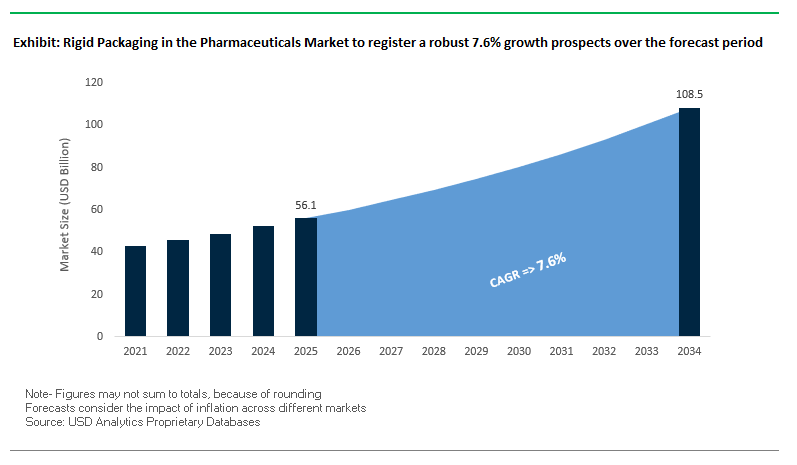
The global Rigid Packaging in the Pharmaceuticals Market is valued at $56.1 billion in 2025 and is projected to reach $108.5 billion by 2034, growing at a CAGR of 7.6%. Within the broader pharmaceutical packaging market, rigid pharmaceutical packaging encompasses bottles and containers, vials, ampoules, cartridges, jars, tubes, selected blister configurations, and associated container-closure systems used to protect solid, liquid, parenteral, and specialty pharmaceutical formulations. The market is increasingly influenced by the expansion of biologics, vaccine packaging applications, antibody-drug conjugates, GLP-1 medicines, biosimilars, cell and gene therapies, and other complex formulations requiring controlled interaction between the drug product and its packaging. These requirements are increasing the technical importance of chemical resistance, extractables and leachables performance, moisture and oxygen barriers, container-closure integrity, dimensional precision, sterility, and compatibility with automated fill-finish equipment.
Plastic bottles continue to support high-volume solid-dose and liquid pharmaceutical applications, while borosilicate glass remains central to injectable drug containment. At the same time, cyclic olefin polymer systems, coated glass, ready-to-use vials and cartridges, high-barrier HDPE bottles, and specialized surface treatments are expanding the range of available pharmaceutical packaging technologies. The distinction between conventional packaging and drug-delivery systems is also narrowing as cartridges and prefillable formats increasingly integrate with pen injectors, autoinjectors, wearable delivery devices, and home-administration platforms. These developments are increasing the value of precision manufacturing and packaging-device compatibility across the pharmaceutical supply chain.
Quality and regulatory requirements remain fundamental to market development. In August 2026, the U.S. FDA issued draft guidance on Container Closure Systems for Human Drugs and Biological Products, covering principles for evaluating container-closure-system quality, including systems that form part of combination products. The draft reflects the growing technical complexity of pharmaceutical containment as drug formulations and delivery formats evolve.
Key Insights for Industry Professionals
The market is shifting from standardized containers toward high-performance drug-containment systems designed around specific formulation, sterility, device, and stability requirements.
Ready-to-use vials and cartridges are becoming more prominent in injectable fill-finish operations, although penetration remains considerably lower than for prefillable syringes.
Glass remains essential for injectable medicines, while COC/COP polymers and barrier-enhanced HDPE are widening material options for selected biologics, drug-delivery devices, and moisture-sensitive formulations.
Container-closure integrity, extractables and leachables, chemical durability, siliconization, particulate control, and fill-line performance are becoming increasingly prominent packaging-development parameters.
Sustainability activity is moving toward lightweighting, secondary-packaging optimization, reusable transport systems, lower-material designs, and circular logistics, while pharmaceutical primary packaging remains subject to product-safety and quality constraints.
Biologics and Complex Injectable Therapies Increase Demand for High-Performance Drug Containment
The expansion of biologics and other sensitive injectable therapies is increasing differentiation within pharmaceutical vials, cartridges, syringes, and container-closure components. Conventional Type I borosilicate glass continues to support a large share of parenteral products packaging, but increasingly complex molecules are driving development of enhanced chemical resistance, coated internal surfaces, lower particulate generation, reduced protein adsorption, controlled silicone exposure, improved mechanical strength, and light-protective formats..
In January 2026, SCHOTT Pharma introduced EVERIC lyo & amber, combining amber pharmaceutical glass with a hydrophobic internal coating for lyophilized, light-sensitive drugs, particularly antibody-drug conjugates. The company states that the platform combines primary-level light protection with surface characteristics developed for lyophilized formulations.
In April 2026, SCHOTT Pharma also announced cartriQ BioPure, a sterile glass cartridge developed for sensitive biologics and designed with enhanced chemical resistance and an improved extractables-and-leachables profile. Commercial launch is scheduled for late 2026. These developments illustrate how pharmaceutical rigid packaging is moving toward formulation-specific containment rather than uniform vial and cartridge specifications.
Ready-to-Use Vials and Cartridges Expand Across Aseptic Fill-Finish Operations
Ready-to-use packaging represents one of the most significant structural developments in injectable drug containment. RTU vials and cartridges arrive washed, sterilized, and configured for aseptic processing, reducing several preparation stages associated with bulk containers. The format aligns with smaller batch production, biologics manufacturing, flexible filling lines, clinical-to-commercial scale-up, and increasingly automated fill-finish operations.
Market penetration nevertheless remains relatively early. Stevanato Group reported in 2025 that only about 5% of the vial market and less than 5% of the cartridge market had transitioned to RTU formats, compared with approximately 95% of prefillable syringe packaging. Its 2025 annual filing subsequently continued to describe RTU penetration of vials and cartridges as below 5%, highlighting the considerable difference between mature RTU syringe adoption and emerging vial/cartridge conversion.
Industry collaboration is reinforcing this transition. In September 2024, SCHOTT Pharma, Gerresheimer, and Stevanato Group formed the Alliance for RTU to support broader adoption of ready-to-use vials and cartridges and standardize technical understanding across pharmaceutical manufacturers, CMOs, and CDMOs. RTU platforms are increasingly associated with nested formats, automated handling, reduced container-to-container contact, flexible batch sizes, and compatibility with advanced aseptic processing.
Rigid Packaging in the Pharmaceuticals Market Share Insights
Bottles and Containers Lead Product-Type Demand with Around 35% Market Share
Bottles and containers account for approximately 35% of the rigid packaging in pharmaceuticals market in 2025, supported by their extensive use for tablets, capsules, powders, oral liquids, OTC medicines, prescription products, and selected nutraceutical formulations. HDPE and polypropylene remain widely used because of their mechanical durability, manufacturability, chemical resistance, and compatibility with desiccants, induction seals, dispensing closures, and child-resistant packaging systems. Moisture-sensitive solid-dose medicines have also increased demand for barrier-enhanced bottles and packaging combinations designed to control water-vapor transmission throughout shelf life.
Container performance is increasingly evaluated in relation to the pharmaceutical product rather than simply packaging cost or format. USP General Chapter <671> addresses functional performance of packaging systems for solid and liquid oral dosage forms, including moisture-vapor transmission testing for plastic packaging systems. Large labeling areas, compatibility with automated filling, tamper-evident features, dispensing convenience, and established pharmacy distribution infrastructure further support bottles as a high-volume format.
Pharmaceutical Manufacturing Accounts for Approximately 65% of End-User Demand
Pharmaceutical manufacturing represents approximately 65% of market demand, reflecting the direct relationship between drug development, stability programs, regulatory submissions, manufacturing processes, and packaging specifications. Primary packaging becomes part of the product-quality framework because changes to materials, closures, surfaces, sterilization methods, or container geometry can affect drug stability, extractables and leachables, particulate profiles, sterility, and compatibility with production equipment.
The growth of biologic and injectable pipelines is increasing the technical intensity of packaging decisions. Container selection for complex parenteral drugs can involve glass composition, coatings, silicone levels, closure elastomers, dimensional tolerances, break resistance, light protection, deep-cold compatibility, and container-closure integrity. USP <1207> treats package-integrity assurance as a lifecycle consideration for sterile pharmaceutical products and covers leak-test selection, validation, closure mechanisms, and seal-quality testing.
Pharmaceutical Bottles Gain Barrier Enhancement and Functional Closure Integration
Rigid plastic bottles remain one of the highest-volume pharmaceutical formats, but innovation increasingly centers on barrier performance, material efficiency, dispensing accuracy, and closure functionality. Moisture-sensitive medicines, effervescent products and their packaging systems, diagnostics, supplements, and oral solid-dose pharmaceuticals require packaging capable of maintaining controlled internal conditions over extended shelf lives.
In April 2026, Gerresheimer and Milliken announced a partnership involving LeneX UltraGuard additive technology for HDPE pharmaceutical packaging. The companies report that the technology can provide up to a 40% improvement in moisture-barrier performance in HDPE packaging while maintaining processing characteristics for demanding pharmaceutical applications.
Rigid packaging is also increasingly designed as a container-closure system rather than as separate bottle and cap components. Child-resistant closures, desiccant integration, induction seals, flow-control features, tamper evidence, dosing inserts, and senior-accessible opening mechanisms are being incorporated into bottle systems serving prescription, OTC, and specialty healthcare products.
Technology and Material Developments in Rigid Pharmaceutical Packaging
Advanced Pharmaceutical Glass, Coatings, and Surface Engineering Address Drug-Packaging Interaction
Glass technology is evolving beyond conventional container geometry. Manufacturers are modifying surfaces, strength profiles, friction characteristics, and optical properties to improve interaction with sensitive drug formulations and automated manufacturing lines.
Corning's Velocity vials use a proprietary external low-friction coating intended to reduce vial-to-vial friction, glass damage, jams, and particulate generation during fill-finish operations. Corning reports customer filling-line efficiency improvements of 20% to 50% and reductions in glass particulates of up to 96%. These figures represent company-reported performance data rather than market-wide results.
SGD Pharma expanded its pharmaceutical-glass portfolio during 2025 around technologies including Sealian, IDENCY, and Sterinity EZ-fill. Sealian applies an internal barrier treatment to molded glass vials to increase chemical durability and reduce interaction between the packaged pharmaceutical and the glass surface. Sterinity extends ready-to-use technology to molded glass vial formats.
These technologies reflect a broader move toward engineered glass systems in which surface characteristics, mechanical durability, particle generation, filling-line behavior, and chemical resistance are treated as differentiated performance attributes.
COC and COP Polymer Systems Broaden Rigid Containment Options
Advanced polymers are gaining relevance where break resistance, low protein adsorption, deep-temperature handling, dimensional precision, or specific extractables-and-leachables profiles are required. Cyclic olefin copolymer and cyclic olefin polymer materials are particularly relevant to selected syringes, cartridges, vials, diagnostic containers, and drug-delivery applications.
In August 2025, SCHOTT Pharma introduced an ISO-dimensioned RTU polymer cartridge manufactured from COC. The platform incorporates cross-linked siliconization and is available in 1.5 mL, 3 mL, and 5 mL formats, with a 10 mL version in development. The company positions the cartridge for sensitive biologics, high-value formulations, viscous drugs, and applications requiring device integration and break resistance.
In January 2026, SCHOTT Pharma announced that the polymer cartridge platform had been verified for compatibility with SHL Medical's large-volume autoinjector platform, linking primary containment development more closely with drug-delivery-device design.
These developments indicate diversification rather than wholesale replacement of pharmaceutical glass. Modern drug pipelines increasingly support parallel glass and polymer containment platforms selected according to formulation characteristics, delivery method, device architecture, sterilization conditions, storage requirements, and manufacturing processes.
Ready-to-Use Packaging Links Container Manufacturing with Advanced Fill-Finish Technology
RTU formats are also changing relationships between packaging manufacturers and filling-equipment suppliers. Nested vials and cartridges reduce direct glass contact during handling and can support flexible filling systems serving smaller biologic batches and multiple container formats.
The continued development of standardized nests, tubs, sterilization systems, and compatible filling equipment is gradually creating an ecosystem similar to that already established for prefillable syringes. Stevanato Group's filings indicate that RTU cartridge capacity is being expanded alongside commercial production infrastructure, while SCHOTT Pharma and Gerresheimer have also incorporated RTU systems into broader injectable-drug packaging portfolios.
RTU adoption is closely connected with the changing composition of pharmaceutical manufacturing. High-value biologics, personalized treatments, clinical batches, and multi-product facilities increasingly require production flexibility alongside sterility assurance and precise container handling.
Serialization, Traceability, and Connected Packaging Expand Digital Functionality
Digital functionality in rigid pharmaceutical packaging spans several distinct applications, including regulatory product identification, supply-chain traceability, manufacturing tracking, authentication, inventory control, and patient-interaction systems. Two-dimensional codes, serialized labels, RFID technologies, NFC tags, and connected dispensing devices are increasingly linked with bottles, cartons, prefillable containers, and drug-delivery platforms.
In the United States, the Drug Supply Chain Security Act established interoperable electronic product-tracing requirements at package level for covered prescription drugs. FDA continues to administer waivers and exemptions within the implementation framework; in August 2026, the agency extended specified exemptions for qualifying small dispensers through November 27, 2027.
Digital identification within pharmaceutical manufacturing is also expanding beyond regulatory serialization. Individual container identification can support automated inspection, filling, device assembly, inventory management, and process traceability as higher-value drug products move through increasingly integrated production environments.
Child-Resistant and Senior-Accessible Rigid Packaging Remains Important for Home-Use Medicines
Growth in home-administered medicines and aging patient populations continues to reinforce demand for packaging systems combining restricted child access with adult usability. Prescription bottles, OTC containers, liquid-medicine packages, dispensing closures, and selected specialty-drug containers increasingly incorporate push-and-turn, squeeze-and-turn, reversible, or controlled-dispensing closure architectures.
The technical balance is important because child resistance does not imply that packaging is impossible for a child to open; it reflects performance against defined testing requirements while preserving appropriate adult access. Rigid packaging therefore increasingly combines closure torque, opening sequence, liner performance, container geometry, tamper evidence, and dispensing functionality within the same system.
Patient-centric development is also extending from bottles into drug-delivery systems. Cartridge formats compatible with pen injectors and large-volume autoinjectors illustrate the broader transition toward packaging that functions simultaneously as containment, manufacturing interface, and part of a home-administration system.
Lightweighting and Circularity Develop Alongside Pharmaceutical Quality Constraints
Sustainability activity in rigid pharmaceutical packaging is increasingly differentiated between primary packaging, secondary packaging, transport components, and manufacturing waste. Product-contact packaging is subject to stringent drug-stability, contamination, sterilization, extractables-and-leachables, and regulatory requirements, limiting direct transfer of sustainability approaches used in consumer packaging.
Material reduction remains one prominent pathway. At CPHI Frankfurt 2025, Corning highlighted Viridian vials manufactured with 20% less glass, with the company reporting up to a 30% cradle-to-gate Scope 3 emissions reduction while retaining its coated-vial handling characteristics.
European regulation also requires careful interpretation. Regulation (EU) 2025/40 establishes broad packaging recyclability and recycled-content requirements, but it expressly exempts immediate packaging for medicinal products from specified recyclability requirements. Certain outer pharmaceutical packaging required to preserve medicinal-product quality is also exempt, while immediate pharmaceutical plastic packaging is excluded from specified minimum recycled-content obligations.
Consequently, pharmaceutical sustainability activity encompasses lightweighting, manufacturing efficiency, transport packaging, tray recovery, secondary-packaging redesign, energy use, and material optimization alongside continued protection of drug quality.
Regulatory and Pharmaceutical Packaging Quality Requirements
FDA Container-Closure Requirements Increase Focus on Drug-Packaging Compatibility
The U.S. regulatory framework treats packaging as part of pharmaceutical product quality. FDA's August 2026 draft guidance Container Closure Systems for Human Drugs and Biological Products provides principles for evaluating CCS quality for human drugs and biologics, including systems that also serve as device constituent parts of combination products. The document remains draft guidance and is not final agency policy.
Container-closure evaluation encompasses issues such as material suitability, protection, safety, compatibility, performance, and drug-product interaction. These requirements increase the significance of packaging development for injectables, biologics, ophthalmic products, oral pharmaceuticals, and combination products in which the container also interfaces with a delivery device.
USP Standards Reinforce Container Performance and Sterile Package Integrity
USP standards provide additional technical frameworks affecting pharmaceutical rigid packaging. General Chapter <1207> addresses integrity assurance for nonporous packages intended for sterile pharmaceutical products, including leaks, closure mechanisms, test-method selection, validation, and lifecycle integrity assessment.
USP <671> covers functional performance testing for packaging systems used for solid and liquid oral dosage forms, including moisture-vapor transmission for plastic packaging systems. These standards reinforce the role of rigid packaging as a performance-controlled pharmaceutical system rather than merely a logistics or branding component.
EU GMP Annex 1 Strengthens Sterile Manufacturing and Container-Closure Controls
The revised EU GMP Annex 1 – Manufacture of Sterile Medicinal Products came into operation on August 25, 2023, with point 8.123 becoming applicable on August 25, 2024. The European Commission now lists Annex 1 as fully applicable.
Annex 1 has increased industry attention on contamination-control strategies, aseptic processing, closure integrity, sterilization, container preparation, automated handling, and reduction of interventions. RTU vials, cartridges, and other pre-sterilized primary packaging systems are increasingly discussed in this context because they remove several container-preparation stages from pharmaceutical filling facilities.
ISO 15378 Establishes GMP-Oriented Quality Requirements for Primary Packaging
ISO 15378:2017 remains the current standard covering quality-management requirements for organizations designing, manufacturing, and supplying primary packaging materials for medicinal products, with reference to GMP. ISO confirmed the standard in 2023, and Amendment 1 covering climate-action changes was published in 2024.
The standard provides an international quality-management framework specifically relevant to pharmaceutical packaging-material manufacturers and supports consistency, traceability, contamination control, documented processes, and regulatory conformity across global supply chains.
China introduced a dedicated Pharmaceutical Packaging Materials Annex to its Good Manufacturing Practice framework, effective January 1, 2026. The National Medical Products Administration requires pharmaceutical packaging-material manufacturers to maintain comprehensive quality-management systems, documented procedures and records, supplier-quality assessment, and risk-based controls.
The regulation increases the formal quality-system requirements surrounding packaging materials supplied into China's pharmaceutical sector and strengthens the connection between packaging-material manufacturing controls and drug-registration quality management.
Competitive Landscape: Advanced Drug Containment, RTU Platforms, and Consolidation Reshape Competition
The global rigid pharmaceutical packaging market includes large diversified packaging groups alongside specialized primary-packaging and drug-containment companies. Gerresheimer, SCHOTT Pharma, Stevanato Group, SGD Pharma, Corning, West Pharmaceutical Services, BD, AptarGroup, Amcor, and Nipro PharmaPackaging participate across glass vials, cartridges, syringes, pharmaceutical bottles, closures, elastomeric components, dispensing systems, drug-delivery interfaces, and related containment technologies. Competition increasingly centers on high-value primary packaging, ready-to-use formats, chemically durable glass, engineered surfaces, advanced polymer systems, device compatibility, sterile packaging, automation, manufacturing scale, and geographic supply resilience. Partnerships such as the Alliance for RTU demonstrate increasing collaboration around common packaging and fill-finish platforms, while manufacturer activity around polymer cartridges, coated vials, barrier-enhanced HDPE, and RTU molded glass reflects diversification of containment technology.
Industry consolidation has also altered the competitive landscape. Amcor completed its combination with Berry Global on April 30, 2025, meaning Berry Global no longer represents an independent competitor in the current company universe. The combined organization expands Amcor's position across rigid containers, closures, dispensing systems, healthcare packaging, and specialty polymers. At the same time, specialist pharmaceutical-packaging companies continue to invest in capacity and high-value systems. SCHOTT Pharma inaugurated more than $60 million of expanded vial manufacturing capacity in Lebanon, Pennsylvania, in June 2026, including standard and sterile RTU glass vials and increased capacity for high-value solutions. Technology specialization, regional manufacturing, biologics exposure, sterile primary-packaging expertise, and integration with drug-delivery devices therefore remain central dimensions of competition.
United States Rigid Packaging in the Pharmaceuticals Market: Domestic Vial Capacity and Container-Closure Quality Drive Development
The United States market is characterized by a large pharmaceutical manufacturing base, substantial biologics and injectable-drug activity, extensive use of prescription bottles, and growing investment in domestic critical-healthcare supply chains. The August 2026 FDA draft guidance on container-closure systems increases regulatory visibility around packaging quality for drugs, biologics, and relevant combination products. In parallel, USP package-integrity and container-performance standards remain important reference points for sterile and oral-dose packaging systems.
Domestic pharmaceutical glass capacity is also expanding. In June 2026, SCHOTT Pharma inaugurated more than $60 million in expanded vial production at Lebanon, Pennsylvania. The project includes new capacity for standard and sterile RTU glass vials, with the company stating that local capacity for high-value solutions more than tripled. The investment received support from the U.S. Biomedical Advanced Research and Development Authority.
Digital traceability is another important feature of the U.S. market. DSCSA implementation has increased package-level electronic tracing across prescription-drug distribution, although FDA continues to apply defined exemptions and transition provisions for certain trading partners. Together, domestic capacity expansion, biologics production, traceability, and stringent container-closure requirements are increasing the technical sophistication of U.S. pharmaceutical rigid packaging.
Germany Rigid Packaging in the Pharmaceuticals Market: High-Value Glass, RTU Systems, and Advanced Polymer Technologies Expand
Germany remains an important European center for pharmaceutical packaging technology, supported by companies including Gerresheimer and SCHOTT Pharma, established glass-manufacturing expertise, equipment suppliers, pharmaceutical manufacturing, and extensive regulatory infrastructure.
Technology development is increasingly concentrated on ready-to-use drug containment, high-performance glass, polymer cartridges, specialized surfaces, and device-compatible formats. SCHOTT Pharma's 2025 RTU COC cartridge and 2026 cartriQ BioPure glass cartridge illustrate the coexistence of advanced glass and polymer platforms serving biologics and drug-delivery systems. Gerresheimer's partnership with Milliken around LeneX UltraGuard similarly extends material-performance innovation into HDPE pharmaceutical bottles.
Germany also operates within the EU GMP Annex 1 and PPWR regulatory environment. Annex 1 strengthens sterile-manufacturing and container-integrity requirements, while PPWR creates wider packaging circularity requirements but contains specific exemptions for immediate pharmaceutical packaging and certain quality-critical outer packaging. This creates a market in which pharmaceutical quality and sustainability initiatives develop under distinct regulatory constraints.
China Rigid Packaging in the Pharmaceuticals Market: Packaging-Material GMP and Pharmaceutical Manufacturing Scale Strengthen Quality Requirements
China's pharmaceutical rigid packaging market is supported by large domestic medicine production, expanding biologics manufacturing, growing injectable-drug capacity, and extensive demand for bottles, vials, ampoules, closures, and other primary packaging formats. Automation and higher-quality pharmaceutical-glass and polymer systems are becoming more prominent as drug manufacturers increase production standards and integrate advanced filling and inspection equipment.
A major regulatory development took effect on January 1, 2026, when China's NMPA Pharmaceutical Packaging Materials Annex became operational. The framework requires pharmaceutical packaging-material manufacturers to establish comprehensive quality-management systems, maintain detailed documentation and records, conduct supplier assessments, and operate under strengthened risk-management and regulatory-inspection requirements.
These requirements deepen the relationship between packaging-material quality and drug-product registration and manufacturing oversight. Packaging companies supplying the Chinese pharmaceutical sector increasingly operate within quality frameworks covering raw materials, production controls, traceability, process documentation, supplier management, deviations, change control, and finished packaging-material quality.
India Rigid Packaging in the Pharmaceuticals Market: Pharmaceutical Manufacturing Growth Supports Glass and Plastic Packaging Capacity
India's large generic-drug, vaccine, API, and finished-dose manufacturing base generates substantial demand for pharmaceutical bottles, vials, ampoules, closures, containers, and other rigid packaging formats. Export-oriented pharmaceutical production also increases demand for packaging systems compatible with international pharmacopoeial and customer requirements.
Indian pharmaceutical rules directly address container and closure quality. CDSCO's Drugs Rules state that containers and closures intended for use must comply with applicable pharmacopoeial requirements and must not be reactive, additive, absorptive, or leach substances to an extent that significantly affects drug quality or purity. Packaging materials for pharmaceutical products are also required to align with Indian Pharmacopoeia requirements.
Domestic pharmaceutical-glass infrastructure is expanding. In September 2025, Corning and SGD Pharma inaugurated a glass-tubing facility in Telangana producing Type I borosilicate pharmaceutical glass tubing. The facility combines Corning glass and Velocity vial technology with SGD Pharma's vial-converting capabilities for injectable medicines, biologics, diagnostics, and related pharmaceutical applications. This investment strengthens India's position within the pharmaceutical primary-packaging supply chain.
Rigid Packaging in the Pharmaceuticals Market Report Scope
Rigid Packaging in the Pharmaceuticals Market
Parameter
Details
Market Size (2025)
$56.1 Billion
Market Size (2034)
$108.5 Billion
Market Growth Rate
7.6%
Segments
By Material Type (Plastics, Glass, Metal, Paper & Paperboard, Bioplastics), By Product Type (Blister Packs, Bottles & Containers, Vials & Ampoules, Jars & Tubes, Other Product Types), By Application (Solid Dosage, Liquid Dosage, Parenterals, Medical Devices, Powders & Granules, Other Applications), By End-User (Pharmaceutical Manufacturing, Medical Device OEMs, Contract Packaging Organizations, Retail Pharmacies, Other End-Users)
Study Period
2020- 2025 and 2026-2034
Units
Revenue (USD)
Qualitative Analysis
Porter’s Five Forces, SWOT Profile, Market Share, Scenario Forecasts, Market Ecosystem, Company Ranking, Market Dynamics, Industry Benchmarking
US, Canada, Mexico, Germany, France, Spain, Italy, UK, Russia, China, India, Japan, South Korea, Australia, South East Asia, Brazil, Argentina, Middle East, Africa
Rigid Packaging in the Pharmaceuticals Market Segmentation
By Material Type
Plastics
Glass
Metal
Paper & Paperboard
Bioplastics
By Product Type
Blister Packs
Bottles & Containers
Vials & Ampoules
Jars & Tubes
Other Product Types
By Application
Solid Dosage
Liquid Dosage
Parenterals
Medical Devices
Powders & Granules
Other Applications
By End-User
Pharmaceutical Manufacturing
Medical Device OEMs
Contract Packaging Organizations
Retail Pharmacies
Other End-Users
Countries Analyzed
North America (US, Canada, Mexico)
Europe (Germany, UK, France, Spain, Italy, Russia, Rest of Europe)
Asia Pacific (China, India, Japan, South Korea, Australia, South East Asia, Rest of Asia)
South America (Brazil, Argentina, Rest of South America)
Middle East and Africa (Saudi Arabia, UAE, Rest of Middle East, South Africa, Egypt, Rest of Africa)
Top Companies in Rigid Packaging in the Pharmaceuticals Market
Amcor plc
Gerresheimer AG
Berry Global Inc.
AptarGroup, Inc.
West Pharmaceutical Services, Inc.
SGD Pharma
Mondi Group
Becton Dickinson and Company
Nippon Paper Industries Co., Ltd.
Huhtamaki Oyj
WestRock Company
CCL Industries Inc.
Sonoco Products Company
Origin Pharma Packaging
Constantia Flexibles
* List Not Exhaustive
Methodology
USDAnalytics has conducted an extensive and data-driven study of the global Rigid Packaging in the Pharmaceuticals Market, integrating both primary and secondary research to provide actionable insights for industry professionals. Our methodology includes consultations with pharmaceutical manufacturers, packaging designers, regulatory experts, and logistics operators, complemented by analysis of corporate reports, mergers and acquisitions, sustainability initiatives, and technological innovations. Market sizing and growth projections are based on historical trends, the rising adoption of recyclable mono-material polymers, connected smart packaging, and high-barrier polymer solutions replacing glass. Segmentation analysis encompasses material type, product type, application, and end-user, while regional insights cover key markets including the U.S., Germany, China, and India. Competitive intelligence evaluates strategic developments, sustainability commitments, and product innovations by leading players such as Amcor, Gerresheimer, AptarGroup, and Constantia Flexibles. By combining regulatory analysis, ESG considerations, and patient-centric packaging trends, USDAnalytics delivers precise, professional, and market-ready insights for stakeholders navigating the evolving pharmaceutical rigid packaging landscape.
Deliverables:
Comprehensive Market Research Report (PDF and Excel) with detailed tables, charts, and interactive visualizations.
Country-Specific Forecasts & Analysis.
Segment-Wise Revenue Forecasts (2026–2034).
Competitive Analysis, Benchmarking, and SWOT Profiles.
Recent Developments & Innovation Tracker.
Executive Summary & Analyst Commentary.
Post-Purchase Analyst Support for Client-Specific Questions and Custom Data Requirements.
Table of Contents: Rigid Packaging in the Pharmaceuticals Market
2. Rigid Packaging in the Pharmaceuticals Market Landscape & Outlook (2025–2034)
2.1. Introduction to Rigid Packaging in the Pharmaceuticals Market
2.2. Market Valuation and Growth Projections (2025–2034)
2.3. Key Drivers and Market Dynamics
2.4. Regulatory and Sustainability Influence
2.5. Technological Advancements and Market Transformation
3. Innovations Reshaping the Rigid Packaging in Pharmaceuticals Market
3.1. Trend: Accelerated Adoption of Recyclable Mono-Material Polymer Structures
3.2. Trend: Integration of Connected Packaging for Patient Adherence and Authentication
3.3. Opportunity: Development of High-Barrier, Glass-Free Solutions for Biologics
3.4. Opportunity: Implementation of Child-Resistant and Senior-Friendly Features for Home Healthcare
4. Competitive Landscape and Strategic Initiatives
4.1. Mergers, Acquisitions and Strategic Alliances
4.2. R&D and Material Innovation
4.3. Sustainability and Strategies
4.4. Market Expansion and Regional Focus
5. Market Share and Segmentation Insights: Rigid Packaging in the Pharmaceuticals Market
5.1. By Material Type
5.1.1. Plastics
5.1.2. Glass
5.1.3. Metal
5.1.4. Paper & Paperboard
5.1.5. Bioplastics
5.2. By Product Type
5.2.1. Blister Packs
5.2.2. Bottles & Containers
5.2.3. Vials & Ampoules
5.2.4. Jars & Tubes
5.2.5. Other Product Types
5.3. By Application
5.3.1. Solid Dosage
5.3.2. Liquid Dosage
5.3.3. Parenterals
5.3.4. Medical Devices
5.3.5. Powders & Granules
5.3.6. Other Applications
5.4. By End-User
5.4.1. Pharmaceutical Manufacturing
5.4.2. Medical Device OEMs
5.4.3. Contract Packaging Organizations
5.4.4. Retail Pharmacies
5.4.5. Other End-Users
6. Country Analysis and Outlook of Rigid Packaging in the Pharmaceuticals Market
6.1. United States
6.2. Canada
6.3. Mexico
6.4. Germany
6.5. France
6.6. Spain
6.7. Italy
6.8. UK
6.9. Russia
6.10. China
6.11. India
6.12. Japan
6.13. South Korea
6.14. Australia
6.15. South East Asia
6.16. Brazil
6.17. Argentina
6.18. Middle East
6.19. Africa
7. Rigid Packaging in the Pharmaceuticals Market Size Outlook by Region (2025–2034)
7.1. North America Market Size Outlook to 2034
7.1.1. By Material Type
7.1.2. By Product Type
7.1.3. By Application
7.1.4. By End-User
7.2. Europe Market Size Outlook to 2034
7.2.1. By Material Type
7.2.2. By Product Type
7.2.3. By Application
7.2.4. By End-User
7.3. Asia Pacific Market Size Outlook to 2034
7.3.1. By Material Type
7.3.2. By Product Type
7.3.3. By Application
7.3.4. By End-User
7.4. South America Market Size Outlook to 2034
7.4.1. By Product Type
7.4.2. By Material Type
7.4.3. By Application
7.4.4. By End-User
7.5. Middle East and Africa Market Size Outlook to 2034
7.5.1. By Material Type
7.5.2. By Product Type
7.5.3. By Application
7.5.4. By End-User
8. Company Profiles: Leading Players in the Rigid Packaging in Pharmaceuticals Market
8.1. Amcor plc
8.2. Gerresheimer AG
8.3. Berry Global Inc.
8.4. AptarGroup, Inc.
8.5. West Pharmaceutical Services, Inc.
8.6. SGD Pharma
8.7. Mondi Group
8.8. Becton Dickinson and Company
8.9. Nippon Paper Industries Co., Ltd.
8.10. Huhtamaki Oyj
8.11. WestRock Company
8.12. CCL Industries Inc.
8.13. Sonoco Products Company
8.14. Origin Pharma Packaging
8.15. Constantia Flexibles
9. Methodology
9.1. Research Scope
9.2. Market Research Approach
9.3. Market Sizing and Forecasting Model
9.4. Research Coverage
9.5. Data Horizon
9.6. Deliverables
10. Appendix
10.1. Acronyms and Abbreviations
10.2. List of Tables
10.3. List of Figures
Rigid Packaging in the Pharmaceuticals Market Segmentation
By Material Type
Plastics
Glass
Metal
Paper & Paperboard
Bioplastics
By Product Type
Blister Packs
Bottles & Containers
Vials & Ampoules
Jars & Tubes
Other Product Types
By Application
Solid Dosage
Liquid Dosage
Parenterals
Medical Devices
Powders & Granules
Other Applications
By End-User
Pharmaceutical Manufacturing
Medical Device OEMs
Contract Packaging Organizations
Retail Pharmacies
Other End-Users
Countries Analyzed
North America (US, Canada, Mexico)
Europe (Germany, UK, France, Spain, Italy, Russia, Rest of Europe)
Asia Pacific (China, India, Japan, South Korea, Australia, South East Asia, Rest of Asia)
South America (Brazil, Argentina, Rest of South America)
Middle East and Africa (Saudi Arabia, UAE, Rest of Middle East, South Africa, Egypt, Rest of Africa)
Growth is fueled by rising demand for injectable drugs, biologics, and vaccines, where sterility and product integrity are critical. Sustainability initiatives, regulatory compliance, and patient-centric innovations like child-resistant and senior-friendly designs are also accelerating adoption globally.
Mono-material polymers, such as polypropylene and polyethylene, simplify recycling compared to multi-layer laminates. These materials meet regulatory mandates like the EU Circular Economy Action Plan, support corporate ESG goals, and maintain high barrier protection for drug stability.
Smart packaging integrates QR codes, NFC chips, and RFID tags to prevent counterfeiting, enhance medication adherence, and enable real-time supply chain tracking. These technologies improve patient safety, compliance, and regulatory alignment while reducing risks from substandard or falsified drugs.
Advanced polymer-based packaging provides equivalent oxygen and moisture protection while reducing fragility and logistics weight compared to glass. This ensures safe cold-chain transport, lowers freight costs, and meets the increasing demand for biologics and injectable therapies.
Industry leaders include Amcor, Gerresheimer, AptarGroup, Constantia Flexibles, and Sonoco, focusing on sterility, sustainability, high-barrier performance, and smart labeling. These companies are driving innovation in recyclable polymers, child-resistant designs, and connected packaging for enhanced patient compliance.
More Healthcare and Pharmaceutical Packaging Reports