Healthcare Blister Packaging Market Overview: Drug Protection, Patient Safety and Material Innovation Drive Demand
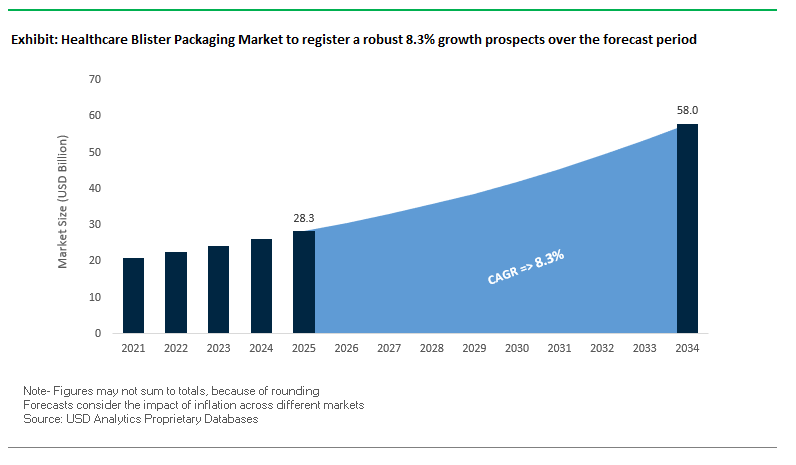
The global healthcare blister packaging market is valued at USD 28.3 billion in 2025 and is projected to reach USD 58 billion by 2034, expanding at a CAGR of 8.3%. Healthcare blister packaging encompasses protective cavity-and-lidding systems used across pharmaceuticals and selected healthcare products, particularly tablets, capsules, OTC medicines and other products requiring unit-level protection, dosage identification, tamper evidence or controlled barrier performance. Unlike the broader blister packaging market, healthcare applications are shaped by pharmaceutical stability requirements, packaging qualification, patient safety, labeling requirements and regulated manufacturing environments.
Demand is increasingly influenced by the protection of medicines against moisture, oxygen, light and physical damage while maintaining high-throughput pharmaceutical packaging operations. Thermoformed structures provide flexibility in material selection and product visibility, while cold-form structures remain important for formulations requiring substantially stronger environmental protection. Barrier performance, thermoformability, sealing characteristics, package dimensions, line productivity, drug stability and packaging economics represent interconnected parameters influencing pharmaceutical blister-material selection.
Patient-centric requirements are adding further value to blister formats. Calendar packs, unit-dose presentation, tamper evidence, child-resistant and senior-friendly opening systems, dose-level information and adherence-oriented designs extend packaging functionality beyond physical containment. At the same time, pharmaceutical companies and packaging suppliers are evaluating PET-, PE- and PP-based alternatives to conventional structures as sustainability objectives increase demand for blister formats combining medicine protection with improved end-of-life characteristics.
Key Healthcare Blister Packaging Market Insights
USD 28.3 billion market size in 2025, rising to USD 58 billion by 2034 at an 8.3% CAGR.
Plastic-based films account for 45% of the market by product type in 2025.
Tablets account for 50% of market demand, followed by capsules at 25%.
Pharmaceutical blister design is increasingly influenced by drug stability, barrier requirements, child resistance, patient usability, traceability and recyclability.
Material development is expanding beyond conventional PVC systems toward PET, PE, PP and specialty high-barrier structures, although adoption remains application-specific.
Recent Developments in Healthcare Blister Packaging
Recent activity shows that healthcare blister packaging innovation is increasingly centered on recyclable mono-material systems, PVC substitution, pharmaceutical-grade barrier performance and compatibility with existing blister lines. Rather than converging on a single replacement for conventional PVC/aluminum structures, suppliers are developing differentiated PET-, PP-, PE- and high-barrier platforms suited to varying drug-protection requirements. Partnerships involving material suppliers, machinery companies, pharmaceutical manufacturers and converters are also becoming more prominent as new blister structures undergo assessment for recyclability, pharmaceutical stability, seal integrity, line productivity, patient safety and qualification requirements.
Bayer and Liveo Research Commercialize Mono-PET Blister Packaging
In October 2024, Bayer and Liveo Research introduced PET-based blister packaging for Aleve in the Netherlands. The mono-material structure eliminates PVC and was reported to deliver a 38% lower packaging carbon footprint per unit than the previous format, together with an approximately 18% reduction in packaging weight.
The commercialization represents a transition of recyclable pharmaceutical blister technology from development-stage activity into a branded OTC healthcare application. Bayer's adoption also reflects the growing use of measurable environmental performance indicators alongside pharmaceutical protection and manufacturing criteria in packaging-material transitions.
Uhlmann and Industry Partners Advance Commercial Mono-PP Blister Production
Uhlmann Pac-Systeme has expanded polypropylene blister activity through collaborative material development and commercial packaging-line implementation. In February 2025, Uhlmann worked with ETIMEX Primary Packaging, Perlen Packaging and Faller Packaging on a PP-based pharmaceutical blister initiative focused on recyclability, processability and pharmaceutical protection.
Separately, Uhlmann configured its BEC 400 blister line for Dr. Pfleger Arzneimittel to process PP forming and lidding materials. These developments illustrate the growing interdependence of films, lidding materials, machinery, secondary packaging and pharmaceutical production in mono-material blister commercialization.
Klöckner Pentaplast Expands Recyclable and High-Barrier Blister Platforms
Klöckner Pentaplast is expanding its kpNext pharmaceutical blister portfolio through PET- and PP-based material systems designed for different protection requirements. The kpNext R1 platform targets recyclable PET thermoforming applications and compatibility with existing pharmaceutical packaging infrastructure, while higher-barrier PP/COC/PP structures address medicines requiring stronger moisture and oxygen protection.
The portfolio reflects a broader competitive transition from universal material-replacement concepts toward application-specific material platforms. Recyclability, barrier performance, machinability, drug stability and installed-equipment compatibility increasingly differentiate pharmaceutical blister-material systems.
Huhtamaki Develops Mono-PET Lidding for Existing Pharmaceutical Lines
Huhtamaki's Push Tab pharmaceutical blister lidding is an aluminum-free PET solution designed for combination with compatible PET forming film to create a mono-PET blister structure.
Manufacturing compatibility represents a central feature of the system. Huhtamaki positions the material for operation on existing pharmaceutical blister lines without major capital investment or production-speed reduction. This reflects the importance of installed equipment, throughput and qualification complexity in pharmaceutical packaging-material adoption.
Amcor Combines PVC-Free Materials with Child-Resistant and Senior-Friendly Design
Amcor addresses healthcare blister innovation through its AmSky platform, which eliminates PVC while offering multiple pharmaceutical blister configurations. The portfolio includes standard push-through formats as well as child-resistant and senior-friendly lidding options.
The platform illustrates increasing integration between sustainability and healthcare-specific functionality. Emerging blister systems increasingly combine drug protection, recyclability, manufacturing efficiency, patient accessibility and child resistance, rather than being differentiated solely by material composition.
Collectively, recent developments indicate that competition is extending beyond standalone film or foil innovation. Bayer and Liveo Research demonstrate commercial mono-PET adoption; Uhlmann and its partners illustrate value-chain collaboration and mono-PP line integration; Klöckner Pentaplast is developing multiple recyclable and high-barrier material pathways; Huhtamaki emphasizes compatibility with installed production equipment; and Amcor combines PVC-free structures with patient-safety functionality.
Across these initiatives, the common market direction involves blister systems combining pharmaceutical protection and regulatory suitability with reduced material complexity and limited disruption to established manufacturing processes.
Drug Stability and Barrier Performance Define Pharmaceutical Blister Material Selection
Drug stability is one of the principal technical determinants of healthcare blister packaging selection. Moisture ingress, oxygen exposure, light and temperature can affect pharmaceutical formulation quality during storage and distribution. U.S. FDA container-closure guidance addresses the suitability of packaging materials used with human drugs and biologics, while unit-dose repackaging guidance recognizes the relationship between packaging protection, stability studies and expiration dating for solid oral dosage products.
Conventional PVC remains widely established for comparatively stable oral solid-dose products because of its transparency, thermoformability, manufacturing familiarity and economics. Pharmaceutical barrier films, including PVdC-coated structures and PCTFE-containing films extend protection for formulations requiring higher moisture barriers. Highly sensitive formulations are associated with cold-form aluminum structures and other high-barrier material combinations providing stronger protection against moisture, oxygen and light.
Material substitution is consequently more complex in pharmaceuticals than in many consumer packaging applications. The European Medicines Agency guideline for plastic immediate packaging materials covers plastic materials in direct contact with active substances or medicinal products and establishes information requirements associated with registrations and packaging variations. Changes involving pharmaceutical forming films can therefore encompass material characterization, compatibility assessment, stability evaluation and regulatory documentation.
Thermoform and Cold-Form Blisters Address Different Pharmaceutical Requirements
Thermoformed blister packaging uses heat and forming pressure or vacuum to produce cavities from polymer-based webs. The technology supports comparatively high production speeds, transparent packs and a broad range of barrier configurations, making it significant for tablets, capsules, OTC medicines, generic pharmaceuticals and nutraceutical products.
Cold-form blister systems generally use aluminum-containing laminates formed mechanically without heat. These structures provide strong protection against moisture, oxygen and light and are therefore associated with pharmaceutical formulations requiring high environmental protection. Their characteristics can include opaque packs, larger package footprints and different forming and line-performance requirements compared with thermoformed structures.
The commercial distinction extends beyond a simple plastic-versus-aluminum comparison. Pharmaceutical blister packaging spans standard thermoform materials, coated and laminated high-barrier structures and cold-form aluminum systems. Formulation sensitivity, shelf-life objectives, distribution environment, cavity geometry, production speed, package dimensions and lifecycle economics collectively influence material adoption.
Child-Resistant, Senior-Friendly and Tamper-Evident Designs Increase Healthcare-Specific Value
Child-resistant packaging represents an important distinction between regulated healthcare blister packaging and general consumer blister formats. Under the U.S. Poison Prevention Packaging Act, specified household substances are subject to packaging requirements intended to make access significantly difficult for children under five within a reasonable period while preserving usability for normal adults. The U.S. Consumer Product Safety Commission administers associated requirements under 16 CFR Parts 1700–1702.
Healthcare blister formats include push-through, peel-push, puncture-resistant and other lidding configurations developed around the interaction between child resistance and senior accessibility. Material strength, peel force, puncture characteristics, package instructions and cavity/lid architecture influence usability and safety performance. These requirements support a specialized technical market for child-resistant and senior-friendly pharmaceutical blister formats.
FDA guidance recognizes blister packs, calendar packs, sachets and pouches as unit-dose packaging formats that can reduce certain medication errors by allowing products to remain in identified packaging rather than being repackaged from bulk containers. Applicable unit-dose containers are also associated with information such as drug identity, expiration date and lot or control details.
Healthcare blister films now span a broad range of performance profiles. PVC remains entrenched because of installed manufacturing capacity, clarity, processing characteristics and cost. PVdC coatings increase barrier performance, while PCTFE-containing structures are associated with applications requiring stronger moisture protection. PET-, PE- and PP-based structures are receiving greater attention as packaging suppliers expand recyclable and PVC-free material portfolios. Development activity includes mono-material systems as well as multilayer structures designed to retain specific moisture, oxygen and mechanical-barrier characteristics.
Material adoption continues to reflect trade-offs involving moisture and oxygen barrier performance, light protection, forming depth, web handling, sealing temperatures, printability, package integrity, material thickness, transparency and machinery compatibility. Sustainability characteristics therefore interact with pharmaceutical stability and manufacturing performance rather than functioning as an independent material-selection criterion.
Healthcare blister development is increasingly characterized by application-specific material platforms rather than a single universal replacement for PVC or aluminum. Stable, high-volume oral solid-dose products represent one class of applications for alternative polymers, while highly sensitive formulations remain associated with more sophisticated barrier architectures.
Recyclable and PVC-Free Blister Systems Move Toward Commercial Adoption
Sustainability activity in pharmaceutical blister packaging is shifting from incremental material reduction toward structural redesign. Traditional combinations of different polymers and aluminum can be difficult to separate through conventional recycling processes, increasing interest in PET-, PE- and PP-based systems with simplified material composition.
In October 2024, Bayer and Liveo Research launched PET blister packaging for Aleve in the Netherlands. The companies reported that the mono-material solution eliminates PVC and reduces the packaging carbon footprint by 38% compared with the previous format. The commercial launch represents adoption of an alternative blister structure by a major OTC healthcare brand rather than only pilot-scale development. It also demonstrates the increasing intersection between pharmaceutical protection, material circularity and large-scale packaging production.
Across the broader market, sustainable blister adoption is progressing at different rates according to formulation sensitivity, installed equipment, regulatory requirements, packaging qualification and the technical maturity of recycling infrastructure.
Packaging-Line Compatibility Becomes a Critical B2B Purchasing Criterion
Pharmaceutical manufacturers have substantial capital invested in forming, filling, sealing, coding, inspection, cartoning and serialization equipment. Material conversion consequently involves more than the procurement cost of a new film. Commercial evaluations frequently encompass tooling requirements, sealing windows, forming temperatures, machine speeds, cavity geometry, downtime, qualification procedures and the effect of material changes on validated manufacturing processes. These factors help explain the emphasis placed by material suppliers on compatibility with installed packaging infrastructure.
Huhtamaki's Push Tab illustrates this market characteristic. The PET-based blister lidding system is designed for use with PET forming film and is positioned to operate on existing blister packaging lines without speed reduction or additional line investment. Machinery compatibility represents only one element of pharmaceutical material qualification. Package integrity, barrier performance, seal quality, stability performance and regulatory suitability remain important determinants of commercial adoption. This has increased the role of technical application support and qualification expertise within the pharmaceutical blister-material supply chain.
Pharmaceutical Traceability and Dose-Level Information Expand Packaging Functionality
Healthcare blister packaging increasingly operates as an information carrier in addition to functioning as a physical barrier. Printed lidding can communicate drug identity, strength, dosage sequence, lot information, expiration data and patient-use instructions, while packaging lines incorporate printing, machine vision and verification technologies.
Under the U.S. Drug Supply Chain Security Act, manufacturers and repackagers of covered prescription products are subject to product-identification requirements at package and homogeneous-case levels. For packages, the machine-readable carrier is a 2D Data Matrix, with the product identifier incorporating information including product code, serial number, lot number and expiration date.
The requirement applies at package level and is distinct from mandatory serialization of every individual blister cavity.
Unit-dose blister formats also support finer-grained identification and medication management. Dose-level information, calendar layouts and appropriately designed lidding can help maintain drug identity throughout treatment and support controlled dispensing across hospitals, pharmacies and home-care environments.
Medication Adherence and Patient-Centric Design Broaden Blister Functionality
Calendar blisters, day-of-week packs, sequential cavities and clearly differentiated doses can make medication regimens easier for patients to interpret. These formats are particularly relevant across chronic therapies, older populations, multi-day treatments and OTC medicines used without continuous healthcare supervision.
Digital features such as QR codes, connected adherence platforms, printed electronics and sensor-enabled systems represent additional areas of development. Commercial adoption varies according to therapy value, economics, reimbursement conditions and intended user populations.
For many high-volume medicines, clear labeling, intuitive dose sequencing and senior-friendly opening characteristics remain important patient-use features. Pharmaceutical blister functionality is consequently expanding around the intersection of drug protection, patient usability and medication information.
Packaging formats capable of maintaining formulation protection while supporting individual-dose identification and correct use provide differentiated healthcare functionality compared with formats centered primarily on material containment.
EU Packaging Rules Increase Attention to Pharmaceutical Packaging Redesign and Regulatory Exemptions
EU Regulation 2025/40 introduces extensive packaging recyclability and recycled-content provisions, while pharmaceutical packaging is subject to specific exemptions and differentiated treatment.
The regulation provides exemptions from certain requirements for immediate medicinal-product packaging, contact-sensitive medical-device packaging and certain outer medicinal-product packaging used to preserve medicine quality. General recycled-content obligations therefore do not apply uniformly across all healthcare blister packaging formats.
Patient safety, drug stability and medicine quality remain central elements of pharmaceutical packaging regulation. At the same time, broader European packaging policy is increasing attention to packaging circularity across the material and converting value chain. This regulatory environment is contributing to development of blister structures combining pharmaceutical-grade performance, feasible end-of-life pathways and compatibility with manufacturing and regulatory requirements.
Plastic-Based Films Lead Healthcare Blister Packaging Market Share by Product Type
Plastic-based films account for approximately 45% of the global healthcare blister packaging market in 2025, supported by thermoformability, clarity, processing efficiency and compatibility with high-volume pharmaceutical production.
PVC remains widely established for conventional oral solid-dose applications, while PVdC-coated and PCTFE-containing structures extend plastic-film use into pharmaceutical products requiring greater moisture protection.
Alternative polymers are beginning to reshape competition within the plastic-film segment rather than eliminating it. PET-, PE- and PP-based platforms are being developed for applications associated with recyclable or PVC-free packaging, while specialty multilayer structures remain relevant where barrier performance is the primary technical requirement.
Aluminum foils and laminates continue to play an important role in high-barrier applications, particularly where medicines require strong moisture, oxygen or light protection. Paper-based blister technologies remain comparatively specialized and represent an emerging sustainability pathway rather than a broad replacement for established pharmaceutical films.
Tablets Account for 50% of Healthcare Blister Packaging Demand by Application
Tablets account for approximately 50% of healthcare blister packaging demand in 2025, reflecting the scale of global oral solid-dose pharmaceutical production and the suitability of blister formats for unit-level protection, dose organization, tamper evidence and patient use.
Calendar packs and sequential-dose formats further support blister adoption across chronic therapies and OTC medicines.
Capsules represent the second-largest application at approximately 25%, with moisture sensitivity increasing the importance of material and barrier characteristics for many formulations. Higher-barrier thermoform films and cold-form structures consequently remain relevant according to capsule composition, shelf-life objectives and distribution conditions.
Healthcare Blister Packaging Market Analysis by Country
United States Healthcare Blister Packaging Market: Child Safety, Unit-Dose Use and Traceability Shape Demand
The United States healthcare blister packaging market is supported by extensive prescription and OTC pharmaceutical distribution, established unit-dose practices and regulatory requirements involving patient safety and product identification.
Under the Poison Prevention Packaging Act, specified products are subject to packaging standards intended to make access significantly difficult for children under five while maintaining adult usability. These requirements support demand for specialized child-resistant pharmaceutical blister structures.
Unit-dose practices create another important pharmaceutical packaging application. FDA guidance recognizes the increasing use of unit-dose containers across healthcare settings and addresses stability and expiration dating for solid oral dosage forms repackaged into these formats.
Traceability adds further technical requirements. DSCSA product-identification provisions require covered prescription-drug packages to carry standardized identifiers, reinforcing the role of coding, print verification and packaging-line inspection. U.S. pharmaceutical blister demand therefore reflects the combined influence of drug protection, labeling performance, child resistance, patient usability and manufacturing consistency.
Germany combines pharmaceutical manufacturing capabilities with a substantial packaging-equipment and engineering base, creating favorable conditions for technically demanding blister-material transitions.
Recyclable structures capable of operating on established packaging lines while maintaining pharmaceutical protection and production efficiency are receiving increasing attention across the German market.
Uhlmann Pac-Systeme's work with Dr. Pfleger Arzneimittel provides a direct example. The BEC 400 blister line was configured to process PP forming and cover films, enabling commercial production of recyclable mono-PP pharmaceutical blisters. Uhlmann states that the BEC 400 can process conventional structures as well as mono-material alternatives, preserving production flexibility across multiple material systems.
EU Regulation 2025/40 is also increasing attention to packaging circularity, although immediate medicinal-product packaging receives exemptions from certain general requirements. German healthcare blister development is consequently characterized by recyclable-material qualification alongside pharmaceutical stability, patient safety and validated manufacturing performance.
China's healthcare blister packaging market is increasingly influenced by formal quality-management requirements for pharmaceutical packaging-material manufacturers.
In June 2025, the National Medical Products Administration issued a Pharmaceutical Packaging Materials Annex to China's drug GMP framework. The requirements cover comprehensive quality-management systems, documentation and raw-material supplier assessment.
These regulatory provisions increase the significance of production consistency, raw-material control, supplier qualification, quality records and structured change management across pharmaceutical packaging-material supply chains.
PVC films, coated films, high-barrier materials and emerging recyclable structures are increasingly assessed within an environment characterized by pharmaceutical quality audits, regulatory documentation and commercial-scale manufacturing requirements.
The regulatory direction strengthens the role of robust pharmaceutical quality systems alongside material innovation. As China's pharmaceutical manufacturing base develops, packaging-material performance and supplier reliability continue to gain importance as competitive factors alongside production capacity and cost.
India Healthcare Blister Packaging Market: Large Generic-Drug Manufacturing Base Sustains High-Volume Demand
India's healthcare blister packaging market benefits from one of the world's largest pharmaceutical manufacturing industries. Government data published in 2026 identifies India as the third-largest pharmaceutical industry globally by volume, with sector turnover reaching ₹4.72 lakh crore in 2024–25.
India also supplies a substantial share of global generic medicines, creating a large demand base for tablet and capsule packaging.
This production structure supports high-throughput thermoform and cold-form blister systems serving generics, prescription medicines, OTC drugs and export-oriented oral solid-dose manufacturing.
Material economics, moisture protection, sealing reliability, production speed and regulatory requirements across export destinations represent important variables in India's pharmaceutical blister market.
India's role as a global generics supplier also increases demand for flexible packaging operations capable of serving multiple countries, pack configurations and stability requirements. Competitive activity among film and foil suppliers is consequently influenced by economics, pharmaceutical-grade performance, technical support and consistency at production scale.
Brazil Healthcare Blister Packaging Market: Fractionable Packs Increase Identification and Integrity Requirements
Brazil has a distinctive regulatory framework for pharmaceutical packs intended for fractional dispensing.
ANVISA states that blister and strip presentations can be registered for fractionated dispensing when the packaging is specifically developed and approved for that purpose. Regulatory requirements provide for individual units to remain protected from the external environment..
Brazilian labeling requirements also influence blister design. ANVISA requires key information to be repeated on destructible multidose primary packaging so the medicine remains identifiable during treatment.
These requirements support demand for barrier films and foils alongside printing capability, perforation designs, unit-level identification and pack structures capable of maintaining product quality when medication packs are subdivided for dispensing.
Japan Healthcare Blister Packaging Market: PTP Safety and Identification Requirements Influence Design
Japan has a distinctive pharmaceutical packaging environment in which press-through-pack, or PTP, sheets are widely used for tablets and capsules.
Ministry of Health, Labour and Welfare guidance recognizes a PTP sheet as a dispensing-level packaging unit for tablets and capsules within Japan's medical-drug identification framework.
Patient safety also affects PTP configuration. Japanese health authorities have issued warnings concerning accidental ingestion of PTP sheets, particularly among older people. MHLW guidance describes perforation approaches intended to prevent sheets from being easily separated into individual cavities and addresses unnecessary cutting into single units by healthcare providers and pharmacies.
These requirements contribute to a specialized market environment where perforation design, printed identification, patient handling and medication safety interact with conventional barrier performance. Japan therefore illustrates the influence of human-factors requirements alongside material science in pharmaceutical blister design.
Competitive Landscape: Barrier Materials, Recyclable Blister Systems and Packaging-Line Compatibility Define Competition
The Healthcare Blister Packaging Market includes pharmaceutical forming-film and lidding suppliers, flexible-packaging converters, thermoforming specialists and healthcare packaging companies competing across barrier performance, patient safety, material sustainability and pharmaceutical manufacturing compatibility. Amcor plc, Constantia Flexibles Group GmbH, Tekni-Plex, Inc., Klöckner Pentaplast, Huhtamaki Oyj, Winpak Ltd., Bilcare Limited and Perlen Packaging AG represent important material and converting capabilities across thermoform films, cold-form structures, lidding materials, aluminum-based systems and high-barrier pharmaceutical packaging. Competition among these suppliers increasingly centers on moisture and oxygen protection, PVC substitution, PET- and PP-based recyclable structures, child-resistant and senior-friendly configurations, seal performance and the ability to introduce new materials without materially disrupting validated blister lines. Amcor's AmSky platform, TekniPlex's recyclable PP- and PET-based blister systems and Klöckner Pentaplast's kpNext portfolio illustrate the widening range of alternatives being developed alongside established PVC, PVdC and aluminum structures.
Smurfit Westrock plc, which replaces the former WestRock Company in the updated competitive set, and Sonoco Products Company participate more broadly across healthcare, adherence, secondary and protective packaging, linking blister formats with cartons, information delivery and patient-facing packaging systems. Smurfit Westrock's current pharmaceutical portfolio includes adherence packaging, child-resistant and senior-friendly formats, cartons, labels and leaflets. Blisterpak, Inc. and Abhinav Enterprises represent smaller thermoforming and blister-converting participants serving healthcare alongside other packaged-product applications. Their presence reflects the fragmented converter layer of the market, where competition is influenced by tooling flexibility, custom cavity design, production economics, material sourcing and the ability to support short- and medium-volume packaging requirements in addition to large pharmaceutical programs.
Packaging-equipment companies form another important competitive group because material adoption is closely linked to forming, sealing, feeding, inspection, coding and cartoning performance. ACG Group, Uhlmann Pac-Systeme GmbH & Co. KG and Romaco Group supply pharmaceutical blister machinery capable of processing thermoform and cold-form materials across different production scales. ACG offers systems ranging from compact clinical and short-run equipment to high-output blister lines, while Uhlmann integrates blister packaging with pharmaceutical cartoning, traceability and line systems; Romaco continues to expand blister and cartoning capabilities, including current activity around PET mono-material processing and localized pharmaceutical packaging support. Competition therefore extends beyond the blister web itself to material-machine compatibility, forming depth, sealing windows, line speed, changeover efficiency, inspection, serialization, technical qualification and pharmaceutical production support, increasing collaboration between material suppliers, machinery companies, converters and drug manufacturers.
Healthcare Blister Packaging Market Report Scope
Healthcare Blister Packaging Market
Parameter
Details
Market Size (2025)
$28.3 Billion
Market Size (2034)
$58 Billion
Market Growth Rate
8.3%
Segments
By Product Type (Paper-based Blisters, Plastic-based Films, Aluminum Foils, Multilayer Laminates), By Technology (Thermoforming, Cold Forming), By Application (Tablets, Capsules, Ampoules, Syringes, Vials, Other Applications), By End-Use Industry (Pharmaceutical, Medical Devices, Cosmetics, Others)
Study Period
2020- 2025 and 2026-2034
Units
Revenue (USD)
Qualitative Analysis
Porter’s Five Forces, SWOT Profile, Market Share, Scenario Forecasts, Market Ecosystem, Company Ranking, Market Dynamics, Industry Benchmarking
US, Canada, Mexico, Germany, France, Spain, Italy, UK, Russia, China, India, Japan, South Korea, Australia, South East Asia, Brazil, Argentina, Middle East, Africa
Healthcare Blister Packaging Market Segmentation
By Product Type
Paper-based Blisters
Plastic-based Films
Aluminum Foils
Multilayer Laminates
By Technology
Thermoforming
Cold Forming
By Application
Tablets
Capsules
Ampoules
Syringes
Vials
Other Applications
By End-Use Industry
Pharmaceutical
Medical Devices
Cosmetics
Others
Countries Analyzed
North America (US, Canada, Mexico)
Europe (Germany, UK, France, Spain, Italy, Russia, Rest of Europe)
Asia Pacific (China, India, Japan, South Korea, Australia, South East Asia, Rest of Asia)
South America (Brazil, Argentina, Rest of South America)
Middle East and Africa (Saudi Arabia, UAE, Rest of Middle East, South Africa, Egypt, Rest of Africa)
Top Companies in Healthcare Blister Packaging Market
Amcor plc
Constantia Flexibles Group GmbH
Smurfit Westrock plc
Tekni-Plex, Inc.
Klöckner Pentaplast
Sonoco Products Company
Huhtamaki Oyj
Winpak Ltd.
ACG Group
Uhlmann Pac-Systeme GmbH & Co. KG
Romaco Group
Bilcare Limited
Perlen Packaging AG
Blisterpak, Inc.
Abhinav Enterprises
*List not Exhaustive
Research Coverage
This report by USDAnalytics investigates the global healthcare blister packaging market, highlighting breakthroughs in high-barrier materials, patient-centric design, and sustainable mono-material structures that are reshaping pharmaceutical and medical device packaging. The analysis reviews evolving manufacturing technologies, including thermoforming and cold forming, innovations in aluminum foils, multilayer laminates, and paper-based alternatives, and emerging trends such as smart blister packs, serialization, and interactive packaging for improved patient adherence. The analysis evaluates high-barrier materials, recyclable blister structures, patient-centric designs, unit-dose formats, child-resistant packaging, pharmaceutical traceability, packaging-line compatibility and regulatory developments influencing healthcare blister packaging. The report provides market, technology, regulatory and competitive analysis for packaging engineers, pharmaceutical manufacturers, healthcare packaging suppliers and other industry participant. By incorporating historical data from 2021–2024 alongside forecasts through 2025–2034, and profiling 15+ leading companies, it delivers a comprehensive overview of market dynamics, regional growth patterns, and strategic initiatives driving high-value and sustainable blister packaging solutions.
Scope Highlights:
Segmentation: By Product Type (Paper-based Blisters, Plastic-based Films, Aluminum Foils, Multilayer Laminates), By Technology (Thermoforming, Cold Forming), By Application (Tablets, Capsules, Ampoules, Syringes, Vials, Other Applications), By End-Use Industry (Pharmaceutical, Medical Devices, Cosmetics, Others)
Geographic Scope: Analysis spans 25+ countries across North America, Europe, Asia Pacific, Latin America, the Middle East & Africa
Timeframe: Historic data from 2021 to 2024 and forecast data from 2025 to 2034
Companies: Analysis and profiles of 15+ key players including Amcor plc, Constantia Flexibles Group, Smurfit Westrock plc, Sonoco Products Company, Tekni-Plex, Klöckner Pentaplast, and Uhlmann Pac-Systeme
Methodology
USDAnalytics conducted this study using a comprehensive combination of primary and secondary research. Primary research included interviews with packaging engineers, pharmaceutical manufacturers, healthcare providers, and regulatory authorities to capture market trends, material adoption, and patient-centric requirements. Secondary research incorporated analysis of corporate reports, scientific publications, regulatory filings, and industry databases to validate production capacities, technology adoption, and sustainability initiatives. Market sizing and forecasts were derived from historical consumption, production trends, and regional healthcare expansion, while scenario modeling accounted for regulatory impacts, smart packaging integration, and sustainability mandates. Competitive benchmarking and innovation analysis provided insights into product development, mergers, capacity expansions, and global market positioning. The methodology supports analysis of material adoption, regulatory developments, manufacturing requirements, competitive positioning and regional healthcare blister packaging trends.
Deliverables:
Comprehensive Market Research Report (PDF and Excel) with detailed tables, charts, and interactive visualizations.
Country-Specific Forecasts & Analysis.
Segment-Wise Revenue Forecasts (2025–2034).
Competitive Analysis, Benchmarking, and SWOT Profiles.
Recent Developments & Innovation Tracker.
Executive Summary & Analyst Commentary.
Post-Purchase Analyst Support for Client-Specific Questions and Custom Data Requirements.
Table of Contents: Healthcare Blister Packaging Market
2. Healthcare Blister Packaging Market Landscape & Outlook (2025–2034)
2.1. Introduction to Healthcare Blister Packaging Market
2.2. Market Valuation and Growth Projections (2025–2034)
2.3. Drivers and Restraints Shaping the Market
2.4. Regulatory Framework and Compliance Overview
2.5. Sustainability Initiatives and ESG Trends
3. Innovations Reshaping the Healthcare Blister Packaging Market
3.1. Trend: Adoption of High-Barrier and Advanced Polymer Materials
3.2. Trend: Integration of Smart Packaging and Serialization
3.3. Opportunity: Development of Sustainable and Recyclable Mono-Material Structures
3.4. Opportunity: Expansion into Home-Use Medical Device and Diagnostic Test Kitting
4. Competitive Landscape and Strategic Initiatives
4.1. Mergers, Acquisitions and Strategic Alliances
4.2. R&D and Material Innovation
4.3. Sustainability and Strategies
4.4. Market Expansion and Regional Focus
5. Market Share and Segmentation Insights: Healthcare Blister Packaging Market
5.1. By Product Type
5.1.1. Paper-based Blisters
5.1.2. Plastic-based Films
5.1.3. Aluminum Foils
5.1.4. Multilayer Laminates
5.2. By Technology
5.2.1. Thermoforming
5.2.2. Cold Forming
5.3. By Application
5.3.1. Tablets
5.3.2. Capsules
5.3.3. Ampoules
5.3.4. Syringes
5.3.5. Vials
5.3.6. Other Applications
5.4. By End-Use Industry
5.4.1. Pharmaceutical
5.4.2. Medical Devices
5.4.3. Cosmetics
5.4.4. Others
6. Country Analysis and Outlook of Healthcare Blister Packaging Market
6.1. United States
6.2. Canada
6.3. Mexico
6.4. Germany
6.5. France
6.6. Spain
6.7. Italy
6.8. UK
6.9. Russia
6.10. China
6.11. India
6.12. Japan
6.13. South Korea
6.14. Australia
6.15. South East Asia
6.16. Brazil
6.17. Argentina
6.18. Middle East
6.19. Africa
7. Healthcare Blister Packaging Market Size Outlook by Region (2025-2034)
7.1. North America Healthcare Blister Packaging Market Size Outlook to 2034
7.1.1. By Product Type
7.1.2. By Technology
7.1.3. By Application
7.1.4. By End-Use Industry
7.2. Europe Healthcare Blister Packaging Market Size Outlook to 2034
7.2.1. By Product Type
7.2.2. By Technology
7.2.3. By Application
7.2.4. By End-Use Industry
7.3. Asia Pacific Healthcare Blister Packaging Market Size Outlook to 2034
7.3.1. By Product Type
7.3.2. By Technology
7.3.3. By Application
7.3.4. By End-Use Industry
7.4. South America Healthcare Blister Packaging Market Size Outlook to 2034
7.4.1. By Product Type
7.4.2. By Technology
7.4.3. By Application
7.4.4. By End-Use Industry
7.5. Middle East and Africa Healthcare Blister Packaging Market Size Outlook to 2034
7.5.1. By Product Type
7.5.2. By Technology
7.5.3. By Application
7.5.4. By End-Use Industry
8. Company Profiles: Leading Players in the Healthcare Blister Packaging Market
8.1. Amcor plc
8.2. Constantia Flexibles Group GmbH
8.3. WestRock Company
8.4. Tekni-Plex, Inc.
8.5. Klöckner Pentaplast
8.6. Sonoco Products Company
8.7. Huhtamaki Oyj
8.8. Winpak Ltd.
8.9. ACG Group
8.10. Uhlmann Pac-Systeme GmbH & Co. KG
8.11. Romaco Group
8.12. Bilcare Limited
8.13. Perlen Packaging AG
8.14. Blisterpak, Inc.
8.15. Abhinav Enterprises
9. Methodology
9.1. Research Scope
9.2. Market Research Approach
9.3. Market Sizing and Forecasting Model
9.4. Research Coverage
9.5. Data Horizon
9.6. Deliverables
10. Appendix
10.1. Acronyms and Abbreviations
10.2. List of Tables
10.3. List of Figures
Healthcare Blister Packaging Market Segmentation
By Product Type
Paper-based Blisters
Plastic-based Films
Aluminum Foils
Multilayer Laminates
By Technology
Thermoforming
Cold Forming
By Application
Tablets
Capsules
Ampoules
Syringes
Vials
Other Applications
By End-Use Industry
Pharmaceutical
Medical Devices
Cosmetics
Others
Countries Analyzed
North America (US, Canada, Mexico)
Europe (Germany, UK, France, Spain, Italy, Russia, Rest of Europe)
Asia Pacific (China, India, Japan, South Korea, Australia, South East Asia, Rest of Asia)
South America (Brazil, Argentina, Rest of South America)
Middle East and Africa (Saudi Arabia, UAE, Rest of Middle East, South Africa, Egypt, Rest of Africa)
Growth is fueled by rising demand for patient-centric designs, high-barrier materials for sensitive drugs, and sustainability mandates. Smart blister packs, serialization, and regulatory compliance initiatives are enhancing patient adherence and supply chain security, further supporting market expansion.
Plastic-based films lead with 45% share due to versatility and cost-effectiveness, while aluminum foils remain critical for moisture- and oxygen-sensitive drugs. Multilayer laminates and paper-based blisters are gaining traction as eco-friendly alternatives.
Smart blister packs use sensors, QR codes, and NFC tags to track dosage adherence, provide real-time data to healthcare providers, and enable interactive patient engagement. These features reduce errors, improve compliance, and strengthen supply chain traceability.
The U.S., Germany, China, India, Brazil, and Japan are key growth markets. Drivers include regulatory mandates, digital and smart packaging adoption, sustainability initiatives, and increasing demand for home-use healthcare products.
EU Regulation 2025/40 increases packaging-circularity requirements but contains specific exemptions for certain immediate medicinal-product packaging and other healthcare packaging where medicine quality or patient safety requirements apply.
More Healthcare and Pharmaceutical Packaging Reports