Market Overview: Ready-to-Use IV Containers, Smart Packaging, and Eco-Design Reshape Sterile Delivery
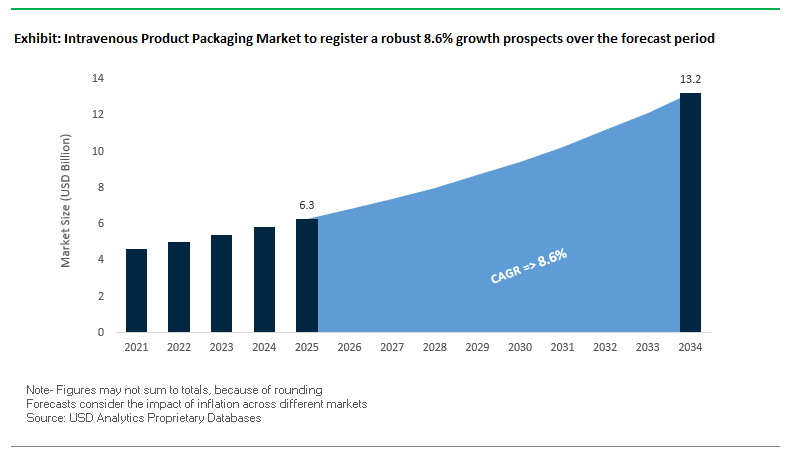
The global Intravenous Product Packaging Market is valued at USD 6.3 billion in 2025 and is projected to reach USD 13.2 billion by 2034, expanding at a CAGR of 8.6%. The market covers packaging systems used to contain, protect, prepare and administer pharmaceutical solutions intended for intravenous delivery, including single-chamber IV bags, premixed drug bags, multi-chamber and dual-chamber systems, large-volume parenteral containers, bottles, selected vials and syringes, ports, connectors and protective overwraps. Flexible IV bags form the core of the market because they combine low weight, collapsibility, storage efficiency and compatibility with high-volume hospital infusion workflows, and IV bags account for approximately 50% of product-type demand, while hospitals represent approximately 70% of application demand.
Material selection is increasingly determined by the interaction between the drug formulation and the complete container system. IV packaging must maintain sterility and container-closure integrity while controlling permeability, extractables and leachables, sorption, particulate contamination and product loss during sterilization, storage and administration. Flexible-container architectures span PVC and non-PVC structures based on polypropylene, polyethylene, EVA and multilayer films. B. Braun currently offers a complete U.S. IV-solution portfolio in containers not made with DEHP or PVC, while Fresenius Kabi's freeflex platform uses non-PVC, non-DEHP flexible bags and Technoflex supplies polypropylene Inerta bags for ready-to-use drugs, supplementation and reconstitution. USP <661.1> and <661.2> provide current compendial frameworks for plastic materials and pharmaceutical packaging systems, reinforcing the importance of material characterization and finished-container suitability.
Packaging architecture is also moving beyond conventional single-compartment fluid bags. Dual- and multi-chamber containers keep drug powders, concentrated solutions, diluents or parenteral-nutrition components separated during storage and permit controlled mixing shortly before administration. B. Braun's DUPLEX system separates a premeasured drug and diluent in a two-compartment container, while Technoflex's Dual-Mix and Ready Mix platforms address powder/liquid and liquid/liquid reconstitution. Fresenius Kabi and Otsuka also maintain extensive multi-chamber parenteral-nutrition systems. These formats link packaging directly with drug stability, pharmacy preparation and bedside workflow rather than functioning solely as passive fluid containers.
Ready-to-administer and premixed IV products are creating a second major change in container requirements. Manufacturer-prepared bags can eliminate or reduce hospital compounding steps while demanding validated compatibility between the formulation, flexible film, ports, overwrap, sterilization process, labeling and shelf-life conditions. At the same time, supply resilience has become strategically important following recent IV-fluid disruptions in North America. The formation of Otsuka ICU Medical in 2025 and Otsuka's subsequent more than USD 500 million North American IV-capacity expansion announced in July 2026 demonstrate that IV packaging competition now encompasses container technology, regional manufacturing scale and continuity of supply alongside material performance.
Key Industry Insights
The Intravenous Product Packaging Market is valued at USD 6.3 billion in 2025 and is projected to reach USD 13.2 billion by 2034 at an 8.6% CAGR.
IV bags account for approximately 50% of product-type demand, reflecting their widespread use for saline, dextrose, electrolyte solutions, premixed drugs, antibiotics and parenteral nutrition. Hospitals represent approximately 70% of application demand.
Non-PVC and DEHP-free container platforms are becoming more prominent as suppliers expand polypropylene, polyethylene and other alternative flexible-film architectures. B. Braun's U.S. IV-solutions portfolio is not made with DEHP or PVC, while Otsuka's 2026 North American expansion specifically includes development work on DEHP-free IV containers.
Premixed and ready-to-administer IV bags are expanding the role of packaging in drug preparation. Fresenius Kabi launched premixed levetiracetam in three concentrations in freeflex bags in the U.S. during Q1 2026, while B. Braun expanded several premixed drug portfolios during 2025.
Dual- and multi-chamber formats support drugs that cannot remain mixed throughout shelf life, enabling separate storage of drug/diluent or multiple nutritional components followed by activation before administration.
Container qualification remains a pharmaceutical-quality requirement. FDA's August 2026 draft Container Closure Systems guidance addresses the quality evaluation of complete packaging systems for human drugs and biological products, while USP <661.2> addresses plastic pharmaceutical packaging systems as complete assemblies rather than only individual polymers.
Recent Developments in the Intravenous Product Packaging Market
Otsuka Commits More Than USD 500 Million to North American IV-Solution Capacity and DEHP-Free Containers
In July 2026, Otsuka Pharmaceutical Factory announced one of the most consequential current investments in the IV-solution supply chain: more than USD 500 million for a new approximately 500,000-square-foot manufacturing facility and upgrades at the existing Austin, Texas operations of Otsuka ICU Medical LLC. The expansion is intended to increase North American IV-solutions manufacturing capacity, improve long-term supply stability and advance product development, explicitly including DEHP-free IV containers.
The investment follows the May 2025 formation of Otsuka ICU Medical. Otsuka Pharmaceutical Factory America acquired a 60% controlling interest in the IV Solutions business transferred from ICU Medical, while ICU Medical retained 40%. The business includes injection, irrigation, nutrition and specialty IV solutions, including sodium chloride, dextrose, balanced electrolytes, Lactated Ringer's and other large-volume products. The transaction materially changes the competitive structure of the North American market because ICU Medical should no longer be described as the sole owner of this IV-solutions operation.
Fresenius Kabi Expands Premixed IV Therapy Through the freeflex Platform
During Q1 2026, Fresenius Kabi launched premixed levetiracetam in freeflex bags in three concentrations in the United States. Fresenius described the product as a premixed, ready-to-use and ready-to-administer solution, extending the company's strategy of moving selected injectable drugs from vial-based or pharmacy-compounded preparation toward manufacturer-prepared flexible containers.
The development is relevant beyond the individual drug because freeflex represents a scalable IV-container platform rather than a single product format. Fresenius Kabi's Wilson, North Carolina manufacturing operation supports terminally sterilized freeflex IV bags from 50 mL to 1,000 mL, alongside prefilled syringe capabilities. This combination allows injectable-product manufacturers to select container formats according to formulation and administration requirements within the same sterile manufacturing network.
B. Braun Expands Ready-to-Activate DUPLEX Drug-Delivery Formats
B. Braun continued expanding its two-compartment DUPLEX IV-container platform during 2025. In March, the company launched Cefazolin 3 g in a ready-to-activate DUPLEX container, adding to its 1 g and 2 g configurations. The system stores the premeasured medication and diluent in separate compartments until bedside activation and can be stored at room temperature. A barcode references the final admixture, lot number and expiration date.
B. Braun subsequently commercialized Piperacillin and Tazobactam in DUPLEX containers in 2.25 g/50 mL, 3.375 g/50 mL and 4.5 g/100 mL configurations. The containers are not made with DEHP or PVC and separate the antibiotic from the diluent until activation. The expansion demonstrates how compartmentalized IV packaging can address formulations whose stability requirements make conventional long-term premixing less suitable.
B. Braun Expands Premixed Drug Portfolio in Non-PVC EXCEL IV Containers
B. Braun also expanded its EXCEL IV-container portfolio during 2025. In July, the company added two Heparin Sodium Injection configurations, expanding its U.S. premixed heparin offering to seven products. The 250 mL and 500 mL bags incorporate enhanced 2D barcodes containing NDC, lot and expiration information, while the EXCEL containers are not made with DEHP, PVC or natural rubber latex.
In September 2025, B. Braun launched Tromethamine Injection in a 500 mL EXCEL flexible IV container, providing an alternative to existing glass-bottle configurations. In October, it added Midazolam in 0.8% Sodium Chloride Injection in 50 mL and 100 mL single-dose bags with a 36-month shelf life and enhanced 2D barcode data. Together, these launches show premixed flexible containers expanding into therapeutic categories previously supplied through glass, vials or pharmacy-prepared systems.
North American IV Supply Recovery Drives Manufacturing and Inventory Resilience
Recent supply interruptions have increased attention to IV-container manufacturing redundancy. B. Braun states that it has invested more than USD 1 billion in new and expanded North American pharmaceutical manufacturing facilities and operates IV-solutions facilities on both U.S. coasts. Following the supply disruption that began in late 2024, the company reported in August 2025 that it had removed allocation restrictions from its entire IV Solutions and Irrigation portfolio after increasing production at its two IV manufacturing plants.
In December 2025, B. Braun introduced a supply-assurance program designed to maintain 45 days of inventory at key distributor warehouse locations, covering its IV solutions, irrigation and nutrition-container products among other categories. Combined with Otsuka's 2026 Austin investment, these developments show supply continuity becoming a differentiating factor alongside bag materials and clinical functionality.
Technoflex Expands Regulated PP Container Options for Hospital Compounding
Technoflex currently offers an FDA 510(k)-cleared and EU MDR Class IIa Empty Solution Container for preparation and intravenous administration of drug solutions. The sterile polypropylene container is available in 100 mL, 250 mL, 500 mL and 1,000 mL formats, is manufactured in ISO 7 cleanrooms and is supplied with spike and injection ports.
Its broader IV portfolio includes Inerta polypropylene bags, Dual-Mix powder/liquid systems, Ready Mix liquid/liquid and nutrition bags, sterile bags and high-barrier overwraps. The Dual-Mix platform incorporates a peelable seal and allows a drug powder or lyophilizate to remain separated from its diluent until reconstitution, while its overwrap structures provide barriers to moisture, oxygen, carbon dioxide and UV exposure. This illustrates increasing specialization among flexible-container suppliers around drug-specific barrier, aseptic-filling and reconstitution requirements.
Flexible-Film Suppliers Increase Focus on Complete IV Bag and Overwrap Systems
The IV packaging value chain is also evolving at the pharmaceutical barrier-film and secondary-barrier level. Polycine supplies multilayer polypropylene and polyethylene films, tubing and port compounds for flexible drug containers, including single- and multi-chamber IV bags. Its portfolio includes dedicated materials for total parenteral nutrition and high-barrier overwrap structures.
Amcor supplies both medium- and high-barrier IV overwraps, including structures designed to control moisture and oxygen transmission for sensitive medical fluids. Its current Crystal Shield laminates provide transparent high-barrier protection, while the Optym IV Overwrap portfolio includes PE- and PP-based structures with sterilization-compatible options. These suppliers compete upstream of the filled IV-solution manufacturers but materially influence shelf life, container protection, manufacturing performance and secondary-barrier design.
Emerging Trends and Opportunities Shaping the Intravenous Product Packaging Market
Accelerated Adoption of Ready-to-Use (RTU) Vials and Prefilled Syringes
The intravenous product packaging market is witnessing a strong shift toward Ready-to-Use (RTU) vials and prefilled syringes, driven primarily by the critical need to minimize medication errors. Prefilled syringes offer exact dosing at the manufacturing stage, effectively eliminating human errors during manual dose preparation in hospitals and clinical settings. This accuracy is especially vital for high-value and sensitive drugs, where even minor deviations can lead to serious clinical consequences. Beyond safety, RTU packaging significantly enhances hospital workflow and operational efficiency. Healthcare professionals save valuable time by avoiding manual preparation, which is particularly beneficial in high-pressure environments such as emergency rooms and operating theaters. For instance, Amneal Pharmaceuticals’ July 2024 FDA approval of its potassium phosphates IV solution in a ready-to-use bag underscored the product’s design focus on both safety and efficiency in hospital operations. Additionally, the rise of home healthcare has propelled the adoption of prefilled syringes, simplifying self-administration for patients with chronic conditions. This convenience not only promotes adherence to prescribed therapies but also reduces treatment gaps, further cementing RTU packaging as a key Market Trend.
Integration of Advanced Polymer Films for Flexible IV Bags with Enhanced Barrier Properties
Pharmaceutical manufacturers are increasingly leveraging advanced polymer films to enhance the barrier properties of flexible IV bags, a trend propelled by the need to protect high-value, sensitive drug formulations such as biologics and parenteral nutrition. These multi-layer films provide superior protection against moisture, oxygen, and light, extending product shelf life while ensuring drug integrity. Polycine, for instance, offers specialty films designed for optimal moisture, light, and gas barrier performance, highlighting the technological advances in this segment. Another critical advantage of these films is the potential to reduce cold chain dependency. By stabilizing drugs at room temperature, manufacturers can minimize the logistical complexity and costs associated with temperature-controlled supply chains. Innovations are particularly evident in multi-chamber IV bags, where drugs must remain separate until point-of-use. The multi-chamber and specialty bags segment is poised for robust growth between 2025 and 2034, reflecting rising demand for versatile packaging solutions for complex intravenous formulations.
Development of In-Line Sensor Technology for Real-Time Integrity Testing
The intravenous product packaging industry is moving toward deterministic, non-destructive, in-line integrity testing, replacing traditional probabilistic approaches like the blue dye test. This opportunity emphasizes ensuring 100% quality control by enabling the inspection of every vial or IV bag on the production line. Modern sensor technologies, such as vacuum decay systems, are recognized by the FDA as standards for detecting even microscopic defects or pinholes that could compromise sterility. According to guidance from the U.S. Pharmacopeia (USP), validated container-closure systems are critical, and integrating real-time sensors ensures compliance while maintaining product safety. Emerging systems are designed to handle the increasing complexity of packaging formats, including flexible IV bags with intricate seals and port regions, which are vulnerable during manufacturing and transit. This innovation represents a significant leap in quality assurance and regulatory compliance in IV product packaging.
Standardization of Connected Packaging for Smart Inventory Management
Connected packaging presents a substantial opportunity to enhance hospital efficiency, reduce wastage, and improve patient safety. By embedding RFID or NFC tags directly into IV bags and vials, hospitals can automate drug inventory management, enabling real-time tracking from pharmacy storage to the patient’s bedside. This technology reduces manual inventory checks and mitigates drug wastage caused by expiration, translating into both financial savings and improved patient safety. For example, collaborations between pharmaceutical services companies and smart packaging providers have resulted in systems that automatically track expiration dates of IV products, ensuring timely use and minimizing risk. Additionally, RFID-enabled IV syringes, such as those launched by GENIXUS Corp. in August 2023, demonstrate the dual benefit of operational efficiency and patient safety by reducing medication errors while optimizing hospital workflow. Connected packaging is therefore emerging as a critical growth opportunity for stakeholders aiming to integrate smart, traceable, and safer intravenous drug delivery systems.
IV Bags Hold the Largest Market Share by Product Type in Intravenous Packaging
IV bags represent 50% of the intravenous product packaging market in 2025, solidifying their position as the standard container for large-volume parenteral solutions. Their widespread adoption is driven by advantages over glass bottles, including reduced weight, safer handling, ease of disposal, and improved storage efficiency. IV bags are used extensively for saline, dextrose, electrolyte solutions, and drug infusion therapies, making them indispensable in modern hospitals. The transition to non-PVC and DEHP-free materials reflects regulatory and safety-driven innovation, ensuring long-term relevance. Vials and syringes remain critical, with vials supporting long-term stability for biologics and vaccines, and syringes especially prefilled formats gaining traction for precision dosing and patient safety. Bottles, once the standard, now occupy a declining niche, while ampoules and other specialized containers cater to emerging drug delivery needs. This segmentation reflects how IV bags dominate by volume, while vials and syringes anchor high-value pharmaceutical packaging applications.
Hospitals Dominate Market Share by Application in Intravenous Product Packaging
Hospitals account for 70% of the intravenous packaging market in 2025, reflecting their central role in global healthcare delivery. They perform the bulk of surgeries, emergency treatments, inpatient therapies, and intensive care interventions, all of which require high volumes of IV fluids, antibiotics, anesthetics, and nutritional solutions. This dominance is reinforced by hospitals’ scale, where procurement strategies demand bulk, reliable, and cost-effective IV packaging formats. Ambulatory surgical centers (ASCs) represent a fast-growing segment, reflecting the healthcare industry’s shift toward outpatient surgeries and cost reduction, with significant demand for vials, IV bags, and prefilled syringes in high-throughput environments. Homecare is another rapidly expanding application, fueled by aging populations and chronic disease management, where user-friendly, safe, and portable IV packaging formats enable treatment outside hospitals. Clinics and smaller healthcare centers remain minor consumers, with usage focused on immunizations and limited outpatient therapies. This segmentation illustrates how hospitals anchor volume consumption, while ASCs and homecare drive diversification in IV packaging demand.
United States: Regulatory Pressure and Innovation Driving IV Packaging Growth
The United States intravenous product packaging market is strongly influenced by the Food and Drug Administration (FDA) and the Drug Supply Chain Security Act (DSCSA), which mandates unique identifiers, RFID tags, and 2D barcodes to secure the supply chain. These regulations are accelerating the adoption of track-and-trace IV packaging technologies to ensure both patient safety and product integrity. Hospitals, clinics, and home healthcare providers represent the largest demand base, particularly for IV bags, pre-filled syringes, and cannulas.
Technological innovation is reshaping the market, with companies like West Pharmaceutical Services launching sterile, high-performance IV containers in February 2024, designed for both safety and workflow efficiency. Corporate investment also plays a pivotal role, as Becton, Dickinson and Company (BD) introduced an IV packaging system with tamper-evident and recyclable features in 2022, while ICU Medical’s acquisition of Smiths Medical in 2021 expanded its IV therapy portfolio. The U.S. market is also seeing strong momentum in eco-friendly IV packaging, where antimicrobial and recyclable materials are being prioritized for sustainable healthcare operations.
Germany: Circular Economy Compliance and Advanced IV Packaging Solutions
The German intravenous product packaging market operates under a rigorous regulatory environment shaped by the EU Packaging and Packaging Waste Regulation (PPWR), which requires all packaging to be fully recyclable or reusable by 2030. This has pushed German companies to adopt sustainable materials like polyolefin for IV solutions while adhering to the broader goals of the German Packaging Act (VerpackG), which incentivizes design-for-recycling practices.
Germany is also a hub of technological innovation in infusion therapy and IV packaging, led by companies such as B. Braun Melsungen AG, which specializes in advanced infusion solutions. Similarly, Gerresheimer AG is investing heavily in vials, ampoules, and next-generation packaging formats to address both regulatory compliance and hospital demand. Germany’s leadership in the circular economy has positioned its IV product packaging industry as a model for integrating sustainability with pharmaceutical-grade safety and performance.
China: Dual-Carbon Strategy and Domestic Expansion in IV Packaging
The China IV product packaging market is closely tied to the government’s “dual carbon” goal, which is driving greener production processes and sustainable material adoption across healthcare packaging. The March 2024 “Action Plan for Large-Scale Equipment Updates and Consumer Goods Replacement” is designed to promote recycling and eco-friendly medical packaging. Additionally, the updated GB/T 31268 standard on restricting excessive packaging (effective November 2024) directly impacts IV packaging by limiting wasteful material use.
China is rapidly integrating automation, AI, and 5G-enabled smart factories to increase IV packaging efficiency. Domestic manufacturers like SSY Group Limited and Forlong Medical Co., Ltd. are scaling up operations to replace imported technologies with locally manufactured high-performance IV packaging. With rising demand in hospitals and expanding government initiatives, the Chinese market is expected to lead in AI-driven production and sustainable medical packaging solutions over the next decade.
India: Government Incentives and Rising Demand for Sustainable IV Packaging
The India intravenous product packaging market is advancing under the government’s Production Linked Incentive (PLI) scheme for Pharmaceuticals and Medical Devices, which promotes domestic manufacturing and sustainable innovation. India’s commitment to a circular economy has increased opportunities for companies offering eco-friendly IV packaging solutions. Regulatory oversight by the Central Drugs Standards Control Organisation (CDSCO) enforces high safety standards, compelling manufacturers to supply hygienic and compliant packaging.
Technological advancement is also evident, as demonstrated by Gufic Biosciences’ June 2022 launch of dual-chamber IV bags that allow safe and efficient drug delivery. Investment in new production facilities is expanding, driven by the country’s fast-growing pharmaceutical exports and healthcare infrastructure. Rising demand from both hospitals and home healthcare has positioned India as one of the fastest-growing IV packaging markets in Asia-Pacific, with sustainability and compliance as its cornerstones.
Japan: Precision Manufacturing and High-Performance IV Packaging Innovations
The Japan IV product packaging market benefits from the country’s strengths in precision engineering and advanced material science. Companies like Nipro and Otsuka Pharmaceutical Co., Ltd. are leading with next-generation medical devices and packaging formats that emphasize both safety and efficiency. Japan’s Plastic Resource Circulation Act (April 2022) has further guided manufacturers toward eco-friendly packaging designs, reducing reliance on single-use plastics.
Japanese companies are also prioritizing functional innovation, developing IV packaging with self-sealing, tamper-proof, and advanced barrier properties to meet specialized medical needs. With strong support from the Ministry of Economy, Trade, and Industry (METI), Japan continues to push for sustainable, high-performance IV product packaging that meets the needs of both hospitals and advanced home healthcare services.
Brazil: Sustainable Waste Management and Expanding IV Packaging Applications
The Brazil intravenous product packaging market is underpinned by the National Solid Waste Policy (PNRS), updated in April 2022, which aims to modernize solid waste management and promote sustainability over the next two decades. These initiatives are directly influencing material choices in the IV packaging industry, encouraging eco-friendly and recyclable solutions.
The market is particularly strong in hospital and clinical sectors, where there is a rising demand for ready-to-use IV packaging and high-value pharmaceutical applications. Technological advancement in cold chain logistics and last-mile delivery is also enabling safer distribution of IV products across Brazil’s vast geography. Moreover, the EU-Mercosur trade agreement is expected to expand investment and diversify packaging solutions, attracting both domestic and international manufacturers to the Brazilian healthcare packaging market.
Competitive Landscape: IV Solution Manufacturing, Flexible Containers and Multi-Chamber Systems Define Competition
The Intravenous Product Packaging Market is led by companies that combine sterile pharmaceutical manufacturing with proprietary flexible-container platforms. Baxter International, B. Braun Melsungen, Fresenius Kabi, Otsuka Pharmaceutical Factory/Otsuka ICU Medical and Terumo Corporation occupy central positions across large-volume parenteral solutions, premixed injectable bags, parenteral nutrition and hospital infusion systems. Baxter competes through VIAFLEX, VIAFLO, MINI-BAG Plus and other flexible IV-container systems, while B. Braun's EXCEL and DUPLEX platforms emphasize non-PVC/DEHP-free materials, premixed drugs and compartmentalized reconstitution. Fresenius Kabi's freeflex platform covers standard IV fluids and manufacturer-prepared drug products, while Otsuka contributes extensive expertise in soft bags and multi-chamber IV systems and is now expanding its North American manufacturing base through Otsuka ICU Medical.
A second competitive group comprises specialist flexible-container and material suppliers. Technoflex competes across PP IV bags, sterile empty solution containers, Dual-Mix and Ready Mix multi-chamber systems and barrier overwraps. Polycine supplies polypropylene and polyethylene films, tubes and compounds used in flexible liquid-drug packaging, while Amcor participates through IV-bag overwrap and high-barrier medical-fluid laminates. Nipro also supplies flexible sodium-chloride containers for selected clinical applications. Competition in this part of the value chain centers on polymer purity, extractables and leachables, drug compatibility, heat and radiation sterilization, seal integrity, permeability, transparency, port design, particulate control and form-fill-seal processing.
Market differentiation is increasingly moving toward integrated container-drug systems rather than commodity bags alone. Premixed drug portfolios require validated shelf-life performance and accurate labeling; multi-chamber systems require reproducible peel-seal performance and reliable mixing; sensitive solutions can require dedicated oxygen-, moisture- or light-barrier overwraps; and hospital compounding applications require sterile empty containers with suitable ports and regulatory documentation. FDA's August 2026 draft Container Closure Systems guidance and current USP plastic-packaging chapters reinforce evaluation of the packaging system as a whole, including materials, components and drug-product compatibility. Regional manufacturing capacity has also become a competitive variable, with Otsuka's more than USD 500 million Austin expansion and B. Braun's North American manufacturing investments placing supply resilience alongside container performance, premix capability and material technology as major dimensions of competition.
Intravenous Product Packaging Market Report Scope
Intravenous Product Packaging Market
Parameter
Details
Market Size (2025)
$6.3 Billion
Market Size (2034)
$13.2 Billion
Market Growth Rate
8.6%
Segments
By Product Type (IV Bags, Bottles, Vials, Syringes, Others), By Material (PVC, Non-PVC, Glass, Others), By Packaging Type (Single-Chamber Bags, Multi-Chamber Bags, Dual-Chamber Bags), By Application (Hospitals, Clinics, ASCs, Homecare, Other Healthcare Centers)
Study Period
2019- 2024 and 2025-2034
Units
Revenue (USD)
Qualitative Analysis
Porter’s Five Forces, SWOT Profile, Market Share, Scenario Forecasts, Market Ecosystem, Company Ranking, Market Dynamics, Industry Benchmarking
Companies
Baxter International Inc., B. Braun Melsungen AG, ICU Medical, Inc., Fresenius Kabi AG, Terumo Medical Corporation, Otsuka Pharmaceutical Co., Ltd., Grifols, S.A., West Pharmaceutical Services, Inc., Nipro Corporation, Amcor plc, SGD Pharma, Gerresheimer AG, Becton, Dickinson and Company (BD), Technoflex, PolyCine GmbH
Countries
US, Canada, Mexico, Germany, France, Spain, Italy, UK, Russia, China, India, Japan, South Korea, Australia, South East Asia, Brazil, Argentina, Middle East, Africa
Intravenous Product Packaging Market Segmentation
By Product Type
IV Bags
Bottles
Vials
Syringes
Others
By Material
PVC
Non-PVC
Glass
Others
By Packaging Type
Single-Chamber Bags
Multi-Chamber Bags
Dual-Chamber Bags
By Application
Hospitals
Clinics
ASCs
Homecare
Other Healthcare Centers
Countries Analyzed
North America (US, Canada, Mexico)
Europe (Germany, UK, France, Spain, Italy, Russia, Rest of Europe)
Asia Pacific (China, India, Japan, South Korea, Australia, South East Asia, Rest of Asia)
South America (Brazil, Argentina, Rest of South America)
Middle East and Africa (Saudi Arabia, UAE, Rest of Middle East, South Africa, Egypt, Rest of Africa)
Top Companies in Intravenous Product Packaging Market
Baxter International Inc.
B. Braun Melsungen AG
ICU Medical, Inc.
Fresenius Kabi AG
Terumo Medical Corporation
Otsuka Pharmaceutical Co., Ltd.
Grifols, S.A.
West Pharmaceutical Services, Inc.
Nipro Corporation
Amcor plc
SGD Pharma
Gerresheimer AG
Becton, Dickinson and Company (BD)
Technoflex
PolyCine GmbH
* List Not Exhaustive
Methodology
USDAnalytics employed a rigorous, multi-source research methodology to deliver a comprehensive analysis of the global Intravenous (IV) Product Packaging Market. Our approach combined both primary and secondary research, with primary insights gathered through consultations with senior executives, procurement heads, R&D managers, and regulatory affairs specialists across hospitals, clinics, and pharmaceutical manufacturing facilities. Secondary research included extensive review of industry reports, regulatory frameworks (FDA, EU PPWR, CDSCO), corporate filings, press releases, and scientific publications related to IV packaging materials, smart packaging, and ready-to-use delivery systems. Quantitative modeling and market forecasting were performed using bottom-up and top-down approaches, factoring in product types, material innovations, geographical trends, adoption of digital and connected packaging solutions, and regulatory influences. USDAnalytics applied cross-validation techniques to ensure accuracy of CAGR projections, market sizing, and segment growth estimates. Trends in RTU vials, prefilled syringes, advanced polymer films, in-line sensor technology, and connected packaging solutions were carefully analyzed for technological and commercial feasibility. Competitive benchmarking assessed market positioning of leading players such as B. Braun, Baxter, Gerresheimer, and SCHOTT, integrating insights from mergers, acquisitions, capacity expansions, and product innovation. Regional market analysis for the U.S., Germany, China, India, Japan, and Brazil incorporated country-specific regulatory, sustainability, and technological dynamics. This methodology ensures that stakeholders receive actionable, data-driven intelligence to guide investment, procurement, and strategic decisions in the evolving IV product packaging landscape.
Deliverables:
Comprehensive Market Research Report (PDF and Excel) with detailed tables, charts, and interactive visualizations.
Country-Specific Forecasts & Analysis.
Segment-Wise Revenue Forecasts (2025–2034).
Competitive Analysis, Benchmarking, and SWOT Profiles.
Recent Developments & Innovation Tracker.
Executive Summary & Analyst Commentary.
Post-Purchase Analyst Support for Client-Specific Questions and Custom Data Requirements.
Table of Contents: Intravenous (IV) Product Packaging Market
1. Executive Summary
1.1. Market Highlights
1.2. Key Findings
1.3. Global Market Snapshot
2. IV Product Packaging Market Landscape & Outlook (2025–2034)
2.1. Introduction to IV Product Packaging Market
2.2. Market Valuation and Growth Projections (2025–2034)
2.3. Market Drivers and Restraints
2.4. Regulatory Landscape
2.5. Technological Advancements
3. Innovations Reshaping the IV Product Packaging Market
3.1. Trend: Accelerated Adoption of Ready-to-Use (RTU) Vials and Prefilled Syringes
3.2. Trend: Integration of Advanced Polymer Films for Flexible IV Bags with Enhanced Barrier Properties
3.3. Opportunity: Development of In-Line Sensor Technology for Real-Time Integrity Testing
3.4. Opportunity: Standardization of Connected Packaging for Smart Inventory Management
4. Competitive Landscape and Strategic Initiatives
4.1. Mergers, Acquisitions and Strategic Alliances
4.2. R&D and Material Innovation
4.3. Sustainability and Strategies
4.4. Market Expansion and Regional Focus
5. Market Share and Segmentation Insights: IV Product Packaging Market
5.1. By Product Type
5.1.1. IV Bags
5.1.2. Bottles
5.1.3. Vials
5.1.4. Syringes
5.1.5. Others
5.2. By Material
5.2.1. PVC
5.2.2. Non-PVC
5.2.3. Glass
5.2.4. Others
5.3. By Packaging Type
5.3.1. Single-Chamber Bags
5.3.2. Multi-Chamber Bags
5.3.3. Dual-Chamber Bags
5.4. By Application
5.4.1. Hospitals
5.4.2. Clinics
5.4.3. Ambulatory Surgical Centers (ASCs)
5.4.4. Homecare
5.4.5. Other Healthcare Centers
6. Country Analysis and Outlook of IV Product Packaging Market
6.1. United States
6.2. Canada
6.3. Mexico
6.4. Germany
6.5. France
6.6. Spain
6.7. Italy
6.8. UK
6.9. Russia
6.10. China
6.11. India
6.12. Japan
6.13. South Korea
6.14. Australia
6.15. South East Asia
6.16. Brazil
6.17. Argentina
6.18. Middle East
6.19. Africa
7. IV Product Packaging Market Size Outlook by Region (2025-2034)
7.1. North America IV Product Packaging Market Size Outlook to 2034
7.1.1. By Product Type
7.1.2. By Material
7.1.3. By Application
7.1.4. By Packaging Type
7.2. Europe IV Product Packaging Market Size Outlook to 2034
7.2.1. By Product Type
7.2.2. By Material
7.2.3. By Application
7.2.4. By Packaging Type
7.3. Asia Pacific IV Product Packaging Market Size Outlook to 2034
7.3.1. By Product Type
7.3.2. By Material
7.3.3. By Application
7.3.4. By Packaging Type
7.4. South America IV Product Packaging Market Size Outlook to 2034
7.4.1. By Product Type
7.4.2. By Material
7.4.3. By Application
7.4.4. By Packaging Type
7.5. Middle East and Africa IV Product Packaging Market Size Outlook to 2034
7.5.1. By Product Type
7.5.2. By Material
7.5.3. By Application
7.5.4. By Packaging Type
8. Company Profiles: Leading Players in the IV Product Packaging Market
8.1. Baxter International Inc.
8.2. B. Braun Melsungen AG
8.3. ICU Medical, Inc.
8.4. Fresenius Kabi AG
8.5. Terumo Medical Corporation
8.6. Otsuka Pharmaceutical Co., Ltd.
8.7. Grifols, S.A.
8.8. West Pharmaceutical Services, Inc.
8.9. Nipro Corporation
8.10. Amcor plc
8.11. SGD Pharma
8.12. Gerresheimer AG
8.13. Becton, Dickinson and Company (BD)
8.14. Technoflex
8.15. PolyCine GmbH
9. Methodology
9.1. Research Scope
9.2. Market Research Approach
9.3. Market Sizing and Forecasting Model
9.4. Research Coverage
9.5. Data Horizon
9.6. Deliverables
10. Appendix
10.1. Acronyms and Abbreviations
10.2. List of Tables
10.3. List of Figures
Intravenous Product Packaging Market Segmentation
By Product Type
IV Bags
Bottles
Vials
Syringes
Others
By Material
PVC
Non-PVC
Glass
Others
By Packaging Type
Single-Chamber Bags
Multi-Chamber Bags
Dual-Chamber Bags
By Application
Hospitals
Clinics
ASCs
Homecare
Other Healthcare Centers
Countries Analyzed
North America (US, Canada, Mexico)
Europe (Germany, UK, France, Spain, Italy, Russia, Rest of Europe)
Asia Pacific (China, India, Japan, South Korea, Australia, South East Asia, Rest of Asia)
South America (Brazil, Argentina, Rest of South America)
Middle East and Africa (Saudi Arabia, UAE, Rest of Middle East, South Africa, Egypt, Rest of Africa)
The IV product packaging market is expanding due to rising adoption of ready-to-use (RTU) vials, prefilled syringes, and advanced IV bags, which minimize medication errors and enhance hospital workflow. Regulatory mandates, such as FDA and EU PPWR guidelines, combined with sustainability initiatives and digital traceability (RFID/NFC/QR codes), further fuel adoption while ensuring patient safety and supply chain integrity.
Manufacturers are increasingly using mono-material polymers, recyclable plastics, and eco-friendly glass alternatives to align with ESG objectives. Circular economy principles are applied in hospitals and production facilities to reduce packaging waste. Innovations in lightweight IV bags, multi-chamber designs, and recyclable prefilled syringes help lower environmental impact while maintaining sterility and drug stability.
Smart packaging solutions with embedded RFID, NFC, or QR codes enable real-time inventory tracking, automated stock management, and anti-counterfeiting measures. Hospitals can monitor product location, expiration, and usage, reducing wastage and enhancing patient safety. Connected packaging also supports compliance with regulatory traceability standards, optimizing operational efficiency across clinical and homecare environments.
IV bags lead market share, representing approximately 50% of the 2025 market due to their ease of handling, reduced weight, and suitability for large-volume parenteral solutions. Prefilled syringes and RTU vials are gaining traction for high-value drugs and homecare applications, offering precise dosing, reduced compounding errors, and enhanced patient safety. Glass vials remain essential for biologics requiring long-term stability.
The U.S. market is driven by stringent FDA regulations and adoption of track-and-trace systems. Germany emphasizes circular economy compliance and eco-friendly IV solutions under EU PPWR guidelines. China focuses on domestic manufacturing, automation, and dual-carbon initiatives to reduce environmental impact. Each region balances regulatory requirements, hospital demand, and technological adoption, collectively shaping global growth trends and innovation priorities.
More Healthcare and Pharmaceutical Packaging Reports