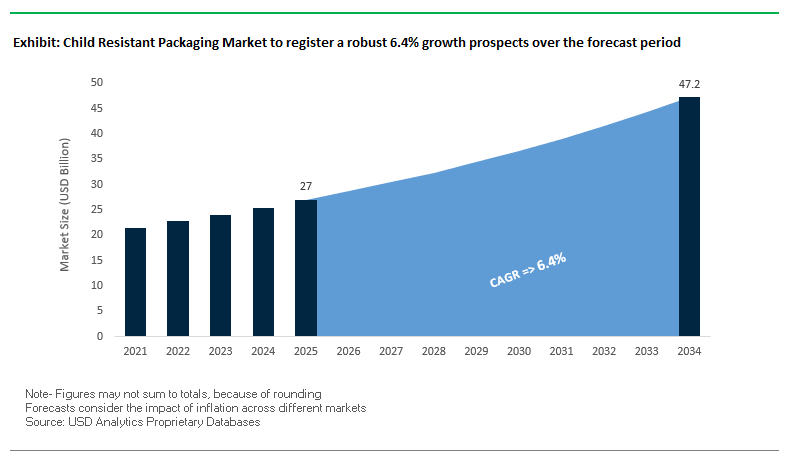
The global Child Resistant Packaging Market is valued at USD 27 billion in 2025 and is projected to reach USD 47.2 billion by 2034, expanding at a CAGR of 6.4%. The market covers bottles and jars, pouches, blister packs, containers, closures, cartons and other packaging engineered to restrict access by young children while remaining usable by adults. Pharmaceuticals represent the largest end-use industry, while cannabis, household chemicals, automotive products, personal care and other hazardous or regulated consumer products broaden the addressable market.
A technically important distinction is that child-resistant does not mean child-proof. Under the U.S. Poison Prevention Packaging Act framework, special packaging must be significantly difficult for children under five to open while remaining accessible to normal adults. CPSC testing requires at least 85% of tested children to be unable to open a package during the first five minutes and at least 80% during the full ten-minute test. For adult accessibility, at least 90% of tested adults must be able to open the package within five minutes and, where applicable, properly resecure a second package within one minute.
Demand therefore depends on more than simply adding a safety closure. Child-resistant packaging development is influenced by child resistance, senior accessibility, product compatibility, reclosability, dispensing accuracy, seal integrity, regulatory certification and manufacturing-line performance. Caps and closures account for approximately 35% of market demand by product type, while pharmaceuticals represent around 55% by end-use industry.
Key Insights for Professionals
Pharmaceuticals account for approximately 55% of Child Resistant Packaging Market demand.
Caps and closures represent approximately 35% of demand by product type.
Reclosable and non-reclosable packages follow different child-resistance testing frameworks.
Senior accessibility, material compatibility and finished-package performance are increasingly important alongside child resistance.
Recent Developments and Manufacturer Strategies in Child Resistant Packaging
Recent developments show child-resistant packaging moving toward lighter closure systems, smaller flexible formats, more intuitive opening mechanisms and closer regulatory scrutiny of nicotine and hazardous consumer products. Manufacturers are also integrating recyclability and material reduction into CR designs while maintaining tested safety performance.
Amcor Launches Lightweight Hector Child Resistant Closure with PCR Capability
In July 2025, Amcor introduced the Hector Child Resistant Closure for household cleaners. The polypropylene squeeze-and-turn closure weighs 7.25 grams, compared with a conventional 14-gram reference closure. Amcor calculates that this represents a reduction of approximately 6.75 tonnes of plastic per one million closures.
The closure can also be produced with up to 100% CleanStream post-consumer recycled polymer for appropriate non-contact-sensitive applications. Its design combines a child-resistant squeeze-and-turn mechanism with a directional dosing nozzle and secure overcap for products such as bleach and toilet cleaners.
The development demonstrates how CR closure engineering increasingly combines regulatory safety functionality with lightweighting, controlled dispensing, recyclability considerations and brand-specific container design.
Fresh-Lock Extends Child-Resistant Reclosability into Smaller Flexible Pouches
In September 2025, Fresh-Lock, a Presto Products business, introduced its Child-Guard Edge slider system for smaller-width flexible pouches. Earlier child-resistant slider systems were constrained by slider dimensions and pouch-opening widths, while the new platform uses a reduced-scale slider and track designed for small-format packs with repeated opening cycles.
The company identifies pharmaceutical, nutraceutical and other regulated applications among the target markets. When combined with compatible films and pouch-conversion processes, the platform enables brands to use reclosable flexible packaging where conventional rigid bottles or larger pouches may previously have been required.
The development expands CR functionality beyond bottles and rigid containers and increases the relevance of flexible pouches for small-count pharmaceutical, supplement and regulated consumer applications.
Chubby Gorilla Introduces X3 Pouch Container with Push-Down-and-Turn Closure
In March 2026, Chubby Gorilla launched the X3 Pouch Container using a push-down-and-turn child-resistant closure. Unlike opening systems that depend on visually aligning package markers, the X3 uses a mechanical opening motion intended to provide a more intuitive user interaction while retaining CR functionality.
The design illustrates increasing attention to adult accessibility and opening ergonomics within child-resistant packaging. These considerations are commercially important for products used by older consumers or people with reduced dexterity, because difficult adult access can undermine the practical usability of otherwise compliant packaging.
The platform also demonstrates continued convergence between pouch-style packaging, rigid closure technology and tamper-evident functionality.
FDA Calls for Child-Resistant Packaging as Nicotine-Pouch Exposure Reports Increase
In September 2025, the U.S. FDA urged nicotine-pouch manufacturers to use child-resistant packaging following increasing reports of accidental exposure. FDA reported that approximately 72% of nicotine-pouch exposure cases reported to U.S. Poison Centers between April 2022 and March 2025 involved children under five years old.
The development is distinct from existing federal requirements for liquid nicotine. Liquid nicotine containers are subject to the Child Nicotine Poisoning Prevention Act, administered for packaging purposes by the CPSC. Nicotine pouches, by contrast, became the subject of renewed FDA safety attention because of their concentrated nicotine content and package formats that can resemble consumer confectionery containers.
This expands commercial attention to CR formats within oral nicotine packaging and reinforces demand for containers that combine restricted child access with convenient repeated adult use.
EU REF-14 Enforcement Brings Child-Resistant Fastenings into 2026 Inspections
ECHA's Enforcement Forum selected hazardous mixtures in consumer products for its REF-14 enforcement project. The initiative covers products such as electronic-cigarette liquids and air fresheners and examines classification, labeling, packaging and child-resistant fastening obligations under the CLP framework. ECHA stated that the project would be prepared during 2025, with inspections expected in 2026.
This moves child-resistant packaging from a design consideration to an active compliance issue for chemical suppliers serving the European market. Compliance assessment covers whether required CR fastenings are appropriate for the classified hazards and package configuration.
Product Recalls Demonstrate Continuing Enforcement of Child-Resistant Packaging Rules
Regulatory compliance remains relevant after products enter the market. In July 2026, Health Canada reported a recall covering methyl hydrate, lacquer thinner, paint thinner, xylene and acetone products because affected packages did not comply with child-resistant packaging requirements under Canada's Consumer Chemicals and Containers Regulations.
A separate May 2026 Canadian recall involved cyanoacrylate adhesives that did not meet applicable child-resistant packaging and labeling requirements.
These enforcement cases illustrate the importance of CR performance in the finished package-product combination, rather than only at the individual closure-component level.
Regulatory and Testing Standards Define Child-Resistant Packaging Performance
U.S. Poison Prevention Packaging Act and CPSC
The PPPA establishes U.S. special-packaging requirements for specified household substances, with CPSC regulations codified at 16 CFR Part 1700. Performance testing evaluates both child resistance and adult accessibility.
The scope has also expanded through product-specific legislation. The Child Nicotine Poisoning Prevention Act applies special-packaging requirements to covered liquid nicotine containers, while Reese's Law introduced special-packaging requirements for specified button-cell and coin-battery products.
ISO 8317 for Reclosable Child-Resistant Packaging
ISO 8317:2015 specifies testing and acceptance criteria for reclosable child-resistant packages and evaluates adult accessibility alongside child resistance. The standard remains current following its most recent confirmation.
ISO 14375 for Non-Reclosable Pharmaceutical Packaging
ISO 14375:2018 covers performance testing of non-reclosable child-resistant packages intended for pharmaceutical products. The standard was reviewed and confirmed in 2024.
ISO 28862 for Non-Pharmaceutical Single-Use Packages
ISO 28862:2018 applies to non-reclosable CR packages for non-pharmaceutical products and specifically excludes pharmaceutical packaging covered by ISO 14375.
European Union CLP Requirements
Under the EU CLP framework, child-resistant fastenings are required for specified hazardous substances or mixtures supplied to the general public. ECHA's 2026 REF-14 inspections add an enforcement dimension by examining whether relevant consumer products are correctly classified, labeled and packaged.
Child Resistant Packaging Market Share Insights
Caps and Closures Hold 35% of the Market by Product Type
Caps and closures account for 35% of the Child Resistant Packaging Market in 2025, making them the largest product category.
Their position reflects broad applicability across pharmaceuticals, cleaners, chemicals, nicotine products and other multi-use products. Push-and-turn and squeeze-and-turn mechanisms can be integrated with established bottle and jar formats while providing repeated reclosure.
Closures also provide flexibility in dispensing design. CR closures are available in configurations incorporating nozzles, droppers, flow-control inserts, measuring systems and tamper-evident bands depending on the application.
Blister packs, pouches, cartons and other formats remain important where single-dose access, flexible packaging or product-specific requirements favor an alternative to conventional bottle-and-cap systems.
Pharmaceuticals Account for 55% of Child Resistant Packaging Demand
The pharmaceutical industry represents 55% of global Child Resistant Packaging Market demand, making it the largest end-use sector.
CR pharmaceutical packaging includes rigid pharmaceutical packaging such as prescription and OTC bottles with special closures, liquid-medicine containers, child-resistant blisters and other packages designed to reduce accidental access to covered medicines.
The sector's importance reflects the combination of regulatory requirements, medicine-safety considerations and the need to maintain product protection throughout storage and use.
Cannabis, nicotine and household chemicals broaden the market beyond pharmaceuticals, while automotive, personal-care and other applications contribute demand where hazardous contents or local regulations require restricted child access.
Child-Resistant Does Not Mean Child-Proof: Testing Performance Defines Compliance
Child-resistant packaging is fundamentally a performance-tested packaging category. A closure or package is not considered child-resistant simply because it uses a push-and-turn, squeeze-and-turn or multi-step opening mechanism.
Under the U.S. PPPA test protocol, groups of young children are given defined periods to attempt to open the package. Adult testing is conducted separately to verify that the packaging does not create excessive access difficulty. The resulting requirement creates a dual design objective: resistance to children and practical accessibility for adults.
The CPSC framework also recognizes that package performance must continue through the usable life of the product where applicable. Interaction between the contained substance and packaging components cannot render the safety mechanism ineffective.
This has direct implications for B2B package development. Closure torque, thread geometry, liner selection, neck finish, film strength, seal construction, opening force and reclosure performance can all affect the finished package's safety behavior.
Reclosable and Non-Reclosable Packaging Require Different Safety Architectures
Child-resistant packaging can be divided broadly into reclosable and non-reclosable systems.
Reclosable packaging includes bottles, jars, tubs and flexible pouches designed to maintain child resistance after repeated opening and closing. Common mechanisms include push-and-turn, squeeze-and-turn, press-and-turn and engineered slider or zipper systems. These formats are important for multi-dose medicines, cannabis products, household chemicals and products consumed over multiple use cycles.
ISO 8317:2015 specifies performance requirements and testing methods for reclosable packages designated as child-resistant. The standard evaluates both resistance to access by children and accessibility for adults.
Non-reclosable CR formats are designed around individual-use portions or packaging elements that are not restored after opening. Pharmaceutical applications are covered by ISO 14375:2018, which establishes performance requirements and test methods for non-reclosable child-resistant pharmaceutical packages.
For non-pharmaceutical products, ISO 28862:2018 provides requirements for non-reclosable child-resistant packaging consisting of one or more single-use units.
Pharmaceuticals Remain the Core Regulated Application for Child-Resistant Packaging
Pharmaceuticals remain the largest regulated application for child-resistant packaging, with demand spanning prescription medicines, OTC products, liquid medicines and individually packaged doses. Packaging configurations include bottles with CR closures, liquid-medicine containers, child-resistant blister systems and other specialized formats designed to reduce accidental access by young children. Packaging configurations include prescription bottles with CR closures, OTC medicine containers, liquid-medicine closures, child-resistant blister systems and other specialized packs.
For multi-dose containers, child-resistant performance is evaluated across repeated opening and reclosing cycles. Unit-dose packaging can incorporate non-reclosable CR architectures designed to restrict child access while maintaining adult usability.
This makes pharmaceutical CR development an interaction between packaging safety engineering and conventional pharmaceutical packaging qualification, rather than a closure-only decision..
Child-Resistant Blister Packaging Combines Dose Protection with Controlled Access
Blister packaging provides a distinct route to child resistance because access can be controlled at the individual dose rather than only at the outer package.
Standard push-through blisters may not provide sufficient CR performance for applications requiring certified child resistance. Child-resistant pharmaceutical blister packaging includes peel-push, peelable-lidding, reinforced-lidding and secondary locking carton systems, depending on the product and applicable testing protocol.
ISO 14375 provides a dedicated framework for non-reclosable child-resistant pharmaceutical packaging, making it particularly relevant to blister and individually accessed pharmaceutical formats.
Material selection remains linked to pharmaceutical barrier needs. Increased opening resistance is evaluated alongside seal integrity, drug stability and packaging-line performance. Changes in forming films or lidding materials associated with recyclability or downgauging can alter package-opening characteristics and CR performance.
This separates child-resistant blister design from ordinary blister packaging through the combined requirements of pharmaceutical protection and demonstrable restricted access.
Cannabis Packaging Creates Demand for Initial and Lifetime Child Resistance
Legal cannabis markets have introduced another significant regulated application for CR containers, jars, pouches and flexible packs.
California requires cannabis goods to be sold in child-resistant packaging. Its framework distinguishes single-use or “initial” CR packaging from multiple-use or “lifetime” CR packaging. Initial CR packages are child-resistant before first opening, while lifetime CR systems must continue to resist child access after repeated opening and closing.
California permits different CR configurations depending on the cannabis product. Edibles, orally consumed concentrates and suppositories generally require multiple-use CR packaging when the package contains more than one serving, while certain flower, pre-roll, topical and cartridge formats can use initial CR approaches subject to applicable conditions.
Canada similarly requires regulated cannabis products to use child-resistant packaging and applies plain-packaging and labeling requirements designed to reduce appeal to young people.
These regulations support demand for CR pouches, jars, tubes, closures and compact containers capable of combining repeated use with freshness, odor control, tamper evidence and compliant labeling.
Nicotine Products Expand the Scope of Child-Resistant Containers
Nicotine packaging requires careful regulatory distinction between different product types.
In the United States, the Child Nicotine Poisoning Prevention Act requires covered liquid nicotine containers to comply with the special-packaging requirements of 16 CFR §1700.15. CPSC states that covered packages must satisfy child-resistant and adult-friendly requirements and, where applicable, restricted-flow provisions.
This requirement is separate from FDA's tobacco-product Deeming Rule. FDA regulates tobacco products and e-liquids under its tobacco authority, while CPSC administers the federal special-packaging requirements established by the CNPPA for covered liquid nicotine containers.
Nicotine pouches represent a newer area of safety focus. FDA's September 2025 call for manufacturers to use child-resistant packaging followed increasing poison-center exposure reports involving young children.
Together, e-liquids and oral nicotine products support demand for small-format bottles, tins and other containers combining repeated adult access with restricted child opening.
Household Chemicals Require Child Resistance Alongside Chemical Compatibility and Controlled Dispensing
Household and consumer chemicals represent another major application because corrosive, toxic or otherwise hazardous formulations can create substantial accidental-exposure risks.
In the European Union, CLP rules require child-resistant fastenings for substances and mixtures supplied to the general public when specified hazard classifications apply. ECHA identifies acute toxicity categories 1–3, certain specific-target-organ-toxicity classifications and other qualifying hazards, while products containing substances such as methanol or dichloromethane can also trigger CR-fastening requirements.
For chemical packaging, closure performance is also influenced by interaction with the contained formulation. Compatibility with bleach, solvents, concentrated cleaners and other aggressive contents can influence polymer choice, liners, seals and closure geometry.
Amcor's Hector closure illustrates this combined requirement: the package incorporates a child-resistant squeeze-and-turn mechanism while also providing directional dispensing for bleach and toilet-cleaner applications.
Recent Canadian recalls involving solvents and adhesives further demonstrate the continuing enforcement significance of CR packaging for hazardous consumer chemicals.
The regulatory objective is not to make packaging universally difficult to open. Child-resistant packaging must restrict young children while remaining reasonably accessible to adults.
Under the U.S. testing protocol, at least 90% of adults in the applicable test group must successfully open the packaging within five minutes, with additional reclosure requirements where relevant.
This creates engineering challenges for older consumers and people with reduced grip strength or dexterity. High opening torque, small grip surfaces, difficult alignment steps or poorly communicated opening instructions can make compliant packages impractical.
Manufacturers are consequently using:
larger gripping surfaces;
tactile features;
optimized squeeze locations;
multi-action opening sequences;
visual and directional cues;
lower-force mechanisms that retain CR performance.
Amcor's larger thumb and finger holds on the Hector closure and Chubby Gorilla's removal of visual alignment from its X3 pouch-opening process illustrate how accessibility is being incorporated into contemporary CR design.
Flexible packaging is widening the available architecture for CR products, particularly cannabis, pharmaceuticals, supplements and concentrated consumer products.
Traditional CR packaging has relied heavily on rigid bottle-and-closure systems because mechanical resistance can be incorporated into threads, caps and neck finishes. Flexible pouches use a different architecture in which the zipper, slider, film, seal and package construction operate together as a child-resistant system.
Fresh-Lock's Child-Guard platform demonstrates this model. Its newer Child-Guard Edge design brings CR slider functionality into smaller-width flexible pouches while retaining repeated opening and reclosure.
The commercial significance is that brands can obtain lightweight packaging, lower package-to-product ratios and compact shipping formats without automatically abandoning reclosable CR functionality.
For regulated applications, however, CR performance applies to the finished package configuration. A compliant zipper or slider component alone does not make every pouch construction automatically compliant.
Sustainable Child-Resistant Packaging Balances Material Reduction with Certified Performance
Sustainability programs increasingly influence CR packaging design, but safety functionality remains the primary performance requirement.
Material reduction offers one practical route. Amcor's 7.25-gram Hector closure uses substantially less polymer than the company's cited 14-gram conventional reference and can incorporate high levels of PCR material in suitable applications.
Flexible pouches can similarly reduce packaging mass compared with many rigid systems, while mono-material closure technologies can improve compatibility with established recycling streams.
Changes in polymer grade, recycled-content percentage, wall thickness, closure stiffness, package geometry, film gauge and seal structure can affect opening force, reclosure behavior and overall child-resistant performance.
Sustainability-related material changes remain linked to the tested functional characteristics of the package. ISO child-resistance standards are based on performance testing, while CPSC requirements also require special packaging to remain effective over the product's usable life.
The Child Resistant Packaging Market includes global packaging groups, pharmaceutical-container manufacturers, closure specialists and flexible-packaging converters competing across reclosable and non-reclosable safety systems. Amcor plc, incorporating the former Berry Global operations following their April 2025 combination, participates across rigid and flexible packaging and has expanded child-resistant closure development through lightweight squeeze-and-turn systems for household chemicals. Gerresheimer AG, including the Bormioli Pharma business acquired in December 2024, combines pharmaceutical glass and plastic containers with specialized closures, dispensing components and integrated primary-packaging systems. AptarGroup, Inc., ALPLA-Werke Alwin Lehner GmbH & Co. KG, O.Berk Company, Pretium Packaging LLC, and TriMas Packaging through its Rieke brand represent important capabilities across child-resistant closures, bottles, jars, dispensing systems and regulated packaging. ALPLA's CRC justONE, O.Berk's range of push-down-and-turn closures and Pretium's CRC-compatible healthcare and cannabis containers illustrate competition around closure weight, neck-finish compatibility, adult accessibility, material efficiency and compatibility with existing filling and capping operations.
Flexible and secondary child-resistant formats broaden competition beyond conventional bottle-and-cap systems. Tekni-Plex, Inc., Constantia Flexibles, C-P Flexible Packaging, Smurfit Westrock plc and Global Packaging Inc. participate across pharmaceutical blister structures, pouches, cartons and other regulated formats where the complete package must achieve required child-resistance performance. Smurfit Westrock's pharmaceutical portfolio includes child-resistant and senior-friendly adherence packaging, while flexible converters compete on zipper and slider integration, film strength, sealing performance, barrier properties and repeat reclosure. SGD Pharma contributes pharmaceutical glass packaging that can be combined with compatible safety closures, while Gerresheimer/Bormioli Pharma extends the glass-and-plastic primary-container segment. Competition in these formats increasingly centers on achieving child resistance without compromising pharmaceutical barrier performance, seal integrity, product compatibility or adult accessibility.
Across the market, supplier differentiation is increasingly determined by tested package performance rather than the closure component alone. Key competitive dimensions include compliance with CPSC and ISO child-resistance protocols, senior-friendly opening forces, reclosure reliability, dispensing control, container-closure compatibility, tamper evidence, manufacturing-line performance, downgauging and recycled-content capability. Flexible pouches and child-resistant blisters add further engineering requirements because films, seals, lidding structures, sliders and secondary locking features can all affect the performance of the finished package. As a result, competition increasingly involves coordination among closure manufacturers, container suppliers, flexible-packaging converters, pharmaceutical packaging specialists and regulated-product manufacturers.
Child Resistant Packaging Market Analysis by Country and Region
United States Child Resistant Packaging Market: PPPA Compliance Extends Across Medicines, Nicotine and Other Household Products
The United States has one of the most developed CR packaging regulatory frameworks through the Poison Prevention Packaging Act and CPSC special-packaging standards. Covered household substances must meet defined child-resistance and adult-accessibility performance requirements.
Product-specific legislation broadens the application base. Covered liquid nicotine packaging is regulated under the Child Nicotine Poisoning Prevention Act, while specified button-cell and coin-battery applications are subject to special-packaging requirements associated with Reese's Law.
FDA's September 2025 nicotine-pouch action adds another area of market attention, particularly for compact containers intended for repeated use.
Germany and the European Union: CLP Requirements Drive CR Fastenings for Hazardous Consumer Mixtures
Germany operates within the EU CLP framework, under which products supplied to the general public can require child-resistant fastenings when specified chemical hazards are present.
The 2026 REF-14 enforcement program increases attention to actual market compliance for products including nicotine mixtures and household consumer chemicals. Inspectors are examining packaging and CR fastening alongside classification, labeling and poison-centre obligations.
For packaging suppliers, this supports demand for tested closure systems accompanied by traceable certification and technical documentation.
Canada's cannabis framework requires regulated cannabis products to use child-resistant packaging alongside prescribed labeling and plain-packaging features.
Demand also extends to household chemicals. Canadian recalls during 2026 involving solvents and cyanoacrylate adhesives demonstrate active enforcement where applicable products are sold without compliant child-resistant packaging.
Canada therefore supports CR packaging demand across both regulated cannabis and conventional hazardous consumer products.
China Child Resistant Packaging Market: National Standards Expand Reclosable and Pharmaceutical CR Testing
China's child-resistant packaging framework is becoming more directly aligned with established international performance-testing approaches. GB/T 25163-2025, effective January 1, 2026, establishes requirements and test procedures for reclosable child-resistant packaging and adopts the principles of ISO 8317.
China also maintains GB/T 42089-2022 for non-reclosable child-resistant packaging used with non-pharmaceutical products. A new pharmaceutical-specific standard, GB/T 47937-2026, was published in July 2026 and is scheduled to take effect on November 1, 2026. The standard covers requirements and testing for non-reclosable pharmaceutical child-resistant packaging and is based on ISO 14375:2018. These developments strengthen the technical framework for child-resistant closures and non-reclosable packaging across China's pharmaceutical and regulated consumer-product markets.
Brazil Child Resistant Packaging Market: Pharmaceuticals and Hazardous Consumer Products Support Specialized Packaging Demand
Brazil's CR packaging market is concentrated in pharmaceutical, household-product and other applications where product hazard, brand requirements or international compliance standards call for restricted-access formats.
Multinational pharmaceutical and consumer-product companies operating in Brazil commonly work with standardized global packaging platforms, increasing demand for closures, bottles and blister systems that can satisfy recognized CR test protocols across multiple markets.
The market includes both locally supplied CR systems and packaging designed around international standards such as ISO 8317 and pharmaceutical non-reclosable testing frameworks.
Child Resistant Packaging Market Report Scope
Child Resistant Packaging Market
Parameter
Details
Market Size (2025)
$27 Billion
Market Size (2034)
$47.2 Billion
Market Growth Rate
6.4%
Segments
By Product Type (Bottles & Jars, Bags & Pouches, Blister & Clamshells, Containers & Tubs, Caps & Closures, Cartons & Boxes, Others), By End-Use Industry (Pharmaceuticals, Cannabis, Household Chemicals, Automotive, Personal Care & Cosmetics, Others), By Material Type (Plastic, Metal, Paper & Paperboard, Glass), By Technology (Push-and-Turn, Squeeze-and-Turn, Reclosable Packaging, Non-Reclosable Packaging)
Study Period
2020- 2025 and 2026-2034
Units
Revenue (USD)
Qualitative Analysis
Porter’s Five Forces, SWOT Profile, Market Share, Scenario Forecasts, Market Ecosystem, Company Ranking, Market Dynamics, Industry Benchmarking
US, Canada, Mexico, Germany, France, Spain, Italy, UK, Russia, China, India, Japan, South Korea, Australia, South East Asia, Brazil, Argentina, Middle East, Africa
Child Resistant Packaging Market Segmentation
By Product Type
Bottles & Jars
Bags & Pouches
Blister & Clamshells
Containers & Tubs
Caps & Closures
Cartons & Boxes
Others
By End-Use Industry
Pharmaceuticals
Cannabis
Household Chemicals
Automotive
Personal Care & Cosmetics
Others
By Material Type
Plastic
Metal
Paper & Paperboard
Glass
By Technology
Push-and-Turn
Squeeze-and-Turn
Reclosable Packaging
Non-Reclosable Packaging
Countries Analyzed
North America (US, Canada, Mexico)
Europe (Germany, UK, France, Spain, Italy, Russia, Rest of Europe)
Asia Pacific (China, India, Japan, South Korea, Australia, South East Asia, Rest of Asia)
South America (Brazil, Argentina, Rest of South America)
Middle East and Africa (Saudi Arabia, UAE, Rest of Middle East, South Africa, Egypt, Rest of Africa)
Top Companies in Child Resistant Packaging Market
Amcor plc
Gerresheimer AG/Bormioli Pharma
AptarGroup
Smurfit Westrock
Tekni-Plex
ALPLA
O.Berk
Pretium Packaging
TriMas Packaging/Rieke
C-P Flexible Packaging
Constantia Flexibles
SGD Pharma
* List Not Exhaustive
Research Coverage
The USDAnalytics Child Resistant Packaging Market study evaluates packaging designed to restrict access by young children while maintaining appropriate adult accessibility across pharmaceutical, cannabis, household-chemical, automotive, personal-care and other regulated applications. Product analysis covers bottles and jars, pouches, blister systems, tubs, closures, cartons and other CR formats. Technology coverage examines push-and-turn, squeeze-and-turn, reclosable and non-reclosable systems, while material analysis covers plastic, metal, paper and paperboard, and glass.
The healthcare component evaluates pharmaceutical bottles, CR closures, child-resistant blister structures and adult-accessible package design. Consumer-product analysis includes hazardous household chemicals, liquid nicotine, cannabis and other products where restricted access is required or increasingly incorporated. Regulatory analysis covers the U.S. PPPA and CPSC testing framework, product-specific U.S. rules, ISO child-resistant packaging standards, European CLP requirements and relevant national packaging regulations.
Research Methodology
USDAnalytics combines primary research with structured secondary research to estimate market size, segmentation, application demand and competitive conditions. Primary research includes interactions with packaging manufacturers, closure suppliers, pharmaceutical companies, converters, regulated-product manufacturers and other industry participants.
Secondary research incorporates official company announcements, regulatory documents, government publications, international standards information, corporate filings and technical literature. Authoritative references for this report include the U.S. Consumer Product Safety Commission, U.S. FDA, ECHA, ISO, Health Canada, California Department of Cannabis Control and national standards authorities.
Market estimates are developed using historical packaging demand, end-use production, regulatory adoption, product-format penetration, materials consumption and regional industry conditions. Company announcements and regulatory actions are used to interpret market developments, while USDAnalytics proprietary research remains the basis for market-size and share estimates.
Deliverables:
Comprehensive Market Research Report (PDF and Excel) with detailed tables, charts, and interactive visualizations.
Country-Specific Forecasts & Analysis.
Segment-Wise Revenue Forecasts (2025–2034).
Competitive Analysis, Benchmarking, and SWOT Profiles.
Recent Developments & Innovation Tracker.
Executive Summary & Analyst Commentary.
Post-Purchase Analyst Support for Client-Specific Questions and Custom Data Requirements.
Table of Contents: Child Resistant Packaging Market
2. Child Resistant Packaging Market Landscape & Outlook (2025–2034)
2.1. Introduction to Child Resistant Packaging Market
2.2. Market Valuation and Growth Projections (2025–2034)
2.3. Regulatory Policies Driving Market Expansion
2.4. Industry Innovations in Packaging Materials and Mechanisms
2.5. Future Outlook and Market Opportunities
3. Innovations Reshaping the Child Resistant Packaging Market
3.1. Trend: Expansion of Regulatory Mandates Beyond Pharmaceuticals to Cannabis and Nicotine
3.2. Trend: Innovation in Senior-Friendly (Adult-Accessible) CRP Mechanisms
3.3. Opportunity: Development of Sustainable and Monomaterial CRP Solutions
3.4. Opportunity: Integration of Smart Packaging Features for Compliance and Adherence
4. Competitive Landscape and Strategic Initiatives
4.1. Mergers, Acquisitions and Strategic Alliances
4.2. R&D and Material Innovation
4.3. Sustainability and Strategies
4.4. Market Expansion and Regional Focus
5. Market Share and Segmentation Insights: Child Resistant Packaging Market
5.1. By Product Type
5.1.1. Bottles & Jars
5.1.2. Bags & Pouches
5.1.3. Blister & Clamshells
5.1.4. Containers & Tubs
5.1.5. Caps & Closures
5.1.6. Cartons & Boxes
5.1.7. Others
5.2. By End-Use Industry
5.2.1. Pharmaceuticals
5.2.2. Cannabis
5.2.3. Household Chemicals
5.2.4. Automotive
5.2.5. Personal Care & Cosmetics
5.2.6. Others
5.3. By Material Type
5.3.1. Plastic
5.3.2. Metal
5.3.3. Paper & Paperboard
5.3.4. Glass
5.4. By Technology
5.4.1. Push-and-Turn
5.4.2. Squeeze-and-Turn
5.4.3. Reclosable Packaging
5.4.4. Non-Reclosable Packaging
6. Country Analysis and Outlook of Child Resistant Packaging Market
6.1. United States
6.2. Canada
6.3. Mexico
6.4. Germany
6.5. France
6.6. Spain
6.7. Italy
6.8. UK
6.9. Russia
6.10. China
6.11. India
6.12. Japan
6.13. South Korea
6.14. Australia
6.15. South East Asia
6.16. Brazil
6.17. Argentina
6.18. Middle East
6.19. Africa
7. Child Resistant Packaging Market Size Outlook by Region (2025–2034)
7.1. North America Child Resistant Packaging Market Size Outlook to 2034
7.1.1. By Product Type
7.1.2. By End-Use Industry
7.1.3. By Material Type
7.1.4. By Technology
7.2. Europe Child Resistant Packaging Market Size Outlook to 2034
7.2.1. By Product Type
7.2.2. By End-Use Industry
7.2.3. By Material Type
7.2.4. By Technology
7.3. Asia Pacific Child Resistant Packaging Market Size Outlook to 2034
7.3.1. By Product Type
7.3.2. By End-Use Industry
7.3.3. By Material Type
7.3.4. By Technology
7.4. South America Child Resistant Packaging Market Size Outlook to 2034
7.4.1. By Product Type
7.4.2. By End-Use Industry
7.4.3. By Material Type
7.4.4. By Technology
7.5. Middle East and Africa Child Resistant Packaging Market Size Outlook to 2034
7.5.1. By Product Type
7.5.2. By End-Use Industry
7.5.3. By Material Type
7.5.4. By Technology
8. Company Profiles: Leading Players in the Child Resistant Packaging Market
8.1. Amcor plc
8.2. Gerresheimer AG
8.3. Berry Global Group, Inc.
8.4. AptarGroup, Inc.
8.5. WestRock Company
8.6. Tekni-Plex, Inc.
8.7. Global Packaging Inc.
8.8. Alpla-Werke Alwin Lehner GmbH & Co KG
8.9. O.Berk Company
8.10. Pretium Packaging LLC
8.11. Bormioli Pharma S.p.A.
8.12. C-P Flexible Packaging
8.13. Rieke Packaging Systems
8.14. Constantia Flexibles
8.15. SGD Pharma
9. Methodology
9.1. Research Scope
9.2. Market Research Approach
9.3. Market Sizing and Forecasting Model
9.4. Research Coverage
9.5. Data Horizon
9.6. Deliverables
10. Appendix
10.1. Acronyms and Abbreviations
10.2. List of Tables
10.3. List of Figures
Child Resistant Packaging Market Segmentation
By Product Type
Bottles & Jars
Bags & Pouches
Blister & Clamshells
Containers & Tubs
Caps & Closures
Cartons & Boxes
Others
By End-Use Industry
Pharmaceuticals
Cannabis
Household Chemicals
Automotive
Personal Care & Cosmetics
Others
By Material Type
Plastic
Metal
Paper & Paperboard
Glass
By Technology
Push-and-Turn
Squeeze-and-Turn
Reclosable Packaging
Non-Reclosable Packaging
Countries Analyzed
North America (US, Canada, Mexico)
Europe (Germany, UK, France, Spain, Italy, Russia, Rest of Europe)
Asia Pacific (China, India, Japan, South Korea, Australia, South East Asia, Rest of Asia)
South America (Brazil, Argentina, Rest of South America)
Middle East and Africa (Saudi Arabia, UAE, Rest of Middle East, South Africa, Egypt, Rest of Africa)
The market is expanding due to stricter global regulations, rising safety concerns, and increased adoption of sustainable, user-friendly packaging. Pharmaceuticals, cannabis, and household chemicals are key industries, while innovations like push-and-turn and squeeze-and-turn closures enhance both child safety and adult accessibility.
Manufacturers are shifting to post-consumer recycled plastics, paper-based tubes, and monomaterial packaging to meet ESG goals. These eco-friendly solutions reduce plastic use, improve recyclability, and align regulatory compliance with circular economy initiatives.
Current CR innovation is concentrated in push-and-turn, squeeze-and-turn, senior-friendly opening mechanisms, flexible slider systems and child-resistant blister architectures. Digital features may supplement authentication, instructions or adherence applications, but child resistance continues to depend on tested package performance under applicable CPSC or ISO protocols.
Demand is significant across North America, Europe and Asia-Pacific, with regulatory frameworks differing by product and country. The U.S. has an established PPPA/CPSC framework, the EU regulates child-resistant fastenings for specified hazardous products under CLP, Canada applies CR requirements across cannabis and consumer chemicals, and China is expanding its national CR packaging standards.
Leading companies include Amcor, Berry Global, AptarGroup, WestRock, Silgan, and Gerresheimer. They differentiate through innovative closures, sustainable materials, smart packaging integration, and global compliance expertise, driving adoption across pharmaceuticals, cannabis, and household goods markets.
More Healthcare and Pharmaceutical Packaging Reports