Sterilized Packaging Market Overview: Sterile Barrier Integrity, Medical Device Safety and Validation Shape Market Demand
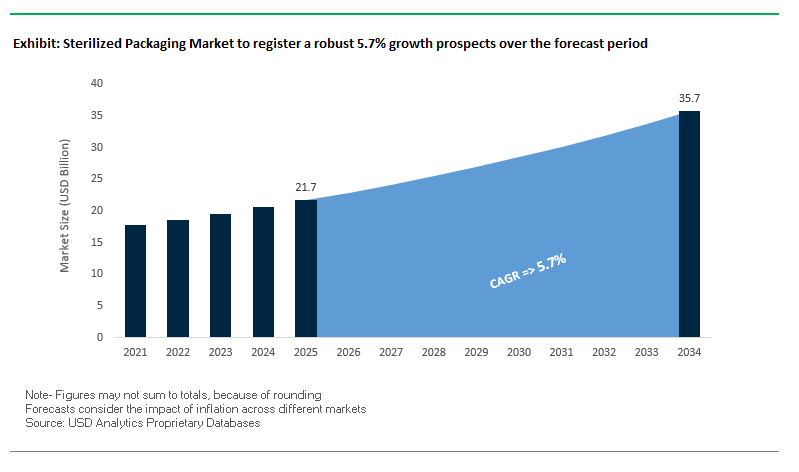
The global Sterilized Packaging Market is valued at USD 21.7 billion in 2025 and is projected to reach USD 35.7 billion by 2034, expanding at a CAGR of 5.7%. The market covers bags and pouches, vials and ampoules, bottles, trays, containers, blister packs, wraps and films used across medical devices, pharmaceuticals and other applications involving controlled sterilization and microbial protection. Bags and pouches account for approximately 28% of market demand by product type, while medical devices represent around 55% by end-use industry.
Within healthcare, sterilized packaging is technically distinct from the broader healthcare packaging market.. The core market includes sterile barrier and packaging systems designed for compatibility with sterilization processes and for maintaining the required sterile condition through transportation, storage and point-of-use opening. ISO 11607-1 covers materials, preformed sterile barrier systems, sterile barrier systems and packaging systems for terminally sterilized medical devices.
Recent Developments in Sterile Barrier Packaging
Recent industry activity is concentrated around regional sterile barrier capacity, technical-development centers, heat-sealing process control, cleanroom converting and lower-carbon material platforms. Investments from healthcare packaging manufacturers indicate continued expansion of engineering and production infrastructure around medical-device and pharmaceutical packaging.
ISO 11607-3:2026 Extends the Sterile Packaging Standards Framework into Heat-Sealing Process Development
In September 2026, ISO published ISO 11607-3:2026, covering process development for forming, sealing and assembly of packaging for terminally sterilized medical devices using heat-sealing technologies. The standard addresses process development before formal validation and recommends minimum heat-sealing equipment characteristics supporting subsequent process monitoring and control.
The addition creates a more detailed standards framework connecting sterile barrier system specifications with heat-sealing process specifications. Temperature, pressure, dwell time, equipment capability and operating-window development are central technical variables in pouch, lidding and thermoformed sterile barrier production.
The publication complements ISO 11607-2, which covers validation of forming, sealing and assembly processes and was reconfirmed as current in 2024.
Nelipak Establishes Asia-Pacific Sterile Barrier Development Center in Singapore
In March 2026, Nelipak Healthcare Packaging opened an Asia-Pacific Technical Development Center in Singapore. The facility combines flexible and rigid sterile barrier packaging development under one roof, expanding Nelipak's regional capabilities across package design, engineering and healthcare packaging development.
The center adds a permanent technical-development presence close to Asia-Pacific medical-device manufacturing and supports programs involving pouches, lidding materials, thermoformed trays and related sterile barrier formats.
Its opening reflects the increasing integration of packaging design and technical development with regional medical-device production rather than relying solely on centralized engineering facilities in North America or Europe.
Amcor Expands Sterile Medical Packaging Coating Capacity in Malaysia
In April 2026, Amcor opened an advanced healthcare packaging coating facility in Subang Jaya, Malaysia, representing an investment of more than USD 35 million. The site introduced air-knife coating technology for coated medical paper used in sterile medical-device packaging and expanded Amcor's healthcare packaging manufacturing footprint in Southeast Asia.
The facility expands regional availability of coated substrates used in medical-device packaging and strengthens Amcor's capability to manufacture both top and bottom packaging substrates within Asia.
The development also reflects increasing regionalization of sterile barrier material production alongside the growth of medical-device manufacturing across Southeast Asia.
TekniPlex Adds 200,000-Square-Foot Barrier Protection Facility in Wisconsin
In June 2025, TekniPlex Healthcare began operations at a new 200,000-square-foot facility in Madison, Wisconsin, serving its Barrier Protection Systems business. The operation combines manufacturing with materials-science capabilities for protective healthcare packaging.
The capacity addition strengthens North American production of coated and printed materials used in medical-device and healthcare applications. It also adds a dedicated manufacturing platform for sterile barrier and contamination-protection systems.
Oliver Healthcare Packaging Expands Asian Manufacturing Capacity
In May 2025, Oliver Healthcare Packaging opened a 120,000-square-foot manufacturing facility in Johor, Malaysia, its largest manufacturing site in Asia. The facility includes ISO Class 7 and Class 8 cleanroom capabilities and production for medical pouches, converted rollstock and die-cut lidding.
The operation serves pharmaceutical, diagnostic and medical-device customers across Asia-Pacific and expands regional supply of converted sterile barrier materials.
The investment reflects continued localization of healthcare packaging capacity near major medical-device and pharmaceutical manufacturing clusters.
Cook Medical, Nelipak and DuPont Introduce Renewable-Attributed Tyvek into Device Packaging
In September 2025, Cook Medical, Nelipak and DuPont collaborated to incorporate Tyvek with Renewable Attribution into packaging for selected Cook Medical biliary and ureteral stent products. The material uses renewable feedstock through a mass-balance approach while retaining the established performance specification of healthcare-grade Tyvek.
The project illustrates a sustainability pathway based on material attribution rather than a complete redesign of the sterile barrier structure. The approach maintains continuity with an established healthcare packaging material while lowering dependence on fossil-based feedstock.
Regulatory and Quality Standards Define Sterile Barrier Packaging Performance
Sterile barrier packaging operates within a structured regulatory and quality environment covering materials, package integrity, forming and sealing processes, sterilization compatibility, distribution conditions and maintenance of sterility through point of use.
ISO 11607-1 Defines Sterile Barrier and Packaging-System Requirements
ISO 11607-1:2019, reconfirmed in 2024, specifies requirements and test methods for materials, preformed sterile barrier systems, sterile barrier systems and packaging systems intended to maintain the sterility of terminally sterilized medical devices until point of use.
The standard places material performance, packaging-system integrity and sterile-barrier functionality within the same framework. The current standard is available through ISO 11607-1 requirements for sterile barrier systems.
ISO 11607-2 Covers Validation of Forming, Sealing and Assembly Processes
ISO 11607-2:2019 specifies requirements for developing and validating the forming, sealing and assembly processes used for terminally sterilized medical-device packaging.
The standard connects sterile barrier performance with repeatability of manufacturing processes. Heat seals, formed cavities, package assemblies and related processes are consequently evaluated as part of a controlled packaging system rather than solely through material specifications.
ISO 11607-3:2026 Adds Heat-Sealing Process Development Requirements
The newly published ISO 11607-3:2026 addresses process development for heat-sealed sterile barrier packaging before formal process validation. It uses the sterile barrier system specification as the basis for development of the process specification and also addresses equipment characteristics supporting control and monitoring.
This establishes a standards pathway covering specification, process development and subsequent validation. Technical information on the new standard is available through ISO 11607-3:2026 heat-sealing process development.
FDA QMSR Establishes the Wider Medical Device Quality-System Environment
The U.S. FDA's Quality Management System Regulation (QMSR) became effective on February 2, 2026, amending 21 CFR Part 820 and incorporating ISO 13485:2016 by reference. FDA also transitioned to an updated device-manufacturer inspection process on the same date.
QMSR provides the broader quality-management framework surrounding medical-device manufacturing, while ISO 11607 provides packaging-specific requirements for terminally sterilized medical devices. The current regulatory framework is described on the FDA Quality Management System Regulation page.
EU MDR Connects Sterile Device Packaging with Maintenance of Sterility
Regulation (EU) 2017/745 states that devices supplied sterile are designed, manufactured and packaged so that they remain sterile under specified transport and storage conditions until the packaging maintaining their sterile condition is opened. The regulation also addresses visible integrity of sterile packaging and validated sterilization methods.
These provisions link sterile barrier integrity directly with medical-device conformity in Europe. The applicable requirements are contained in the EU Medical Device Regulation 2017/745.
EU PPWR Contains Specific Exemptions for Healthcare Packaging
Regulation (EU) 2025/40 introduces wider packaging circularity and recycled-content provisions but includes specific exemptions for healthcare applications. Certain contact-sensitive packaging for medical devices and in-vitro diagnostic devices, along with defined medicinal-product packaging, is excluded from relevant recycled-content requirements.
The regulatory treatment reflects the additional material-safety and product-protection constraints associated with healthcare packaging.
Sterile Barrier Systems Maintain Sterility Through Processing, Distribution and Point of Use
A sterile barrier system represents the minimum packaging configuration providing a microbial barrier and supporting aseptic presentation of a medical device. Additional protective packaging can provide mechanical protection during distribution and handling.
Sterile barrier performance spans several stages of the product lifecycle, including:
package forming and sealing;
sterilization exposure;
storage and aging;
transportation and vibration;
temperature and humidity variation;
hospital and clinical handling;
point-of-use opening.
ISO 11607-1 specifically addresses packaging systems intended to maintain sterility until use.
The mechanical demands vary substantially by device. Catheters and tubing create different package stresses from orthopedic implants, surgical instruments or procedure kits. Sharp components can increase puncture risk, while heavy devices can create additional seal and tray stresses during distribution.
The resulting market encompasses flexible sterile pouches, formed trays, lidding systems and protective structures developed around combinations of device geometry, sterilization method, material properties and distribution conditions.
Validated Forming, Sealing and Assembly Processes Define Manufacturing Control
Forming and sealing processes have a direct relationship with sterile barrier integrity. Channel defects, wrinkles, particulate contamination within a seal, incomplete sealing and inconsistent peel performance can affect the integrity of an otherwise suitable package-material combination.
Heat-sealing systems are characterized by parameters including:
sealing temperature;
pressure;
dwell time;
material orientation;
tooling condition;
line speed;
equipment calibration.
ISO 11607-2 covers development and validation of forming, sealing and assembly processes, while ISO 11607-3 extends the standards framework into heat-sealing process development.
Process-window development establishes the range of operating conditions associated with repeatable seal characteristics. Validation then provides evidence of consistent output under the defined production process.
Material changes, seal-coating changes, equipment changes and site transfers can consequently become part of packaging-system change-control and qualification activity within regulated medical-device manufacturing.
Sterilization Method Shapes Packaging Material and Barrier Design
Sterilized packaging requirements vary significantly by sterilization method, including gamma radiation, ethylene oxide (EtO), electron beam (e-beam), steam and other technologies. Each method exposes packaging materials to a different combination of radiation, temperature, moisture or chemical conditions, creating distinct requirements for material compatibility, seal integrity, dimensional stability and barrier performance.
Ethylene Oxide Supports Temperature-Sensitive and Complex Medical Devices
Ethylene oxide is widely associated with temperature-sensitive medical devices and products with complex geometries. Breathable sterile barrier materials can permit sterilant penetration and subsequent aeration while retaining microbial-barrier characteristics following processing.
Packaging performance in EtO applications is associated with gas permeability, seal stability, material compatibility and aeration characteristics.
Gamma radiation provides deep penetration and is used across a broad range of single-use medical products. Ionizing radiation can affect polymer characteristics depending on resin chemistry and absorbed dose.
Radiation exposure can influence discoloration, embrittlement, tensile properties and seal behavior. This creates a material-selection distinction between radiation-compatible packaging and structures designed primarily for other sterilization methods.
E-Beam Combines High Processing Rates with Different Penetration Characteristics
Electron-beam sterilization also uses ionizing radiation but has different penetration characteristics from gamma processing. Device density, package geometry and loading configuration influence dose distribution.
E-beam applications therefore create packaging considerations around both radiation resistance and the physical arrangement of packaged products during processing.
Steam Sterilization Involves Elevated Heat and Moisture
Steam sterilization exposes packages to elevated temperature, pressure and moisture. Medical-grade papers and other breathable structures are widely associated with applications in which the sterilization environment reaches the packaged product through a porous barrier.
Material stability and seal performance after thermal and moisture exposure are key characteristics distinguishing steam-compatible sterile barrier systems.
Low-temperature technologies such as vaporized hydrogen peroxide serve devices with greater sensitivity to heat. Their use adds another sterilization-specific compatibility category within sterile medical-device packaging.
Bags and Pouches Lead Sterilized Packaging Demand Across Flexible Medical Applications
Bags and pouches are widely used across catheters, surgical instruments, diagnostic components, procedure products and other medical devices requiring flexible sterile barrier protection.
Common structures include combinations of:
medical-grade paper and film;
Tyvek and polymer film;
multilayer flexible films;
coated porous substrates;
specialty barrier laminates.
Flexible systems offer relatively low package weight and can be produced across a wide range of dimensions and seal configurations.
Performance characteristics include microbial-barrier properties, puncture resistance, seal strength, peel characteristics and sterilization compatibility. Internal device dimensions and package headspace also influence mechanical stress on seals during transportation.
Recent investments by Oliver Healthcare Packaging, TekniPlex and Amcor indicate continuing expansion of regional manufacturing capacity for healthcare barrier substrates and flexible converted formats.
Rigid Trays Provide Structural Protection for Complex Medical Devices
Rigid and semi-rigid thermoformed trays are widely used for medical devices requiring positional stability, mechanical protection or organized presentation at the point of use.
Applications include orthopedic products, surgical instruments, diagnostic systems, procedural devices and products containing sharp or fragile components.
Tray systems commonly combine a thermoformed base with porous or non-porous lidding selected according to sterilization requirements. The formed cavity reduces device movement and can limit contact between sharp device features and the sterile barrier.
Rigid systems generally use more material than flexible pouches, but their role is differentiated by mechanical protection and device organization. High-value implants, complex procedural products and devices with sensitive geometry represent important applications.
Tray design also interacts with clinical presentation, including orientation, opening geometry and access to the sterile device.
Seal Integrity and Package Validation Support Sterility Assurance
Sterile barrier integrity depends on both the packaging material and the continuity of package seals. Channel defects, incomplete seals, pinholes and mechanical damage can create potential routes for microbial or particulate contamination.
Package-testing programs include multiple methods addressing different failure modes:
seal-strength testing;
visual inspection;
dye-penetration testing;
bubble-emission testing;
vacuum-decay and other deterministic integrity methods;
distribution simulation;
accelerated aging;
real-time aging.
ASTM F1929-23 describes a dye-penetration method for detecting and locating channel defects in seals formed between a transparent material and a porous sheet material. The method is qualitative rather than a quantitative measurement of leak size.
Sterilization-process indicators serve a different purpose from package-integrity tests. CDC states that chemical indicators show exposure to sterilization-process conditions but do not independently demonstrate that sterilization has been achieved. Biological indicators directly monitor the lethality of the sterilization process through resistant microorganisms.
These different testing categories create a broader validation environment encompassing process exposure, package integrity, mechanical performance and shelf-life evidence.
Aseptic Presentation and Controlled Opening Influence Sterile Package Design
Sterile medical packaging also performs a clinical presentation function. The way a pouch, tray or lid opens can influence the transfer of a medical device into a sterile field or controlled-use environment.
Important package characteristics include:
predictable peel behavior;
controlled opening force;
low fiber or particulate generation;
opening direction;
grip area;
device orientation;
package stability during presentation.
Porous lidding and pouch materials are commonly engineered to separate from sealant surfaces in a controlled manner. Package geometry can similarly influence whether the user can access a device without unnecessary contact with non-sterile surfaces.
EU MDR's requirements for sterile devices extend through the point at which packaging intended to maintain the sterile condition is opened.
Medical Device Complexity Expands Customized Sterile Barrier Applications
Medical-device portfolios increasingly include products with complex geometry, multiple components and specialized materials. These characteristics expand the range of sterile barrier configurations used across the market.
Packaging variables are influenced by:
sharp or pointed device components;
flexible tubing;
implants and implant-delivery systems;
electronic components;
surface coatings;
multi-component procedural kits;
fragile diagnostic assemblies.
A pouch suitable for a simple disposable component can differ substantially from a sterile barrier system surrounding an orthopedic implant or complex minimally invasive device.
Nelipak's 2026 Singapore technical-development center exemplifies the market shift toward combined flexible and rigid package-development capabilities serving increasingly varied device formats.
This device diversity contributes to demand for customized trays, pouch dimensions, lidding structures, protective components and sterilization-compatible material combinations.
Sustainable Sterile Packaging Developments Center on Material Efficiency and Lower-Carbon Inputs
Sustainability developments in sterile healthcare packaging are increasingly centered on material reduction, package optimization, renewable-attributed feedstocks, manufacturing efficiency and selective use of recyclable structures.
The Cook Medical, Nelipak and DuPont initiative involving Tyvek with Renewable Attribution represents one current example. The material incorporates renewable feedstock through a mass-balance system while maintaining the established Tyvek healthcare packaging specification.
Other activity across the industry includes lighter packaging structures, optimized tray dimensions, lower material usage and reductions in secondary packaging.
Sterile medical packaging differs from many consumer categories because material transitions intersect with microbial barrier properties, sterilization compatibility, aging behavior and validated process conditions. As a result, sustainability development frequently occurs through modifications that maintain continuity with established sterile barrier performance.
End-of-life conditions also vary. Technical recyclability of a packaging material does not necessarily mean that clinically used or contaminated healthcare packaging enters conventional recycling systems, making material efficiency and carbon-intensity reductions additional sustainability metrics within the market.
Sterilized Packaging Market Share Insights
Bags and Pouches Account for Approximately 28% of Market Demand
Bags and pouches hold approximately 28% of the Sterilized Packaging Market in 2025, making them the leading product type. Their market position reflects extensive use across single-use medical devices, surgical products, catheters, diagnostics and procedure components. Flexible formats combine low material weight with broad dimensional flexibility and compatibility with high-volume converting.
Porous and non-porous structures extend pouch use across multiple sterilization technologies. Medical paper and Tyvek combinations are strongly associated with breathable sterile barriers, while multilayer films provide additional options for process-specific applications.
Rigid trays, vials and ampoules, bottles, containers, blister packs, wraps and films account for the remainder of the product mix, serving applications with different mechanical-protection, containment and pharmaceutical-packaging requirements.
Medical Devices Represent Approximately 55% of Sterilized Packaging Demand
Medical devices account for approximately 55% of global Sterilized Packaging Market demand, making them the largest end-use category.
The segment covers surgical instruments, catheters, syringes, implants, diagnostics, procedure kits and numerous disposable medical products supplied in a sterile condition.
The large share reflects the extended functional role of medical-device packaging. The sterile barrier system interacts with sterilization, storage, distribution, shelf life and point-of-use presentation rather than functioning solely as a transport container.
Pharmaceutical packaging applications represent another important end-use segment, while food and beverages, cosmetics and personal care, and other applications broaden the overall sterilized packaging market.
Sterilized Packaging Market Analysis by Country and Region
United States Sterilized Packaging Market: Medical Device Quality Systems and Domestic Barrier Capacity Shape Demand
The United States combines a large medical-device industry with established use of sterile barrier standards and regulated medical-device manufacturing systems.
FDA's QMSR became effective in February 2026, incorporating ISO 13485:2016 into the U.S. medical-device quality-system framework. Packaging-process validation, supplier controls, manufacturing documentation and change management operate within this wider quality environment.
Sterile barrier manufacturing capacity is also expanding. TekniPlex's 200,000-square-foot Madison facility added a major North American production platform for barrier protection materials in 2025.
U.S. demand spans medical pouches, lidding systems, thermoformed trays and other packaging used across surgical, diagnostic, implantable and disposable medical products.
European Sterilized Packaging Market: MDR Requirements Keep Sterile Integrity Central to Medical Device Packaging
European sterile medical-device packaging is shaped by EU MDR requirements governing products supplied in a sterile condition. The regulation connects sterile status with package integrity through specified transport and storage conditions and point-of-use opening.
The PPWR adds packaging-circularity considerations, while healthcare-specific exemptions distinguish regulated medical and pharmaceutical packaging from many conventional consumer packaging applications.
The resulting market combines high levels of regulatory documentation with material-efficiency and lower-carbon packaging development.
China Sterilized Packaging Market: Medical Device Manufacturing Supports Barrier Packaging Demand
China's large medical-device and pharmaceutical manufacturing base supports demand for sterile pouches, formed trays, pharmaceutical containers, lidding materials and sterilization-compatible films.
Export-oriented medical-device programs frequently incorporate internationally recognized sterile barrier requirements, including ISO 11607-based packaging development and customer-specific sterilization and distribution protocols.
Demand extends from high-volume disposable healthcare products to increasingly complex devices requiring customized packaging structures and technical documentation.
India Sterilized Packaging Market: Pharmaceutical and Medical Device Production Expands Healthcare Packaging Requirements
India's pharmaceutical and medical-device manufacturing base supports demand for pouches, medical-grade films, trays, vials, ampoules and other sterilized packaging formats.
Both domestic healthcare supply and export-oriented manufacturing influence the market. Medical products destined for multiple regulated jurisdictions create demand for packaging systems aligned with international device-quality and sterile-barrier frameworks.
High-volume consumables support flexible pouch and film demand, while more complex devices expand applications for formed trays and customized sterile barrier systems.
Japan Sterilized Packaging Market: High-Specification Medical Products Support Precision Packaging
Japan's healthcare manufacturing environment includes sophisticated diagnostic, surgical, pharmaceutical and medical-device applications. These products support demand for packaging with controlled materials, consistent sealing and documented sterile barrier performance.
High-value devices with delicate geometry or complex components generate applications for precision thermoformed trays, lidding and flexible sterile barrier formats.
International sterile barrier standards also support common technical specifications across multinational healthcare supply chains serving Japan.
Brazil Sterilized Packaging Market: Healthcare Manufacturing Supports Medical and Pharmaceutical Barrier Formats
Brazil's healthcare manufacturing and consumption base supports demand for sterile medical pouches, trays, pharmaceutical containers, films and related packaging.
Multinational medical-device production connects the local market with international healthcare packaging platforms and validation practices. Distribution over large geographic distances also increases the relevance of mechanical package protection and sterile barrier integrity through logistics networks.
The market therefore includes both locally supplied packaging and global sterile barrier systems used across multinational medical-device programs.
Competitive Landscape: Sterile Barrier Materials, Healthcare Packaging and Medical Device Protection Define Competition
The Sterilized Packaging Market includes sterile barrier material suppliers, flexible and rigid healthcare packaging specialists, pharmaceutical-container manufacturers and medical-device packaging companies. Major participants include Amcor plc, DuPont de Nemours, Inc., 3M Company, Tekni-Plex, Inc., Gerresheimer AG, Wipak Group, Nelipak Healthcare Packaging, Sealed Air Corporation, Oliver Healthcare Packaging, B. Braun SE, West Pharmaceutical Services, Sonoco Products Company, SteriPackGroup and Nelplast ECO Ghana Ltd. Their activities span sterile barrier substrates, pouches, lidding, thermoformed structures, pharmaceutical containers, medical-device protection, flexible films and healthcare packaging services.
Sterilized Packaging Market Report Scope
Sterilized Packaging Market
Parameter
Details
Market Size (2025)
$21.7 Billion
Market Size (2034)
$35.7 Billion
Market Growth Rate
5.7%
Segments
By Material (Plastics, Paper & Paperboard, Glass, Metal, Composites), By Product Type (Bags & Pouches, Vials & Ampoules, Bottles, Trays, Containers, Blister Packs, Wraps & Films), By Sterilization Method (Gamma Radiation, Ethylene Oxide, E-beam, Steam, Other), By End-Use Industry (Medical Devices, Pharmaceuticals & Drugs, Food & Beverages, Cosmetics & Personal Care, Others)
Porter’s Five Forces, SWOT Profile, Market Share, Scenario Forecasts, Market Ecosystem, Company Ranking, Market Dynamics, Industry Benchmarking
Companies
Amcor plc, DuPont de Nemours, Inc., Berry Global, Inc., 3M Company, Tekni-Plex, Inc., Gerresheimer AG, Wipak Group, Nelipak Healthcare Packaging, Sealed Air Corporation, Oliver Healthcare Packaging, B. Braun SE, West Pharmaceutical Services, Inc., Sonoco Products Company, SteriPackGroup, Nelplast ECO Ghana Ltd.
Countries
US, Canada, Mexico, Germany, France, Spain, Italy, UK, Russia, China, India, Japan, South Korea, Australia, South East Asia, Brazil, Argentina, Middle East, Africa
Sterilized Packaging Market Segmentation
By Material
Plastics
Paper & Paperboard
Glass
Metal
Composites
By Product Type
Bags & Pouches
Vials & Ampoules
Bottles
Trays
Containers
Blister Packs
Wraps & Films
By Sterilization Method
Gamma Radiation
Ethylene Oxide
E-beam
Steam
Others
By End-Use Industry
Medical Devices
Pharmaceuticals & Drugs
Food & Beverages
Cosmetics & Personal Care
Others
Countries Analyzed
North America (US, Canada, Mexico)
Europe (Germany, UK, France, Spain, Italy, Russia, Rest of Europe)
Asia Pacific (China, India, Japan, South Korea, Australia, South East Asia, Rest of Asia)
South America (Brazil, Argentina, Rest of South America)
Middle East and Africa (Saudi Arabia, UAE, Rest of Middle East, South Africa, Egypt, Rest of Africa)
Top Companies in Sterilized Packaging Market
Amcor plc
DuPont de Nemours, Inc.
Berry Global, Inc.
3M Company
Tekni-Plex, Inc.
Gerresheimer AG
Wipak Group
Nelipak Healthcare Packaging
Sealed Air Corporation
Oliver Healthcare Packaging
B. Braun SE
West Pharmaceutical Services, Inc.
Sonoco Products Company
SteriPackGroup
Nelplast ECO Ghana Ltd.
* List Not Exhaustive
Research Coverage
The USDAnalytics Sterilized Packaging Market study examines packaging systems used across terminally sterilized medical devices, pharmaceuticals and other applications requiring controlled sterile or sterilized presentation. Medical-device analysis focuses on sterile barrier systems, flexible pouches, thermoformed trays, lidding materials, sterilization compatibility, heat-sealing processes, integrity testing, aging, distribution performance and aseptic presentation.
The research evaluates how ethylene oxide, gamma radiation, electron beam, steam and other sterilization methods influence package-material selection and validation requirements. It also analyzes the interaction between device geometry, packaging configuration and processing conditions. Regulatory coverage includes ISO 11607 Parts 1, 2 and the newly published Part 3, FDA QMSR, EU MDR and relevant packaging sustainability requirements. Competitive analysis covers sterile barrier material suppliers, healthcare packaging converters, pharmaceutical-container manufacturers and medical-device packaging specialists active across flexible and rigid sterile packaging.
Research Methodology
USDAnalytics combines primary and secondary research to estimate market size, segment demand, company participation and regional conditions. Primary research incorporates interactions with packaging engineers, material suppliers, medical-device manufacturers, pharmaceutical companies, sterilization specialists, converters, quality personnel and supply-chain participants.
Secondary research uses company filings and official announcements, regulatory publications, international standards, government information and technical literature. Key authoritative sources for this report include the International Organization for Standardization, U.S. FDA, European Commission and EU regulatory texts, together with official disclosures from healthcare packaging manufacturers. Market sizing incorporates historical demand, product volumes, sterile medical-device production, packaging-material consumption, sterilization-method usage and geographic manufacturing patterns. USDAnalytics proprietary analysis forms the basis of the quantitative forecasts, while regulatory and manufacturer evidence supports interpretation of technology and competitive developments.
Deliverables:
Comprehensive Market Research Report (PDF and Excel) with detailed tables, charts, and interactive visualizations.
Country-Specific Forecasts & Analysis.
Segment-Wise Revenue Forecasts (2025–2034).
Competitive Analysis, Benchmarking, and SWOT Profiles.
Recent Developments & Innovation Tracker.
Executive Summary & Analyst Commentary.
Post-Purchase Analyst Support for Client-Specific Questions and Custom Data Requirements.
Table of Contents: Sterilized Packaging Market
1. Executive Summary
1.1. Market Highlights
1.2. Key Findings
1.3. Global Market Snapshot
2. Sterilized Packaging Market Landscape & Outlook (2025–2034)
2.1. Introduction to Sterilized Packaging Market
2.2. Market Valuation and Growth Projections (2025–2034)
2.3. Market Analysis: Strategic Developments in Sterilized Packaging
2.4. Regulatory Environment and Compliance Standards
2.5. Supply Chain and Regional Manufacturing Trends
3. Innovations Reshaping the Sterilized Packaging Market
3.1. Trend: Adoption of Recyclable and Reduced-Plastic Material Structures
3.2. Trend: Integration of Smart Features for Enhanced Traceability and Integrity
3.3. Opportunity: Development of Packaging for Novel Sterilization Modalities
3.4. Opportunity: Advanced Seal Integrity Testing Technologies
4. Competitive Landscape and Strategic Initiatives
4.1. Mergers, Acquisitions and Strategic Alliances
4.2. R&D and Material Innovation
4.3. Sustainability and Strategies
4.4. Market Expansion and Regional Focus
5. Market Share and Segmentation Insights: Sterilized Packaging Market
5.1. By Material
5.1.1. Plastics
5.1.2. Paper & Paperboard
5.1.3. Glass
5.1.4. Metal
5.1.5. Composites
5.2. By Product Type
5.2.1. Bags & Pouches
5.2.2. Vials & Ampoules
5.2.3. Bottles
5.2.4. Trays
5.2.5. Containers
5.2.6. Blister Packs
5.2.7. Wraps & Films
5.3. By Sterilization Method
5.3.1. Gamma Radiation
5.3.2. Ethylene Oxide
5.3.3. E-beam
5.3.4. Steam
5.3.5. Other
5.4. By End-Use Industry
5.4.1. Medical Devices
5.4.2. Pharmaceuticals & Drugs
5.4.3. Food & Beverages
5.4.4. Cosmetics & Personal Care
5.4.5. Others
6. Country Analysis and Outlook of Sterilized Packaging Market
6.1. United States
6.2. Canada
6.3. Mexico
6.4. Germany
6.5. France
6.6. Spain
6.7. Italy
6.8. UK
6.9. Russia
6.10. China
6.11. India
6.12. Japan
6.13. South Korea
6.14. Australia
6.15. South East Asia
6.16. Brazil
6.17. Argentina
6.18. Middle East
6.19. Africa
7. Sterilized Packaging Market Size Outlook by Region (2025-2034)
7.1. North America Sterilized Packaging Market Size Outlook to 2034
7.1.1. By Material
7.1.2. By Product Type
7.1.3. By Sterilization Method
7.1.4. By End-Use Industry
7.2. Europe Sterilized Packaging Market Size Outlook to 2034
7.2.1. By Material
7.2.2. By Product Type
7.2.3. By Sterilization Method
7.2.4. By End-Use Industry
7.3. Asia Pacific Sterilized Packaging Market Size Outlook to 2034
7.3.1. By Material
7.3.2. By Product Type
7.3.3. By Sterilization Method
7.3.4. By End-Use Industry
7.4. South America Sterilized Packaging Market Size Outlook to 2034
7.4.1. By Material
7.4.2. By Product Type
7.4.3. By Sterilization Method
7.4.4. By End-Use Industry
7.5. Middle East and Africa Sterilized Packaging Market Size Outlook to 2034
7.5.1. By Material
7.5.2. By Product Type
7.5.3. By Sterilization Method
7.5.4. By End-Use Industry
8. Company Profiles: Leading Players in the Sterilized Packaging Market
8.1. Amcor plc
8.2. DuPont de Nemours, Inc.
8.3. Berry Global, Inc.
8.4. 3M Company
8.5. Tekni-Plex, Inc.
8.6. Gerresheimer AG
8.7. Wipak Group
8.8. Nelipak Healthcare Packaging
8.9. Sealed Air Corporation
8.10. Oliver Healthcare Packaging
8.11. B. Braun SE
8.12. West Pharmaceutical Services, Inc.
8.13. Sonoco Products Company
8.14. SteriPackGroup
8.15. Nelplast ECO Ghana Ltd.
9. Methodology
9.1. Research Scope
9.2. Market Research Approach
9.3. Market Sizing and Forecasting Model
9.4. Research Coverage
9.5. Data Horizon
9.6. Deliverables
10. Appendix
10.1. Acronyms and Abbreviations
10.2. List of Tables
10.3. List of Figures
Sterilized Packaging Market Segmentation
By Material
Plastics
Paper & Paperboard
Glass
Metal
Composites
By Product Type
Bags & Pouches
Vials & Ampoules
Bottles
Trays
Containers
Blister Packs
Wraps & Films
By Sterilization Method
Gamma Radiation
Ethylene Oxide
E-beam
Steam
Others
By End-Use Industry
Medical Devices
Pharmaceuticals & Drugs
Food & Beverages
Cosmetics & Personal Care
Others
Countries Analyzed
North America (US, Canada, Mexico)
Europe (Germany, UK, France, Spain, Italy, Russia, Rest of Europe)
Asia Pacific (China, India, Japan, South Korea, Australia, South East Asia, Rest of Asia)
South America (Brazil, Argentina, Rest of South America)
Middle East and Africa (Saudi Arabia, UAE, Rest of Middle East, South Africa, Egypt, Rest of Africa)
The global sterilized packaging market is projected to grow from USD 21.7 billion in 2025 to USD 35.7 billion by 2034, achieving a CAGR of 5.7%. This growth is driven by rising demand for sterile medical devices, regulatory compliance, and innovations in sustainable and smart packaging solutions.
Sterilized packaging primarily uses plastics, paper & paperboard, glass, metal, and composite materials. Advanced plastics and mono-material structures are increasingly preferred for microbial barrier performance, sterilization compatibility, and recyclability in healthcare and pharmaceutical applications.
Different sterilization technologies impose different requirements on package materials. Ethylene oxide can require breathable sterilant-permeable barriers, radiation processes require resistance to irradiation-induced material changes, and steam requires materials capable of tolerating heat and moisture. Packaging materials and seals must therefore be qualified together with the intended sterilization process.
Bags and pouches lead with 28% market share due to their versatility across sterilization methods. Other key formats include trays, blister packs, vials, bottles, and wraps, supporting critical applications in medical devices, pharmaceuticals, and single-use surgical instruments.
Key players driving the sterilized packaging market include DuPont, Amcor, Oliver Healthcare Packaging, West Pharmaceutical Services, and SteriPackGroup. They focus on high-performance barrier materials, sustainable mono-material solutions, advanced seal integrity testing, and smart packaging technologies to enhance traceability, sterility, and compliance.
More Healthcare and Pharmaceutical Packaging Reports