Medical Device Packaging Market Overview: Device Protection, Sterility, Traceability and Distribution Requirements Define Demand
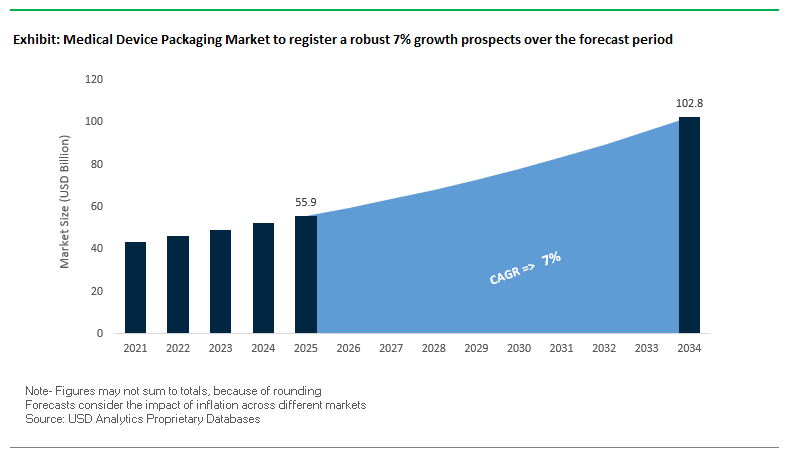
The global Medical Device Packaging Market is valued at USD 55.9 billion in 2025 and is projected to reach USD 102.8 billion by 2034, expanding at a CAGR of 7.0%. The market encompasses packaging used to protect, identify, transport and present medical devices, including pouches and bags, thermoformed trays, boxes and cartons, blister packs, vials, ampoules and other protective formats. Pouches and bags account for approximately 45% of market demand by product type, while medical device manufacturers represent around 55% by end user.
Medical device packaging covers a broader technical scope than sterile barrier packaging alone. Sterile devices such as catheters, surgical instruments, implants and procedure kits can require validated sterile barrier systems compatible with terminal sterilization, while non-sterile devices use protective packaging designed around mechanical protection, cleanliness, labeling, transport and product presentation. Secondary cartons, protective components and distribution packaging also form part of the broader device-packaging system.
Packaging configuration is closely linked to device geometry, fragility, sterilization status, shelf-life requirements and mode of use. Flexible pouches support high-volume disposables and relatively low-profile devices, while rigid and semi-rigid trays provide positional control for implants, surgical products and complex devices. Labels and package surfaces also perform a regulatory identification function as UDI requirements connect physical packaging with electronic device-traceability systems.
The market spans material conversion, sterile and non-sterile packaging, thermoforming, flexible packaging, labeling, UDI-bearing package formats, package validation and distribution protection. This broader scope distinguishes the Medical Device Packaging Market from the Sterilized Packaging Market, which is more specifically centered on sterile barrier integrity, sterilization compatibility and validated forming and sealing processes.
Recent Developments in Medical Device Packaging Industry
Recent company activity is concentrated around regional manufacturing capacity, sterile barrier substrates, cleanroom converting, package-development infrastructure and material transitions that preserve healthcare-grade performance. Expansion has been particularly visible in North America and Asia-Pacific, where medical-device manufacturing clusters are supporting additional packaging investment.
Amcor Opens USD 35 Million Healthcare Packaging Coating Facility in Malaysia
In April 2026, Amcor opened an advanced healthcare packaging coating facility in Subang Jaya, Selangor, following completion of the site announced in 2025. The facility represents an investment of more than USD 35 million and introduces air-knife coating technology for coated medical paper used in sterile medical-device packaging. Amcor also identified the operation as its first Asian facility capable of producing both top and bottom substrates for medical-device packaging.
The investment expands regional access to coated healthcare substrates and creates an integrated production platform close to Southeast Asian medical-device manufacturing. It also illustrates the increasing localization of specialized medical packaging materials rather than reliance solely on interregional supply.
TekniPlex Adds 200,000-Square-Foot Barrier Protection Facility in Wisconsin
In June 2025, TekniPlex Healthcare commenced production at a new 200,000-square-foot facility in Madison, Wisconsin, serving as the flagship location for its Barrier Protection Systems business. The ISO 13485-certified site produces coated and printed healthcare packaging materials, including coated Tyvek and heat-seal-coated reinforced papers used in sterilizable applications such as procedure kits, intravenous (IV) sets, syringes and implantable devices..
The facility also incorporates air-knife coating and high-definition flexographic printing capabilities, linking substrate production with healthcare-specific print requirements. The development reflects continued investment in domestic North American capacity for medical-device barrier materials and converted packaging.
Oliver Healthcare Packaging Opens 120,000-Square-Foot Johor Manufacturing Facility
In May 2025, Oliver Healthcare Packaging opened a 120,000-square-foot manufacturing facility in Johor, Malaysia, its largest Asian facility. The site includes ISO Class 7 and Class 8 cleanroom environments and produces pouches, die-cut lids and rollstock for pharmaceutical and medical-device applications.
The Johor operation complements Oliver's existing Asian capabilities, including medical packaging conversion in Suzhou and technical resources in Singapore. Its location within the Johor-Singapore manufacturing corridor reflects the expanding concentration of healthcare-packaging production around Asia-Pacific medtech clusters.
Nelipak Establishes Asia-Pacific Medical Packaging Development Center in Singapore
In March 2026, Nelipak Healthcare Packaging opened an Asia-Pacific Technical Development Center in Singapore combining flexible and rigid sterile barrier packaging development. The center supports medical-device package design, prototype development, validation preparation and material-transition programs across Class I through Class III devices.
The facility extends Nelipak's activities beyond package conversion into early-stage medical-device packaging engineering and development. It also establishes a permanent technical base serving Southeast Asia, China, Japan, South Korea, India, Australia and New Zealand.
Nelipak Expands Thermoformed Medical Packaging Through Merrill's Packaging Acquisition
In December 2025, Nelipak completed the acquisition of Merrill's Packaging, a specialist in custom thermoformed medical-device, pharmaceutical and life-science packaging. Merrill's operations include ISO 13485-certified facilities with ISO Class 8 cleanrooms in California and Costa Rica, together with capabilities in thermoforming, die-cut pouch cards, design, development and tooling.
The acquisition expanded Nelipak's geographic footprint and thermoformed packaging capacity across two established medical-device manufacturing hubs. It also added additional design and tooling capability alongside cleanroom conversion.
Cook Medical, Nelipak and DuPont Introduce Renewable-Attributed Tyvek into Device Packaging
In September 2025, Cook Medical, Nelipak and DuPont announced the use of Tyvek with Renewable Attribution in packaging for selected Cook Medical products, including biliary and ureteral stent systems. The material uses certified renewable feedstock through a mass-balance approach while retaining the established performance specification of healthcare-grade Tyvek.
The project demonstrates a form of sustainability transition based on preserving established sterile-barrier material performance while changing the feedstock basis. This approach is distinct from wholesale package redesigns that alter material construction, sealing behavior or sterilization compatibility.
Regulatory, Labeling and Quality Standards for Medical Device Packaging
Medical device packaging operates within a regulatory framework covering quality systems, identification, labeling, sterile barrier integrity and information supplied with the device. The requirements differ between sterile and non-sterile products, while UDI obligations add a data and traceability function to packaging alongside its physical protective role.
FDA QMSR Aligns the U.S. Device Quality Framework with ISO 13485
The FDA's Quality Management System Regulation (QMSR) became effective on February 2, 2026, replacing the previous Quality System Regulation framework and incorporating ISO 13485:2016 by reference into 21 CFR Part 820. The rule provides the broader quality-management environment for medical-device manufacturing, including process controls, supplier controls, documentation, risk management and validated manufacturing activities.
QMSR is not itself a medical-device packaging standard. Packaging-specific requirements arise through the device specification, labeling requirements, sterile-barrier standards and validated manufacturing processes applicable to the finished device.
FDA UDI Requirements Connect Device Identification with Packaging
Under the FDA's Unique Device Identification system, device labelers generally place a UDI on medical-device labels and packages unless an exception or alternative applies.. The identifier is presented in both easily readable plain text and machine-readable automatic identification and data capture form. Device information is also submitted to the Global Unique Device Identification Database.
This requirement makes package artwork and labeling an element of device traceability. It is separate from the U.S. Drug Supply Chain Security Act, which applies to prescription-drug distribution rather than medical devices.
EU MDR and EUDAMED Expand Device and Packaging-Level Traceability
The EU Medical Device Regulation (MDR) establishes UDI requirements at device and packaging levels. Higher levels of packaging generally receive their own UDI, while shipping containers are exempt from this specific requirement. For sterile devices, the MDR also requires packaging to preserve the sterile condition under specified transport and storage conditions until the packaging intended to maintain sterility is opened.
A major 2026 change is the mandatory use of the first four EUDAMED modules from May 28, 2026, including the UDI/Devices registration module. Manufacturers placing relevant devices on the EU market operate within an increasingly integrated electronic identification and device-registration framework.
ISO 11607 Governs the Sterile Barrier Subsegment of Medical Device Packaging
For terminally sterilized medical devices, ISO 11607-1 specifies requirements for materials, preformed sterile barrier systems, sterile barrier systems and packaging systems intended to maintain sterility until point of use. ISO 11607-2 separately covers validation of forming, sealing and assembly processes. Both 2019 editions were reviewed and confirmed in 2024.
ISO 11607 applies specifically to terminally sterilized medical-device packaging and represents one important subsegment of the wider Medical Device Packaging Market rather than a universal standard for every non-sterile device package.
ISO 20417:2026 Updates Requirements for Information Supplied with Medical Devices
The second edition of ISO 20417:2026 was published in March 2026. The standard specifies general requirements for information supplied by medical-device manufacturers, including identification, labeling, packaging information, marking and accompanying documentation. It replaces the 2021 edition and introduces revised normative references and other technical updates.
Its scope is particularly relevant to the broader Medical Device Packaging Market because it addresses the information architecture associated with device packaging rather than focusing only on sterile barrier performance.
Transformative Trends and Emerging Opportunities in the Medical Device Packaging Market
Strategic Corporate Investment in U.S.-Based Sustainable Packaging Manufacturing
The medical device packaging market is undergoing a significant transformation driven by sustainability and domestic manufacturing initiatives. Major players are making substantial capital investments to expand production of sustainable packaging materials within the United States, aligning with regulatory shifts and growing demand for environmentally responsible solutions. DuPont, for instance, leverages its U.S. manufacturing footprint to provide medical-grade Tyvek® with Renewable Attribution, sourcing 100% of electricity from renewable energy certificates (DuPont 2024 Sustainability Report). Similarly, Oliver Healthcare Packaging announced a new facility in Costa Rica, complementing its existing U.S. plants, strengthening regional supply chains and mitigating risks from single-source dependence. Beyond energy and production, firms are implementing circular economy strategies, such as mass balance approaches using certified renewable raw materials, which reduce reliance on fossil fuels while maintaining product performance—offering “drop-in” solutions for device manufacturers.
Integration of Advanced Supply Chain Technology for Regulatory Compliance
Regulatory mandates and the fight against counterfeit medical products are propelling the integration of smart technologies in medical device packaging. Compliance with the European MDR and U.S. UDI system requires unique identifiers on each package, typically a 2D data matrix code, to ensure traceability. Coupled with the DSCSA, these requirements drive packaging companies to implement secure serialization using GTINs and unique serial numbers, creating a verifiable digital trail from manufacturer to patient (GS1 US). Advanced printing, vision systems, RFID, and NFC integration support automated data capture, reducing human error while improving operational efficiency. Real-time monitoring of location, temperature, and tampering becomes critical for high-value or temperature-sensitive devices, offering manufacturers end-to-end supply chain visibility and enhanced patient safety.
Development of Packaging for Novel Cell and Gene Therapies
The emergence of advanced therapeutic medicinal products (ATMPs) presents a compelling opportunity for specialized ultra-cold chain packaging solutions. Cell and gene therapies often require storage below -130°C, posing challenges for traditional packaging, which may become brittle and compromise container closure integrity (CCI). Innovative materials like Daikyo Crystal Zenith vials offer inert, break-resistant solutions suitable for cryogenic conditions (West Pharmaceutical Services whitepaper). Packaging for these high-value therapies must also withstand multiple freeze-thaw cycles, prevent contamination, and ensure sterile closed systems, aligning with EMA guidelines. Hermetically sealed cryovials, for example, provide a robust alternative to traditional cryo-bags, safeguarding product integrity and patient safety for doses worth hundreds of thousands of dollars.
Standardization of Packaging for At-Home Healthcare Delivery
The shift toward hospital-at-home and ambulatory care necessitates packaging that is patient-safe, intuitive, and sterile. Packaging must be easy to open, clearly labeled, and durable enough to maintain sterility in uncontrolled environments (Medical Packaging Inc.). There is a growing opportunity to integrate patient education features such as step-by-step instructions, pictorial guides, QR codes linking to videos, and tamper-evident or color-coded components, ensuring proper device use. Additionally, sustainable materials, including paper-based solutions and single-material flexible pouches, are increasingly being adopted to facilitate residential recycling while maintaining performance and safety standards. This convergence of usability, sterility, and sustainability positions medical packaging as a critical enabler of at-home healthcare innovation.
Medical Device Packaging Market Share Insights
Pouches & Bags Dominate Market Share by Product Type in Medical Device Packaging
Pouches and bags account for 45% of the medical device packaging market, establishing themselves as the most widely used format for sterile packaging solutions. Their leadership stems from their versatility across simple and complex medical products, ranging from gauze and syringes to catheter kits and diagnostic tools. The combination of transparent medical-grade plastic films with Tyvek® lids allows breathability for sterilization while maintaining a microbial barrier until the point of use. This balance of cost-effectiveness, regulatory compliance (ISO 11607), and shipping efficiency secures their adoption by both high-volume disposable device categories and sophisticated surgical kits. As healthcare systems continue to expand single-use sterile products, pouches and bags will remain the backbone of sterile medical device packaging.
Medical Device Manufacturers Drive Market Share by End-User in Medical Device Packaging
Medical device manufacturers command 55% of demand in the medical device packaging industry, reinforcing their role as the primary decision-makers and specifiers of packaging systems. For these companies, packaging is not merely a logistics requirement but an integral part of regulatory approval, sterility assurance, and brand value. Their packaging needs span across pouches, trays, blister packs, and cartons, depending on the complexity of the device, and each design must be validated for compatibility with sterilization processes like ethylene oxide, gamma radiation, or steam sterilization. Furthermore, global players are increasingly demanding sustainable packaging solutions that reduce material usage and improve recyclability without compromising barrier integrity. As the developers of high-value surgical and diagnostic devices, manufacturers will continue to lead innovation in packaging selection, ensuring this segment maintains its commanding market share.
United States Medical Device Packaging Market Strengthened by FDA QMSR Rule and Smart Packaging Innovations
The U.S. medical device packaging market is heavily regulated under FDA standards, with the January 2024 Quality Management System Regulation (QMSR) Final Rule harmonizing U.S. regulations with ISO 13485:2016. This alignment ensures packaging design, labeling, and manufacturing meet the highest standards for sterility and integrity. Technological innovations, such as RFID tags and environmental sensors, are enabling real-time monitoring of temperature-sensitive medical devices, crucial for patient safety and product efficacy. Hydromer’s 2025 launch of PFAS-free hydrophilic coatings highlights the industry’s commitment to eco-friendly and safer materials.
Corporate investments are expanding global production capabilities. Amcor’s acquisition of a Shanghai-based medical device packaging company in February 2024 demonstrates strategic positioning to meet Asia-Pacific demand. The market sees strong application growth in home healthcare and e-commerce, particularly for devices like continuous glucose monitors and remote patient monitoring systems, which require durable, user-friendly, and sterile packaging. Sustainability remains a priority, with firms like Coveris developing recyclable thermoforming films to comply with California’s Extended Producer Responsibility (EPR) laws.
Germany Medical Device Packaging Market Drives Innovation with MDR Compliance and Circular Economy Initiatives
Germany’s medical device packaging market operates under the EU Medical Device Regulation (MDR) 2017/745, ensuring enhanced traceability through the Unique Device Identifier (UDI) system. This regulation impacts packaging design, labeling, and material selection, driving innovation in performance and compliance. Companies like Mondi are introducing plastic-free and recyclable packaging solutions, while German converters integrate oxygen-barrier labels with UDI data to maintain drug stability and regulatory compliance.
The country’s leadership in the circular economy promotes advanced, easily de-inkable, and recyclable packaging. There is also growing adoption of solvent-free and water-based adhesives to reduce environmental impact. Key applications are concentrated in surgical instruments, implants, and diagnostic devices, driven by Germany’s robust healthcare infrastructure and high-quality medical technology sector. Advanced packaging solutions are increasingly critical for patient safety, device sterility, and operational efficiency.
China Medical Device Packaging Market Expands Through Domestic Manufacturing and Regulatory Reforms
China’s medical device packaging industry benefits from government initiatives like the 10-measure plan (mid-2025), aimed at advancing high-end medical device production and streamlining approval processes for innovative packaging solutions. Regulatory reforms by the NMPA—including the draft Medical Device Administrative Law (MDAL)—could remove the requirement for foreign devices to have prior approval in their country of origin, simplifying market entry.
Technological advancements include automation, AI, and precision packaging systems to ensure compliance with sterility, safety, and international quality standards. Domestic manufacturing of high-end medical devices drives demand for advanced packaging for both disposables and complex medical equipment. The market is fueled by China’s rapidly growing healthcare sector, modernization of hospitals, and increased need for temperature-controlled and secure packaging solutions.
India Medical Device Packaging Market Bolstered by Make in India and PLI Scheme Investments
India’s medical device packaging market is supported by the Make in India initiative and the National Medical Devices Policy 2023, aimed at promoting domestic manufacturing and reducing import dependence. Regulatory updates by the CDSCO in August 2025 amended risk-based categorization for cardiovascular and neurological devices, which impacts packaging requirements.
Technological advancements focus on sterilization, barrier protection, and high-performance packaging. The Production Linked Incentive (PLI) Scheme, with an outlay of ₹3,420 crore, encourages investments in medical device parks like the Andhra Pradesh MedTech Zone (AMTZ), fostering local R&D and production. The market sees strong demand in high-value devices, driven by India’s growing healthcare infrastructure, expanding medical device adoption, and increasing focus on compliant, durable, and patient-safe packaging solutions.
Japan Medical Device Packaging Market Advances with Precision Manufacturing and Regulatory Enhancements
Japan’s medical device packaging industry thrives on precision manufacturing and advanced material technology, offering solutions with superior barrier properties and reliability. The Pharmaceuticals and Medical Devices Agency (PMDA) enforces strict labeling and quality standards, and the May 2025 amendment to the Pharmaceuticals and Medical Devices Act strengthens supply stability, directly influencing packaging logistics.
The market is witnessing a pivot toward specialty and value-added packaging solutions, especially for sensitive medical devices requiring high-volume automated assembly. Innovation focuses on surgical and dental device packaging, improving sterility, functionality, and ease of use, while supporting Japan’s position as a global leader in high-quality healthcare products and patient safety.
Brazil Medical Device Packaging Market Strengthens with UDI Implementation and Sustainable Innovations
Brazil’s medical device packaging market is advancing through the national UDI system (Siud), effective July 2025, aligning with global standards for device traceability and regulatory compliance. Technological innovation is prominent, with manufacturers developing biodegradable, recyclable, and compostable packaging to reduce environmental impact.
Corporate investments, such as Sonoco acquiring the remaining stake in its Brazilian flexible packaging joint venture in April 2022, are enhancing local manufacturing capabilities and reducing import dependence. The market is particularly strong in pharmaceuticals and medical devices, fueled by Brazil’s growing demand for packaged healthcare products, the rise of online retail, and increasing emphasis on safe, sterile, and compliant packaging solutions.
The Medical Device Packaging Market includes flexible and rigid healthcare-packaging manufacturers, sterile-barrier specialists, pharmaceutical and injectable-container suppliers, labeling companies and broader packaging groups. Companies include Amcor plc, West Pharmaceutical Services, Inc., Gerresheimer AG, SCHOTT AG, Tekni-Plex, Inc., AptarGroup, Inc., Berry Global Inc., Oliver Healthcare Packaging, Sonoco Products Company, Huhtamaki Oyj, WestRock Company, Nelipak Healthcare Packaging, Sealed Air Corporation, SteriPack Group, and CCL Industries Inc. Their participation spans pouches and rollstock, thermoformed trays, coated papers and lidding, injectable containers and delivery systems, cartons, labels, healthcare conversion and contract packaging.
Medical Device Packaging Market Report Scope
Medical Device Packaging Market
Parameter
Details
Market Size (2025)
$55.9 Billion
Market Size (2034)
$102.8 Billion
Market Growth Rate
7%
Segments
By Material (Plastics, Paper & Paperboard, Glass, Metal), By Product Type (Pouches & Bags, Trays, Boxes & Cartons, Blister Packs, Vials & Ampoules, Others), By Application (Sterile Packaging, Non-Sterile Packaging), By End-User (Medical Device Manufacturers, Contract Manufacturing & Sterilization Organizations, Pharmaceutical & Biotechnology Companies, Hospitals & Clinics)
Study Period
2020- 2025 and 2026-2034
Units
Revenue (USD)
Qualitative Analysis
Porter’s Five Forces, SWOT Profile, Market Share, Scenario Forecasts, Market Ecosystem, Company Ranking, Market Dynamics, Industry Benchmarking
Companies
Amcor plc, West Pharmaceutical Services, Inc., Gerresheimer AG, SCHOTT AG, Tekni-Plex, Inc., AptarGroup, Inc., Berry Global Inc., Oliver Healthcare Packaging, Sonoco Products Company, Huhtamaki Oyj, WestRock Company, Nelipak Healthcare Packaging, Sealed Air Corporation, SteriPack Group, CCL Industries Inc.
Countries
US, Canada, Mexico, Germany, France, Spain, Italy, UK, Russia, China, India, Japan, South Korea, Australia, South East Asia, Brazil, Argentina, Middle East, Africa
Europe (Germany, UK, France, Spain, Italy, Russia, Rest of Europe)
Asia Pacific (China, India, Japan, South Korea, Australia, South East Asia, Rest of Asia)
South America (Brazil, Argentina, Rest of South America)
Middle East and Africa (Saudi Arabia, UAE, Rest of Middle East, South Africa, Egypt, Rest of Africa)
Top Companies in Medical Device Packaging Market
Amcor plc
West Pharmaceutical Services, Inc.
Gerresheimer AG
SCHOTT AG
Tekni-Plex, Inc.
AptarGroup, Inc.
Berry Global Inc.
Oliver Healthcare Packaging
Sonoco Products Company
Huhtamaki Oyj
WestRock Company
Nelipak Healthcare Packaging
Sealed Air Corporation
SteriPack Group
CCL Industries Inc.
* List Not Exhaustive
Methodology
The research methodology for the global Medical Device Packaging market leverages a comprehensive approach combining primary interviews, secondary data analysis, and advanced market modeling to deliver actionable insights for industry professionals. Primary research included discussions with packaging manufacturers, device OEMs, contract sterilization organizations, regulatory experts, and supply chain specialists to understand trends in sterile and sustainable packaging, smart technologies, and regional expansions. Secondary research analyzed company reports, FDA, EU MDR, PMDA, and NMPA regulations, industry whitepapers, press releases, and scientific publications to validate packaging innovations, material performance, and regulatory compliance. Market sizing, growth projections, and segmentation by material, product type, application, and end-user were calculated using both top-down and bottom-up approaches, accounting for factors like sterility assurance, supply chain security, patient safety, and ESG compliance. This methodology ensures that USDAnalytics provides a holistic, data-driven overview of market dynamics, technological advancements, competitive positioning, and emerging opportunities across global regions.
Deliverables:
Comprehensive Market Research Report (PDF and Excel) with detailed tables, charts, and interactive visualizations.
Country-Specific Forecasts & Analysis.
Segment-Wise Revenue Forecasts (2025–2034).
Competitive Analysis, Benchmarking, and SWOT Profiles.
Recent Developments & Innovation Tracker.
Executive Summary & Analyst Commentary.
Post-Purchase Analyst Support for Client-Specific Questions and Custom Data Requirements.
Table of Contents: Global Medical Device Packaging Market
1. Executive Summary
1.1. Market Highlights
1.2. Key Findings
1.3. Global Market Snapshot
2. Medical Device Packaging Market Landscape & Outlook (2025–2034)
2.1. Introduction to Medical Device Packaging Market
2.2. Market Valuation and Growth Projections (2025–2034)
2.3. Market Drivers and Restraints
2.4. Regulatory Landscape Overview
2.5. Emerging Market Opportunities
3. Innovations Reshaping the Medical Device Packaging Market
3.1. Trend: Strategic Corporate Investment in U.S.-Based Sustainable Packaging Manufacturing
3.2. Trend: Integration of Advanced Supply Chain Technology for Regulatory Compliance
3.3. Opportunity: Development of Packaging for Novel Cell and Gene Therapies
3.4. Opportunity: Standardization of Packaging for At-Home Healthcare Delivery
4. Competitive Landscape and Strategic Initiatives
4.1. Mergers, Acquisitions and Strategic Alliances
4.2. R&D and Material Innovation
4.3. Sustainability and Strategies
4.4. Market Expansion and Regional Focus
5. Market Share and Segmentation Insights: Medical Device Packaging Market
5.1. By Material
5.1.1. Plastics
5.1.2. Paper & Paperboard
5.1.3. Glass
5.1.4. Metal
5.2. By Product Type
5.2.1. Pouches & Bags
5.2.2. Trays
5.2.3. Boxes & Cartons
5.2.4. Blister Packs
5.2.5. Vials & Ampoules
5.2.6. Others
5.3. By Application
5.3.1. Sterile Packaging
5.3.2. Non-Sterile Packaging
5.4. By End-User
5.4.1. Medical Device Manufacturers
5.4.2. Contract Manufacturing & Sterilization Organizations
5.4.3. Pharmaceutical & Biotechnology Companies
5.4.4. Hospitals & Clinics
6. Country Analysis and Outlook of Medical Device Packaging Market
6.1. United States
6.2. Canada
6.3. Mexico
6.4. Germany
6.5. France
6.6. Spain
6.7. Italy
6.8. UK
6.9. Russia
6.10. China
6.11. India
6.12. Japan
6.13. South Korea
6.14. Australia
6.15. South East Asia
6.16. Brazil
6.17. Argentina
6.18. Middle East
6.19. Africa
7. Medical Device Packaging Market Size Outlook by Region (2025-2034)
7.1. North America Market Size Outlook to 2034
7.1.1. By Material
7.1.2. By Product Type
7.1.3. By Application
7.1.4. By End-User
7.2. Europe Market Size Outlook to 2034
7.2.1. By Material
7.2.2. By Product Type
7.2.3. By Application
7.2.4. By End-User
7.3. Asia Pacific Market Size Outlook to 2034
7.3.1. By Material
7.3.2. By Product Type
7.3.3. By Application
7.3.4. By End-User
7.4. South America Market Size Outlook to 2034
7.4.1. By Material
7.4.2. By Product Type
7.4.3. By Application
7.4.4. By End-User
7.5. Middle East and Africa Market Size Outlook to 2034
7.5.1. By Material
7.5.2. By Product Type
7.5.3. By Application
7.5.4. By End-User
8. Company Profiles: Leading Players in the Medical Device Packaging Market
8.1. Amcor plc
8.2. West Pharmaceutical Services, Inc.
8.3. Gerresheimer AG
8.4. SCHOTT AG
8.5. Tekni-Plex, Inc.
8.6. AptarGroup, Inc.
8.7. Berry Global Inc.
8.8. Oliver Healthcare Packaging
8.9. Sonoco Products Company
8.10. Huhtamaki Oyj
8.11. WestRock Company
8.12. Nelipak Healthcare Packaging
8.13. Sealed Air Corporation
8.14. SteriPack Group
8.15. CCL Industries Inc.
9. Methodology
9.1. Research Scope
9.2. Market Research Approach
9.3. Market Sizing and Forecasting Model
9.4. Research Coverage
9.5. Data Horizon
9.6. Deliverables
10. Appendix
10.1. Acronyms and Abbreviations
10.2. List of Tables
10.3. List of Figures
The global medical device packaging market is expected to reach $55.9 billion in 2025 and grow to $102.8 billion by 2034, reflecting a CAGR of 7%. Growth is fueled by rising adoption of single-use and minimally invasive devices, regulatory demands for sterility, and innovations in sustainable and smart packaging technologies.
Pouches and bags lead the market, accounting for 45% share, due to their versatility, cost-effectiveness, and compatibility with sterilization processes. They are widely used for syringes, catheters, diagnostic kits, and surgical instruments, providing a reliable microbial barrier while ensuring regulatory compliance and efficient shipping.
Sustainability initiatives and local manufacturing expansions are transforming the market. Companies like DuPont, Amcor, and Oliver Healthcare Packaging are investing in recyclable materials, circular economy approaches, and regional facilities to reduce carbon footprints, ensure supply chain resilience, and comply with ESG goals while maintaining product performance.
Smart packaging solutions, including RFID tags, QR codes, and sensors, enhance traceability, combat counterfeiting, and ensure regulatory compliance with systems like UDI and DSCSA. Real-time monitoring of temperature, tampering, and location improves supply chain efficiency and patient safety, particularly for high-value or temperature-sensitive medical devices.
The U.S., Germany, China, India, Japan, and Brazil are key growth markets. Drivers include regulatory frameworks like FDA QMSR, EU MDR, PMDA updates, and NMPA reforms, along with strategic facility expansions, adoption of sustainable materials, and demand for patient-friendly packaging solutions in hospital-at-home, biologics, and advanced therapy applications.
More Healthcare and Pharmaceutical Packaging Reports