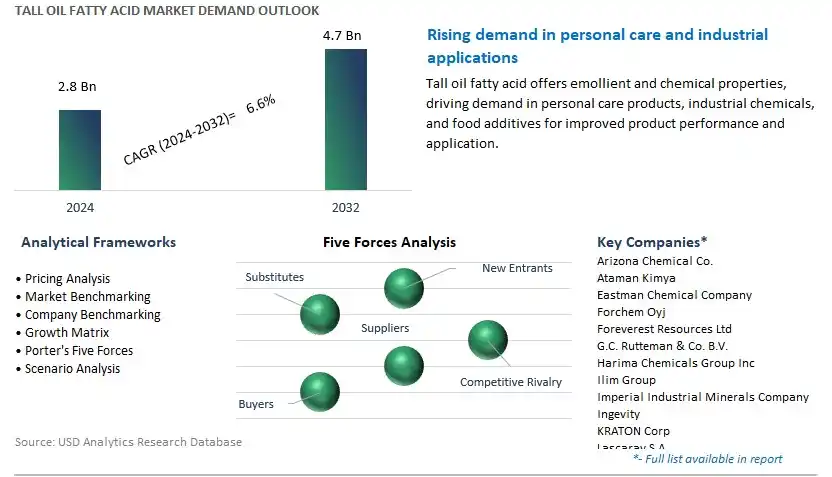
Global Tall Oil Fatty Acid Market Size is valued at $2.8 Billion in 2024 and is forecast to register a growth rate (CAGR) of 6.6% to reach $4.7 Billion by 2032.
The global Tall Oil Fatty Acid Market Study analyzes and forecasts the market size across 6 regions and 24 countries for diverse segments -By Product (Oleic Acid, Linoleic Acid, Linolenic Acid, Palmitic Acid, Others), By Application (Alkyd Resins, Dimer Acids, Fatty Acid Ester, Others), By End-User (Soaps and Detergents, Paints and Coatings, Automotive, Metal Working Fluids, Oil and Gas, Others).
An Introduction to Tall Oil Fatty Acid Market in 2024
Tall oil fatty acids (TOFA), derived from the fractional distillation of crude tall oil, are versatile raw materials with diverse applications in 2024. With a high content of unsaturated fatty acids, TOFA finds extensive use in the production of alkyd resins, coatings, adhesives, lubricants, and chemical intermediates. In the coatings and paints industry, TOFA-based resins offer excellent durability, flexibility, and corrosion resistance, making them ideal for architectural, automotive, and industrial coatings. Additionally, TOFA serves as a key ingredient in the manufacturing of soaps, detergents, and personal care products due to its emulsifying and cleansing properties. As industries increasingly prioritize sustainability and seek alternatives to petrochemical-based products, TOFA's renewable and biodegradable nature positions it favorably in the market. d research into process optimization and the development of value-added derivatives is expected to further expand the applications and demand for tall oil fatty acids in the coming years.
Tall Oil Fatty Acid Market Competitive Landscape
The market report analyses the leading companies in the industry including Arizona Chemical Co., Ataman Kimya, Eastman Chemical Company, Forchem Oyj, Foreverest Resources Ltd, G.C. Rutteman & Co. B.V., Harima Chemicals Group Inc, Ilim Group, Imperial Industrial Minerals Company, Ingevity, KRATON Corp, Lascaray S.A., Pasand Speciality Chemicals, Pine Chemical Group, Segezha-Group, Shaxian Lixin Resin Co. Ltd, UNIVAR SOLUTIONS, and others.
Tall Oil Fatty Acid Market Dynamics
Market Trend: Increasing Demand for Sustainable and Renewable Chemicals
A prominent trend in the tall oil fatty acid market is the increasing demand for sustainable and renewable chemicals. Tall oil fatty acids (TOFA) are derived from the wood pulping process and serve as essential raw materials in various industries, including adhesives, paints, coatings, lubricants, and personal care products. With growing environmental concerns and regulatory pressures to reduce reliance on fossil fuels and minimize carbon footprint, there is a rising preference for bio-based chemicals derived from renewable sources such as tall oil. TOFA offers advantages such as biodegradability, renewability, and compatibility with green chemistry principles, making it an attractive option for industries seeking sustainable alternatives to petroleum-based chemicals. As consumers and manufacturers prioritize environmental sustainability and circular economy practices, the demand for tall oil fatty acids as eco-friendly raw materials is expected to continue to grow, driving market expansion and innovation in TOFA-based products.
Market Driver: Growth in End-user Industries and Specialty Applications
The primary driver behind the growth of the tall oil fatty acid market is the expansion of end-user industries and specialty applications. TOFA serves as a versatile ingredient in a wide range of industrial applications, including surfactants, emulsifiers, corrosion inhibitors, and lubricant additives. Industries such as adhesives and sealants, paints and coatings, and personal care products rely on TOFA for its unique chemical properties, such as high oleic content, low levels of unsaturation, and excellent oxidative stability. Additionally, TOFA finds niche applications in specialty markets such as oilfield chemicals, mining flotation agents, and metalworking fluids, where specific performance requirements must be met. As these industries continue to grow and diversify, the demand for tall oil fatty acids as essential components in formulation blends is expected to increase, stimulating market demand and investment in TOFA production and applications.
Market Opportunity: Development of Value-added Derivatives and Specialty Products
An opportunity for the tall oil fatty acid market lies in the development of value-added derivatives and specialty products to meet evolving customer needs and application requirements. While TOFA serves as a fundamental building block in various industrial formulations, there is untapped potential to innovate and create differentiated products with enhanced performance and functionality. For example, there is an opportunity to develop modified TOFA derivatives such as tall oil fatty acid esters, amides, and salts, which offer improved solubility, emulsification, or compatibility with specific substrates. Additionally, there is potential to explore niche markets such as bio-based polymers, green surfactants, and renewable lubricants, where tall oil fatty acids can offer unique advantages in terms of biodegradability, toxicity, and sustainability. By investing in research and development initiatives focused on novel synthesis techniques, chemical modifications, and application testing, TOFA manufacturers can create value-added products that address emerging market needs, differentiate their offerings, and capture opportunities in specialized applications. Expanding into value-added derivatives and specialty products presents an opportunity for the market to diversify its product portfolio, penetrate new market segments, and sustain growth in a competitive landscape.
Tall Oil Fatty Acid Market Share Analysis: Oleic Acid segment generated the highest revenue in 2024
Within the tall oil fatty acid market segmented by product, oleic acid is the largest segment, commanding a significant share due to its versatile applications and favorable properties. Oleic acid, a monounsaturated omega-9 fatty acid, finds widespread use in industries such as chemicals, pharmaceuticals, personal care, and food processing. Its versatility stems from its ability to serve as a key ingredient in the production of various derivatives, including esters, surfactants, emulsifiers, and lubricants. Moreover, oleic acid's low susceptibility to oxidation and its ability to improve the stability and performance of formulations make it highly desirable in numerous applications. The growing demand for bio-based and sustainable ingredients in various end-use industries has further bolstered the prominence of oleic acid in the tall oil fatty acid market. Additionally, ongoing research and development efforts aimed at enhancing the production efficiency and purity of oleic acid are driving its continued dominance in the market. As industries continue to prioritize performance, sustainability, and regulatory compliance, oleic acid is expected to maintain its leading position in the tall oil fatty acid market, driving growth and innovation.
Tall Oil Fatty Acid Market Share Analysis: Dimer Acids is poised to register the fastest CAGR over the forecast period
Among the segments delineated within the tall oil fatty acid market by application, dimer acids emerge as the fastest-growing segment, driving significant advancements in various industrial sectors. Dimer acids, derived from tall oil fatty acids through a dimerization process, offer unique chemical properties that make them ideal for a wide range of applications. They are extensively used in the production of polyamide resins, adhesives, coatings, lubricants, and surfactants, where they impart superior performance characteristics such as enhanced flexibility, durability, and chemical resistance. The growing demand for high-performance and environmentally sustainable materials across industries such as paints and coatings, automotive, and construction has propelled the adoption of dimer acids. Moreover, technological advancements in dimerization processes and the development of novel derivatives have further expanded the application scope of dimer acids, driving their rapid growth in the tall oil fatty acid market. As industries continue to seek innovative solutions to meet evolving performance and sustainability requirements, the dimer acids segment is poised to witness sustained growth, driving innovation and reshaping the landscape of the tall oil fatty acid market.
Tall Oil Fatty Acid Market Share Analysis: Soaps and Detergents segment generated the highest revenue in 2024
Within the tall oil fatty acid market segmented by end-users, soaps and detergents emerge as the largest segment, commanding a significant share due to their widespread use and consistent demand in the consumer goods industry. Tall oil fatty acids serve as key raw materials in the production of various soap and detergent formulations, where they contribute to the cleaning efficacy, foaming properties, and overall performance of the products. The versatility of tall oil fatty acids allows formulators to tailor soap and detergent formulations to meet specific consumer preferences and market demands. Moreover, the growing awareness of environmental sustainability and the increasing demand for bio-based and eco-friendly ingredients in cleaning products have further bolstered the prominence of tall oil fatty acids in the soaps and detergents segment. As consumer preferences continue to evolve and industries prioritize sustainable solutions, the demand for tall oil fatty acids in soaps and detergents is expected to remain robust, solidifying its position as the largest segment in the tall oil fatty acid market.
Tall Oil Fatty Acid Market
By Product
Oleic Acid
Linoleic Acid
Linolenic Acid
Palmitic Acid
Others
By Application
Alkyd Resins
Dimer Acids
Fatty Acid Ester
Others
By End-User
Soaps and Detergents
Paints and Coatings
Automotive
Metal Working Fluids
Oil and Gas
Others
Countries Analyzed
North America (US, Canada, Mexico)
Europe (Germany, UK, France, Spain, Italy, Russia, Rest of Europe)
Asia Pacific (China, India, Japan, South Korea, Australia, South East Asia, Rest of Asia)
South America (Brazil, Argentina, Rest of South America)
Middle East and Africa (Saudi Arabia, UAE, Rest of Middle East, South Africa, Egypt, Rest of Africa)
Tall Oil Fatty Acid Companies Profiled in the Study
Arizona Chemical Co.
Ataman Kimya
Eastman Chemical Company
Forchem Oyj
Foreverest Resources Ltd
G.C. Rutteman & Co. B.V.
Harima Chemicals Group Inc
Ilim Group
Imperial Industrial Minerals Company
Ingevity
KRATON Corp
Lascaray S.A.
Pasand Speciality Chemicals
Pine Chemical Group
Segezha-Group
Shaxian Lixin Resin Co. Ltd
UNIVAR SOLUTIONS
*- List Not Exhaustive
TABLE OF CONTENTS
1 Introduction to 2024 Tall Oil Fatty Acid Market
1.1 Market Overview
1.2 Quick Facts
1.3 Scope/Objective of the Study
1.4 Market Definition
1.5 Countries and Regions Covered
1.6 Units, Currency, and Conversions
1.7 Industry Value Chain
2 Research Methodology
2.1 Market Size Estimation
2.2 Sources and Research Methodology
2.3 Data Triangulation
2.4 Assumptions and Limitations
3 Executive Summary
3.1 Global Tall Oil Fatty Acid Market Size Outlook, $ Million, 2021 to 2032
3.2 Tall Oil Fatty Acid Market Outlook by Type, $ Million, 2021 to 2032
3.3 Tall Oil Fatty Acid Market Outlook by Product, $ Million, 2021 to 2032
3.4 Tall Oil Fatty Acid Market Outlook by Application, $ Million, 2021 to 2032
3.5 Tall Oil Fatty Acid Market Outlook by Key Countries, $ Million, 2021 to 2032
4 Market Dynamics
4.1 Key Driving Forces of Tall Oil Fatty Acid Industry
4.2 Key Market Trends in Tall Oil Fatty Acid Industry
4.3 Potential Opportunities in Tall Oil Fatty Acid Industry
4.4 Key Challenges in Tall Oil Fatty Acid Industry
5 Market Factor Analysis
5.1 Value Chain Analysis
5.2 Competitive Landscape
5.2.1 Global Tall Oil Fatty Acid Market Share by Company (%), 2023
5.2.2 Product Offerings by Company
5.3 Porter’s Five Forces Analysis
5.4 Pricing Analysis and Outlook
6 Growth Outlook Across Scenarios
6.1 Growth Analysis-Case Scenario Definitions
6.2 Low Growth Scenario Forecasts
6.3 Reference Growth Scenario Forecasts
6.4 High Growth Scenario Forecasts
7 Global Tall Oil Fatty Acid Market Outlook by Segments
7.1 Tall Oil Fatty Acid Market Outlook by Segments, $ Million, 2021- 2032
By Product
Oleic Acid
Linoleic Acid
Linolenic Acid
Palmitic Acid
Others
By Application
Alkyd Resins
Dimer Acids
Fatty Acid Ester
Others
By End-User
Soaps and Detergents
Paints and Coatings
Automotive
Metal Working Fluids
Oil and Gas
Others
8 North America Tall Oil Fatty Acid Market Analysis and Outlook To 2032
8.1 Introduction to North America Tall Oil Fatty Acid Markets in 2024
8.2 North America Tall Oil Fatty Acid Market Size Outlook by Country, 2021-2032
8.2.1 United States
8.2.2 Canada
8.2.3 Mexico
8.3 North America Tall Oil Fatty Acid Market size Outlook by Segments, 2021-2032
By Product
Oleic Acid
Linoleic Acid
Linolenic Acid
Palmitic Acid
Others
By Application
Alkyd Resins
Dimer Acids
Fatty Acid Ester
Others
By End-User
Soaps and Detergents
Paints and Coatings
Automotive
Metal Working Fluids
Oil and Gas
Others
9 Europe Tall Oil Fatty Acid Market Analysis and Outlook To 2032
9.1 Introduction to Europe Tall Oil Fatty Acid Markets in 2024
9.2 Europe Tall Oil Fatty Acid Market Size Outlook by Country, 2021-2032
9.2.1 Germany
9.2.2 France
9.2.3 Spain
9.2.4 United Kingdom
9.2.4 Italy
9.2.5 Russia
9.2.6 Norway
9.2.7 Rest of Europe
9.3 Europe Tall Oil Fatty Acid Market Size Outlook by Segments, 2021-2032
By Product
Oleic Acid
Linoleic Acid
Linolenic Acid
Palmitic Acid
Others
By Application
Alkyd Resins
Dimer Acids
Fatty Acid Ester
Others
By End-User
Soaps and Detergents
Paints and Coatings
Automotive
Metal Working Fluids
Oil and Gas
Others
10 Asia Pacific Tall Oil Fatty Acid Market Analysis and Outlook To 2032
10.1 Introduction to Asia Pacific Tall Oil Fatty Acid Markets in 2024
10.2 Asia Pacific Tall Oil Fatty Acid Market Size Outlook by Country, 2021-2032
10.2.1 China
10.2.2 India
10.2.3 Japan
10.2.4 South Korea
10.2.5 Indonesia
10.2.6 Malaysia
10.2.7 Australia
10.2.8 Rest of Asia Pacific
10.3 Asia Pacific Tall Oil Fatty Acid Market size Outlook by Segments, 2021-2032
By Product
Oleic Acid
Linoleic Acid
Linolenic Acid
Palmitic Acid
Others
By Application
Alkyd Resins
Dimer Acids
Fatty Acid Ester
Others
By End-User
Soaps and Detergents
Paints and Coatings
Automotive
Metal Working Fluids
Oil and Gas
Others
11 South America Tall Oil Fatty Acid Market Analysis and Outlook To 2032
11.1 Introduction to South America Tall Oil Fatty Acid Markets in 2024
11.2 South America Tall Oil Fatty Acid Market Size Outlook by Country, 2021-2032
11.2.1 Brazil
11.2.2 Argentina
11.2.3 Rest of South America
11.3 South America Tall Oil Fatty Acid Market size Outlook by Segments, 2021-2032
By Product
Oleic Acid
Linoleic Acid
Linolenic Acid
Palmitic Acid
Others
By Application
Alkyd Resins
Dimer Acids
Fatty Acid Ester
Others
By End-User
Soaps and Detergents
Paints and Coatings
Automotive
Metal Working Fluids
Oil and Gas
Others
12 Middle East and Africa Tall Oil Fatty Acid Market Analysis and Outlook To 2032
12.1 Introduction to Middle East and Africa Tall Oil Fatty Acid Markets in 2024
12.2 Middle East and Africa Tall Oil Fatty Acid Market Size Outlook by Country, 2021-2032
12.2.1 Saudi Arabia
12.2.2 UAE
12.2.3 Oman
12.2.4 Rest of Middle East
12.2.5 Egypt
12.2.6 Nigeria
12.2.7 South Africa
12.2.8 Rest of Africa
12.3 Middle East and Africa Tall Oil Fatty Acid Market size Outlook by Segments, 2021-2032
By Product
Oleic Acid
Linoleic Acid
Linolenic Acid
Palmitic Acid
Others
By Application
Alkyd Resins
Dimer Acids
Fatty Acid Ester
Others
By End-User
Soaps and Detergents
Paints and Coatings
Automotive
Metal Working Fluids
Oil and Gas
Others
13 Company Profiles
13.1 Company Snapshot
13.2 SWOT Profiles
13.3 Products and Services
13.4 Recent Developments
13.5 Financial Profile
Arizona Chemical Co.
Ataman Kimya
Eastman Chemical Company
Forchem Oyj
Foreverest Resources Ltd
G.C. Rutteman & Co. B.V.
Harima Chemicals Group Inc
Ilim Group
Imperial Industrial Minerals Company
Ingevity
KRATON Corp
Lascaray S.A.
Pasand Speciality Chemicals
Pine Chemical Group
Segezha-Group
Shaxian Lixin Resin Co. Ltd
UNIVAR SOLUTIONS
14 Appendix
14.1 Customization Offerings
14.2 Subscription Services
14.3 Related Reports
14.4 Publisher Expertise
By Product
Oleic Acid
Linoleic Acid
Linolenic Acid
Palmitic Acid
Others
By Application
Alkyd Resins
Dimer Acids
Fatty Acid Ester
Others
By End-User
Soaps and Detergents
Paints and Coatings
Automotive
Metal Working Fluids
Oil and Gas
Others
Countries Analyzed
North America (US, Canada, Mexico)
Europe (Germany, UK, France, Spain, Italy, Russia, Rest of Europe)
Asia Pacific (China, India, Japan, South Korea, Australia, South East Asia, Rest of Asia)
South America (Brazil, Argentina, Rest of South America)
Middle East and Africa (Saudi Arabia, UAE, Rest of Middle East, South Africa, Egypt, Rest of Africa)
