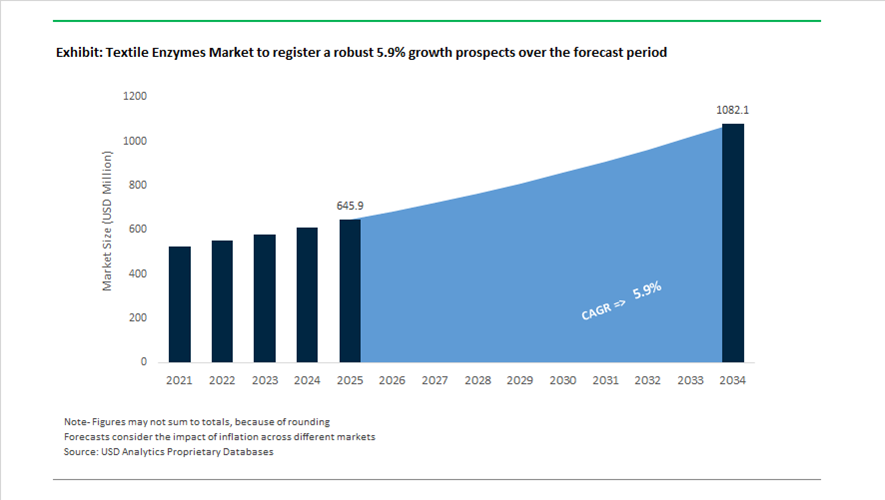
Textile Enzymes Market 2025–2034: $645.9 Million to $1,082 Million at 5.9% CAGR Driven by Circular Textiles, AI-Enzyme Design, and Low-Impact Processing
The global textile enzymes market is valued at $645.9 million in 2025 and is projected to reach $1,082 million by 2034, expanding at a CAGR of 5.9%. Textile enzymes—including cellulases, amylases, catalases, pectinases, proteases, and emerging depolymerizing biocatalysts—are increasingly central to low-temperature desizing, bio-polishing, stonewashing, bleaching optimization, and fiber recycling. The market is transitioning from cost-driven enzyme substitution toward precision biocatalysis engineered for circular textiles, carbon reduction, and PFAS-free finishing systems. AI-assisted protein engineering and integrated recycling technologies are redefining competitive advantage, particularly in denim processing and synthetic fiber regeneration.
Industry consolidation and biosolutions scaling accelerated in 2024. In January 2024, Novonesis was formed through the merger of Novozymes and Chr. Hansen, creating the world’s largest enzyme portfolio with textile biosolutions positioned as a core sustainability lever. In September 2024, Associated British Foods completed the acquisition of Roal Oy, integrating it as AB Enzymes Finland Oy under AB Enzymes, consolidating R&D and manufacturing to streamline textile enzyme innovation. In early 2024, IFF and AB Enzymes launched next-generation cellulase systems engineered for neutral pH and lower-temperature bio-polishing, reducing energy consumption during denim and cotton finishing. By March 2025, AB Enzymes completed a corporate rebrand emphasizing digital-first and sustainable processing strategies.
Circular textile technologies reached commercial inflection in 2025. In September 2025, Samsara Eco opened its first commercial enzymatic recycling facility in Australia, utilizing AI-designed enzymes to depolymerize polyester and nylon 6,6 blends into reusable monomers. Earlier in 2025, BASF SE began commercial production of loopamid® in Shanghai, integrating enzymatic and chemical depolymerization to recycle nylon 6 textile waste into virgin-quality fibers. Throughout 2025, IFF reported halving enzyme development timelines via AI-driven high-throughput screening, particularly targeting cold-water proteases and cellulases for reduced carbon processing. In February 2025, Novonesis introduced enzymatic carbon capture technology capable of converting over 90% of CO₂ emissions into carbonates, with pilot projects in textile manufacturing clusters. By late 2025 and early 2026, complementary sustainable finishing solutions—such as PFAS-free repellents from Pulcra and Devan and the global Sanitized® distribution partnership with RUDOLF—enabled enzyme-compatible processing ecosystems.
Structural Demand Shifts and Monetizable Innovation Pathways in the Textile Enzymes Market
Cellulase Enzymes Become a Non-Discretionary Input in Denim Finishing
The textile enzymes market has entered a phase where enzyme adoption is no longer driven by sustainability signaling but by enforceable buyer mandates and operational economics. Nowhere is this more evident than in denim finishing, where cellulase enzymes have become the de facto replacement for potassium permanganate and pumice stones in abrasion and fading processes. Leading brands have moved from pilot-scale enzyme use to contractual requirements embedded in supplier codes of conduct.
As of late 2025, Levi Strauss & Co. confirmed that cellulase-dependent Water From an operational standpoint, industrial trials conducted during 2024–2025 demonstrate that replacing 50 kilograms of pumice stones with 100 to 200 grams of concentrated cellulase enzymes delivers materially superior outcomes. Fabric tensile loss is reduced by an average of 10 to 15%, back-staining risks are minimized, and multiple post-wash rinses required to remove stone sediment are eliminated. Collectively, these factors compress processing time by approximately 20% per batch, improving machine utilization and lowering per-garment energy and water intensity. The result is a structurally higher willingness to pay for high-activity cellulase formulations that deliver reproducible abrasion control across large-volume denim programs.
Thermostable Amylase Adoption Scales with High-Speed, Continuous Desizing Lines
A second structural trend reshaping the textile enzymes market is the rapid modernization of desizing operations. As mills transition from batch processing to continuous, high-speed ranges, conventional acid or oxidative desizing methods are proving incompatible with throughput, fabric integrity, and effluent compliance requirements. This has elevated thermostable bacterial amylase from a cost-saving alternative to a process-critical input.
In December 2025, Novonesis disclosed that its amylase-based desizing systems have become standard practice in mills targeting ZDHC Level 3 compliance. These enzymes maintain activity at temperatures approaching 90°C to 100°C, enabling one-step starch removal on heavy cotton warps without fiber damage. Compared to traditional batch desizing, mills deploying thermostable amylase in continuous lines report energy savings of roughly 30% due to reduced reheating cycles and fewer process stages.
Equally important is the downstream impact on wastewater treatment. Comparative effluent studies completed in 2025 indicate that enzymatic desizing waste streams are approximately 90% more biodegradable than oxidative alternatives. For mills operating under Zero Liquid Discharge mandates in India and China, this reduction in chemical oxygen demand is not a marginal benefit but a licensing prerequisite. As regulatory scrutiny intensifies, demand is consolidating around enzyme suppliers capable of delivering consistent high-temperature performance paired with documented biodegradability metrics.
Enzyme Platforms Enable Processing of Lyocell, Hemp, and Recycled Polyester Blends
The expansion of next-generation fibers has created a processing gap that conventional textile chemicals are unable to bridge. Lyocell, hemp, and mechanically recycled polyester blends exhibit surface behaviors such as fibrillation, uneven dye uptake, and residual impurities that require highly selective biological catalysts rather than aggressive chemical treatments.
In mid-2025, Lenzing deepened its collaboration with enzyme developers to optimize bio-polishing cellulases specifically for Lyocell-based fabrics. These enzymes selectively remove micro-fibrils responsible for pilling while preserving tensile strength and softness, a critical quality parameter for premium apparel applications. As Lyocell penetration expands across fashion and home textiles, enzyme suppliers with fiber-specific activity profiles are positioned to capture recurring demand tied directly to fiber volume growth.
At the same time, enzyme-enabled circularity is emerging as a high-value growth vector. In September 2025, Samsara Eco commissioned a commercial-scale facility using AI-designed enzymes capable of depolymerizing polyester and nylon 6,6 from mixed textile waste. This textile-to-textile recycling pathway fundamentally changes the role of enzymes from process aids to infrastructure enablers, creating long-term supply opportunities for high-purity catalytic systems embedded in circular economy platforms.
The final and most disruptive opportunity lies in the development of synergistic multi-enzyme systems that collapse multiple pre-treatment steps into a single, low-temperature bath. Traditional cotton preparation relies heavily on caustic soda, high thermal input, and sequential processing stages, each contributing to water intensity, energy consumption, and effluent load.
Technical advancements showcased at VIATT 2026 demonstrate that integrated enzyme cocktails combining amylase, pectinase, and catalase can achieve effective desizing, scouring, and bleach preparation at temperatures as low as 50°C. This represents a fundamental shift from conventional 90°C processing and materially alters the cost structure of cotton wet processing.
Early adopters across Asia-Pacific report water consumption reductions of up to 70% and greenhouse gas emission cuts of approximately 25% per kilogram of fabric produced. By eliminating caustic soda and simplifying effluent neutralization, these systems also reduce chemical procurement costs and wastewater treatment complexity. For enzyme producers, multi-functional formulations represent a premium category where performance integration, rather than unit price, drives procurement decisions.
Textile Enzymes Market Share and Segmentation Insights
Enzyme Type Market Share: Cellulases Dominate with Bio-Polishing and Sustainable Denim Processing
Cellulases account for 32.80% of the textile enzymes market in 2025, reflecting their widespread adoption across bio-polishing, denim finishing, and fabric surface modification processes. Their ability to remove fuzz, enhance softness, and deliver controlled abrasion makes them essential in both natural and synthetic fiber processing. Other enzyme types such as amylases, proteases, pectinases, laccases, lipases, and catalases support niche roles in desizing, bleaching, and wastewater treatment. A key industry shift is the transition toward sustainable denim processing, where cellulase-based bio-finishing replaces pumice stones, reducing water consumption, minimizing fiber damage, and enabling consistent, reproducible stone-washed effects in large-scale textile manufacturing.
End-Use Industry Market Share: Apparel Segment Leads with Sustainable Fashion and Enzyme-Based Processing
Apparel dominates the textile enzymes market with a 52.80% share in 2025, driven by high enzyme consumption in garment washing, denim finishing, and fabric enhancement processes. The segment benefits from continuous demand for soft, comfortable, and visually appealing textiles across fashion cycles. Home textiles and technical textiles represent smaller but steadily growing segments with specialized enzyme applications. The shift toward sustainable fashion is a major growth driver, with enzyme-based processing enabling reduced water usage, lower energy consumption, and minimal chemical load. Enzymes play a critical role in eco-friendly textile manufacturing, supporting bio-polished cotton, enzyme-softened fabrics, and sustainable denim production aligned with global environmental standards.
Textile Enzymes Market Competitive Landscape
The textile enzymes market in 2026 is shaped by the Biosolutions Era, where consolidation and advanced biocatalysis drive innovation. Market leaders are prioritizing enzyme cocktails for circular textile recycling, low-temperature processing, and EU ESPR compliance, enabling selective fiber degradation and sustainable textile manufacturing.
Novonesis Dominates with Integrated Biosolutions Platform and Circular Textile Enzyme Systems
Novonesis leads the global textile enzymes market following the Novozymes–Chr. Hansen merger, leveraging a unified biosolutions platform. The company delivered 7% organic growth in 2025, driven by cross-selling enzymes and microbes across emerging markets. Its DeniSafe® system enhances worker safety through closed-loop enzyme delivery. Synergy realization of DKK 1.2–1.6 billion by 2026 strengthens operational efficiency and R&D scale. The company is advancing biopolishing enzymes as “longevity catalysts” to extend garment lifecycle. Strategic focus on India and China targets enzyme optimization for low-liquor ratio dyeing systems.
IFF Expands Enzyme Engineering Capabilities with AI-Driven Biomaterials and BASF Collaboration
IFF is a key innovator in textile biosolutions, leveraging its Designed Enzymatic Biomaterials™ platform to bridge chemistry and biotechnology. Its collaboration with BASF accelerates development of enzyme-polymer hybrid solutions for advanced textile processing. The OPTIMASE® portfolio sets industry benchmarks in peroxide removal, eliminating the need for chemical reducers. AI-assisted protein engineering enhances enzyme stability in harsh surfactant environments. The company is positioning enzymes as regenerative solutions for wastewater treatment and technical textiles. Strategic investments in directed evolution technologies are compressing R&D cycles and improving enzyme efficiency.
BASF Accelerates Green Transformation with Lavergy® Enzymes and Circular Textile Recycling Integration
BASF is strengthening its position in textile enzymes through its Lavergy® liquid enzyme portfolio, including advanced cellulases and lipases for low-temperature processing. The divestment of hydrosulfite assets in 2026 signals a full transition toward sustainable enzymatic solutions. Its loopamid® facility in Shanghai integrates enzymatic pretreatment with chemical recycling for polyamide textiles. BASF’s €2 billion annual R&D investment prioritizes circular economy and cold-water textile processing innovations. The company’s enzyme solutions support textile-to-textile recycling and reduced energy consumption. Integration across the textile value chain enhances its competitive advantage in sustainable auxiliaries.
Kemin Scales Global Enzyme Production Through CJ Youtell Acquisition and Precision Fermentation
Kemin Industries has rapidly expanded its footprint in textile enzymes through the acquisition of CJ Youtell Biotech in 2025. This move provides access to large-scale fermentation facilities in China, strengthening supply chain efficiency in Asia-Pacific. The company’s vertically integrated model spans strain development to final enzyme formulation. Its “From Feed to Future” strategy leverages fermentation expertise to enter textile and industrial enzyme markets. Kemin focuses on enzyme stabilization to ensure performance under industrial processing conditions. This capability enhances reliability in textile finishing and chemical auxiliary applications.
AB Enzymes Strengthens Denim Processing with High-Performance Cellulase and Multi-Enzyme Systems
AB Enzymes is a specialized leader in cellulase-based textile enzymes, particularly for denim finishing applications. Its ECOSTONE® range enables stonewash effects without pumice stones, reducing environmental impact. The company focuses on high-concentration enzyme formulations for flexible integration into textile processes. Its solutions support reduced water consumption in bio-polishing and finishing operations. Compatibility with auxiliary chemicals allows formulation of multi-enzyme systems combining cellulases, pectinases, and laccases. Continuous innovation in functional fiber development enhances its relevance in technical textiles.
Lumis Enzymes Expands Research-Driven Textile Solutions with Customized Biocatalysts and Field Validation
Lumis Enzymes is gaining traction through research-driven, customized enzyme solutions tailored to niche textile applications. The company showcased global field trial data in 2026, reinforcing its R&D credibility. Its focus on quantifiable efficiency improvements supports adoption in cost-sensitive textile markets. Lumis specializes in enzyme implementation across varying fabric types and water conditions. The company is targeting South Asia and the U.S. with sustainable desizing and finishing alternatives. Strong technical support capabilities ensure consistent enzyme performance in industrial-scale textile processing.
China Textile Enzymes Market Accelerated by Industrial Digitalization and Biomanufacturing Mandates
China’s textile enzymes market is entering a structurally transformative phase as industrial policy increasingly favors enzymatic alternatives over conventional wet chemistry. In late 2025, the Ministry of Industry and Information Technology released a Manufacturing Upgrade Plan for 2026 that explicitly prioritizes enzymatic processing to lower chemical oxygen demand in wastewater across the Yangtze River Delta. This policy shift is materially increasing demand for cellulases, amylases, laccases, and peroxidases as textile mills seek regulatory compliance without sacrificing throughput. Enzymatic desizing and bio-scouring are now being positioned as baseline technologies rather than premium add-ons, particularly in export-oriented clusters facing tightening environmental scrutiny.
Large-scale industrial integration is reinforcing this transition. The Sinopec Yizheng Chemical Fiber complex reached full operational status in August 2025, embedding enzymatic pre-treatment routes into bio-based polyester intermediate production. This integration has demonstrated a 15% reduction in energy intensity versus traditional chemical pathways, strengthening the economic case for enzymes in man-made fiber processing. Parallel investments in synthetic biology, supported by approximately $2.8 billion in state-backed biotech funding between 2023 and 2025, are enabling the development of designed enzymes with higher specificity and traceability. Mandates in Zhejiang for low-temperature bleaching using laccase and peroxidase systems further anchor enzymes at the core of China’s carbon-neutral textile pilots for 2026.
India Textile Enzymes Market Shaped by ZLD Infrastructure and Cotton Productivity Programs
India’s textile enzymes market is being driven by infrastructure-led sustainability and fiber-quality enhancement initiatives. The Union Budget 2025–26 increased allocations to the Ministry of Textiles by 19% to ₹5,272 crore, channeling funds into centralized Zero Liquid Discharge facilities within the seven PM MITRA mega parks. These ZLD systems rely heavily on enzymatic wastewater remediation and low-load processing, structurally lifting demand for enzyme blends that minimize residual salts and reduce effluent toxicity at source.
Agricultural policy is also influencing enzyme adoption. The five-year Cotton Productivity Mission launched in 2025 with ₹600 crore focuses on improving Extra-Long Staple cotton yields, indirectly boosting the use of specialized cellulases and pectinases for gentle bio-scouring of high-value fibers. Textile clusters in Tirupur and Surat began transitioning in 2025 to one-bath scouring and dyeing enabled by multi-enzyme cocktails, reporting water savings of roughly 30% per batch. Regulatory changes, such as the removal of the Quality Control Order on Viscose Staple Fibre in November 2025, have intensified competition with imports, pushing mills toward enzyme-driven finishing to achieve international quality benchmarks. Strategic R&D pivots by domestic players, including Balaji Amines, toward enzymatic synthesis routes for bio-polishing further reinforce India’s positioning in sustainable denim and export apparel.
Germany Textile Enzymes Market Anchored in Low-Temperature Performance and PFAS-Free Compliance
Germany’s textile enzymes market is defined by innovation-led compliance and premium performance requirements. In October 2025, BASF SE and International Flavors & Fragrances announced a strategic collaboration to accelerate Designed Enzymatic Biomaterials technologies for fabric care and industrial cleaning. This partnership reflects Germany’s focus on enzyme platforms that deliver stain removal, color protection, and fabric longevity at ultra-low wash temperatures, aligning with energy reduction targets across the EU.
Operational expansion at BASF’s Ludwigshafen site in July 2025 introduced the Lavergy C Care and A Star enzyme ranges, engineered for biodegradability and performance under cold-wash conditions. These innovations are complemented by broader regulatory alignment. Following federal mandates, enzyme suppliers such as AB Enzymes and CHT Group completed the transition to fully PFAS-free, enzyme-compatible finishing systems by late 2025. Germany’s parallel investments in methane pyrolysis, through a joint development agreement between BASF and ExxonMobil, aim to secure low-emission hydrogen for upstream bio-based chemical precursors, indirectly strengthening the enzyme value chain.
United States Textile Enzymes Market Driven by Bio-Based Polymers and Regulatory Substitution
The United States textile enzymes market is evolving in response to both innovation in bio-based polymers and impending regulatory bans. In October 2025, Geno and Sojitz formed a partnership to commercialize plant-based Nylon-6 using enzymatic fermentation. This initiative targets global apparel brands seeking petroleum-free fibers, structurally increasing demand for enzymes used in polymerization, finishing, and fabric treatment stages.
Regulation is accelerating substitution dynamics. The Environmental Protection Agency’s prohibition on articles containing PIP (3:1), effective October 2026, is pushing U.S. textile manufacturers toward enzymatic flame-retardant binders and bio-based adhesives that avoid restricted substances. Feedstock innovation is reinforcing this shift. The Qore facility in Iowa, a joint venture between Cargill and HELM, scaled production of QIRA bio-based BDO in 2025 using Geno’s enzymatic technology. This renewable BDO is now a critical input for PTMEG and spandex, strengthening enzyme-linked demand across the U.S. textile value chain.
Comparative Snapshot: Textile Enzymes Market by Country
Textile Enzymes Market County Level Snapshot
Country
Primary Policy or Market Driver
Enzyme Focus Area
Strategic Implication
China
MIIT biomanufacturing mandates
Low-temperature bleaching and enzymatic pre-treatment
Enzymes become default compliance tools
India
ZLD parks and cotton productivity
Bio-scouring and one-bath dyeing
Water and effluent efficiency-driven adoption
Germany
PFAS-free and cold-wash performance
High-specificity, low-temperature enzymes
Premium, regulation-ready formulations
United States
Bio-based polymers and EPA bans
Enzymatic polymers and binders
Rapid substitution of restricted chemistries
Textile Enzymes Market Report Scope
Textile Enzymes Market
Parameter
Details
Market Size (2025)
$645.9 Million
Market Size (2034)
$1082 Million
Market Growth Rate
5.9%
Segments
By Enzyme Type (Cellulases, Amylases, Proteases, Pectinases, Laccases, Lipases, Catalases), By Application Phase (Pre-treatment, Finishing, Wastewater Treatment, Fabric Modification), By Fiber Type (Natural Fibers, Synthetic Fibers, Cellulosic Fibers), By End-Use Industry (Apparel, Home Textiles, Technical Textiles)
Study Period
2019- 2025 and 2026-2034
Units
Revenue (USD)
Qualitative Analysis
Porter’s Five Forces, SWOT Profile, Market Share, Scenario Forecasts, Market Ecosystem, Company Ranking, Market Dynamics, Industry Benchmarking
Companies
Novonesis, International Flavors and Fragrances Inc., BASF SE, AB Enzymes, Advanced Enzyme Technologies Ltd., DSM-Firmenich, Kemin Industries, Inc., Sunson Industry Group Co., Ltd., Amano Enzyme Inc., DyStar Group, Sinopec Group, Geno, Tex Biosciences Pvt. Ltd., Bestzyme Bio-Engineering Co., Ltd., Antozyme Biotech Pvt. Ltd.
Countries
US, Canada, Mexico, Germany, France, Spain, Italy, UK, Russia, China, India, Japan, South Korea, Australia, South East Asia, Brazil, Argentina, Middle East, Africa
Textile Enzymes Market Segmentation
By Enzyme Type
Cellulases
Amylases
Proteases
Pectinases
Laccases
Lipases
Catalases
By Application Phase
Pre-treatment
Finishing
Wastewater Treatment
Fabric Modification
By Fiber Type
Natural Fibers
Synthetic Fibers
Cellulosic Fibers
By End-Use Industry
Apparel
Home Textiles
Technical Textiles
By Region
North America (United States, Canada, Mexico)
Europe (Germany, France, United Kingdom, Spain, Italy, Rest of Europe)
Asia Pacific (China, India, Japan, South Korea, Australia, Rest of APAC)
South and Central America (Brazil, Argentina, Rest of SCA)
Middle East and Africa (Saudi Arabia, UAE, South Africa, Rest of Middle East, Rest of Africa)
2. Textile Enzymes Market Landscape & Outlook (2025–2034)
2.1. Introduction to Textile Enzymes Market
2.2. Market Valuation and Growth Projections (2025–2034)
2.3. Circular Textile Processing and Low-Impact Manufacturing Trends
2.4. AI-Assisted Enzyme Engineering and Biocatalysis Innovation
2.5. PFAS-Free Finishing Systems and Enzyme-Compatible Processing
3. Innovations Reshaping the Textile Enzymes Market
3.1. Trend: Cellulase Enzymes as Core Inputs in Denim Finishing
3.2. Trend: Thermostable Amylase Adoption in Continuous Desizing Operations
3.3. Opportunity: Enzyme Platforms for Lyocell, Hemp, and Recycled Polyester Processing
3.4. Opportunity: Multi-Enzyme Cocktails for Low-Temperature Cotton Pre-Treatment
4. Competitive Landscape and Strategic Initiatives
4.1. Mergers and Acquisitions
4.2. R&D and Material Innovation
4.3. Sustainability and ESG Strategies
4.4. Market Expansion and Regional Focus
5. Market Share and Segmentation Insights: Textile Enzymes Market
5.1. By Enzyme Type
5.1.1. Cellulases
5.1.2. Amylases
5.1.3. Proteases
5.1.4. Pectinases
5.1.5. Laccases
5.1.6. Lipases
5.1.7. Catalases
5.2. By Application Phase
5.2.1. Pre-treatment
5.2.2. Finishing
5.2.3. Wastewater Treatment
5.2.4. Fabric Modification
5.3. By Fiber Type
5.3.1. Natural Fibers
5.3.2. Synthetic Fibers
5.3.3. Cellulosic Fibers
5.4. By End-Use Industry
5.4.1. Apparel
5.4.2. Home Textiles
5.4.3. Technical Textiles
5.5. By Region
5.5.1. North America
5.5.2. Europe
5.5.3. Asia Pacific
5.5.4. South and Central America
5.5.5. Middle East and Africa
6. Country Analysis and Outlook of Textile Enzymes Market
6.1. United States
6.2. Canada
6.3. Mexico
6.4. Germany
6.5. France
6.6. Spain
6.7. Italy
6.8. UK
6.9. Russia
6.10. China
6.11. India
6.12. Japan
6.13. South Korea
6.14. Australia
6.15. South East Asia
6.16. Brazil
6.17. Argentina
6.18. Middle East
6.19. Africa
7. Textile Enzymes Market Size Outlook by Region (2025-2034)
7.1. North America Textile Enzymes Market Size Outlook to 2034
7.1.1. By Enzyme Type
7.1.2. By Application Phase
7.1.3. By Fiber Type
7.1.4. By End-Use Industry
7.1.5. By Region
7.2. Europe Textile Enzymes Market Size Outlook to 2034
7.2.1. By Enzyme Type
7.2.2. By Application Phase
7.2.3. By Fiber Type
7.2.4. By End-Use Industry
7.2.5. By Region
7.3. Asia Pacific Textile Enzymes Market Size Outlook to 2034
7.3.1. By Enzyme Type
7.3.2. By Application Phase
7.3.3. By Fiber Type
7.3.4. By End-Use Industry
7.3.5. By Region
7.4. South America Textile Enzymes Market Size Outlook to 2034
7.4.1. By Enzyme Type
7.4.2. By Application Phase
7.4.3. By Fiber Type
7.4.4. By End-Use Industry
7.4.5. By Region
7.5. Middle East and Africa Textile Enzymes Market Size Outlook to 2034
7.5.1. By Enzyme Type
7.5.2. By Application Phase
7.5.3. By Fiber Type
7.5.4. By End-Use Industry
7.5.5. By Region
8. Company Profiles: Leading Players in the Textile Enzymes Market
8.1. Novonesis
8.2. International Flavors and Fragrances Inc.
8.3. BASF SE
8.4. AB Enzymes
8.5. Advanced Enzyme Technologies Ltd.
8.6. DSM-Firmenich
8.7. Kemin Industries, Inc.
8.8. Sunson Industry Group Co., Ltd.
8.9. Amano Enzyme Inc.
8.10. DyStar Group
8.11. Sinopec Group
8.12. Geno
8.13. Tex Biosciences Pvt. Ltd.
8.14. Bestzyme Bio-Engineering Co., Ltd.
8.15. Antozyme Biotech Pvt. Ltd.
9. Methodology
9.1. Research Scope
9.2. Market Research Approach
9.3. Market Sizing and Forecasting Model
9.4. Research Coverage
9.5. Data Horizon
9.6. Deliverables
10. Appendix
10.1. Acronyms and Abbreviations
10.2. List of Tables
10.3. List of Figures
Textile Enzymes Market Segmentation
By Enzyme Type
Cellulases
Amylases
Proteases
Pectinases
Laccases
Lipases
Catalases
By Application Phase
Pre-treatment
Finishing
Wastewater Treatment
Fabric Modification
By Fiber Type
Natural Fibers
Synthetic Fibers
Cellulosic Fibers
By End-Use Industry
Apparel
Home Textiles
Technical Textiles
By Region
North America (United States, Canada, Mexico)
Europe (Germany, France, United Kingdom, Spain, Italy, Rest of Europe)
Asia Pacific (China, India, Japan, South Korea, Australia, Rest of APAC)
South and Central America (Brazil, Argentina, Rest of SCA)
Middle East and Africa (Saudi Arabia, UAE, South Africa, Rest of Middle East, Rest of Africa)
The textile enzymes market is valued at $645.9 million in 2025 and is projected to reach $1,082 million by 2034, growing at a CAGR of 5.9%. Growth is driven by circular textile initiatives, enzyme-based low-temperature processing, and PFAS-free finishing systems. Increasing regulatory pressure on chemical usage is accelerating enzyme adoption across global textile hubs.
Cellulase enzymes have shifted from optional additives to essential inputs in denim finishing due to sustainability mandates from global brands. They replace pumice stones and oxidative chemicals, reducing water usage and fabric damage. Industrial adoption improves processing efficiency by lowering cycle time and enhancing reproducibility. This transition is structurally increasing demand for high-activity cellulase formulations.
AI-assisted protein engineering is significantly reducing enzyme development timelines and improving performance specificity. Companies are designing enzymes for cold-water processing, enhanced stability, and targeted fiber modification. This enables energy savings, lower emissions, and improved process consistency. AI-driven innovation is becoming a key competitive differentiator in textile biosolutions.
Enzymatic depolymerization of polyester and nylon is creating a new value chain for textile-to-textile recycling. Facilities like Samsara Eco are commercializing AI-designed enzymes to recover monomers from mixed textile waste. This positions enzymes as infrastructure-level inputs rather than process aids. Circular textile policies and brand commitments are expected to drive long-term demand.
Leading players include Novonesis, BASF SE, International Flavors and Fragrances Inc., AB Enzymes, DSM-Firmenich, and Kemin Industries. These companies are investing in AI-driven enzyme design, multi-enzyme systems, and circular textile solutions. Strategic mergers and R&D expansion are strengthening their market position. Innovation in sustainable biosolutions defines competitive leadership.