Water-Borne Latex Paints Market Size Expansion Driven by Low-VOC Mandates and Decorative Coatings Demand
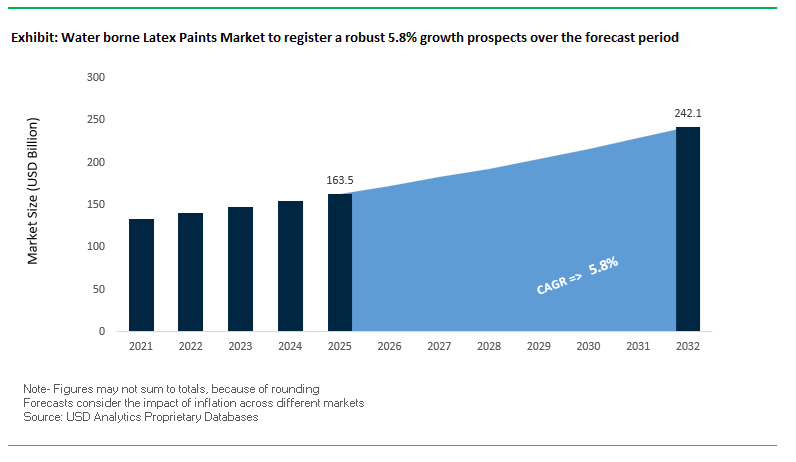
The global Water-Borne Latex Paints Market was valued at $163.5 billion in 2025 and is projected to grow at a CAGR of 5.8% between 2025 and 2032, reaching $242.6 billion by 2032. This sustained expansion is underpinned by the accelerating global transition toward low-VOC, eco-friendly coatings, particularly across architectural, residential, and infrastructure applications. Water-borne latex paints have emerged as the dominant coating technology due to their low odor, fast drying characteristics, superior color retention, and compliance with stringent environmental regulations across North America, Europe, and increasingly Asia-Pacific.
The market is experiencing structural growth driven by urbanization, rising renovation cycles, and increasing adoption of green building standards such as LEED and WELL certifications. Latex paints, formulated using advanced acrylic emulsions and polymer dispersions, are increasingly engineered for enhanced washability, stain resistance, antimicrobial protection, and UV durability, making them suitable for both interior and exterior applications. Additionally, the growing demand for premium decorative finishes, textured coatings, and customized color palettes is pushing manufacturers to develop differentiated latex paint solutions aligned with evolving consumer preferences.
A significant growth catalyst is the intersection of sustainability and performance innovation. Manufacturers are prioritizing zero-VOC formulations, bio-based resins, and recyclable packaging, while also improving functional performance such as adhesion on multi-substrates and resistance to harsh climatic conditions. The expansion of smart cities, infrastructure modernization programs, and electric vehicle (EV) manufacturing ecosystems is further amplifying demand for water-borne latex coatings in both construction and industrial segments.
Market Analysis: Zero-VOC Innovation, and Capacity Expansion Accelerating Competitive Dynamics
The Water-Borne Latex Paints Market is currently characterized by strategic consolidation, aggressive capacity expansion, and rapid product innovation, as leading players reposition themselves for long-term competitiveness in a sustainability-driven landscape. A defining development is the March 2026 announcement of the AkzoNobel–Axalta merger, structured as a “merger of equals,” which is expected to create a $17 billion global coatings powerhouse. This strategic alignment focuses heavily on integrating R&D capabilities in waterborne and energy-curable technologies, combining AkzoNobel’s strength in decorative latex paints with Axalta’s advanced mobility coatings expertise. The deal, anticipated to close by late 2026 or early 2027, signals a broader trend toward portfolio consolidation and innovation centralization.
Corporate restructuring is also shaping competitive positioning. In February 2026, AkzoNobel finalized the divestment of its Indian subsidiary, enabling a sharper focus on higher-margin markets in Europe and North America, while streamlining operations and improving EBITDA margins through workforce optimization. Meanwhile, PPG Industries’ March 2025 commissioning of its Samut Prakan waterborne coatings plant in Thailand highlights the strategic importance of Southeast Asia as a manufacturing and export hub, particularly for supplying latex-based coatings to rapidly growing EV OEM ecosystems in China.
Innovation in product development remains a key differentiator. In January 2026, Benjamin Moore launched its updated Eco Spec® line, featuring zero VOC and zero emissions technology, along with rapid re-occupancy capabilities tailored for commercial environments such as hospitals and hospitality spaces. Similarly, Sherwin-Williams’ 2026 Colormix® Trend Forecast introduced new latex formulations aligned with emotional wellness and aesthetic personalization trends, emphasizing soft, “weightless” color palettes for modern interiors. These developments indicate a shift toward consumer-centric innovation, combining performance with experiential design elements.
Earlier strategic initiatives further reinforce market momentum. BASF’s 2025–2026 color trend collection introduced advanced pigment technologies compatible with water-based latex systems, emphasizing sustainability through renewable raw materials. AkzoNobel’s expansion of UV-stable waterborne technologies in partnership with Signify improved gloss retention for outdoor applications by 20%, addressing durability challenges in high-exposure environments. Additionally, Asian Paints’ expansion of its Kasna manufacturing hub and Nippon Paint’s scaling of antimicrobial latex solutions highlight increasing investments in localized production, automation, and health-focused coatings.
The enforcement of the California Air Resources Board 2025–2026 Architectural Coatings Suggested Control Measure is significantly reshaping the water-borne latex paints market, particularly across the Western United States. The introduction of a uniform 50 g/L VOC cap for both flat and non-flat coatings as of January 1, 2026 is accelerating the transition toward low-VOC latex paints and environmentally compliant architectural coatings.
To meet these stringent VOC limits while maintaining application performance, manufacturers are increasingly adopting bio-based coalescents that offer high boiling points without contributing to VOC levels under EPA Method 24. This advancement is enabling improved workability and extended open time, ensuring that low-VOC latex paints maintain the application characteristics expected in professional painting and large-scale construction projects.
Despite the reduction in solvent content, 2026-generation water-based latex paints are delivering high durability, achieving Class 1 scrub resistance as per ISO 11998. These coatings demonstrate less than 5 microns of film loss after 200 cycles, ensuring long-lasting performance in high-traffic residential and commercial environments. This balance between regulatory compliance and durability is strengthening the demand for high-performance latex paints in the global architectural coatings market.
Market Trend: China GB/T 9756-2025 Standard Enhancing Hygrothermal Stability and Coverage Efficiency
China’s GB/T 9756-2025 standard, fully enforced nationwide in late 2025 and early 2026, is raising the performance benchmarks for interior water-borne latex paints, particularly in high-humidity regions. The focus on hygrothermal stability is driving innovation in moisture-resistant latex paints suited for rapidly urbanizing areas in Southern China and similar climatic regions.
The updated standard introduces stricter opacity requirements, mandating a contrast ratio of at least 0.95 for first-grade latex paint products. This ensures superior hiding power and allows for full surface coverage in fewer coats, reducing overall paint consumption by approximately 15% in large-scale construction and infrastructure projects. This efficiency is particularly valuable for developers seeking cost optimization and sustainable material usage.
In addition, the requirement for low-temperature film formation at 5°C without the use of restricted glycol additives is pushing manufacturers toward low minimum film forming temperature resin technologies. These advanced binders enable crack-free film formation under challenging environmental conditions, enhancing the versatility and reliability of water-borne latex paints across diverse climatic zones.
The increasing emphasis on sustainable construction materials under the USDA BioPreferred Program and the EU Circular Economy Action Plan is creating strong growth opportunities for bio-based latex paints. Advanced 2026 formulations are achieving bio-based carbon content of 25% or higher, validated through ASTM D6866 testing, positioning these products at the forefront of the eco-friendly paints segment.
These coatings utilize renewable raw materials such as plant oils and agricultural waste-derived monomers, reducing reliance on petrochemical feedstocks. As a result, manufacturers are able to report a 20% to 30% reduction in cradle-to-gate carbon emissions, a critical factor for developers targeting LEED Platinum certification and net-zero building objectives.
Importantly, performance parity with conventional coatings has been achieved, with bio-based latex paints demonstrating minimal yellowness index shift below 1.0 even after 1,000 hours of UV exposure. This ensures long-term color stability and durability, reinforcing their suitability for premium architectural applications and sustainable building projects.
Market Opportunity: Formaldehyde-Eliminating Latex Paints Advancing Indoor Air Quality Solutions
The rise of functional coatings is opening new opportunities in the water-borne latex paints market, particularly through formaldehyde-eliminating technologies designed to improve indoor air quality. These advanced latex paints incorporate functionalized amine groups within the binder matrix, enabling the chemical capture and neutralization of airborne formaldehyde.
Laboratory testing under ISO 16000-23 standards indicates that high-performance formaldehyde-scavenging latex paints can achieve a reduction of 80% or more in ambient formaldehyde levels within 24 hours of application. This capability is increasingly critical in healthcare facilities, educational institutions, and commercial buildings where indoor air quality standards are tightly regulated.
These coatings provide long-term benefits, remaining active for up to five years depending on environmental conditions and exposure levels. This creates a continuous passive air purification effect at the wall surface, complementing mechanical ventilation systems and enhancing overall indoor environmental quality.
In practical applications, 2026 school retrofit projects have demonstrated a measurable improvement of approximately 12% in indoor environmental quality scores following the use of formaldehyde-eliminating latex paints. This performance is facilitating faster regulatory approvals and project certifications, strengthening the role of functional latex paints in the healthy building materials market.
Waterborne Latex Paints Market Share and Segmentation Insights
Acrylic Latex Leads with 53.6% Share Due to Superior Durability and All-Weather Performance
The acrylic latex segment dominates the waterborne latex paints market with a leading 53.6% market share in 2025, driven by its exceptional durability, adhesion, and weather resistance in architectural coatings. In the water-based paints and exterior wall coatings market, 100% acrylic latex formulations are widely recognized as the industry standard for exterior applications, offering superior UV resistance, flexibility, and long-term color stability across diverse climates. These coatings adhere effectively to multiple substrates, including concrete, masonry, wood, and previously painted surfaces, making them highly versatile for residential and commercial buildings. A key technological advantage is their low-temperature coalescence capability, allowing application at temperatures as low as 35°F (2°C)—significantly extending painting seasons in temperate and cold regions compared to vinyl acrylic alternatives. As demand rises for high-performance, low-VOC, and weather-resistant paints, acrylic latex continues to lead the global waterborne latex paints market.
Home Improvement and DIY Centers Dominate with 47.2% Share Driven by Consumer Accessibility
The home improvement and DIY centers segment leads the waterborne latex paints market with a 47.2% market share in 2025, fueled by strong demand from homeowners and small contractors engaged in renovation and repainting projects. Within the architectural coatings and home improvement retail market, major chains such as Home Depot, Lowe’s, B&Q, and Leroy Merlin serve as primary distribution hubs, offering latex paints in gallon and 5-gallon packaging for both interior and exterior use. A key growth driver is the dominance of DIY painting activities, where consumers prioritize convenience, competitive pricing, and immediate product availability. These retail centers enhance the purchasing experience through advanced color matching kiosks, extended operating hours, and dedicated contractor service desks, catering to both individual consumers and professionals. As trends in home renovation, décor upgrades, and eco-friendly water-based paints continue to rise, this channel remains the cornerstone of growth in the global waterborne latex paints market.
Competitive Landscape Analysis of the Water-Borne Latex Paints Market
AkzoNobel Strengthens Global Leadership with Axalta Merger and Bio-Based Latex Innovation
AkzoNobel N.V. is reinforcing its leadership in the water-borne latex paints market with the confirmed USD 25 billion merger with Axalta Coating Systems, creating a global coatings powerhouse with USD 17 billion in annual revenue. The company reported a Q1 2026 adjusted EBITDA margin of 14.5%, supported by its focus on industrial excellence and divestment of non-core assets. Its RUBBOL® WF 3350 coating, featuring 20% bio-based content, has set a benchmark for sustainable wood protection. With 173 manufacturing sites globally and expansion through the Dubai Aerospace Hub, AkzoNobel is strengthening its position in low-VOC latex coatings and advanced waterborne technologies.
PPG Expands AI-Driven Latex Coatings and Sustainable Manufacturing Capacity
PPG Industries, Inc. controls 19% of the water-borne latex paints market, driven by strong performance in industrial and architectural coatings. In 2026, the company announced a USD 380 million investment to modernize North American facilities for zero-VOC latex paint production. Its PPG DELTRON® NXT system utilizes AI-driven color matching to reduce application time by 15% for automotive OEMs. PPG’s focus on sustainability is evident, with 43% of its 2025 sales derived from sustainably advantaged products, targeting 50% by 2027. The company’s leadership in anti-corrosive waterborne coatings for marine and aerospace sectors further strengthens its competitive edge.
Sherwin-Williams Dominates Contractor Channel with High-Performance Latex Paint Systems
The Sherwin-Williams Company continues to lead the water-borne latex paints market, supported by a 6.8% increase in Q1 2026 net sales to USD 5.67 billion. Its Performance Coatings Group has experienced double-digit growth in industrial latex solutions. With over 4,800 company-operated stores, Sherwin-Williams dominates the professional contractor segment, holding a 63% share of the U.S. pro-painter market. Its Emerald® and Duration® latex lines provide high durability, while Solo™ 100% Acrylic latex offers one-coat coverage with self-leveling properties, reducing labor costs by 20%. The integration of BASF’s Decorative Paints business enhances its presence in the EMEA region.
Nippon Paint Expands Asia-Pacific Leadership with Quick-Dry Latex Technologies
Nippon Paint Holdings is a major player in the water-borne latex paints market, particularly in Asia-Pacific, which accounts for nearly 40% of global demand. Under its 2026 strategy, the company is targeting growth in China and Southeast Asia, supported by rising demand for green renovation coatings. Its Quick-Dry Latex technology, utilizing advanced styrene-acrylic copolymers, enables curing within 60 minutes even at 85% humidity. Nippon Paint’s integrated approach combines latex paints, wall putty, and sealers under a unified warranty system, enhancing customer retention. This positions the company strongly in high-performance decorative coatings and humid-climate applications.
Asian Paints Leads Premiumization Strategy in Emerging Water-Borne Latex Markets
Asian Paints Limited dominates the water-borne latex paints market in the Indian subcontinent with a 41% market share, driven by its premiumization strategy. The company is transitioning consumers from distempers to high-performance water-based emulsions, particularly in rural and semi-urban markets. Its Apcolite Advanced PU Emulsion offers a 4-year warranty, capturing a 15% share in premium commercial real estate applications. Asian Paints has expanded its Beautiful Homes service with AI-powered color consultations integrated with automated tinting systems across 70,000+ retail outlets.
China Leading Low-VOC Transition and Smart Infrastructure Coatings
China remains the largest and most influential market in the water-borne latex paints sector, driven by strict environmental mandates and massive infrastructure programs. The enforcement of GB 30981 standards has effectively eliminated high-VOC solvent coatings, making water-borne latex the dominant solution across residential and industrial applications.
Infrastructure initiatives such as the “New Infrastructure” program and large-scale urban renewal projects are driving substantial demand for latex coatings in residential refurbishment and transportation networks. Technological advancements include antimicrobial latex paints with silver-ion and nano-TiO₂, widely adopted in healthcare construction.
Major investments in zero-emission automated manufacturing lines are strengthening domestic production capacity. Regulatory frameworks like the China Environmental Labelling certification are now mandatory for most government procurement, reinforcing China’s leadership in low-VOC, high-volume latex coatings.
United States Driving Infrastructure Demand and DIY-Led Latex Paint Growth
The United States market is shaped by strong regulatory compliance and a surge in infrastructure and residential renovation activity. The Infrastructure Investment and Jobs Act (IIJA) is boosting demand for water-borne acrylic latex coatings in highways, bridges, and public infrastructure.
Regulatory frameworks such as CARB VOC limits (as low as 50 g/L) are making water-based latex the standard across major states. Product innovation includes fast-curing, high-performance latex coatings and increasing use of bio-renewable latex binders to reduce carbon footprint.
The DIY boom is a major growth driver, with strong consumer preference for low-odor, paint-and-primer-in-one formulations. Applications also extend to commercial retrofitting projects targeting WELL and LEED certifications, positioning the U.S. as a leader in sustainable and consumer-driven latex paint innovation.
Germany Setting the Global Benchmark for Sustainable Latex Coatings
Germany leads the European water-borne latex paints market through stringent environmental standards and advanced material innovation. The widespread adoption of the “Blue Angel” certification ensures extremely low emissions and high indoor air quality compliance.
Technological advancements include self-crosslinking latex systems offering solvent-like durability, as well as alkyd-latex hybrids for wood coatings. Investments in advanced dispersions are improving scrub resistance without coalescing solvents.
Public procurement laws mandate the use of water-borne coatings in 95% of government infrastructure projects, while energy-efficient coatings such as thermal-reflective latex paints are being adopted under the Energiewende initiative. Germany remains the global benchmark for high-performance, eco-certified latex coatings.
India’s Rapid Expansion Driven by Urbanization and Premiumization Trends
India is one of the fastest-growing markets in the water-borne latex paints industry, fueled by housing demand and infrastructure development. Government programs such as PMAY and Smart Cities Mission are driving large-scale adoption of water-based emulsions and distempers.
Massive capacity expansions by major players are strengthening domestic production of polymer emulsions, while the market is witnessing a shift toward premium, washable, stain-resistant latex paints among middle-class consumers.
Technological advancements include improved formulations compatible with airless spray applications, enabling faster project execution. Regulatory evolution toward stricter VOC norms is expected to further accelerate adoption, positioning India as a key hub for high-growth and premium latex paint solutions.
South Korea Leading Functional Latex Coatings for Smart Buildings and Electronics
South Korea is advancing the water-borne latex coatings market through integration of advanced functionalities. Regulatory frameworks like G-SEED standards mandate low-emission coatings in large-scale construction projects.
Technological innovation includes photocatalytic latex coatings capable of breaking down air pollutants, as well as moisture-proof insulating coatings for humid climates. The integration of conductive latex coatings is supporting applications in hospitals and R&D facilities where electrostatic discharge control is critical.
Government initiatives supporting carbon neutrality are accelerating the transition to water-based systems, positioning South Korea as a leader in high-tech, functional latex coatings.
Brazil Leveraging Raw Material Advantage and Construction Growth
Brazil’s water-borne latex paints market is supported by strong domestic manufacturing and abundant raw material availability, particularly titanium dioxide and minerals. Regulatory frameworks under Abrafati standards have improved product quality by eliminating high-solvent formulations.
Growth is driven by government housing programs and construction sector expansion, with increasing adoption of UV-resistant latex coatings designed for intense solar exposure. Product innovation includes carbon-neutral latex paints, aligning with sustainability trends.
Key applications include architectural coatings, automotive refinish, and social housing projects, positioning Brazil as a major player in cost-effective and sustainable latex paint production.
Japan Driving Precision Latex Coatings for Infrastructure and Advanced Applications
Japan’s market focuses on high-performance and specialized latex coatings, particularly for infrastructure longevity and indoor air quality. Strict regulations ensure ultra-low VOC emissions, making water-borne latex the standard for interior applications.
Technological advancements include fluoropolymer-latex hybrids for long-life infrastructure coatings and cool-roof latex paints to mitigate urban heat island effects. Innovations in elastomeric latex coatings are enhancing seismic resilience in high-rise buildings.
The market also benefits from robotic application technologies, improving precision in prefabricated construction. Japan remains a leader in high-durability, precision-engineered latex coatings.
Water borne Latex Paints Market Report Scope
Water borne Latex Paints Market
Parameter
Details
Market Size (2025)
$163.5 Billion
Market Size (2032)
$242.6 Billion
Market Growth Rate
5.8%
Segments
By Resin Type (Acrylic Latex, Vinyl Acrylic, Styrene Acrylic, Vinyl-Acetate Ethylene, Natural Latex), By Product Type (Interior Paints, Exterior Paints, Primers and Undercoats, Specialty Latex Coatings), By End-User Industry (Construction, Transportation, Industrial Manufacturing, Infrastructure), By Application Method (Brush and Roller, Spray Coating, Industrial Automated Lines), By Sales Channel (B2B, Specialty Paint Stores, Home Improvement and DIY Centers, Online), By Grade (Premium, Standard Grade, Economy Grade)
Study Period
2019- 2025 and 2026-2032
Units
Revenue (USD)
Qualitative Analysis
Porter’s Five Forces, SWOT Profile, Market Share, Scenario Forecasts, Market Ecosystem, Company Ranking, Market Dynamics, Industry Benchmarking
Companies
The Sherwin-Williams Company, PPG Industries, Inc., AkzoNobel N.V., Nippon Paint Holdings Co., Ltd., Asian Paints Limited, BASF SE, Kansai Paint Co., Ltd., RPM International Inc., Jotun A/S, Axalta Coating Systems, Berger Paints India Limited, Masco Corporation, Benjamin Moore and Co., DAW SE, Hempel A/S
Countries
US, Canada, Mexico, Germany, France, Spain, Italy, UK, Russia, China, India, Japan, South Korea, Australia, South East Asia, Brazil, Argentina, Middle East, Africa
Water borne Latex Paints Market Segmentation
By Resin Type
Acrylic Latex
Vinyl Acrylic
Styrene Acrylic
Vinyl-Acetate Ethylene
Natural Latex
By Product Type
Interior Paints
Wall and Ceiling Paints
Trim and Cabinetry Enamels
Exterior Paints
Facade and Masonry Coatings
Deck and Porch Paints
Primers and Undercoats
Sealer Primers
Bonding Primers
Specialty Latex Coatings
Antibacterial
Anti-Fouling
Low-VOC
Elastomeric
By End-User Industry
Construction
Transportation
Industrial Manufacturing
Infrastructure
By Application Method
Brush and Roller
Spray Coating
Industrial Automated Lines
By Sales Channel
B2B
Specialty Paint Stores
Home Improvement and DIY Centers
Online
By Grade
Premium
Standard Grade
Economy Grade
Leading Countries in the Industry
North America (United States, Canada, Mexico)
Europe (Germany, France, Spain, United Kingdom, Italy, Russia, Rest of Europe)
Asia Pacific (China, India, Japan, South Korea, Australia, South East Asia, Rest of APAC)
South and Central America (Brazil, Argentina, Rest of SCA)
Middle East and Africa (Saudi Arabia, UAE, MENA, Sub-Saharan Africa)
Top Companies in Water borne Latex Paints Industry
The Sherwin-Williams Company
PPG Industries, Inc.
AkzoNobel N.V.
Nippon Paint Holdings Co., Ltd.
Asian Paints Limited
BASF SE
Kansai Paint Co., Ltd.
RPM International Inc.
Jotun A/S
Axalta Coating Systems
Berger Paints India Limited
Masco Corporation
Benjamin Moore & Co.
DAW SE
Hempel A/S
*- List not Exhaustive
Table of Contents: Water-Borne Latex Paints Market
1. Executive Summary
1.1. Market Highlights
1.2. Key Findings
1.3. Global Market Snapshot
2. Water-Borne Latex Paints Market Landscape and Outlook (2025–2034)
2.1. Introduction to the Water-Borne Latex Paints Market
2.2. Market Valuation and Growth Projections (2025–2034)
2.3. Demand Drivers in Low-VOC Decorative Coatings, Renovation Activity, and Green Building Adoption
2.4. Regulatory Trends and Sustainability Standards in Zero-VOC and Bio-Based Latex Paint Technologies
2.5. Strategic Opportunities and Future Outlook
4. Competitive Landscape and Strategic Initiatives
4.1. Mergers and Acquisitions
4.2. Product Innovation and Portfolio Expansion
4.3. Sustainability and Circular Economy Strategies
4.4. Capacity Expansion and Regional Market Development
5. Market Share and Segmentation Insights: Water-Borne Latex Paints Market
5.1. By Resin Type
5.1.1. Acrylic Latex
5.1.2. Vinyl Acrylic
5.1.3. Styrene Acrylic
5.1.4. Vinyl-Acetate Ethylene
5.1.5. Natural Latex
5.2. By Product Type
5.2.1. Interior Paints
5.2.1.1. Wall and Ceiling Paints
5.2.1.2. Trim and Cabinetry Enamels
5.2.2. Exterior Paints
5.2.2.1. Facade and Masonry Coatings
5.2.2.2. Deck and Porch Paints
5.2.3. Primers and Undercoats
5.2.3.1. Sealer Primers
5.2.3.2. Bonding Primers
5.2.4. Specialty Latex Coatings
5.2.4.1. Antibacterial
5.2.4.2. Anti-Fouling
5.2.4.3. Low-VOC
5.2.4.4. Elastomeric
5.3. By End-User Industry
5.3.1. Construction
5.3.2. Transportation
5.3.3. Industrial Manufacturing
5.3.4. Infrastructure
5.4. By Application Method
5.4.1. Brush and Roller
5.4.2. Spray Coating
5.4.3. Industrial Automated Lines
5.5. By Sales Channel
5.5.1. B2B
5.5.2. Specialty Paint Stores
5.5.3. Home Improvement and DIY Centers
5.5.4. Online
5.6. By Grade
5.6.1. Premium
5.6.2. Standard Grade
5.6.3. Economy Grade
6. Country Analysis and Outlook of Water-Borne Latex Paints Market
6.1. United States
6.2. Canada
6.3. Mexico
6.4. Germany
6.5. France
6.6. Spain
6.7. Italy
6.8. United Kingdom
6.9. Russia
6.10. China
6.11. India
6.12. Japan
6.13. South Korea
6.14. Australia
6.15. South East Asia
6.16. Brazil
6.17. Argentina
6.18. Saudi Arabia
6.19. United Arab Emirates
6.20. Rest of Middle East and Africa
7. Water-Borne Latex Paints Market Size Outlook by Region (2025–2034)
7.1. North America Water-Borne Latex Paints Market Size Outlook to 2034
7.1.1. By Resin Type
7.1.2. By Product Type
7.1.3. By End-User Industry
7.1.4. By Application Method
7.1.5. By Sales Channel
7.1.6. By Grade
7.2. Europe Water-Borne Latex Paints Market Size Outlook to 2034
7.2.1. By Resin Type
7.2.2. By Product Type
7.2.3. By End-User Industry
7.2.4. By Application Method
7.2.5. By Sales Channel
7.2.6. By Grade
7.3. Asia Pacific Water-Borne Latex Paints Market Size Outlook to 2034
7.3.1. By Resin Type
7.3.2. By Product Type
7.3.3. By End-User Industry
7.3.4. By Application Method
7.3.5. By Sales Channel
7.3.6. By Grade
7.4. South and Central America Water-Borne Latex Paints Market Size Outlook to 2034
7.4.1. By Resin Type
7.4.2. By Product Type
7.4.3. By End-User Industry
7.4.4. By Application Method
7.4.5. By Sales Channel
7.4.6. By Grade
7.5. Middle East and Africa Water-Borne Latex Paints Market Size Outlook to 2034
7.5.1. By Resin Type
7.5.2. By Product Type
7.5.3. By End-User Industry
7.5.4. By Application Method
7.5.5. By Sales Channel
7.5.6. By Grade
8. Company Profiles: Leading Players in the Water-Borne Latex Paints Market
8.1. The Sherwin-Williams Company
8.2. PPG Industries, Inc.
8.3. AkzoNobel N.V.
8.4. Nippon Paint Holdings Co., Ltd.
8.5. Asian Paints Limited
8.6. BASF SE
8.7. Kansai Paint Co., Ltd.
8.8. RPM International Inc.
8.9. Jotun A/S
8.10. Axalta Coating Systems
8.11. Berger Paints India Limited
8.12. Masco Corporation
8.13. Benjamin Moore and Co.
8.14. DAW SE
8.15. Hempel A/S
9. Methodology
9.1. Research Scope
9.2. Market Research Approach
9.3. Market Sizing and Forecasting Model
9.4. Research Coverage
9.5. Data Horizon
9.6. Deliverables
10. Appendix
10.1. Acronyms and Abbreviations
10.2. List of Tables
10.3. List of Figures
Water borne Latex Paints Market Segmentation
By Resin Type
Acrylic Latex
Vinyl Acrylic
Styrene Acrylic
Vinyl-Acetate Ethylene
Natural Latex
By Product Type
Interior Paints
Wall and Ceiling Paints
Trim and Cabinetry Enamels
Exterior Paints
Facade and Masonry Coatings
Deck and Porch Paints
Primers and Undercoats
Sealer Primers
Bonding Primers
Specialty Latex Coatings
Antibacterial
Anti-Fouling
Low-VOC
Elastomeric
By End-User Industry
Construction
Transportation
Industrial Manufacturing
Infrastructure
By Application Method
Brush and Roller
Spray Coating
Industrial Automated Lines
By Sales Channel
B2B
Specialty Paint Stores
Home Improvement and DIY Centers
Online
By Grade
Premium
Standard Grade
Economy Grade
Leading Countries in the Industry
North America (United States, Canada, Mexico)
Europe (Germany, France, Spain, United Kingdom, Italy, Russia, Rest of Europe)
Asia Pacific (China, India, Japan, South Korea, Australia, South East Asia, Rest of APAC)
South and Central America (Brazil, Argentina, Rest of SCA)
Middle East and Africa (Saudi Arabia, UAE, MENA, Sub-Saharan Africa)
The global Water-Borne Latex Paints Market was valued at $163.5 billion in 2025 and is projected to reach $242.6 billion by 2032, growing at a CAGR of 5.8% during the forecast period. Increasing adoption of low-VOC architectural coatings, sustainable building materials, and premium decorative finishes is driving long-term market expansion globally.
Regulations such as CARB 2025-2026 VOC standards, LEED certifications, WELL standards, and China GB/T 9756-2025 are accelerating the adoption of low-emission and eco-friendly latex paints. Manufacturers are increasingly developing bio-based binders, zero-VOC coatings, and recyclable packaging solutions to comply with sustainability and indoor air quality requirements.
Acrylic latex paints dominate the market due to their superior UV resistance, weather durability, fast drying performance, and long-term color stability. Their strong adhesion across concrete, masonry, wood, and previously painted surfaces makes them highly preferred for residential, commercial, and infrastructure coating applications worldwide.
Innovations such as formaldehyde-eliminating coatings, antimicrobial latex paints, AI-driven color matching systems, self-crosslinking acrylic dispersions, and bio-based resin technologies are transforming the market. These advancements improve indoor air quality, coating durability, application efficiency, and environmental performance across construction and industrial sectors.
Major companies operating in the market include The Sherwin-Williams Company, PPG Industries, Inc., AkzoNobel N.V., Nippon Paint Holdings Co., Ltd., Asian Paints Limited, and BASF SE. These companies are investing in bio-based latex technologies, antimicrobial coatings, AI-enabled paint systems, and sustainable decorative coating innovations.