Advanced water treatment is increasingly being organized around four interconnected questions: which contaminants must be removed, how much water can be recovered, how membrane performance can be maintained, and what happens to the concentrated residual stream after treatment. This is changing the role of adsorption media, reverse osmosis (RO), membrane-treatment chemicals and fouling-resistant membrane designs across municipal and industrial water systems.
Water reuse is adding commercial importance to this integrated treatment architecture. In April 2026, the U.S. Environmental Protection Agency launched Water Reuse Action Plan 2.0 with a stronger focus on industrial, technology and energy-sector reuse. The initiative addresses wastewater as a potential alternative water source while leaving treatment-process selection dependent on the intended end use and water-quality requirements.
The technology response is not centered on a single purification process. PFAS can require selective capture, wastewater reuse can require high-rejection membranes, increasing RO recovery concentrates scaling species and dissolved contaminants, while biological and organic fouling can determine how long membrane systems operate between cleaning events.
Advanced Water Treatment Technology Map
PFAS Treatment Is Separating Capture from Final Residual Management
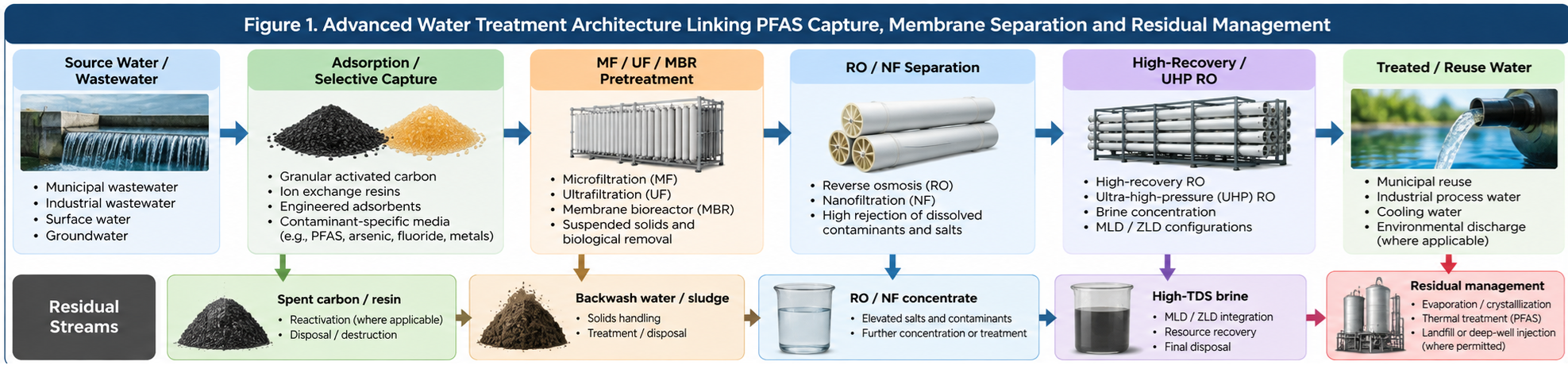
PFAS treatment illustrates the distinction between removing contaminants from water and destroying the captured contaminant mass. Granular activated carbon, PFAS-selective ion-exchange resins and engineered adsorbents transfer PFAS from the liquid phase onto treatment media, while RO and NF retain PFAS in a smaller-volume membrane concentrate.
The process therefore continues after treated water leaves the primary separation stage. Activated carbon becomes PFAS-loaded spent media, single-use ion-exchange resins retain captured compounds, regenerable resin systems can create concentrated regenerant, and pressure-driven membranes produce a liquid reject stream with elevated contaminant concentrations.
EPA's 2026 Interim Guidance on PFAS Destruction and Disposal specifically addresses PFAS-containing wastes from water treatment and evaluates large-scale management routes including thermal treatment under specified conditions, landfills and underground injection. EPA describes the guidance as non-binding and identifies continuing scientific uncertainties around destruction and disposal technologies.
Commercial activity is expanding around both capture media and media lifecycle. Kuraray/Calgon Carbon announced approximately $100 million of investment in March 2026 to add 12,300 tons per year of drinking-water reactivated-carbon capacity at its Columbus, Ohio facility, with operations scheduled for the first quarter of 2028.
Selective adsorbents are developing alongside activated carbon. In April 2026, Kurita Water Industries invested in Cyclopure and obtained exclusive U.S. sales rights for DEXSORB across specified industrial and municipal applications. The development links contaminant-specific adsorbent chemistry with established water-treatment distribution and technical-service infrastructure.
USDAnalytics examines treatment-system deployment, adsorption, ion exchange, membrane separation and PFAS residual handling in the PFAS Filtration Market.
Adsorbent Selection Is Becoming More Contaminant-Specific
Adsorption is moving beyond a simple activated-carbon-versus-resin distinction. Water-treatment media are increasingly matched to the chemical characteristics of the target contaminant, source-water composition and treatment objective.
Activated carbon remains widely established for dissolved organic contaminants, taste and odor compounds, natural organic matter and selected emerging contaminants. Activated alumina is associated with contaminants such as arsenic and fluoride, while iron-based adsorbents target arsenic and other oxyanions. Ion-exchange and specialty polymeric adsorbents introduce stronger selectivity for defined ionic or molecular contaminants.
EPA's drinking-water treatment framework identifies granular activated carbon alongside aluminum-, iron-, titanium- and zirconium-based adsorptive media. It also notes that usable adsorption capacity depends on the specific medium, water chemistry, contaminant characteristics and operating conditions. Once capacity is exhausted, media must be replaced or regenerated, creating spent solids or concentrated regenerant requiring subsequent management.
This makes breakthrough behavior and media life commercially important. A treatment medium with strong equilibrium adsorption under laboratory conditions does not automatically provide the longest service interval in a full-scale water matrix containing natural organic matter, competing ions and multiple contaminants.
Engineered mineral, polymeric and surface-modified adsorbents add additional treatment routes where conventional carbon or alumina has limited selectivity. Their commercial role is increasingly differentiated through contaminant affinity, media loading, hydraulic characteristics, regeneration potential and the volume of residual material generated after treatment.
USDAnalytics covers activated carbon, activated alumina, metal oxides, zeolites, polymeric and specialty treatment media in the Adsorbents for Water Purification Market.
High-Recovery RO Is Moving Wastewater Treatment Toward Brine Concentration
Reverse osmosis has traditionally been associated with desalting and high-quality permeate production. Industrial water reuse is extending the technology toward a second function: concentrating wastewater while recovering a larger fraction of the feed as reusable water.
This changes the operating environment inside the RO system. Higher recovery increases the concentrations of dissolved salts, silica, organics and other rejected constituents in the concentrate stream. Osmotic pressure rises as brine becomes more concentrated, while mineral saturation and membrane-fouling risks can become more restrictive.
In April 2026, SUEZ and Salinity Solutions launched a 100 m³/day Hybrid Batch RO pilot treating municipal wastewater at Béziers, France. The companies report recovery of 90–95% under the pilot configuration, with repeated brine recirculation used to reduce the volume of concentrate produced.
Ultra-high-pressure membranes are extending the concentration range further. DuPont's FilmTec Fortilife XC220 is designed for industrial water reuse, resource recovery and MLD/ZLD configurations and is specified for brine concentration of up to 220 g/L NaCl within its defined application envelope.
These developments position RO between conventional water reuse and energy-intensive thermal concentration. In minimal liquid discharge (MLD) systems, membrane stages can reduce residual wastewater volume before further treatment. In zero liquid discharge (ZLD) configurations, high-pressure membrane concentration can operate upstream of evaporation and crystallization.
The commercial relationship between recovery and concentrate management is examined in the Wastewater Reverse Osmosis Membrane Market.
RO Chemistry Is Shifting from Fixed Dosing Toward Feedwater-Specific Control
Higher membrane recovery also increases the importance of chemical control. RO antiscalants, dechlorination agents, biocides and cleaning formulations are increasingly connected with feedwater analysis and normalized membrane-performance data rather than being treated only as fixed-dose consumables.
Antiscalant requirements change with calcium, carbonate, sulfate, barium, strontium, silica, pH, temperature and system recovery. Industrial reuse streams can also contain residual coagulants, organics and metals that change scaling behavior or interact with membrane-treatment chemicals.
The supplier structure is reflecting this shift. In April 2025, Kurita America absorbed Avista Technologies, combining Kurita's membrane-chemical portfolio with Avista's RO products, services and technical support. Kurita specifically identified RO chemicals as part of the business expansion created by the integration.
Digital monitoring adds another layer. Ecolab/Nalco Water's 3D TRASAR for RO combines chemistry dosing with membrane KPI collection, normalized performance calculations and dashboard monitoring. The platform reflects a wider movement toward linking chemical consumption with membrane performance rather than evaluating dosage independently of flux, rejection and pressure behavior.
The same approach applies to membrane cleaning. Carbonate scale, sulfate deposits, silica, metal oxides, natural organic matter and biological deposits require different cleaning chemistry. Normalized permeate flow, salt passage and pressure drop provide operating evidence that helps distinguish gradual membrane deterioration from temporary feedwater effects.
RO antiscalants, membrane cleaners, biocides, dechlorination chemistry and condition-based treatment programs are covered in the Reverse Osmosis (RO) Membrane Chemicals Market.
Fouling Control Is Moving Into Membrane and Module Design
Chemical cleaning remains an important part of membrane operation, but manufacturers are increasingly engineering fouling resistance directly into the membrane surface, feed spacer and element architecture.
In September 2026, Nitto Denko and Hydranautics launched PRO-XR1-X-LD, a fouling-resistant RO element developed for difficult wastewater reuse in semiconductor, mining and industrial manufacturing. The product addresses both membrane fouling and element differential pressure under challenging feedwater conditions.
Biofouling adds a specific design problem because microorganisms can attach to membrane and spacer surfaces and subsequently multiply. DuPont FilmTec Fortilife CR100 is explicitly designed for biologically fouling-prone water. In a June 2025 industrial wastewater technical evaluation, DuPont reported 64% more operating time between cleanings and 36% fewer annual cleanings than the comparator element under the documented operating conditions.
Surface chemistry is developing in parallel with conventional polyamide RO design. ZwitterCo expanded its commercial portfolio in July 2025 with Evolution, Elevation and Expedition membranes for food processing, water reuse and difficult industrial wastewater. Its Elevation platform uses permanently bonded zwitterionic surface chemistry designed to resist irreversible organic adhesion under high-TOC and high-COD feed conditions. Company-reported performance claims remain specific to the documented products and applications.
The distinction between anti-adhesion and antimicrobial action is important. Hydrophilic and zwitterionic surfaces primarily reduce interaction between the membrane and foulants, while antimicrobial surfaces act against microorganisms near or on the membrane. Feed-spacer geometry, crossflow and module hydrodynamics address a third mechanism by changing the physical conditions under which deposits and biofilms accumulate.
USDAnalytics examines surface chemistry, module hydrodynamics, low-fouling RO, MBR design and ceramic cleanability in the Biofouling-Resistant Membranes Market.
Water Reuse Is Increasingly a Multi-Barrier Treatment Architecture
Water reuse demonstrates why adsorption, membranes, chemistry and fouling control cannot be evaluated in isolation. A typical advanced reuse train can involve biological treatment, MF/UF or MBR, reverse osmosis and subsequent polishing or disinfection, with each stage addressing a different contaminant or operating constraint.
Singapore's NEWater program provides long-duration operating evidence for this architecture. PUB has tested flow-reversal technology in the RO stage and reported increasing recovery from 85% to as high as 90% during trials. PUB states that the technology will be incorporated into future NEWater facilities. The agency has also demonstrated ceramic MBR and biomimetic membrane technologies within its broader used-water treatment program.
The process sequence also changes the fouling environment reaching RO. MBR or UF removes suspended solids and microorganisms, adsorption can remove selected organics, pretreatment chemistry controls mineral and colloidal loading, and RO becomes a high-rejection barrier for dissolved constituents. Increasing RO recovery then concentrates whatever the membrane retains.
EPA's 2026 water-reuse initiative gives this architecture a broader industrial context. The agency identifies industrial manufacturing, technology-sector water use and energy applications among the areas where purpose-specific treatment of wastewater can expand reuse.
Water treatment is consequently becoming more feedwater-specific and function-specific: capture processes address targeted contaminants, pretreatment establishes membrane feed quality, RO determines dissolved-solute separation and recovery, and residual-management processes address the concentrated material left after purification.
What the 2025–2026 Commercial Evidence Shows
Commercial developments during 2025–2026 show four changes occurring simultaneously. Adsorbents are becoming more contaminant-specific, membrane systems are operating at higher recovery and concentration, RO chemical programs are becoming more data-driven, and fouling resistance is increasingly being designed into membranes and modules before a cleaning event occurs.
|
Date |
Company / Organization |
Development |
Technical or Commercial Evidence |
|---|---|---|---|
|
Apr. 2025 |
Kurita / Avista |
Avista absorbed into Kurita America |
RO membrane chemicals and technical services integrated into Kurita's North American platform |
|
Jul. 2025 |
ZwitterCo |
Evolution, Elevation and Expedition launched |
Commercial zwitterionic platforms for food processing, water reuse and industrial wastewater |
|
Mar. 2026 |
Kuraray / Calgon Carbon |
U.S. carbon-reactivation expansion |
Approx. $100 million investment; 12,300 t/year additional capacity |
|
Apr. 2026 |
Kurita / Cyclopure |
DEXSORB partnership expanded |
Exclusive U.S. rights for specified industrial and municipal applications |
|
Apr. 2026 |
SUEZ / Salinity Solutions |
Hybrid Batch RO wastewater-reuse pilot |
100 m³/day; company-reported 90–95% recovery |
|
2026 |
DuPont |
Fortilife XC220 advanced brine-concentration RO |
Up to 220 g/L NaCl within specified application conditions |
|
Sep. 2026 |
Nitto / Hydranautics |
PRO-XR1-X-LD launched |
Fouling-resistant RO for difficult industrial wastewater reuse |
The underlying commercial pattern is not a movement toward one dominant advanced-water-treatment technology. It is a movement toward integrated treatment trains in which each process has a narrower technical function—adsorption for targeted capture, membranes for high-rejection separation and recovery, chemistry for stable membrane operation, and material or module design for fouling control.