Rising Demand in the Global Wastewater Reverse Osmosis Membrane Market
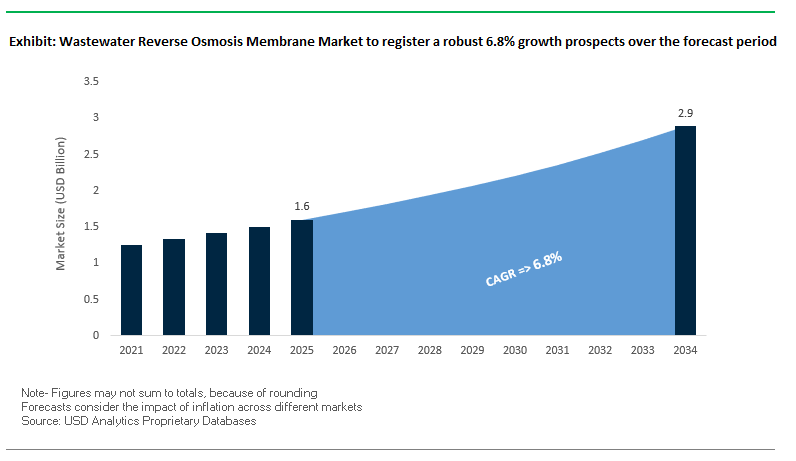
The global Wastewater Reverse Osmosis Membrane Market is valued at $1.6 billion in 2025 and is projected to reach $2.9 billion by 2034, expanding at a CAGR of 6.8%. Wastewater RO membranes are pressure-driven separation materials used to remove dissolved salts, ionic contaminants, selected dissolved organics and trace contaminants from pretreated municipal and industrial wastewater. Commercial configurations include low-fouling RO membranes, wastewater-ready brackish-water RO elements, high-rejection membranes and chemically tolerant RO products used across municipal water reuse, industrial wastewater recycling, high-purity water production and MLD/ZLD systems.
Wastewater RO operates within treatment trains that prepare complex effluent for membrane separation. Municipal installations commonly place microfiltration, ultrafiltration or membrane bioreactor treatment ahead of RO, while industrial systems can incorporate clarification, biological treatment, media filtration, UF, activated carbon, ion exchange or other pretreatment according to feedwater composition. Wastewater source chemistry determines membrane selection because organic matter, colloids, hardness, silica, microorganisms, solvents, trace contaminants and total dissolved solids produce different fouling, scaling and rejection requirements.
Commercial demand extends across industrial water reuse, municipal wastewater reclamation, potable reuse, semiconductor water recycling, textile wastewater treatment, pharmaceutical effluent, refinery and petrochemical reuse, landfill leachate, power generation and high-recovery brine concentration. Membrane replacement cycles, fouling resistance, salt and trace-contaminant rejection, feed-spacer configuration, cleaning tolerance, operating pressure and concentrate generation influence the economics of wastewater RO installations.
Key factors shaping the market include:
Water Scarcity and Reuse Mandates: With 48% of global wastewater still discharged untreated, governments and industries are prioritizing advanced RO-based water reuse systems for agriculture, industrial processes, and even potable applications.
Industrial Wastewater Regulations: Stricter rules, such as the U.S. EPA’s Effluent Guidelines, are forcing industries to adopt RO membranes for minimal liquid discharge (MLD) and resource recovery, turning wastewater into a valuable resource.
Energy-Efficient RO Systems: Next-generation RO membranes operate at lower pressures, cutting energy consumption and OPEX for municipal and industrial wastewater treatment plants.
Advanced Contaminant Removal: Reverse osmosis membranes are increasingly deployed for emerging pollutants such as PFAS, microplastics, and pharmaceutical residues critical for compliance and public health.
Market Analysis: Recent Developments in Wastewater RO Membranes
The wastewater reverse osmosis membrane industry is experiencing accelerated innovation and strategic partnerships, highlighted by major developments between October 2026 and August 2025. These events underscore the industry’s dual focus on sustainability and efficiency.
Wastewater-specific fouling resistance is becoming a more explicit product-design category. In September 2026, Nitto Denko and Hydranautics launched PRO-XR1-X-LD, a fouling-resistant RO membrane element designed for difficult wastewater reuse in semiconductor manufacturing, mining and other industrial applications. The product is positioned around stable performance under feedwaters with elevated fouling potential rather than conventional clean brackish-water service. Nitto's PRO-XR1-X-LD wastewater-reuse membrane announcement documents the product's targeted industrial wastewater applications.
High-recovery wastewater treatment is moving RO deeper into brine-concentration service. In April 2026, DuPont Water Solutions expanded its FilmTec Fortilife portfolio with membrane elements developed for MLD, ZLD and resource-recovery applications. The XC220 element is specified for brine concentrations up to 220 g/L NaCl within its defined operating envelope, extending membrane separation into concentration ranges that historically placed greater reliance on thermal treatment. DuPont's FilmTec Fortilife high-brine-concentration portfolio identifies industrial reuse, brine recovery and ZLD/MLD among the target applications.
Batch and flow-management architectures are changing the recovery profile of municipal wastewater RO. In April 2026, SUEZ and Salinity Solutions launched an industrial Hybrid Batch Reverse Osmosis pilot at the Béziers wastewater treatment plant in France. The 100 m³/day system treats municipal wastewater under operating conditions, with the companies reporting 90–95% water recovery and reduced brine volume under the pilot configuration. The Béziers Hybrid Batch RO wastewater-reuse pilot provides the operating capacity and company-reported recovery range.
High-rejection membranes are moving into wastewater-to-ultrapure-water treatment for semiconductor production. Toray Industries has developed its TBW-XHR series around enhanced rejection of difficult neutral molecules including urea, boron and alcohols from recycled wastewater. Toray reports nearly 90% urea removal in internal evaluations and positions the technology for ultrapure-water production using reclaimed wastewater in advanced semiconductor facilities.
Low-fouling wastewater RO also continues to generate long-duration operating evidence. MANN+HUMMEL's TRISEP X-20 is used in municipal and refinery wastewater-reuse applications, with current published cases documenting tertiary-treatment RO operation, high-fouling feedwater and extended element life. Its municipal reuse reference reports a 5.9 MGD RO permeate design capacity and permeate conductivity below 100 µS/cm under the cited operating configuration.
Emerging Trends and Growth Opportunities in the Wastewater Reverse Osmosis Membrane Market
Rising Impact of Strict Government Regulations on Wastewater RO Adoption
The wastewater reverse osmosis (RO) membrane market is heavily influenced by government mandates pushing industries and municipalities toward sustainable water management. The U.S. Environmental Protection Agency (EPA) continuously updates its technology-based “Effluent Guidelines,” requiring advanced treatment processes such as RO to reduce industrial wastewater pollutants. Similarly, in India, the National Green Tribunal (NGT) has imposed substantial penalties on state authorities for failing to meet wastewater treatment standards, reinforcing the need for RO systems in municipal and industrial sectors. This growing enforcement framework is expected to accelerate the deployment of wastewater RO membranes worldwide.
Technological Advancements in Anti-Fouling RO Membranes
Membrane fouling remains one of the most persistent challenges in wastewater treatment. Recent R&D breakthroughs are addressing this limitation, with nanomaterial-enhanced RO membranes showing significantly higher resistance to fouling. Research published in ACS Applied Materials & Interfaces highlights the effectiveness of titanium dioxide and graphene oxide-modified RO membranes, which substantially reduce organic and biological fouling. These membranes not only cut down cleaning frequency but also extend system lifespan, making them highly attractive for cost-sensitive industries facing complex wastewater streams.
Strategic Corporate Investments Strengthening Market Position
Leading membrane manufacturers are investing aggressively in capacity expansion and R&D to meet rising demand. LG Chem recently committed multi-million-dollar funding to expand its RO membrane production, targeting industrial and wastewater reuse applications. Likewise, Toray Industries broadened its membrane manufacturing capabilities in China, specifically focusing on advanced wastewater treatment. These large-scale investments reflect a growing confidence in the long-term profitability of wastewater RO technologies and highlight intensified competition in the market.
Expanding Application in Municipal and Industrial Water Reuse
Beyond traditional industrial wastewater treatment, RO membranes are playing a transformative role in municipal water reuse. In California, large-scale reclamation plants now use RO membranes as a key purification step for groundwater recharge, enabling “toilet-to-tap” projects that secure sustainable urban water supplies. In the industrial sector, alumina production facilities have successfully deployed RO systems to recycle complex wastewater, significantly reducing freshwater demand. This expansion into potable reuse and high-value industrial recycling demonstrates the growing versatility and critical role of wastewater RO membranes in achieving circular water economy goals.
Market Share Analysis of the Wastewater Reverse Osmosis Membrane Market
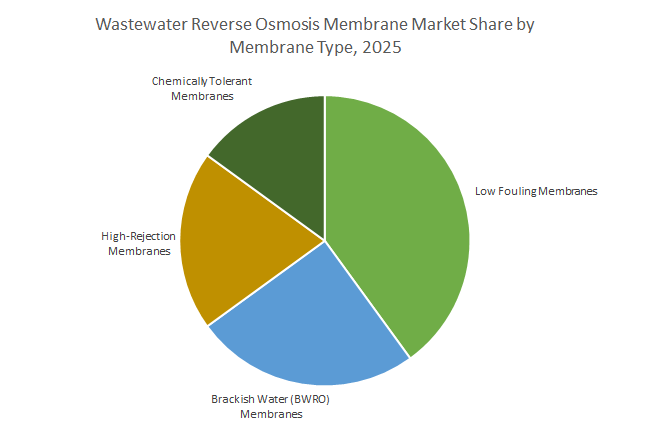
Market Share by Membrane Type
Low Fouling Membranes are projected to command the largest share at 40% due to their ability to resist organic and biological fouling, the most critical operational challenge in wastewater treatment. Brackish Water RO (BWRO) membranes will hold around 25%, serving less aggressive effluents or second-stage treatment. High-Rejection Membranes, with a 20% share, are indispensable for applications requiring >99.5% salt removal, particularly in potable reuse and compliance with stringent discharge standards. Chemically Tolerant Membranes will account for 15%, providing essential resistance to aggressive effluents such as textile, pharmaceutical, and landfill leachate wastewater. The dominance of low-fouling solutions underscores the market’s prioritization of operational reliability, while specialized membranes address extreme industrial conditions.
Market Share by Wastewater Source
Industrial Wastewater Treatment will dominate the market with approximately 65% share, driven by zero-liquid discharge (ZLD) regulations, escalating disposal costs, and corporate sustainability commitments. Within this category, industries such as pharmaceuticals, textiles, oil & gas, and microelectronics face highly diverse contamination challenges ranging from heavy metals to solvents and dyes, necessitating advanced RO configurations. Municipal Wastewater Reuse will capture 30%, expanding rapidly due to rising demand for irrigation, aquifer recharge, and potable reuse in water-stressed urban centers. Industrial applications drive the bulk of volume, but municipal reuse projects are emerging as the flagship growth driver, shaping public policy and infrastructure investment.
Market Share by System Integration & Process
Integrated Membrane Systems (IMS), combining RO with pre-treatment processes such as microfiltration (MF) or ultrafiltration (UF), will account for nearly 85% of the market. This dominance reflects the industry’s recognition that successful wastewater RO treatment depends heavily on robust pre-treatment, which reduces fouling, increases recovery rates, and extends membrane life. Standalone RO systems will represent just 15%, mostly in niche applications where influent wastewater is already highly polished or where retrofits limit pre-treatment integration. Despite higher upfront capital costs, IMS configurations deliver superior long-term return on investment (ROI), making them the preferred design in both municipal and industrial projects worldwide.
Wastewater RO Membrane Regulatory and Water-Reuse Framework
Water-reuse regulation affects wastewater RO demand primarily by defining finished-water quality, treatment barriers, monitoring requirements and permissible end uses rather than prescribing RO for every application. In the United States, wastewater reuse remains governed through combinations of federal environmental law and state reuse frameworks, with technology selection determined by source water, intended end use and project-specific permitting.
California's Direct Potable Reuse regulations became effective October 1, 2024 and apply to public-water systems that elect to develop DPR projects. The rules establish treatment, monitoring and operational requirements without compelling utilities to implement DPR. The State Water Board's Direct Potable Reuse regulatory framework provides the adopted rulemaking record and effective date.
Federal policy also places greater emphasis on recycled water for industrial and technology-sector use. EPA launched Water Reuse Action Plan 2.0 in April 2026, with actions covering manufacturing, data-center cooling, power and other reuse applications. The plan supports wastewater recycling as a water-supply strategy but does not designate reverse osmosis as a universal treatment requirement. EPA's Water Reuse Action Plan 2.0 describes its industrial and technology-sector focus.
European water-reuse policy similarly establishes water-quality and risk-management frameworks rather than an RO technology mandate. Wastewater RO is commercially relevant where reclaimed-water specifications require substantial removal of dissolved salts, persistent organics or trace constituents beyond the capability of upstream biological and solids-removal processes.
China: Regulatory Push and Industrial Adoption of Reverse Osmosis Membranes
China’s wastewater reverse osmosis membrane market is strongly influenced by stringent environmental regulations and strategic government investments. The Ministry of Ecology and Environment (MEE) enforces strict guidelines on industrial wastewater discharge, compelling companies to adopt advanced reverse osmosis membrane technologies to meet compliance standards. In 2024, Chinese researchers developed hollow-fiber ultrafiltration membranes with enhanced antifouling properties, which are increasingly integrated as pretreatment for RO systems in membrane bioreactors (MBRs), reducing maintenance costs and improving efficiency. The textile industry is also a key application area, with membrane-based recycling systems recovering over 95% of process water from dyeing effluents containing high total dissolved solids (TDS), showcasing RO membranes’ critical role in industrial water reuse. Government-backed investments in zero-liquid discharge (ZLD) systems further bolster demand for high-performance RO membranes across China’s industrial sector.
Saudi Arabia: Desalination Infrastructure and Energy-Efficient RO Technologies
Saudi Arabia is a leading market for wastewater reverse osmosis membranes, driven by large-scale desalination projects and energy-efficient innovations. ACWA Power’s Jubail 3A desalination plant, an independent water project (IWP), produces 600,000 cubic meters of freshwater daily using advanced RO membranes, highlighting the country’s infrastructure-driven demand. The Saline Water Conversion Corporation (SWCC) pioneers energy-efficient seawater reverse osmosis (SWRO) membranes, exemplified by the Yanbu 4 plant producing 450,000 cubic meters of water per day. Government initiatives by the Saudi Water Partnership Company (SWPC), such as the Rabigh 4 project, reinforce the strategic adoption of RO-based membrane solutions, cementing Saudi Arabia’s position as a hub for large-scale, membrane-driven water treatment.
United States: Government Funding and Private Sector Innovation
The United States wastewater reverse osmosis membrane market benefits from robust government funding, academic research, and private sector deployment. The Bipartisan Infrastructure Law allocates over $50 billion to the EPA for upgrading drinking water, wastewater, and stormwater infrastructure, including advanced RO membrane technologies to address emerging contaminants like PFAS. NSF-funded research centers focus on innovative membranes for water purification, chemical separations, and biopharmaceutical processing, driving technical advancements. Companies like Veolia Water Technologies have deployed reverse osmosis systems to deliver PFAS-compliant water to over 140,000 Americans, demonstrating the integration of advanced RO membranes in municipal and industrial applications.
India: Policy Support and Strategic Infrastructure Investments
India’s wastewater reverse osmosis membrane market is growing due to government programs, urban infrastructure development, and industrial adoption. The Jal Jeevan Mission and the Department of Science & Technology’s Water Technology Initiative promote R&D in filtration technologies, including reverse osmosis, to ensure affordable access to safe water in rural areas. The Ghaziabad Nagar Nigam raised ₹150 crore through India’s first Certified Green Municipal Bond for a Tertiary Sewage Treatment Plant (TSTP) utilizing RO and other membrane technologies for wastewater reuse. Additionally, VA TECH WABAG’s seven-year O&M contract for the 110 MLD SWRO Nemmeli Desalination Plant in Chennai, valued at INR 415 crores, underscores significant investment in membrane-based water infrastructure, highlighting the growing reliance on RO membranes for industrial and municipal applications.
Japan: Academic and Corporate Leadership in RO Membranes
Japan is a key player in the wastewater reverse osmosis membrane market, leveraging both academic excellence and corporate innovation. The Membrane Engineering Group at Kobe University continues to develop novel functional membranes for water and atmospheric applications, including RO systems. Toray Industries, a global leader, supplies high-performance RO membranes for large-scale projects such as desalination plants in Saudi Arabia, where these membranes often serve as essential pretreatment or main filtration units. Japan’s focus on research and global deployment reinforces its leadership in RO membrane technology for water and wastewater applications.
Australia: Water Recycling and Advanced RO Research
Australia faces chronic water stress, driving strong adoption of wastewater reverse osmosis membranes. Facilities like the Sydney Water Wollongong Water Resource Recovery Facility employ integrated microfiltration and RO systems to treat wastewater for irrigation and industrial reuse. Academic research at Victoria University’s Institute for Sustainable Industries and Liveable Cities (ISILC) focuses on increasing water recovery from desalination processes and minimizing membrane fouling and scaling, critical challenges in sustainable water management. These initiatives position Australia as a leader in membrane-based water recycling and advanced RO technology adoption.
Competitive Landscape: Key Players in the Wastewater RO Membrane Market
The wastewater RO membrane market is highly competitive, with leading players focusing on technological innovation, sustainability strategies, and large-scale project execution. Below is an in-depth look at the key companies shaping the industry:
The competitive landscape includes global wastewater RO membrane manufacturers, low-fouling membrane suppliers, industrial water-reuse technology companies and integrated wastewater-treatment providers. Product differentiation centers on fouling resistance, salt and trace-contaminant rejection, operating pressure, feed-spacer architecture, active membrane area, cleaning tolerance and performance under variable wastewater composition.
Low-Fouling and Wastewater-Reuse RO Membrane Suppliers
DuPont Water Solutions, Nitto Denko/Hydranautics, MANN+HUMMEL, Toray Industries, NanoH2O, Vontron and KeenSen maintain RO technologies applicable to wastewater reuse or difficult feedwater. Product portfolios span low-fouling spiral-wound elements, wastewater-ready BWRO membranes, high-rejection products and high-pressure membranes.
Commercial differentiation in this segment is increasingly application-specific. Municipal effluent treatment emphasizes stable normalized flow and manageable differential pressure, while refinery, textile and leachate treatment places greater weight on foulant resistance and repeated chemical cleaning.
High-Rejection and High-Recovery Membrane Platforms
DuPont, Toray, Nitto/Hydranautics and NanoH2O participate in applications requiring high solute rejection or operation at elevated recovery and pressure. Semiconductor wastewater reuse creates demand for stronger rejection of trace neutral molecules, while industrial MLD/ZLD increases demand for high-pressure and brine-concentration membranes.
High-recovery membrane suppliers also compete around compatibility with existing pressure-vessel infrastructure, active area, pressure rating and the concentration range achievable before thermal treatment becomes necessary.
Integrated Wastewater Reuse Technology Providers
Veolia Water Technologies, SUEZ and Xylem participate at system level through wastewater-treatment trains incorporating membrane pretreatment, RO, process integration and operating services. Their role differs from companies focused primarily on membrane-sheet or spiral-wound element manufacture.
Kovalus Separation Solutions, AXEON Water Technologies and Applied Membranes add membrane, element, OEM or integrated-separation capabilities serving industrial and commercial water-treatment applications.
Porter’s Five Forces, SWOT Profile, Market Share, Scenario Forecasts, Market Ecosystem, Company Ranking, Market Dynamics, Industry Benchmarking
Companies
DuPont Water Solutions, Toray Industries, Nitto Denko / Hydranautics, NanoH2O, MANN+HUMMEL Water & Fluid Solutions, Kovalus Separation Solutions, Vontron Technology, KeenSen Technology, AXEON Water Technologies, Applied Membranes, Veolia Water Technologies, SUEZ, Xylem, Toyobo
Countries
US, Canada, Mexico, Germany, France, Spain, Italy, UK, Russia, China, India, Japan, South Korea, Australia, South East Asia, Brazil, Argentina, Middle East, Africa
Europe (Germany, UK, France, Spain, Italy, Russia, Rest of Europe)
Asia Pacific (China, India, Japan, South Korea, Australia, South East Asia, Rest of Asia)
South America (Brazil, Argentina, Rest of South America)
Middle East and Africa (Saudi Arabia, UAE, Rest of Middle East, South Africa, Egypt, Rest of Africa)
Top Companies in the Wastewater Reverse Osmosis Membrane Industry include-
DuPont Water Solutions
Toray Industries
Nitto Denko / Hydranautics
NanoH2O
MANN+HUMMEL Water & Fluid Solutions
Kovalus Separation Solutions
Vontron Technology
KeenSen Technology
AXEON Water Technologies
Applied Membranes
Veolia Water Technologies
SUEZ
Xylem
Toyobo
*- List not Exhaustive
Research Coverage
This report investigates the global wastewater RO membrane market, delivering analysis reviews on how water-scarcity risk, reuse mandates, and industrial effluent complexity are accelerating RO adoption from MLD/ZLD plants to potable-reuse trains. It highlights breakthroughs in low-pressure/high-permeance sheets, chemically tolerant layers, and anti-fouling surface chemistries that cut OPEX and extend cleaning intervals, while digital design tools improve staging, recovery, and brine-management economics. The study also highlights policy tightening (effluent guidelines, reuse targets), integrated pretreatment (MF/UF) that stabilizes SDI and protects RO, and emerging contaminant control (PFAS, pharmaceuticals, microplastics) shaping specification trends. With stack-level reliability metrics and country rollouts, USDAnalytics converts technology performance into bankable outcomes making this report an essential resource for utilities, EPCs, and industrial owners planning resilient wastewater-to-resource projects. Scope Includes-
Segmentation: By Membrane Type (Wastewater-Ready BWRO; Low Fouling; High-Rejection; Chemically Tolerant); By Wastewater Source (Municipal Reuse; Industrial Wastewater Food & Beverage, Power, Microelectronics, Pharmaceuticals, Textiles, Landfill & Leachate, Oil & Gas); By System Integration & Process (Standalone RO Systems; Integrated Membrane Systems)
Geographic Scope: Analysis spans 25+ countries across North America, Europe, Asia Pacific, Latin America, the Middle East & Africa.
Time Frame: Historic data 2021–2024 and forecasts 2025–2034.
Companies: Profiles of 15+ companies (e.g., DuPont, SUEZ, Veolia, Toray, Pentair, Xylem, Asahi Kasei, Kubota, LG Chem, Dow, MANN+HUMMEL, Evoqua, Hydranautics/Nitto, Koch, VA TECH WABAG)
Methodology
We employ a mixed-methods design: primary interviews with utilities, industrial operators, OEMs/EPCs, and regulators; and secondary research across standards, patents, filings, and peer-reviewed literature. Market sizing blends top-down triangulation (installed base, retrofit cycles, reuse mandates, disposal cost curves) with bottom-up BOM models for RO trains (element area, flux, TMP, recovery, specific energy, cleaning frequency, replacement intervals). Forecasts incorporate learning rates for sheet manufacturing, pretreatment quality (SDI/turbidity) sensitivity, electricity/chemicals pricing, and policy cadence for discharge/reuse. Competitive benchmarking evaluates membrane classes on normalized permeability, salt/TOC rejection, fouling propensity, chemical/thermal envelopes, and lifecycle cost per 1,000 m³. All results pass cross-validation against commissioning data, project announcements, and scenario stress-tests (PFAS compliance, high-TDS leachate, textile dyes).
Deliverables:
Comprehensive Market Research Report (PDF and Excel) with detailed tables, charts, and interactive visualizations.
Country-Specific Forecasts & Analysis.
Segment-Wise Revenue Forecasts (2026–2034).
Competitive Analysis, Benchmarking, and SWOT Profiles.
Recent Developments & Innovation Tracker.
Executive Summary & Analyst Commentary.
Post-Purchase Analyst Support for Client-Specific Questions and Custom Data Requirements.
Table of Contents: Wastewater Reverse Osmosis Membrane Market
1. Executive Summary
1.1. Market Highlights
1.2. Key Insights for Stakeholders
1.3. Global Market Snapshot
2. Wastewater Reverse Osmosis Membrane Market Outlook (2025–2034)
2.1. Introduction: Growth Drivers and Industry Transformation
2.2. Market Valuation and Growth Projections (2025–2034)
RO provides a molecular-level barrier that removes dissolved salts and emerging contaminants (PFAS, APIs, microplastics) beyond what media or biological polishing can achieve. For plants targeting MLD/ZLD or potable-reuse, RO stabilizes effluent quality irrespective of upstream fluctuations, enabling regulatory compliance and water-security ROI when freshwater is scarce or costly.
Wastewater feeds demand robust MF/UF pretreatment to control SDI, colloids, and bioburden. IMS architectures cut cleaning frequency, improve recovery, and extend element life lowering total cost of ownership. Though capex is higher, lifecycle economics favor IMS through reduced energy, chemicals, and downtime across multi-year horizons.
Tightening effluent guidelines and reuse targets push operators toward advanced treatment trains with RO to meet salts, nutrients, and contaminant caps. Penalties and consent orders elevate compliance risk, while incentives for reuse reduce freshwater withdrawals together accelerating RO deployment in textiles, microelectronics, power, and municipal reuse schemes.
Prioritize normalized permeability (LMH/bar), salt/TOC rejection, guaranteed SDI at RO inlet, clean-in-place recovery, and element lifetime under site-specific chemistry. Evaluate energy at target recovery (kWh/m³), brine-management strategy, and condition-based monitoring (fouling indices, differential-pressure trends). Benchmark suppliers on cost per 1,000 m³ over the full membrane life, not just capex.