
Advances in electrochemical membranes, ultrapure-water systems, biopharmaceutical filtration and industrial liquid treatment are connecting material performance with application-specific operating requirements.
Membrane technologies are increasingly assessed through their performance within complete industrial and biopharmaceutical processes rather than through isolated material specifications. Ionic conductivity, membrane permeability, chemical resistance and particle-retention characteristics remain essential technical parameters, but their commercial relevance depends on operating stability, process efficiency, product quality and validated performance under application-specific conditions.
Recent developments across ion exchange membranes, electrodeionization, polytetrafluoroethylene (PTFE) membranes, medical membranes and liquid filtration illustrate different aspects of this transition. Manufacturers are introducing specialized membrane formulations, integrated filtration equipment and modular purification systems while expanding facilities for application testing and production.
The relationship between material characteristics and process performance is particularly important in semiconductor manufacturing, pharmaceutical processing, electrochemical energy technologies and industrial water reuse. Although these industries share requirements for consistent separation performance, their contaminant profiles, qualification procedures and operating environments differ substantially.
Application Requirements Define High-Purity Separation Performance
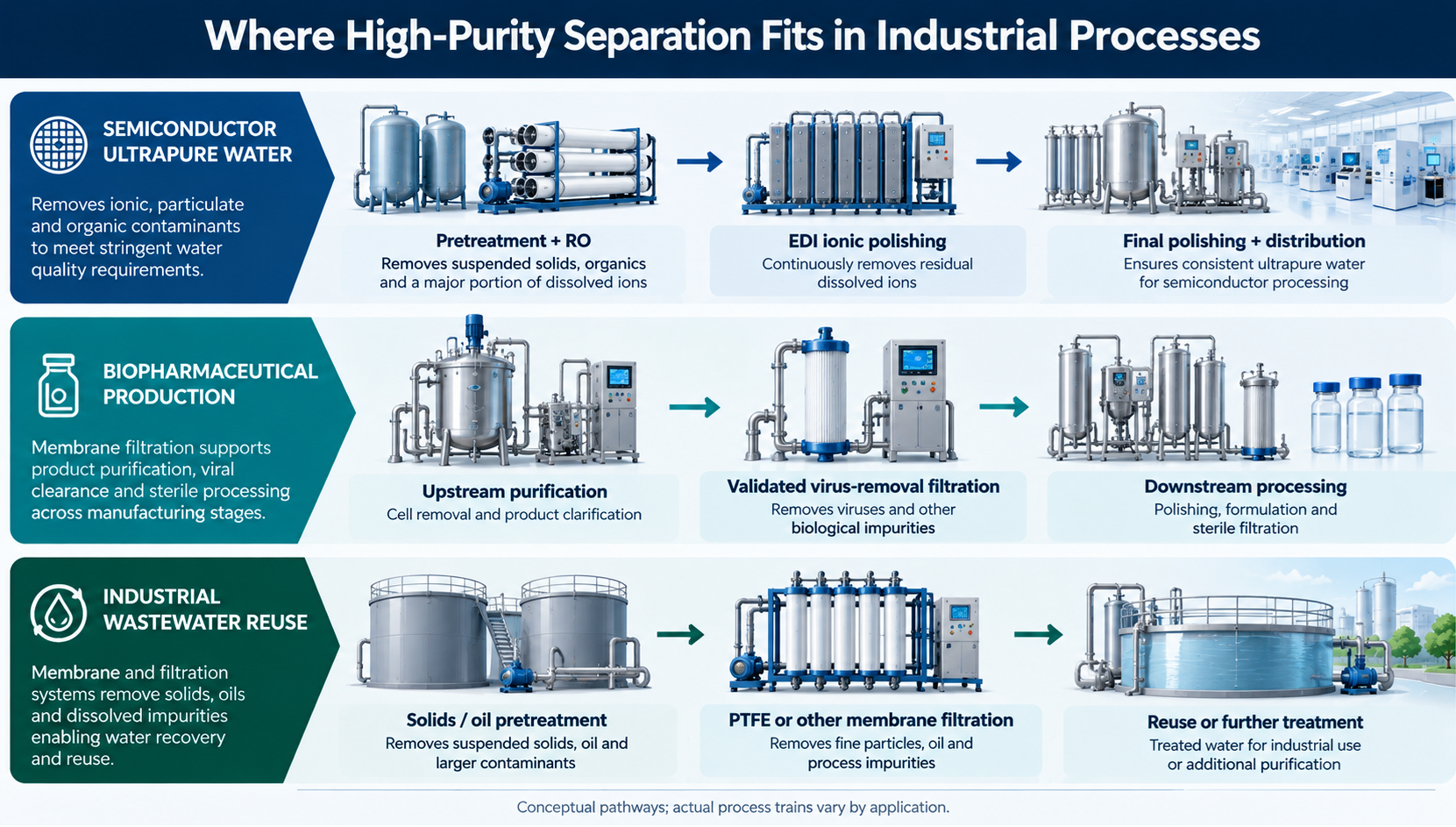
High-purity separation encompasses multiple technologies that address distinct chemical, physical and biological requirements. In semiconductor manufacturing, ultrapure-water production requires control of dissolved ions, particles, organic contaminants and other impurities that can affect wafer processing. Electrodeionization provides continuous ionic polishing within a larger purification system, while reverse osmosis, additional polishing processes and distribution controls address other water-quality parameters.
Biopharmaceutical manufacturing places different demands on membrane technology. Protein purification and virus-removal filtration require membranes capable of achieving defined biological retention while maintaining acceptable product recovery and process throughput. Sterilizing-grade filtration must satisfy separate microbial-retention and process-integrity requirements.
Industrial wastewater treatment introduces another operating environment, where membrane systems encounter suspended solids, oils, variable feedwater chemistry and potentially high contaminant-loading conditions. Chemical resistance, membrane wettability, fouling behaviour and cleaning compatibility can influence water recovery and equipment service life.
The position of a membrane within these processes is therefore as important as its intrinsic material characteristics. A membrane designed for aqueous industrial wastewater cannot be evaluated using the same performance criteria as an electrochemical membrane or a biopharmaceutical virus-removal filter.
Figure 1. How Separation Technologies Integrate into High-Purity Processing
Ion Exchange Membranes and Electrodeionization Connect Electrochemical Performance with System Integration
Electrochemical separation illustrates how membrane properties influence operating conditions beyond the material itself. In ion exchange membrane systems, ionic selectivity and electrical resistance affect separation efficiency, while membrane swelling, chemical degradation and mechanical instability can influence operating life and equipment reliability.
These relationships are particularly significant in hydrogen electrolysis, where membrane behaviour is influenced by electrode interfaces, current density, electrolyte composition and operating temperature. Material conductivity alone does not establish the long-term efficiency or durability of an assembled electrochemical cell.
In June 2026, Evonik opened an anion exchange membrane application technology center in Shanghai to evaluate its DURAION membranes under representative electrolysis conditions. The facility includes single-cell and demonstration-scale testing capabilities for membranes manufactured commercially in Marl, Germany. The development connects polymer manufacturing with application-specific performance assessment, particularly the integration of membrane materials into complete electrochemical assemblies.
The commercial requirements differ between chlor-alkali electrolysis, electrodialysis and hydrogen production. Membrane replacement frequency, electrical consumption and chemical stability depend on the specific operating environment, creating distinct qualification requirements within the broader ion exchange membranes market.
Electrodeionization represents a separate application of electrically driven ion transport. Continuous EDI combines ion exchange resins, selective membranes and an electrical field to remove residual dissolved ions from pretreated water. Its performance depends on feedwater chemistry, pretreatment effectiveness, electrical conditions and the design of the complete purification system.
In June 2026, QUA, an Aquatech company, introduced FEDI GIGA Q-Connect, a pre-engineered modular arrangement combining multiple EDI stacks within a common assembly. The configuration uses three principal process headers for feedwater, product water and reject, reducing the piping and instrumentation requirements associated with individually connected stacks.
The development illustrates the importance of equipment integration in high-flow purification applications rather than introducing a new ionic separation mechanism. In semiconductor manufacturing, EDI contributes to ionic polishing but operates alongside additional processes controlling particles, organics and other contaminants.
The electrodeionization market therefore reflects demand for both ionic separation performance and integrated ultrapure-water equipment, particularly where continuous operation, water recovery and modular capacity influence process economics.
PTFE Membrane Technologies Translate Chemical Resistance into Industrial Operating Performance
PTFE membranes occupy a different technical position within high-purity processing. Expanded and other porous PTFE structures provide chemical resistance and controlled permeability, with membrane configuration and surface treatment determining suitability for different fluids and operating conditions.
PTFE's natural hydrophobicity supports gas filtration and protective venting, while hydrophilic surface modifications enable selected aqueous liquid-filtration applications. In industrial processing, membrane fouling, chemical-cleaning tolerance, pressure differential and contaminant concentration influence filtration performance and service intervals.
A documented example emerged in February 2026, when Sumitomo Electric commercialized a compact POREFLON membrane treatment system for industrial wastewater and waste liquids containing oil. The equipment uses chemically resistant PTFE membrane technology with hydrophilic surface treatment to support liquid clarification and recovery.
The manufacturer reported a reduction in waste-disposal volume of up to 90% under specified verification conditions involving waterjet cutting wastewater. The result reflects the complete treatment system and the composition of the tested process stream rather than a universal recovery rate for PTFE membranes.
The system was designed for treatment capacity of up to 5 m³ per day, depending on feedwater quality, and was adopted for a commercial industrial application. Its reported performance connects material properties with site-specific waste-liquid management and process-fluid recovery.
The application differs from expanded PTFE membranes used in electronic-device or battery-enclosure venting, where airflow and ingress protection are central performance parameters. These distinct requirements demonstrate the application breadth of the PTFE membrane market without implying that the same membrane configuration can serve every end-use environment.
Separation Performance Metrics Differ Across Technologies
Filtration efficiency, ionic conductivity and membrane permeability are not interchangeable performance indicators. Their relevance depends on the separation mechanism and the conditions under which the finished system operates.
The commercial implications also vary. Increased electrical resistance affects the energy required for electrochemical processes, while higher pressure differential can influence pumping energy and filter replacement intervals. In biological filtration, throughput must be evaluated alongside product recovery and validated retention.
Table 1. Application-Level Performance Measures and Commercial Variables Across Five Separation Technologies
|
Technology |
Critical operating variable |
Evidence used to assess performance |
Commercially relevant factor |
|
Ion exchange membranes |
Ionic resistance, selectivity and chemical stability |
Current efficiency, cell voltage, ionic crossover and membrane durability |
Electrical consumption, component life and electrochemical operating stability |
|
Electrodeionization |
Feedwater ionic load, silica and dissolved CO₂ |
Product-water resistivity, recovery and sustained polishing performance |
Continuous operation, pretreatment requirements and module servicing |
|
PTFE membranes |
Surface wettability, contaminant loading and chemical exposure |
Permeate flux, retention, pressure differential and cleaning tolerance |
Filtration capacity, cleaning frequency and membrane operating life |
|
Medical membranes |
Biological product characteristics or blood-solute composition |
Viral-retention validation, protein recovery or dialysis clearance, according to application |
Batch throughput, product retention, clinical performance and qualified consumables |
|
Liquid filtration |
Particle loading, adsorption demand and fluid characteristics |
Filtrate quality, differential pressure, contaminant-holding capacity and breakthrough behaviour |
Consumable replacement, production continuity and process-fluid quality |
Source: USDAnalytics technical analysis. The measures are application-specific and are not intended as a cross-technology performance ranking.
Medical Membranes Connect Biological Retention with Process and Clinical Validation
Medical membranes require performance evidence that extends beyond permeability and conventional particle filtration. In biopharmaceutical manufacturing, virus-removal membranes are used within validated purification processes, while clinical dialysis membranes facilitate selective solute transfer during extracorporeal blood treatment.
The qualification requirements for these applications differ substantially. Virus filtration is assessed through viral-retention performance, process compatibility and product recovery. Dialysis membrane performance involves solute clearance, albumin retention, ultrafiltration characteristics and biological compatibility with blood.
In October 2024, Asahi Kasei introduced Planova FG1, a hydrophilic modified polyethersulfone hollow-fiber membrane filter for virus removal during biopharmaceutical manufacturing. The company reported approximately seven times the water flux of its earlier Planova BioEX product under specified comparison conditions.
The Planova FG1 development is significant because the manufacturer evaluated filtration performance and viral retention across selected processing conditions. The reported water-flux advantage cannot be interpreted independently as an equivalent improvement in protein-processing throughput for every formulation.
In September 2026, Asahi Kasei Bioprocess introduced its VANTIJ SU-VFC Benchtop system for automated, single-use virus filtration in laboratory and process-development applications. The platform accommodates Planova 35N filters with effective membrane areas of 0.12 m² and 0.3 m². It illustrates how established membrane products can be incorporated into different equipment configurations with process-control and reporting capabilities.
Clinical applications follow a separate commercialization pathway. In August 2026, Nipro launched ELISIO-HX in the United States following FDA 510(k) clearance. The dialyzer uses an engineered PES membrane intended to increase the clearance of larger middle-molecular-weight uremic toxins while controlling albumin loss.
These developments reflect the different application requirements within the medical membranes market. Biopharmaceutical filtration performance is evaluated within the pharmaceutical manufacturing process, whereas finished dialysis devices operate under clinical performance and medical-device quality requirements.
From Material Characterization to Application-Level Evidence
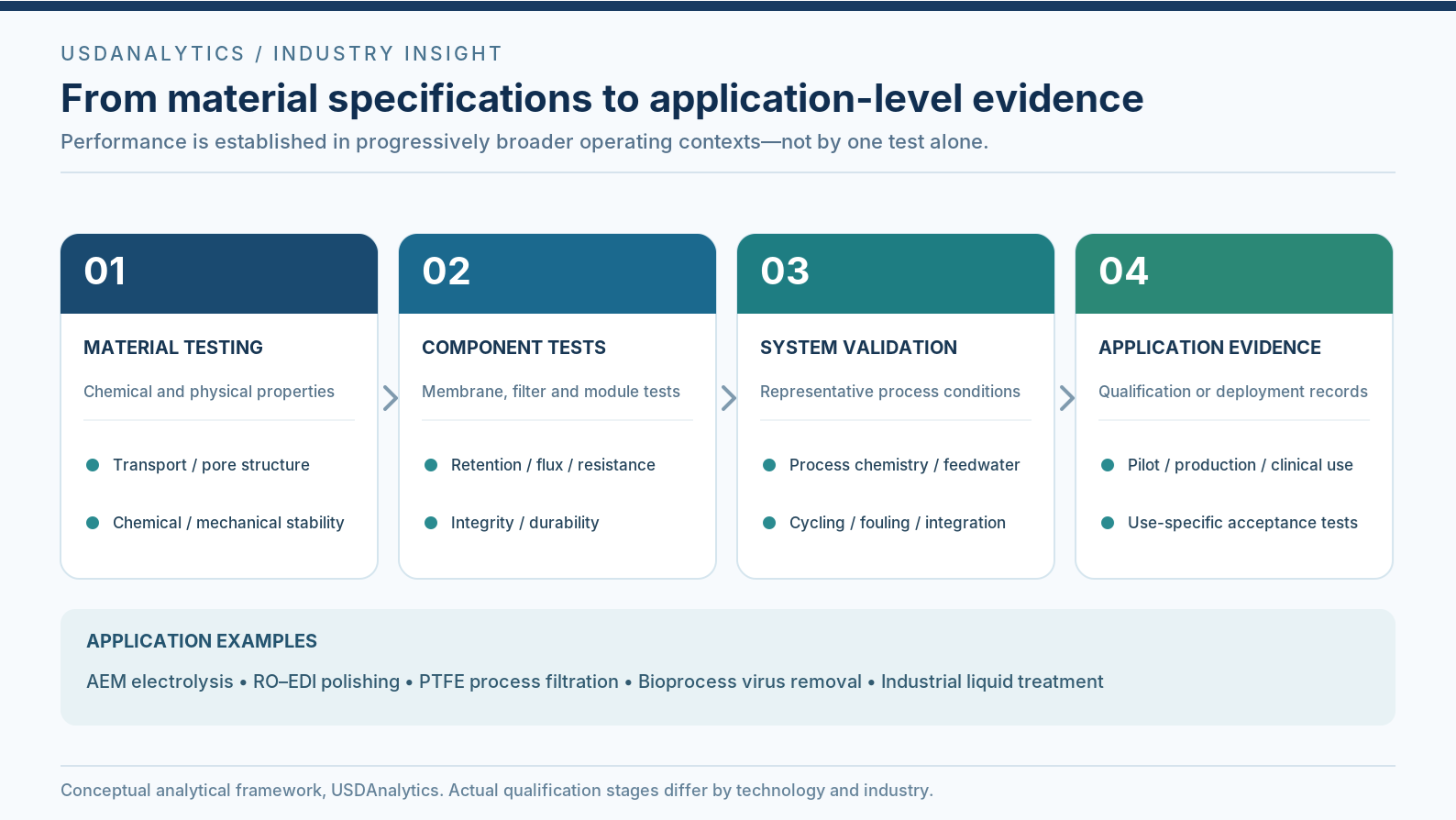
The progression from laboratory membrane properties to commercial use involves several forms of technical evidence. Material characterization establishes chemical and physical attributes, while component testing examines filtration or electrochemical performance under defined conditions. System-level validation introduces representative fluids, equipment configurations, operating cycles and process requirements.
Application evidence can then include documented qualification, pilot installations, production use or regulated clinical-device clearance, depending on the technology. These stages are not identical across industrial water systems, electrochemical equipment and medical devices.
Evonik's application-testing infrastructure and Asahi Kasei's automated virus-filtration platform represent different points within this broader qualification framework. Neither manufacturer development alone establishes an industry-wide qualification period or guarantees commercial adoption.
Figure 2. From Material Specifications to Application-Level Evidence
Industrial Liquid Filtration Connects Media Performance with Manufacturing Scale
Industrial liquid filtration involves different separation mechanisms, including depth filtration, adsorptive filtration, mechanical filtration and membrane-based purification. The performance of individual filtration media must be evaluated against process-fluid composition, contaminant-loading conditions and the requirements of downstream manufacturing equipment.
Depth filters, for example, can combine particle retention with adsorptive removal of selected impurities. Their operating performance is influenced by media structure, adsorbent loading, fluid compatibility and pressure differential across the filtration assembly.
In April 2026, Eaton introduced BECO CARBON ACF 04, an activated-carbon depth filtration medium containing 1,000 g/m² of immobilized activated carbon. The material is intended for selected pharmaceutical, chemical, food and beverage applications involving discoloration, organic impurities and other adsorbable constituents.
Eaton offers the BECO CARBON filtration media in different formats, including filter sheets and stacked-disc configurations. The development illustrates how a specialized filtration material can be incorporated into equipment formats with different processing capacities. Filter-media composition is only one part of performance qualification, alongside process compatibility, filtration area and contaminant-loading behaviour.
Large-scale water-reuse infrastructure introduces different system requirements. In July 2025, Veolia announced the Vitória Water Reclamation Station project in Brazil, designed to reclaim municipal wastewater for industrial use.
The planned facility has a treatment capacity of 450 litres per second, equivalent to approximately 38,880 m³ per day, and targets recovery of 85% of the wastewater processed from the Camburi basin. Its treatment configuration incorporates membrane bioreactor technology and reverse osmosis.
This project illustrates the integration of multiple filtration and separation technologies to achieve industrial water-quality requirements. The announced treatment capacity represents a planned facility specification, rather than verified operational output.
The broader liquid filtration market encompasses both consumable filtration media and integrated treatment equipment, with commercial requirements varying according to process scale, contaminant characteristics, product-water quality and system operating conditions.
Manufacturer Developments Reflect Different Commercialization Stages
Manufacturer activity during 2024–2026 spans new membrane products, filtration-system launches, application-testing facilities, material certifications and planned manufacturing capacity.
These developments represent different types of commercial evidence. A product launch establishes market availability, while application testing provides performance information under defined conditions. A manufacturing expansion indicates planned or additional production capability, but does not independently demonstrate increased customer adoption.
The distinction is important when interpreting manufacturer-reported technical performance. Product-specific results must remain associated with the relevant test conditions, and projected milestones must be separated from completed production or commercial deployment.
Table 2. Verified Membrane and High-Purity Filtration Developments, 2024–2026
|
Date |
Manufacturer |
Development |
Commercialization evidence and status |
|
Oct. 2024 |
Planova FG1 virus-removal filter |
Commercial launch; approximately 7× water flux versus Planova BioEX under specified conditions |
|
|
Jul. 2025 |
Vitória water-reuse project |
Planned 450 L/s treatment capacity and 85% recovery target; not verified operational output |
|
|
Jul. 2025 |
Fourth Planova hollow-fiber spinning plant |
Planned manufacturing capacity; operations targeted for January 2030 |
|
|
Jan. 2026 |
Expanded ISCC PLUS-certified materials |
Approximately 40–60% lower fossil-based material content in Sartopore Evo filters; not a carbon-emissions figure |
|
|
Feb. 2026 |
Compact POREFLON liquid-treatment system |
Commercial sales commenced; up to 90% lower waste-disposal volume under specified verification conditions |
|
|
Apr. 2026 |
BECO CARBON ACF 04 |
Commercial filter-media launch; 1,000 g/m² immobilized activated carbon |
|
|
Jun. 2026 |
Shanghai AEM application center |
Facility opened for single-cell and demonstration-scale testing of DURAION membranes |
|
|
Jun. 2026 |
FEDI GIGA Q-Connect |
Modular EDI product launch using three common process headers |
|
|
Sep. 2026 |
VANTIJ SU-VFC Benchtop |
Automated laboratory-scale virus-filtration platform accommodating selected Planova 35N filters |
Source: Original manufacturer announcements, 2024–2026. Quantitative figures are manufacturer-reported and relate to different operating conditions, products and performance measures.
Technical Standards Establish Application-Specific Qualification Requirements
The evaluation of separation technologies is influenced by standards and regulatory frameworks that differ substantially between semiconductor processing, pharmaceutical manufacturing and fluoropolymer applications.
For semiconductor manufacturing, the SEMI F63-1224 Guide for Ultrapure Water Used in Semiconductor Processing provides guidance on water-quality specifications and operating-control parameters. EDI contributes to ionic polishing, while complete ultrapure-water systems incorporate additional treatment and monitoring processes for particles, organics and other contaminants.
Pharmaceutical water quality operates under different requirements. The European Medicines Agency's Guideline on the Quality of Water for Pharmaceutical Use, effective February 2021, addresses water-grade expectations for medicinal-product manufacturing. It reflects European Pharmacopoeia provisions permitting appropriately qualified technologies other than distillation for Water for Injection production. EDI is not universally mandated as an individual purification technology.
Biopharmaceutical virus filtration is assessed through the applicable viral-safety framework. The FDA's ICH Q5A(R2) guidance, finalized in January 2024, addresses viral-risk evaluation and clearance validation for specified biotechnology-derived products. Membrane retention must be interpreted within validated manufacturing conditions.
Fluorinated membrane materials are subject to a separate regulatory process. In March 2026, the European Chemicals Agency advanced its scientific evaluation of the proposed broad PFAS restriction, including consideration of industrial uses, alternatives and potential derogations. The ECHA PFAS restriction process had not established a general enacted prohibition on PTFE membrane technologies as of October 2026.
Regulatory compliance consequently depends on the intended application, relevant quality requirements and validated performance of the complete process or finished device, rather than a common membrane-material specification.
Application-Level Performance Defines Commercial Differentiation
The manufacturer developments examined across electrochemical membranes, ultrapure-water systems, PTFE filtration, medical membranes and liquid filtration demonstrate that commercialization involves more than improvements in intrinsic material properties.
System integration influences equipment configuration, operational continuity and the relationship between membrane performance and downstream processing. Application validation establishes whether membrane characteristics remain suitable under representative industrial, biological or electrochemical conditions. Manufacturing capabilities influence the availability and consistency of specialized membrane components, while regulatory requirements establish different qualification boundaries for pharmaceutical, medical and industrial uses.
The commercial value of membrane technology is therefore linked to its ability to deliver the required separation function within a specific operating environment. Electrical resistance, product-water resistivity, viral retention, contaminant-loading capacity and membrane durability remain distinct measures, but each affects equipment performance and the economics of its intended application.
The evidence from 2024–2026 illustrates an increasingly application-specific approach to membrane development, filtration-system integration and commercial qualification across high-purity industrial and healthcare processes.