Electrodeionization Market Size, Growth Drivers and Industry Outlook
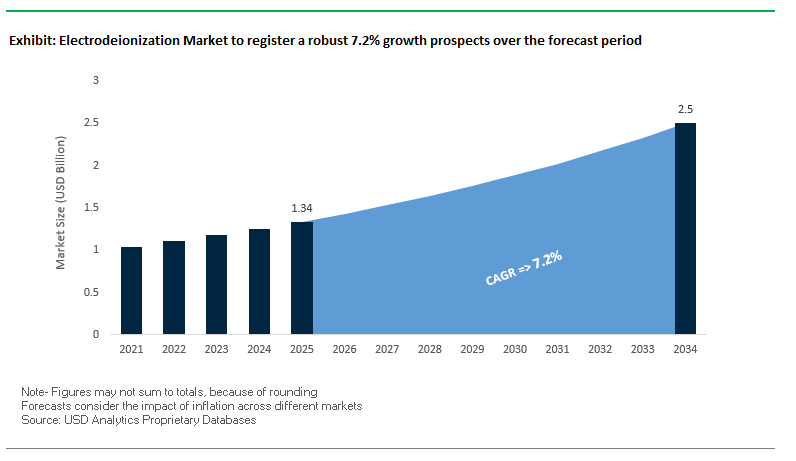
The global Electrodeionization (EDI) Market is projected to expand from USD 1.34 billion in 2025 to USD 2.5 billion by 2034, registering a CAGR of 7.2%. Market demand is supported by high-purity and ultrapure water production across semiconductor manufacturing, pharmaceutical processing, power generation and specialized industrial applications. Continuous electrodeionization (CEDI) systems are increasingly incorporated into integrated water-treatment configurations where consistent ionic purity, reduced chemical regeneration requirements and uninterrupted process-water availability influence operating economics.
Electrodeionization combines ion exchange resins, ion-selective membranes and direct-current electrical power to remove dissolved ionic contaminants from pretreated water. The process continuously regenerates the ion exchange media through electrically driven ion transport and water dissociation, reducing dependence on acid and caustic regeneration associated with conventional mixed-bed deionization. EDI typically follows reverse osmosis (RO), with feedwater quality, dissolved carbon dioxide, silica concentration and residual hardness influencing stack performance, electrical consumption and membrane operating life.
Semiconductor and microelectronics manufacturing represent major demand areas, where ultrapure water systems require stringent control of ionic impurities, particles, dissolved gases and organic contaminants. EDI contributes to ionic polishing within multistage purification systems, while downstream treatment and distribution processes address additional water-quality requirements. Pharmaceutical and biotechnology facilities employ EDI in purified-water generation systems, including configurations requiring sanitary construction and controlled microbial conditions. Power generation applications include high-purity boiler makeup water, where residual silica and dissolved ions can contribute to scaling and corrosion within steam-water circuits.
The competitive landscape encompasses EDI module manufacturers, ultrapure-water engineering specialists and integrated water-treatment system suppliers. Product differentiation is associated with membrane-stack architecture, feedwater tolerance, electrical efficiency, water recovery and application-specific qualification. Developments in modular high-flow systems, hot-water-sanitizable EDI modules and digitally monitored RO-EDI configurations are expanding the range of commercially available high-purity water technologies.
Electrodeionization Market Share and Key Industry Insights
Electrodeionization Market Size and Growth: The global EDI market is forecast to increase from USD 1.34 billion in 2025 to USD 2.5 billion by 2034, registering a CAGR of 7.2%.
Plate & Frame EDI Systems Lead by Type: Plate & frame configurations account for approximately 85% of the market in 2025, reflecting their established industrial application base, modular stack arrangements and widespread integration into high-purity water systems.
Mixed-Bed Resin Configurations Dominate: Mixed-bed resin designs represent approximately 75% of the market, supported by their role in simultaneous cation and anion removal and continuous electrochemical regeneration within EDI modules.
Ultrapure Water Production Represents the Largest Application: Ultrapure water production accounts for approximately 90% of market demand, with EDI used as an ionic polishing stage within multistep water-treatment systems serving high-purity industrial processes.
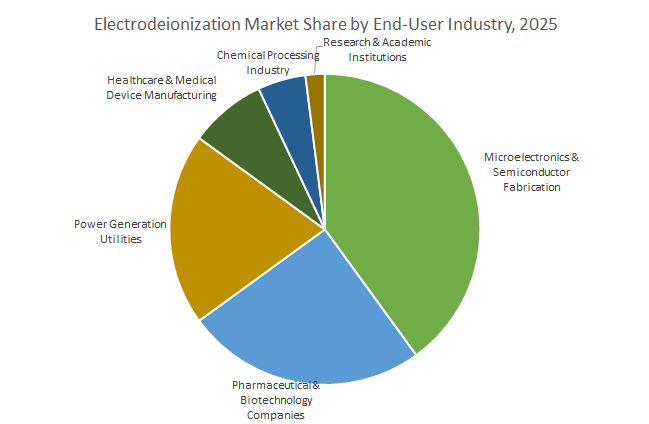
Semiconductor and Pharmaceutical Industries Drive End-Use Demand: Microelectronics and semiconductor manufacturing account for 40% of the market, followed by pharmaceutical and biotechnology applications at 25% and power generation at 20%.
Integrated RO-EDI Systems Influence Commercial Adoption: Continuous deionization eliminates periodic acid and caustic resin regeneration within EDI modules, while high-flow modular stacks, sanitary configurations and integrated process controls influence operating costs and equipment qualification.
Market Analysis: Recent Developments Shaping the Electrodeionization Industry
Recent developments in the electrodeionization industry have focused on high-flow module configurations, simplified system integration and the expansion of ultrapure-water engineering capabilities. Manufacturer announcements during 2024–2026 indicate continued differentiation between standalone EDI components and integrated water-treatment systems, particularly in semiconductor manufacturing, industrial boiler makeup and pharmaceutical purified-water applications.
In June 2026, QUA, an Aquatech company, introduced FEDI GIGA Q-Connect, a pre-engineered modular electrodeionization system designed for high-flow ultrapure-water and boiler-feed applications. The system integrates multiple FEDI GIGA stacks in a common rack-based assembly using three principal headers for feedwater, product water and reject streams. Its configuration reduces individual stack piping and electrical-interface complexity compared with separately assembled modules. QUA reported an existing industrial application in automotive manufacturing, while the modular architecture also addresses high-flow requirements in semiconductor, power generation and other advanced manufacturing environments. Standardized installation interfaces and removable stack arrangements are relevant to equipment delivery schedules, maintenance access and the engineering requirements of large-capacity EDI installations.
The development builds on QUA's established fractional electrodeionization portfolio, which uses differentiated electrical operating zones to manage ionic loading and feedwater variability. Its existing FEDI-Rx product family serves pharmaceutical and laboratory applications requiring sanitary configurations and hot-water sanitization. The company has documented FEDI-Rx operation at temperatures of approximately 80–85°C for sanitization, illustrating the different qualification requirements associated with pharmaceutical EDI compared with conventional industrial water-polishing systems.
In December 2025, Ecolab completed the acquisition of Ovivo's electronics ultrapure-water business, extending its technology and engineering presence in semiconductor water purification. The acquired operation continues under the Ovivo, Ultrapure Water+ by Ecolab brand, combining semiconductor-specific water-treatment capabilities with Ecolab's broader industrial water-management and service operations. The transaction is relevant to the competitive environment surrounding ultrapure-water treatment and recovery, including systems that may incorporate EDI polishing. The acquisition announcement did not identify a new EDI module or establish that every acquired installation uses electrodeionization.
Manufacturing capabilities within the EDI supply chain also expanded in April 2024, when QUA announced the commencement of production at its new membrane manufacturing facility in Pune, India. The company reported a fourfold increase in production capacity across its advanced membrane technology portfolio, which includes FEDI GIGA fractional electrodeionization systems and other filtration products. The facility incorporates automated manufacturing and process-monitoring technologies, together with an industrial wastewater recycling system designed around zero-discharge operations. The reported capacity increase applies to the manufacturing facility's broader membrane portfolio and is not a separately disclosed fourfold increase in EDI-only output.
In integrated industrial water treatment, Veolia Water Technologies has documented the commercial availability of its Terion S RO-CEDI product family, combining single-pass reverse osmosis with continuous electrodeionization on a standardized skid. Product documentation published in 2024 describes seven configurations with nominal flow capacities ranging from 110 to 4,000 litres per hour and product-water resistivity of up to 18 MΩ·cm, subject to feedwater and operating conditions. The system incorporates PLC-based controls and compatibility with Veolia's Hubgrade remote-monitoring platform, addressing equipment standardization and operational monitoring in laboratory, industrial and power-generation applications.
Key Trends in the Electrodeionization Market
Growing Demand for Ultrapure Water in High-Tech and Industrial Applications
The increasing dependence on ultrapure water in industries such as pharmaceuticals, semiconductors, and power generation is one of the most defining trends in the electrodeionization market. EDI technology delivers consistent production of ultrapure water with resistivity levels of up to 18 MΩ·cm, meeting the highest standards of wafer rinsing in semiconductor fabs and Water for Injection (WFI) in pharmaceutical manufacturing. Power generation plants also adopt EDI to prevent scaling and corrosion in boilers and turbines, thereby reducing downtime and maintenance costs. Companies like Veolia, through its E-Cell EDI stacks, have already demonstrated successful case studies in both microelectronics and power plants, underscoring the dominance of EDI in high-stakes industrial settings.
Shift Toward Chemical-Free and Sustainable Water Treatment Solutions
Environmental sustainability is pushing industries to adopt water purification methods that minimize hazardous chemical use. Unlike conventional ion exchange processes, electrodeionization eliminates the need for acid and caustic regeneration, making it inherently safer and more eco-friendly. The U.S. Department of Energy (DOE) highlighted a collaborative EDI process by Argonne National Laboratory and EDSEP Inc. that reduces chemical consumption by 90% and waste streams by over 50%. This shift toward green water purification solutions is a key factor propelling EDI adoption in industries under regulatory and environmental scrutiny.
Technological Advancements Driving Efficiency and Lower Energy Consumption
Continuous research and development in EDI technology is delivering groundbreaking innovations such as resin-wafer EDI (RW-EDI) and membrane-free EDI (MF-EDI). Studies published in Water Research X indicate that these advanced systems can operate at energy levels as low as 0.1–0.3 kWh/m³, making them highly competitive compared to traditional deionization methods. Enhanced fouling resistance, modular stack designs, and integration with reverse osmosis systems further improve EDI performance, reducing total cost of ownership and accelerating market penetration across industries that prioritize operational efficiency.
Expansion into New Applications Beyond Ultrapure Water
While EDI is primarily known as a polishing technology in ultrapure water production, its role is expanding into advanced wastewater treatment and niche chemical purification. Case studies from Aarhus University highlight the effectiveness of EDI in removing heavy metals such as chromium, copper, and cesium from industrial wastewater streams, including those from mining and electroplating operations. This demonstrates the versatility of EDI systems, opening new growth avenues in environmental remediation, industrial discharge management, and specialty chemical processing.
Emerging Opportunities Accelerating the Electrodeionization Market
Strong Adoption in Semiconductor and Electronics Manufacturing
The booming global semiconductor and Electronics Manufacturing industry presents the single largest opportunity for electrodeionization. Fabrication plants require ultrapure rinsewater at resistivity levels of 18.2 MΩ·cm, and even minor deviations can result in millions of dollars in losses due to rejected wafers. EDI’s continuous operation and elimination of downtime for regeneration make it the preferred technology for ensuring process reliability. With the ongoing expansion of semiconductor manufacturing capacity worldwide, demand for EDI systems is set to grow exponentially.
Pharmaceutical and Biotechnology Industries Embracing EDI for Compliance and Safety
The pharmaceutical and biotech sector provides significant opportunities for EDI adoption, especially for Water for Injection (WFI) and Purified Water applications that must meet cGMP, USP, and EP standards. By eliminating chemical regeneration, EDI simplifies compliance audits and enhances operator safety. Growing investment in biologics and advanced therapies further accelerates the sector’s reliance on reliable, chemical-free ultrapure water, positioning EDI as a critical enabler of future pharmaceutical manufacturing.
Rising Role of EDI in Power Generation and Energy Efficiency
The power generation sector represents another major opportunity, as high-purity water is critical for high-pressure boilers and turbines. The adoption of EDI minimizes scaling, corrosion, and unplanned shutdowns, directly improving plant efficiency. As utilities worldwide strive to maximize efficiency while meeting stricter environmental regulations, electrodeionization is positioned as a key solution for ensuring both operational reliability and compliance.
Expanding Scope in Wastewater Treatment and Environmental Remediation
A rapidly growing opportunity lies in the use of EDI for industrial wastewater treatment, particularly for industries facing stringent discharge standards. Its ability to selectively remove heavy metals and other contaminants gives it a role beyond ultrapure water, making it a valuable tool for sustainable industrial operations. With governments tightening wastewater discharge norms, EDI adoption is poised to accelerate in sectors such as mining, electroplating, and chemical processing.
Market Share Analysis of the Electrodeionization Market
Market Share by Type: Plate & Frame Dominates the Electrodeionization Industry
By 2025, Plate & Frame EDI devices are projected to capture nearly 85% of the market, while Spiral Wound systems account for the remaining share. Plate & Frame’s dominance is rooted in its unmatched reliability, robustness, and ability to consistently produce high-resistivity ultrapure water (16–18 MΩ·cm). Its scalability and tolerance to variations in feedwater quality make it indispensable for mission-critical applications such as semiconductor fabs and power plants. In contrast, Spiral Wound designs serve a specialized niche where compact form factor and lower initial costs outweigh their limitations in handling high scaling risk, positioning them as suitable for applications using already high-quality feedwater.
Market Share by Resin Type: Mixed-Bed Resin Leads Due to Efficiency
In terms of resin configuration, Mixed-Bed designs command 75% of the market as they deliver the most efficient ion exchange and electro-regeneration performance, closely mimicking the characteristics of a traditional mixed-bed polisher. They enable the production of consistently high-purity water required in sensitive industries. Meanwhile, Separated-Bed resin designs account for 25% of the market, used primarily in applications with unbalanced ion loads or specialized maintenance requirements. Although less common, Separated-Bed systems provide advantages in fouling resistance and targeted ion removal, making them strategically important in niche industrial processes.
Market Share by Application: Ultrapure Water Production is the Core Application
Electrodeionization is overwhelmingly driven by ultrapure water production, accounting for 90% of the market by 2025. Its ability to operate continuously without chemical regeneration has made it synonymous with UPW polishing across industries. Conventional water treatment represents 8% of the market, primarily in partial demineralization for boiler feedwater. However, this segment remains limited due to the higher cost of EDI compared to traditional ion exchange. The remaining 2% is driven by specialized laboratory and chemical applications, where ultrapure and chemical-specific purification requirements create demand for smaller-scale EDI units.
Market Share by End-User Industry: Microelectronics Sets the Benchmark for Adoption
The end-user landscape is dominated by microelectronics and semiconductor manufacturing, accounting for 40% of market share due to their unmatched need for ultrapure rinsewater. Pharmaceutical and biotechnology companies follow with 25%, driven by strict regulatory standards and the need for chemical-free compliance in water purification. Power generation utilities represent 20%, leveraging EDI to prevent scaling in turbines and ensure high operational efficiency. Healthcare and medical device manufacturing contribute 8%, where high-purity water is essential for biocompatibility testing and final rinsing. The chemical processing sector (5%) and research institutions (2%) represent smaller but important niches. Across industries, the unifying demand driver is the transition toward chemical-free, sustainable, and continuous water purification, making EDI a preferred choice for mission-critical operations.
Electrodeionization Market – Country Analysis
China: Regulatory Push and Hydrogen Fuel Cell Applications
China’s electrodeionization (EDI) market is strongly influenced by stringent environmental regulations and rapid industrial adoption. The Ministry of Ecology and Environment (MEE) enforces rigorous wastewater discharge standards, pushing industries to adopt advanced EDI systems to meet emission norms. Technological advancements, such as the 2024 development of hollow-fiber ultrafiltration membranes with enhanced antifouling properties, are improving long-term efficiency and reducing maintenance costs of EDI units. A key growth driver is China’s expanding hydrogen fuel cell sector, where companies are developing ultra-thin reinforced proton exchange membranes to increase power density in stationary and automotive applications. These innovations position China as a leading market for EDI systems in both industrial water treatment and emerging energy applications.
United States: Government Funding and Industry-Led EDI Innovation
The U.S. EDI market benefits from substantial federal support and private sector innovation. The Bipartisan Infrastructure Law provides over $50 billion to the EPA to upgrade water infrastructure, targeting emerging contaminants such as PFAS that require advanced EDI filtration technologies. NSF-funded research centers are at the forefront of developing new membranes for water purification, chemical separations, and biopharmaceutical applications, accelerating innovation in the EDI sector. Leading companies, including DuPont Water Solutions and Evoqua Water Technologies, are developing next-generation perfluorinated ion exchange membranes for chemical processing and the rapidly expanding green hydrogen market, solidifying the U.S. position as a hub for advanced EDI solutions.
India: Government Initiatives and Infrastructure Investments
India’s electrodeionization market is driven by regulatory policies, rural water initiatives, and strategic infrastructure investments. The “Jal Jeevan Mission” aims to provide 55 liters of tap water per rural household daily by 2024, emphasizing the use of advanced filtration technologies like EDI for contaminant removal. The Ghaziabad Nagar Nigam’s issuance of India’s first Certified Green Municipal Bond, raising ₹150 crore for a Tertiary Sewage Treatment Plant (TSTP), illustrates the adoption of EDI and other membrane-based technologies for industrial wastewater reuse. Furthermore, VA TECH WABAG’s seven-year O&M contract for the 110 MLD SWRO Nemmeli Desalination Plant in Chennai, valued at INR 415 crores, highlights India’s expanding investment in maintaining and deploying EDI-based water treatment infrastructure.
Saudi Arabia: Desalination Expansion and EDI Polishing Applications
Saudi Arabia is a global leader in membrane-based desalination, and EDI plays a critical role in water polishing. ACWA Power’s Jubail 3A desalination plant, producing 600,000 cubic meters per day, uses RO technology with EDI as a post-treatment step to ensure ultra-pure water quality. The Kingdom’s Saline Water Conversion Corporation (SWCC) employs ion exchange pre-treatment to prevent scaling and enhance operational efficiency, which complements EDI polishing for high-purity water production. Additionally, the Saudi Water Partnership Company (SWPC) continues launching RO-based desalination projects, reinforcing the strategic adoption of membrane technologies, including EDI, across the country’s water infrastructure.
Germany: Industrial EDI Adoption and Green Hydrogen Integration
Germany is at the forefront of EDI applications in industrial wastewater treatment and the green hydrogen economy. Companies such as PWT Wassertechnik integrate EDI and reverse osmosis for industrial water reuse while complying with stringent European environmental regulations. In the hydrogen sector, Enapter is scaling anion exchange membranes for modular electrolyzers, creating significant demand for PFAS-free EDI membranes. Technological advancements by MANN+HUMMEL focus on innovative membrane and digital solutions addressing global water challenges, highlighting Germany’s dual leadership in industrial and energy-related EDI applications.
Japan: Research-Driven EDI Innovation and Global Project Deployment
Japan’s EDI market is heavily influenced by research and innovation. Academic and corporate institutions are developing novel functional membranes, including biomimetic and highly porous designs, to improve water treatment efficiency. Toray Industries continues to play a leading role, providing high-performance RO membranes for large-scale desalination plants, often integrating EDI as a polishing step to achieve ultra-pure water quality. Japan’s expertise in membrane technologies positions it as a key technology provider for global projects requiring advanced EDI applications in industrial and municipal water systems.
Electrodeionization Market Regulatory Standards, Ultrapure Water Quality and E-E-A-T Validation
Electrodeionization systems operate within application-specific water-quality and manufacturing frameworks rather than a single regulation mandating EDI technology. Semiconductor manufacturing, pharmaceutical processing and power generation impose different purity requirements, with EDI functioning as one treatment stage within larger water-production and distribution systems.
The semiconductor industry applies stringent specifications to ultrapure water used in wafer rinsing, cleaning and other wet-processing operations. The SEMI F63-1224 Guide for Ultrapure Water Used in Semiconductor Processing provides guidance on water-quality parameters, system performance expectations and process-control criteria. The December 2024 revision reflects evolving semiconductor manufacturing requirements. EDI contributes to dissolved-ion removal, while particle, organic, microbial and dissolved-gas control requires additional treatment and monitoring technologies.
The European Medicines Agency's Guideline on the Quality of Water for Pharmaceutical Use, effective February 1, 2021, establishes expectations for water grades used in medicinal-product manufacturing. The guideline reflects European Pharmacopoeia provisions permitting qualified alternatives to distillation for Water for Injection production.
EDI can be incorporated into validated membrane-based pharmaceutical water systems, but compliance depends on the complete treatment, storage and distribution configuration rather than EDI equipment alone.
The European Commission's EU GMP Annex 1 — Manufacture of Sterile Medicinal Products addresses contamination-control requirements relevant to sterile pharmaceutical manufacturing, including water-system qualification and monitoring. Most provisions became applicable in August 2023, with provision 8.123 applicable from August 2024.
EDI-based pharmaceutical water systems are therefore assessed through validated product-water quality, sanitization capability, system integrity and documented control of microbial and chemical contamination.
Electrodeionization Market Competitive Landscape and Leading EDI System Manufacturers
The global electrodeionization market competitive landscape includes specialist EDI module manufacturers, high-purity water technology companies and suppliers of integrated RO-EDI systems. Xylem Inc., through its Ionpure continuous electrodeionization portfolio acquired with Evoqua Water Technologies, supplies industrial and pharmaceutical CEDI modules, including LX, VNX and hot-water-sanitizable configurations. DuPont de Nemours, Inc. participates through spiral-wound EDI modules designed for continuous polishing of reverse-osmosis permeate, with product differentiation associated with membrane and resin integration, operating stability and low ionic leakage. Veolia Water Technologies supplies E-Cell electrodeionization technologies and integrated Terion RO-CEDI systems serving industrial, laboratory and high-purity applications.
Aquatech International, through QUA, competes with its fractional electrodeionization technology, including FEDI GIGA high-flow configurations and FEDI-Rx products for pharmaceutical water systems. SnowPure LLC manufactures Electropure EDI modules for industrial, power-generation, pharmaceutical and laboratory applications, supported by its Excellion ion exchange membrane technology. These manufacturers compete on module performance, feedwater tolerance, water recovery, electrical efficiency, manufacturing consistency and application-specific qualification.
Specialized electroseparation and ultrapure-water technology suppliers provide additional competition in industrial and high-purity applications. Organo Corporation supplies proprietary EDI technologies, including D2EDI and EDISTA configurations, within its semiconductor, pharmaceutical and industrial ultrapure-water systems. MEGA a.s. manufactures RALEX MPure electrodeionization modules and high-purity-water systems used in power generation and industrial processing, with product differentiation associated with membrane-stack modularity and low-silica product water. BWT Pharma & Biotech supplies SEPTRON electrodeionization modules for pharmaceutical purified-water production, including sanitary spiral-wound configurations.
EUROWATER integrates EDI into reverse-osmosis-based water-treatment systems for boiler makeup, industrial processing, laboratories and pharmaceutical applications. Ion Exchange (India) Limited participates through its INDION EDI systems, combining electrically regenerated ion exchange with modular industrial and pharmaceutical water-treatment equipment. Competition among these suppliers reflects differences in equipment scale, sanitary construction, feedwater pretreatment, membrane configuration and system-level service capabilities.
The broader competitive environment also includes engineering companies supplying complete ultrapure-water treatment facilities. Gradiant, incorporating the H+E water-treatment business, integrates electrodeionization with membrane pretreatment and water-recovery technologies for semiconductor and advanced industrial applications. Ecolab Inc., through Ovivo Ultrapure Water+, participates in semiconductor water-system engineering and water reuse following its December 2025 acquisition of Ovivo's electronics business; its broader ultrapure-water portfolio is not directly equivalent to proprietary EDI module manufacturing.
Pure Aqua, Inc. manufactures packaged electrodeionization and RO-EDI systems for industrial, laboratory, pharmaceutical and power-generation applications, while Lenntech supplies engineered EDI installations and integrates modules from established technology manufacturers. Competitive differentiation within integrated systems is influenced by project execution, equipment availability, feedwater variability, operating continuity, validation requirements and lifecycle service support.
Electrodeionization Market Report Scope
Electrodeionization Market
Parameter
Details
Market Size (2025)
$1.34 Billion
Market Size (2034)
$2.5 Billion
Market Growth Rate
7.2%
Segments
Type (Plate & Frame Design, Spiral Wound Design), Resin (Mixed-Bed Resin, Separated-Bed Resin), Application (Ultrapure Water (UPW) Production, Conventional Water Treatment, Others), System Integration (Standalone EDI Systems, Post Reverse Osmosis), End-User Industry (Microelectronics & Semiconductor Fabrication, Pharmaceutical & Biotechnology Companies, Power Generation Utilities, Chemical Processing Industry, Healthcare & Medical Device Manufacturing, Research & Academic Institutions)
Study Period
2020- 2025 and 2026-2034
Units
Revenue (USD)
Qualitative Analysis
Porter’s Five Forces, SWOT Profile, Market Share, Scenario Forecasts, Market Ecosystem, Company Ranking, Market Dynamics, Industry Benchmarking
Companies
DuPont de Nemours, Inc., SUEZ, Veolia, Pentair plc, Xylem Inc., Toray Industries, Inc., Asahi Kasei Corporation, Kubota Corporation, The Dow Chemical Company, MANN+HUMMEL, Evoqua Water Technologies, LG Chem, Koch Industries, V.A. TECH WABAG Ltd., Ion Exchange (India) Ltd.
Countries
US, Canada, Mexico, Germany, France, Spain, Italy, UK, Russia, China, India, Japan, South Korea, Australia, South East Asia, Brazil, Argentina, Middle East, Africa
Electrodeionization Market Segmentation
By Type
Plate & Frame Design
Spiral Wound Design
By Resin
Mixed-Bed Resin
Separated-Bed Resin
By Application
Ultrapure Water (UPW) Production
Conventional Water Treatment
Others
By System Integration
Standalone EDI Systems
Post Reverse Osmosis
By End-User Industry
Microelectronics & Semiconductor Fabrication
Pharmaceutical & Biotechnology Companies
Power Generation Utilities
Chemical Processing Industry
Healthcare & Medical Device Manufacturing
Research & Academic Institutions
Countries Analyzed
North America (US, Canada, Mexico)
Europe (Germany, UK, France, Spain, Italy, Russia, Rest of Europe)
Asia Pacific (China, India, Japan, South Korea, Australia, South East Asia, Rest of Asia)
South America (Brazil, Argentina, Rest of South America)
Middle East and Africa (Saudi Arabia, UAE, Rest of Middle East, South Africa, Egypt, Rest of Africa)
Leading Electrodeionization System Market Players
Xylem Inc. (Ionpure)
DuPont de Nemours, Inc.
Veolia Water Technologies
Aquatech International (QUA)
SnowPure LLC
Organo Corporation
MEGA a.s.
BWT Pharma & Biotech
EUROWATER
Ion Exchange (India) Limited
Gradiant
Ecolab Inc. (Ovivo Ultrapure Water+)
Pure Aqua, Inc.
Lenntech
The company coverage includes EDI module manufacturers, integrated high-purity water-system suppliers and ultrapure-water engineering providers. The list is not exhaustive and does not represent a proprietary revenue-based company ranking or market-share order.
Research Coverage
This report investigates the global electrodeionization (EDI) market, delivering analysis reviews of demand shifts from ultrapure water (UPW) in fabs and pharma suites to chemical-free polishing for power plants and advanced reuse lines. It highlights breakthroughs in stack architectures (plate-and-frame dominance, spiral niches), resin strategies (mixed-bed vs. separated-bed), and emerging variants (RW-EDI/MF-EDI) that lift resistivity, curb energy per m³, and eliminate hazardous regeneration. The study also highlights how decarbonization, factory expansions in Asia, and modular RO+EDI skids are reshaping procurement, qualification, and lifecycle cost models. With benchmarking on reliability KPIs (ASR, silica/boron leakage, conductivity breakthrough) and system integration pathways, USDAnalytics translates technical performance into bankable outcomes this report is an essential resource for process engineers, EPCs, and buyers standardizing UPW trains across multi-site footprints. Scope Includes-
Segmentation: By Type (Plate & Frame; Spiral Wound); By Resin (Mixed-Bed; Separated-Bed); By Application (Ultrapure Water Production; Conventional Demineralization; Others); By System Integration (Standalone EDI; Post-RO Integration); By End-User (Microelectronics & Semiconductors; Pharmaceutical & Biotechnology; Power Generation; Chemical Processing; Healthcare & Medical Devices; Research & Academia).
Geographic Scope: Analysis spans 25+ countries across North America, Europe, Asia Pacific, Latin America, the Middle East & Africa.
Time Frame: Historical assessment 2021–2024 with forecasts 2025–2034.
Companies: Profiles of 15+ companies (e.g., DuPont, SUEZ/Veolia, Ovivo, SnowPure, Pentair, Xylem, Toray, Asahi Kasei, LG Chem, Dow, Koch, VA TECH WABAG, Ion Exchange (India)).
Electrodeionization Market Research Methodology
The USDAnalytics Electrodeionization Market study integrates primary and secondary research to assess market size, technology developments, competitive dynamics and demand across semiconductor manufacturing, pharmaceuticals, power generation and industrial water treatment. Primary research includes industry perspectives from EDI manufacturers, water-treatment equipment suppliers, system integrators and end users, while secondary research incorporates corporate disclosures, technical publications, regulatory documentation and industry sources.
Market estimation employs top-down and bottom-up approaches, supported by data triangulation to assess market values, segment shares and regional demand. Forecast analysis considers historical water-treatment activity, ultrapure-water requirements, industrial capacity development, equipment adoption and replacement demand. Competitive assessment examines EDI module architectures, technology portfolios, manufacturing capabilities and application coverage, maintaining consistency with USDAnalytics' proprietary forecasts through 2034.
Deliverables:
Comprehensive Market Research Report (PDF and Excel) with detailed tables, charts, and interactive visualizations.
Country-Specific Forecasts & Analysis.
Segment-Wise Revenue Forecasts (2025–2034).
Competitive Analysis, Benchmarking, and SWOT Profiles.
Recent Developments & Innovation Tracker.
Executive Summary & Analyst Commentary.
Post-Purchase Analyst Support for Client-Specific Questions and Custom Data Requirements.
Table of Contents: Electrodeionization Market
1. Executive Summary
1.1. Market Highlights
1.2. Key Insights for Stakeholders
1.3. Global Market Snapshot
2. Electrodeionization Market Outlook (2025–2034)
2.1. Introduction: Growth Drivers and Industry Transformation
2.2. Market Valuation and Growth Projections (2025–2034)
EDI continuously polishes RO permeate to 16–18 MΩ·cm without acid/caustic regeneration, eliminating hazardous chemicals, downtime, and neutralization systems. Plants gain steadier resistivity, lower operator risk, and smaller footprints. Over multi-year horizons, reduced consumables and fewer production stops improve total cost of ownership.
Mixed-bed stacks mimic traditional mixed-bed polishers, delivering the tightest ions leakage and fastest commissioning for UPW. Separated-bed designs help where ion loads are unbalanced or fouling selectivity is needed, trading peak purity for resilience and serviceability. The decision hinges on feed chemistry, boron/silica targets, and maintenance philosophy.
Plate-and-frame provides robust hydraulics, uniform current distribution, and scalable rack architectures that hold resistivity under transient loads. Compared with spiral wound, it tolerates a wider operating window and integrates cleanly with RO→EDI skids, which is why semiconductors, power, and pharma standardize around it for mission-critical UPW.
Advances such as resin-wafer EDI (RW-EDI) and membrane-free EDI (MF-EDI) reduce ohmic losses and enhance mass transfer, enabling ~0.1–0.3 kWh/m³ operation in optimized duty. Coupled with smarter RO pretreatment and tighter TOC control, plants see longer stack life, fewer cleanings, and steadier product resistivity.
Beyond polishing, EDI is moving into boiler make-up for high-pressure units, selective metals removal in industrial wastewater, and compact lab/clinical systems (integrated RO+EDI skids). Chemical-free operation helps sites meet ESG targets while simplifying permits, and modular designs speed deployment in space-constrained retrofits.