Global Ion Exchange Membranes Market Overview: Growth Driven by Clean Energy, Resource Recovery, and Water Purification
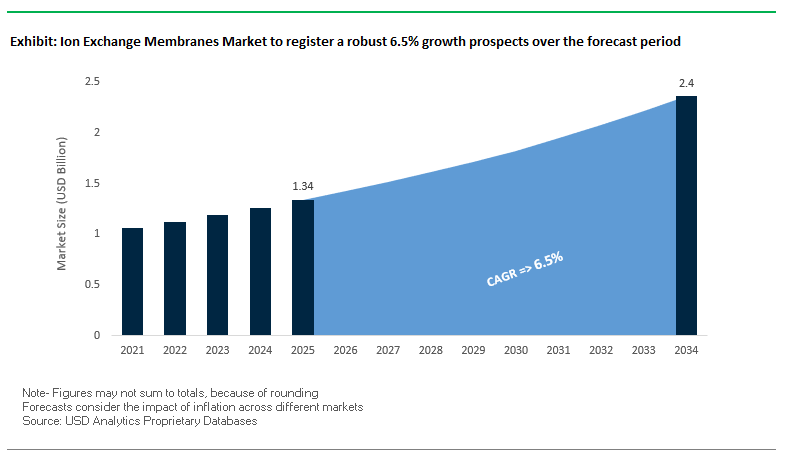
The global Ion Exchange Membranes Market is projected to expand from USD 1.34 billion in 2025 to USD 2.4 billion by 2034, registering a CAGR of 6.5% during the forecast period. Market demand is supported by established applications in chlor-alkali production, electrodialysis, industrial chemical processing and water treatment, alongside emerging applications in hydrogen electrolysis and electrochemical energy systems. Membrane replacement requirements, industrial separation capacity and the commercialization of specialized ion-selective materials influence demand across end-use industries.
Ion exchange membranes contain fixed ionic functional groups that enable selective transport of charged species. Cation exchange membranes (CEMs), anion exchange membranes (AEMs) and bipolar membranes (BPMs) serve different electrochemical and separation functions. Their commercial performance depends on ionic conductivity, permselectivity, chemical resistance, dimensional stability and operating life, with these characteristics influencing electrical consumption, process efficiency and membrane replacement costs.
Industrial applications continue to support demand for membranes used in salt production, acid recovery, solution concentration and process-water demineralization. Hydrogen-related applications are extending the market toward proton-conducting and hydroxide-conducting membrane technologies, where membrane–electrode compatibility, gas crossover and long-term durability affect equipment performance. Competition encompasses established fluorinated membrane producers, hydrocarbon membrane specialists and manufacturers supplying integrated electrochemical separation systems.
Ion Exchange Membranes Market Share and Key Industry Insights
Market Size and Growth: The global ion exchange membranes market is projected to increase from USD 1.34 billion in 2025 to USD 2.4 billion by 2034, registering a CAGR of 6.5%.
Hydrocarbon-Based Membranes Lead Material Segmentation: Hydrocarbon-based membranes account for approximately 45% of the market in 2025, supported by applications in electrodialysis, food processing and industrial water treatment.
Cation Exchange Membranes Dominate by Function: CEMs represent approximately 55% of the functional market in 2025, reflecting established applications in industrial electrolysis, electrodialysis and proton-conducting electrochemical systems.
Electrodialysis Supports Industrial Separation Demand: Electrodialysis and electrodialysis reversal remain established applications for desalination, ionic concentration and process-water treatment, where membrane resistance and fouling characteristics affect operating costs.
Hydrogen Electrolysis Expands Technology Differentiation: PEM and AEM electrolyzer development is broadening demand for specialized ionomers and membrane structures, with qualification requirements centred on system efficiency, membrane durability and electrochemical stability.
Bipolar Membranes Extend Resource Recovery Applications: BPM technologies are under development for acid and alkali generation, salt conversion and chemical recovery, with commercial feasibility linked to electricity requirements, feed composition and process integration..
Recent Developments in the Ion Exchange Membranes Market: Manufacturing Expansion and Technology Commercialization
Recent developments in the ion exchange membranes industry reflect manufacturing-capacity expansion, electrochemical membrane qualification and the development of alternative polymer materials for hydrogen applications. Manufacturer activity during 2025–2026 has included new testing facilities, membrane production programs and component-level collaborations, while established chlor-alkali operations continue to provide an industrial base for ion exchange membrane manufacturing.
In August 2026, Asahi Kasei announced regional economic incentives for its Kawasaki electrolysis manufacturing expansion, covering facilities for alkaline water electrolysis and ion-exchange-membrane chlor-alkali equipment. The company is developing cell-frame and membrane manufacturing facilities with targeted capacity of at least 2 GW each by 2028. Including existing chlor-alkali equipment operations, Asahi Kasei expects combined annual cell-frame and membrane manufacturing capacity to exceed 3 GW. The announcement covers multiple electrolysis technologies rather than dedicated PEM or AEM electrolyzer capacity, reflecting the company's manufacturing presence across established industrial electrolysis and hydrogen equipment.
In June 2026, Evonik opened an anion exchange membrane application technology center in Shanghai, establishing its first dedicated AEM testing facility in Asia. The center evaluates DURAION membranes manufactured commercially at Marl, Germany, under operating conditions representative of industrial applications. The facility provides additional infrastructure for assessing membrane integration, electrochemical performance and durability in AEM water-electrolysis systems, where laboratory-scale material characteristics do not independently establish performance at the assembled-cell level.
In April 2025, Sumitomo Bakelite established a project team to prepare mass production of PFAS-free anion exchange membranes for hydrogen production equipment. The technology uses polynorbornene-based polymer materials developed through the company's Promerus business. Prototype membranes were undergoing evaluation by water-electrolysis equipment manufacturers, with production conditions targeted for fiscal 2027 and mass production planned for fiscal 2030. The project represents a developing hydrocarbon-based membrane platform rather than an existing large-scale commercial supply operation.
In June 2025, Ionomr Innovations and Jolt Solutions entered into a memorandum of understanding combining Ionomr's hydrocarbon-based ion exchange membranes and ionomers with Jolt's nickel-based activated electrodes. The collaboration addresses membrane–electrode integration in AEM electrolysis, where interfacial resistance, electrochemical stability and component manufacturing influence stack-level performance. Its development program reflects the increasing importance of qualified membrane and electrode combinations in emerging electrochemical systems.
Key Market Trends Reshaping the Ion Exchange Membranes Industry
The ion exchange membranes industry is experiencing increasing specialization between established industrial separation products and membranes designed for electrochemical energy applications. Industrial membrane producers continue to emphasize dimensional stability, low electrical resistance and reliable operation under variable process conditions, while hydrogen-related membrane development places greater emphasis on compatibility with electrodes and long-duration electrochemical performance.
A significant market trend is the increasing availability of alternative polymer formulations for applications historically associated with fluorinated membrane technologies. Hydrocarbon-based materials are receiving additional commercial attention in emerging electrochemical systems, particularly where material composition, manufacturing costs and regulatory considerations affect technology development. Their adoption remains application-dependent because polymer chemistry influences chemical stability, conductivity and operating life.
Application-level qualification is becoming more prominent in membrane commercialization. Manufacturers are expanding testing activities from material characterization to representative electrochemical cells and industrial operating environments, with performance evaluation incorporating membrane degradation, component compatibility and production consistency.
In established separation markets, demand continues to favour membrane products capable of meeting defined industrial operating requirements. Specialized membrane grades, reinforced structures and application-specific configurations support differentiation across electrodialysis, electrodeionization, industrial chemical processing and related separation technologies.
Developing market opportunities for ion exchange membranes are associated with industrial applications that require selective ion recovery, electrochemical conversion and the separation of valuable constituents from complex process streams.
Bipolar membrane electrodialysis is being evaluated for converting suitable salt-containing streams into acid and alkaline products. Applications include chemical recovery, treatment of selected industrial by-products and processes where recovered chemicals have further industrial use. Commercial potential depends on feed chemistry, achievable product concentration, current efficiency and integration with existing production operations.
Selective electrodialysis is also being investigated for lithium-containing brines and other mineral-bearing streams. Membrane systems offering differential transport of monovalent and multivalent ions may support specific separation stages, although competing-ion concentrations, membrane fouling and downstream purification requirements influence their commercial applicability.
Additional opportunities arise in specialty chemical purification, food ingredient processing and electrochemical conversion technologies. These applications differ in required membrane selectivity, operating environments and production scale, creating distinct demand for specialized materials rather than a uniform membrane technology.
Membrane Chemistry, Ion Selectivity and Performance Trade-offs
Membrane chemistry influences the operating economics and technical performance of ion exchange membrane systems. Commercial formulations include sulfonated hydrocarbon polymers, perfluorinated ionomers and reinforced polymer composites, with differences in ionic conductivity, chemical stability, water uptake and mechanical strength. Membrane functionality is determined by fixed ionic groups, while polymer composition influences durability and compatibility with the operating environment.
Cation exchange membranes contain fixed negatively charged groups and preferentially transport cations, whereas anion exchange membranes contain positively charged groups that facilitate anion transport. Bipolar membranes combine cation- and anion-exchange layers to enable water dissociation under an applied electrical potential. These functional distinctions determine their roles in industrial separation and electrochemical conversion.
Membrane resistance is a significant operating-cost variable because higher electrical resistance increases voltage requirements at a given current density. Polymer swelling and dimensional instability can affect sealing, membrane integrity and operating life, while inadequate selectivity can increase unwanted ion crossover and reduce process efficiency. Reinforced membrane structures provide mechanical support but may involve trade-offs between thickness, transport resistance and manufacturing complexity.
Hydrocarbon and fluorinated membrane systems consequently compete on application-specific performance rather than polymer composition alone. Chemical stability, electrical efficiency, replacement intervals and qualification requirements influence their suitability for established industrial equipment and emerging electrochemical applications.
Electrodialysis, Industrial Separation and Resource Recovery
Electrodialysis and electrodialysis reversal represent established industrial applications for ion exchange membranes in desalination, process-stream concentration and controlled ionic separation. Commercial systems are used in salt production, food and beverage demineralization, industrial water treatment and selected chemical-processing operations. Diffusion dialysis provides a separate membrane-based route for acid recovery, using concentration gradients rather than externally applied electrical current.
The economics of electrodialysis depend on feedwater conductivity, ionic composition, membrane resistance, current efficiency and pretreatment requirements. Membrane fouling and mineral scaling can increase electrical consumption and cleaning requirements, while membrane durability influences replacement frequency and plant availability. Electrodialysis reversal can mitigate certain scaling and fouling conditions through periodic changes in electrical polarity and process-stream routing.
Industrial resource recovery extends these applications into the separation and concentration of useful constituents from manufacturing streams. Membrane-based acid recovery and salt concentration can reduce the volume of waste requiring downstream handling, although commercial performance varies with contaminant concentrations, achievable product purity and the energy required per unit of recovered material.
These process characteristics differentiate electrically driven ion exchange membrane systems from pressure-driven reverse osmosis and nanofiltration technologies, which rely on different separation mechanisms and operating-cost structures.
Hydrogen Electrolysis and Emerging Electrochemical Applications
Hydrogen electrolysis is extending the commercial requirements for ion exchange membranes into applications characterized by high current densities, demanding chemical environments and long operating periods. PEM and AEM electrolysis use different ion-conducting membrane platforms, with performance differences affecting catalyst compatibility, stack configuration, system efficiency and materials demand.
PEM electrolyzers commonly employ proton-conducting fluorinated membranes because of their conductivity and stability in acidic electrochemical environments. Membrane resistance, gas crossover and chemical degradation influence electricity requirements, hydrogen purity and equipment operating life. AEM technologies permit alternative catalyst configurations under alkaline conditions, including the potential use of non-precious-metal materials, although membrane durability and component qualification remain important commercial limitations.
Electrolyzer economics are influenced by membrane and electrode costs, electrical efficiency, operating hours and replacement intervals. Long-duration membrane performance is particularly relevant because degradation can increase electrical resistance or gas crossover during equipment operation. Membrane–electrode assembly characteristics therefore form part of the technical qualification process for commercial electrolysis systems.
Ion exchange membranes also participate in fuel cells and selected redox-flow battery technologies. In these applications, ionic conductivity and crossover behaviour influence energy efficiency and operating stability, while membrane chemical compatibility varies according to the electrolyte and electrode environment.
Market Share Analysis of the Ion Exchange Membranes Market
Market Share by Material
By 2025, hydrocarbon-based ion exchange membranes are expected to hold the largest share at approximately 45%, reflecting their balance of cost-effectiveness, mechanical durability, and versatility in electrodialysis for water treatment and food processing. Partially or fully fluorinated membranes, such as PFSA-based Nafion™, are projected at 35% share, continuing to dominate in high-performance applications like proton exchange membrane (PEM) fuel cells and electrolyzers due to their unmatched stability and conductivity, despite high costs. Anion Exchange Membranes (AEMs), projected to capture 12% of the market, represent the fastest-growing material class, driven by their ability to operate in alkaline environments and support low-cost catalyst systems, thereby reducing the overall cost of fuel cells and electrolyzers. Composite and hybrid membranes, at 8% share, are gaining adoption in applications requiring tailored performance, including enhanced thermal and chemical stability. Together, this segmentation highlights a dual trend: hydrocarbons driving cost-sensitive adoption, while fluorinated and emerging AEMs power high-value energy applications.
Market Share by Function
The ion exchange membranes market by function will remain led by cation exchange membranes (CEMs), expected to capture 55% share in 2025. Their established role in electrodialysis, proton transport, and electrolysis processes secures their dominance across industries. Anion exchange membranes (AEMs), projected at 35%, are rapidly gaining ground, fueled by advances in material stability and their role in alkaline fuel cells and water electrolyzers, which enable reduced reliance on costly precious-metal catalysts. Bipolar membranes (BPMs), with 10% market share, represent a small but strategically important niche, as they enable innovative chemical conversions such as splitting salt streams into valuable acids and bases without the need for external chemical input. This growing demand for eco-efficient processes in chemical industries positions BPMs as a future growth lever, even if their market size remains relatively modest compared to CEMs and AEMs.
Market Share by Application
Application-wise, electrodialysis and electrodialysis reversal (ED/EDR) are projected to lead the market with 40% share by 2025, cementing their role as the workhorse technologies for desalination, brackish water treatment, and food & beverage processing. Fuel cells are expected to account for 20%, driven by surging demand for clean transportation and stationary energy solutions as nations accelerate hydrogen adoption. Electrolysis applications, projected at 18%, will see explosive growth due to their central role in producing green hydrogen, with ion exchange membranes serving as the critical enabler of efficient electrochemical splitting of water. Battery separators and flow batteries, at 15%, reflect the growing importance of grid-scale renewable energy storage, where ion exchange membranes enhance durability and reduce cross-contamination between electrolytes. The remaining 7% share is held by diffusion dialysis and other specialized separations, including acid recovery and pharmaceutical purification. Collectively, this distribution underscores how the market is diversifying rapidly, with traditional water desalination maintaining leadership but energy-related applications emerging as the fastest-growth engines.
Ion Exchange Membrane Standards, PFAS Regulation and Technology Validation
Technical standards and regulatory developments influence ion exchange membrane qualification across industrial water reuse and electrochemical applications. ISO 20468-6:2021 provides guidelines for evaluating ion exchange and electrodialysis technologies used in water reuse, covering both ion exchange resins and ion exchange membranes. The standard addresses performance evaluation rather than establishing identical operating requirements for the two technologies.
In hydrogen applications, the European Union's Clean Hydrogen Partnership AEMELIA project is developing fluorine-free ionomers and AEM electrolyzer components, with technical targets covering current density, cell voltage, durability and prototype-stack performance. These are research and demonstration objectives rather than established commercial performance benchmarks.
Ion Exchange Membranes Market Competitive Landscape and Leading Manufacturers
The global ion exchange membranes market includes established chlor-alkali membrane manufacturers, industrial electrodialysis specialists and developers of electrochemical membrane materials. Asahi Kasei Corporation maintains an established position in ion-exchange-membrane chlor-alkali equipment and associated membrane manufacturing. AGC Inc. supplies FLEMION membranes for chlor-alkali electrolysis, SELEMION membranes for industrial electrodialysis and FORBLUE S-SERIES materials for specialized ionic separation and electrochemical applications.
The Chemours Company competes through its Nafion fluorinated ion exchange membrane portfolio, serving chlor-alkali production, PEM electrolysis and related electrochemical systems. These manufacturers operate in applications where chemical resistance, electrical consumption, membrane operating life and qualification history influence commercial product selection.
Industrial separation suppliers include ASTOM Corporation, which manufactures NEOSEPTA membranes and ACILYZER equipment for electrodialysis, electrodialysis reversal, diffusion dialysis and bipolar membrane processes. MEGA a.s. supplies RALEX heterogeneous ion exchange membranes for industrial electrodialysis, electrodeionization and electrocoating applications. Fumatech BWT GmbH provides Fumasep and Fumapem membrane products spanning water treatment, industrial separation and electrochemical energy systems.
SnowPure LLC supplies Excellion ion exchange membranes for electrodialysis, electrodeionization and specialized high-purity water applications. Competition among these manufacturers is associated with membrane resistance, selectivity, mechanical strength, industrial operating compatibility and membrane replacement requirements.
In emerging electrochemical membrane technologies, Evonik Industries AG competes through its DURAION anion exchange membrane platform, supported by commercial-scale membrane production and application-testing capabilities. Ionomr Innovations Inc. develops hydrocarbon-based Aemion and Pemion ion exchange membranes and ionomers for hydrogen production, fuel cells and electrochemical applications. Toray Industries, Inc. participates through proton exchange membrane and membrane–electrode assembly technologies associated with hydrogen systems.
Sumitomo Bakelite Co., Ltd. represents a developing participant in PFAS-free AEM materials, with its polynorbornene-based membrane program undergoing production preparation and customer evaluation. Competitive positioning in these applications is influenced by material-performance qualification, membrane–electrode compatibility, manufacturing readiness and long-term electrochemical durability.
China’s ion exchange membranes market is strongly influenced by strict environmental regulations, technological advancements, and emerging energy applications. The Ministry of Ecology and Environment (MEE) enforces stringent industrial wastewater discharge standards, compelling manufacturers to adopt advanced ion exchange membranes to comply with emission limits. In 2024, Chinese researchers introduced a hollow-fiber ultrafiltration (UF) membrane with superior antifouling properties, addressing a major challenge in industrial wastewater treatment and improving membrane bioreactor (MBR) efficiency while reducing maintenance costs. Furthermore, the nation’s rapidly expanding hydrogen fuel cell sector is a key driver for ion exchange membrane adoption. Chinese companies are investing in ultra-thin reinforced proton exchange membranes to enhance power density in fuel cell stacks, supporting applications in stationary energy storage and automotive markets. These combined regulatory, technological, and energy-driven initiatives position China as a critical growth hub for ion exchange membrane technologies.
Saudi Arabia: Strategic Desalination Investments and Ion Exchange Integration
Saudi Arabia continues to strengthen its ion exchange membranes market through extensive investments in desalination infrastructure and advanced membrane technologies. The Saudi Water Partnership Company (SWPC) leads new desalination projects heavily reliant on reverse osmosis (RO), where ion exchange membranes play a critical pre-treatment role to prevent scaling and enhance operational efficiency. Companies like Ion Exchange are actively delivering advanced membrane bioreactor (MBR) systems, often integrated with ion exchange technology, to support wastewater management and water reuse initiatives. The Kingdom’s Saline Water Conversion Corporation (SWCC) is pioneering energy-efficient RO membranes, exemplified in projects such as Jubail 3A, where ion exchange is integral to maximizing membrane longevity and overall performance. Saudi Arabia’s strategic focus on membrane-based water solutions highlights the growing adoption of ion exchange membranes in large-scale industrial and municipal applications.
United States: Government Support and Advanced Research Driving Adoption
The United States ion exchange membranes market is supported by significant government funding, cutting-edge academic research, and private-sector innovation. The Bipartisan Infrastructure Law allocates over $50 billion to the Environmental Protection Agency (EPA) for modernizing water infrastructure, with a focus on emerging contaminants like PFAS, which require advanced ion exchange filtration solutions. Research centers funded by the National Science Foundation (NSF), including the Membrane Applications Science and Technology (MAST) Center, focus on developing next-generation membranes for water purification, chemical separations, and biopharmaceutical processes. Corporations such as DuPont Water Solutions and Chemours are advancing perfluorinated ion exchange membranes for industrial applications and the expanding green hydrogen market. This combination of public funding, academic innovation, and corporate initiatives underscores the U.S. as a leading market for high-performance ion exchange membrane technologies.
India: Government Programs and Technological Investments Expanding Market Presence
India’s adoption of ion exchange membranes is accelerated by government initiatives, infrastructure investments, and advanced manufacturing capabilities. The Jal Jeevan Mission and the Department of Science & Technology's Water Technology Initiative drive the implementation of nano-material and filtration technologies to provide safe and affordable drinking water in rural regions. In August 2024, VA TECH WABAG secured a seven-year O&M contract for the 110 MLD SWRO Nemmeli Desalination Plant in Chennai, valued at approximately INR 415 crores, highlighting substantial investments in membrane-based water infrastructure. Additionally, Ion Exchange (India) operates a state-of-the-art membrane manufacturing unit in Verna, Goa, producing HYDRAMEM-branded membranes to expand domestic market share and export capacity. India’s strategic focus on government-backed programs and local manufacturing underscores its growing significance in the global ion exchange membranes market.
Japan: Innovation and Strategic Collaborations in Clean Energy and Water Treatment
Japan remains a key player in ion exchange membrane innovation through academic research, corporate development, and strategic collaborations. Toray Industries continues to develop high-performance RO membranes for desalination projects, including large-scale implementations in Saudi Arabia, reinforcing Japan’s role as a global technology provider. Fujifilm maintains a diverse portfolio of ion exchange membranes applied across drinking water, pharmaceutical, food processing, and wastewater treatment sectors, reflecting a broad technological focus. Additionally, Asahi Kasei’s investments in next-generation ion exchange membrane companies for hydrogen energy applications demonstrate a strategic orientation toward clean energy markets, enhancing Japan’s global influence in advanced membrane technologies.
Germany: Industrial Wastewater Applications and Hydrogen Economy Expansion
Germany’s ion exchange membranes market is driven by industrial wastewater treatment expertise, technological innovation, and participation in the hydrogen economy. Companies such as PWT Wassertechnik specialize in advanced membrane solutions, including ion exchange, to treat and recycle industrial water while meeting stringent European environmental standards. German firms are also scaling anion exchange membranes for modular electrolyzers, exemplified by Enapter, targeting PFAS-free membranes in the green hydrogen sector. Multinational companies like MANN+HUMMEL are innovating in membrane and digital solutions to address water challenges and industrial process optimization. Germany’s integrated approach to industrial applications and renewable energy positions it as a leading market for high-performance ion exchange membranes.
Porter’s Five Forces, SWOT Profile, Market Share, Scenario Forecasts, Market Ecosystem, Company Ranking, Market Dynamics, Industry Benchmarking
Companies
SUEZ, DuPont de Nemours, Inc., Veolia, Toray Industries, Inc., Asahi Kasei Corporation, The Dow Chemical Company, Kuraray Co., Ltd., LG Chem, SOLVAY, LANXESS, PENTAIR, Ion Exchange (India) Ltd., FUJIFILM Corporation, W. L. Gore & Associates, Inc., Mitsubishi Chemical Corporation
Countries
US, Canada, Mexico, Germany, France, Spain, Italy, UK, Russia, China, India, Japan, South Korea, Australia, South East Asia, Brazil, Argentina, Middle East, Africa
Ion Exchange Membranes Market Segmentation
By Material
Hydrocarbon-based Membranes
PFSA
SPEEK
SPSF
PBI
Partially/Halogenated Membranes
Composite/Hybrid Membranes
Anion Exchange Membranes (AEM)
By Function
Cation Exchange Membranes (CEM)
Anion Exchange Membranes (AEM)
Bipolar Membranes (BPM)
By Structure
Homogeneous Membranes
Heterogeneous Membranes
Interpolymer Membranes
Supported Membranes
By Application
Electrodialysis (ED/EDR)
Electrodialysis Reversal (EDR)
Electrolysis
Fuel Cells
Battery Separators & Flow Batteries
Diffusion Dialysis
Others
By End-User
Energy & Power
Chemical Processing
Water & Wastewater Treatment
Food & Beverage
Healthcare & Pharmaceuticals
Electronics & Semiconductors
Other Industries
Countries Analyzed
North America (US, Canada, Mexico)
Europe (Germany, UK, France, Spain, Italy, Russia, Rest of Europe)
Asia Pacific (China, India, Japan, South Korea, Australia, South East Asia, Rest of Asia)
South America (Brazil, Argentina, Rest of South America)
Middle East and Africa (Saudi Arabia, UAE, Rest of Middle East, South Africa, Egypt, Rest of Africa)
Leading Ion Exchange Membrane Manufacturers and Key Market Players
Asahi Kasei Corporation
AGC Inc.
The Chemours Company
ASTOM Corporation
Fumatech BWT GmbH
MEGA a.s.
Evonik Industries AG
Ionomr Innovations Inc.
Toray Industries, Inc.
SnowPure LLC
Sumitomo Bakelite Co., Ltd.
The coverage includes established membrane manufacturers and developing electrochemical materials suppliers. It does not represent a proprietary market-share ranking.
Research Coverage
This report investigates the global ion exchange membranes market, delivering rigorous analysis reviews of demand drivers across clean energy, resource recovery, and advanced water purification. It highlights 2024–2025 breakthroughs in polymer architectures (hydrocarbon AEMs, reinforced PEMs, composite/hybrid stacks), operational durability at higher current densities, and emerging use-cases spanning PFAS removal, lithium recovery, and electrochemical manufacturing. The study maps competitive moves, technology roadmaps for ED/EDR, electrolysis, fuel cells, and flow batteries, and quantifies how hydrogen-economy buildouts and circular-economy mandates are reshaping procurement and total cost of ownership. With country-level policy lenses, capex signals, and end-user adoption curves, this report is an essential resource for product strategists, procurement leaders, and investors aligning materials choices to reliability, efficiency, and lifecycle compliance. Developed by USDAnalytics, it integrates technology benchmarking with outcome-oriented decision frameworks to convert technical performance into commercial advantage. Scope Includes-
Segmentation: By Material (Hydrocarbon-based, PFSA, SPEEK, SPSF, PBI, Partially/Halogenated, Composite/Hybrid, AEM), By Function (CEM, AEM, BPM), By Structure (Homogeneous, Heterogeneous, Interpolymer, Supported), By Application (ED/EDR, Electrolysis, Fuel Cells, Battery Separators & Flow Batteries, Diffusion Dialysis, Others), By End-User (Energy & Power, Chemical Processing, Water & Wastewater, Food & Beverage, Healthcare & Pharmaceuticals, Electronics & Semiconductors, Other Industries)
Geographic Scope: Analysis spans 25+ countries across North America, Europe, Asia Pacific, Latin America, the Middle East & Africa.
Time Frame: Historic data 2021–2024; forecasts 2025–2034.
Companies: Profiles of 15+ companies like SUEZ, DuPont, Veolia, Toray, Asahi Kasei, Dow, Kuraray, LG Chem, Solvay, LANXESS, Pentair, Ion Exchange (India), Fujifilm, W. L. Gore, Mitsubishi Chemical
Ion Exchange Membranes Market Research Methodology
The USDAnalytics Ion Exchange Membranes Market study integrates primary and secondary research to assess market size, technology developments, competitive dynamics and industry demand across electrochemical separation, chemical processing, water treatment and energy applications. Primary research incorporates industry perspectives from membrane manufacturers, equipment suppliers and end users, while secondary research draws on company disclosures, technical literature, regulatory publications and industry sources.
Market estimation employs top-down and bottom-up approaches, supported by data triangulation to assess market values, segmentation and regional trends. Forecast analysis considers historical demand, industrial membrane applications, manufacturing developments, electrochemical technology adoption and replacement requirements. Competitive assessment examines membrane portfolios, material differentiation, application coverage and commercial capabilities, maintaining consistency with USDAnalytics' proprietary forecasts through 2034.
Deliverables:
Comprehensive Market Research Report (PDF and Excel) with detailed tables, charts, and interactive visualizations.
Country-Specific Forecasts & Analysis.
Segment-Wise Revenue Forecasts (2025–2034).
Competitive Analysis, Benchmarking, and SWOT Profiles.
Recent Developments & Innovation Tracker.
Executive Summary & Analyst Commentary.
Post-Purchase Analyst Support for Client-Specific Questions and Custom Data Requirements.
Table of Contents: Ion Exchange Membranes Market
1. Executive Summary
1.1. Market Highlights
1.2. Key Insights for Stakeholders
1.3. Global Market Snapshot
2. Ion Exchange Membranes Market Outlook (2025–2034)
2.1. Introduction: Growth Drivers and Industry Transformation
2.2. Market Valuation and Growth Projections (2025–2034)
Growth is propelled by green hydrogen scale-up (PEM/AEM electrolyzers), desalination and PFAS remediation, and resource recovery (e.g., lithium from brines). Tighter discharge limits and circular-economy goals are pushing ED/EDR into municipal and industrial flowsheets, while improved durability at higher temperatures and current densities lowers lifetime cost for energy applications.
Hydrocarbon membranes lead in cost-sensitive ED/EDR due to robust mechanics and favorable economics. PFSA (e.g., PFSA-based PEMs) remains the benchmark for high-performance fuel cells/electrolyzers where conductivity and stability are mission-critical. AEMs are the fastest-growing, enabling alkaline operation with lower-cost catalysts and expanding the addressable market for green hydrogen.
They deliver ROI in brackish desalination, selective ion removal, and PFAS/nitrate/heavy-metal mitigation—often reducing chemical consumption versus conventional routes. In ED/EDR, optimized stack design and low-resistance membranes cut energy per m³, while diffusion dialysis recovers acids/alkalis from side-streams to lower opex and waste-disposal burdens.
CEMs dominate proton transport and ED desalting, anchoring reliability. AEMs support alkaline chemistries, unlocking lower-cost catalysts in fuel cells/electrolyzers and selective separations in food/bioprocessing. BPMs enable on-site acid/base generation from salts, decarbonizing chemical supply and simplifying ESH compliance—small today but strategically important for green chemicals.
Strongest CAGR is expected in electrolysis and fuel cells as hydrogen roadmaps mature, followed by battery separators/flow batteries supporting renewable-heavy grids. ED/EDR maintains scale leadership in water and food processing, and diffusion dialysis expands with acid recovery mandates. Regions with desalination build-outs and hydrogen incentives will outpace global averages.

 market Share by Application, 2025.png)