Global Liquid Filtration Market Size, Growth Drivers and Industry Outlook
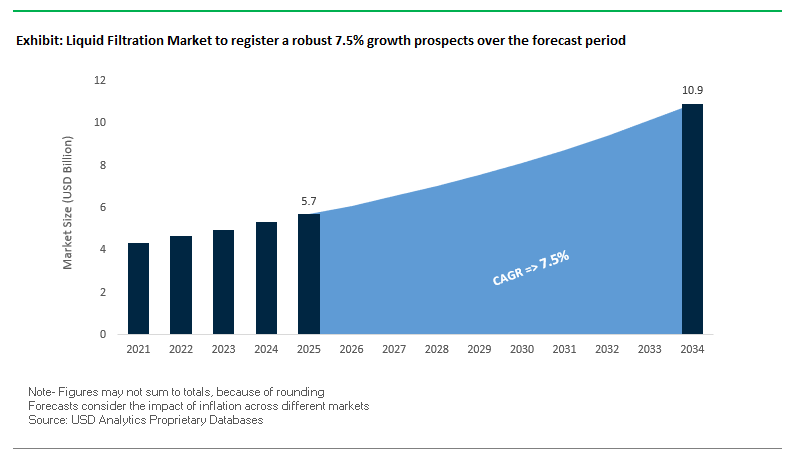
The global Liquid Filtration Market is projected to increase from USD 5.7 billion in 2025 to USD 10.9 billion by 2034, registering a CAGR of 7.5%, according to USDAnalytics' proprietary market assessment. Market demand is supported by industrial wastewater treatment, municipal water purification, pharmaceutical manufacturing, food and beverage processing, and high-purity industrial applications. Increasing requirements for contaminant removal, process-water reuse and consistent fluid quality influence filtration equipment demand and replacement cycles across industrial and municipal end users.
Liquid filtration encompasses mechanical separation, depth filtration, membrane filtration and adsorptive technologies used to remove suspended particles, microorganisms and selected dissolved contaminants from process fluids. Woven, non-woven and mesh filter media serve different particle-retention and fluid-processing requirements, while polymeric and specialty membrane technologies enable microfiltration, ultrafiltration, nanofiltration and reverse osmosis. Filtration performance depends on particle-size distribution, retention efficiency, pressure differential, contaminant-loading capacity, chemical compatibility and operating conditions.
Industrial treatment represents a major application area, with filtration systems used in chemical manufacturing, power generation, pharmaceuticals, semiconductor processing and food production. High-purity manufacturing requires more stringent control of particulate and dissolved contaminants, while wastewater reuse applications employ multistage treatment processes to manage variable feedwater quality. Membrane filtration is increasingly integrated with conventional pretreatment and polishing technologies to achieve application-specific water-quality requirements.
The competitive environment includes filtration media manufacturers, cartridge and filter-housing suppliers, membrane technology developers and integrated water-treatment companies. Product differentiation is influenced by filter service life, energy consumption, cleaning requirements, manufacturing consistency and system-level operating costs. Recent developments in high-capacity depth filtration, industrial water-reuse membranes and regional filtration manufacturing facilities are reshaping supply capabilities across specialized liquid-processing applications.
Key Industry Insights
Regulatory Impact: In 2024, the U.S. EPA launched a USD 1.2 billion water infrastructure improvement program, fueling immediate demand for advanced municipal and industrial liquid filtration systems.
Pharma & Biotech Growth: The UK pharmaceutical sector allocated 18% of total business R&D spending to pharma in 2024, highlighting the sector’s increasing reliance on high-purity liquid filtration solutions.
Smart Filtration Revolution: Adoption of IoT and AI-based monitoring reduces operational downtime by up to 20%, giving end-users measurable ROI advantages.
Membrane Filtration Rise: Ultrafiltration and nanofiltration technologies are displacing conventional systems in high-specification industries due to their ability to remove ultra-fine contaminants.
Market Analysis and Recent Industry Developments
Recent developments in the liquid filtration industry reflect the commercialization of specialized filter media, expansion of manufacturing capacity and deployment of membrane-based water-reuse systems. Manufacturer activity during 2024–2026 has included advances in depth filtration materials, biopharmaceutical filtration infrastructure, municipal wastewater reclamation and consolidation among industrial filtration suppliers.
In April 2026, Eaton Corporation introduced the BECO CARBON ACF 04 activated-carbon depth filter sheet, extending its portfolio of adsorptive filtration media for pharmaceutical, biopharmaceutical, cosmetics, food and beverage, and specialty chemical applications. The new grade contains approximately 1,000 g/m² of immobilized activated carbon and is designed for the removal of selected organic impurities, color bodies and medium- to large-molecular-weight constituents from liquid process streams. Eaton offers the material in flat sheets, stacked-disc cartridges and single-use filter units, allowing the same filtration medium to be applied at different production scales. The development follows the company's 2025 introduction of BECO Helix polypropylene depth filter cartridges, which incorporate graded non-woven layers to increase contaminant-holding capacity and extend filter service life. The manufacturer reported service-life improvements exceeding 40% against its specified conventional cartridge comparison.
In August 2026, Parker Hannifin Corporation completed its acquisition of Filtration Group Corporation, expanding its industrial and life sciences filtration portfolio. The transaction incorporated filtration media, engineered porous materials and filtration components serving industrial fluids, healthcare and other specialized applications. The acquired businesses include Porex, whose porous-material technologies support liquid filtration, venting and fluid-management applications. The transaction broadens Parker's filtration materials and replacement-component portfolio, although Filtration Group's operations extend beyond liquid filtration.
In September 2025, Merck KGaA opened a €150 million filtration manufacturing facility in Blarney, Cork, Ireland, expanding its production infrastructure for biopharmaceutical filtration devices. The facility incorporates approximately 3,000 m² of cleanroom space and was scheduled to begin production during the fourth quarter of 2025. Its manufacturing scope includes filtration technologies used in aseptic processing, tangential flow filtration and virus removal for vaccines, monoclonal antibodies and advanced biologic therapies. The site was designed for climate-neutral operations using renewable electricity and a heat-recovery system, with the company reporting plans to reuse up to 95% of high-purity reverse-osmosis water generated within its filtration manufacturing operations.
In industrial and municipal water reuse, Veolia announced a membrane-based wastewater reclamation project in Vitória, Brazil, in July 2025. The planned facility has a treatment capacity of 450 litres per second, equivalent to approximately 38,880 m³ per day, and incorporates memDENSE membrane bioreactor technology, ZeeWeed ultrafiltration membranes and PROflex reverse osmosis. The system is designed to reclaim approximately 85% of municipal wastewater from the Camburi basin for industrial applications, including water supply to major industrial consumers. The project represents a planned large-scale water-reuse application rather than an already operational filtration facility.
Membrane technology commercialization has also extended into beverage processing. In March 2025, GEA Group reported the planned installation of its AromaPlus membrane filtration system at Germany's FARNY brewery for alcohol-free wheat beer production. The process uses reverse-osmosis membranes and diafiltration to separate alcohol and water from beer at comparatively low temperatures, while retaining selected aroma and product-quality characteristics. In parallel, Pall Corporation, part of Danaher, opened a USD 150 million manufacturing facility in Singapore in June 2024, expanding regional production of filtration, purification and separation products used in semiconductor lithography and wet-etch processing.
Key Trends and Strategic Growth Opportunities in the Liquid Filtration Market
Strategic Shift to Advanced Hollow-Fiber Membranes for Biopharmaceutical Processing
The liquid filtration market is witnessing a pronounced shift toward advanced hollow-fiber membranes, particularly driven by the biopharmaceutical sector's rapid expansion in biologics, cell, and gene therapies (CGT). Hollow-fiber cartridges, a type of tangential flow filtration (TFF) system, offer extremely high surface area in compact modules, enabling efficient separation and concentration of proteins and biomolecules, which significantly increases product yield and reduces costly losses. This technology minimizes shear stress on sensitive cells and large biomolecules, maintaining their viability and potency—an essential factor for complex therapies. Hollow-fiber systems are highly scalable, supporting a seamless transition from lab-scale development to commercial manufacturing without changing the filtration platform. Additionally, single-use disposable hollow-fiber cartridges align with aseptic processing trends, reducing cross-contamination risks and cleaning requirements. These advantages make hollow-fiber membranes a core enabler for high-purity filtration in modern biopharmaceutical production.
Deployment of Ceramic Membranes for Harsh Industrial Wastewater Treatment
Industrial wastewater treatment is driving the adoption of ceramic membranes due to their chemical and thermal resilience, long operational life, and fouling resistance. Ceramic membranes, composed of alumina or silicon carbide, can withstand extreme pH ranges (0–14) and temperatures up to 800°C, making them ideal for harsh applications such as metal finishing, chemical production, and landfill leachate treatment. Their durability extends membrane lifespan, reducing replacement frequency and overall cost of ownership. The hydrophilic surface resists organic and biological fouling, maintaining high flux over prolonged operation, critical for continuous industrial processes. Case studies highlight their deployment in oily wastewater treatment, where robustness against corrosive cleaning agents allowed substantial water reuse while complying with strict discharge regulations. The combination of resilience, longevity, and high performance positions ceramic membranes as an increasingly preferred solution for industrial wastewater filtration.
Development of PFAS-Specific Selective Filtration Media
The rise of PFAS (per- and polyfluoroalkyl substances) contamination presents a pressing environmental challenge, creating demand for highly selective filtration solutions. Traditional media like granular activated carbon (GAC) and ion exchange resins are inefficient and quickly saturated when removing PFAS. Molecularly imprinted polymers (MIPs) are being developed to offer “lock-and-key” specificity for PFAS molecules, providing higher removal efficiency and longer filter life. Advanced regenerable adsorbents allow on-site regeneration, reducing disposal costs and environmental impact. Regulatory pressures, such as the U.S. EPA’s proposed drinking water standards for PFAS, accelerate market adoption and incentivize R&D investment in novel selective filtration media. This opportunity is particularly relevant for municipal water treatment facilities and industrial operators seeking compliance while minimizing operational costs.
Membrane-Based Lithium Extraction for Direct Lithium Brine Extraction (DLE)
The surging demand for lithium to support the global electric vehicle (EV) transition has opened a strategic opportunity for membrane-based Direct Lithium Extraction (DLE). Traditional evaporation ponds are slow, land-intensive, and environmentally taxing. Nanofiltration (NF) and selective electrodialysis membranes enable faster, more sustainable, and higher-yield lithium extraction from brines. Membrane-based DLE significantly reduces water use and shortens extraction timelines from months or years to hours or days. High-selectivity membranes effectively separate lithium ions from magnesium, sodium, and other brine impurities, producing high-purity lithium carbonate efficiently. Furthermore, this approach allows extraction from previously uneconomical sources such as geothermal brines and oilfield wastewater, expanding the global lithium supply base. Membrane-based DLE not only addresses sustainability and energy efficiency concerns but also strengthens the resilience and diversity of the lithium supply chain.
Liquid Filtration Market Share Insights
Non-Woven Media Hold Market Share Leadership by Filter Media in the Liquid Filtration Industry
Non-woven filter media dominate the liquid filtration industry with a commanding 58% market share in 2025, cementing their position as the backbone of global filtration solutions. Their randomly oriented fiber matrix enables depth filtration, providing high dirt-holding capacity, superior retention efficiency, and longer service life compared to woven or mesh media. Non-wovens are indispensable in bag filters, cartridge filters, and pre-filtration stages across industries ranging from pharmaceuticals and food & beverage to chemicals, metals, and mining, making them the most versatile and widely adopted medium. Woven media sustain a meaningful share by offering high mechanical strength, durability, and reusability, particularly in dewatering, belt filters, and high-flow processes where surface filtration is more efficient. Mesh media, though the smallest contributor, remain critical in high-precision applications, offering absolute pore size control and structural integrity in high-pressure or high-temperature conditions. This segmentation underscores how non-woven media drive mainstream adoption, while woven and mesh solutions secure niche roles in heavy-duty and precision environments.
Industrial Treatment Dominates Market Share by End-User in the Liquid Filtration Industry
Industrial treatment commands 65% of the global liquid filtration market in 2025, reflecting its central role in ensuring compliance, efficiency, and water reuse across complex industrial processes. Industries such as power generation, petrochemicals, pharmaceuticals, food and beverage, and mining generate diverse and challenging effluents that require customized filtration solutions to protect equipment and meet stringent environmental regulations. The need for robust filtration systems that balance operational efficiency, sustainability, and cost control secures this segment’s dominance. Municipal treatment, while representing a smaller share of revenue, accounts for vast processing volumes in potable water production and wastewater treatment. Population growth in developing countries and infrastructure modernization in developed regions continue to drive steady investment in large-scale municipal systems, where filtration technologies must prioritize reliability, scalability, and affordability. Together, these dynamics demonstrate that industrial treatment drives revenue through complexity and compliance, while municipal applications anchor high-volume, society-critical demand.
Liquid Filtration Market Competitive Landscape and Leading Manufacturers
The global liquid filtration market competitive landscape comprises diversified filtration equipment manufacturers, industrial membrane suppliers and specialized filtration media producers. Danaher Corporation, through Pall, supplies liquid filtration technologies for semiconductor processing, pharmaceuticals, bioprocessing and industrial applications, with its portfolio covering filtration media, cartridges, high-purity components and separation systems. Eaton Corporation competes through BECO depth filtration media, activated-carbon filter sheets, industrial filter bags and filtration housings for food and beverage, pharmaceutical and chemical processing. Parker Hannifin Corporation supplies industrial liquid filters, hydraulic filtration equipment and fluid-processing components, with its portfolio expanded through the completed Filtration Group acquisition. Donaldson Company participates in industrial liquid filtration through hydraulic, lubricant, fuel and process-fluid filtration technologies, while Thermo Fisher Scientific broadened its filtration and membrane portfolio following the September 2025 acquisition of Solventum's Purification and Filtration business. The acquired technologies cover bioprocessing, healthcare and industrial membrane applications, but exclude Solventum's drinking-water filtration business, which was removed from the transaction.
Municipal and industrial water-treatment applications involve a different competitive structure, with filtration technologies integrated into complete water-treatment facilities. Veolia supplies ZeeWeed ultrafiltration membranes, membrane bioreactor systems and advanced water-reuse technologies for municipal, industrial and semiconductor applications. SUEZ, operating as a separate water and wastewater services group, participates through membrane filtration, low-pressure reverse osmosis and industrial treatment projects. Pentair plc, through its X-Flow portfolio, supplies hollow-fiber microfiltration, ultrafiltration and nanofiltration technologies for drinking water, industrial wastewater, dairy processing and beverage filtration. MANN+HUMMEL Group manufactures industrial membranes through its Water & Membrane Solutions business, including MICRODYN, NADIR and other microfiltration, ultrafiltration and nanofiltration products. Xylem Inc., incorporating Evoqua Water Technologies, participates through MEMCOR membrane filtration and related water-treatment technologies. These suppliers compete through treatment capacity, membrane configuration, water recovery, operational reliability and system integration capabilities.
Specialized filter media and process-separation suppliers address additional liquid filtration requirements across manufacturing and food processing. Alfa Laval AB supplies cross-flow membrane filtration systems, separation equipment and process solutions used in dairy, beverages, fermentation and industrial applications. GEA Group manufactures membrane filtration systems for food and beverage processing, including reverse-osmosis-based concentration and dealcoholization technologies. Ahlstrom supplies engineered fibrous filter media for industrial liquids, hydraulic fluids, water filtration and food processing, with material differentiation associated with particle retention, permeability and mechanical performance. Freudenberg Filtration Technologies participates through Viledon non-woven filtration media for coolant, lubricant, fuel, food and beverage, and membrane-support applications. Merck KGaA supplies sterile filtration, ultrafiltration and bioprocess membrane technologies, with product differentiation associated with microbial retention, protein compatibility, filtration throughput and validated performance in pharmaceutical manufacturing.
Liquid Filtration Market Regulatory Standards, Water Quality Requirements and Filtration Validation
The liquid filtration industry is influenced by environmental discharge requirements, drinking-water quality regulations and application-specific filtration validation standards. Regulatory frameworks differ across municipal treatment, industrial water reuse and pharmaceutical manufacturing, with membrane filtration, mechanical filtration and adsorptive systems addressing different contaminant-removal requirements.
Municipal Water Treatment and Environmental Regulations
The European Union's revised Urban Wastewater Treatment Directive (EU) 2024/3019 entered into force on January 1, 2025, establishing a framework for expanded wastewater collection, nutrient removal and micropollutant treatment. Implementation requirements are phased, with quaternary treatment obligations applying to specified wastewater treatment facilities over subsequent years. Membrane filtration, activated carbon and other advanced processes may form part of treatment configurations, depending on the pollutants and required discharge quality.
In the United States, the Environmental Protection Agency's PFAS drinking-water regulatory framework includes the 2024 National Primary Drinking Water Regulation and subsequent regulatory proposals. In May 2026, EPA proposed changes to compliance timelines and certain PFAS regulatory provisions. These proposals were separate from the underlying rule and did not themselves constitute finalized amendments. PFAS treatment applications involve technology-specific performance differences among granular activated carbon, ion exchange resins and high-pressure membrane systems.
Pharmaceutical Liquid Filtration Standards
For pharmaceutical manufacturing, the European Commission's EU GMP Annex 1 establishes requirements for contamination control, sterilizing filtration and filter integrity testing. Most provisions became applicable in August 2023, with provision 8.123 applicable from August 2024.
In April 2026, ASTM International published ASTM E3469-26, Standard Practice for Validating End-User Sterilizing Filtration, covering process-specific bacterial-retention validation for pharmaceutical and biopharmaceutical liquids. The standard addresses membrane performance under representative processing conditions, including filtration time, pressure differential and fluid compatibility. Sterilizing-grade filtration qualification depends on validated microbial retention rather than nominal pore-size designation alone.
United States Liquid Filtration Market Driven by Advanced Membrane Technologies and Regulatory Compliance
The U.S. liquid filtration market is strongly influenced by stringent Environmental Protection Agency (EPA) regulations and state-level air and water quality boards, with the Safe Drinking Water Act (SDWA) and Clean Water Act (CWA) driving demand for advanced filtration solutions across municipal and industrial sectors. Investments in manufacturing facilities and adherence to pollution control norms are key growth drivers, particularly in sectors requiring high-purity water such as pharmaceuticals, healthcare, and food and beverage production.
Technological advancements such as nanofiltration, ultrafiltration, and real-time digital monitoring systems are enabling predictive maintenance, reducing downtime, and ensuring superior system reliability. Corporate investments are robust, exemplified by Pall Corporation’s expansion in semiconductor-grade liquid filtration, reflecting the critical role of filtration in contamination-sensitive applications. Government and industrial initiatives, including infrastructure upgrades and manufacturing reshoring, further fuel demand, particularly in automotive and chemical industries where high-quality liquid filtration solutions are essential.
Germany Strengthens Liquid Filtration Market With High-Performance Systems and Circular Economy Initiatives
Germany’s liquid filtration market operates under stringent EU water directives and well-established industrial standards, fostering demand for high-performance, eco-friendly filtration solutions. The country is recognized for its technological innovation in filter media, membranes, and system design, providing extended lifespan, enhanced efficiency, and low-maintenance solutions across industrial applications.
Germany’s commitment to the circular economy and sustainable manufacturing drives the development of advanced wastewater treatment and resource recovery systems. Corporate investments are significant, with companies focusing on pharmaceutical and food and beverage sectors, expanding their capabilities to meet growing demand for high-quality, environmentally sustainable filtration technologies.
China Liquid Filtration Market Expands With Environmental Policies and Industrial Modernization
China’s liquid filtration market is supported by government initiatives targeting environmental protection and industrial modernization, including the dual carbon goal and the Action Plan for Promoting Large-Scale Equipment Updates. Regulatory reforms, such as NSF P535, establish minimum requirements for point-of-use water filters, driving adoption of high-performance, safe filtration solutions.
Technological investments, including automation, AI, and large-scale water treatment plant projects, enhance production efficiency and meet growing demand from urban and industrial sectors. Partnerships, like Xiniupi Waterproof Technology collaborating with European firms, showcase innovation in membrane systems. The emphasis on domestic manufacturing and high-quality circular solutions positions China as a key driver in the liquid filtration industry, particularly for municipal, industrial, and environmental water treatment applications.
India Liquid Filtration Market Gains Momentum From Jal Jeevan Mission and Industrial Growth
India’s liquid filtration industry is receiving a significant boost from the Jal Jeevan Mission, aimed at providing safe tap water to all rural households, supported by a ₹67,000 crore budget allocation. The focus on municipal water treatment is complemented by the growing demand in industrial and urban sectors.
Advanced filtration technologies, such as membrane filtration, are being increasingly adopted to ensure high-quality water across food and beverage, pharmaceutical, and e-commerce sectors. Corporate investments are rising, supported by the expansion of local production facilities to meet domestic demand. The growing exports of industrial products, particularly pharmaceuticals, drive the need for modern, high-performance liquid filtration solutions that comply with international standards.
Japan Liquid Filtration Market Advances With Precision Membranes and Specialized Filtration Solutions
Japan’s liquid filtration market benefits from the country’s precision manufacturing capabilities and strong regulatory emphasis on wastewater management and industrial emissions control. Companies such as Toray Industries are leading in advanced membrane design for wastewater reuse, optimizing both environmental sustainability and industrial efficiency.
The market focuses on specialty and high-performance filtration systems for sectors like electronics, automotive, and high-tech manufacturing. Innovations such as self-cleaning filters and multi-barrier contaminant removal technologies, exemplified by Hitachi Zosen’s installations, cater to the specific needs of industrial and municipal applications, ensuring superior water purity and compliance with stringent Japanese standards.
Brazil Liquid Filtration Market Grows With Water Reuse Innovations and Sustainable Sanitation Practices
Brazil’s liquid filtration industry is shaped by the National Solid Waste Policy, promoting sustainable water management and eco-friendly filtration solutions over a 20-year horizon. The sanitation sector is embracing innovative technologies, including membrane bioreactors and reverse osmosis, with projects like Veolia’s facility in Vitória, the world’s first municipal wastewater-to-reuse plant, setting a benchmark.
Demand is particularly high in industrial and agricultural sectors, as well as new construction and renovation projects. Corporate investments, supported by the EU-Mercosur trade agreement, are attracting both domestic and international players, driving diversification and enhancing Brazil’s position in the high-performance liquid filtration market.
Liquid Filtration Market Report Scope
Liquid Filtration Market
Parameter
Details
Market Size (2025)
$5.7 Billion
Market Size (2034)
$10.9 Billion
Market Growth Rate
7.5%
Segments
By Filter Media (Woven, Non-woven, Mesh), By Fabric Material Type (Polymer, Cotton, Aramid, Metal, Others), By End-User (Industrial Treatment, Municipal Treatment), By Technology (Mechanical Filtration, Membrane Filtration, Activated Carbon Filters, Others)
Study Period
2020- 2025 and 2026-2034
Units
Revenue (USD)
Qualitative Analysis
Porter’s Five Forces, SWOT Profile, Market Share, Scenario Forecasts, Market Ecosystem, Company Ranking, Market Dynamics, Industry Benchmarking
US, Canada, Mexico, Germany, France, Spain, Italy, UK, Russia, China, India, Japan, South Korea, Australia, South East Asia, Brazil, Argentina, Middle East, Africa
Liquid Filtration Market Segmentation
By Filter Media
Woven
Non-woven
Mesh
By Fabric Material Type
Polymer
Cotton
Aramid
Metal
Others
By End-User
Industrial Treatment
Municipal Treatment
By Technology
Mechanical Filtration
Membrane Filtration
Activated Carbon Filters
Others
Countries Analyzed
North America (US, Canada, Mexico)
Europe (Germany, UK, France, Spain, Italy, Russia, Rest of Europe)
Asia Pacific (China, India, Japan, South Korea, Australia, South East Asia, Rest of Asia)
South America (Brazil, Argentina, Rest of South America)
Middle East and Africa (Saudi Arabia, UAE, Rest of Middle East, South Africa, Egypt, Rest of Africa)
Leading Liquid Filtration Industry Players
Danaher Corporation (Pall Corporation)
Eaton Corporation
Parker Hannifin Corporation
Donaldson Company, Inc.
Thermo Fisher Scientific Inc.
Veolia
SUEZ
Pentair plc
MANN+HUMMEL Group
Xylem Inc. (including Evoqua technologies)
Alfa Laval AB
GEA Group
Ahlstrom
Freudenberg Filtration Technologies
Merck KGaA
The company coverage includes filtration media manufacturers, industrial filtration equipment suppliers, membrane technology providers and integrated water-treatment companies. It is not a proprietary market-share ranking and does not indicate equal competitive exposure across end-use industries.
Liquid Filtration Market Research Methodology
The USDAnalytics Liquid Filtration Market study integrates primary and secondary research to assess market size, technology developments, competitive dynamics and demand across industrial and municipal treatment applications. The research framework includes industry perspectives from filtration manufacturers, equipment suppliers, municipal water authorities and industrial end users, supported by company disclosures, technical publications, regulatory documentation and industry sources.
Market estimation employs top-down and bottom-up approaches, with data triangulation used to assess market values, segment shares and geographic demand. Forecast analysis considers industrial filtration requirements, water-treatment infrastructure, membrane technology adoption, consumable replacement demand and relevant regulatory developments. Competitive assessment examines manufacturer portfolios, filtration media, product performance and application coverage, maintaining consistency with USDAnalytics' proprietary market estimates and forecasts through 2034.
Deliverables:
Comprehensive Market Research Report (PDF and Excel) with detailed tables, charts, and interactive visualizations.
Country-Specific Forecasts & Analysis.
Segment-Wise Revenue Forecasts (2025–2034).
Competitive Analysis, Benchmarking, and SWOT Profiles.
Recent Developments & Innovation Tracker.
Executive Summary & Analyst Commentary.
Post-Purchase Analyst Support for Client-Specific Questions and Custom Data Requirements.
Table of Contents: Liquid Filtration Market
1. Executive Summary
1.1. Market Highlights
1.2. Key Findings
1.3. Global Market Snapshot
2. Liquid Filtration Market Landscape & Outlook (2025–2034)
2.1. Introduction to Liquid Filtration Market
2.2. Market Valuation and Growth Projections (2025–2034)
2.3. Market Overview: Regulatory Impact and Technological Transformation
2.4. Market Analysis: Sustainability, Circular Economy, and Industry Consolidation
2.5. Market Dynamics: Drivers, Restraints, and Growth Opportunities
3. Innovations Reshaping the Liquid Filtration Market
3.1. Trend: Strategic Shift to Advanced Hollow-Fiber Membranes for Biopharmaceutical Processing
3.2. Trend: Deployment of Ceramic Membranes for Harsh Industrial Wastewater Treatment
3.3. Opportunity: Development of PFAS-Specific Selective Filtration Media
3.4. Opportunity: Membrane-Based Lithium Extraction for Direct Lithium Brine Extraction (DLE)
4. Competitive Landscape and Strategic Initiatives
4.1. Mergers, Acquisitions and Strategic Alliances
4.2. R&D and Material Innovation
4.3. Sustainability and Strategies
4.4. Market Expansion and Regional Focus
5. Market Share and Segmentation Insights: Liquid Filtration Market
5.1. By Filter Media
5.1.1. Woven
5.1.2. Non-Woven
5.1.3. Mesh
5.2. By Fabric Material Type
5.2.1. Polymer
5.2.2. Cotton
5.2.3. Aramid
5.2.4. Metal
5.2.5. Others
5.3. By End-User
5.3.1. Industrial Treatment
5.3.2. Municipal Treatment
5.4. By Technology
5.4.1. Mechanical Filtration
5.4.2. Membrane Filtration
5.4.3. Activated Carbon Filters
5.4.4. Others
6. Country Analysis and Outlook of Liquid Filtration Market
6.1. United States
6.2. Canada
6.3. Mexico
6.4. Germany
6.5. France
6.6. Spain
6.7. Italy
6.8. UK
6.9. Russia
6.10. China
6.11. India
6.12. Japan
6.13. South Korea
6.14. Australia
6.15. South East Asia
6.16. Brazil
6.17. Argentina
6.18. Middle East
6.19. Africa
7. Liquid Filtration Market Size Outlook by Region (2025–2034)
7.1. North America Liquid Filtration Market Size Outlook to 2034
7.1.1. By Filter Media
7.1.2. By Fabric Material Type
7.1.3. By End-User
7.1.4. By Technology
7.2. Europe Liquid Filtration Market Size Outlook to 2034
7.2.1. By Filter Media
7.2.2. By Fabric Material Type
7.2.3. By End-User
7.2.4. By Technology
7.3. Asia Pacific Liquid Filtration Market Size Outlook to 2034
7.3.1. By Filter Media
7.3.2. By Fabric Material Type
7.3.3. By End-User
7.3.4. By Technology
7.4. South America Liquid Filtration Market Size Outlook to 2034
7.4.1. By Filter Media
7.4.2. By Fabric Material Type
7.4.3. By End-User
7.4.4. By Technology
7.5. Middle East and Africa Liquid Filtration Market Size Outlook to 2034
7.5.1. By Filter Media
7.5.2. By Fabric Material Type
7.5.3. By End-User
7.5.4. By Technology
8. Company Profiles: Leading Players in the Liquid Filtration Market
8.1. Pall Corporation
8.2. Eaton Corporation
8.3. SUEZ
8.4. Veolia Environnement S.A.
8.5. Donaldson Company, Inc.
8.6. 3M Company
8.7. Parker Hannifin Corporation
8.8. Alfa Laval AB
8.9. MANN+HUMMEL Group
8.10. Lydall, Inc.
8.11. Pentair plc
8.12. Ahlstrom-Munksjö Oyj
8.13. Cummins Inc.
8.14. Freudenberg Filtration Technologies SE & Co. KG
8.15. Merck KGaA
9. Methodology
9.1. Research Scope
9.2. Market Research Approach
9.3. Market Sizing and Forecasting Model
9.4. Research Coverage
9.5. Data Horizon
9.6. Deliverables
10. Appendix
10.1. Acronyms and Abbreviations
10.2. List of Tables
10.3. List of Figures
10.4. FAQs
Liquid Filtration Market Segmentation
By Filter Media
Woven
Non-woven
Mesh
By Fabric Material Type
Polymer
Cotton
Aramid
Metal
Others
By End-User
Industrial Treatment
Municipal Treatment
By Technology
Mechanical Filtration
Membrane Filtration
Activated Carbon Filters
Others
Countries Analyzed
North America (US, Canada, Mexico)
Europe (Germany, UK, France, Spain, Italy, Russia, Rest of Europe)
Asia Pacific (China, India, Japan, South Korea, Australia, South East Asia, Rest of Asia)
South America (Brazil, Argentina, Rest of South America)
Middle East and Africa (Saudi Arabia, UAE, Rest of Middle East, South Africa, Egypt, Rest of Africa)
The market is driven by rising demand in pharmaceuticals, biotechnology, industrial wastewater treatment, and high-purity manufacturing. Regulatory initiatives, such as the U.S. EPA water infrastructure program, and technological adoption of AI, IoT, and smart filtration systems enhance efficiency and compliance. Sustainability and high-performance membranes further fuel adoption across industrial and municipal applications.
Membrane-based filtration, including ultrafiltration, nanofiltration, and hollow-fiber systems, is increasingly replacing conventional methods due to high retention efficiency and compatibility with sensitive biopharmaceutical and semiconductor processes. Ceramic membranes are preferred for harsh industrial wastewater, while AI-enabled monitoring ensures operational reliability and predictive maintenance.
Non-woven media hold a 58% market share due to their depth filtration capability, high dirt-holding capacity, and versatility across bag, cartridge, and pre-filtration applications. Woven media offer durability and reusability in high-flow processes, while mesh media provide precision pore control for high-temperature or high-pressure applications, supporting niche industrial needs.
Key opportunities include PFAS-specific selective filtration media to meet strict regulatory standards, and membrane-based Direct Lithium Extraction (DLE) for sustainable lithium production. Both technologies address environmental and operational challenges, improve resource efficiency, and enable high-purity outputs for industrial, municipal, and battery applications.
The global liquid filtration market is expected to grow from USD 5.7 billion in 2025 to USD 10.9 billion by 2034, at a CAGR of 7.5%. Growth is driven by industrial treatment demand, adoption of advanced membranes, regulatory compliance initiatives, and increasing investments in digital and smart filtration solutions across pharmaceuticals, water treatment, and high-purity manufacturing sectors.