Global Medical Membranes Market Size, Growth Drivers and Industry Outlook
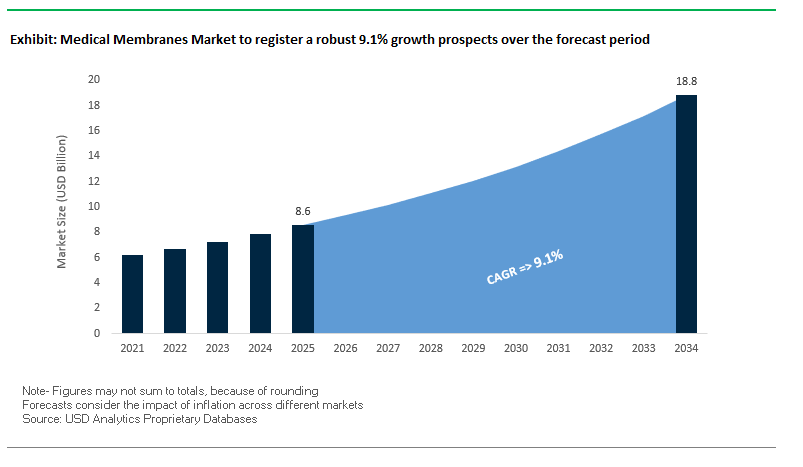
The global Medical Membranes Market is valued at USD 8.6 billion in 2025 and is projected to reach USD 18.8 billion by 2034, registering a CAGR of 9.1% during the forecast period. Market demand is supported by pharmaceutical filtration, biopharmaceutical purification, hemodialysis, diagnostic testing and specialized medical-device applications. Increasing biologics manufacturing activity, established dialysis treatment requirements and demand for validated filtration technologies influence membrane consumption across healthcare and life sciences.
Medical membranes include polymeric and cellulose-based materials engineered for selective separation, microbial retention, solute transport and fluid management. Polyethersulfone (PES), polysulfone (PSU), polyvinylidene fluoride (PVDF), polytetrafluoroethylene (PTFE), polymethyl methacrylate (PMMA) and cellulose derivatives serve different applications according to their permeability, pore structure, chemical compatibility and biological performance.
Biopharmaceutical filtration represents a major demand segment, with virus-removal membranes, sterilizing-grade filters and tangential flow filtration (TFF) supporting monoclonal antibody production, vaccines and advanced biologic therapies. Membrane capacity, protein adsorption and filtration throughput influence consumable requirements and processing costs. In clinical applications, hollow-fiber dialysis membranes facilitate the removal of uremic solutes, with molecular selectivity, albumin retention and hemocompatibility determining performance characteristics.
The competitive environment includes membrane manufacturers, bioprocess filtration specialists and integrated dialysis-device suppliers. Product differentiation is associated with membrane surface modification, validated retention performance, operating efficiency and manufacturing consistency. Developments in low-adsorption PES formulations, virus-removal membrane capacity and specialized dialysis products are extending the range of commercially available filtration technologies.
Medical Membranes Market Share and Key Industry Insights
Medical Membranes Market Size and Growth: The market is projected to expand from USD 8.6 billion in 2025 to USD 18.8 billion by 2034, registering a CAGR of 9.1%,
Microfiltration Leads by Technology: Microfiltration accounts for approximately 35% of the market in 2025, reflecting established demand from pharmaceutical filtration, microbial contamination control and medical fluid-processing applications.
Pharmaceutical Filtration Dominates Applications: Pharmaceutical filtration represents approximately 30% of market share in 2025, supported by sterile drug manufacturing, vaccine production and membrane-based biopharmaceutical purification.
Hemodialysis Membranes Maintain Recurring Clinical Demand: Hollow-fiber PES, PSU and PMMA membranes serve extracorporeal blood purification, where solute clearance, membrane replacement requirements and hemocompatibility influence product differentiation.
Virus Filtration Technologies Advance: Modified PES membranes and specialized hollow-fiber filters are addressing throughput limitations, protein adsorption and viral-retention requirements in monoclonal antibody and advanced biologic manufacturing.
Manufacturing Capacity and Material Development Influence Competition: Recent developments include additional virus-filter production facilities, low-adsorption membrane formulations and certified renewable feedstocks for selected single-use filtration products.
Recent Developments in the Medical Membranes Market: Product Launches, Technology Advancements and Capacity Expansion
Recent developments in the medical membranes industry reflect the commercialization of specialized dialysis membranes, higher-throughput biopharmaceutical filters and additional manufacturing capacity for critical healthcare filtration products. Manufacturer activity during 2024–2026 has addressed membrane selectivity, protein adsorption, process throughput and the supply of validated filtration components.
In August 2026, Nipro Corporation announced the U.S. commercial launch of its ELISIO-HX dialyzer following FDA 510(k) clearance. The product incorporates a super high-flux Polynephron PES membrane with an engineered pore structure designed to increase the removal of larger middle-molecular-weight uremic toxins while maintaining albumin retention. Nipro reported albumin loss below 1 gram per treatment session under its stated performance conditions. ELISIO-HX is compatible with existing hemodialysis equipment, distinguishing its membrane-based expanded hemodialysis approach from therapies requiring additional hemodiafiltration infrastructure.
In June 2026, Merck KGaA introduced the first phase of its Viresolve Pro-S virus filtration solution for complex and high-concentration monoclonal antibody processing. The technology uses modified PES membrane surface chemistry to reduce protein adsorption and associated filtration fouling, influencing membrane throughput and required filtration area. The company reported that the gamma-irradiated filtration devices are manufactured without intentionally added PFAS. Merck had also expanded its manufacturing infrastructure in September 2025 with the opening of a €150 million filtration facility in Blarney, Cork, Ireland. Incorporating approximately 3,000 m² of cleanroom space, the facility supports filtration-device production for vaccines, monoclonal antibodies and cell and gene therapies.
In September 2026, Asahi Kasei Bioprocess introduced the VANTIJ SU-VFC Benchtop automated virus filtration platform for laboratory-scale and process-development applications. The system accommodates Planova 35N filters with effective membrane areas of 0.12 m² and 0.3 m², incorporating single-use flow paths and automated process controls. The development extends established membrane technology into smaller-scale viral-clearance workflows. Asahi Kasei had previously introduced Planova FG1 in October 2024, incorporating a hydrophilic modified PES hollow-fiber membrane. The company reported approximately seven times the water flux of Planova BioEX under its specified comparison conditions. In July 2025, Asahi Kasei announced a fourth Planova cellulose hollow-fiber spinning plant in Nobeoka, Japan, with operations planned for January 2030 and support from Japan's Ministry of Economy, Trade and Industry.
In pharmaceutical sterile filtration, Sartorius expanded its product portfolio with Sartopore Evo, incorporating modified PES membranes designed to reduce the adsorption of proteins and formulation excipients during final filtration. Lower adsorption of formulation components, including polysorbates, is relevant to product recovery and filtration consistency in biologics filling operations. In January 2026, Sartorius announced additional ISCC PLUS certifications covering manufacturing operations in Göttingen, Germany, and M'Hamdia, Tunisia. The company reported that certified renewable raw materials could reduce fossil-based material content in Sartopore Evo filters by approximately 40–60% under its mass-balance accounting framework.
Emerging Trends and High-Impact Opportunities in the Medical Membranes Market
Strategic Capacity Expansion to Support mRNA Vaccine and Therapeutic Production
The medical membranes market is experiencing a surge in capacity expansion driven by the growing mRNA vaccine and therapeutic sector. Leading material science companies are investing heavily to scale manufacturing of highly purified filtration membranes, which are critical for mRNA purification. The sustained demand stems from the expanding mRNA pipeline, including over 120 clinical trials for RNA-based cancer vaccines as of August 2025, alongside therapeutic development for genetic disorders. These advanced membranes enable streamlined bioprocessing, supporting modular manufacturing platforms that can reduce personalized vaccine production timelines from nine weeks to under four weeks. The trend also aligns with broader capital investments in biopharmaceutical manufacturing, such as a $120 million facility expansion in Germany for next-generation biologics. Collectively, these initiatives underscore the importance of specialized filtration membranes in meeting the growing demand for high-purity, mRNA-based therapies, and personalized medicine.
Regulatory Push for Advanced Pathogen Detection Driving Filtration Demand
New U.S. federal regulations are creating a pronounced need for precision filtration membranes in environmental and water quality monitoring. The Safe Drinking Water Act (SDWA) empowers the EPA to enforce stricter standards for microbial contaminants such as Cryptosporidium and Legionella, necessitating advanced filtration solutions for pathogen detection. Real-time monitoring is becoming critical, with modern sensors using membranes to filter particulates, ensuring accurate turbidity, dissolved oxygen, and contaminant measurements. Legislative frameworks, including the America’s Water Infrastructure Act (AWIA), require public water systems to implement risk and resilience assessments, further driving demand for membrane-based water monitoring technologies. These regulatory imperatives create a steady growth trajectory for filtration membranes, particularly in environmental monitoring and public health applications.
Development of Membranes for Point-of-Care Diagnostic Devices
The rise of decentralized healthcare has generated a high-growth opportunity for membrane-based point-of-care (POC) diagnostic devices. Membranes are essential for sample preparation, separation, and signal detection in rapid cartridge-based diagnostics for clinics, pharmacies, and home use. The global POC diagnostics market is expanding rapidly, with lab-on-a-chip devices relying heavily on thin, porous membranes to enable precise fluid manipulation and fast analyte detection. Membrane integration facilitates rapid disease diagnosis, with lateral flow assays capable of delivering results in 15 minutes or less. This opportunity positions membranes as a critical enabler of accessible, accurate, and fast POC testing, meeting the growing demand for decentralized and patient-friendly healthcare solutions.
Innovation in Membranes for Automated Cell Therapy Manufacturing
The scaling of autologous cell therapies, including CAR-T cells, presents a significant opportunity for novel membrane solutions in automated, closed-system manufacturing. Hollow fiber membrane bioreactors offer a controlled environment for optimal cell growth, providing large surface areas for gas exchange and nutrient delivery while maintaining high cell viability. These membranes enable closed-system manufacturing, reducing contamination risk and improving scalability for expensive, sensitive therapies. Integrated membrane-based gas exchange systems in bioreactors enhance cell expansion efficiency and ensure reproducibility, which is critical for commercializing advanced cell-based therapeutics. The trend highlights the strategic role of membranes in enabling cost-effective, safe, and high-quality cell therapy production.
Medical Membranes Market Share Insights
Microfiltration Leads Market Share by Technology in the Medical Membranes Industry
Microfiltration accounts for 35% of the global medical membranes market, positioning it as the cornerstone technology for sterility assurance. With pore sizes ranging from 0.1 to 10 microns, microfiltration membranes are indispensable in removing bacteria and particulates from injectable drugs, IV fluids, and medical gases used in ventilators and bioreactors. Their dominance is directly linked to the expansion of sterile pharmaceutical manufacturing and parenteral drug production, where zero microbial contamination is non-negotiable. Additionally, microfiltration is widely adopted in hospitals for in-line filtration of infusions, further reinforcing its recurring demand. While ultrafiltration and dialysis membranes are also critical technologies, microfiltration’s role as the universal workhorse in sterility compliance ensures it remains the largest contributor to market share.
Pharmaceutical Filtration Dominates Market Share by Application in Medical Membranes
Pharmaceutical filtration represents 30% of the medical membranes market, making it the largest application segment due to its essential role in drug manufacturing. From harvesting cell cultures to clarifying APIs, concentrating proteins, and removing viruses, membranes are integrated at nearly every stage of biologics and vaccine production. The complexity and high cost of these biologics drive reliance on ultrafiltration and nanofiltration membranes to ensure process integrity and product yield. At the same time, sterility requirements for injectable formulations mandate widespread use of microfiltration. The rapid growth of monoclonal antibodies, cell therapies, and next-generation vaccines ensures pharmaceutical filtration continues to dominate market value, as membrane technologies are irreplaceable in meeting regulatory, safety, and efficiency standards.
Medical Membrane Regulatory Standards, Filtration Validation and Quality Requirements
Medical membranes are subject to different regulatory requirements according to whether they are used in pharmaceutical manufacturing or incorporated into finished medical devices. The European Commission's EU GMP Annex 1, applicable from August 2023 with provision 8.123 applicable from August 2024, addresses contamination control, sterilizing filtration and filter integrity testing. These requirements are relevant to membrane filters used in aseptic pharmaceutical processing.
For biopharmaceutical viral safety, the U.S. FDA's ICH Q5A(R2) guidance, finalized in January 2024, establishes principles for viral-risk assessment and clearance validation. The framework applies to biotechnology products derived from human or animal cell lines, including manufacturing processes incorporating virus-removal membranes.
Clinical dialysis membranes are covered by device-specific requirements. ISO 8637-1:2024 specifies requirements and test methods for hemodialyzers, hemodiafilters, hemofilters and hemoconcentrators, including relevant device-performance and safety characteristics.
In the United States, the FDA's Quality Management System Regulation (QMSR) became effective on February 2, 2026, incorporating ISO 13485:2016 into the medical-device quality framework. The regulation applies to finished medical-device manufacturers, including applicable membrane-based dialysis and diagnostic products.
Medical Membranes Market Competitive Landscape and Manufacturer Analysis
The global medical membranes market competitive landscape comprises biopharmaceutical filtration suppliers, clinical dialysis membrane manufacturers and specialty medical filtration providers. Merck KGaA, operating as MilliporeSigma in the United States and Canada, supplies sterilizing-grade filters, virus-removal membranes and tangential flow filtration technologies for biopharmaceutical processing. Sartorius AG competes through modified PES sterile filtration products, ultrafiltration membranes and single-use bioprocess systems. Danaher Corporation, through Cytiva and Pall, maintains a broad portfolio spanning virus filtration, bioprocess microfiltration and downstream purification. Asahi Kasei Corporation specializes in hollow-fiber virus-removal membranes through its Planova platform, supported by dedicated production facilities. Thermo Fisher Scientific expanded its filtration capabilities following the approximately USD 4 billion acquisition of Solventum's Purification and Filtration business in September 2025, incorporating healthcare filtration, membrane technologies and bioprocessing products. Repligen Corporation participates through hollow-fiber and flat-sheet membrane technologies used in tangential flow filtration for biologics manufacturing.
Clinical dialysis membrane competition is characterized by established polymer platforms, recurring consumable demand and product qualification requirements. Fresenius Medical Care supplies dialyzers incorporating Helixone hydro polysulfone membranes, with product differentiation associated with solute clearance, hemocompatibility and albumin retention. Nipro Corporation maintains its ELISIO dialysis membrane portfolio, including engineered PES hollow-fiber technologies for high-flux and expanded hemodialysis. Toray Industries, Inc. supplies polysulfone and PMMA membrane-based dialyzers through products including Toraysulfone, Toraylight and Filtryzer. Vantive Health, established as a standalone kidney-care company following the divestiture of Baxter's Kidney Care business in January 2025, participates through Polyflux, Revaclear and related extracorporeal blood-purification products. Competition within this segment reflects membrane permeability, molecular-weight selectivity, biocompatibility, device compatibility and qualification requirements across regional healthcare markets.
Specialized filtration suppliers address applications requiring controlled microporosity, fluid management, chemical compatibility and validated membrane performance. W. L. Gore & Associates supplies expanded PTFE membrane materials for medical-device venting and selected filtration applications. Parker Hannifin Corporation participates through PROPOR PES pharmaceutical filtration products and expanded its broader filtration portfolio following the August 2026 acquisition of Filtration Group, including Porex porous-material technologies. Meissner Corporation competes through PES-based sterilizing filtration products and bioprocess filtration assemblies. Hangzhou Cobetter Filtration Equipment supplies polymer membrane filters and components for pharmaceutical manufacturing, medical filtration and biotechnology processing. Sterlitech Corporation serves laboratory filtration, membrane characterization and application-development activities through specialized membrane products and filtration equipment. Product differentiation across these suppliers is associated with membrane pore structure, filtration capacity, chemical compatibility, extractables and leachables, and application-specific qualification.
United States Medical Membranes Market Accelerates with FDA Regulations and Nanofiber Innovations
The U.S. medical membranes market is highly regulated under FDA standards, where advanced quality management systems and the Unique Device Identifier (UDI) system drive demand for high-purity, traceable membrane materials. Technological advancements in nanofiber membranes are enabling next-generation solutions for drug delivery, tissue engineering, and advanced filtration. A key trend is the development of single-use membrane assemblies to minimize cross-contamination in biopharmaceutical manufacturing.
Corporate investments are expanding capacity for specialized applications, exemplified by a major U.S. medical device company commissioning a membrane casting line in Massachusetts in late 2024 for gene therapy applications. Strong demand exists in biopharmaceutical manufacturing and dialysis, driven by the prevalence of chronic kidney disease and the growth of vaccine and monoclonal antibody production. Sustainability is gaining focus, with bio-based polymers being explored to reduce the environmental footprint of medical membranes.
Germany Medical Membranes Market Drives Growth with MDR Compliance and Bioprocessing Innovations
Germany’s medical membranes market operates under the EU Medical Device Regulation (MDR 2017/745), which requires enhanced traceability and stringent clinical data for all membrane-based devices. This regulatory pressure drives innovation in high-performance membranes for bioprocessing, sterile filtration, and single-use systems. Companies like Sartorius AG are leading the charge with next-generation single-use membrane technologies to meet pharmaceutical manufacturing needs.
Germany’s strong R&D ecosystem and robust pharmaceutical industry fuel demand for advanced membrane solutions. Strategic investments are being made to meet regulatory requirements and market needs, such as a French pharmaceutical firm investing €1.3 billion in insulin production in Frankfurt (August 2024), requiring high-quality filtration systems. Key applications span biopharmaceuticals, sterile filtration, and gene therapy, supported by Germany’s emphasis on quality healthcare and precision manufacturing.
China Medical Membranes Market Expands Through Domestic Manufacturing and Regulatory Streamlining
China’s medical membranes industry is supported by government initiatives, including the mid-2025 10-measure plan, aimed at accelerating high-end medical device production and streamlining approval processes. Regulatory reforms by the NMPA, including the draft Medical Device Administrative Law (MDAL), propose removing the requirement for imported devices to be pre-approved in their country of origin, simplifying market entry for foreign membrane manufacturers.
Technological investments in automation and AI are increasing production efficiency, supporting domestic high-end medical device manufacturing. The push for import substitution and circular products drives local expansion, with demand fueled by China’s booming pharmaceutical and healthcare sectors. Applications range from sterile filtration to specialized biopharma membranes, emphasizing quality, safety, and compliance with international standards.
India Medical Membranes Market Supported by Make in India and Advanced Manufacturing Policies
India’s medical membranes market is being propelled by the Make in India initiative and the National Medical Devices Policy 2023, promoting domestic manufacturing and innovation. In September 2025, the ICMR licensed nine cutting-edge health technologies, enhancing local production and commercialization. The CDSCO regulates medical devices, while the PLI Scheme incentivizes investment in MedTech manufacturing, including membrane technology.
Advanced membrane adoption is rising in dental, orthopedic, and cardiovascular applications, bolstered by joint ventures such as a Japanese company entering dialysis membrane production in India (late 2024). Investments in medical device parks like the Andhra Pradesh MedTech Zone (AMTZ) provide a favorable environment for R&D, production scaling, and advanced membrane manufacturing. The market benefits from growing healthcare infrastructure, rising medical device adoption, and high-performance, compliant membranes.
Japan Medical Membranes Market Leads with Precision Manufacturing and High-Performance Filtration
Japan’s medical membranes industry is driven by precision manufacturing and expertise in advanced material technologies, with companies like Asahi Kasei Medical and Toray Industries leading innovations in hemodialysis and virus filtration membranes. The PMDA enforces strict quality and safety regulations, while the May 2025 amendment to the Pharmaceuticals and Medical Devices Act strengthens supply stability, impacting manufacturing and supply chain logistics.
The market is increasingly focused on specialty and high-value membranes, particularly for sensitive devices requiring fast, reliable assembly and sterilization solutions. Demand is rising in surgical, dental, and advanced biopharma applications, where membranes must ensure sterility, efficiency, and superior performance. Japan’s emphasis on high-quality healthcare products and technological innovation positions it as a global leader in medical membrane solutions.
Brazil Medical Membranes Market Expands with UDI Implementation and Sustainable Membrane Development
Brazil’s medical membranes market is strengthened by the launch of the national UDI system (Siud) in July 2025, aligning with global traceability standards and impacting membrane labeling and compliance. Technological advancements focus on biodegradable, recyclable, and compostable membrane solutions, reflecting a growing sustainability trend.
Corporate investments are increasing, with companies establishing local manufacturing facilities to reduce dependency on imports and strengthen the domestic supply chain. For instance, Sonoco’s acquisition of its Brazilian joint venture stake (April 2022) expanded its local footprint. The market is driven by pharmaceuticals and medical device sectors, with rising demand for packaged, sterile, and high-performance membranes, supported by Brazil’s growing healthcare infrastructure and online retail expansion.
Medical Membranes Market Report Scope
Medical Membranes Market
Parameter
Details
Market Size (2025)
$8.6 Billion
Market Size (2034)
$18.8 Billion
Market Growth Rate
9.1%
Segments
By Material (PES, PSU, PVDF, PP, PTFE, Cellulose Acetate, Others), By Technology (Microfiltration, Ultrafiltration, Nanofiltration, Dialysis, Gas Filtration, Others), By Application (Pharmaceutical Filtration, IV Infusion & Sterile Filtration, Hemodialysis, Drug Delivery, Bio-artificial Processes, Diagnostics), By End-User (Pharmaceutical & Biotechnology Companies, Hospitals & Clinics, Medical Device Manufacturers, Diagnostic Laboratories)
Study Period
2020- 2025 and 2026-2034
Units
Revenue (USD)
Qualitative Analysis
Porter’s Five Forces, SWOT Profile, Market Share, Scenario Forecasts, Market Ecosystem, Company Ranking, Market Dynamics, Industry Benchmarking
US, Canada, Mexico, Germany, France, Spain, Italy, UK, Russia, China, India, Japan, South Korea, Australia, South East Asia, Brazil, Argentina, Middle East, Africa
Medical Membranes Market Segmentation
By Material
PES
PSU
PVDF
PP
PTFE
Cellulose Acetate
Others
By Technology
Microfiltration
Ultrafiltration
Nanofiltration
Dialysis
Gas Filtration
Others
By Application
Pharmaceutical Filtration
IV Infusion & Sterile Filtration
Hemodialysis
Drug Delivery
Bio-artificial Processes
Diagnostics
By End-User
Pharmaceutical & Biotechnology Companies
Hospitals & Clinics
Medical Device Manufacturers
Diagnostic Laboratories
Countries Analyzed
North America (US, Canada, Mexico)
Europe (Germany, UK, France, Spain, Italy, Russia, Rest of Europe)
Asia Pacific (China, India, Japan, South Korea, Australia, South East Asia, Rest of Asia)
South America (Brazil, Argentina, Rest of South America)
Middle East and Africa (Saudi Arabia, UAE, Rest of Middle East, South Africa, Egypt, Rest of Africa)
Leading Medical Membrane Manufacturers and Key Market Players
Merck KGaA (MilliporeSigma)
Sartorius AG
Danaher Corporation (Cytiva and Pall)
Asahi Kasei Corporation
Thermo Fisher Scientific Inc.
Repligen Corporation
Fresenius Medical Care AG
Nipro Corporation
Toray Industries, Inc.
Vantive Health
W. L. Gore & Associates, Inc.
Parker Hannifin Corporation (including Porex)
Meissner Corporation
Hangzhou Cobetter Filtration Equipment Co., Ltd.
Sterlitech Corporation
The company coverage includes membrane manufacturers, integrated filtration suppliers, dialysis-device producers and specialized membrane technology providers. It does not represent a proprietary market-share ranking.
Medical Membranes Market Research Methodology
The USDAnalytics Medical Membranes Market study integrates primary and secondary research to assess market size, technology developments, competitive dynamics and demand across pharmaceutical filtration, dialysis, medical devices and diagnostics. Primary research incorporates industry perspectives from membrane manufacturers, filtration suppliers and healthcare participants, while secondary research draws on company disclosures, regulatory publications, technical literature and industry sources.
Market estimation employs top-down and bottom-up approaches, supported by data triangulation to assess market values, segment shares and regional trends. Forecast analysis considers historical demand, membrane technology adoption, biopharmaceutical manufacturing activity, dialysis utilization and regulatory developments. Competitive assessment examines manufacturer portfolios, membrane materials, product performance and application coverage, maintaining consistency with USDAnalytics' proprietary market estimates through 2034.
Deliverables:
Comprehensive Market Research Report (PDF and Excel) with detailed tables, charts, and interactive visualizations.
Country-Specific Forecasts & Analysis.
Segment-Wise Revenue Forecasts (2025–2034).
Competitive Analysis, Benchmarking, and SWOT Profiles.
Recent Developments & Innovation Tracker.
Executive Summary & Analyst Commentary.
Post-Purchase Analyst Support for Client-Specific Questions and Custom Data Requirements.
Table of Contents: Global Medical Membranes Market
1. Executive Summary
1.1. Market Highlights
1.2. Key Findings
1.3. Global Market Snapshot
2. Medical Membranes Market Landscape & Outlook (2025–2034)
2.1. Introduction to Medical Membranes Market
2.2. Market Valuation and Growth Projections (2025–2034)
2.3. Market Drivers and Restraints
2.4. Recent Developments and Industry Transformations
2.5. Emerging Applications in Biologics, Dialysis, and Wearable Devices
3. Innovations Reshaping the Medical Membranes Market
3.1. Trend: Strategic Capacity Expansion for mRNA Vaccine and Therapeutic Production
3.2. Trend: Regulatory Push for Advanced Pathogen Detection
3.3. Opportunity: Development of Membranes for Point-of-Care Diagnostic Devices
3.4. Opportunity: Innovation in Membranes for Automated Cell Therapy Manufacturing
4. Competitive Landscape and Strategic Initiatives
4.1. Mergers, Acquisitions, and Strategic Alliances
4.2. R&D and Material Innovation
4.3. Sustainability and Strategies
4.4. Market Expansion and Regional Focus
5. Market Share and Segmentation Insights: Medical Membranes Market
5.1. By Material
5.1.1. PES
5.1.2. PSU
5.1.3. PVDF
5.1.4. PP
5.1.5. PTFE
5.1.6. Cellulose Acetate
5.1.7. Others
5.2. By Technology
5.2.1. Microfiltration
5.2.2. Ultrafiltration
5.2.3. Nanofiltration
5.2.4. Dialysis
5.2.5. Gas Filtration
5.2.6. Others
5.3. By Application
5.3.1. Pharmaceutical Filtration
5.3.2. IV Infusion & Sterile Filtration
5.3.3. Hemodialysis
5.3.4. Drug Delivery
5.3.5. Bio-artificial Processes
5.3.6. Diagnostics
5.4. By End-User
5.4.1. Pharmaceutical & Biotechnology Companies
5.4.2. Hospitals & Clinics
5.4.3. Medical Device Manufacturers
5.4.4. Diagnostic Laboratories
6. Country Analysis and Outlook of Medical Membranes Market
6.1. United States
6.2. Canada
6.3. Mexico
6.4. Germany
6.5. France
6.6. Spain
6.7. Italy
6.8. UK
6.9. Russia
6.10. China
6.11. India
6.12. Japan
6.13. South Korea
6.14. Australia
6.15. South East Asia
6.16. Brazil
6.17. Argentina
6.18. Middle East
6.19. Africa
7. Medical Membranes Market Size Outlook by Region (2025-2034)
7.1. North America Market Size Outlook to 2034
7.1.1. By Material
7.1.2. By Technology
7.1.3. By Application
7.1.4. By End-User
7.2. Europe Market Size Outlook to 2034
7.2.1. By Material
7.2.2. By Technology
7.2.3. By Application
7.2.4. By End-User
7.3. Asia Pacific Market Size Outlook to 2034
7.3.1. By Material
7.3.2. By Technology
7.3.3. By Application
7.3.4. By End-User
7.4. South America Market Size Outlook to 2034
7.4.1. By Material
7.4.2. By Technology
7.4.3. By Application
7.4.4. By End-User
7.5. Middle East and Africa Market Size Outlook to 2034
7.5.1. By Material
7.5.2. By Technology
7.5.3. By Application
7.5.4. By End-User
8. Company Profiles: Leading Players in the Medical Membranes Market
8.1. Merck KGaA (MilliporeSigma)
8.2. Sartorius AG
8.3. 3M Company
8.4. Danaher Corporation (Pall Corporation)
8.5. Asahi Kasei Corporation
8.6. W. L. Gore & Associates
8.7. Koch Membrane Systems, Inc.
8.8. Toray Industries, Inc.
8.9. Nipro Corporation
8.10. Medtronic plc
8.11. Mann+Hummel
8.12. GEA Group
8.13. Hangzhou Cobetter Filtration Equipment
8.14. Sterlitech Corporation
8.15. Novasep
9. Methodology
9.1. Research Scope
9.2. Market Research Approach
9.3. Market Sizing and Forecasting Model
9.4. Research Coverage
9.5. Data Horizon
9.6. Deliverables
10. Appendix
10.1. Acronyms and Abbreviations
10.2. List of Tables
10.3. List of Figures
Medical Membranes Market Segmentation
By Material
PES
PSU
PVDF
PP
PTFE
Cellulose Acetate
Others
By Technology
Microfiltration
Ultrafiltration
Nanofiltration
Dialysis
Gas Filtration
Others
By Application
Pharmaceutical Filtration
IV Infusion & Sterile Filtration
Hemodialysis
Drug Delivery
Bio-artificial Processes
Diagnostics
By End-User
Pharmaceutical & Biotechnology Companies
Hospitals & Clinics
Medical Device Manufacturers
Diagnostic Laboratories
Countries Analyzed
North America (US, Canada, Mexico)
Europe (Germany, UK, France, Spain, Italy, Russia, Rest of Europe)
Asia Pacific (China, India, Japan, South Korea, Australia, South East Asia, Rest of Asia)
South America (Brazil, Argentina, Rest of South America)
Middle East and Africa (Saudi Arabia, UAE, Rest of Middle East, South Africa, Egypt, Rest of Africa)
The global medical membranes market is valued at $8.6 billion in 2025 and is projected to reach $18.8 billion by 2034, growing at a CAGR of 9.1%. Growth is driven by rising biologics production, increased dialysis demand, wearable healthcare devices, and stringent regulatory requirements for high-performance membranes.
Microfiltration leads with 35% market share due to its critical role in sterility assurance, removing bacteria and particulates from injectable drugs, IV fluids, and bioreactor systems. Ultrafiltration, nanofiltration, and dialysis membranes also play key roles in pharmaceutical, cell therapy, and diagnostic applications.
High-purity filtration membranes are essential for mRNA vaccine and therapeutic production, enabling efficient purification, sterile processing, and modular biomanufacturing. Capacity expansions by leading companies reduce production timelines for personalized vaccines and support the growing pipeline of RNA-based therapies.
Membranes are crucial for sample preparation, fluid manipulation, and analyte detection in point-of-care diagnostics and wearable drug delivery systems. Their integration enables rapid, accurate results in decentralized healthcare settings, supporting personalized medicine and patient-friendly monitoring.
The U.S., Germany, China, India, Japan, and Brazil lead growth due to regulatory frameworks, domestic manufacturing initiatives, and technological advancements. Key drivers include FDA and EMA compliance, Make in India and PLI schemes, EU MDR requirements, and strategic investments in high-performance filtration solutions for biopharmaceutical and dialysis applications.