
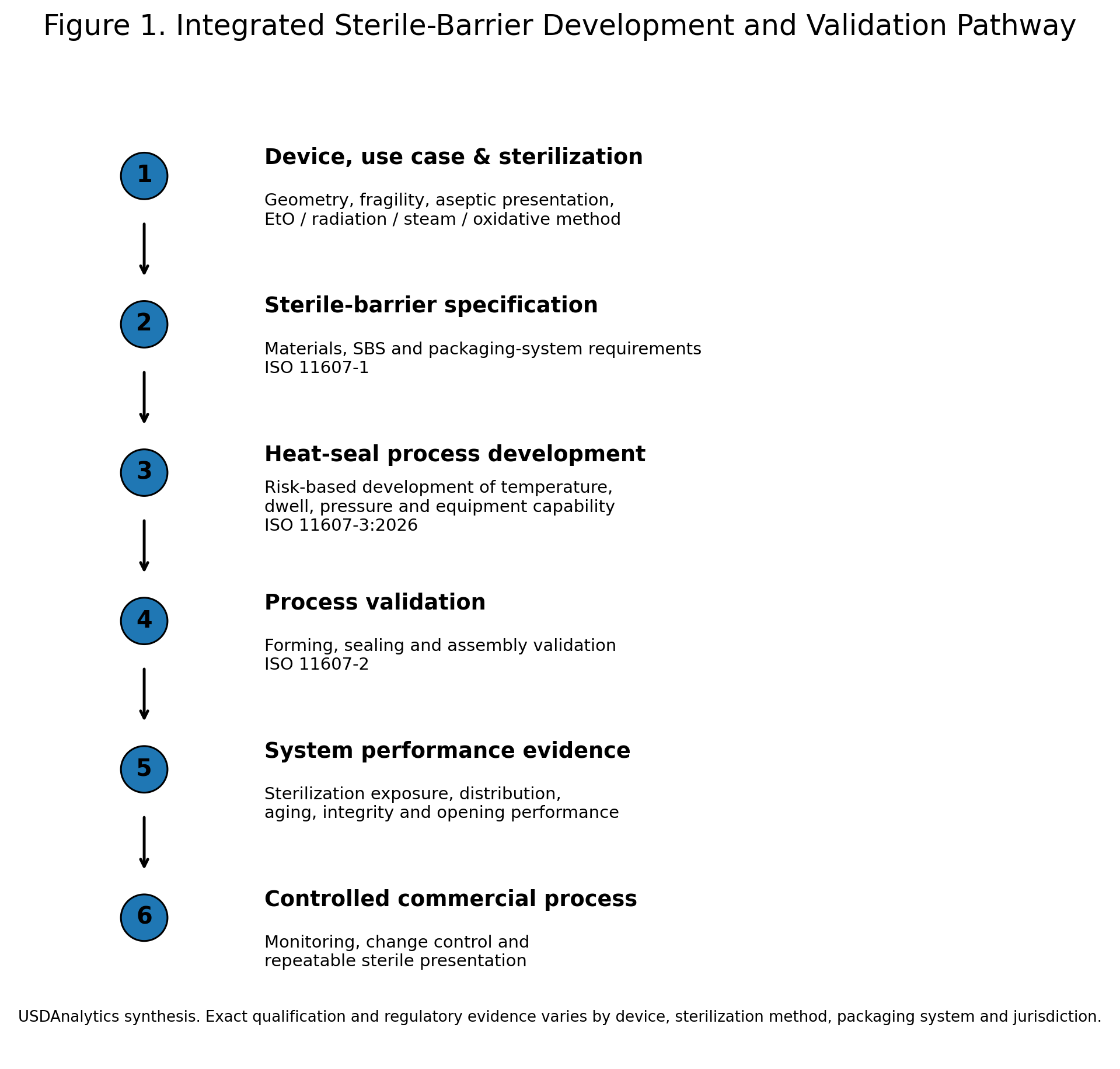
Sterile medical device packaging is moving toward a more integrated validation model in which materials, package geometry, sterilization exposure, sealing parameters, distribution stresses, aging and aseptic presentation are considered as parts of one packaging system. The change is particularly visible in the ISO 11607 framework. ISO 11607-1 defines requirements for sterile-barrier materials and packaging systems, ISO 11607-2 addresses validation of forming, sealing and assembly processes, and the newly published ISO 11607-3:2026 adds a dedicated process-development stage for heat-sealed packaging before formal validation.
This changes the emphasis from proving that a material or seal can pass an isolated test to demonstrating that a reproducible manufacturing process can produce a packaging system capable of maintaining sterility until point of use. At the same time, 2025–2026 investments by Amcor, TekniPlex Healthcare, Oliver Healthcare Packaging and Nelipak show suppliers expanding cleanroom, coating, converting and technical-development infrastructure around both flexible and rigid sterile-barrier systems.
Sterile-Barrier Validation Is Moving Beyond Material Qualification
A sterile barrier system (SBS) is not validated by material selection alone. Device geometry can create puncture or abrasion risks; sterilization can alter polymers, coatings or seals; distribution can introduce shock and compression; aging can change package performance; and the opening mechanism must support aseptic presentation. Those variables make the packaging system an engineered interface between the medical device, the sterilization process, the manufacturing line and the clinical environment.
ISO 11607-1:2019, confirmed as current in 2024, specifies requirements and test methods for materials, preformed sterile barrier systems, sterile barrier systems and packaging systems intended to maintain sterility until point of use. Its 2023 amendment adds application of risk management. ISO 11607-2:2019 addresses the development and validation of forming, sealing and assembly processes, also supplemented by a 2023 risk-management amendment.
ISO 11607-3 Adds a Process-Development Layer Before Formal Validation
Published on September 18, 2026, ISO 11607-3:2026 specifies requirements for process development for forming, sealing and assembly of terminally sterilized medical-device packaging when heat-sealing technologies are used. The standard applies to both preformed SBS and SBS configurations and is explicitly intended for use before formal process validation. It uses the sterile-barrier-system specification to develop the process specification through risk-management principles and recommends minimum heat-sealing equipment features that support later validation, process control and monitoring.
The new Part 3 does not replace ISO 11607-2. It makes the development stage more explicit. In practical terms, the sequence becomes easier to distinguish: define what the sterile barrier must achieve, establish a robust heat-seal process window and equipment capability, then validate the production process.
Table 1. ISO 11607 Sterile-Barrier Validation Architecture
|
Standard |
Primary scope |
Role in packaging validation |
Current significance |
|---|---|---|---|
|
ISO 11607-1:2019 + Amd 1:2023 |
Materials, preformed SBS, SBS and packaging systems |
Defines the requirements and test framework for the package intended to maintain sterility |
Provides the SBS/package specification that later process work must satisfy |
|
ISO 11607-2:2019 + Amd 1:2023 |
Forming, sealing and assembly processes |
Defines process-specification and formal process-validation requirements |
Remains the core process-validation standard |
|
ISO 11607-3:2026 |
Process development using heat-sealing technologies |
Develops the process specification from the SBS specification before validation |
Adds a formalized pre-validation development layer and equipment expectations |
Heat-Seal Development Connects Material Selection with Package Integrity
The heat-sealing process illustrates why an integrated approach is necessary. In an August 2025 technical article, Oliver Healthcare Packaging identifies temperature, dwell time and pressure as the primary inputs for a design-of-experiments approach to tray/lid sealing. Key outputs include seal strength, visual seal appearance and package integrity. Too little energy can leave incomplete seals and voids, while excessive sealing can distort a tray flange or damage/delaminate a lid during opening.
The relationship is particularly visible in rigid or semi-rigid sterile systems using coated Tyvek lids on thermoformed trays. The lid, adhesive/coating, tray flange, tooling and machine settings act as one sealing system. Validation therefore depends on identifying a process window that can repeatedly generate an acceptable seal rather than selecting a nominal sealing temperature in isolation.
Table 2. Sterile-Barrier Design and Validation Variables
|
Variable |
Why it matters |
Typical evidence/output |
|---|---|---|
|
Device geometry and weight |
Influences puncture, abrasion, restraint and package configuration |
Package design rationale, protective features and retention evidence |
|
Sterilization method |
Exposure can alter material, coating and seal performance |
Material compatibility and post-sterilization package performance |
|
Seal temperature |
Controls heat-seal bond formation and the operating window |
Seal-strength, visual-quality and integrity results |
|
Dwell time |
Affects heat transfer and bond formation |
DOE/process-window evidence |
|
Seal pressure |
Influences contact and bond consistency across the seal area |
Seal uniformity and process-window evidence |
|
Distribution stresses |
Shock, vibration, compression and low-temperature events can challenge packaging |
Conditioning/distribution simulation followed by integrity testing |
|
Aging |
Package must maintain performance through claimed shelf life |
Accelerated and/or real-time aging evidence |
|
Aseptic presentation |
Opening behavior can influence contamination risk at point of use |
Peel, particulate/lint and usability evidence |
Flexible and Rigid Systems Converge on the Same Validation Requirements
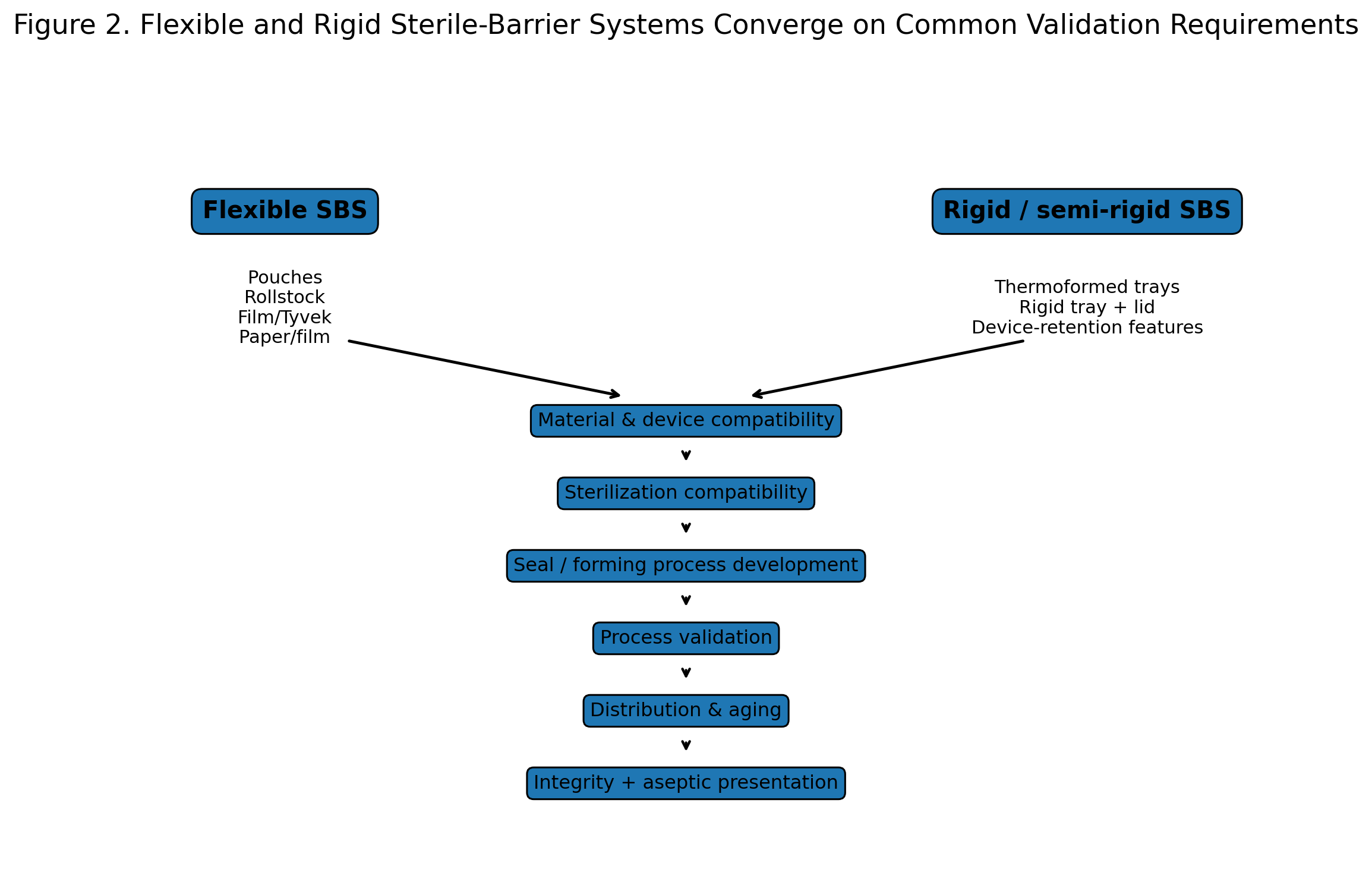
Sterile medical packaging uses both flexible systems—such as pouches and rollstock—and rigid or semi-rigid systems such as thermoformed trays with die-cut lids. Their geometries differ, but the underlying validation questions converge: Is the material compatible with the device and sterilization method? Can forming and sealing be controlled? Does the package remain intact after sterilization, transport and aging? Can the user open it without compromising sterile presentation?
The convergence is visible in supplier infrastructure. In March 2026, Nelipak opened an Asia-Pacific Technical Development Center in Singapore designed specifically to integrate flexible and rigid sterile-barrier packaging development under one roof. The model brings package design and technical-development capability closer together instead of treating pouches and rigid trays as separate development disciplines.
Sterilization Compatibility Remains Package-Specific
Material compatibility with sterilization is a necessary starting point, but it does not replace package-specific qualification. DuPont states that Tyvek 1073B and its other medical-packaging Tyvek styles are compatible with ethylene oxide, gamma radiation, electron beam, steam under controlled conditions and low-temperature oxidative methods. DuPont also highlights microbial barrier, puncture resistance, moisture resistance, clean peel and low linting as relevant performance attributes.
Those characteristics explain the broad use of Tyvek in pouches and tray lidding, but sterilization compatibility must still be evaluated within the final package. Device geometry, coating chemistry, tray or film substrate, seal process, dose/exposure conditions and post-sterilization aging can all influence system performance. The relevant question is therefore not whether a material is generally compatible with a sterilization modality, but whether the complete SBS remains functional after the specific sterilization and lifecycle conditions applied to the device.
Manufacturing Investment Is Expanding Sterile-Barrier Capability
Current capital investments show suppliers expanding the manufacturing infrastructure needed to support these validated systems. In June 2025, TekniPlex Healthcare began production at a 200,000-square-foot Barrier Protection Systems facility in Madison, Wisconsin. The ISO 13485-certified site includes an air-knife coater for coated Tyvek and heat-seal-coated reinforced papers, together with advanced healthcare printing capability. The facility serves medical-device and pharmaceutical sterile-barrier applications including procedure kits, IV sets, syringes and implantable devices.
Oliver Healthcare Packaging opened a 120,000-square-foot Johor, Malaysia facility in May 2025. The site includes ISO Class 7 and Class 8 cleanrooms and manufactures pouches, lids and rollstock, extending regional sterile-barrier converting capability for medical-device, diagnostic and pharmaceutical customers.
In April 2026, Amcor opened a healthcare packaging coating facility in Subang Jaya, Malaysia after investing more than USD 35 million. The site uses air-knife coating technology for coated medical paper and incorporates closed-loop process controls, in-line quality monitoring and automated manufacturing systems. Amcor also describes the investment as creating an integrated regional site and a platform for pilot-to-production scale-up.
Sustainability Changes Increasingly Depend on Equivalence and Change Control
Sterile-barrier sustainability is constrained by the cost and risk of changing a validated material. A new substrate can alter seal behavior, sterilization response, particulate performance or opening characteristics and may trigger extensive qualification work. That makes material equivalence and documented change control particularly important.
Tyvek with Renewable Attribution provides one current example. DuPont uses certified renewable feedstocks through a mass-balance approach while maintaining the same product specifications, performance and quality documentation as conventional Tyvek styles, positioning the material as a drop-in extension of the established healthcare-packaging portfolio.
In September 2025, Cook Medical and Nelipak announced use of the material for packaging the Compass BDS Biliary Plastic Stent and Resonance Metallic Ureteral Stent, explicitly describing integration into existing healthcare-packaging production processes.
Later that month, Olympus announced that it would begin incorporating Tyvek with Renewable Attribution into sterile packaging for more than 100 single-use device categories from 2026. Olympus expects the change to reduce CO2 emissions by approximately one-third of the Tyvek carbon footprint. A DuPont case study states that Olympus determined that extensive revalidation datasets were not required because specifications and physical properties remained unchanged. That is an important validation lesson: sustainability changes can scale more rapidly when they are engineered to preserve the validated functional characteristics of the existing sterile-barrier material.
Table 3. Sterile-Barrier Technology, Capacity and Validation Developments, 2025–2026
|
Date |
Company / organization |
Development |
Evidence |
Validation significance |
|---|---|---|---|---|
|
May 2025 |
Oliver Healthcare Packaging |
Johor manufacturing facility |
120,000 sq ft; ISO Class 7/8 cleanrooms; pouches, lids and rollstock |
Regional cleanroom capability across flexible SBS and tray lidding |
|
Jun 2025 |
TekniPlex Healthcare |
Madison Barrier Protection Systems facility |
200,000 sq ft; ISO 13485; coated Tyvek and heat-seal-coated reinforced papers |
Integrates barrier coating, printing and production capability |
|
Sep 2025 |
Cook Medical + Nelipak + DuPont |
Tyvek RA stent packaging |
Compass BDS and Resonance stent packaging |
Sustainability change integrated into established production architecture |
|
Sep 2025 |
Olympus + DuPont |
Large-scale Tyvek RA adoption |
>100 single-use device categories from 2026; ~one-third Tyvek footprint reduction expected |
Equivalence/change-control pathway for scaled material transition |
|
Mar 2026 |
Nelipak |
Singapore Technical Development Center |
Rigid and flexible SBS development combined under one roof |
Integrated packaging development across system types |
|
Apr 2026 |
Amcor |
Malaysia healthcare coating facility |
>$35M; air-knife coating; closed-loop controls; in-line quality monitoring |
Greater control of coated sterile-packaging substrates and scale-up |
|
Sep 2026 |
ISO |
ISO 11607-3:2026 |
Process-development standard for heat-sealed packaging before validation |
Formalizes the pre-validation layer in SBS manufacturing |
FDA QMSR Places Packaging Validation Within a Broader Quality-System Framework
The U.S. regulatory environment also changed in 2026. The FDA Quality Management System Regulation (QMSR) became effective on February 2, 2026 and incorporates ISO 13485:2016 by reference into the device CGMP framework under 21 CFR Part 820. FDA simultaneously moved away from QSIT to its QMSR-aligned inspection process.
QMSR does not replace ISO 11607 package-validation standards, but it places sterile-barrier development and validation inside a broader quality-management environment based on documented processes, risk management, controlled production and lifecycle evidence. For packaging engineers, that makes process-development records, validation rationale, supplier controls and change-management evidence part of a wider quality-system context rather than isolated packaging documents.
What the 2025–2026 Evidence Shows
The sterile-barrier packaging model is becoming more integrated in three ways. First, the standards architecture is more explicit: ISO 11607-1 defines the package/SBS requirements, ISO 11607-3 now formalizes heat-seal process development, and ISO 11607-2 remains the formal process-validation framework. Second, suppliers are investing in cleanroom converting, coating, printing, rigid/flexible development and regional capacity that bring design and manufacturing control closer together. Third, sustainability changes are increasingly being framed through equivalence and change control rather than through material substitution alone.
The result is a validation model centered on the complete packaging system. Material properties remain essential, but commercial robustness depends on how the device, sterilization method, seal process, forming process, distribution environment, shelf life and opening behavior interact. For medical device packaging and sterilized packaging, that system-level perspective is increasingly the technical basis for both new package development and controlled material change.
The same engineering logic also matters within the broader healthcare packaging landscape. Rigid or semi-rigid sterile tray systems provide a selective connection to rigid packaging in pharmaceuticals where thermoformed trays, lidding interfaces or sterile combination-product packaging are relevant, although pharmaceutical bottles, vials and other non-sterile-barrier rigid formats remain outside the scope of this Insight.
Related USDAnalytics Research
- Medical Device Packaging Market — sterile and non-sterile packaging formats, materials, sterilization compatibility, regulatory developments and supplier positioning.
- Sterilized Packaging Market — sterile-barrier materials, sterilization methods, packaging formats and validation requirements.
- Healthcare Packaging Market — wider pharmaceutical, medical-device, diagnostic and healthcare packaging analysis.
- Rigid Packaging in the Pharmaceuticals Market — rigid pharmaceutical containers and selected thermoformed/sterile rigid packaging applications.
Research note: ISO 11607-3:2026 applies specifically to process development for forming, sealing and assembly when heat-sealing technologies are used and is intended before formal validation. Supplier material-compatibility and sustainability claims should remain attributed to the respective manufacturers. Package qualification remains device-, material-, sterilization- and process-specific.