Membrane performance is often compared through pore size, molecular-weight cut-off, salt rejection, permeability, or membrane chemistry. At plant level, however, these properties operate through a physical module architecture that determines how much membrane area fits into a treatment train, how feedwater moves across the separation surface, where solids accumulate, how the module is cleaned, and how easily elements can be replaced.
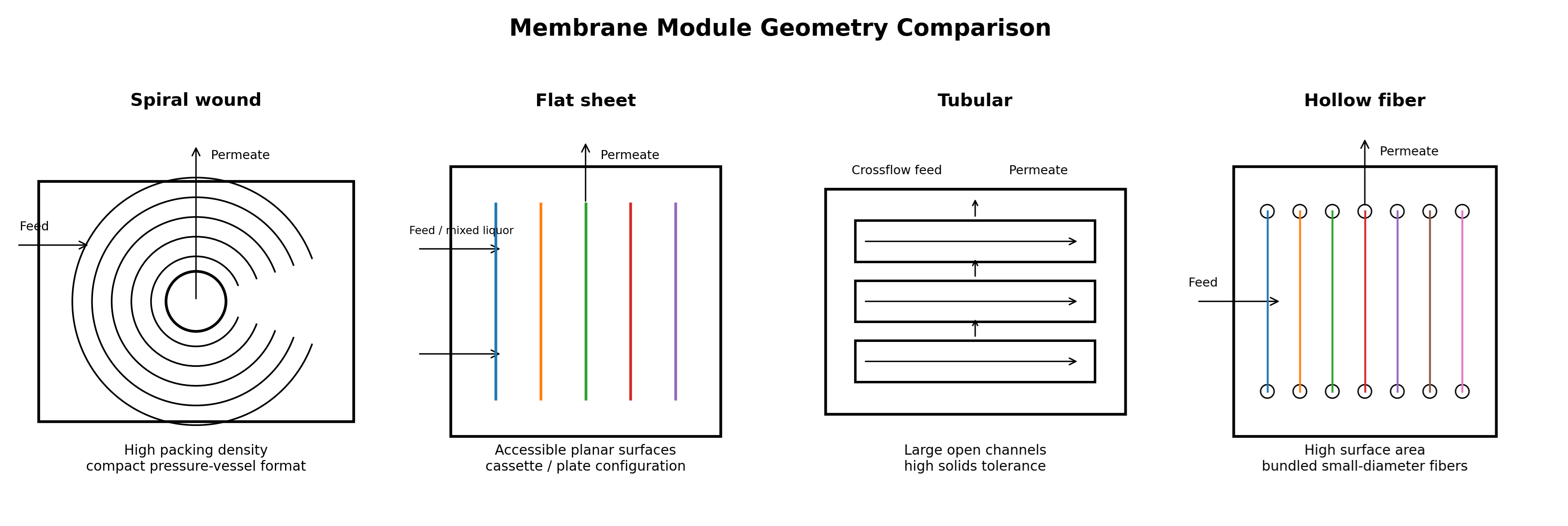
This makes membrane geometry an operating and cost variable rather than simply a mechanical design choice. Spiral-wound elements concentrate membrane area inside compact pressure vessels. Flat-sheet systems provide accessible planar filtration surfaces. Tubular membranes maintain comparatively open feed passages for solids-intensive streams, while hollow-fiber modules achieve high surface area through bundles of small-diameter fibers.
The commercial question is therefore not which geometry is technically superior. It is how membrane packing density, channel dimensions, fouling behavior, pumping energy, maintenance access, retrofit compatibility, and replacement frequency combine under a specific feed condition.
Membrane Geometry Creates a Trade-off Between Compactness and Feed Tolerance
The most fundamental difference between membrane configurations is the relationship between membrane area and hydraulic openness.
Compact configurations place more separation area inside a smaller equipment envelope. That can reduce pressure-vessel count, membrane-rack footprint, civil requirements, and associated piping. The trade-off is that tighter feed channels can become more sensitive to suspended solids, biological growth, organic matter, or precipitated material.
More open module geometries move in the opposite direction. Wider channels generally tolerate more solids and permit more aggressive cleaning, but the lower membrane-area density can increase equipment volume or recirculation requirements.
This trade-off helps explain why conventional RO and NF treatment trains favor compact spiral-wound membrane elements, while high-solids industrial wastewater streams may require substantially more open geometries.
Table 1. How Membrane Geometry Changes the Commercial Cost Structure
|
Membrane configuration |
Geometry advantage |
Feed-handling profile |
Important operating-cost variable |
Maintenance characteristic |
Typical commercial role |
|
Spiral wound |
High membrane area within compact pressure vessels |
Best suited to comparatively controlled feeds |
Feed pressure, pressure drop and cleaning |
CIP and element replacement |
RO/NF, desalination, water reuse, process concentration |
|
Flat sheet |
Accessible planar surfaces |
Biological solids and selected process streams |
Aeration and cleaning |
Panel, cartridge or cassette access |
MBR, wastewater and process filtration |
|
Tubular |
Large open flow channels |
Oils, biomass, suspended solids and viscous feeds |
Crossflow recirculation energy |
Strong chemical/mechanical cleaning capability |
Industrial wastewater, external MBR and food processing |
|
Hollow fiber |
High membrane-area density |
Depends strongly on lumen diameter and operating mode |
Backwashing, aeration or pressure |
Bundled and typically backwashable |
UF/MF and advanced NF |
The commercial implication is that high membrane-area density does not automatically produce the lowest lifecycle filtration cost. Pretreatment requirements, pumping power, chemical cleaning, membrane replacement, production interruptions, and plant footprint can outweigh differences in membrane purchase price.
Compact Modules Shift More Responsibility to Feed Conditioning and Hydraulic Design
Spiral-wound membranes illustrate this trade-off clearly. Flat membrane leaves, feed spacers, and permeate carriers are wound around a central permeate tube, creating substantial membrane area within standardized cylindrical pressure vessels.
That compactness supports large desalination, industrial water reuse, ultrapure water, and process-separation systems. It also means that feed-channel design becomes commercially important. Suspended solids, biological material, scaling constituents, and organic matter can increase differential pressure or reduce membrane productivity when deposits accumulate inside narrow spacer channels.
Feed spacers consequently perform more than a structural role. Spacer thickness and geometry influence flow distribution, pressure loss, mass transfer, and cleanability. DuPont, Hydranautics, Toray and other RO membrane manufacturers increasingly differentiate elements through combinations of membrane-surface chemistry and feed-channel engineering rather than salt rejection alone.
The same relationship appears in industrial process separation. Alfa Laval's 2025 DuroLac spiral ultrafiltration element was developed to increase permeate productivity in dairy applications, with the company reporting up to 15% additional permeate capacity per element under application-dependent conditions. Greater throughput per installed element can affect membrane-vessel utilization, production time, utilities consumption, and the number of elements required for a defined processing duty.
These developments show why spiral-wound membrane economics depend on the interaction between compact membrane packing and sufficiently controlled feed conditions.
Open Surface Designs Change the Economics of Solids Management
When the feed contains biological solids, concentrated suspended matter, or material that readily forms surface deposits, the commercial value of more open membrane geometries becomes more apparent.
In submerged MBR installations, planar membrane sheets are assembled into cassettes and immersed directly in mixed liquor. Air scouring limits solids accumulation while permeate is drawn through the membrane. Compared with dense pressure-vessel arrangements, the commercial emphasis shifts from maximum membrane packing toward sustainable flux, cassette accessibility, air demand, sludge characteristics, and cleaning frequency.
These operating characteristics underpin demand for flat-sheet membrane configurations across municipal and industrial MBR installations, while ceramic flat-sheet systems are also moving into more demanding pretreatment applications.
Meidensha's 2026 ceramic flat-sheet demonstration at Singapore's Tuas Desalination Plant provides a practical example of this equipment-design trade-off. The evaluation examines whether submerged flat-sheet geometry can deliver stable filtration within an established pretreatment facility while altering equipment footprint, solids-handling requirements, and maintenance access.
The significance for membrane geometry is not that flat-sheet technology is displacing conventional desalination pretreatment across the industry. It is that planar submerged configurations are being tested at capacities where equipment footprint, membrane accessibility, solids handling, and integration with existing treatment infrastructure become material commercial variables.
Difficult Industrial Feeds Create a Different Geometry–Energy Trade-off
Open channels become even more important in wastewater containing oils, biomass, emulsions, suspended solids, precipitates, or highly viscous material.
Tubular membranes use comparatively large internal flow passages that allow such material to circulate across the membrane surface with substantially less plugging risk than narrow-channel designs. This makes tubular membrane systems commercially relevant in external MBRs, landfill leachate, oily wastewater, metal-processing fluids, fermentation streams, and difficult industrial effluent.
The trade-off moves from packing density toward recirculation energy.
Crossflow velocity is used to limit concentration polarization and cake formation, which can require significant pumping energy. Manufacturers are therefore engineering internal surfaces and channel geometries to generate useful turbulence without relying solely on higher bulk flow rates.
Pentair X-Flow's Helix configuration is one example. Its internal geometry is intended to increase mixing at the membrane surface and improve fouling control under lower crossflow conditions. The commercial issue is the balance between sustainable membrane flux and the energy consumed to maintain that flux.
Geometry also affects the cost of material substitution. Pentair announced in 2026 that its planned PES tubular membrane generation is being developed around standard installation dimensions. The retrofit-compatible PES development is significant because changing polymer chemistry becomes considerably more expensive if membrane housings, piping, racks, or pumps must also be modified.
Module Architecture Is Becoming a Separate Layer of Commercial Differentiation
Membrane chemistry does not operate independently of the equipment surrounding it. Feed distributors, housings, spacers, potting materials, permeate collectors, seals, manifolds, cassettes, and pressure vessels determine how much of the theoretical membrane performance reaches full-scale operation.
This is where the economics of membrane filtration modules become distinct from the membrane material itself.
One important development is the integration of treatment functions within the module architecture. In April 2026, DuPont launched Inge ultrafiltration modules incorporating an integrated pre-filter. The integrated UF module design combines debris removal and ultrafiltration in one housing while retaining dimensions and membrane materials associated with the existing module family.
The commercial value lies in removing equipment rather than changing the separation mechanism. Eliminating a separate upstream prefilter can reduce manifolds, valves, piping, footprint, and installation complexity in applicable systems.
Module manufacturers are also increasing treatment capacity without proportionally expanding filtration racks. Pall's Membralox GP-IC ceramic module architecture uses intermingled channels and gradient permeability, with Pall reporting up to 45% greater filtration capacity than conventional ceramic filters of similar dimensions under its applicable comparison conditions.
Such developments shift the buyer question from membrane area alone to usable treatment capacity per installed module and per unit of plant space.
Figure 1. Membrane Geometry Trade-off: Footprint Efficiency vs Difficult-Feed Tolerance
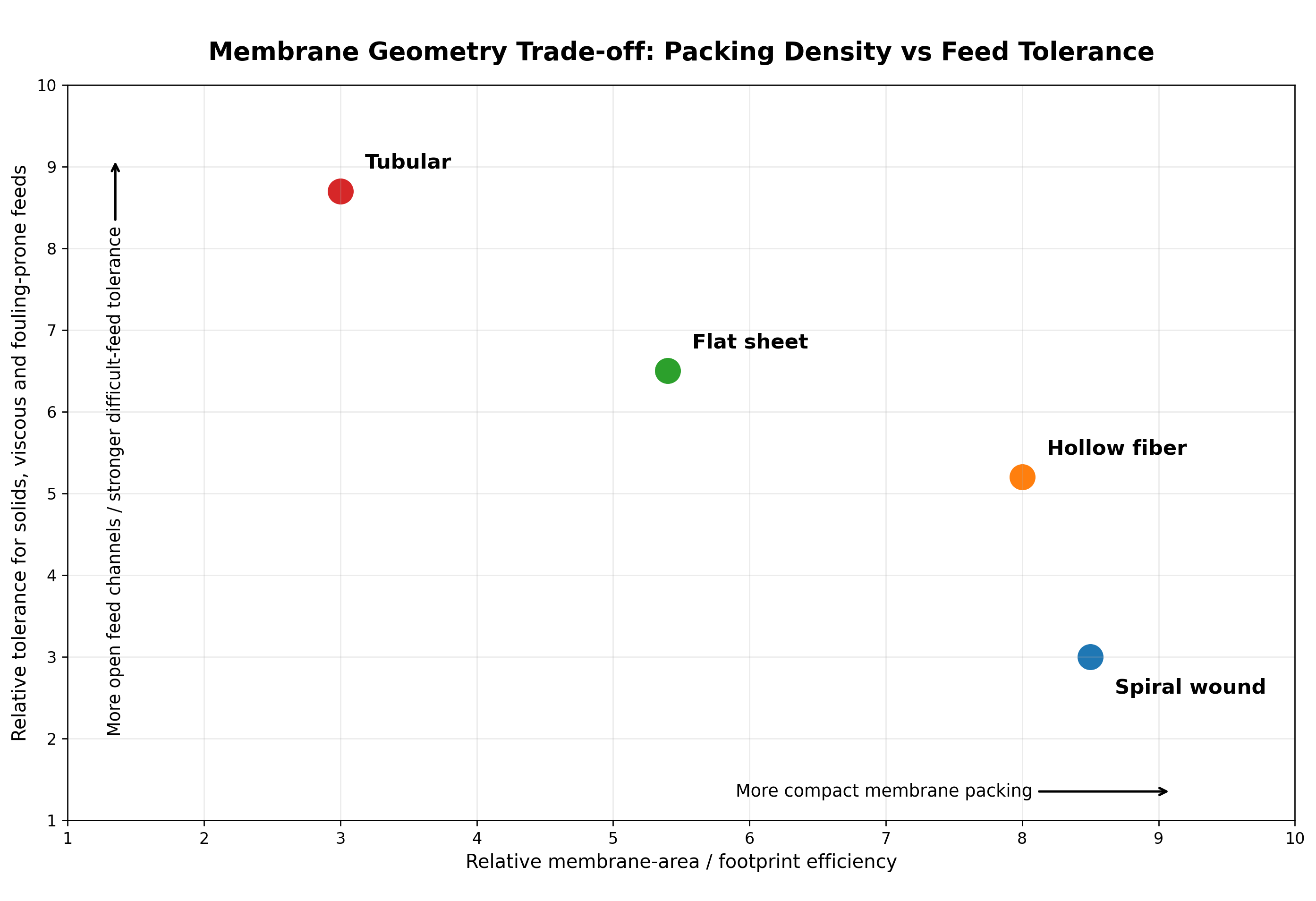
The comparative relationship can be represented qualitatively as follows:
- Spiral wound: high membrane-area density, comparatively lower difficult-feed tolerance.
- Hollow fiber: high area density, with feed tolerance strongly dependent on lumen dimensions and filtration mode.
- Flat sheet: moderate packing density with greater surface accessibility.
- Tubular: lower packing density but high tolerance for solids-intensive and viscous streams.
The positions are indicative rather than standardized ratings because actual performance depends on membrane material, channel dimensions, feed composition, operating pressure, hydrodynamics, and pretreatment.
Recent Module Developments Are Targeting Lifecycle Cost Rather Than Geometry Alone
Recent product developments show that module suppliers are using geometry to address three economic constraints simultaneously: equipment footprint, fouling-related operating costs, and replacement complexity.
Table 2. Selected Membrane-Geometry Developments and Their Commercial Relevance
|
Period |
Company |
Development |
Verified metric/status |
Commercial relevance |
|
Jun. 2026 |
Meidensha |
Ceramic flat-sheet desalination pretreatment demonstration |
Approx. 28,000 m³/day filtrate capacity |
Tests planar ceramic filtration at larger desalination scale |
|
Apr. 2026 |
DuPont |
UF module with integrated prefilter |
Two filtration functions in one housing |
Reduces separate upstream equipment in applicable systems |
|
Apr.–May 2026 |
Toray |
F-HFUG UF module |
0.005 μm nominal pore size |
Targets biopolymer passage associated with downstream RO biofouling |
|
May 2026 |
Pentair X-Flow |
Planned PES tubular generation |
Retrofit-oriented standard dimensions |
Limits equipment modification during material transition |
|
Sep. 2025 |
Pall |
Membralox GP-IC |
Up to 45% more capacity in manufacturer's comparison |
Improves usable filtration capacity per module |
|
Apr. 2025 |
Alfa Laval |
DuroLac spiral element |
Up to 15% additional permeate capacity per element |
Raises process output from installed membrane area |
|
Sep. 2026 |
Kovalus |
Spiral-element assembly expansion |
>USD 30 million; capacity +30% |
Supports element availability and replacement supply |
DuPont reduces auxiliary equipment. Pall increases usable capacity within similar module dimensions. Alfa Laval increases permeate output per spiral element. Pentair preserves replacement compatibility while changing membrane material. Toray positions upstream UF geometry partly around its effect on downstream RO operation.
The common theme is that membrane-module engineering is increasingly measured through its effect on the entire treatment train, not solely through nominal membrane performance.
Replacement Compatibility Turns Installed Geometry into an Aftermarket
Once a filtration system is commissioned, module geometry becomes embedded in the plant.
Pressure-vessel diameter, cassette dimensions, element length, manifold connections, air-scouring arrangements, recirculation pumps, backwash equipment, rack spacing, and control logic all influence whether a replacement membrane can be introduced without modifying surrounding infrastructure.
This creates recurring revenue beyond new treatment capacity.
Standardized spiral-wound elements support competition within compatible pressure vessels. Submerged systems generate recurring cassette and cartridge requirements. Tubular installations are sensitive to module dimensions and hydraulic resistance because changes can affect recirculation equipment. Hollow-fiber replacements depend on rack connections, header arrangements, integrity-testing systems, and backwash design.
Manufacturing location also becomes relevant in this installed-base market. Kovalus completed a spiral-element assembly expansion in Monterrey, Mexico, in September 2026 involving more than USD 30 million of expenditure and increasing production capacity by 30%. The additional capacity serves food, dairy, beverage, and industrial separation products.
For operating treatment plants, manufacturing capacity affects more than supplier scale. It influences replacement lead times, batch availability, element consistency, inventory requirements, and continuity of membrane supply.
Filtration Economics Ultimately Depend on the Interaction Between Geometry and Feed Conditions
No membrane geometry simultaneously maximizes packing density, solids tolerance, cleaning access, low pressure drop, and minimum pumping energy.
Spiral-wound elements provide high membrane-area density where feed conditioning can maintain narrow channels. Flat-sheet membranes offer accessible separation surfaces for submerged biological systems and selected process applications. Tubular membranes preserve open flow paths for solids-intensive and fouling-prone streams but require greater consideration of crossflow energy. Hollow-fiber modules achieve high surface area while introducing their own integrity, lumen, and backwashing constraints.
The relevant cost therefore extends beyond the membrane purchase price.
Pretreatment requirements, pumping energy, aeration, cleaning chemicals, production downtime, module replacement, filtration-rack utilization, and plant footprint together determine lifecycle membrane economics.
As manufacturers redesign channels, integrate pretreatment functions, increase membrane area, preserve retrofit compatibility, and reduce fouling-related operating penalties, membrane geometry is becoming an increasingly important source of differentiation in industrial water treatment and process separation.
Membrane Module Geometry Comparison