
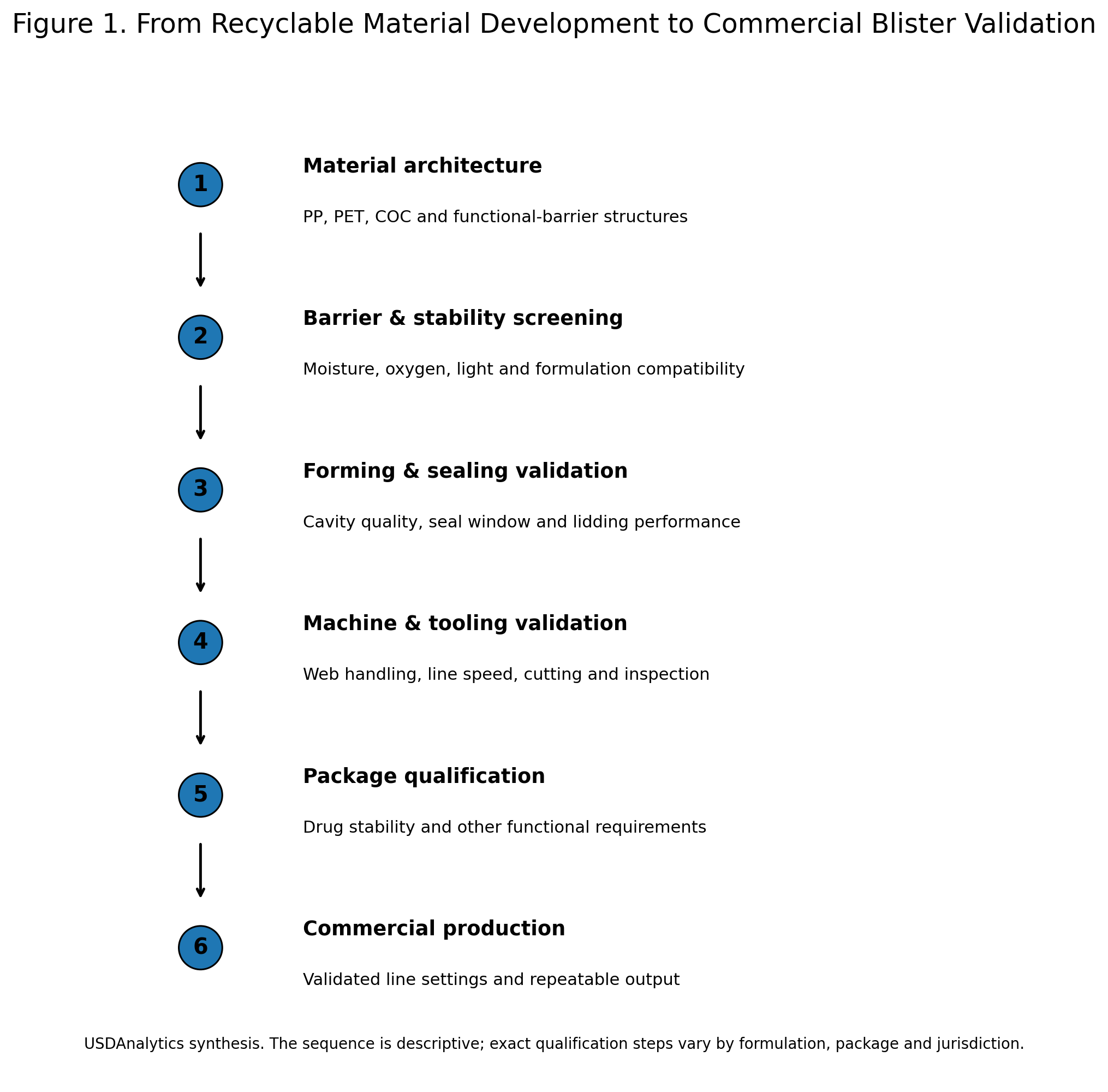
Recyclable blister packaging is moving beyond the stage where a new polymer structure can be evaluated only as a material concept. For pharmaceutical applications, the forming web and lidding structure must protect the product while also forming consistently, sealing within a workable process window, running through inspection and cartoning equipment, and supporting the stability profile of the finished drug. That makes recyclability a system-engineering issue rather than a simple resin substitution exercise.
Recent 2025–2026 developments show polypropylene (PP), polyethylene terephthalate (PET), cyclic olefin-based structures and functional-barrier polymers moving further into production trials, commercial equipment and, in several cases, marketed pharmaceutical applications. At the same time, high-barrier PCTFE laminates and cold-form aluminum remain technically important where moisture, oxygen or light protection cannot be compromised. The emerging picture is therefore one of application-specific material migration rather than a universal replacement of conventional blister structures.
Recyclability Is Becoming a System-Level Packaging Requirement
A pharmaceutical blister is not defined by the forming film alone. The package combines the cavity web, lidding, seal interface, printing or coding, downstream inspection and secondary packaging. A material that is theoretically recyclable can still fail commercially if it narrows the seal window, deforms during forming, changes pocket geometry, reduces line speed or cannot maintain the required drug-protection profile.
This is why current development programs increasingly connect film suppliers with machinery manufacturers and converters. In April 2025, Uhlmann Pac-Systeme, ETIMEX Primary Packaging, Perlen Packaging and Faller Packaging disclosed a PP pharmaceutical blister collaboration spanning primary film, machine processing and secondary packaging. ETIMEX PP materials were tested and optimized on an Uhlmann BEC 400 under production-relevant conditions, making the program evidence of value-chain validation rather than material development in isolation.
PP Blister Systems Are Moving into Commercial Pharmaceutical Production
Public evidence now extends beyond pilot concepts. Dr. Pfleger Arzneimittel is producing recyclable PP mono blisters on an Uhlmann BEC 400. The public case study identifies batch sizes from 500 to 50,000 packs, changeovers of less than 30 minutes and the ability to process PP mono, PP/aluminum and aluminum/aluminum formats on the same line. This is important because it demonstrates routine pharmaceutical production rather than only a machine demonstration.
On the material side, ETIMEX PURELAY PHARM is offered in 250–800 µm thicknesses and paired with PURELAY LID, which starts at 90 µm, to form a PP mono-material blister. ETIMEX positions the system for high water-vapor barrier, pharmaceutical processing and blister/FFS equipment, with its broader portfolio information stating that conventional machines can be used with only minor modifications.
PET Provides a Lower-Barrier Recycling Route While PP and COC Extend the Barrier Range
PET-based blister systems are gaining commercial evidence where formulations require limited moisture protection. Romaco demonstrated Liveo Research PET/PET One-Material Blister on the Noack N 760 at up to 150 blisters per minute in four-lane operation and stated that an international pharmaceutical group was already marketing painkillers in the PET OMB structure. Huhtamaki Push Tab with kpNext R1 PET forming film is likewise positioned to run on existing lines without equipment modification or speed reduction, with barrier performance described as comparable to mono-PVC.
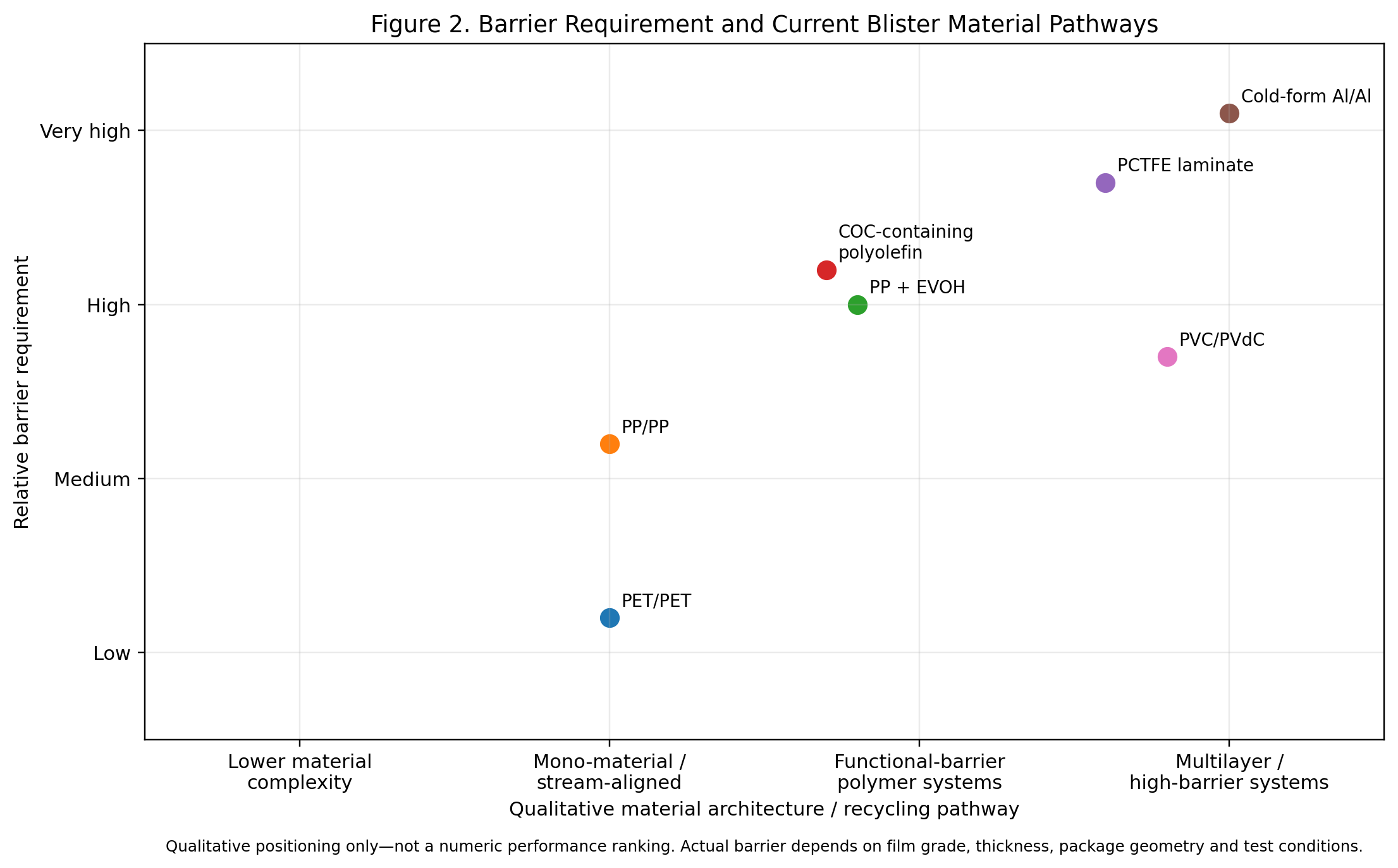
Supplier portfolios are also widening the range of recyclable structures. Liveo Research expanded its One-Material Blister portfolio in late 2025 from PET into PP and COC concepts, moving from low/no moisture-barrier applications toward medium and medium-to-high water-vapor protection. TekniPlex Healthcare similarly positions PET structures for drugs requiring little or no moisture barrier and COC-containing polyolefin structures with PP lidding for mid-to-high moisture-barrier applications. EVOH can be incorporated where additional oxygen protection is required.
Table 1. Recyclable and Conventional Pharmaceutical Blister Technology Comparison
|
Blister architecture |
Transparency |
Relative moisture barrier |
Relative oxygen barrier |
Forming route |
Recycling / circularity consideration |
Commercial maturity / role |
|---|---|---|---|---|---|---|
|
PVC + aluminum lidding |
Yes |
Baseline to moderate |
Application dependent |
Thermoform |
Mixed-material structure; recycling is difficult in conventional streams |
Established pharmaceutical benchmark |
|
PVC/PVdC + aluminum lidding |
Yes |
Medium to high |
Medium to high |
Thermoform |
Multilayer / mixed-material structure |
Established higher-barrier thermoform system |
|
PCTFE laminate + aluminum lidding |
Yes |
High to ultra-high |
Application dependent; can be engineered with other barrier layers |
Thermoform |
Multilayer structure; selected when transparent high moisture barrier is needed |
Established high-barrier benchmark |
|
Cold-form aluminum / aluminum |
No |
Very high / total barrier |
Very high / total barrier |
Cold form |
Complex multilayer structure; material minimization is an important sustainability route |
Established maximum-barrier benchmark |
|
PET / PET |
Yes |
Low; supplier platforms position it near mono-PVC applications |
Application dependent |
Thermoform |
Designed for PET recycling pathways where collection/sorting infrastructure exists |
Commercial pharmaceutical use and line demonstrations |
|
PP / PP |
Yes |
Medium to high, depending on architecture |
Application dependent |
Thermoform |
Designed for PP recycling pathways where infrastructure exists |
Commercial production and machine validation |
|
PP with EVOH functional barrier + PP lidding |
Yes |
Mid-range in the cited kp platform |
Enhanced oxygen barrier |
Thermoform |
Polyolefin-based design intended for the PP stream |
Commercial platform; drop-in line compatibility claimed |
|
COC-containing / polyolefin systems |
Yes |
Medium to high moisture barrier in cited supplier platforms |
Can be enhanced with functional barrier layers |
Thermoform |
Supplier-specific polyolefin recycling pathway claims |
Commercially offered; conventional FFS compatibility reported |
Note: Barrier descriptions are qualitative across suppliers because WVTR/OTR values are not directly comparable unless film thickness, temperature, relative humidity and test methods are aligned. Recycling claims also depend on local collection, sorting and reprocessing infrastructure.
Functional Barrier Layers Are Extending Recyclable Polymer Performance
The clearest quantitative example is Klöckner Pentaplast's kpNext RB5/RB5.1 family. Under identical test conditions, both films are reported at an MVTR of 0.300 g/m²/day at 38°C/90% RH. RB5.1 adds an EVOH functional layer and reduces OTR from 10.0 to 0.250 cm³/m²/day at 23°C/50% RH. The supplier also reports that RB5.1 paired with PP lidding can seal roughly 10–15°C lower than conventional structures. The significance is not that one polymer architecture solves every barrier requirement; it is that oxygen protection can be engineered separately from moisture protection while preserving a PP-oriented material pathway.
TekniPlex Healthcare's 2026 portfolio follows the same application-specific logic: PET/PET for lower barrier needs, COC-containing thermoform structures with PP lidding for higher moisture protection, optional EVOH for oxygen-sensitive products, and a pharma-grade PET film containing 30% post-consumer recycled content on a mass-balance basis for selected minimal-barrier applications.
Commercial-Line Compatibility Is Becoming a Critical Proof Point
Line performance is now a recurring part of supplier messaging because pharmaceutical packaging assets are capital-intensive and validated around defined materials, tooling and operating windows. A new structure that requires extensive machine replacement or materially lower throughput faces a different commercialization path from a drop-in or low-modification solution.
Romaco's Unity 600, presented in April 2026, is rated at up to 600 blisters and 350 cartons per minute and can process PET and PP mono-material foils alongside conventional PVC/aluminum and aluminum/aluminum formats. Huhtamaki says its PET-based Push Tab configuration can operate without modifications or speed reduction. Liveo describes its PET, PP and COC One-Material Blister concepts as typically usable without machine adjustments. These claims do not eliminate the need for product-specific qualification, but they show where development emphasis has moved: recyclability is increasingly being demonstrated alongside throughput, tooling and seal performance.
Table 2. Recyclable Blister Commercialization and Line-Validation Tracker, 2025–2026
|
Date / status |
Company / collaboration |
Material / system |
Development focus |
Public evidence |
Maturity signal |
|---|---|---|---|---|---|
|
Apr 2025 |
Uhlmann + ETIMEX + Perlen Packaging + Faller Packaging |
PP pharmaceutical blister |
Cross-value-chain material and machine validation under production-relevant conditions |
ETIMEX PP materials tested/optimized on Uhlmann BEC 400; secondary packaging included |
Machine trial / validation |
|
Current public case study |
Dr. Pfleger Arzneimittel + Uhlmann |
PP mono blister |
Routine production on BEC 400 |
500–50,000-pack batches; changeovers under 30 minutes |
Commercial pharmaceutical production |
|
Jul 2025 |
Liveo Research + Romaco |
PET/PET One-Material Blister |
High-speed commercial-line processing |
Up to 150 PET/PET blisters/min on Noack N 760; marketed painkiller application cited |
Commercial use + machine demonstration |
|
Oct 2025 |
Liveo Research |
PET, PP and COC one-material concepts |
Barrier-level expansion |
PET for low/no moisture barrier; PP medium; COC medium-to-high; typically positioned as drop-in solutions |
Commercial portfolio expansion |
|
Apr 2026 |
Romaco |
PET and PP mono-material foils |
High-speed line flexibility |
Unity 600 rated up to 600 blisters/min and 350 cartons/min |
High-speed equipment compatibility |
|
May 2026 |
TekniPlex Healthcare |
COC/PP, PET/PET and PCR-PET platforms |
Recyclable structures across different barrier needs |
Conventional platen/rotary FFS compatibility; 30% PCR via mass-balance for selected PET applications |
Commercial portfolio / line compatibility |
|
Current |
Huhtamaki + Klöckner Pentaplast |
PET lidding + kpNext R1 PET forming film |
Existing-line conversion |
Runs without equipment modification or speed reduction; RecyClass A certification reported |
Commercial platform / line compatibility |
|
Current |
Klöckner Pentaplast |
kpNext RB5 / RB5.1 PP platform |
Barrier enhancement with EVOH |
RB5.1 OTR 0.250 vs RB5 10.0 cm³/m²/day at same test conditions; both MVTR 0.300 g/m²/day |
Commercial platform / technical validation |
|
Jan 2026 |
ACG |
SuperPod cold-form laminate |
Material minimization while retaining cold-form barrier |
Up to 39% smaller cavities in some cases; designed for existing lines |
Commercial technology / line compatibility |
|
Apr 2025 |
Amcor |
AmSky HDPE/PE blister system |
Commercial adoption outside prescription pharma |
Commercial order for TheraBreath chewing gum; extensive validation reported |
Commercial non-drug blister application |
Conventional High-Barrier Structures Still Set the Performance Benchmark
The expansion of recyclable structures should not be interpreted as the disappearance of high-barrier incumbent technologies. Honeywell Aclar PCTFE remains a transparent high-moisture-barrier benchmark and can be laminated with substrates including PVC, PET, PP and COC. For the most demanding barrier requirements, aluminum continues to provide a reference point: the European Aluminium Foil Association describes foil as excluding moisture, oxygen and other gases, microorganisms and light.
This creates a tiered material landscape. PET is currently most visible in lower-barrier recyclable applications; PP and COC-containing systems are extending into higher moisture-barrier use cases; EVOH and other functional layers address oxygen sensitivity; and PCTFE or cold-form aluminum remain relevant where formulation stability requires stronger protection. The transition is therefore formulation-specific rather than a linear move from one incumbent material to one replacement polymer.
PPWR Changes the Design Context, but Pharmaceutical Exemptions Matter
The EU Packaging and Packaging Waste Regulation, Regulation (EU) 2025/40, began applying from 12 August 2026. The regulation establishes a wider circularity framework, but immediate medicinal-product packaging is specifically exempt from the Article 6 recyclability requirements, and certain outer pharmaceutical packaging is also exempt where it is necessary to preserve product quality. The Commission must review those Article 6 exceptions by 1 January 2035. Immediate medicinal-product packaging is also excluded from specified Article 7 minimum recycled-content requirements.
This distinction matters because the regulatory signal is more nuanced than a simple mandate to make every pharmaceutical blister recyclable. Packaging minimization remains a separate design pressure: Article 10 requires, from 1 January 2030, packaging weight and volume to be reduced to the minimum necessary to ensure functionality. For pharmaceutical blisters, that places material efficiency, cavity geometry and secondary-packaging reduction alongside recyclability as relevant design directions.
Material Minimization Is Developing Alongside Mono-Material Design
ACG's SuperPod illustrates this second pathway. The cold-form laminate is not a mono-material recyclable blister, but ACG reports that enhanced drawability can reduce cavity size by up to 39% in some cases while maintaining cold-form barrier performance and compatibility with existing lines. Smaller cavities can reduce the amount of primary material per dose and can also reduce the footprint of cartons, shippers and storage.
The broader sustainability transition is therefore splitting into at least two technical routes: material simplification for recycling-oriented systems, and material reduction for applications that still require maximum barrier. Those routes can coexist because the packaging requirement is determined first by the drug's protection profile and then by the feasible material and manufacturing architecture.
Drug Stability Still Governs Commercial Adoption
FDA's final 1999 container-closure guidance remains the current final guidance while the agency evaluates its August 2026 draft replacement. The new draft is explicitly not for implementation and proposes a risk-based framework for evaluating the quality of container-closure systems. The regulatory direction reinforces a basic constraint on recyclable blister adoption: a new structure must be evaluated as part of the package that protects the drug, not only as a more recyclable film.
For selected medicines, redesign can also intersect with unit-dose functionality and child-resistant or senior-friendly opening performance. Those requirements sit alongside barrier and machine considerations and help explain why commercially viable blister redesign often takes place across material suppliers, machinery companies, converters and pharmaceutical manufacturers rather than within a single part of the value chain.
What the 2025–2026 Evidence Shows
The most important change is not the number of new recyclable blister materials being announced. It is the increasing amount of public evidence connecting those materials with production equipment and real pharmaceutical use. PP mono blisters are in production at Dr. Pfleger; PET/PET structures have been demonstrated at commercial speeds and are cited in a marketed pharmaceutical application; newer PP, COC and EVOH-containing systems are extending the available barrier range; and high-speed equipment is being designed to process both recyclable and conventional structures.
That does not establish a universal replacement cycle for PVC, PVdC, PCTFE or cold-form aluminum. It establishes a broader set of technically differentiated options. The next stage of recyclable blister packaging is therefore likely to be defined less by whether a new polymer can form a cavity and more by whether the complete package can preserve drug stability, run efficiently on validated equipment and fit the required recycling or material-efficiency pathway.
Related USDAnalytics Research
Blister Packaging Market — market sizing, forecasts, product/material segmentation, regional demand and competitive positioning.
Healthcare Blister Packaging Market — pharmaceutical and healthcare-specific barrier materials, dosage formats and manufacturer developments.
Unit Dose Packaging Market — unit-dose formats across pharmaceutical and related applications.
Child-Resistant Packaging Market — child-resistant and senior-friendly package architectures across closures, flexible packs and blister systems.
Research note: Manufacturer recyclability, carbon-footprint and line-performance claims are reported as published by the respective companies. Actual recyclability depends on local collection, sorting and reprocessing infrastructure. Numerical barrier values should only be compared when test conditions and material constructions are equivalent.