
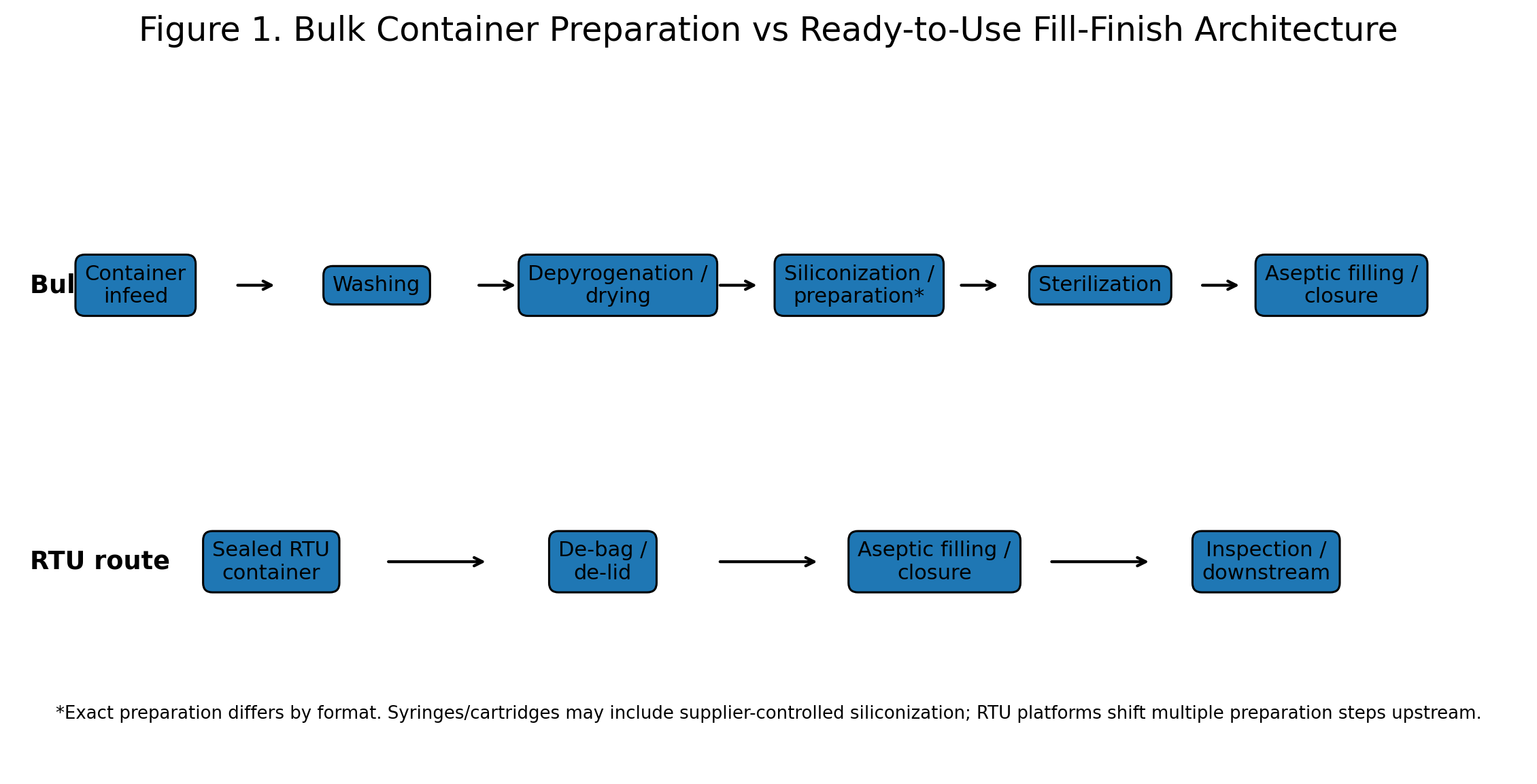
Ready-to-use (RTU) primary containers are changing injectable drug packaging by moving multiple container-preparation activities from the pharmaceutical filling site to specialized packaging suppliers. Instead of receiving bulk glass or polymer containers that require washing, depyrogenation, sterilization and, for selected formats, siliconization before filling, pharmaceutical manufacturers can increasingly receive vials, prefillable syringes and cartridges in preprocessed configurations designed for direct introduction into aseptic fill-finish operations. Stevanato Group's EZ-fill platform, for example, spans pre-sterilized vials, syringes and cartridges and explicitly positions RTU processing around the removal of several container-preparation steps.
The significance extends beyond manufacturing simplification. Current 2026 developments show RTU formats becoming closely connected with biologic stability, larger injection volumes, vaccine presentation, elastomeric-component performance and pen/autoinjector engineering. RTU packaging is therefore evolving from a container-preparation architecture into an interface connecting primary containment, aseptic filling and drug-delivery-system design.
RTU Packaging Moves Container Preparation Upstream
In conventional bulk processing, primary containers may pass through incoming handling, washing, depyrogenation or drying, sterilization and other format-specific preparation before aseptic filling. RTU platforms transfer much of that preparation to the container manufacturer under controlled processes. The exact sequence varies by format: prefillable syringes and cartridges can also require supplier-controlled siliconization, while vial systems may be supplied washed, depyrogenated, packaged and sterilized in nest-and-tub or tray configurations.
SCHOTT Pharma's adaptiQ vials are delivered pre-washed and pre-sterilized in standardized nest-and-tub or tray formats. The tray configuration is washed and depyrogenated before packaging in a cleanroom and subsequent sterilization, while the nested configuration is designed for automated aseptic filling with reduced glass-to-glass contact. Stevanato Group's RTU cartridge architecture illustrates the same manufacturing shift: its published process comparison reduces a bulk sequence involving washing, siliconization, depyrogenation and crimping to a shorter RTU sequence centered on de-bagging/de-lidding, filling, stoppering and downstream inspection.
Vials, Syringes and Cartridges Now Share a Common RTU Manufacturing Logic
RTU adoption is no longer confined to prefillable syringes. Vials, syringes and cartridges are increasingly supplied through common nested and standardized secondary-packaging architectures, allowing fill-finish operations to handle multiple injectable formats with fewer upstream preparation activities. The formats nevertheless perform different downstream roles.
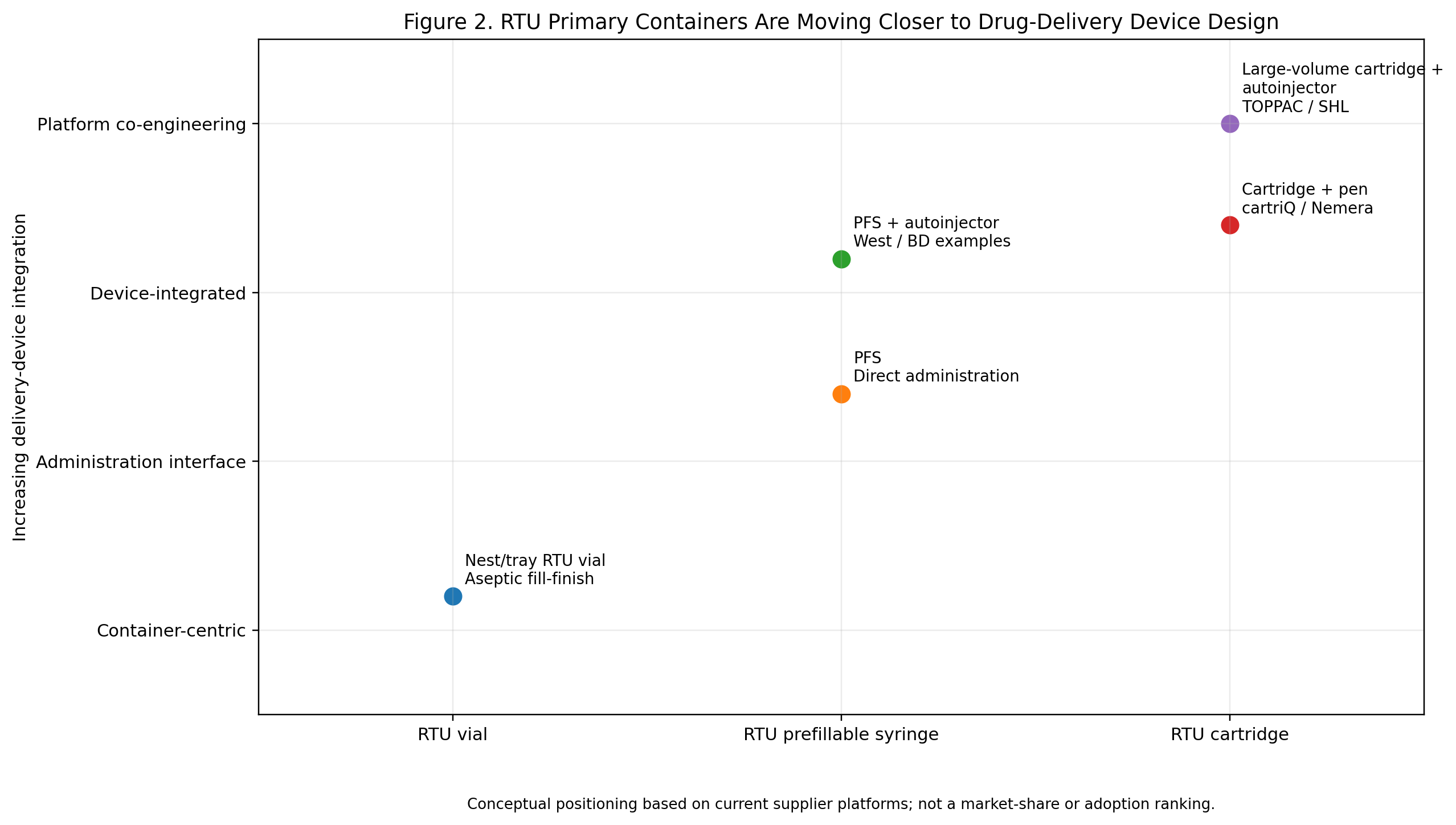
RTU vials retain the greatest flexibility across liquid and lyophilized drugs, vaccines and early clinical programs. RTU prefillable syringes combine containment with the administration interface and increasingly connect directly to safety devices and autoinjectors. RTU cartridges push integration further because dimensional tolerances, plunger behavior and container geometry must match pens, autoinjectors, pumps or on-body systems.
Table 1. RTU Vials, Syringes and Cartridges: Functional and Manufacturing Comparison
|
RTU format |
Typical supplier processing state |
Common secondary presentation |
Fill-finish role |
Delivery / device interface |
Representative current platforms |
|---|---|---|---|---|---|
|
RTU vial |
Pre-washed, depyrogenated and pre-sterilized; exact process depends on platform |
Nest-and-tub or tray |
Direct aseptic filling for liquid or lyophilized injectables; supports clinical to commercial batches |
Usually lowest direct device integration; can feed conventional administration workflows |
SCHOTT adaptiQ; Stevanato EZ-fill / EZ-fill Smart |
|
RTU prefillable syringe |
Pre-washed and pre-sterilized; often siliconized where required by the platform |
Nest-and-tub |
Aseptic filling into a container that can also become the administration interface |
High: direct injection, safety systems and autoinjector integration |
West Synchrony S1; BD Neopak; Stevanato EZ-fill syringes; SCHOTT syriQ / TOPPAC |
|
RTU cartridge |
Pre-washed, pre-siliconized where required, pre-sterilized; supplier-specific closure handling |
Nest-and-tub or tray |
Aseptic filling for reusable or single-use delivery devices |
Very high: pen injectors, autoinjectors, pumps and on-body systems |
SCHOTT cartriQ / TOPPAC cartridge; Stevanato EZ-fill cartridges |
Processing descriptions are representative of current supplier platforms and should not be treated as universal specifications. Washing, siliconization, sterilization, closure and secondary-packaging processes vary by material, container system and supplier.
2026 Capacity Investments Show RTU Moving Further into Industrial-Scale Supply
Several 2026 investments demonstrate that RTU packaging is moving beyond specialist or small-batch use. In January, BD announced a USD 110 million investment at its Columbus, Nebraska site. USD 100 million is allocated to establishing BD Neopak glass prefillable syringe production, with supply expected to begin in mid-2026, while USD 10 million supports cannula manufacturing. BD linked the program to increasing requirements for biologics, GLP-1 products and combination-product supply.
In June, SCHOTT Pharma inaugurated more than USD 60 million of new vial capacity in Lebanon, Pennsylvania. The expansion covers both standard and sterile RTU glass vials for biologics, complex injectable therapies, vaccines and emergency medicines, and SCHOTT states that the project more than tripled local capacity for high-value solutions.
Stevanato Group's Q2 2026 capacity update shows the same expansion occurring across several container formats. The company completed performance qualification on its first EZ-fill vial line at Fishers, Indiana, continued bringing high-value PFS capacity into service at Latina, Italy, and prepared installation of its first next-generation RTU 400 EZ-fill cartridge line, with commercial cartridge production targeted for early 2027.
Integrated Prefillable Syringe Systems Reduce the Boundary Between Container and Delivery Device
The prefillable syringe is increasingly being qualified as an assembled system rather than a barrel selected independently from its elastomeric and needle-shield components. West Pharmaceutical Services made Synchrony S1 globally commercially available in January 2026. The platform includes 1 mL long and 2.25 mL staked-needle configurations for biologics and 1 mL staked-needle and Luer-lock configurations for vaccines, together with West plungers and needle-shield or tip-cap components.
This has direct relevance to both biologics and vaccines without turning RTU into a single-therapy format. In the broader prefilled syringe packaging ecosystem, the key engineering variables extend from barrel material and siliconization to break-loose/glide force, plunger compatibility, needle configuration and downstream device fit. For vaccines specifically, the availability of standardized 1 mL RTU/PFS configurations demonstrates how a container platform can be adapted to vaccine presentation while remaining part of a broader injectable packaging architecture.
Large-Volume Biologics Are Expanding Syringe and Cartridge Design Space
Higher-dose and higher-viscosity biologics are pushing RTU systems beyond conventional 1 mL formats. In January 2026, BD and Ypsomed announced development of a 5.5 mL BD Neopak XtraFlow glass prefillable syringe for the YpsoMate 5.5 autoinjector. The design uses an 8 mm needle and thin-wall cannula architecture, with feasibility samples expected during 2026. The program follows earlier 2.25 mL collaboration and reflects the movement of selected biologics toward larger-volume subcutaneous self-administration.
Cartridges are moving in the same direction. SCHOTT Pharma and SHL Medical verified 3 mL and 5 mL TOPPAC RTU polymer cartridges with SHL's Maggie 3.0 mL and 5.0 mL autoinjector platforms. SCHOTT describes TOPPAC as an ISO-standardized RTU polymer cartridge delivered in an industry-standard nest-and-tub configuration. The compatibility work covered dimensional and functional fit, illustrating how the primary container is increasingly co-engineered with the delivery device before a drug reaches commercial filling.
Sensitive Biologics Are Raising RTU Container Performance Requirements
RTU does not simply mean that a conventional container has been sterilized in advance. Sensitive biologics can require tighter control of glass chemistry, silicone exposure, extractables and leachables, particles, dimensions and mechanical performance. SCHOTT Pharma's cartriQ BioPure, announced in April 2026, illustrates this higher-performance direction. The sterile RTU glass cartridge uses FIOLAX Pro Type I borosilicate glass, controlled sodium and aluminum release criteria, baked-on siliconization and coated elastomer options. It is planned in 3 mL and 5 mL formats, with samples available ahead of the planned commercial launch at the end of 2026.
The significance is broader than one cartridge family. RTU container selection is increasingly linked to the molecule's stability profile and final delivery mode. For the wider parenteral products packaging environment, this means vial, syringe and cartridge decisions increasingly intersect with formulation properties, aseptic processing and administration-device requirements rather than being made as independent packaging choices.
Cartridge Qualification Is Increasingly Connected to Pen and Autoinjector Compatibility
In July 2026, SCHOTT Pharma and Nemera verified a 3 mL cartriQ RTU glass cartridge with Nemera's pen-injector platform. The evaluation included break-loose and gliding forces, inorganic and organic leachables, dimensional accuracy, filling-volume performance and other mechanical and chemical parameters. SCHOTT states that the combined system met the predefined acceptance criteria.
This kind of compatibility program changes the role of primary packaging. Cartridge dimensions and functional behavior affect device assembly, dose accuracy and injection performance, while the delivery device imposes mechanical requirements back onto the container. RTU cartridges therefore sit at the intersection of pharmaceutical packaging and combination-product engineering.
USP <382> Reinforces System-Level Evaluation of Injectable Components
The regulatory and compendial environment is also moving toward complete-system performance. USP General Chapter <382> Elastomeric Component Functional Suitability in Parenteral Product Packaging/Delivery Systems addresses the functional suitability of elastomeric components as part of parenteral packaging and delivery systems. The implementation transition became effective on December 1, 2025, replacing the earlier reliance on the functionality tests contained in USP <381>.
In July 2026, Aptar Pharma launched an injectable system-level framework that combines partner collaboration, assembled-system testing and performance data. In September, Aptar and Stevanato Group described a USP <382>-aligned evaluation approach covering complete PFS configurations including syringe, plunger and rigid needle shield. The direction is important: RTU standardization can simplify container preparation, but it does not remove the requirement to establish suitability of the final packaging/delivery system.
FDA's August 2026 draft Container Closure Systems guidance likewise addresses the quality evaluation of complete CCSs used for human drugs and biological products, including systems that also serve as device constituent parts of combination products. The document remains draft guidance and is not for implementation.
RTU Capability Is Also Influencing Portfolio Expansion and M&A
Container suppliers are expanding RTU capability through both capital investment and portfolio consolidation. Following its 2025 acquisition of Alphial, SGD Pharma added European tubular glass capabilities spanning vials, ampoules and RTU formats across Alphial's Italian manufacturing footprint. The transaction complements SGD Pharma's molded-glass portfolio and illustrates how RTU capability has become part of competitive portfolio design rather than a niche add-on to conventional vial manufacturing.
Table 2. RTU Injectable Packaging Developments and Capacity Tracker, 2025–2026
|
Date |
Company / collaboration |
Format / platform |
Development |
Quantitative / technical evidence |
What it demonstrates |
|---|---|---|---|---|---|
|
Jan 13, 2026 |
BD |
Neopak glass prefillable syringe |
U.S. manufacturing investment in Columbus, Nebraska |
$100M for Neopak PFS production + $10M for cannula capability; supply expected mid-2026 |
RTU/PFS capacity localization for biologics and GLP-1 delivery |
|
Jan 14, 2026 |
SCHOTT Pharma + SHL Medical |
TOPPAC RTU polymer cartridge |
Compatibility verified with Maggie large-volume autoinjectors |
3 mL TOPPAC with Maggie 3.0 mL; 5 mL TOPPAC with Maggie 5.0 mL |
RTU cartridge and device co-engineering for large-volume biologics |
|
Jan 20, 2026 |
West Pharmaceutical Services |
Synchrony S1 PFS system |
Global commercial availability |
1 mL long and 2.25 mL staked-needle options for biologics; 1 mL staked-needle and Luer-lock options for vaccines |
Integrated syringe, elastomer and needle-shield/tip-cap system |
|
Jan 21, 2026 |
BD + Ypsomed |
Neopak XtraFlow 5.5 mL |
Large-volume PFS development for YpsoMate 5.5 |
5.5 mL glass PFS; 8 mm needle; feasibility samples expected mid-2026 |
Expansion of PFS/device integration for higher-volume and higher-viscosity biologics |
|
Apr 28, 2026 |
SCHOTT Pharma |
cartriQ BioPure RTU glass cartridge |
New high-performance cartridge for sensitive biologics |
3 mL and 5 mL; FIOLAX Pro glass; baked-on silicone; commercial launch planned for year-end 2026 |
Drug-stability engineering within RTU cartridge architecture |
|
Jun 3, 2026 |
SCHOTT Pharma |
adaptiQ RTU glass vials |
Expanded vial production in Lebanon, Pennsylvania |
More than $60M investment; new standard and sterile RTU vial lines; local high-value capacity more than tripled |
Industrial-scale RTU vial localization for biologics, vaccines and complex injectables |
|
Q2 2026 |
Stevanato Group |
EZ-fill vials / RTU 400 EZ-fill cartridges |
Capacity expansion in Fishers, Indiana and Latina, Italy |
First Fishers EZ-fill vial line completed performance qualification; first next-gen RTU 400 cartridge line to be installed with commercial production targeted for early 2027 |
RTU capacity moving across vials, PFS and cartridges at commercial scale |
|
Jul 17, 2026 |
Aptar Pharma |
Injectables system-level framework |
Integrated testing and performance-data framework |
Focus on partner PFS platforms with rigid needle shields and coated plungers; aligned to evolving USP <382> expectations |
RTU primary containers increasingly evaluated as assembled packaging/delivery systems |
|
Jul 21, 2026 |
SCHOTT Pharma + Nemera |
cartriQ 3 mL RTU glass cartridge |
Pen-injector compatibility verified |
Mechanical and chemical testing included break-loose/glide force, leachables, dimensional accuracy and filling-volume performance |
Cartridge-device compatibility is becoming part of primary-container qualification |
|
Sep 8, 2026 |
Aptar Pharma + Stevanato Group |
PFS + plunger + rigid needle shield |
USP <382>-aligned system-level evaluation approach |
Assessment covers complete PFS configurations rather than isolated elastomer components |
Functional qualification is shifting toward the assembled injectable system |
|
Q4 2025 integration |
SGD Pharma + Alphial |
Tubular vials, ampoules and RTU products |
Acquisition expands tubular and RTU capabilities in Europe |
Alphial operates four Italian manufacturing sites and produces vials, ampoules and RTU products |
RTU capability is also influencing portfolio expansion and consolidation |
What the 2026 Evidence Shows
The current evidence points to three simultaneous changes. First, RTU processing is moving further into industrial-scale supply, supported by new vial and syringe capacity in the United States and cartridge expansion in Europe. Second, container formats are becoming more specialized around biologics: higher-performance glass, controlled siliconization, polymer alternatives and larger-volume formats are being developed for molecules that place tighter demands on primary packaging. Third, RTU systems are moving closer to drug-delivery-device architecture through verified syringe and cartridge interfaces.
These developments do not make vials, syringes and cartridges interchangeable. Each format retains a distinct role. Vials remain highly flexible for clinical development, vaccines, lyophilized products and many commercial injectables; prefillable syringes combine drug containment with direct administration; and cartridges increasingly serve device-based self-administration. The common change is upstream standardization: more of the washing, preparation, sterilization and container-handling burden is being engineered into the packaging platform before the container reaches the filling line.
For the broader pharmaceutical packaging value chain, RTU therefore represents a manufacturing architecture as much as a container category. Its significance lies in the connection between standardized primary packaging, aseptic fill-finish, drug stability and increasingly integrated delivery systems. Vaccine applications form part of that transition where RTU vials and prefillable syringe configurations can support defined presentation and filling requirements, while the broader vaccine packaging environment continues to incorporate additional cold-chain, secondary-packaging and distribution considerations outside the scope of this Insight.
Related USDAnalytics Research
Parenteral Products Packaging Market — market sizing, vial/PFS/cartridge segmentation, regional demand and competitive positioning.
Prefilled Syringe Packaging Market — detailed analysis of glass and polymer PFS systems, biologics, device integration and manufacturer strategies.
Pharmaceutical Packaging Market — broader primary, secondary and tertiary pharmaceutical packaging analysis through 2034.
Vaccine Packaging Market — vaccine-container formats, cold-chain requirements, materials and packaging developments.
Research note: Product specifications and capacity figures are reported from manufacturer and regulatory primary sources. Development-stage products such as the BD Neopak XtraFlow 5.5 mL PFS should not be treated as commercially launched unless the supplier states otherwise. RTU processing steps differ by container, material and supplier, and pharmaceutical companies remain responsible for qualifying the final drug-container and delivery-system configuration.