Vaccine Packaging Market Overview: Sterility, Container Integrity and Temperature-Controlled Distribution Define Demand
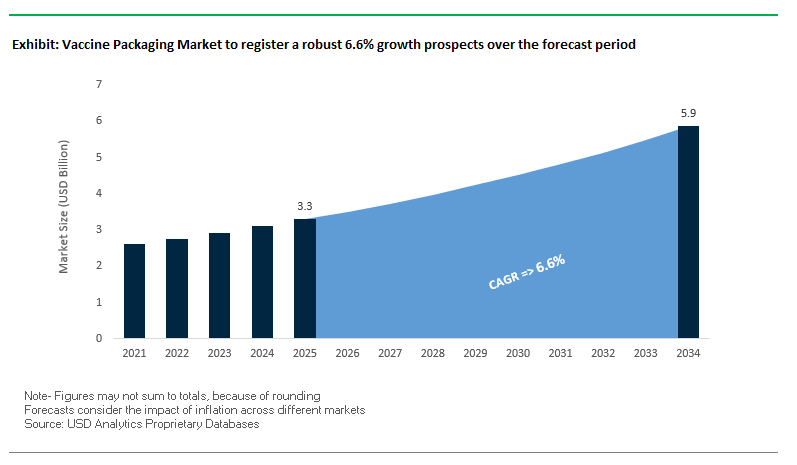
The global Vaccine Packaging Market is valued at USD 3.3 billion in 2025 and is projected to reach USD 5.9 billion by 2034, expanding at a CAGR of 6.6%. Vials account for approximately 50% of market demand by product type, while pharmaceutical and biotechnology companies represent approximately 70% by end-use industry. The formal market scope covers vials, ampoules and cartridges, syringes, blister packs, bags and pouches across glass, plastics, paper and paperboard, and metals. Applications include human and veterinary vaccines.
Vaccine packaging encompasses the primary containers, closure components, secondary packs and temperature-controlled transport systems used to maintain vaccine sterility, stability, identification and physical integrity from fill-finish through distribution and administration. Primary systems include glass or polymer vials, elastomeric stoppers, aluminum seals, ampoules, cartridges and prefillable syringes. Secondary packaging organizes and identifies individual containers, while tertiary systems include insulated shippers, refrigerated containers and other packaging used within vaccine cold chains.
Packaging requirements differ substantially according to vaccine formulation and presentation. Liquid vaccines, lyophilized vaccines, mRNA products, viral-vector vaccines and adjuvanted formulations can present different requirements for temperature, container-closure integrity, extractables and leachables, stopper compatibility, light protection and reconstitution. Single-dose and multi-dose presentations also create different relationships between package volume, dose density and immunization logistics. Accordingly, ultra-low-temperature packaging is relevant to selected formulations rather than being a universal requirement across vaccines.
The market is increasingly characterized by ready-to-use vial platforms, prefillable syringe systems, high-quality Type I pharmaceutical glass, specialized elastomeric closures, deep-cold container technologies and vaccine-specific temperature-monitoring systems. The 2025 edition of WHO's vaccine shipping guidance now explicitly addresses ultra-low-temperature vaccine shipments, reflecting how vaccine packaging and cold-chain requirements have broadened since the pandemic period. WHO Guidelines for the International Packaging and Shipping of Vaccines, 7th edition
Recent Developments and Company Strategies in Vaccine Packaging
SCHOTT Pharma Adds More Than USD 60 Million of U.S. Vial Capacity with BARDA Support
In June 2026, SCHOTT Pharma inaugurated expanded vial production at its Lebanon, Pennsylvania facility following an investment of more than USD 60 million supported by the U.S. Biomedical Advanced Research and Development Authority. The expansion adds production for standard and sterile ready-to-use glass vials intended for biologics, vaccines, emergency medicines and other injectable therapies.
The investment connects vaccine primary packaging with pandemic-preparedness infrastructure and domestic pharmaceutical supply. Ready-to-use vial production also reflects a broader shift toward preprocessed containers that arrive washed, sterilized and configured for pharmaceutical filling operations.
Corning and SGD Pharma Localize Type I Pharmaceutical Glass Production in India
In September 2025, Corning Incorporated and SGD Pharma inaugurated a pharmaceutical glass-tubing facility in Telangana, India. The plant manufactures Type I borosilicate glass tubing for injectable drugs, biologics, diagnostics and related applications and combines Corning's pharmaceutical-glass technology with SGD Pharma's vial-conversion capabilities.
The facility strengthens the upstream material base supporting vaccine and injectable-drug packaging in India. Corning's Velocity Vial technology is also being integrated into the partnership, linking glass production with vial quality and filling-line performance.
Nipro and Stevanato Group Expand Ready-to-Use Vials Through D2F and EZ-fill Technology
In October 2024, Nipro PharmaPackaging launched D2F glass vials using Stevanato Group's EZ-fill platform. The vials are supplied washed, depyrogenated, arranged in nest-and-tub configurations and sterilized for direct introduction into aseptic fill-finish operations. Nipro states that the nest-and-tub architecture reduces glass-to-glass contact during transport and handling.
The collaboration demonstrates increasing standardization of ready-to-use vial formats across packaging suppliers. Such systems are particularly relevant to vaccines and biologics where sterile primary containers interface directly with automated filling operations and high-value drug products.
Gerresheimer reported development of its EZ-fill Smart platform as a next-generation ready-to-fill vial packaging system. The company identified vaporized hydrogen peroxide sterilization as an alternative to conventional ethylene oxide processing and stated that commercial production was scheduled to begin before the end of 2025.
The platform combines preprocessed vial presentation with changes to secondary packaging and sterilization. Gerresheimer has also reported substantially lower particle load in the new configuration through replacement of a conventional porous lid with a polymer sealing film.
SCHOTT Pharma Develops Deep-Cold Vials for mRNA and Viral-Vector Vaccines
SCHOTT Pharma introduced its EVERIC freeze vial platform in January 2024 for drug products requiring storage at temperatures down to −80°C. The system uses strengthened pharmaceutical glass, optimized vial geometry and increased wall thickness and is positioned for mRNA vaccines, viral-vector vaccines and other sensitive biologics.
The platform illustrates how deep-cold vaccine packaging involves more than thermal shipping equipment. Freezing and thawing can introduce mechanical stress into primary glass containers, making vial strength and container-closure integrity important performance characteristics at ultra-low temperatures.
UNICEF Tests Refrigerated Sea Transport for Vaccine Distribution
In July 2025, UNICEF completed its first vaccine shipment by sea, transporting more than 500,000 doses of pneumococcal 13-valent conjugate vaccine from Belgium to Côte d'Ivoire in refrigerated maritime containers. UNICEF states that suitable sea freight can reduce greenhouse-gas emissions by up to 90% and freight costs by around 50% compared with air transport.
The initiative broadens the role of tertiary vaccine packaging and cold-chain transport beyond insulated air-freight systems. Longer-duration refrigerated transport places emphasis on validated temperature control, monitoring and route-specific logistics rather than on short shipment duration alone.
Regulatory and Quality Framework for Vaccine Packaging
Vaccine packaging operates within a combination of biological-product quality requirements, pharmaceutical container-closure standards, injectable-container specifications and international cold-chain guidance. Requirements vary between the primary container, closure system, labeling and international transport packaging.
WHO 2025 Guidelines Expand Vaccine Shipping Requirements to Ultra-Low-Temperature Products
The seventh edition of WHO's international vaccine packaging and shipping guidelines was published in July 2025. The revision incorporates ultra-low-temperature shipments, dry-ice use, active shipping containers and updated route-profiling considerations that were not included in the 2020 edition.
The document covers international transport from vaccine manufacturers to recipient countries and addresses package size and weight, temperature maintenance, reception checks, transport qualification and environmental considerations. This establishes vaccine shipping as a product-specific pharmaceutical cold-chain packaging activity rather than a single standardized temperature model.
FDA's 2026 Draft Container-Closure Guidance Applies to Biological Products
The document remains draft guidance, is not for implementation and contains non-binding recommendations while FDA receives comments. For vaccines, its relevance centers on the interaction between the biological formulation and the complete primary container-closure system.
ISO 8362-1 Defines Glass Vial Requirements for Injectable Preparations
ISO 8362-1:2018 for glass injection vials specifies the form, dimensions, capacities, materials and performance requirements for glass vials used for injectable preparations. The edition was reviewed and confirmed in 2024 and remains current.
The standard covers colorless and amber glass containers manufactured from glass tubing and provides an established technical reference for the vial format that represents the largest product segment.
ISO 11040-4:2024 Applies to Prefillable Glass Syringe Systems
ISO 11040-4:2024 establishes material, dimensional, quality and performance requirements for tubing-glass barrels and sterilized subassembled syringes ready for filling.
Its relevance to vaccine packaging has increased as some vaccine presentations move from traditional vials to ready-to-fill or prefilled syringe configurations. The standard concerns the syringe barrel and sterilized subassembly before pharmaceutical filling rather than every component of the finished drug-device system.
USP <1207> Provides a Framework for Sterile Package Integrity Evaluation
USP General Chapter <1207> Package Integrity Evaluation—Sterile Products addresses leakage, closure mechanisms, test-method selection and package integrity through the product lifecycle. It applies to nonporous packages intended for sterile pharmaceutical products and includes guidance on ensuring that packages maintain sterility and relevant physicochemical specifications.
For vaccines supplied in vials or prefilled syringes, package-integrity considerations encompass the container, closure and seal interface.
Vaccine Packaging Market Share Insights
Vials Account for Approximately 50% of Market Demand by Product Type
Vials account for approximately 50% of Vaccine Packaging Market demand in 2025, making them the largest product-type segment. Their market position reflects extensive compatibility with liquid and lyophilized formulations, single-dose and multi-dose presentation, conventional refrigerated vaccines and selected frozen products.
Type I pharmaceutical glass remains particularly important, while current developments include higher-strength glass, coated vial surfaces and ready-to-use configurations. Polymer vials and alternative container systems occupy more specialized applications.
Prefilled syringe packaging represents another significant format where administration convenience, dose accuracy and integration with ready-to-fill operations support adoption. Ampoules and cartridges, together with bags, pouches and secondary components, address additional vaccine and veterinary applications within the broader market.
Pharmaceutical and Biotechnology Companies Represent Approximately 70% of End-Use Demand
Pharmaceutical and biotechnology companies account for approximately 70% of the Vaccine Packaging Market by end use. Their position reflects responsibility for vaccine formulation, primary-container qualification, fill-finish, stability studies, labeling and commercial packaging. Packaging suppliers operate within closely defined product specifications determined by the interaction between formulation and container-closure system.
Hospitals and clinics represent downstream packaging users and administration points, while government agencies play a significant role through public immunization procurement, stockpiling and distribution programs. Research and development organizations generate additional demand through clinical vaccine programs and developmental packaging configurations.
Vials Remain the Core Vaccine Container Across Single-Dose and Multi-Dose Presentations
Vials account for approximately half of Vaccine Packaging Market demand because major rigid pharmaceutical packaging format for sterile injectable products across both human and veterinary vaccination programs. Type I borosilicate glass remains the principal material platform due to its chemical resistance, barrier properties and compatibility with high-throughput aseptic filling.
Vial systems combine the container with an elastomeric stopper and an aluminum or equivalent overseal. Performance depends on the interaction between the glass surface, vaccine formulation, closure material and sealing geometry. Tubular glass designs dominate many pharmaceutical applications, while molded glass and specialized polymer containers serve selected formulations and operating environments.
Single-dose vials contain one administration unit, while multi-dose containers support removal of multiple doses through repeated stopper puncture. The latter configuration increases the importance of stopper fragmentation resistance, reseal behavior and formulation-specific handling after first opening.
Vials also accommodate a wide range of vaccine technologies, including liquid formulations, lyophilized products, adjuvanted vaccines and selected deep-frozen products. Their continued market position is linked to manufacturing infrastructure and formulation flexibility rather than to one vaccine platform.
Ready-to-Use Vials and Prefillable Syringes Expand Across Aseptic Vaccine Fill-Finish
Ready-to-use primary packaging is becoming more visible across vaccines, biologics and other injectable medicines. RTU vials are supplied through controlled washing, depyrogenation, packaging and sterilization processes before pharmaceutical filling, while ready-to-fill syringe systems are similarly delivered as sterilized subassemblies.
Nipro's D2F platform, Stevanato Group's EZ-fill technology and Gerresheimer's EZ-fill Smart architecture illustrate this shift. In 2026, SCHOTT Pharma's Pennsylvania expansion also added sterile RTU vial capacity intended for vaccines and other injectables.
Nest-and-tub systems reduce direct vial-to-vial contact and are designed for automated filling and handling. Their use connects primary packaging more closely with robotic fill-finish, small-batch manufacturing and flexible production configurations.
Prefillable syringes represent another RTU pathway. Their role is application-specific because dose volume, vaccine stability, needle configuration and administration environment differ across vaccination programs. SCHOTT Pharma's planned USD 371 million North Carolina facility illustrates continuing investment in both glass and polymer prefillable syringe capacity, including systems associated with mRNA vaccines and other biologic therapies.
Ultra-Low-Temperature and Deep-Cold Packaging Supports Selected mRNA and Viral-Vector Vaccines
Temperature requirements vary significantly across vaccine products. Many established vaccines are distributed under refrigerated conditions, while selected formulations require frozen or ultra-low-temperature storage. Packaging analysis increasingly differentiates between refrigerated, frozen and ULT vaccine supply chains.
WHO's 2025 international shipping guidance formally incorporates ULT shipments and dry-ice configurations, reflecting developments that became prominent during COVID-19 vaccine distribution.
At primary-container level, deep-cold exposure can create mechanical stresses during freezing and thawing. SCHOTT Pharma's EVERIC freeze vials are designed for temperatures down to −80°C and incorporate modified vial geometry and glass characteristics intended to maintain container-closure integrity in this environment.
Tertiary packaging at these temperatures can include passive insulated systems with dry ice or active temperature-controlled containers. Temperature-monitoring equipment provides evidence of shipment conditions across the distribution cycle.
Container-Closure Integrity, Stoppers and Seals Protect Sterile Vaccine Formulations
A vaccine vial is only one element of the sterile container-closure system. Elastomeric stoppers, aluminum seals and container-neck dimensions determine whether the system maintains closure integrity through filling, storage, shipping and administration.
Closure performance can be affected by puncture force, fragmentation, resealing, compression and interaction with the vaccine formulation. Lyophilized products introduce additional stopper requirements because the closure can occupy an intermediate position during freeze-drying before being fully seated at the end of the cycle.
Extractables and leachables are also relevant because elastomeric materials remain in long-term contact with the internal package environment. Adjuvants, proteins and other vaccine constituents can create formulation-specific compatibility considerations.
In 2026, Datwyler highlighted stopper and seal platforms for both liquid and lyophilized vaccines, including products designed around container-closure integrity, extractables performance and compatibility with adjuvants and sensitive antigens. Package-integrity evaluation consequently extends across the full vial–stopper–seal assembly.
Lyophilized Vaccines Create Distinct Vial, Stopper and Diluent-Packaging Requirements
Lyophilization is used for vaccines and biological products whose stability can be improved by removing water from the formulation before storage. The resulting packaging architecture differs from that used for a conventional liquid vaccine.
During freeze-drying, the vial must tolerate thermal cycling and vacuum conditions while the stopper remains positioned to permit vapor transfer. At completion, the stopper is seated to close the vial before subsequent sealing. Vial geometry, stopper configuration and package integrity therefore form part of the lyophilization process itself.
Some lyophilized vaccine presentations include a separate diluent that is combined with the vaccine before administration. The commercial package can consequently include both a vaccine vial and a diluent vial, ampoule or prefilled device, together with labeling and handling information identifying the correct combination.
WHO vaccine guidance also distinguishes storage and transport of vaccine products and diluents because temperature sensitivity can differ.
Single-Dose and Multi-Dose Vial Formats Influence Cold-Chain Volume and Dose Presentation
Single-dose and multi-dose vial configurations create materially different packaging and distribution profiles. A single-dose vial provides one administration unit per container, while a multi-dose vial distributes the weight and volume of the primary container across several doses.
This distinction affects the physical volume occupied within secondary cartons, cold rooms, vaccine carriers and international shipping systems. WHO vaccine-prequalification documentation commonly reports cold-chain volume per dose, demonstrating that packaging density forms part of vaccine distribution analysis.
Multi-dose configurations can reduce container and transport volume per dose but introduce repeated closure puncture and product-specific after-opening conditions. Single-dose containers increase the number of primary packages required for an equivalent number of administrations while providing individually separated doses. Dose presentation is therefore connected with both primary-packaging architecture and immunization logistics. The relationship varies by vaccine, health-system setting and approved product configuration rather than following one universal packaging model.
Vaccine Vial Monitors and Temperature Indicators Strengthen Heat-Exposure Monitoring
Vaccine-specific temperature monitoring is substantially more established than generic blockchain or connected-package claims. A vaccine vial monitor is a time-temperature-sensitive indicator attached to an individual vaccine vial or other primary container.
According to WHO guidance on Vaccine Vial Monitors, the indicator changes color according to cumulative heat exposure and provides a visible indication when a predefined exposure limit has been reached.
VVM response characteristics are linked to the thermostability profile of the specific vaccine. WHO therefore recognizes different VVM types rather than one standard heat-exposure threshold for all products.
VVMs also perform a different function from electronic cold-chain data loggers. The vial monitor remains with the individual primary container and records cumulative heat exposure, whereas electronic devices can record temperatures within refrigerators, cold boxes, shipping containers or transport routes. WHO notes that VVMs do not directly measure vaccine potency and do not detect all forms of temperature damage, including freezing exposure.
The use of these systems gives vaccine packaging a product-level temperature-information function that is considerably more specific than general pharmaceutical serialization.
Material-Efficient and High-Performance Glass Platforms Expand Vaccine Packaging Options
Vaccine primary packaging remains dominated by pharmaceutical glass, but material development increasingly focuses on reducing breakage, particles, filling-line friction and material usage while preserving Type I performance.
Corning's Viridian Vials use externally coated Type I borosilicate glass and contain approximately 20% less glass material than conventional comparable vials. Corning reports up to a 30% reduction in cradle-to-gate emissions and increased filling-line efficiency associated with the low-friction exterior coating.
The same supplier portfolio includes Velocity Vials, developed around higher fill-finish productivity and reduced glass particulates, demonstrating that sustainability and manufacturing performance can be addressed within the same pharmaceutical-glass platform.
Glass reduction is different from replacing a validated primary container with an unrelated bio-based polymer. Vaccine packaging material transitions remain associated with sterility, chemical compatibility, container-closure performance and stability of the biological product.
Polymer primary containers, including cyclic olefin systems, remain relevant for selected vaccine and biologic applications where break resistance or specific low-temperature characteristics support the container design.
Vaccine Packaging Market Analysis by Country and Region
United States Vaccine Packaging Market : Domestic Vial and Syringe Capacity Expands Alongside Biologic Container Requirements
The U.S. vaccine packaging environment is increasingly characterized by domestic primary-container capacity and biologic container-closure requirements. FDA's 2026 draft container-closure guidance provides a current quality reference for biological products, while vaccine packaging itself continues to span glass vials, prefillable syringes, closures and cold-chain distribution systems.
In June 2026, SCHOTT Pharma inaugurated more than USD 60 million of additional vial capacity in Pennsylvania with BARDA support. The site supplies standard and sterile RTU glass vials for vaccines and other injectable products and was explicitly linked with emergency-response supply capability.
SCHOTT Pharma is also developing a USD 371 million prefillable syringe facility in Wilson, North Carolina. The facility is intended to manufacture glass and polymer syringe systems and includes platforms associated with mRNA vaccines and deep-cold biologics.
This provides a more direct basis for U.S. vaccine-packaging analysis than generic e-pharmacy or unit-dose trends.
European Union Vaccine Packaging Market: Vaccine Labeling, Storage Conditions and Injectable Packaging Remain Central
European vaccine packaging is influenced by pharmaceutical-quality requirements, healthcare labeling requirements, product-specific storage conditions and a substantial injectable-packaging manufacturing base..
EMA's current vaccine product-information guideline covers shelf life, storage and transport conditions, container description, multi-dose presentations and reconstitution instructions. It establishes a more direct regulatory connection to vaccine packaging than broad assumptions about circular-economy legislation.
The EU Falsified Medicines framework also applies safety features including a unique identifier and anti-tampering device to the outer packaging of covered medicines.
Packaging sustainability is affected by Regulation (EU) 2025/40, but medicinal-product packaging is subject to healthcare-specific provisions and exemptions. Material policy therefore operates alongside medicine-quality and biological-product requirements rather than through a blanket requirement to replace all vaccine packaging with reusable or recycled-content formats.
China Vaccine Packaging Market: Pharmaceutical Packaging Materials Enter a Formal GMP Annex
China introduced a major packaging-quality change through the NMPA Pharmaceutical Packaging Materials Annex to the Good Manufacturing Practice for Drugs, effective January 1, 2026. The framework covers quality systems, supplier assessment, inspection and release, documentation, change management and regulatory supervision of pharmaceutical packaging-material manufacturers.
The requirements are directly relevant to vaccine primary containers and closures because they place packaging materials used with medicinal products within an explicit GMP-oriented manufacturing and quality framework.
China's domestic vaccine and biologics manufacturing base also creates demand for glass vials, closures, prefillable systems and cold-chain packaging. The market is therefore characterized by formalized pharmaceutical-packaging quality and biologics production than by generic AI, 5G or carbon-neutrality narratives.
India Vaccine Packaging Market: Vaccine Manufacturing and Pharmaceutical Glass Localization Strengthen Packaging Supply
India combines one of the world's major vaccine-manufacturing bases with expanding pharmaceutical primary-packaging infrastructure. In September 2025, Corning and SGD Pharma opened their Type I borosilicate pharmaceutical glass-tubing facility in Telangana, strengthening local material supply for vials and other injectable containers.
Vaccine distribution is also supported by the government's Electronic Vaccine Intelligence Network (eVIN), which tracks vaccine inventory and temperature information within the immunization cold chain. Ministry of Health documentation describes eVIN as a system for monitoring stock levels and storage conditions rather than as a packaging-level QR-code requirement.
Japan Vaccine Packaging Market: Pharmaceutical Container Quality and Vaccine Lot Control Define the Packaging Environment
Japan's packaging framework for injectable products is grounded in pharmaceutical container and closure requirements. The Japanese Pharmacopoeia includes specific tests for glass containers for injections and requires such containers to avoid interactions that alter product quality and to provide suitable sealing against microbial ingress.
More recent Japanese Pharmacopoeia documentation also addresses risk assessment for glass containers, plastic containers and rubber closures used with pharmaceutical products.
Japan additionally maintains formal inspection and lot-release arrangements for vaccines, with PMDA publishing current vaccine inspection-pass information for fiscal 2026. Domestic supplier Nipro Corporation provides another packaging connection through pharmaceutical glass vials and ready-to-use technologies.
Brazil Vaccine Packaging Market: Digital Product Information Adds a Secondary-Packaging Dimension
Brazil's vaccine packaging environment combines public immunization logistics with Anvisa regulation of biological products and medicinal-product labeling.
In 2024, Anvisa established RDC 885/2024, a pilot framework for digital medicine leaflets using electronic product-information repositories and QR-code access. The pilot remains in force through the end of 2026 and allows specified medicine categories to adopt digital product information under defined conditions.
The initiative concerns medicinal-product information and secondary packaging rather than primary vaccine-container integrity. Specific Anvisa decisions have also addressed vaccine presentations in which QR codes provide access to Portuguese-language digital leaflets, demonstrating practical use of digital information on vaccine cartons.
Cold-chain reliability and public procurement remain more fundamental to physical vaccine packaging than digital leaflet adoption alone.
Competitive Landscape: Vials, Closures, RTU Systems and Injectable Drug-Delivery Platforms Define Competition
The Vaccine Packaging Market includes pharmaceutical glass manufacturers, closure specialists, prefillable syringe suppliers, flexible-packaging groups and fill-finish organizations. Companies include Gerresheimer AG, West Pharmaceutical Services, Inc., Nipro Corporation, SCHOTT AG, SGD Pharma, Amcor plc, AptarGroup, Inc., Stevanato Group, Becton, Dickinson and Company, Corning Incorporated, Tekni-Plex, Inc., DWK Life Sciences, Nelipak Healthcare Packaging, Datwyler Holding Inc., and Catalent Inc. Their activities span Type I glass vials, ready-to-use systems, syringes, elastomeric stoppers and seals, ampoules, secondary and flexible packaging, sterile components and contract fill-finish services.
Vaccine Packaging Market Report Scope
Vaccine Packaging Market
Parameter
Details
Market Size (2025)
$3.3 Billion
Market Size (2034)
$5.9 Billion
Market Growth Rate
6.6%
Segments
By Product Type (Vials, Ampoules & Cartridges, Syringes, Blister Packs, Bags & Pouches), By Material (Glass, Plastics, Paper & Paperboard, Metals), By Application (Human Vaccines, Veterinary Vaccines), By End-Use Industry (Pharmaceuticals & Biotechnology, Hospitals & Clinics, Research & Development, Government Agencies)
Study Period
2020- 2025 and 2026-2034
Units
Revenue (USD)
Qualitative Analysis
Porter’s Five Forces, SWOT Profile, Market Share, Scenario Forecasts, Market Ecosystem, Company Ranking, Market Dynamics, Industry Benchmarking
US, Canada, Mexico, Germany, France, Spain, Italy, UK, Russia, China, India, Japan, South Korea, Australia, South East Asia, Brazil, Argentina, Middle East, Africa
Vaccine Packaging Market Segmentation
By Product Type
Vials
Ampoules & Cartridges
Syringes
Blister Packs
Bags & Pouches
By Material
Glass
Plastics
Paper & Paperboard
Metals
By Application
Human Vaccines
Veterinary Vaccines
By End-Use Industry
Pharmaceuticals & Biotechnology
Hospitals & Clinics
Research & Development
Government Agencies
Countries Analyzed
North America (US, Canada, Mexico)
Europe (Germany, UK, France, Spain, Italy, Russia, Rest of Europe)
Asia Pacific (China, India, Japan, South Korea, Australia, South East Asia, Rest of Asia)
South America (Brazil, Argentina, Rest of South America)
Middle East and Africa (Saudi Arabia, UAE, Rest of Middle East, South Africa, Egypt, Rest of Africa)
Top Companies in Vaccine Packaging Market
Gerresheimer AG
West Pharmaceutical Services, Inc.
Nipro Corporation
SCHOTT AG
SGD Pharma
Amcor plc
AptarGroup, Inc.
Stevanato Group
Becton, Dickinson & Co.
Corning Incorporated
Tekni-Plex, Inc.
DWK Life Sciences
Nelipak Healthcare Packaging
Datwyler Holding Inc.
Catalent Inc.
* List Not Exhaustive
Methodology
USDAnalytics employs a comprehensive and industry-focused research methodology to evaluate the global vaccine packaging market, integrating primary insights from key stakeholders—including pharmaceutical and biotech manufacturers, packaging solution providers, regulatory bodies, and healthcare organizations—with secondary data from corporate reports, scientific publications, and regulatory frameworks. Our research analyzes market dynamics driven by cold chain innovations, patient safety requirements, regulatory compliance, and sustainability trends, with a particular focus on pre-filled syringes, ready-to-use vials, ultra-low temperature packaging, and anti-counterfeiting technologies. USDAnalytics also provides granular segmentation by product type, material, application, and end-use industry, alongside detailed regional insights covering North America, Europe, Asia-Pacific, China, India, Japan, and Latin America. Strategic investments, mergers and acquisitions, and technological advancements in smart packaging, digital traceability, and eco-friendly materials are examined to provide actionable intelligence for industry professionals aiming to navigate growth, compliance, and innovation in the evolving vaccine packaging landscape.
Deliverables:
Comprehensive Market Research Report (PDF and Excel) with detailed tables, charts, and interactive visualizations.
Country-Specific Forecasts & Analysis.
Segment-Wise Revenue Forecasts (2026–2034).
Competitive Analysis, Benchmarking, and SWOT Profiles.
Recent Developments & Innovation Tracker.
Executive Summary & Analyst Commentary.
Post-Purchase Analyst Support for Client-Specific Questions and Custom Data Requirements.
Table of Contents: Vaccine Packaging Market
1. Executive Summary
1.1. Market Highlights
1.2. Key Findings
1.3. Global Market Snapshot
2. Vaccine Packaging Market Landscape & Outlook (2025–2034)
2.1. Introduction to Vaccine Packaging Market
2.2. Market Valuation and Growth Projections (2025–2034)
2.3. Industry Dynamics: Technological Innovation, Sustainability, and Strategic Investments
2.4. Recent Market Developments and Strategic Moves
2.5. Future Outlook and Market Drivers
3. Innovations Reshaping the Vaccine Packaging Market
3.1. Trend: Ready-to-Use (RTU) Vials and Pre-Fillable Syringes
3.2. Trend: Ultra-Low Temperature (ULT) Packaging and Cold Chain Monitoring
3.3. Opportunity: Sustainable and Low-Carbon Footprint Packaging Solutions
3.4. Opportunity: Digital End-to-End Traceability and Anti-Counterfeiting
4. Competitive Landscape and Strategic Initiatives
4.1. Mergers, Acquisitions and Strategic Alliances
4.2. R&D and Material Innovation
4.3. Sustainability and Corporate Strategies
4.4. Market Expansion and Regional Focus
5. Market Share and Segmentation Insights: Vaccine Packaging Market
5.1. By Product Type
5.1.1. Vials
5.1.2. Ampoules & Cartridges
5.1.3. Syringes
5.1.4. Blister Packs
5.1.5. Bags & Pouches
5.2. By Material
5.2.1. Glass
5.2.2. Plastics
5.2.3. Paper & Paperboard
5.2.4. Metals
5.3. By Application
5.3.1. Human Vaccines
5.3.2. Veterinary Vaccines
5.4. By End-Use Industry
5.4.1. Pharmaceuticals & Biotechnology
5.4.2. Hospitals & Clinics
5.4.3. Research & Development
5.4.4. Government Agencies
6. Country Analysis and Outlook of Vaccine Packaging Market
6.1. United States
6.2. Canada
6.3. Mexico
6.4. Germany
6.5. France
6.6. Spain
6.7. Italy
6.8. UK
6.9. Russia
6.10. China
6.11. India
6.12. Japan
6.13. South Korea
6.14. Australia
6.15. South East Asia
6.16. Brazil
6.17. Argentina
6.18. Middle East
6.19. Africa
7. Vaccine Packaging Market Size Outlook by Region (2025–2034)
7.1. North America Vaccine Packaging Market Size Outlook to 2034
7.1.1. By Product Type
7.1.2. By Material
7.1.3. By Application
7.1.4. By End-Use Industry
7.2. Europe Vaccine Packaging Market Size Outlook to 2034
7.2.1. By Product Type
7.2.2. By Material
7.2.3. By Application
7.2.4. By End-Use Industry
7.3. Asia Pacific Vaccine Packaging Market Size Outlook to 2034
7.3.1. By Product Type
7.3.2. By Material
7.3.3. By Application
7.3.4. By End-Use Industry
7.4. South America Vaccine Packaging Market Size Outlook to 2034
7.4.1. By Product Type
7.4.2. By Material
7.4.3. By Application
7.4.4. By End-Use Industry
7.5. Middle East and Africa Vaccine Packaging Market Size Outlook to 2034
7.5.1. By Product Type
7.5.2. By Material
7.5.3. By Application
7.5.4. By End-Use Industry
8. Company Profiles: Leading Players in the Vaccine Packaging Market
8.1. Gerresheimer AG
8.2. West Pharmaceutical Services, Inc.
8.3. Nipro Corporation
8.4. SCHOTT AG
8.5. SGD Pharma
8.6. Amcor plc
8.7. AptarGroup, Inc.
8.8. Stevanato Group
8.9. Becton, Dickinson & Co.
8.10. Corning Incorporated
8.11. Tekni-Plex, Inc.
8.12. DWK Life Sciences
8.13. Nelipak Healthcare Packaging
8.14. Datwyler Holding Inc.
8.15. Catalent Inc.
9. Methodology
9.1. Research Scope
9.2. Market Research Approach
9.3. Market Sizing and Forecasting Model
9.4. Research Coverage
9.5. Data Horizon
9.6. Deliverables
10. Appendix
10.1. Acronyms and Abbreviations
10.2. List of Tables
10.3. List of Figures
Vaccine Packaging Market Segmentation
By Product Type
Vials
Ampoules & Cartridges
Syringes
Blister Packs
Bags & Pouches
By Material
Glass
Plastics
Paper & Paperboard
Metals
By Application
Human Vaccines
Veterinary Vaccines
By End-Use Industry
Pharmaceuticals & Biotechnology
Hospitals & Clinics
Research & Development
Government Agencies
Countries Analyzed
North America (US, Canada, Mexico)
Europe (Germany, UK, France, Spain, Italy, Russia, Rest of Europe)
Asia Pacific (China, India, Japan, South Korea, Australia, South East Asia, Rest of Asia)
South America (Brazil, Argentina, Rest of South America)
Middle East and Africa (Saudi Arabia, UAE, Rest of Middle East, South Africa, Egypt, Rest of Africa)
The global vaccine packaging market is expected to grow from USD 3.3 billion in 2025 to USD 5.9 billion by 2034, at a CAGR of 6.6%. Growth is driven by demand for temperature-controlled delivery, advanced anti-counterfeiting features, pre-filled syringes, and sustainable packaging innovations in response to global immunization campaigns and regulatory standards.
Vials hold the largest market share at approximately 50%, supported by their superior barrier properties, compatibility with ultra-low temperature storage, and scalability for mass immunization programs. Pre-filled syringes, ampoules, and cartridges are also gaining traction due to improved patient safety, reduced dosing errors, and streamlined administration workflows.
Ultra-low temperature (ULT) packaging, incorporating dry ice, vacuum insulation, and IoT-enabled temperature sensors, ensures vaccine integrity from manufacturing to administration. Real-time monitoring and smart cold chain solutions reduce spoilage risks, enhance regulatory compliance, and support large-scale distribution of mRNA and other temperature-sensitive vaccines globally.
Sustainability initiatives are prompting a shift toward mono-material, bio-based, and recyclable packaging, such as polyethylene (PE), polypropylene (PP), and plant-based plastics. These innovations minimize environmental impact, reduce carbon footprint, and align with circular economy policies and corporate ESG commitments while maintaining the protective performance required for vaccines.
North America and Europe lead due to stringent FDA and EMA regulations, digital traceability, and high adoption of pre-filled and ready-to-use formats. China and India are growing rapidly with regulatory tightening, smart packaging, and cold chain expansion, while Japan focuses on advanced and ergonomic solutions for an aging population. Brazil is emerging as a hub for sustainable and digitally integrated vaccine packaging driven by public immunization programs.
More Healthcare and Pharmaceutical Packaging Reports