
The cost of desalinated water is often discussed in terms of membrane efficiency, electricity consumption and treatment-plant capacity. These measurements explain part of the economics of reverse osmosis, but they do not capture the full cost of establishing a dependable water supply. A desalination project may require groundwater production wells, offshore intake structures, transmission pipelines, pumping stations, brine-disposal facilities and long-term operating arrangements that materially exceed the expenditure associated with the membrane treatment plant.
This distinction is becoming more visible as coastal and inland desalination projects expand into different infrastructure environments. Seawater reverse osmosis (SWRO) typically involves higher feedwater salinity, substantial pumping energy and marine engineering. Brackish water reverse osmosis (BWRO) can operate at lower hydraulic pressures, but groundwater conveyance, mineral scaling and inland concentrate disposal introduce separate cost constraints. The resulting economics depend on where the water originates, how it is treated, where residual salts are discharged and how far the finished water must travel.
Recent projects in Texas, Western Australia and Chile demonstrate why desalination plant capital expenditure and delivered-water cost are not interchangeable measures. Their economics also show that lower-cost membrane separation does not necessarily translate into lower total water-supply expenditure.
The Cost of Desalinated Water Extends Beyond the Reverse Osmosis Treatment Plant
Desalination procurement is generally organized around a defined treatment capacity and finished-water quality. Municipal utilities, industrial operators and independent water producers, however, ultimately pay for a larger set of infrastructure and operating obligations. Source-water abstraction, electricity supply, feedwater pretreatment, storage, concentrate management and conveyance all contribute to the capital and operating expenditure associated with a desalination system.
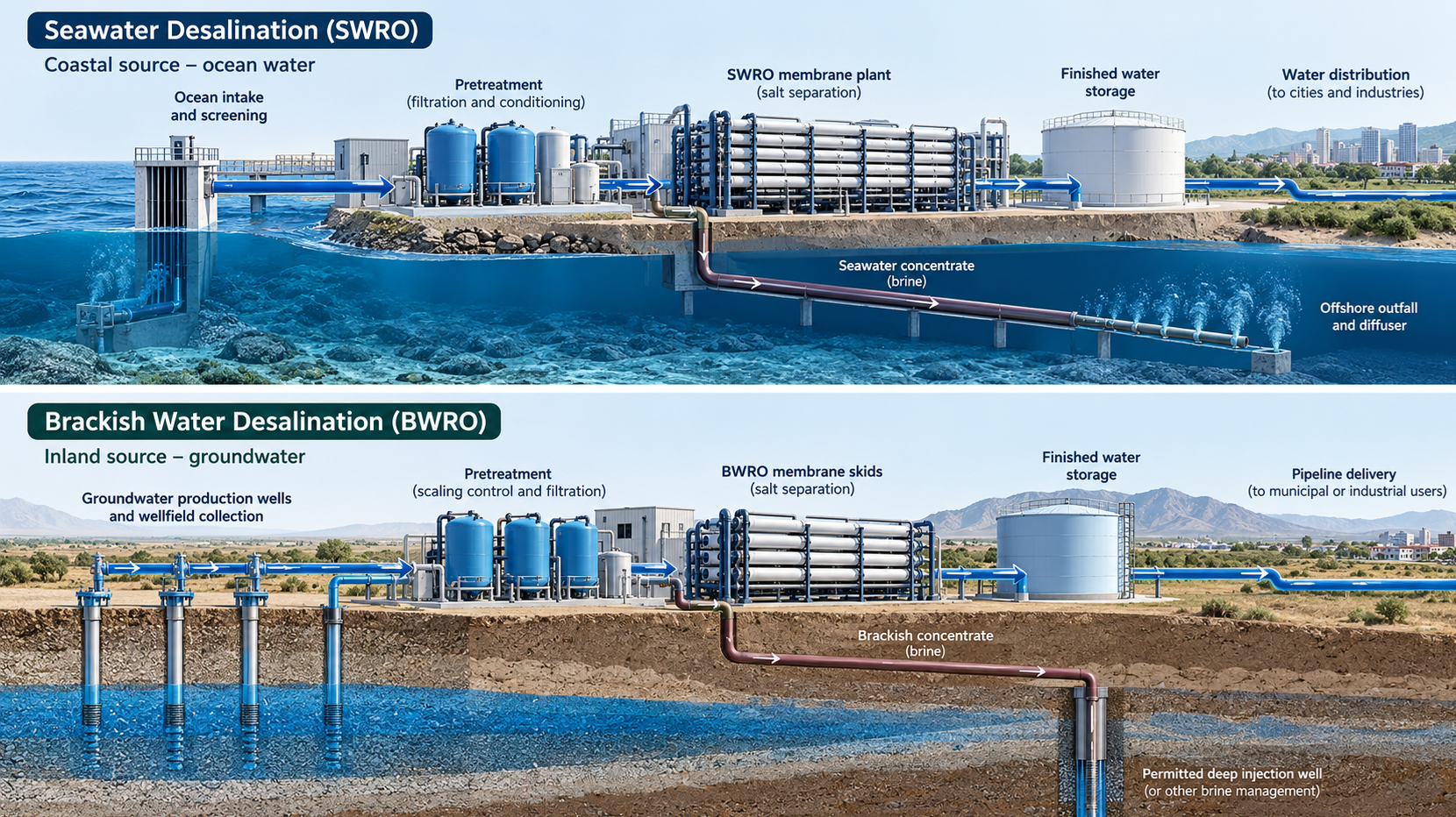
A seawater desalination facility commonly requires intake screening, offshore structures, pretreatment, high-pressure RO equipment, energy-recovery devices, remineralization and marine outfall infrastructure. Its location near the coast can simplify seawater access while creating complex marine construction and environmental-permitting requirements. For inland facilities, groundwater production wells and brackish-water conveyance may replace offshore intake systems, but concentrate cannot necessarily be discharged into a nearby receiving waterbody.
The membrane separation stage itself remains a substantial source of technical differentiation. Salt rejection, permeability, membrane recovery, pumping pressure and fouling resistance influence the equipment configuration and operating costs of membrane-based desalination systems. Yet the commercial benefit of improved membrane performance depends partly on whether electricity, infrastructure, concentrate handling or another expense dominates the overall water-delivery system.
Table 1. Cost Drivers Across Seawater and Brackish Desalination Projects
|
Cost component |
Seawater desalination |
Brackish-water desalination |
Commercial implication |
|
Source-water infrastructure |
Marine intakes, offshore tunnels, screening and coastal pumping |
Groundwater wells, well-field infrastructure and raw-water pipelines |
Initial capital expenditure and site development |
|
Membrane operating conditions |
Higher osmotic pressure and substantial high-pressure pumping requirements |
Generally lower pressure, with recovery affected by hardness, silica and scaling |
Electricity, membrane cleaning and replacement |
|
Pretreatment |
Algae, suspended solids, organic matter and biofouling control |
Hardness, iron, silica, sulfate and mineral-scaling control |
Equipment sizing, chemical consumption and reliability |
|
Concentrate management |
Marine outfalls, diffusers and environmental monitoring |
Deep-well injection, evaporation ponds, permitted discharge or additional recovery |
Disposal permits and residual-treatment expenditure |
|
Finished-water delivery |
Storage, distribution connections and potentially long-distance pipelines |
Conveyance from inland production sites and integration with existing networks |
Pumping and transmission costs |
|
Commercial arrangements |
EPC, independent water production, concessions and long-term O&M |
Municipal ownership, modular procurement and Water-as-a-Service agreements |
Capital allocation, contract risk and operating responsibility |
The relevant comparison is consequently not limited to SWRO versus BWRO membrane pressure. It concerns the complete infrastructure needed to deliver water at a specified volume, quality and reliability over the operating life of the project.
Corpus Christi Shows Why BWRO Equipment Is Only Part of Inland Water-Supply Expenditure
The clearest recent illustration comes from Corpus Christi, Texas. In February 2026, the city approved a project involving FCC Aqualia USA to develop a containerized brackish groundwater desalination facility at the O.N. Stevens Water Treatment Plant. The proposed system will treat water from the Western Well Field, with phased production intended to increase from approximately 3.91 million gallons per day to 21.3 million gallons per day.
The City of Corpus Christi's February 2026 project approval identified a USD 175 million program comprising USD 43.5 million for the packaged desalination plant, up to USD 11.5 million for ancillary improvements at the treatment site and up to USD 120 million for pipelines, storage, pumping and associated infrastructure.
The treatment-plant allocation represents approximately 24.9% of the stated program total, while the other infrastructure categories together account for approximately 75.1%. These percentages describe the announced allocation, not final audited expenditure or a benchmark for other BWRO projects.
Figure 1. Corpus Christi Brackish Desalination Program: Approved Infrastructure Allocation, February 2026
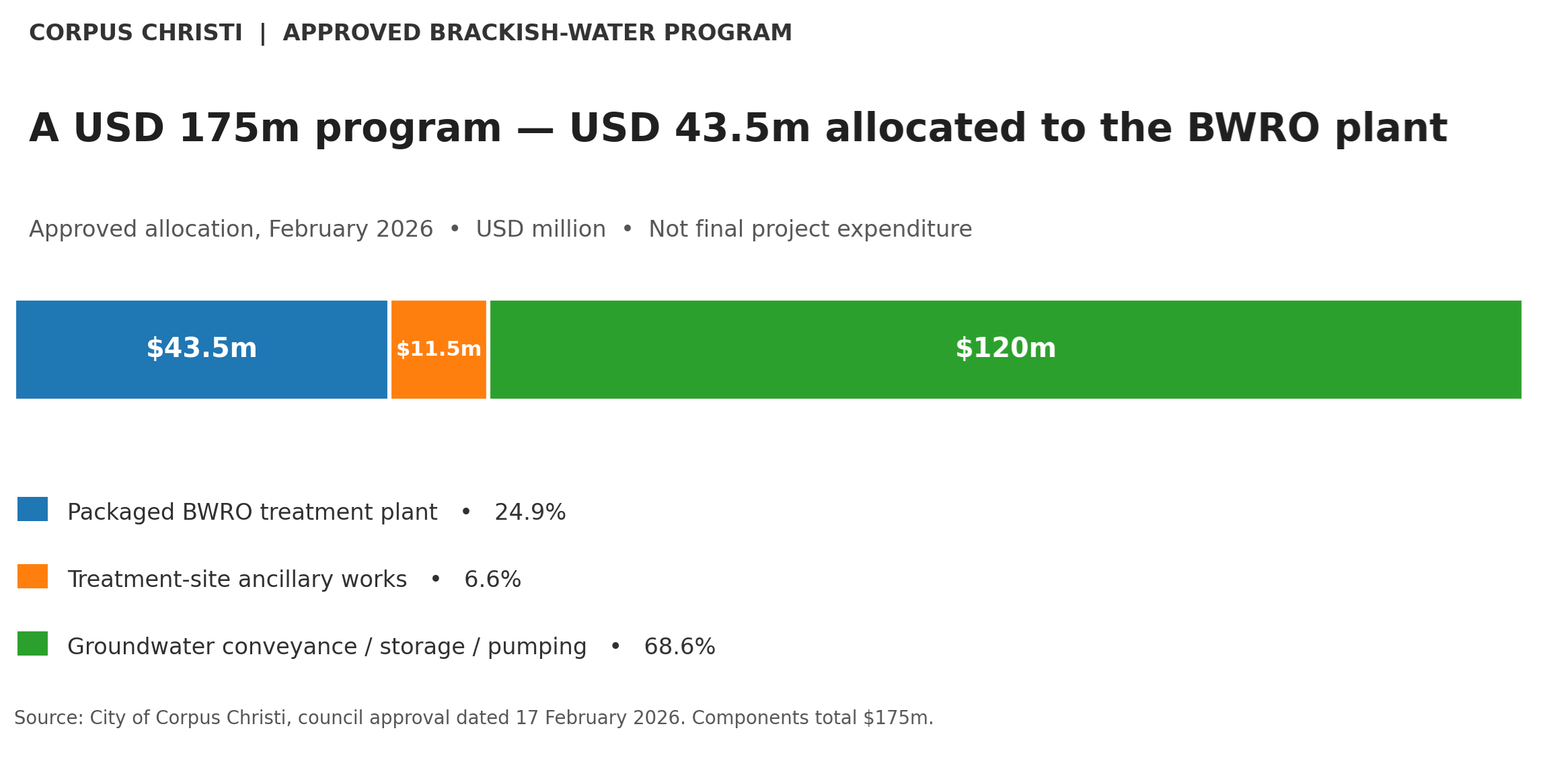
The project illustrates an important feature of inland desalination economics. Procurement of a packaged BWRO plant represents only one transaction within the development of a functioning water supply. Groundwater collection, transmission, storage and pumping must be incorporated before the membrane system can deliver the intended municipal benefit.
For utilities evaluating brackish water desalination systems, the capital boundary therefore extends beyond membrane racks and pressure vessels. Well-field productivity, source-water distance, treatment-site integration, concentrate routing and finished-water delivery determine the expenditure associated with usable capacity.
The Corpus Christi example also demonstrates why capacity-based comparisons can be misleading when procurement scopes differ. A containerized plant quotation may exclude infrastructure that another project's EPC contract includes. Even when the two facilities employ similar BWRO membranes, their published capital costs may describe substantially different assets.
Coastal Intake, Brine Outfalls and Transmission Infrastructure Shape SWRO Project Costs
Seawater desalination introduces a different infrastructure burden because intake structures and concentrate discharge systems must operate within a marine environment. Offshore construction can involve seabed tunnelling, intake screening, corrosion-resistant materials, marine vessels, environmental surveys and specially engineered discharge diffusers.
Western Australia's Alkimos Seawater Desalination Plant illustrates the scale of these requirements. The AUD 2.8 billion program includes a first-stage water-production target of 50 billion litres annually, supported by offshore intake and outfall infrastructure and connections to the regional drinking-water network.
In September 2026, Water Corporation confirmed the completion of separate 2.5 km seawater-intake and 4 km brine-outfall tunnels, installed beneath the seabed as part of the Alkimos marine construction milestone. The project involves offshore intake structures and an outfall diffuser, with the tunnels designed to accommodate future expansion. Construction was continuing, with plant operations scheduled to begin in 2028.
The expenditure associated with such infrastructure is not captured by membrane prices or specific energy consumption. Marine construction equipment, tunnel-boring operations, offshore connections and environmental monitoring are separate engineering activities that influence project schedules and capital requirements.
The Alkimos program also includes a 33.5 km underground transmission main connecting the desalination facility to the regional water-supply network. The pipeline has an internal diameter of approximately 1.6 metres and is designed for both initial production and future expansion. Water Corporation reported that its larger-diameter design reduces associated pumping-energy requirements and greenhouse-gas emissions by approximately 21% compared with the smaller-pipeline alternative assessed for the project.
This highlights the importance of network hydraulics in desalinated-water economics. Pipeline diameter affects friction losses, pumping requirements, civil expenditure and the distribution of operating costs over an infrastructure asset's useful life. A larger pipeline may involve different initial material and construction costs while reducing energy demand during water transmission.
The interaction between marine construction and delivery infrastructure is an important commercial characteristic of seawater desalination systems. The RO facility produces treated water, but coastal abstraction, outfall engineering and regional conveyance determine the expenditure required to make that production available to customers.
These infrastructure costs also depend on environmental conditions. Seabed geology, intake location, marine biodiversity, receiving-water circulation and coastal land availability influence the physical design of an SWRO project. Brine discharge requirements can affect diffuser placement and offshore construction independently of membrane recovery performance.
Energy Consumption Matters, but It Does Not Explain Total Delivered-Water Cost
Electricity remains a major component of desalination operating expenditure, particularly for seawater reverse osmosis. High-pressure pumping must overcome the osmotic pressure of seawater, while energy-recovery devices transfer hydraulic energy from the concentrated discharge stream back into the treatment process.
The International Energy Agency's March 2026 analysis of desalination electrification reports that seawater reverse osmosis typically uses approximately 2.5–6 kWh/m³ across the core desalination process and associated stages included in its assessment. Modern efficient installations and brackish-water desalination can require less energy, reflecting differences in feed salinity, membrane operation and process configuration.
Those values provide context for RO operating economics but do not establish a uniform delivered-water cost. Electricity prices differ by project, and the energy boundary used in reported consumption figures may not include every external pumping or transmission requirement.
Figure 2. Seawater and Brackish Desalination: Water-Supply Infrastructure and Concentrate Pathways
Long-distance industrial water supply provides a particularly important distinction between desalination-plant energy and total water-delivery energy. Codelco's Northern District desalinated-water project in Chile was designed around an initial seawater RO capacity of approximately 840 litres per second, together with more than 160 km of pipelines and pumping infrastructure conveying water to industrial facilities around 3,000 metres above sea level.
The engineering requirements of this project differ from those of a municipal SWRO plant delivering water to a nearby coastal network. Even with efficient reverse osmosis membranes, substantial energy is required to overcome elevation changes and hydraulic losses during transmission. A project's total energy exposure may therefore include desalination, distribution and high-lift pumping obligations that are not directly comparable with standalone SWRO treatment specifications.
For industrial water purchasers, the relevant economic measurement is often the delivered cost of water at the required pressure, location and quality. Differences in conveyance elevation and distance can be commercially significant even when two desalination facilities operate with similar RO membrane technologies.
Inland Concentrate Disposal and Water-Service Contracts Change BWRO Economics
Brackish-water desalination can benefit from lower feedwater salinity and reduced operating pressure, but it generally produces a concentrated residual stream that requires a viable management route. Coastal seawater plants may discharge concentrate through permitted marine outfalls. Inland facilities face more site-specific limitations involving geology, disposal permits, receiving-water availability and residual-treatment requirements.
El Paso's Kay Bailey Hutchison Desalination Plant in Texas demonstrates this distinction. The facility has an installed treatment capacity of up to 27.5 million gallons per day and treats brackish groundwater from strategically located wells. Its infrastructure includes deep-well injection for concentrate disposal, creating a separate engineered system beyond the reverse osmosis treatment process.
The operational economics depend on feedwater recovery, groundwater production, membrane scaling, pumping energy, concentrate composition and injection-system availability. A higher membrane recovery rate can reduce residual volume, but additional separation may require greater pressure, chemicals, pretreatment or downstream equipment.
High-recovery configurations, electrodialysis-assisted treatment and membrane–thermal combinations are commercially relevant where additional water production changes the cost of concentrate disposal. The economic role of hybrid desalination systems is therefore connected to the balance between recovered-water value and the additional capital, energy and maintenance required by the combined process.
Resource recovery introduces another possible revenue component, but it is highly dependent on feed chemistry and local markets. A June 2026 technoeconomic assessment published through the National Alliance for Water Innovation found that extracting saleable products from brackish desalination concentrates was uneconomic in many evaluated scenarios, although particular high-salinity compositions produced more favorable results. Recovering technically separable salts does not automatically create commercial value when processing costs exceed product revenue.
The financing and operating model can further change the comparison between inland desalination projects. In July 2025, Seven Seas Water Group and the City of Alice, Texas, commissioned a publicly partnered BWRO facility designed to provide up to 2.7 million gallons per day of potable water. Its Water-as-a-Service structure incorporates long-term operating responsibility, contracted water delivery and eventual transfer of the plant to the municipality after the agreed period.
Such arrangements change the allocation of initial expenditure, performance risk and maintenance responsibilities. The water purchaser's contractual payment may incorporate capital recovery and operating services that would otherwise appear separately in municipal project accounts.
Table 2. Desalination Projects Illustrating Different Water-Delivery Cost Structures
|
Project |
Verified infrastructure or contractual characteristic |
Principal economic exposure |
|
Corpus Christi, Texas |
USD 175 million approved program, including a USD 43.5 million packaged BWRO plant |
Groundwater conveyance, storage and infrastructure outside treatment equipment |
|
Alkimos, Western Australia |
Offshore intake/outfall tunnels and 33.5 km regional transmission main |
Marine construction, discharge infrastructure and distribution pumping |
|
Kay Bailey Hutchison, El Paso |
Up to 27.5 MGD inland BWRO capacity, with concentrate managed through deep-well injection |
Source-water abstraction, membrane recovery and permitted residual disposal |
|
Alice, Texas |
Up to 2.7 MGD BWRO facility with a 15-year contracted water-service structure |
Water-purchase commitments, asset operation and transfer of ownership |
|
Codelco Northern District, Chile |
Initial 840 L/s desalination design, more than 160 km of pipelines and high-elevation pumping |
Transmission infrastructure, electricity and industrial delivery reliability |
Why Desalination Project Economics Depend on the Delivery Boundary
Seawater and brackish desalination are often compared through membrane pressure, recovery rate and specific energy consumption. These parameters remain fundamental to equipment selection and treatment efficiency, but they account for only part of the expenditure associated with a dependable water supply.
Corpus Christi's approved program demonstrates the substantial share of inland water-supply expenditure allocated to conveyance and supporting infrastructure. Alkimos illustrates the corresponding coastal requirements for marine intake, outfall and regional distribution. El Paso establishes the significance of inland concentrate disposal, while Alice shows how long-term water-service agreements alter the financial boundary of a desalination project. Codelco's industrial infrastructure further illustrates how transmission distance and elevation can become defining cost components.
The economic differences between seawater and brackish desalination are primarily structural, reflecting variations in source-water infrastructure, operating conditions, concentrate management, and finished-water delivery. Feedwater salinity affects membrane operation, but geography, residual management, delivery distance, regulatory obligations and contracting arrangements determine how treatment efficiency translates into the full cost of supplied water.
For municipal and industrial water systems, desalination's commercial value ultimately resides in the reliable delivery of water at the required quality, volume, location and contractual cost, with membrane performance forming one component of a much larger infrastructure and operating system.