
The global water filtration industry is becoming increasingly segmented as industrial manufacturers, municipal utilities and commercial facilities adopt filtration equipment designed for specific water-quality and operating requirements. Demand extends from replaceable string-wound filter cartridges and membrane microfiltration to hollow-fiber ultrafiltration, selective nanofiltration and integrated water purification systems.
According to USDAnalytics, the Advanced Water Filtration Systems Market is projected to expand from USD 38.2 billion in 2025 to USD 112.9 billion by 2034, at a CAGR of 12.8%. The market encompasses residential, commercial, industrial and municipal treatment equipment, with growth influenced by drinking-water quality requirements, industrial water reuse, filtration-system operating costs and connected monitoring technologies.
Competition increasingly reflects equipment capacity, filtration performance, replacement consumables, energy requirements and lifecycle treatment economics. Manufacturers are differentiating their portfolios through specialized filter materials, compact membrane modules, selective contaminant removal and integrated filtration systems.
Industrial Water Filtration Demand Shifts Toward Application-Specific Equipment
Industrial water filtration systems serve different commercial requirements depending on feedwater quality, production processes and downstream treatment equipment. String-wound cartridges remain important in sediment prefiltration and process-fluid clarification, while membrane filtration systems are used where finer particulate removal, microbial control or dissolved-contaminant separation is required.
The String Wound Filter Materials Market is supported by recurring demand for replacement cartridges across industrial water treatment, chemicals, food and beverage, oil and gas, and manufacturing. Graded-density yarn construction influences particulate loading, pressure development and service intervals, while cartridge dimensions and housing compatibility affect maintenance costs.
Membrane filtration introduces different equipment and operating requirements. Microfiltration and ultrafiltration support particulate and microbial reduction, whereas nanofiltration provides selective separation of multivalent ions and certain dissolved organic compounds. The financial significance of these distinctions lies in filtration capacity, electricity consumption, cleaning frequency, equipment replacement and the quality required from subsequent treatment stages.
Table 1: Industrial Water Filtration Technologies — Commercial Applications and Cost Drivers
|
Filtration technology |
Principal commercial applications |
Key operating-cost and purchasing factors |
|
String-wound depth filtration |
Industrial prefiltration, sediment removal, process-water treatment |
Cartridge price, dirt-holding capacity, replacement frequency |
|
Membrane microfiltration |
Pharmaceutical filtration, beverage processing, municipal water treatment |
Filter throughput, microbial retention validation, consumables |
|
Hollow-fiber ultrafiltration |
Industrial wastewater reuse, drinking-water treatment, RO pretreatment |
Module capacity, energy consumption, cleaning and membrane replacement |
|
Nanofiltration |
Water softening, selective contaminant removal, industrial water recovery |
Operating pressure, solute rejection, electricity and concentrate management |
|
Integrated advanced filtration |
Residential, commercial and industrial purification systems |
Equipment capacity, monitoring, maintenance contracts and replacement components |
Source: Analysis of manufacturer documentation from Eaton, Porvair, DuPont, Toray and NX Filtration, including product-specific operating characteristics.
The commercial structure differs between consumable-based cartridge filtration, membrane-module supply and complete treatment-system delivery. Standardized cartridges create recurring replacement demand, while engineered membrane installations involve additional equipment, automation and service requirements.
Microfiltration and Ultrafiltration Competition Focuses on Reliability and Operating Costs
The Membrane Microfiltration Market serves pharmaceutical manufacturing, food and beverage production and industrial water treatment, with increasing differentiation between disposable and reusable filtration equipment.
In pharmaceutical manufacturing, filter compatibility, validated microbial retention, integrity testing and product recovery influence qualification and operating costs. Food and beverage manufacturers use microfiltration for microbial reduction, clarification and process consistency, where filtration capacity and cartridge replacement affect production economics.
Hollow-fiber ultrafiltration suppliers increasingly compete on equipment integration, membrane fouling resistance and maintenance requirements. Municipal water treatment and industrial wastewater recovery facilities incorporate UF membranes to stabilize water quality before downstream reverse osmosis and other purification processes.
The Hollow Fiber Ultrafiltration Market includes pressurized and submerged modules, with product differentiation centered on membrane permeability, pretreatment integration, hydraulic performance and module service life.
In April 2026, DuPont introduced Inge ultrafiltration modules with integrated prefilters, combining two filtration functions within a single housing. The company identifies reduced equipment footprint and the elimination of separate prefiltration manifolds as potential benefits for qualifying installations.
Toray's F-HFUG hollow-fiber UF module, announced in April 2026, addresses biopolymer-related fouling in downstream RO membranes. Reduced downstream fouling can influence chemical-cleaning requirements, membrane reliability and operating continuity, although actual savings depend on feedwater characteristics and plant conditions.
Filtration Equipment Suppliers Expand Portfolios Around Commercial Performance
Recent supplier developments demonstrate growing differentiation in industrial filtration consumables, membrane materials and integrated purification equipment.
Table 2: Selected Filtration Industry Developments and Commercial Significance, 2025–2026
|
Date |
Company |
Verified development |
Commercial significance |
|
September 2025 |
American Filter Manufacturing |
Expanded identity and integrated string-wound, pleated, melt-blown and membrane cartridge portfolios |
Broader consumable supply and cartridge-housing integration |
|
June 2025 |
Porvair Filtration Group |
Launched Biofil 1 PES membrane cartridge |
Food and beverage microbial filtration and process compatibility |
|
March 2026 |
DuPont |
Upgraded FilmTec NF270-400/34 nanofiltration membranes |
Lower energy consumption and pressure drop under specified conditions |
|
April 2026 |
DuPont |
Launched UF modules with integrated prefilters |
Equipment integration and potential reduction in installation footprint |
|
April 2026 |
Toray Industries |
Announced F-HFUG hollow-fiber UF module |
Downstream RO fouling control and treatment reliability |
|
May 2026 |
Culligan International |
Announced recognition for its Purity commercial filtration platform |
Integrated water dispensing, monitoring and maintenance functionality |
Source: Official company announcements. Product performance and commercial benefits are manufacturer-reported and depend on the stated operating conditions.
The developments illustrate differences in supplier positioning. Cartridge manufacturers compete through media selection, product availability and replacement compatibility. Membrane manufacturers focus on filtration performance, durability and operating efficiency, while advanced water purification providers differentiate through packaged equipment, system monitoring and service capabilities.
Advanced Water Filtration Systems: Capacity and End-Use Demand Shape Market Structure
The advanced water filtration market serves a broad range of equipment capacities, from residential drinking-water units to engineered commercial and industrial purification systems.
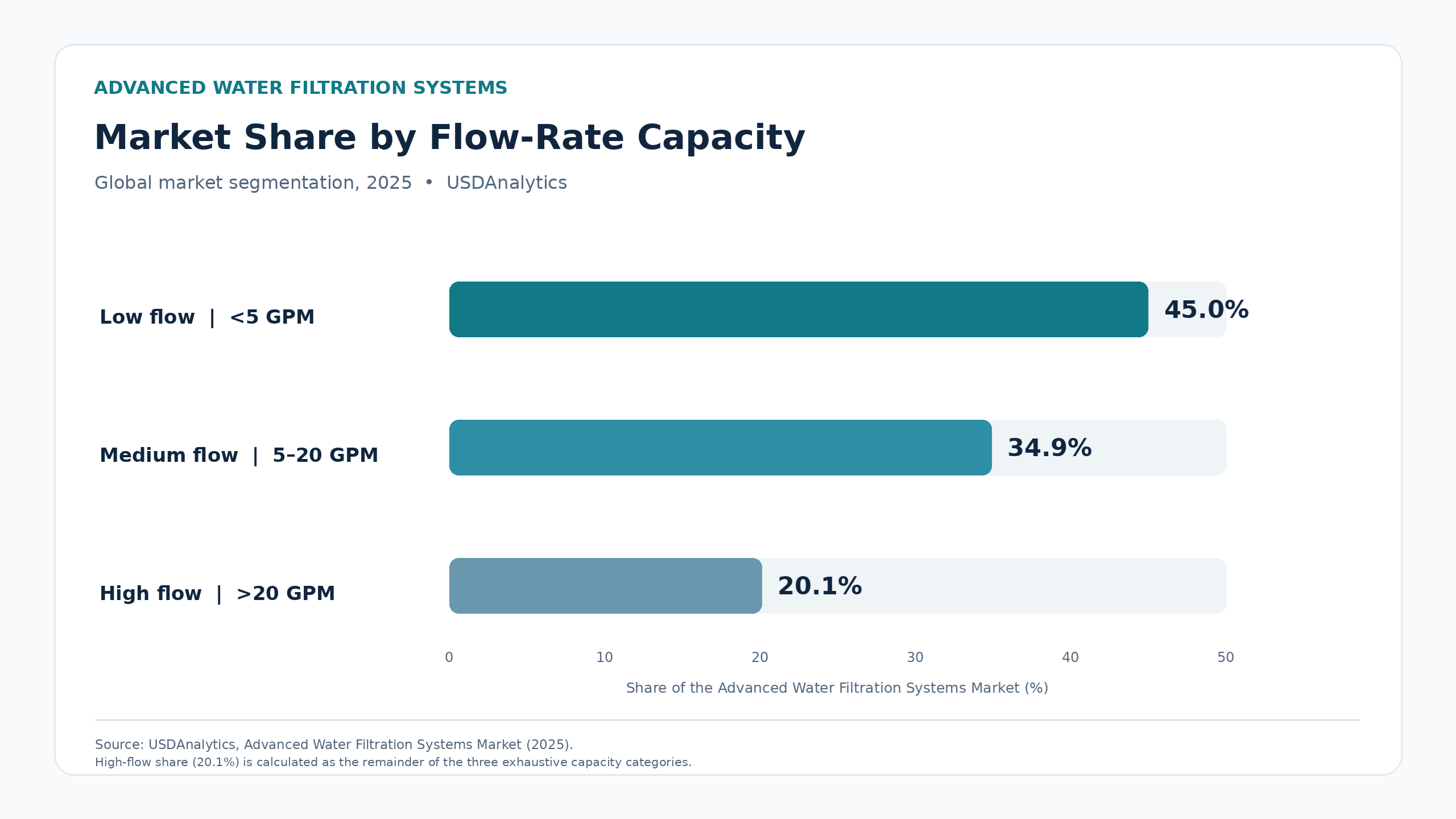
USDAnalytics' 2025 flow-rate segmentation identifies low-flow systems below 5 gallons per minute (GPM) as the largest category, with a 45% market share. Medium-flow systems operating at 5–20 GPM account for 34.9%, while high-flow systems above 20 GPM represent the remaining 20.1%, calculated from the reported categories.
Chart 1: Advanced Water Filtration Systems Market Share by Flow-Rate Capacity, 2025
Residential and smaller commercial systems are associated with standardized purification equipment and recurring consumable demand. Higher-capacity commercial and industrial systems involve greater engineering integration, treatment monitoring and maintenance requirements.
The commercial structure of these categories differs accordingly. Replacement-filter sales and equipment service are important in packaged water purification, while large industrial filtration installations involve membrane modules, pumps, pressure vessels, automation and application-specific maintenance.
Connected monitoring technologies are also expanding product differentiation. Filter-life indicators, automatic flushing and remote monitoring provide equipment-performance information and maintenance support, although they do not independently establish contaminant-removal compliance.
Nanofiltration Membranes Compete on Energy Efficiency and Selective Separation
The Nanofiltration Membranes Market is developing around applications requiring selective dissolved-solute removal rather than complete desalination.
Municipal drinking-water softening, industrial wastewater treatment, dairy processing and selected micropollutant-control applications represent important demand segments. Commercial performance depends on membrane permeability, rejection characteristics, electricity consumption, cleaning frequency and concentrate management.
Verified Energy-Efficiency Developments
In March 2026, DuPont introduced upgraded FilmTec NF270-400/34 membranes for drinking-water treatment. Compared with previous models under specified conditions, the company reports:
- 6–10% lower energy consumption at equivalent membrane flux.
- Up to 30% lower initial pressure drop.
These figures establish product-specific performance improvements, not average savings across the nanofiltration industry.
Operating costs are also influenced by membrane cleaning, feedwater composition and the degree of dissolved-contaminant removal required. Nanofiltration systems designed for partial demineralization may have different energy requirements from high-rejection reverse osmosis systems, although differences depend on water chemistry and process design.
Commercial-Scale Water Reuse Demonstrates Membrane Treatment Economics
The SAPAL water reuse project in León, Mexico, provides a commercial example of hollow-fiber nanofiltration integrated into an indirect potable reuse system.
The project, supplied with NX Filtration membrane technology, treats secondary municipal wastewater using screening, cloth-disk filtration and hollow-fiber nanofiltration, followed by ozone polishing. The treated water enters the El Palote reservoir before subsequent drinking-water treatment.
Figure 1: Hollow-Fiber Nanofiltration Treatment Process at SAPAL, León, Mexico
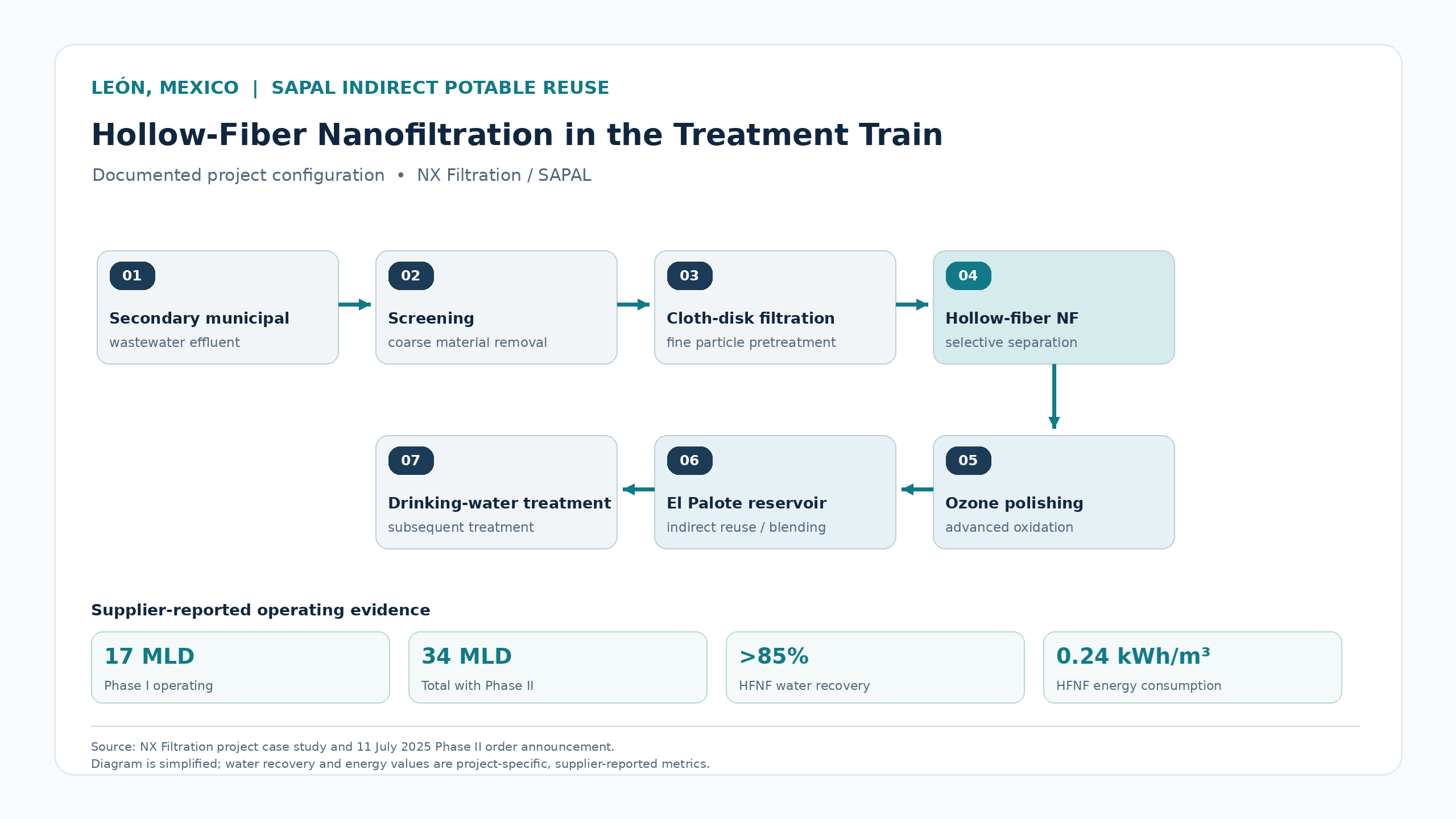
The operating first phase has a capacity of 17 million liters per day, while the second phase increases planned total capacity to 34 million liters per day.
NX Filtration reports the following operating characteristics for the hollow-fiber NF system:
|
Performance indicator |
Supplier-reported figure |
|
Water recovery |
Above 85% |
|
Membrane flux |
Approximately 30 LMH |
|
Membrane-treatment energy consumption |
Approximately 0.24 kWh/m³ |
These figures illustrate the operating characteristics of one commercial installation, not an industry-wide performance benchmark. The electricity figure relates to the membrane treatment process rather than all energy consumed across the complete reuse and drinking-water treatment system.
The project also demonstrates the commercial importance of equipment integration and water recovery in regions where municipal wastewater can supplement conventional water supplies.
Regulatory Compliance and Filter Certification Influence Supplier Competition
Filtration-system demand is influenced by drinking-water standards, industrial discharge requirements and product-specific performance validation.
In the United States, the Environmental Protection Agency's Long Term 2 Enhanced Surface Water Treatment Rule establishes microbial treatment requirements for qualifying public water systems. Membrane filtration treatment credit depends on demonstrated performance and integrity testing rather than nominal pore-size ratings alone.
Product certification also differentiates residential and commercial filtration equipment. NSF/ANSI 42 addresses specified aesthetic contaminant claims, NSF/ANSI 53 covers defined health-related contaminants, NSF/ANSI 58 applies to reverse osmosis drinking-water treatment systems, and NSF/ANSI 401 addresses selected emerging compounds.
The European Union's Drinking Water Directive introduced harmonized PFAS monitoring requirements effective January 12, 2026. These requirements strengthen the regulatory context for advanced water treatment, particularly where dissolved contaminants require technologies beyond conventional particulate filtration.
Compliance requirements differ by contaminant, application and jurisdiction. String-wound depth filters, MF/UF membranes, nanofiltration and high-rejection RO technologies therefore occupy different positions within the drinking-water and industrial treatment equipment markets.
Competitive Landscape: Filtration Suppliers Differentiate Through Equipment and Lifecycle Performance
Competition in the global water filtration industry spans cartridge manufacturers, membrane technology suppliers and integrated purification companies.
Eaton and American Filter Manufacturing participate in industrial filtration consumables, including string-wound and other replacement cartridge technologies. Porvair Filtration Group competes through specialized membrane cartridges and filtration media used in food processing and other industrial applications.
DuPont and Toray Industries supply advanced membrane technologies for water purification, industrial reuse and pretreatment applications, with recent developments emphasizing module integration, energy efficiency and membrane fouling control. NX Filtration participates through hollow-fiber nanofiltration and related membrane technologies used in municipal and industrial water treatment.
In commercial purification, Culligan International provides integrated filtration equipment, connected monitoring and service-oriented water treatment systems.
Across these suppliers, competitive differentiation reflects product qualification, membrane performance, equipment compatibility, manufacturing capabilities, maintenance requirements and lifecycle treatment costs.
Water Filtration Market Competition Becomes More Application-Specific
Developments across string-wound depth filtration, membrane microfiltration, hollow-fiber ultrafiltration and nanofiltration demonstrate a market increasingly defined by application-specific equipment and operating performance.
The commercial differences extend beyond particle-removal capability. Cartridge replacement, membrane cleaning, electricity consumption, treatment capacity, contaminant-specific validation and equipment integration contribute to distinct cost structures across filtration technologies.
Recent manufacturer launches and commercial water reuse projects demonstrate how filtration suppliers are differentiating their products through equipment efficiency, durability, system integration and verified treatment performance.