Market Overview: String Wound Filter Materials Market Expands with Industrial Depth Filtration, Water Treatment and Cartridge Replacement Demand
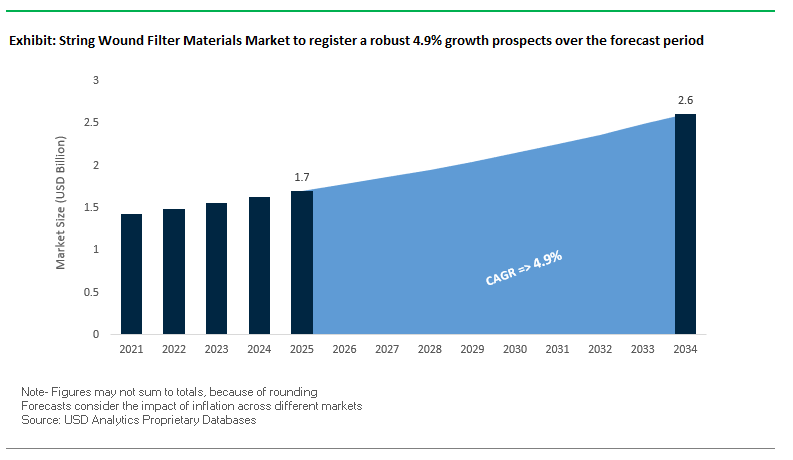
The global String Wound Filter Materials Market is projected to increase from USD 1.7 billion in 2025 to USD 2.6 billion by 2034, registering a CAGR of 4.9% during the forecast period. Market growth is supported by industrial liquid filtration, sediment removal, process-fluid clarification and recurring demand for replacement filter cartridges across water treatment, chemicals, food and beverage, pharmaceuticals and oil and gas. String wound depth filters are widely used for removing suspended particles, rust and silt in industrial water systems, reverse osmosis (RO) pretreatment and manufacturing operations. Demand is influenced by industrial production activity, feedwater quality and the installed base of cartridge filtration equipment.
Graded-density winding and material selection remain important factors in filtration performance and operating economics. Precision-controlled yarn winding enables particles to be retained throughout the cartridge depth, influencing dirt-holding capacity, pressure drop and replacement frequency. Polypropylene, cotton, polyester and glass-fiber yarns serve different chemical, temperature and particulate-loading conditions, while specialized core materials support demanding industrial applications. Cartridge procurement costs, housing compatibility, maintenance requirements and service intervals influence lifecycle filtration expenditure. Competition from melt-blown and pleated filtration technologies varies according to required particle retention, operating conditions and total filtration costs.
North America and Europe represent established markets for industrial process filtration, replacement cartridges and specialized depth-filter materials. Asia Pacific contributes manufacturing capacity and demand from industrial water treatment, chemical processing, pharmaceuticals and food production, particularly across China, India and Southeast Asia. Middle Eastern desalination and industrial water treatment facilities provide additional demand for sediment prefiltration cartridges. The competitive landscape includes filtration-media manufacturers, string wound cartridge producers, equipment suppliers and distributors, with differentiation centered on yarn quality, winding consistency, cartridge compatibility and filtration performance.
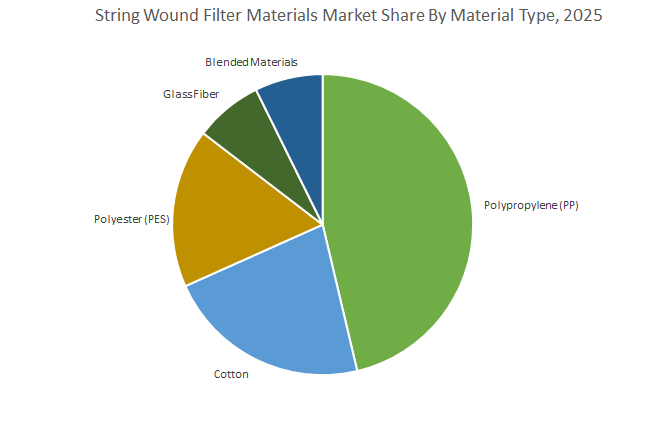
Polypropylene Leads Filter Material Demand: Polypropylene accounts for 48.5% of the market in 2025, followed by cotton at 22.5% and polyester at 16.9%, supported by industrial water treatment and process filtration applications.
Graded-Density Winding Dominates Cartridge Construction: Graded-density winding represents 64.3% of the market in 2025, compared with 35.7% for conventional winding, reflecting its dirt-holding capacity and depth-filtration characteristics.
Water Treatment Remains the Largest Application: Water treatment holds 32.8% market share in 2025, followed by food and beverage and chemical processing at 16.9% each, and industrial manufacturing at 11.8%.
Industrial Applications Support Recurring Cartridge Demand: Chemicals, oil and gas, power generation and manufacturing contribute to replacement-cartridge consumption through sediment removal, process-liquid clarification and equipment protection.
Cartridge Replacement Economics Influence Market Competition: Dirt-holding capacity, differential pressure, cartridge service life, replacement labor and disposal costs influence operating expenditure and product differentiation.
Specialty Yarn and Winding Technologies Expand Applications: Continuous-filament polypropylene, multi-density winding, glass-fiber media and specialty cores support diverse chemical and temperature requirements, including standardized 10–40-inch and extended-length cartridges.
Recent Developments in String Wound Filter Materials, Depth Filtration Cartridges and Industrial Prefiltration
Recent developments in the String Wound Filter Materials Market reflect product differentiation in high-density wound media, greater cartridge manufacturing integration and continued demand for application-specific sediment prefiltration. In May 2026, Guangzhou AAL Filter Environment Technology Co., Ltd. (AALfilter) published a North African seawater desalination case study documenting the use of 50-inch polypropylene string wound cartridges in reverse osmosis pretreatment. The installation involved higher yarn loading and denser cartridge construction, with individual cartridges weighing approximately 950–1,000 grams. The company reported more stable operating differential pressure and longer replacement intervals during its application testing. The AALfilter seawater pretreatment case study illustrates the role of cartridge construction and dirt-holding capacity in high-throughput industrial filtration, although the operating results are supplier-reported rather than independently verified.
Product-market activity also continued through certification-oriented filtration portfolios and international supplier participation. In April 2026, SF Filter (China Shuangfa) announced participation in the Water Quality Association's WQA 2026 exhibition in Miami. Its product portfolio includes JPW-series NSF-listed string wound water filter cartridges and cotton-wound filtration products, alongside melt-blown and activated-carbon cartridges. The company's official filtration product and 2026 exhibition updates reflect the continued commercial presence of certified wound-filter products in drinking-water and residential filtration markets. Certification status is product-specific and depends on the applicable standard and registered product configuration.
Manufacturing consolidation has also affected the supply structure of industrial filtration consumables. In September 2025, American Meltblown & Filtration, Inc. announced its transition to American Filter Manufacturing Inc., effective October 1, 2025. The company identified a 148,000-square-foot manufacturing facility in Indiana and an expanded product portfolio encompassing string-wound, melt-blown, pleated, high-flow, carbon and membrane cartridges. The announcement also included the integration of its sister company, Liquid Filter Housings, Inc., into the broader manufacturing organization. The American Filter Manufacturing corporate and portfolio announcement reflects the growing importance of coordinated cartridge manufacturing, compatible housings and private-label supply within the industrial filtration market.
Product engineering activity remains centered on graded winding, specialized media and cartridge interchangeability. United Filters International maintains dual-wound cartridge designs combining a coarser outer winding with tighter internal media, while its UPDN municipal string-filter range incorporates product-specific drinking-water certification. Gopani supplies CNC-wound Clarywound cartridges incorporating polypropylene, cotton and glass-fiber materials for water treatment, chemical processing and condensate filtration. Sedifilt, produced by Syntech Fibres, continued its water-industry market presence through announced participation in Aquatech Amsterdam and WEFTEC during 2025, with its product technology based on continuous-filament polypropylene yarn and graded-depth construction.
Regulatory Framework and E-E-A-T: Drinking Water Contact Materials, Food Processing Requirements and String Wound Filter Performance Validation
Regulatory requirements for string wound filter materials depend on the liquid being processed, material composition, intended contact application and filtration-system performance. In drinking-water treatment, NSF/ANSI/CAN 61 — Drinking Water System Components: Health Effects provides criteria for evaluating potentially harmful substances released from materials and components in contact with potable water. The standard covers relevant filtration media, cartridges and associated equipment, but certification does not independently establish sediment-removal efficiency or microbial treatment performance.
For point-of-use and point-of-entry water filtration, NSF/ANSI 42 addresses aesthetic-related treatment claims, including specified particulate-reduction performance. Product certification and test claims depend on the evaluated configuration and applicable standard. A manufacturer's nominal micron rating does not automatically establish an absolute particle-retention threshold, sterilizing performance or removal of dissolved contaminants.
Food and beverage filtration materials are subject to additional contact-safety requirements. In the United States, 21 CFR §177.1520 governing olefin polymers establishes conditions under which specified polypropylene materials may be used in food-contact articles. Compliance of a finished cartridge depends on its relevant materials, intended conditions of use and other applicable requirements. Within the European Union, Regulation (EC) No 1935/2004 provides the general legal framework for materials intended to contact food, including requirements concerning transfer of constituents into food under normal or foreseeable conditions.
String wound filters function primarily as particulate depth filters. Their use as pretreatment upstream of advanced contaminant-control systems does not establish direct removal of dissolved per- and polyfluoroalkyl substances (PFAS). The U.S. EPA's assessment of PFAS drinking-water treatment technologies identifies granular activated carbon, ion exchange and high-pressure membranes among the relevant removal approaches. Technical assessment of string wound cartridges instead centers on validated particulate retention, pressure-drop behavior, media migration, chemical compatibility, dirt-holding capacity and compliance of wetted materials with the intended process application.
Key Trends Driving Growth and Innovation
Pursuit of Enhanced Filtration Performance
The string wound filter materials market is witnessing significant innovation in filtration performance. Recent studies highlight the transition from chopped-fiber to continuous filament yarns, engineered to prevent media migration and chemical leaching. Continuous filaments are melt-spun without spin-finish chemicals, ensuring cleaner filtration across water, chemical, and industrial applications. Companies such as Gopani Filters have introduced advanced CNC-controlled winding technologies, producing structurally robust cores and tightly wound honeycomb patterns. Products like their Clarywound filter deliver higher dirt-holding capacity, improved flow consistency, and extended service life, illustrating the industry’s focus on high-efficiency, durable filter media.
Integration of Digital Technologies for System Optimization
IoT and AI integration are transforming string wound filtration systems into smart, predictive maintenance platforms. Sensors continuously monitor pressure, flow rate, and contamination levels, enabling operators to replace filters only when performance declines. Academic reviews indicate that real-time monitoring can reduce annual filter consumption by 20–30%, optimizing cost and operational efficiency. This trend is particularly relevant in industrial manufacturing, water treatment, and chemical processing, where downtime or inefficient filtration can significantly impact productivity and compliance.
Growing Demand for Sustainable and Environmentally Friendly Materials
Sustainability is becoming a core driver in the string wound filter materials market. Research highlights the adoption of polypropylene and other eco-friendly polymers free from binders and adhesives, minimizing chemical leaching and environmental impact. Manufacturers increasingly publicize chemical-free melt spinning processes to produce yarns, resulting in filters that meet stringent environmental and regulatory standards. This trend aligns with global initiatives to reduce industrial pollution, ensure safe water treatment, and develop eco-conscious filtration solutions across diverse applications.
Emerging Opportunities in String Wound Filter Materials
The market presents substantial opportunities in high-performance and sustainable filtration. Growing industrial demand for precision filtration in water treatment, pharmaceuticals, and chemical processing is fueling investment in advanced materials and winding technologies. Adoption of graded density and continuous filament designs enables higher dirt-holding capacity and longer filter life, opening avenues for premium product offerings. Additionally, digital integration and IoT-enabled predictive maintenance provide cost-saving and operational efficiency opportunities for utilities and industrial end-users. Companies that combine durable, chemically compatible materials with smart monitoring solutions are positioned to capture significant market share in both conventional and high-value applications.
Market Share Insights of String Wound Filter Materials Market
Market Share by Material Type: Polypropylene Dominates, Specialty Materials Capture Niches
Polypropylene (PP, 48.5%) leads the market due to its chemical inertness, hydrophobic nature, broad compatibility with acids and alkalis, and cost-effectiveness. Cotton (22.5%) is preferred in hot water and oil filtration applications, offering biodegradability but water-swelling limitations. Polyester (PES, 16.9%) provides high tensile strength and chemical resistance, suitable for solvents and harsh environments. Glass fiber serves high-temperature and aggressive chemical applications, while blended materials combine properties to meet specialized requirements like controlled swelling or enhanced absorption. Material selection is primarily driven by chemical compatibility, particle type, and operational conditions, highlighting the importance of matching filter media to specific industrial fluids.
Market Share by Winding Pattern: Graded Density Emerges as Performance Standard
Graded density winding (64.3%) dominates, featuring a loose outer layer and progressively tighter inner layers. This design allows high dirt-loading capacity, extended service life, and consistent flow rates, making it the preferred choice for industrial and municipal filtration. Standard/conventional winding (35.7%) remains in price-sensitive or simple applications but is gradually declining as performance demands increase. The shift underscores the market preference for high-efficiency, performance-oriented string wound filters over basic, low-cost alternatives.
Market Share by Application: Water Treatment Leads, High-Value Applications Expand
Water treatment (32.8%) remains the largest application, providing essential pre-filtration for RO/UF systems, point-of-entry systems, and industrial process water, ensuring downstream system protection and water quality. Food & Beverage (16.9%) and Pharmaceuticals represent high-value segments due to strict regulatory compliance, FDA requirements, and premium material use. Chemical processing (16.9%) and Industrial manufacturing (11.8%) utilize string wound filters as reliable workhorses for protecting equipment and maintaining product quality. Oil & Gas applications involve produced water and fuel oil filtration, often using cotton or glass fiber. Other niche applications (5%) include swimming pools, agriculture, and aquaculture. The distribution highlights the dual role of string wound filters in cost-effective bulk applications and high-value, critical processes.
U.S. Water Quality Regulations and Corporate Consolidation Fueling String Wound Filter Demand
The United States string wound filter materials market is expanding rapidly, driven by strict regulatory oversight and industry consolidation. The U.S. Environmental Protection Agency (EPA) has introduced rigorous drinking water standards, including legally enforceable limits for six PFAS compounds, significantly boosting the adoption of robust string wound filtration systems. This regulatory pressure is particularly critical for municipal water utilities and industries that must ensure compliance while addressing growing public health concerns. On the corporate front, strategic acquisitions are strengthening market capabilities Micronics Engineered Filtration Group’s February 2022 acquisition of National Filter Media (NFM) expanded its product portfolio in both liquid and air filtration, enhancing its ability to deliver total engineered solutions, including advanced string wound cartridges. Market growth is further supported by rising demand from water and wastewater treatment, petrochemicals, and chemicals, alongside infrastructure modernization projects aimed at ensuring reliable access to clean drinking water.
China’s Environmental Mandates and Infrastructure Investments Driving High-Performance Filter Adoption
China has become one of the fastest-growing markets for string wound filter materials, driven by strict government policies and infrastructure expansion. The 14th Five-Year Plan emphasizes sustainable development and environmental protection, compelling industries to adopt advanced filtration materials to control emissions and combat widespread water pollution. Technological progress is also advancing quickly, with Yonseng Filter’s 2023 launch of new cartridge filter housings showcasing domestic innovation in system integration and efficiency improvements. Massive infrastructure investments, particularly in urbanizing regions, are further boosting the deployment of industrial-grade string wound filters across large-scale municipal water projects. With petrochemical and refining industries contributing heavily to pollution, demand for high-performance filters continues to climb, positioning China as a core hub for both domestic adoption and global exports of string wound filter solutions.
India’s Focus on Advanced Filter Innovation and Expanding Water Treatment Facilities
India’s string wound filter materials market is being propelled by domestic innovation and government-driven infrastructure programs. Companies like Gopani are leading technological advancements with their Clarywound 3X string wound cartridges, delivering triple the efficiency of conventional filters while maintaining cost-effectiveness a critical factor in price-sensitive markets. Government initiatives aimed at enhancing water and air quality, coupled with the push to expand local manufacturing, are amplifying demand for advanced filter materials. Large-scale water treatment projects and the expansion of industrial sectors such as pharmaceuticals and food and beverage are further increasing adoption rates. The dual challenge of ensuring clean drinking water in urban areas and supporting industrial growth has made string wound filters indispensable across multiple applications, reinforcing India’s emergence as a competitive regional market for filtration materials.
UK’s AMP 8 Mandates and Corporate Leadership in Filtration Yarn Production
The United Kingdom string wound filter market is being shaped by regulatory reform and domestic manufacturing capabilities. The Asset Management Period (AMP) 8 framework requires utilities to modernize water treatment infrastructure to reduce environmental risks, directly increasing the demand for high-purity string wound filter materials. This regulatory requirement aligns with the UK’s broader sustainability commitments, ensuring ongoing investment in advanced filtration solutions. Corporate leaders such as Coats Group Plc play a pivotal role in this ecosystem by supplying polypropylene and acrylic yarns, which are essential in producing durable and efficient string wound filters. Beyond regulatory compliance, market growth is also tied to the replacement of aging infrastructure and the need to improve resilience in water service delivery, establishing the UK as a key market for advanced filtration technologies.
Germany’s EU Wastewater Directive and Innovation in Micropollutant Filtration
Germany stands out in the European string wound filter materials market due to its regulatory intensity and technological innovation. The revised EU Urban Wastewater Treatment Directive, enforced in January 2025, requires stringent monitoring and pollutant removal standards, creating significant opportunities for string wound filters in municipal and industrial water treatment. German companies and research institutions are also pioneering advanced solutions designed to remove micro-pollutants and pharmaceutical residues, addressing growing environmental and health concerns. The market is further reinforced by strong public demand for clean water and sustainable wastewater treatment systems. As a result, Germany remains a leader in deploying cutting-edge filtration materials that comply with strict EU policies while pushing technological boundaries for long-term sustainability.
Japan’s string wound filter materials market is evolving under the combined influence of technological innovation and industrial requirements. In November 2021, Nitto Boseki Co., Ltd. commenced operations at a new special glass yarn facility in Taiwan, producing NE-glass yarn that serves as a core material in high-temperature string wound filter applications. On the industrial front, Japan’s August 2024 approval to restart the Kashiwazaki-Kariwa nuclear power plant the world’s largest nuclear facility has amplified demand for advanced, high-performance filtration systems to support both water purification and safety operations. This intersection of corporate expansion and regulatory oversight underscores Japan’s strategic approach, where innovation in material science and the energy sector’s stringent requirements converge to drive market growth. With rising environmental concerns and a regulatory emphasis on clean technologies, Japan is positioned as a key innovator in the global string wound filter materials market.
Competitive Landscape: Global String Wound Filter Materials Market
The global String Wound Filter Materials Market competitive landscape includes industrial filtration manufacturers, specialized depth-filter producers, yarn-based cartridge suppliers and liquid filtration equipment companies. Parker Hannifin Corporation participates through its Fulflo SWC string wound cartridge portfolio, offering different fiber and core combinations for industrial liquids, petroleum products and water treatment. Eaton Corporation supplies LOFWIND wound depth-filter cartridges, including polypropylene, cotton and glass-fiber configurations for chemical processing, water filtration and elevated-temperature applications. United Filters International specializes in U-Series string wound filtration products, including UPDN municipal water cartridges and dual-wound designs that differentiate coarse and fine particulate loading within the filter structure.
North American manufacturers compete through product customization, cartridge interchangeability and manufacturing capabilities. American Filter Manufacturing Inc. produces W and WQ series string wound cartridges using computer-controlled winding, with product configurations spanning water filtration, paints, inks and industrial processing. Micronics Engineered Filtration Group supplies string wound cartridge filters and complementary liquid filtration equipment, including cartridge and bag filtration systems. Coleman Filter Company manufactures wound depth filters for oil and gas, municipal water, chemical processing and industrial applications, with cotton, polypropylene, nylon, polyester and other yarn configurations supplied through standardized and specialty cartridge designs.
Specialized filtration-media producers maintain positions through yarn engineering, controlled winding and material compatibility. Syntech Fibres (Pvt.) Ltd., through Sedifilt, supplies continuous-filament polypropylene string wound cartridges designed for depth loading and reduced fiber migration. Gopani Product Systems manufactures Clarywound cartridges, including graded-density polypropylene filters, specialty cotton and glass-fiber products, and condensate-polishing prefilters. Hongtek Filtration Co., Ltd. participates through industrial string wound cartridges for water treatment and chemical processing, with product differentiation based on selected yarn materials, winding construction and cartridge operating conditions.
Asian manufacturers contribute to global cartridge supply through standardized wound-filter products, private-label manufacturing and filtration-system components. Brother Filtration supplies ProClean polypropylene, cotton and glass-fiber string wound cartridge ranges for municipal water, desalination pretreatment, food processing and industrial applications. Filter Concept Private Limited manufactures wound-filter cartridges and process filtration equipment for industrial liquid and gas filtration requirements. SF Filter (China Shuangfa) supplies polypropylene and cotton string wound cartridges, including its JPW series for drinking-water filtration and related commercial and residential applications.
Competition also includes suppliers focused on industrial process filtration, long-length cartridge configurations and drinking-water components. Shanghai Pullner Filtration Technology Co., Ltd. supplies PHFX-series string wound cartridges for condensate prefiltration and other industrial applications. AALfilter provides polypropylene wound cartridges for seawater desalination pretreatment and industrial water processing, including extended-length configurations. Industrial Filter Manufacturing Ltd. supplies wound-filter cartridges for water filtration applications, with relevant products appearing in NSF's drinking-water component certification listings. Across these companies, product competition is influenced by yarn consistency, particulate-retention characteristics, material traceability, cartridge dimensions, core compatibility and replacement economics.
String Wound Filter Materials Market Report Scope
String Wound Filter Materials Market
Parameter
Details
Market Size (2025)
$1.7 Billion
Market Size (2034)
$2.6 Billion
Market Growth Rate
4.9%
Segments
By Material Type (Polypropylene (PP), Cotton, Polyester (PES), Glass Fiber, Blended Materials), By Winding Pattern (Standard/Conventional Winding, Graded Density Winding), By Application (Water Treatment, Food & Beverage Processing, Chemical Processing, Pharmaceuticals, Oil & Gas, Industrial Manufacturing, Other Applications), By End-User (Industrial, Commercial, Residential)
Study Period
2020- 2025 and 2026-2034
Units
Revenue (USD)
Qualitative Analysis
Porter’s Five Forces, SWOT Profile, Market Share, Scenario Forecasts, Market Ecosystem, Company Ranking, Market Dynamics, Industry Benchmarking
Companies
Coats Group Plc, Micronics Engineered Filtration Group, Schweitzer-Mauduit International, Inc., William Barnet and Son, LLC, Eaton Corporation, The Dow Chemical Company, Solvay S.A., Lydall, Inc., J.B. Martin Co. Inc., Filtration Group Corporation, Hongtek Filtration Co., Ltd., East Asia Textile Technology Ltd., Gopani Product Systems Private Limited, MMP Filtration Pvt. Ltd., Filter-Tech, Inc.
Countries
US, Canada, Mexico, Germany, France, Spain, Italy, UK, Russia, China, India, Japan, South Korea, Australia, South East Asia, Brazil, Argentina, Middle East, Africa
String Wound Filter Materials Market Segmentation
By Material Type
Polypropylene (PP)
Cotton
Polyester (PES)
Glass Fiber
Blended Materials
By Winding Pattern
Standard/Conventional Winding
Graded Density Winding
By Application
Water Treatment
Food & Beverage Processing
Chemical Processing
Pharmaceuticals
Oil & Gas
Industrial Manufacturing
Other Applications
By End-User
Industrial
Commercial
Residential
Countries Analyzed
North America (US, Canada, Mexico)
Europe (Germany, UK, France, Spain, Italy, Russia, Rest of Europe)
Asia Pacific (China, India, Japan, South Korea, Australia, South East Asia, Rest of Asia)
South America (Brazil, Argentina, Rest of South America)
Middle East and Africa (Saudi Arabia, UAE, Rest of Middle East, South Africa, Egypt, Rest of Africa)
Leading Companies in the String Wound Filter Materials Market
The String Wound Filter Materials Market study by USDAnalytics this report investigates demand inflections across industrial, municipal, and residential pre-filtration, maps material performance under diverse chemistries, and highlights breakthroughs in continuous-filament yarns, graded-density winding, and digitally monitored change-out strategies; our analysis reviews supply security, total cost of ownership, and life-cycle impacts, links filtration architecture to downstream RO/UF protection and process uptime, and benchmarks competitors on quality, certifications, and global reach. By integrating market sizing with field evidence from water, chemicals, F&B, pharma, and oil & gas users, this report is an essential resource for procurement leaders, plant engineers, and product managers planning resilient pre-filtration programs through 2034. Scope Includes-
Geographic Scope: “Analysis spans 25+ countries across North America, Europe, Asia Pacific, Latin America, the Middle East & Africa.”
Historic data from 2021 to 2024 and forecast data from 2025 to 2034.
Companies (Profiles of 15+ companies): Coats Group Plc; Micronics Engineered Filtration Group; Schweitzer-Mauduit International, Inc.; William Barnet and Son, LLC; Eaton Corporation; The Dow Chemical Company; Solvay S.A.; Lydall, Inc.; J.B. Martin Co. Inc.; Filtration Group Corporation; Hongtek Filtration Co., Ltd.; East Asia Textile Technology Ltd.; Gopani Product Systems Private Limited; MMP Filtration Pvt. Ltd.; Filter-Tech, Inc.
Methodology
USDAnalytics evaluates the global String Wound Filter Materials Market through a combined bottom-up shipment and top-down expenditure analysis covering polypropylene, cotton, polyester, glass fiber and blended materials; graded-density and conventional winding patterns; industrial, commercial and residential end users; and applications across water treatment, food and beverage processing, chemicals, pharmaceuticals, oil and gas, and manufacturing. The research incorporates primary interviews with water-treatment operators, environmental health and safety personnel, maintenance supervisors, filtration suppliers and industrial end users, supplemented by company disclosures, product specifications, regulatory publications, distributor information and filtration performance data.
Market estimates are triangulated using cartridge shipment volumes, average selling prices, replacement cycles, filtration-housing demand, industrial consumable expenditure and regional market activity. Technical assessments incorporate micron ratings, dirt-holding capacity, differential-pressure development, core materials, media migration and chemical compatibility. The forecast framework applies scenario-based analysis to industrial production, water treatment expenditure, yarn-material demand, cartridge replacement and filtration-system requirements over 2025–2034, with competitive benchmarking covering supplier portfolios, manufacturing capabilities, product specifications and regional market participation.
Deliverables:
Comprehensive Market Research Report (PDF and Excel) with detailed tables, charts, and interactive visualizations.
Country-Specific Forecasts & Analysis.
Segment-Wise Revenue Forecasts (2026–2034).
Competitive Analysis, Benchmarking, and SWOT Profiles.
Recent Developments & Innovation Tracker.
Executive Summary & Analyst Commentary.
Post-Purchase Analyst Support for Client-Specific Questions and Custom Data Requirements.
Table of Contents: String Wound Filter Materials Market
Start with chemistry and temperature: PP offers broad acid/alkali compatibility at attractive cost; cotton suits hydrocarbons and hot oils but can swell in water; PES brings tensile strength and solvent resistance; glass fiber handles higher temperatures and aggressive media. Map fluid, pH, and cleanability to media datasheets, then validate with a short pilot at the target micron, flow, and ΔP.
Graded density loads larger particles outside and fines inside, boosting dirt-holding capacity and extending service life. This reduces change-outs, waste volume, and downtime, while stabilizing downstream RO/UF differential pressure. Plants commonly report 20–30% fewer cartridges consumed annually when migrating from uniform to graded wind patterns.
They act as robust pre-filters ahead of GAC, IX, RO, or AOP units removing sediment and colloids that would foul polishing media. Correctly sized cartridges maintain lower SDI/TSS, lengthening bed life and RO run time. Specify tight micron ratings and clean, low-shedding filaments to avoid media migration into the PFAS stage.
Inline sensors tracking flow, ΔP, turbidity/NTU, and conductivity enable condition-based change-outs instead of fixed schedules. Connected dashboards forecast clogging, auto-alert stores for spares, and document compliance. Users typically gain 10–15% uptime on critical skids and cut emergency maintenance by switching to predictive replacements.
Audit material compliance (FDA/EC 1935/2004, USP Class VI, NSF/ANSI), traceability, and fiber/finish declarations to minimize extractables. Review lot testing, burst/collapse data, and fiber migration limits; request application references and performance curves at your viscosity and temperature. Lock in QA via change-control agreements and incoming inspection plans to maintain consistency across sites.