Market Overview: Advanced Water Filtration Systems Market Expands with Smart Water Purification, PFAS Treatment and Industrial Water Reuse
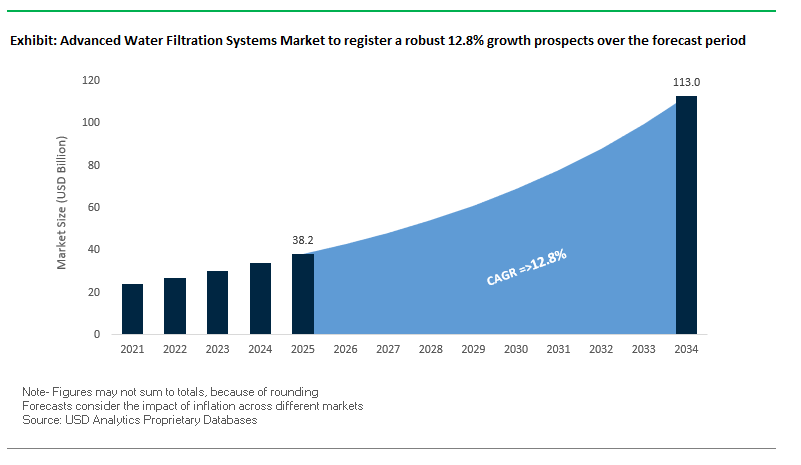
The global Advanced Water Filtration Systems Market is projected to grow from USD 38.2 billion in 2025 to USD 112.9 billion by 2034, registering a CAGR of 12.8% during the forecast period. Market growth is supported by increasing drinking-water quality requirements, concerns over emerging contaminants, industrial water recycling and the expansion of residential and commercial purification systems. Demand spans point-of-use (POU) and point-of-entry (POE) filtration, municipal treatment infrastructure and industrial systems integrating membrane separation, activated carbon, ion exchange and other treatment technologies.
Residential water purification represents the largest application segment, supported by demand for under-sink reverse osmosis (RO), whole-house filtration and connected water purifiers. Commercial applications include offices, hospitality facilities, restaurants and healthcare institutions, where water quality, equipment reliability and replacement-filter services influence operating costs. Industrial demand centers on high-capacity filtration systems for process-water preparation, cooling systems, wastewater recovery and high-purity manufacturing. Filtration requirements differ by application, ranging from chlorine and sediment reduction to dissolved-salt removal and treatment of specified PFAS compounds.
Smart filtration technologies are becoming more established across residential and industrial systems. Connected controllers, filter-life indicators, automatic flushing and remote monitoring provide information on equipment operation and maintenance requirements. In industrial installations, sensor-based monitoring supports filtration performance assessment, membrane cleaning and process reliability. Commercial differentiation increasingly reflects equipment purchase costs, consumable replacement, water recovery, electricity consumption and maintenance services.
Regionally, North America and Europe represent established markets for certified drinking-water filtration, advanced contaminant treatment and industrial water purification. Asia Pacific contributes demand from residential RO systems, urban water infrastructure and manufacturing expansion, particularly across China, India and Southeast Asia. The Middle East remains important for desalination and industrial water treatment. The market includes residential appliance manufacturers, filtration-media suppliers, membrane technology providers and integrated water treatment companies operating across different system capacities and price categories.
Key Insights: Advanced Water Filtration Systems Market
Membrane Filtration Leads Technology Demand: Membrane-based technologies account for 45.7% of the market in 2025, supported by RO, nanofiltration (NF), ultrafiltration (UF) and microfiltration (MF). Activated-carbon media, hybrid filtration and other treatment technologies serve complementary contaminant-removal requirements.
Residential Applications Dominate Market Demand: Residential water filtration holds 40.4% market share in 2025, while industrial, commercial and municipal applications contribute demand for process-water treatment, drinking-water dispensing and large-scale purification infrastructure.
Under-Sink Systems Lead Equipment Configuration: Under-sink filtration units account for 35.8% of the market in 2025, supported by compact RO and multistage purification systems. Whole-house installations, countertop purifiers, industrial skid-mounted equipment and municipal plants serve different capacity requirements.
Smart Monitoring Becomes an Important Product Differentiator: Filter-life indicators represent 30.6% of the smart-feature segment in 2025. IoT connectivity, automatic flushing, real-time monitoring and AI-enabled performance analytics extend filtration-system functionality across residential and industrial applications.
Low-Flow Systems Maintain the Largest Capacity Share: Systems below 5 gallons per minute (GPM) represent 45% of market demand, while medium-flow systems operating at 5–20 GPM account for 34.9%. High-flow systems serve larger commercial and industrial applications.
Filtration Economics Depend on Contaminant and System Requirements: Membrane replacement, activated-carbon consumption, water recovery, energy costs, maintenance and product certification influence equipment differentiation. PFAS treatment, low-waste RO configurations and connected filtration services are important areas of product development.
Recent Developments in Advanced Water Filtration Systems, Smart Purification and Contaminant Removal
Recent developments in the Advanced Water Filtration Systems Market reflect increasing integration of digital monitoring, multistage treatment and application-specific filtration technologies. In July 2026, DuPont expanded its WAVE PRO digital modeling platform to integrate ultrafiltration, ion exchange, reverse osmosis and nanofiltration in a single treatment-design environment. The DuPont multi-technology water treatment platform supports municipal drinking water, industrial utility water, wastewater and seawater desalination applications. The development reflects increasing use of integrated performance modeling to evaluate treatment configurations, membrane energy consumption and operating requirements.
Commercial filtration systems also advanced through connected monitoring and multistage purification. In May 2026, Culligan International announced that its Purity commercial water filtration platform had received the Red Dot Product Design Award. The system combines multistage filtration, ultraviolet treatment and C-Sense monitoring technology for workplace drinking-water applications. The Culligan Purity commercial filtration announcement highlights the integration of water-quality monitoring, filtration equipment and service diagnostics within commercial dispensing systems. Culligan's Aquasential Smart RO system also received a 2026 Good Housekeeping Home Reno Award, reflecting product development in connected residential purification.
Residential water filtration portfolios have expanded through established appliance manufacturers. In November 2024, A. O. Smith Corporation completed its acquisition of Pureit from Unilever for approximately USD 120 million, subject to adjustments. The A. O. Smith–Pureit acquisition announcement identified residential water purifiers, replacement filters and distribution operations across South Asian and other markets. During 2026, Pentair also updated its residential filtration portfolio documentation, covering point-of-use systems, point-of-entry treatment, filtration housings and associated water-treatment components.
Regulatory Framework and E-E-A-T: PFAS Drinking Water Requirements, Filtration Certifications and Water Quality Standards
Regulatory requirements affecting advanced water filtration systems vary according to intended use, contaminant profile and treatment capacity. In the United States, the Environmental Protection Agency's 2024 PFAS National Primary Drinking Water Regulation established enforceable maximum contaminant levels of 4.0 parts per trillion each for PFOA and PFOS. In May 2026, EPA announced a proposed PFOA and PFOS compliance extension that would allow eligible water systems additional time until 2031. A separate proposal concerns other PFAS regulatory provisions. These proposed changes remain distinct from currently effective requirements.
In the European Union, Directive (EU) 2020/2184 establishes drinking-water quality requirements, including PFAS monitoring and risk-based assessment. The European Commission confirmed that new EU-wide PFAS drinking-water monitoring requirements became applicable on January 12, 2026. The framework includes parametric values of 0.10 µg/L for the sum of 20 specified PFAS and 0.50 µg/L for PFAS Total, subject to the applicable monitoring provisions.
Product-specific certification is important for residential and commercial filtration. The NSF drinking-water treatment standards distinguish NSF/ANSI 42 for aesthetic contaminant reduction, NSF/ANSI 53 for specified health-related contaminants, NSF/ANSI 58 for reverse osmosis systems and NSF/ANSI 401 for selected emerging compounds. Certification applies to defined product configurations and contaminant-reduction claims rather than establishing universal removal performance.
Separately, NSF/ANSI/CAN 61 addresses potential chemical migration from materials and components in contact with drinking water. It does not independently certify contaminant removal. Activated carbon, ion exchange, RO and other filtration technologies exhibit different removal characteristics, while connected sensors and filter-life indicators provide operational information rather than direct evidence of water-quality compliance.
Trends and Opportunities in Advanced Water Filtration Systems Market
Trend 1: Nanofiltration & Graphene Membranes Replace Traditional RO for Selective Contaminant Removal
The advanced water filtration systems market is witnessing a pivotal shift from conventional reverse osmosis (RO) towards nanofiltration (NF) and graphene-based membranes due to the demand for targeted contaminant removal and reduced energy consumption. Nanofiltration membranes operate at significantly lower pressures (0.5–2.5 MPa) than RO systems (~4 MPa), decreasing electricity costs while maintaining effective removal of heavy metals like copper, cobalt, and lead. Graphene and graphene oxide membranes provide exceptional adsorption of emerging pollutants such as PFAS, with studies demonstrating over 95% rejection rates for antibiotics like tetracycline under optimized conditions. Research in next-generation graphene membranes emphasizes structural stability over extended operation, creating high-efficiency solutions that address both environmental and regulatory concerns in industrial, municipal, and residential water treatment applications.
Trend 2: Point-of-Use (POU) Filtration Systems Surge Due to Rising Concerns Over Microplastics
Rising awareness of microplastic contamination in drinking water has driven strong demand for point-of-use (POU) filtration systems. Studies indicate microplastics are present in over 70% of tap water samples globally, prompting consumers to seek reliable filtration solutions. Advanced POU systems with fine membranes (0.2 microns) are capable of removing nearly 100% of microplastics, along with other impurities such as bacteria and chlorine. The surge in adoption is fueled by growing concerns over human health impacts, including inflammation and hormonal disruption, and reflects an industry-wide effort to provide comprehensive, consumer-friendly water purification solutions in residential, commercial, and institutional settings.
Opportunity 1: Self-Cleaning Filters with AI-Powered Clog Detection for Industrial Applications
Industrial water filtration is increasingly adopting AI-integrated self-cleaning systems to minimize downtime and reduce operational costs. These systems monitor pressure and flow rates in real time and automatically initiate cleaning cycles when a clog is detected, ensuring continuous production. AI algorithms enable predictive maintenance by detecting early signs of fouling, reducing the need for manual intervention. The automation enhances efficiency, prolongs filter lifespan, and lowers labor and replacement costs, making AI-powered self-cleaning filtration systems a highly attractive investment for food & beverage, pharmaceutical, semiconductor, and metals & mining industries.
Opportunity 2: Ceramic Membrane Filters for Low-Cost, Long-Lasting Water Purification in Developing Countries
Ceramic membrane filters are emerging as a cost-effective, durable, and locally producible solution for decentralized water purification, particularly in developing nations and off-grid communities. Resistant to abrasion, corrosion, and extreme pH or temperature, ceramic membranes provide consistent high-quality effluent, effectively removing bacteria and turbidity while preserving taste and odor. Simple production using locally available materials like clay and sawdust ensures accessibility and sustainability. With a service life of up to five years, ceramic membranes reduce operational costs and maintenance frequency, offering a scalable and reliable method for safe drinking water provision in resource-limited environments.
Advanced Water Filtration Systems Market Share Insights
Membrane Filtration Dominates with 45% Market Share
Membrane filtration systems remain the dominant technology in the advanced water filtration market, accounting for approximately 45.7% of global demand in 2025. The segment includes Reverse Osmosis (RO) for dissolved solids, Ultrafiltration (UF) for pathogens, and Nanofiltration (NF) for selective contaminant removal, offering the highest performance for both residential drinking water and high-purity industrial applications. Media filtration serves as the versatile workhorse for removing chlorine, sediment, taste/odor compounds, and VOCs, forming the backbone of many whole-house and point-of-entry systems. Hybrid systems are gaining traction as premium solutions that combine multiple technologies into a single unit, addressing broad-spectrum contaminant removal for residential, commercial, and critical industrial applications.
Residential Applications Drive 40% of Market Demand
Residential use is the largest application segment at 40.4% market share, propelled by growing consumer health awareness and concerns over tap water quality. Under-sink RO systems, whole-house filtration units, and advanced shower filters dominate the category. Industrial users rely on high-capacity, skid-mounted filtration systems to provide process water, boiler feed, and ingredient water, with stringent requirements for reliability and regulatory compliance. Commercial demand comes from hotels, offices, restaurants, and schools, where safe, palatable water is critical for guests and employees. Municipal installations incorporate ultrafiltration and nanofiltration to comply with increasingly strict regulations on pathogens and emerging contaminants like PFAS, reflecting infrastructure modernization trends.
System Configuration Trends Highlight Under-Sink & Whole-House Solutions
Under-sink units (35.8%) remain the residential performance champion, combining space efficiency with high-quality drinking water output. Whole-house systems are increasingly adopted for point-of-entry treatment, protecting plumbing, skin, and household appliances from contaminants like chlorine and sediment. Industrial skid-mounted systems dominate factory, laboratory, and commercial applications, offering modular scalability and robust performance. Municipal-scale plants serve entire communities, emphasizing membrane-based filtration for large-scale public health protection, while countertop units (~5%) target renters and portable-use scenarios.
Smart Features Enhance Performance, Monitoring, and Efficiency
Filter life indicators (30.6%) represent the most widely adopted smart feature, enabling accurate replacement alerts based on real usage rather than simple timers. IoT connectivity allows users to remotely monitor system performance, water quality, and usage statistics, supporting predictive maintenance and remote diagnostics. Real-time monitoring ensures continuous water quality assurance, while automatic flushing preserves RO membrane integrity. Cutting-edge AI-powered optimization is emerging to analyze usage patterns, optimize flush cycles, and provide water quality insights, reflecting the industry's push towards intelligent, connected filtration solutions.
Flow Rate Capacity & Price Segment Insights
Low-flow systems (<5 GPM) dominate at 45%, encompassing most under-sink and countertop units for residential drinking water. Medium-flow systems (34.9%) serve whole-house residential and small commercial needs, while high-flow systems target industrial and large commercial applications requiring custom-engineered solutions. Price segmentation shows mid-range products as the largest revenue contributor, balancing performance and affordability. Premium units offer advanced features and integrated systems for residential luxury and commercial-grade applications, while economy units address entry-level, low-cost consumer demand, and luxury/commercial-grade systems cater to high-flow industrial and high-end commercial operations.
Country Analysis of the Advanced Water Filtration Systems Market
United States: Accelerating Advanced Filtration Through Regulations and AI Integration
The United States market for advanced water filtration systems is strongly influenced by the Bipartisan Infrastructure Law, which provides significant funding for drinking water and wastewater infrastructure upgrades. The EPA’s tightening of regulations on emerging contaminants, such as PFAS (per- and polyfluoroalkyl substances), is accelerating the adoption of granular activated carbon, nanofiltration technology, and sensor-based real-time monitoring systems. A growing trend is the integration of artificial intelligence (AI) and machine learning to optimize water treatment operations, predict demand, and support predictive maintenance. Leading companies like Xylem are collaborating with utilities to deploy PFAS treatment solutions, while the Department of the Interior’s $300 million funding for water recycling and desalination projects further underscores the governmental focus on advanced water technologies. These initiatives collectively enhance the efficiency, sustainability, and compliance of advanced filtration systems across the country.
China: Policy-Driven Growth in Advanced Filtration Technologies
China’s Water Ten Plan and Beautiful China initiative are central to the nation’s drive for clean water and advanced filtration infrastructure. The government aims for 95% wastewater treatment coverage in county-level cities and a 25% water reuse rate in water-scarce areas, fueling demand for high-efficiency filtration systems. With real-time emission disclosure requirements for key enterprises, China is pushing the development of continuously monitored, IoT-enabled advanced water filtration systems. Investments exceeding RMB 673 billion between 2017 and 2022 have been allocated to water pollution control, supporting industrial parks and containerized solutions for on-site treatment and reuse. The regulatory and investment environment positions China as a major growth hub for smart, sustainable filtration technologies.
Israel: Innovation Hub for Smart and Sustainable Water Filtration
Israel’s water sector is recognized globally for its innovation, with over 130 companies developing advanced filtration, smart water management, and emergency water solutions. Research at the Technion Institute focuses on aerated soil injection for agricultural wastewater treatment, complementing advanced filtration technologies. Companies like BioCastle Water Technologies are deploying eco-friendly MBR systems, while NanoClear Water Solutions uses ProBio Media, a nano-ceramic biofiltration technology, to enhance treatment capacity by up to 40% and reduce sludge generation. Israeli desalination plants, supplying 75% of national drinking water, employ Pressure-Filtration Reverse Osmosis (PFRO), which significantly improves fouling resistance and overall efficiency, establishing Israel as a global benchmark for sustainable, high-performance water filtration systems.
India: Expanding IoT-Enabled and Modular Filtration Solutions
India’s Jal Jeevan Mission is creating a smart rural water supply ecosystem by deploying sensor-based IoT devices in over six lakh villages. Rising water scarcity is driving adoption of advanced filtration technologies across municipal and industrial sectors. The Central and State Pollution Control Boards enforce stringent effluent discharge standards under The Water (Prevention and Control of Pollution) Act, 1974, which is accelerating the deployment of membrane bioreactors (MBR) and sequencing batch reactors (SBR). Innovative solutions, including water ATMs are enhancing accessibility in rural areas. These developments highlight India’s growing investment in modular, decentralized, and high-efficiency water filtration systems.
Germany (Europe): Driving Innovation Through Regulatory Compliance and Circular Economy
Germany’s adoption of advanced water filtration systems is fueled by the EU’s Urban Wastewater Treatment Directive, which mandates treatment for communities above 1,000 population-equivalents. The directive also enforces Extended Producer Responsibility for pharmaceuticals and cosmetics, supporting advanced micropollutant removal solutions. Collaborative initiatives like the Fraunhofer-Allianz SysWasser and the German Association for Gas and Water (DVGW) are advancing system-oriented water extraction, filtration, and sustainable wastewater treatment. Germany emphasizes energy-efficient and resource-recovering filtration technologies, integrating circular economy principles while ensuring compliance and operational reliability in urban and rural areas.
United Arab Emirates: Investing in Large-Scale Solar-Powered Filtration Systems
The UAE’s Water Security Strategy 2036 and Dubai’s Integrated Water Resource Management Strategy 2030 are major drivers for advanced filtration systems, particularly in large-scale desalination projects. The Hassyan Complex employs seawater reverse osmosis (SWRO) technology with a production capacity of 180 million gallons per day, powered solely by solar energy, making it the world’s largest solar-driven desalination initiative. Researchers at Khalifa University are advancing graphene-based nanostructured membranes and solar vapor generation techniques to produce freshwater efficiently and sustainably. IoT-enabled monitoring systems are increasingly adopted in industrial, commercial, and residential applications to track water quality, pressure, and consumption in real time, reflecting a shift toward smart and energy-efficient water filtration solutions.
Competitive Landscape: Global Advanced Water Filtration Systems Market
The global Advanced Water Filtration Systems Market includes residential purification manufacturers, commercial water-service providers and industrial treatment technology companies. A. O. Smith Corporation participates through residential water purifiers, Aquasana and Pureit products, while Pentair plc supplies Everpure, residential filtration and X-Flow membrane technologies. Culligan International competes through household RO systems, commercial dispensers, connected filtration equipment and recurring service models.
Residential and commercial filtration manufacturers maintain established positions in point-of-use and point-of-entry treatment. BRITA Group supplies household water filters and professional dispensing systems for offices, hospitality and foodservice applications. KENT RO Systems Ltd. manufactures residential RO, UF and UV-based water purifiers, while Eureka Forbes participates through Aquaguard water purification products, replacement cartridges and household filtration services.
Appliance and component manufacturers contribute to market competition through equipment integration and water-quality functionality. LG Electronics supplies PuriCare water purifiers incorporating filtration and connected appliance technologies. Kinetico Incorporated provides residential and commercial water filtration and treatment equipment, including reverse osmosis systems. Watts Water Technologies supplies water filtration components, drinking-water treatment systems and Pure H2O products for residential and commercial applications.
Filtration equipment and consumable suppliers compete through product configurations, certifications and replacement requirements. Whirlpool Corporation participates through household water filtration products and compatible replacement filters. 3M Company supplies Aqua-Pure and 3M water filtration technologies for residential, foodservice and commercial applications. DuPont de Nemours, Inc. competes through FilmTec RO and NF membranes, ultrafiltration technologies and ion-exchange materials for municipal and industrial treatment systems.
Large-scale water technology companies participate through integrated treatment infrastructure and contaminant-removal services. Veolia supplies membrane filtration, activated-carbon treatment and industrial water purification technologies. SUEZ provides drinking-water treatment, advanced filtration and micropollutant-removal systems. Xylem Inc., including the former Evoqua Water Technologies business, competes through municipal and industrial treatment equipment, advanced filtration platforms and digitally monitored water infrastructure.
Advanced Water Filtration Systems Market Report Scope
Advanced Water Filtration Systems Market
Parameter
Details
Market Size (2025)
$38.2 Billion
Market Size (2034)
$112.9 Billion
Market Growth Rate
12.8%
Segments
By Technology Type (Membrane Filtration, Media Filtration, Electrochemical Filtration, Hybrid Systems), By Application (Residential, Commercial, Industrial, Municipal), By System Configuration (Under-Sink Units, Countertop Systems, Whole-House Installations, Industrial Skid-Mounted Systems, Municipal-Scale Plants), By Smart Features (Real-Time Monitoring, Filter Life Indicators, Automatic Flushing, IoT Connectivity, AI-Powered Optimization), By Flow Rate Capacity (Low Flow (<5 GPM), Medium Flow (5-20 GPM), High Flow (>20 GPM)), By Price Segment (Economy, Mid-Range, Premium, Luxury/Commercial Grade)
Study Period
2020- 2025 and 2026-2034
Units
Revenue (USD)
Qualitative Analysis
Porter’s Five Forces, SWOT Profile, Market Share, Scenario Forecasts, Market Ecosystem, Company Ranking, Market Dynamics, Industry Benchmarking
Companies
A.O. Smith Corporation, Pentair, LG Electronics, Eureka Forbes, Kent RO Systems Ltd., Culligan Water, 3M, Panasonic Holdings Corporation, Whirlpool Corporation, Unilever, Kinetico Incorporated, Aquasana, Watts Water Technologies, BRITA, Evoqua Water Technologies (now part of Xylem)
Countries
US, Canada, Mexico, Germany, France, Spain, Italy, UK, Russia, China, India, Japan, South Korea, Australia, South East Asia, Brazil, Argentina, Middle East, Africa
Advanced Water Filtration Systems Market Segmentation
By Technology Type
Membrane Filtration
Reverse Osmosis (RO)
Nanofiltration (NF)
Ultrafiltration (UF)
Microfiltration (MF)
Forward Osmosis (FO)
Media Filtration
Activated Carbon
Ceramic Filters
Biochar Filters
Zeolite Filters
Graphene-Based Filters
Electrochemical Filtration
Hybrid Systems
By Application
Residential
Commercial
Office buildings
Hotels/restaurants
Hospitals
Industrial
Food & beverage
Pharmaceuticals
Semiconductor manufacturing
Metals and Mining
Other Industries
Municipal
By System Configuration
Under-Sink Units
Countertop Systems
Whole-House Installations
Industrial Skid-Mounted Systems
Municipal-Scale Plants
By Smart Features
Real-Time Monitoring
Filter Life Indicators
Automatic Flushing
IoT Connectivity
AI-Powered Optimization
By Flow Rate Capacity
Low Flow (<5 GPM)
Medium Flow (5-20 GPM)
High Flow (>20 GPM)
By Price Segment
Economy
Mid-Range
Premium
Luxury/Commercial Grade
Countries Analyzed
North America (US, Canada, Mexico)
Europe (Germany, UK, France, Spain, Italy, Russia, Rest of Europe)
Asia Pacific (China, India, Japan, South Korea, Australia, South East Asia, Rest of Asia)
South America (Brazil, Argentina, Rest of South America)
Middle East and Africa (Saudi Arabia, UAE, Rest of Middle East, South Africa, Egypt, Rest of Africa)
Leading Companies in the Advanced Water Filtration Systems Market
A. O. Smith Corporation (Aquasana and Pureit)
Pentair plc
Culligan International
BRITA Group
KENT RO Systems Ltd.
Eureka Forbes
LG Electronics
Kinetico Incorporated
Watts Water Technologies
Whirlpool Corporation
3M Company
DuPont de Nemours, Inc.
Veolia
SUEZ
Xylem Inc. (including Evoqua Water Technologies)
* List Not Exhaustive
Research Coverage
This report investigates the Global Advanced Water Filtration Systems Market, delivering in-depth analysis reviews of regulatory shifts, sustainable membrane innovations, and smart technologies driving growth. Published by USDAnalytics, the study highlights breakthrough advancements such as PFAS destruction technologies, nanofiltration and graphene-based membranes, and IoT-enabled AI-driven filtration systems that redefine water quality and compliance worldwide. It also underscores milestone contracts, acquisitions, and cross-sector partnerships, showcasing how utilities, industries, and municipalities are integrating advanced solutions to meet emerging regulatory challenges while enhancing operational efficiency. By combining technology roadmaps, contract analysis, and regional market intelligence, this report is an essential resource for industry leaders, policymakers, utilities, and technology providers navigating one of the fastest-evolving segments of the water sector.
Scope Includes:
Segmentation: By Technology (RO, NF, UF, Hybrid Systems, Media Filtration), By Application (Residential, Commercial, Industrial, Municipal), By System Configuration (Under-Sink, Whole-House, Industrial Skid-Mounted, Municipal-Scale, Countertop), By Flow Rate Capacity (Low, Medium, High), By Smart Features (IoT, AI, Real-Time Monitoring, Auto-Flushing, Filter Life Indicators), and By Price Segment (Economy, Mid-Range, Premium, Luxury/Commercial).
Geographic Scope: Analysis spans 25+ countries across North America, Europe, Asia Pacific, Latin America, the Middle East & Africa.
Historic Data: 2021 to 2024, and Forecast Data: 2025 to 2034.
Companies: Profiles and analysis of 15+ key players including DuPont, Veolia, SUEZ, Xylem, Pentair, and Kurita.
Research Methodology
USDAnalytics evaluates the global Advanced Water Filtration Systems Market through combined primary and secondary research covering filtration technologies, residential and commercial applications, industrial and municipal treatment, system configurations, smart features, flow-rate capacities, pricing categories and geographic demand. Primary research incorporates interviews with water utilities, industrial water managers, technology providers and regulatory stakeholders. Secondary sources include company disclosures, government publications, water-quality standards and technical literature.
Market estimates are developed through top-down and bottom-up triangulation using filtration equipment demand, installed treatment systems, technology adoption and replacement requirements. The 2025–2034 forecast incorporates drinking-water regulations, residential purifier adoption, industrial water treatment demand, smart-system deployment and regional water infrastructure activity. Competitive analysis covers supplier portfolios, filtration performance, product certification, pricing categories and system integration capabilities.
Deliverables:
Comprehensive Market Research Report (PDF and Excel) with detailed tables, charts, and interactive visualizations.
Country-Specific Forecasts & Analysis.
Segment-Wise Revenue Forecasts (2025–2034).
Competitive Analysis, Benchmarking, and SWOT Profiles.
Recent Developments & Innovation Tracker.
Executive Summary & Analyst Commentary.
Post-Purchase Analyst Support for Client-Specific Questions and Custom Data Requirements.
Table of Contents: Advanced Water Filtration Systems Market
1. Executive Summary
1.1. Market Highlights
1.2. Strategic Imperatives for Stakeholders
1.3. Global Market Snapshot
2. Advanced Water Filtration Systems Market Overview & Outlook (2025–2034)
2.1. Introduction to the Market
2.2. Market Valuation and Growth Projections (2025–2034)
2.2.1. Current Market Size (2025): $38.2 Billion
2.2.2. Forecasted Market Size (2034): $112.9 Billion at 12.8% CAGR
2.3. Key Drivers and Market Dynamics
2.3.1. Stricter Environmental and Health Regulations (e.g., PFAS)
2.3.2. Integration of Smart Technologies and AI
2.3.3. Demand for Sustainable and High-Efficiency Membranes
3. Market Analysis: Contract Wins, Breakthrough Technologies, and Cross-Sector Expansion
3.1. Overview of R&D Commercialization and Strategic Partnerships
3.2. Recent Strategic Developments of Key Players
3.2.1. DuPont's FilmTec™ Fortilife™ Membranes Award (August 2025)
The global advanced water filtration systems market is expected to expand from USD 38.2 billion in 2025 to USD 112.9 billion by 2034, growing at a CAGR of 12.8%. This surge is driven by PFAS regulations, sustainable membrane innovations, and the rise of IoT-enabled smart filtration technologies.
Membrane-based systems hold ~45% of the market in 2025, led by RO, UF, and NF membranes for broad-spectrum contaminant removal. Media filtration (~30%) remains the workhorse for chlorine and VOC removal, while hybrid systems (~20%) are gaining traction by combining multiple filtration methods into premium, high-performance units.
Regulatory tightening is the strongest adoption driver, with the U.S. EPA’s PFAS restrictions and Europe’s Drinking Water Directive pushing utilities and industries toward advanced membranes and smart monitoring systems. Countries like China and India are also accelerating investments through rural water programs and effluent discharge standards, fueling large-scale adoption.
The residential sector accounts for 40% of global demand in 2025, driven by rising health awareness and concerns over tap water safety. Industrial users (~30%) rely on high-capacity skid-mounted systems, while commercial (~20%) and municipal (~10%) sectors are modernizing with advanced treatment to meet stricter standards.
Smart systems now integrate IoT connectivity, real-time water quality monitoring, and AI-driven optimization, reducing maintenance costs and improving system efficiency. Features such as filter life indicators (~30%) and automatic flushing (~15%) are widely adopted, while AI-powered predictive maintenance is emerging as a game-changer for both residential and industrial users.

.png)