Market Overview: Membrane Microfiltration Market Expands with Biopharmaceutical Manufacturing, Water Treatment and Food Processing Demand
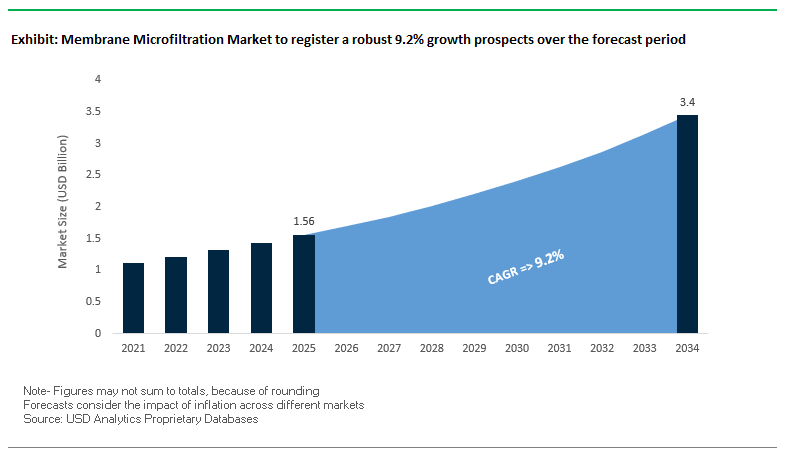
The global Membrane Microfiltration Market is projected to increase from USD 1.56 billion in 2025 to USD 3.4 billion by 2034, registering a CAGR of 9.2% during the forecast period. Market growth is supported by increasing demand for pharmaceutical sterile filtration, municipal and industrial water purification, food processing and contamination control in high-purity manufacturing. Pharmaceutical and biopharmaceutical manufacturing represents a major demand segment, with microfiltration membranes used in cell culture media preparation, bioburden reduction, buffer filtration and sterile drug manufacturing. Sterilizing-grade filters, commonly rated at 0.2 or 0.22 micrometers, require validated microbial retention, while membrane throughput, product compatibility and integrity testing influence filtration performance and operating costs.
Water and wastewater treatment represents a substantial application base, with microfiltration systems used for suspended-solids removal, turbidity reduction and microbial control in municipal and industrial processes. Microfiltration also supports membrane bioreactors and pretreatment for reverse osmosis systems, particularly where consistent feedwater quality influences downstream equipment performance. Food and beverage applications include dairy processing, brewing, winemaking and beverage clarification, where ceramic and polymeric membranes enable particle separation, bacterial reduction and product stabilization. Commercial demand is influenced by filtration capacity, membrane replacement, cleaning requirements and processing efficiency across these industries.
Membrane material selection and lifecycle filtration costs remain important competitive factors. Polymeric membranes, including polyethersulfone (PES), polyvinylidene fluoride (PVDF), polytetrafluoroethylene (PTFE) and cellulose-based materials, serve pharmaceutical, laboratory and water treatment applications. Ceramic and metallic membranes address specialized industrial requirements involving chemical resistance, elevated temperatures and repeated cleaning. Regionally, North America and Europe maintain established demand from pharmaceutical manufacturing, food processing and regulated water treatment, while Asia Pacific contributes through biopharmaceutical production, municipal infrastructure and industrial expansion across China, India, Japan and South Korea. Competition includes membrane manufacturers, sterile filtration specialists, industrial filtration suppliers and integrated water treatment providers.
Key Insights: Membrane Microfiltration Market
Polymeric Membranes Lead Material Demand: Polymeric membranes account for approximately 75% of the market in 2025, supported by widespread use in pharmaceutical sterile filtration, laboratory processing and water treatment. Ceramic membranes represent 20%, while metallic membranes contribute 5%, reflecting specialized industrial filtration applications requiring greater chemical, thermal or mechanical resistance.
Hollow Fiber and Pleated Cartridges Dominate Module Configurations: Hollow-fiber modules account for 30% of the market in 2025, followed by pleated filter cartridges at 25% and spiral-wound modules at 15%. Syringe filters represent 10%, plate-and-frame modules 8%, tubular configurations 7%, and depth-filter formats 5%.
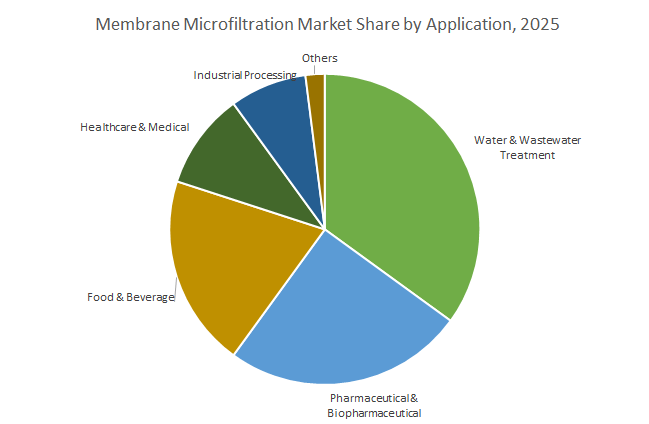
Water and Wastewater Treatment Represents the Largest Application: Water and wastewater treatment accounts for 35% of market demand in 2025, supported by municipal purification, industrial water processing and wastewater reuse. Microfiltration supports suspended-solids removal, microbial reduction and pretreatment for more selective downstream membrane processes.
Pharmaceutical and Food Processing Applications Support High-Value Filtration Demand: Pharmaceutical and biopharmaceutical applications account for 25% of the market, followed by food and beverage processing at 20%. Healthcare and medical applications contribute 10%, industrial processing 8%, and other applications, including laboratory and electronics uses, represent 2%.
Membrane Throughput and Validation Influence Filtration Economics: Filtration capacity, membrane fouling, product adsorption, disposable filter consumption, cleaning requirements and integrity testing affect operating costs across pharmaceutical and industrial applications. Sterilizing-grade membrane products are distinguished by validated bacterial retention and process compatibility, while reusable industrial systems are evaluated through cleaning durability and lifecycle filtration performance.
Specialized Membrane Materials Expand Application Coverage: Surface-modified PES membranes, ceramic crossflow filters and regenerable metallic membranes are extending the range of available filtration technologies. Recent product developments emphasize low-binding sterile filtration, microbial retention, improved membrane wettability and greater compatibility with demanding processing environments.
Recent Developments in Membrane Microfiltration Technologies, Sterile Filtration and Industrial Processing
Recent developments in the membrane microfiltration market reflect continued product innovation in pharmaceutical sterile filtration, high-throughput membrane materials and specialized industrial filtration. In July 2026, Alioth Biotechnology introduced its Alipore EZ sterilizing-grade filter incorporating proprietary asymmetric membrane technology for biopharmaceutical processing. The company reported improvements in filtration capacity, wettability and operating convenience, including product testing involving repeated steam-in-place cycles. The Alioth Alipore EZ product launch reflects ongoing development of application-specific membrane filters for biological manufacturing processes where microbial retention, filtration throughput and system integrity influence product qualification.
Sartorius expanded its sterilizing-grade filtration portfolio during 2025 with Sartopore Evo, a surface-modified polyethersulfone membrane filter developed for final formulation and filling applications. The product combines a 0.8 µm prefiltration layer with a 0.2 µm final membrane and is manufactured without the intentional use of per- and polyfluoroalkyl substances (PFAS). The membrane design emphasizes low protein and excipient adsorption, including compatibility with formulations containing polysorbates. The Sartopore Evo sterile filtration technology illustrates growing material differentiation in pharmaceutical microfiltration, particularly around formulation compatibility, filter capacity and fluoropolymer alternatives.
Food and beverage filtration also saw product portfolio expansion. In June 2025, Porvair Filtration Group introduced its Biofil 1 polyethersulfone membrane cartridge for beverage and food-processing applications. The new filter incorporates a hydrophilic PES membrane designed for microbial retention, rapid wettability and compatibility with applicable food-contact requirements. According to the Porvair Biofil 1 product announcement, the cartridge extends the company's membrane filtration portfolio for liquid food processing and beverage production, where microbial stability and consistent filtration performance are important product-quality parameters.
Industrial microfiltration technology also expanded into regenerable metallic filtration media. In June 2025, GKN Powder Metallurgy introduced Metallic Membrane cartridge filters for chemical, pharmaceutical and food and beverage processing. The filters are available in filtration grades ranging from 3 µm to 0.1 µm, incorporating metallic membrane material on the inner surface of the cartridge. The design reflects increasing availability of fine-filtration components intended for repeated cleaning and reuse, particularly where process conditions place greater mechanical and thermal demands on filtration equipment.
Regulatory Framework and E-E-A-T: Pharmaceutical Sterile Filtration, Drinking Water Treatment and Membrane Validation Standards
Regulatory requirements influencing membrane microfiltration vary according to application, microbial risk, product-contact materials and intended filtration performance. In pharmaceutical manufacturing, the European Commission's EudraLex Volume 4, Annex 1 — Manufacture of Sterile Medicinal Products establishes GMP expectations for contamination control, sterilizing filtration, filter integrity and aseptic processing. The revised annex became fully applicable on August 25, 2024. Sterilizing-grade filtration involves validated microorganism retention and applicable pre-use and post-use integrity testing, rather than reliance solely on a nominal membrane pore-size designation.
In the United States, the Food and Drug Administration's Sterile Drug Products Produced by Aseptic Processing — CGMP Guidance addresses filter selection, microbial retention validation, filter compatibility and aseptic manufacturing controls. Sterilizing-grade membrane filtration is typically associated with 0.2 or 0.22 µm filters that have demonstrated appropriate bacterial retention under validated conditions. Conventional microfiltration does not provide universal virus removal, and virus filtration represents a separate, more selective membrane process.
For drinking-water treatment, the U.S. Environmental Protection Agency's Long Term 2 Enhanced Surface Water Treatment Rule establishes provisions for control of Cryptosporidium and other microbial risks. Membrane filtration treatment credit depends on demonstrated removal performance, challenge testing and membrane integrity verification. Treatment effectiveness cannot be inferred from nominal pore size alone.
Product-contact safety is addressed through standards such as NSF/ANSI/CAN 61 — Drinking Water System Components: Health Effects, which evaluates potential chemical contaminants introduced by materials and components in contact with drinking water. The standard does not independently certify microbial or dissolved-contaminant removal performance. Across wastewater reuse and industrial treatment, microfiltration primarily controls suspended particles and larger microorganisms; dissolved salts, many organic micropollutants and dissolved PFAS generally require complementary treatment technologies.
Emerging Trends and Growth Opportunities in the Membrane Microfiltration Market
Rising Demand for High-Purity Water Treatment Solutions
A major trend in the membrane microfiltration market is the surging demand for high-purity water, particularly in municipal and industrial applications. Regulatory pressure is a key factor, with agencies like the U.S. Environmental Protection Agency (EPA) enforcing strict Surface Water Treatment Rules that mandate the removal of pathogens such as Giardia lamblia and Cryptosporidium. This regulatory landscape positions microfiltration as a critical technology to ensure compliance, public health, and sustainability. Growing urban populations and water scarcity challenges further amplify the role of microfiltration as a frontline defense against microbial contamination in drinking water systems.
Technological Shift Toward Ceramic Membranes
The transition from traditional polymeric membranes to ceramic microfiltration membranes is reshaping the market due to the latter’s superior durability, chemical resistance, and service lifespan. Studies from institutions such as India’s CSIR-Central Glass & Ceramic Research Institute (CGCRI) emphasize the breakthrough performance of alumina-based ceramic membranes with clear water fluxes of 100–200 LMH, proving their viability for industrial water recycling and juice clarification. This advancement highlights a clear trend toward more resilient, sustainable, and cost-effective solutions for industries facing aggressive operational environments.
Expansion of Microfiltration in Food and Beverage Processing
The food and beverage sector is increasingly adopting microfiltration for “cold sterilization” and product clarification to enhance shelf life while retaining flavor, aroma, and nutritional integrity. Case studies, such as one featured in the Journal of Food Engineering on large-scale breweries, demonstrate that microfiltration effectively removes haze-forming particulates and microorganisms without altering sensory properties. This adoption underscores a broader industry shift toward non-thermal processing methods that align with the clean-label movement and consumer preference for minimally processed products.
Critical Role of Microfiltration in Biopharmaceutical Manufacturing
Biopharmaceutical applications represent one of the most vital areas of microfiltration adoption, where the technology supports sterile filtration, virus removal, and cell harvesting. A notable case study from a leading filtration company revealed how microfiltration membranes optimized fermentation broth clarification, reducing both costs and processing time compared to centrifugation. These membranes ensured high product purity and recovery rates, making them indispensable in maintaining compliance with stringent regulatory frameworks for drug safety and efficacy.
Opportunities for Market Expansion Across High-Value Applications
The evolving landscape of membrane microfiltration presents significant opportunities in high-value markets such as advanced pharmaceuticals, biotechnology, and industrial wastewater treatment. Increasing regulatory mandates, consumer demand for safe and natural products, and technological innovations in membrane design are accelerating adoption. Companies investing in ceramic and application-specific membrane systems stand to benefit the most, particularly in industries requiring high reliability under harsh operational conditions.
Market Share Analysis of Membrane Microfiltration
Market Share by Material Composition
Polymeric membranes are projected to dominate the market with around 75% share by 2025, primarily due to their cost-effectiveness, broad chemical compatibility, and disposability—attributes highly valued in pharmaceutical and food safety applications. Ceramic membranes, accounting for approximately 20%, are the fastest-growing segment, driven by their superior chemical and thermal resistance, longer operational lifespans, and ability to withstand CIP/SIP cleaning regimes. Metallic membranes, while limited to niche applications with extreme temperature and mechanical demands, maintain strategic importance in sectors like metallurgy and hot gas filtration, holding a small yet essential 5% share.
Market Share by Module Design Preferences
Module design preferences strongly influence market dynamics, with hollow fiber modules holding the largest projected share at 30% due to their high packing density and dominance in membrane bioreactors for municipal wastewater treatment. Pleated filter cartridges, with a 25% share, represent a core segment for sterile filtration in pharma and food industries, driven by their disposability and reliability. Spiral-wound modules hold 15% and are preferred in large-scale water treatment pre-filtration. Niche but critical modules such as syringe filters (10%) dominate laboratory and R&D environments, while plate & frame (8%) and tubular designs (7%) thrive in high-solid and fouling-prone streams like dairy or pigments. Depth filters, though smaller at 5%, remain essential as protective pre-filters.
Market Share by Application Areas
Water and wastewater treatment is projected to remain the largest application segment with a 35% share by 2025, propelled by rising water reuse initiatives, population growth, and regulatory enforcement of water safety standards. Pharmaceuticals and biopharmaceuticals follow with a 25% share, representing the highest value segment where sterility, compliance, and patient safety outweigh cost considerations. Food and beverage applications account for 20%, benefiting from non-thermal sterilization and consumer-driven clean-label preferences. Healthcare and medical uses secure 10%, leveraging microfiltration for device sterilization, diagnostics, and dialysis. Industrial processing represents 8%, applying microfiltration in chemical, catalytic, and finishing operations. The remaining 2% includes specialized niches such as laboratories and electronics, where precision and reliability are critical.
China: Regulatory Compliance and Industrial Expansion Driving Microfiltration Adoption
China’s membrane microfiltration market is strongly influenced by stringent regulatory frameworks, technological advancements, and rapid industrial expansion. The Ministry of Ecology and Environment (MEE) mandates that all industrial entities discharging atmospheric and water pollutants obtain emission permits, pushing companies to adopt advanced microfiltration membranes to ensure compliance. In 2024, researchers developed hollow-fiber ultrafiltration (UF) membranes with enhanced antifouling properties, improving the long-term efficiency and reducing maintenance costs of membrane bioreactors (MBRs), where microfiltration plays a key role. China’s expanding municipal and industrial wastewater treatment sectors, including applications in radioactive and heavy metal wastewater treatment, are significant drivers for microfiltration membrane demand. Furthermore, government investments under the 14th Five-Year Plan (2021-2025) to expand natural gas production are increasing the adoption of microfiltration technologies in the oil and gas sector, positioning China as a critical market for advanced membrane solutions.
United States: Government Funding and Private Sector Innovation Driving Market Growth
The United States membrane microfiltration market is driven by substantial government funding, academic research, and corporate initiatives addressing emerging contaminants. The Infrastructure Investment and Jobs Act of 2021 allocates over $50 billion to the EPA to improve drinking water, wastewater, and stormwater infrastructure, with dedicated funding for contaminants such as PFAS, which require advanced microfiltration technologies. Research centers funded by the National Science Foundation (NSF) focus on developing next-generation membranes for water purification, chemical separations, and biopharmaceutical applications, providing continuous innovation in the microfiltration space. Private companies, including Veolia Water Technologies, have deployed microfiltration as a pretreatment step in treatment systems supplying water with regulated PFAS levels below threshold standards to over 140,000 Americans. This collaboration between government, academia, and industry underscores the U.S. as a leading market for microfiltration technology.
India: Government Initiatives and Infrastructure Investments Fueling Market Expansion
India’s microfiltration market is bolstered by government initiatives, strategic infrastructure investments, and industrial adoption. The Jal Jeevan Mission, alongside the Department of Science & Technology’s Water Technology Initiative, promotes R&D in filtration technologies to provide safe and affordable drinking water in rural regions. The Ghaziabad Nagar Nigam, issuing India’s first Certified Green Municipal Bond of ₹150 crore, has funded a state-of-the-art Tertiary Sewage Treatment Plant (TSTP) utilizing advanced microfiltration for industrial wastewater reuse, reducing reliance on freshwater sources. Additionally, VA TECH WABAG’s seven-year O&M contract for the 110 MLD SWRO Nemmeli Desalination Plant in Chennai, valued at approximately INR 415 crores, highlights the growing adoption of microfiltration in large-scale industrial and municipal water treatment projects. These initiatives demonstrate India’s strategic commitment to expanding microfiltration applications across multiple sectors.
Germany: Industrial Applications and Ceramic Membrane Innovations Leading Adoption
Germany is a global leader in membrane microfiltration, particularly in industrial wastewater treatment and ceramic membrane innovations. PWT Wassertechnik specializes in a range of microfiltration processes for industrial water reuse, ensuring compliance with European environmental regulations. German companies like CERAFILTEC are pioneering ceramic membrane bioreactors (MBRs) through strategic partnerships, representing a transformative approach to long-lasting and robust microfiltration systems. MANN+HUMMEL, a multinational German firm, focuses on developing innovative membrane and digital solutions for industrial water treatment and green energy applications, reinforcing Germany’s position as a technology hub for microfiltration solutions across industrial and municipal sectors.
Japan: Academic Research and Global Technology Leadership Enhancing Market Position
Japan’s membrane microfiltration market is driven by cutting-edge academic research and corporate technology leadership. Kobe University’s Membrane Engineering Group, in a 2024 study, highlighted the development of novel functional membranes, including biomimetic and highly porous microfiltration membranes for water and atmospheric applications. Toray Industries, a global leader, continues to develop high-performance RO membranes for large-scale desalination plants, such as projects in Saudi Arabia, where microfiltration is often used as a critical pretreatment step. Japan’s strong focus on research and export of advanced membrane technologies positions it as a key contributor to global microfiltration adoption.
Australia: Water Recycling Initiatives and Research Driving Sustainable Adoption
Australia faces significant water scarcity, making it a leading market for membrane microfiltration in water recycling and reuse initiatives. The Sydney Water Wollongong Water Resource Recovery Facility utilizes a combination of microfiltration and reverse osmosis to treat wastewater for non-potable applications, including sports field irrigation. Academic research at the Institute for Sustainable Industries and Liveable Cities (ISILC), Victoria University, focuses on increasing water recovery from desalination processes and mitigating membrane fouling and scaling, two critical challenges in sustainable water treatment. These initiatives highlight Australia’s strategic adoption of microfiltration technologies to improve water resilience and efficiency.
Competitive Landscape: Global Membrane Microfiltration Market
The global Membrane Microfiltration Market competitive landscape includes pharmaceutical sterile filtration specialists, polymeric membrane manufacturers, industrial filtration companies and water technology providers. Merck KGaA, through its Life Science business and Millipore filtration portfolio, supplies membrane filters, Millex syringe filters and Millipore Express products for laboratory, pharmaceutical and bioprocess applications. Danaher Corporation, through Pall, participates in sterilizing-grade filtration, bioburden reduction and membrane-based pharmaceutical processing, including Supor and Fluorodyne technologies. Sartorius AG competes through Sartopore, Sartobran and Sartopore Evo membrane filters, with product differentiation centered on bacterial retention, filtration capacity and formulation compatibility.
Specialized filtration suppliers maintain positions in pharmaceutical, biotechnology and industrial process applications. Meissner Corporation provides sterilizing-grade membrane filters, including SteriLUX PVDF, STyLUX and EverLUX products, alongside capsule filters and single-use filtration assemblies. 3M Company participates through LifeASSURE membrane cartridge filtration technologies for pharmaceutical liquids, industrial processing and high-purity applications. Porvair Filtration Group supplies Biofil PES membrane filters, Fluorofil PTFE filtration products and other liquid and gas filtration technologies for food processing, pharmaceuticals and industrial operations.
Water-treatment membrane companies compete through equipment scale, filtration performance and membrane-system integration. Veolia supplies Memtrex pleated microfiltration membranes and sanitary membrane systems for water treatment, food processing and industrial separation. DuPont de Nemours, Inc. participates through MemCor hollow-fiber membrane filtration technologies used in municipal and industrial water purification. Asahi Kasei Corporation supplies Microza microfiltration and ultrafiltration hollow-fiber membranes for municipal water treatment, industrial processing and high-purity manufacturing applications.
Membrane suppliers serving food processing, industrial separation and analytical applications contribute additional competition. Pentair plc, through X-Flow, supplies R100 and R30 hollow-fiber microfiltration elements for beverage clarification, dairy processing and microbial reduction. Toray Industries, Inc. participates through polymeric membrane filtration technology, including PVDF hollow-fiber products for water purification and industrial separation. GVS S.p.A. provides PES, mixed-cellulose-ester and other microfiltration membrane materials for laboratory testing, pharmaceutical processing, microbial analysis and industrial filtration applications.
Competition across specialized materials includes ceramic, metallic and emerging pharmaceutical membrane technologies. CERAFILTEC participates through ceramic membrane filtration systems for municipal and industrial water treatment, where chemical resistance, mechanical durability and membrane regeneration influence application suitability. GKN Powder Metallurgy supplies regenerable metallic membrane cartridge filters for fine filtration in chemical and industrial processing. Alioth Biotechnology participates through sterilizing-grade membrane filtration technologies for biopharmaceutical production, including its Alipore product portfolio. Competitive differentiation across these suppliers reflects membrane material properties, product qualification, filter format, treatment throughput and compatibility with application-specific operating conditions.
Porter’s Five Forces, SWOT Profile, Market Share, Scenario Forecasts, Market Ecosystem, Company Ranking, Market Dynamics, Industry Benchmarking
Companies
Veolia, DuPont de Nemours, Inc., SUEZ, Toray Industries, Inc., Pentair plc, Xylem Inc., Asahi Kasei Corporation, Koch Industries, Kubota Corporation, The Dow Chemical Company, MANN+HUMMEL, Evoqua Water Technologies, LG Chem, W. L. Gore & Associates, Inc., Merck KGaA
Countries
US, Canada, Mexico, Germany, France, Spain, Italy, UK, Russia, China, India, Japan, South Korea, Australia, South East Asia, Brazil, Argentina, Middle East, Africa
Membrane Microfiltration Market Segmentation
By Material
Polymeric Membranes
Ceramic Membranes
Metallic Membranes
By Module Design
Cross-flow Modules
Hollow Fiber
Spiral Wound
Tubular & Multi-tubular
Plate & Frame
Direct Flow Modules
Pleated Filter Cartridges
Syringe Filters
Depth Filters
By Application
Water & Wastewater Treatment
Food & Beverage
Pharmaceutical & Biopharmaceutical
Industrial Processing
Healthcare & Medical
Others
Countries Analyzed
North America (US, Canada, Mexico)
Europe (Germany, UK, France, Spain, Italy, Russia, Rest of Europe)
Asia Pacific (China, India, Japan, South Korea, Australia, South East Asia, Rest of Asia)
South America (Brazil, Argentina, Rest of South America)
Middle East and Africa (Saudi Arabia, UAE, Rest of Middle East, South Africa, Egypt, Rest of Africa)
Leading Companies in the Membrane Microfiltration Market
Merck KGaA (MilliporeSigma / Millipore)
Danaher Corporation (Pall)
Sartorius AG
Meissner Corporation
3M Company
Porvair Filtration Group
Veolia
DuPont de Nemours, Inc.
Asahi Kasei Corporation
Pentair plc
Toray Industries, Inc.
GVS S.p.A.
CERAFILTEC
GKN Powder Metallurgy
Alioth Biotechnology
*- List not Exhaustive
Research Coverage
This report investigates the membrane microfiltration market, delivering analysis reviews on how water scarcity, biopharma scale-up, and food safety mandates are accelerating adoption across utilities and process industries. It highlights breakthroughs in ceramic and advanced polymeric media, long-life modules that withstand aggressive CIP/SIP, and pre-treatment designs that stabilize downstream RO and desalination performance. The study further highlights regulatory pressure on pathogen and PFAS control, rising sterile operations in pharmaceuticals and ADC manufacturing, and non-thermal “cold sterilization” for beverages. With granular views on module preferences (hollow fiber, pleated cartridges, spiral-wound, tubular, plate & frame), operating economics, and hygiene validation, this report is an essential resource for engineers, product managers, and investors planning compliant, high-uptime filtration assets. Developed by USDAnalytics, it translates membrane performance and lifecycle metrics into procurement-ready insights for decision-makers. Scope Includes-
Segmentation: By Material (Polymeric, Ceramic, Metallic), By Module Design (Cross-flow: Hollow Fiber, Spiral Wound, Tubular & Multi-tubular, Plate & Frame; Direct Flow: Pleated Filter Cartridges, Syringe Filters, Depth Filters), By Application (Water & Wastewater Treatment; Food & Beverage; Pharmaceutical & Biopharmaceutical; Industrial Processing; Healthcare & Medical; Others)
Geographic Scope: Analysis spans 25+ countries across North America, Europe, Asia Pacific, Latin America, the Middle East & Africa.
Time Frame: Historic data 2021–2024; forecasts 2025–2034.
Companies: Profiles of 15+ companies
Methodology
USDAnalytics evaluates the global Membrane Microfiltration Market through an integrated top-down and bottom-up market-sizing approach covering polymeric, ceramic and metallic membrane materials; hollow-fiber, pleated cartridge, spiral-wound, tubular, plate-and-frame and laboratory filtration formats; and applications across water and wastewater treatment, pharmaceuticals, food and beverage, healthcare and industrial processing. The research framework combines primary industry interviews involving water utilities, original equipment manufacturers, engineering contractors, membrane suppliers and quality-assurance specialists with secondary analysis of corporate disclosures, regulatory publications, technical studies and filtration product information.
Market estimates are triangulated using membrane equipment demand, industrial filtration capacity, module and cartridge consumption, replacement cycles, pharmaceutical processing activity and municipal water treatment infrastructure. Technical and commercial assessments incorporate membrane flux, fouling characteristics, cleaning requirements, filter integrity, product compatibility, consumable costs and lifecycle filtration economics. The 2025–2034 forecast reflects water treatment demand, biopharmaceutical manufacturing activity, food processing requirements, material technology developments and regional regulatory conditions, with competitive benchmarking covering supplier portfolios, membrane technologies, application coverage and product performance.
Deliverables:
Comprehensive Market Research Report (PDF and Excel) with detailed tables, charts, and interactive visualizations.
Country-Specific Forecasts & Analysis.
Segment-Wise Revenue Forecasts (2026–2034).
Competitive Analysis, Benchmarking, and SWOT Profiles.
Recent Developments & Innovation Tracker.
Executive Summary & Analyst Commentary.
Post-Purchase Analyst Support for Client-Specific Questions and Custom Data Requirements.
Table of Contents: Membrane Microfiltration Market
1. Executive Summary
1.1. Market Highlights
1.2. Key Insights for Stakeholders
1.3. Global Market Snapshot
2. Membrane Microfiltration Market Outlook (2025–2034)
2.1. Introduction: Growth Drivers and Industry Transformation
2.2. Market Valuation and Growth Projections (2025–2034)
Demand is fueled by stricter water-quality rules in APAC/EU, microbial safety requirements for municipal systems, and pre-treatment needs for RO/desalination under rising water stress. In parallel, biopharma growth—including sterile steps for expanding ADC pipelines—elevates high-purity filtration. Food and beverage processors adopt cold sterilization to extend shelf life without heat or preservatives.
Ceramic modules deliver higher chemical/thermal robustness, tolerate aggressive CIP/SIP, and sustain stable flux driving longer service life and fewer changeouts. While capex is higher, opex savings accrue from lower fouling rates, wider pH/temperature windows, and reduced unplanned downtime. Polymeric remains attractive where disposability, sterility, and cost are priorities (e.g., pharma cartridges).
Utilities and large industrial plants favor hollow fiber (packing density for MBRs) and spiral-wound in high-flow pre-filtration. Pleated cartridges dominate pharma/biopharma sterile filtration due to disposability, validation ease, and integrity testing. Tubular and plate & frame excel in high-solids, fouling-prone streams (e.g., dairy, pigments), while syringe filters lead lab/R&D workflows.
ROI peaks when microfiltration is used as frontline pre-treatment to stabilize RO reducing chemical dosing, cleaning frequency, and energy from pressure spikes. In municipalities, meeting pathogen targets (e.g., Giardia/Cryptosporidium removal) and lowering turbidity cuts regulatory risk. For PFAS management, microfiltration improves upstream water quality and protects downstream PFAS-targeted steps.
Scale-up in biologics and ADCs increases demand for sterile, low-extractables cartridges with validated bacterial retention and robust integrity tests (bubble point, diffusion). Facilities prioritize materials compatible with solvents and buffers, low protein binding, and consistent batch-to-batch recovery. Single-use flowsheets and GMP expectations push suppliers to deliver tighter QC and documentation.