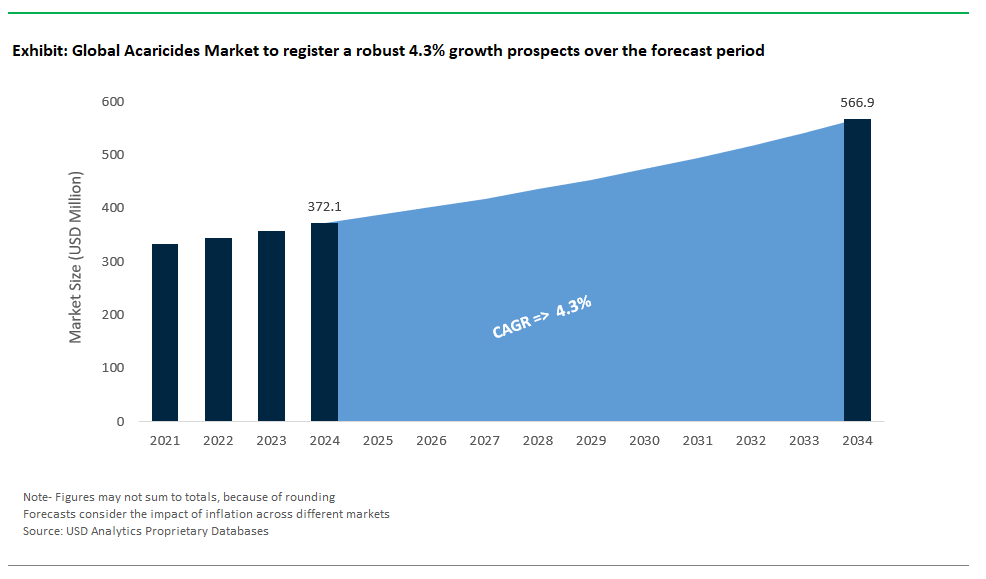
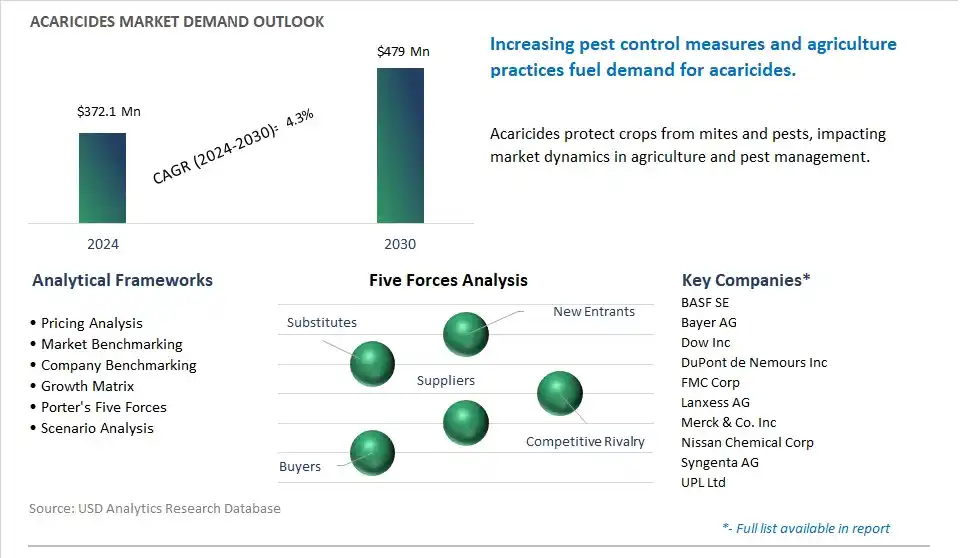
Global Acaricides is forecast to reach $567 Million in 2034 from $372.1 Million in 2024, registering a CAGR of 4.3%.
The global Acaricides Market Study analyzes and forecasts the market size across 6 regions and 24 countries for diverse segments -By Chemical (Organophosphates, Carbamates, Organochlorines, Pyrethrins, Pyrethroids, Others), By Application (Spray, Dipping, Hand Dressing, Others).
An Introduction to Global Acaricides Market in 2025
The acaricides market is experiencing growth driven by the increasing prevalence of ectoparasitic infestations in livestock, companion animals, and agricultural crops, as well as the growing demand for effective pest control solutions in public health and vector management programs. Key trends shaping the future of the industry include innovations in acaricide formulations, delivery systems, and integrated pest management (IPM) strategies to enhance efficacy, safety, and sustainability. Advanced acaricides offer targeted control of ticks, mites, and other arthropod pests while minimizing risks to non-target organisms, beneficial insects, and the environment. Moreover, the emergence of acaricide-resistant pest populations and regulatory restrictions on conventional chemical pesticides drive market demand for novel active ingredients, biopesticides, and alternative control methods such as biological control agents and host plant resistance. Additionally, the integration of acaricides into innovative application technologies such as slow-release formulations, microencapsulation, and controlled-release devices improves treatment efficacy, duration, and residual activity, reducing the need for frequent reapplications and minimizing environmental impact. As stakeholders collaborate to address emerging challenges in acaricide resistance, environmental stewardship, and public health, the acaricides market is poised for continued growth and innovation as a critical component of integrated pest management strategies worldwide.
Acaricides Market Competitive Landscape
The market report analyses the leading companies in the industry including BASF SE, Bayer AG, Dow Inc, DuPont de Nemours Inc, FMC Corp, Lanxess AG, Merck & Co. Inc, Nissan Chemical Corp, Syngenta AG, UPL Ltd.
Acaricides Market Dynamics
Acaricides Market Trend: Growing Demand for Integrated Pest Management Solutions
A prominent trend in the acaricides market is the growing demand for integrated pest management (IPM) solutions. As concerns over pesticide resistance, environmental sustainability, and food safety continue to rise, there is an increasing emphasis on adopting holistic approaches to pest control that minimize reliance on chemical pesticides. Acaricides, which are chemicals specifically designed to target and control mites and ticks, play a vital role in IPM strategies by providing effective pest management while reducing the overall environmental impact. This trend reflects a broader shift towards sustainable agriculture practices and the adoption of integrated pest management techniques to achieve long-term pest control solutions.
Acaricides Market Driver: Expansion of Agriculture and Horticulture Industries
A key driver for the acaricides market is the expansion of agriculture and horticulture industries. Mites and ticks are significant pests in agricultural crops, ornamental plants, and livestock, causing economic losses through damage to crops, transmission of diseases, and reduction in yield and quality. With increasing global population growth and food demand, there is a growing need for effective pest control measures to protect crops and ensure food security. Acaricides offer farmers and growers a valuable tool for managing mite and tick infestations and safeguarding crop production. The expansion of agriculture and horticulture industries, driven by population growth, urbanization, and changing dietary habits, fuels the demand for acaricides as essential inputs in pest management programs.
Acaricides Market Opportunity: Development of Environmentally Friendly and Target-Specific Formulations
An opportunity within the acaricides market lies in the development of environmentally friendly and target-specific formulations. While conventional acaricides have been effective in controlling mites and ticks, there is increasing demand for products that are less harmful to beneficial organisms, wildlife, and the environment. Manufacturers can capitalize on this opportunity by investing in research and development to create novel acaricide formulations that are biodegradable, have minimal impact on non-target organisms, and exhibit target-specificity towards mites and ticks. Additionally, there is potential to explore alternative modes of action, such as biological control agents or botanical extracts, that offer effective pest control with reduced environmental risks. By developing environmentally friendly and target-specific acaricides, manufacturers can meet the evolving needs of growers, regulators, and consumers, and position themselves as leaders in sustainable pest management solutions.
Acaricides Market Share Analysis: Pyrethroids segment generated the highest revenue in the industry
Pyrethroids constitute the largest segment in the acaricides market due to diverse compelling reasons. The pyrethroids are widely recognized for their broad-spectrum activity against a diverse range of pests, including acarids, making them highly effective in pest control applications. Their potency against various species of mites, ticks, and other arachnids makes them a preferred choice for agricultural, veterinary, and public health pest management programs. Secondly, pyrethroids exhibit relatively low mammalian toxicity compared to some other chemical classes like organophosphates and carbamates, enhancing their safety profile for use around humans and animals. Thirdly, pyrethroids are characterized by their fast knockdown effect and residual activity, providing prolonged protection against acarid infestations and ensuring sustained control over time. In addition, the versatility of pyrethroids allows for their formulation into various product types such as sprays, dusts, and dips, catering to diverse application needs across different sectors. Over the forecast period, the superior efficacy, safety, and versatility of pyrethroids contribute to their dominance as the largest segment in the acaricides market.
Acaricides Market Share Analysis: Spray Segment is poised to register the fastest growth rate (CAGR) over the forecast period from 2025 to 2034.
The spray segment is witnessing the fastest growth in the acaricides market, driven by diverse key factors. The the spray application method offers convenience and ease of use, making it a preferred choice for both agricultural and non-agricultural applications. Farmers, pest control professionals, and homeowners find spray formulations practical and efficient for treating large areas or specific target sites with acaricides. Secondly, advancements in formulation technologies have led to the development of innovative spray formulations with enhanced efficacy, prolonged residual activity, and reduced environmental impact. These developments have further fueled the adoption of spray-based acaricides across various sectors. Thirdly, the increasing demand for integrated pest management (IPM) practices, which prioritize environmentally sustainable and ecologically sound pest control methods, has contributed to the growth of spray applications. Spray-based acaricides can be easily integrated into IPM programs, allowing for targeted pest control while minimizing adverse effects on non-target organisms and the environment. Additionally, the versatility of spray applications enables their use in diverse settings, including agriculture, public health, veterinary, and residential pest control, further driving market growth. Over the forecast period, the spray segment is poised for continued expansion in the acaricides market due to its convenience, effectiveness, and compatibility with evolving pest management practices.
Acaricides Market Report Scope
|
Parameter
|
Details
|
|
Market Size (2024)
|
$372.1 Million
|
|
Market Size (2034)
|
$567 Million
|
|
Market Growth Rate
|
4.3%
|
|
Segments
|
By Chemical (Organophosphates, Carbamates, Organochlorines, Pyrethrins, Pyrethroids, Others), By Application (Spray, Dipping, Hand Dressing, Others)
|
|
Study Period
|
2019- 2024 and 2025-2034
|
|
Units
|
Revenue (USD)
|
|
Qualitative Analysis
|
Porter’s Five Forces, SWOT Profile, Market Share, Scenario Forecasts, Market Ecosystem, Company Ranking, Market Dynamics, Industry Benchmarking
|
|
Companies
|
BASF SE, Bayer AG, Dow Inc, DuPont de Nemours Inc, FMC Corp, Lanxess AG, Merck & Co. Inc, Nissan Chemical Corp, Syngenta AG, UPL Ltd, and Others.
|
|
Countries
|
US, Canada, Mexico, Germany, France, Spain, Italy, UK, Russia, China, India, Japan, South Korea, Australia, South East Asia, Brazil, Argentina, Middle East, Africa
|
Acaricides Market Segmentation
By Chemical
Organophosphates
Carbamates
Organochlorines
Pyrethrins
Pyrethroids
Others
By Application
Spray
Dipping
Hand Dressing
Others
Geographical Analysis
North America (US, Canada, Mexico)
Europe (Germany, UK, France, Spain, Italy, Russia, Rest of Europe)
Asia Pacific (China, India, Japan, South Korea, Australia, South East Asia, Rest of Asia)
South America (Brazil, Argentina, Rest of South America)
Middle East and Africa (Saudi Arabia, UAE, Rest of Middle East, South Africa, Egypt, Rest of Africa)
Acaricides Companies Profiled in the Market Study
BASF SE
Bayer AG
Dow Inc
DuPont de Nemours Inc
FMC Corp
Lanxess AG
Merck & Co. Inc
Nissan Chemical Corp
Syngenta AG
UPL Ltd
*- List Not Exhaustive
TABLE OF CONTENTS
1 Introduction to 2024 Acaricides Market
1.1 Market Overview
1.2 Quick Facts
1.3 Scope/Objective of the Study
1.4 Market Definition
1.5 Countries and Regions Covered
1.6 Units, Currency, and Conversions
1.7 Industry Value Chain
2 Research Methodology
2.1 Market Size Estimation
2.2 Sources and Research Methodology
2.3 Data Triangulation
2.4 Assumptions and Limitations
3 Executive Summary
3.1 Global Acaricides Market Size Outlook, $ Million, 2021 to 2030
3.2 Acaricides Market Outlook by Type, $ Million, 2021 to 2030
3.3 Acaricides Market Outlook by Product, $ Million, 2021 to 2030
3.4 Acaricides Market Outlook by Application, $ Million, 2021 to 2030
3.5 Acaricides Market Outlook by Key Countries, $ Million, 2021 to 2030
4 Market Dynamics
4.1 Key Driving Forces of Acaricides Industry
4.2 Key Market Trends in Acaricides Industry
4.3 Potential Opportunities in Acaricides Industry
4.4 Key Challenges in Acaricides Industry
5 Market Factor Analysis
5.1 Value Chain Analysis
5.2 Competitive Landscape
5.2.1 Global Acaricides Market Share by Company (%), 2023
5.2.2 Product Offerings by Company
5.3 Porter’s Five Forces Analysis
5.4 Pricing Analysis and Outlook
6 Growth Outlook Across Scenarios
6.1 Growth Analysis-Case Scenario Definitions
6.2 Low Growth Scenario Forecasts
6.3 Reference Growth Scenario Forecasts
6.4 High Growth Scenario Forecasts
7 Global Acaricides Market Outlook by Segments
7.1 Acaricides Market Outlook by Segments, $ Million, 2021- 2030
By Chemical
Organophosphates
Carbamates
Organochlorines
Pyrethrins
Pyrethroids
Others
By Application
Spray
Dipping
Hand Dressing
Others
8 North America Acaricides Market Analysis and Outlook To 2030
8.1 Introduction to North America Acaricides Markets in 2024
8.2 North America Acaricides Market Size Outlook by Country, 2021-2030
8.2.1 United States
8.2.2 Canada
8.2.3 Mexico
8.3 North America Acaricides Market size Outlook by Segments, 2021-2030
By Chemical
Organophosphates
Carbamates
Organochlorines
Pyrethrins
Pyrethroids
Others
By Application
Spray
Dipping
Hand Dressing
Others
9 Europe Acaricides Market Analysis and Outlook To 2030
9.1 Introduction to Europe Acaricides Markets in 2024
9.2 Europe Acaricides Market Size Outlook by Country, 2021-2030
9.2.1 Germany
9.2.2 France
9.2.3 Spain
9.2.4 United Kingdom
9.2.4 Italy
9.2.5 Russia
9.2.6 Norway
9.2.7 Rest of Europe
9.3 Europe Acaricides Market Size Outlook by Segments, 2021-2030
By Chemical
Organophosphates
Carbamates
Organochlorines
Pyrethrins
Pyrethroids
Others
By Application
Spray
Dipping
Hand Dressing
Others
10 Asia Pacific Acaricides Market Analysis and Outlook To 2030
10.1 Introduction to Asia Pacific Acaricides Markets in 2024
10.2 Asia Pacific Acaricides Market Size Outlook by Country, 2021-2030
10.2.1 China
10.2.2 India
10.2.3 Japan
10.2.4 South Korea
10.2.5 Indonesia
10.2.6 Malaysia
10.2.7 Australia
10.2.8 Rest of Asia Pacific
10.3 Asia Pacific Acaricides Market size Outlook by Segments, 2021-2030
By Chemical
Organophosphates
Carbamates
Organochlorines
Pyrethrins
Pyrethroids
Others
By Application
Spray
Dipping
Hand Dressing
Others
11 South America Acaricides Market Analysis and Outlook To 2030
11.1 Introduction to South America Acaricides Markets in 2024
11.2 South America Acaricides Market Size Outlook by Country, 2021-2030
11.2.1 Brazil
11.2.2 Argentina
11.2.3 Rest of South America
11.3 South America Acaricides Market size Outlook by Segments, 2021-2030
By Chemical
Organophosphates
Carbamates
Organochlorines
Pyrethrins
Pyrethroids
Others
By Application
Spray
Dipping
Hand Dressing
Others
12 Middle East and Africa Acaricides Market Analysis and Outlook To 2030
12.1 Introduction to Middle East and Africa Acaricides Markets in 2024
12.2 Middle East and Africa Acaricides Market Size Outlook by Country, 2021-2030
12.2.1 Saudi Arabia
12.2.2 UAE
12.2.3 Oman
12.2.4 Rest of Middle East
12.2.5 Egypt
12.2.6 Nigeria
12.2.7 South Africa
12.2.8 Rest of Africa
12.3 Middle East and Africa Acaricides Market size Outlook by Segments, 2021-2030
By Chemical
Organophosphates
Carbamates
Organochlorines
Pyrethrins
Pyrethroids
Others
By Application
Spray
Dipping
Hand Dressing
Others
13 Company Profiles
13.1 Company Snapshot
13.2 SWOT Profiles
13.3 Products and Services
13.4 Recent Developments
13.5 Financial Profile
BASF SE
Bayer AG
Dow Inc
DuPont de Nemours Inc
FMC Corp
Lanxess AG
Merck & Co. Inc
Nissan Chemical Corp
Syngenta AG
UPL Ltd
14 Appendix
14.1 Customization Offerings
14.2 Subscription Services
14.3 Related Reports
14.4 Publisher Expertise
By Chemical
Organophosphates
Carbamates
Organochlorines
Pyrethrins
Pyrethroids
Others
By Application
Spray
Dipping
Hand Dressing
Others
Countries Analyzed
North America (US, Canada, Mexico)
Europe (Germany, UK, France, Spain, Italy, Russia, Rest of Europe)
Asia Pacific (China, India, Japan, South Korea, Australia, South East Asia, Rest of Asia)
South America (Brazil, Argentina, Rest of South America)
Middle East and Africa (Saudi Arabia, UAE, Rest of Middle East, South Africa, Egypt, Rest of Africa)
