Acrylic Surface Coating Market Size and Growth Fueled by Low-VOC Innovation and Multi-Industry Demand
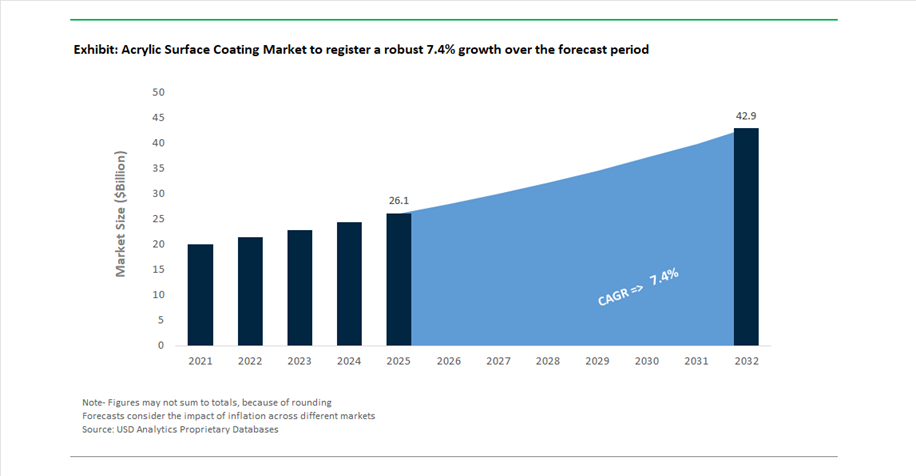
The Acrylic Surface Coating Market is witnessing strong and sustained expansion, valued at USD 26.1 billion in 2025 and projected to reach USD 43 billion by 2032, advancing at a CAGR of 7.4%. The growth is underpinned by the increasing adoption of acrylic-based coatings across construction, automotive, and industrial sectors, driven by their superior balance of fast drying time, weather resistance, UV stability, and formulation versatility.
Acrylic coatings continue to dominate due to their compatibility with water-borne and low-VOC formulations, aligning with tightening environmental regulations across North America, Europe, and Asia-Pacific. As sustainability becomes a core procurement criterion, industries are transitioning away from solvent-heavy coatings toward eco-efficient acrylic technologies that deliver both performance and compliance. In architectural applications, acrylic coatings are widely used for exterior facades, roofing systems, and decorative finishes, offering long-term resistance against moisture, UV radiation, and temperature fluctuations. In the automotive sector, acrylic systems are critical for OEM and refinish applications, providing high gloss retention, color durability, and scratch resistance.
The market is also benefiting from rapid urbanization, infrastructure expansion, and automotive production recovery, particularly in emerging economies. Increasing demand for cool roof technologies, energy-efficient buildings, and high-performance industrial coatings is further accelerating adoption. Additionally, advancements in bio-based acrylic monomers, UV-curable systems, and hybrid coating technologies are reshaping product development pipelines, enabling manufacturers to meet evolving regulatory and performance benchmarks.
The acrylic surface coating market is undergoing a structural shift driven by major mergers, technological innovation, and sustainability-led investments. Innovation remains a central competitive lever, with leading players focusing on high-performance and application-specific acrylic technologies. In November 2025, PPG introduced Envirocron® Extreme Protection Edge Plus, a one-coat powder system leveraging advanced acrylic and polyester chemistry to deliver enhanced edge coverage and abrasion resistance, eliminating additional surface preparation steps. Sherwin-Williams’ acquisition and integration of Suvinil significantly strengthened its footprint in Latin America’s architectural coatings market, particularly in water-based acrylic systems. Similarly, BASF’s 2025–2026 “Driving the Proxy” collection highlights the integration of 2K acrylic technologies to achieve superior aesthetic depth and environmental resistance in automotive coatings, reflecting the convergence of functional performance and visual innovation.
Sustainability-driven advancements are reshaping raw material sourcing and formulation strategies. Arkema’s expansion of bio-attributed acrylic monomer production marks a significant step toward low-carbon coatings, enabling manufacturers to produce bio-based acrylic resins using mass-balance approaches without compromising technical performance. In parallel, Dow’s 2025 launch of a high-performance acrylic binder for cool roof coatings addresses the growing demand for energy-efficient building solutions, offering improved solar reflectivity and long-term dirt resistance.
Regional demand dynamics are further supported by product innovation and capacity expansion in high-growth markets. Kansai Nerolac’s launch of Excel Total Floor Coat targets industrial and commercial flooring applications, combining abrasion resistance with environmental durability to cater to infrastructure growth in South Asia. Meanwhile, Nippon Paint’s April 2026 report of strong recovery in automotive acrylic coatings reflects improving global vehicle production and pricing power for premium acrylic systems.
VOC Regulations and Fluorine Limits Forcing Transition to Waterborne Acrylic Technologies
The acrylic surface coating industry is undergoing a decisive transformation as global environmental regulations impose stricter limits on Volatile Organic Compounds (VOCs) and fluorinated additives. The 2026 updates to EU Ecolabel standards alongside the U.S. EPA National VOC Emission Standards have intensified compliance requirements, effectively accelerating the phase-out of solvent-borne acrylic coatings across multiple application sectors. With the EPA’s finalized amendments for aerosol coatings set to take effect by January 17, 2027, manufacturers are facing a substantial increase in reformulation complexity, with R&D expenditures projected to rise by 15% to 20% as companies transition toward ultra-low VOC and waterborne acrylic systems.
Simultaneously, emerging European chemical frameworks targeting a 50 ppm threshold for total fluorine content are eliminating the use of traditional fluorinated acrylic surfactants commonly employed for flow and leveling. This dual regulatory pressure is reshaping formulation chemistry, forcing innovation in alternative additives that maintain surface performance without compromising environmental compliance. As a result, waterborne acrylic coatings have achieved significant market penetration, particularly in environmentally progressive regions. In Nordic countries and across parts of the European Union, water-based acrylic systems now account for more than 65% of architectural coatings volume, reflecting a structural shift away from solvent-heavy formulations.
This regulatory-driven transition is not merely compliance-oriented but is also redefining competitive differentiation. Manufacturers capable of delivering high-performance, low-VOC acrylic coatings with comparable durability, gloss retention, and application efficiency are gaining strategic advantage. The industry is therefore entering a phase where sustainability credentials and regulatory alignment are as critical as functional performance, fundamentally altering product development priorities and market positioning.
Technological advancements in polymer science are enabling a new generation of self-stratifying acrylic coatings, which are disrupting conventional multi-layer coating systems. By leveraging acrylic block copolymers engineered with distinct thermodynamic properties, these advanced coatings can spontaneously separate into functional layers during curing—forming a corrosion-resistant primer at the substrate interface and a UV-resistant, high-gloss acrylic topcoat at the surface in a single application.
This innovation delivers substantial operational efficiencies. Self-stratifying systems can reduce total labor and application time by up to 40%, eliminating the need for multiple coating passes and inter-coat drying intervals. This is particularly valuable in large-scale industrial applications such as marine coatings, bridge infrastructure, and heavy equipment, where downtime directly translates into economic loss. Performance optimization is closely tied to application parameters, with research indicating that film thicknesses between 400 and 800 microns yield optimal stratification. Within this range, epoxy-acrylic hybrid copolymers demonstrate effective phase separation, ensuring that corrosion protection is concentrated at the substrate while UV and environmental resistance is maximized at the exposed surface.
Market adoption of these systems is accelerating, with demand for high-performance stratified coatings increasing by approximately 6.8% in 2025, particularly in sectors requiring extended asset lifecycles and reduced maintenance frequency. This shift toward multifunctional, single-application coatings represents a broader industry trend focused on efficiency, performance integration, and lifecycle cost reduction, positioning self-stratifying acrylic technologies as a key growth driver in advanced surface coatings.
Anti-Soiling Acrylic Nanocoatings Enhancing Photovoltaic Efficiency and Lifecycle Economics
The rapid expansion of global solar energy infrastructure is creating a significant opportunity for acrylic-based anti-soiling coatings (ASCs), particularly in utility-scale photovoltaic (PV) installations. Dust accumulation and organic contamination—collectively referred to as “soiling”—can reduce solar panel energy output by 10% to 25%, especially in arid and semi-arid regions where cleaning frequency is limited by water availability and operational costs.
Acrylic nanocoatings are emerging as a cost-effective and scalable solution to this challenge, offering high optical transparency and surface hydrophobicity. Advanced formulations are capable of maintaining light transmittance above 94%, ensuring minimal interference with solar irradiance while effectively preventing particle adhesion. This directly translates into improved energy yield and operational efficiency. Additionally, the application of hydrophobic acrylic coatings can reduce manual cleaning cycles by up to 50%, delivering substantial cost savings for large-scale solar farms where maintenance logistics and water consumption are critical concerns.
Durability has also improved significantly with the development of UV-curable acrylic systems engineered to withstand long-term environmental exposure. These coatings are now passing 20-year simulated weathering tests, aligning with the operational lifespan of PV modules. As solar capacity continues to scale globally, particularly in high-dust regions such as the Middle East, India, and parts of Africa, anti-soiling acrylic coatings are expected to become a standard component of PV system design, creating a high-growth niche within the broader acrylic coatings market.
Intumescent Acrylic Coatings Addressing Thermal Runaway Risks in Electric Vehicle Batteries
The accelerating adoption of electric vehicles (EVs) is generating a critical demand for advanced fire protection solutions, particularly in battery systems where thermal runaway presents significant safety risks. Acrylic-based intumescent coatings are emerging as a key technology for Passive Fire Protection (PFP) in EV battery enclosures, offering a lightweight and highly effective alternative to traditional mechanical shielding systems.
During a thermal event, these coatings expand to form an insulating char layer, significantly delaying heat transfer and containing the spread of fire. Advanced intumescent acrylic formulations are capable of maintaining internal battery temperatures below the critical 150°C cathode decomposition threshold for an additional 15 to 30 minutes, providing crucial time for passenger evacuation and emergency response. This extended safety window is becoming a key design requirement for automotive OEMs and Tier 1 suppliers.
In addition to safety benefits, acrylic PFP coatings contribute to vehicle efficiency through weight reduction. Compared to conventional fire protection systems, thin-film intumescent coatings can reduce battery pack weight by 2 kg to 5 kg per vehicle, directly enhancing driving range and energy efficiency—two critical performance metrics in the EV market. With global incidents of EV thermal runaway occurring at a frequency of approximately once per week, regulatory bodies and automotive manufacturers are increasingly treating fire-resistant coatings as a mandatory specification rather than an optional enhancement.
Acrylic Surface Coating Market Share by Resin Type in 2025: Pure Acrylics Set the Benchmark for Durability and UV Resistance
Pure Acrylic Resin Dominance Driven by Exterior Performance and Waterborne Innovation
The acrylic surface coating market by resin type in 2025 is led by pure acrylics, capturing 38.00% market share, establishing themselves as the premium standard for long-term exterior durability, UV resistance, and weatherability. Unlike styrene acrylics, vinyl acrylics, and methacrylic systems, pure acrylic polymers maintain structural integrity without chalking, yellowing, or embrittlement, making them indispensable in high-performance architectural coatings and elastomeric roof applications. The shift toward waterborne pure acrylic coatings is a major growth driver, supported by stringent VOC regulations and sustainable building codes across North America and Europe, particularly in cool roof coatings that demand high reflectivity and dirt pick-up resistance. Additionally, pure acrylics are expanding beyond decorative uses into automotive basecoats and aerospace topcoats, where regulatory pressure is phasing out solvent-based alternatives. This trend positions pure acrylic resin technology as a cornerstone of next-generation eco-friendly and high-performance coating systems globally.
Acrylic Surface Coating Market Share by End-Use Industry in 2025: Architectural Segment Commands Unmatched Volume Leadership
Architectural & Decorative Coatings Drive Demand with Massive Global Repainting Cycles
The acrylic surface coating market by end-use industry in 2025 is overwhelmingly dominated by the architectural & decorative segment, holding 54.00% market share, reflecting its critical role in global residential and commercial construction and repainting activities. Acrylic coatings serve as the primary binder in nearly 99% of water-based interior and exterior house paints, driven by rapid urbanization and population growth in regions such as India, Southeast Asia, and Africa. The segment exhibits a clear value-volume bifurcation, where styrene acrylics dominate low-cost interior wall paints, while pure acrylic coatings capture high-value applications like exterior trims, deck coatings, and contractor-grade finishes. Beyond traditional paint applications, this segment includes high-growth subcategories such as elastomeric wall coatings and waterproofing membranes, which leverage the flexibility, crack-bridging capability, and adhesion properties of pure acrylic emulsions. This reinforces acrylic coatings as a backbone of sustainable, waterborne infrastructure coatings and modern architectural protection systems.
Acrylic Surface Coating Market Competitive Landscape Driven by Digital Innovation and Sustainable Acrylic Technologies
The acrylic surface coating market is defined by sustainable waterborne technologies, bio-based resins, and advanced color science platforms. Leading companies are enhancing production capacity, accelerating digital integration, and expanding high-performance acrylic coatings across automotive, architectural, packaging, and industrial applications.
AkzoNobel advances digital platforms and bio-based acrylic coating innovations
AkzoNobel remains a key player in acrylic coatings through strong brands such as Dulux and International®, supported by portfolio optimization and digital transformation. The company reported €1.44 billion in adjusted EBITDA in 2025, achieving a 14.2% margin with €98 million in cost savings through efficiency programs. In 2026, it progressed its proposed all-stock merger with Axalta Coating Systems to strengthen global leadership in automotive coatings and acrylic technologies. The launch of RUBBOL WF 3350 introduced a water-based wood coating with 20% bio-based content, aligning with sustainable coatings demand. Its Dulux Maestro platform, introduced in May 2026, integrates acrylic color science with real-time visualization tools for design professionals. Product development continues to emphasize low-VOC, high-durability acrylic coatings.
PPG Industries expands waterborne acrylic capacity and automated coating systems
PPG Industries continues to strengthen its acrylic coatings portfolio through geographic expansion and sustainable product innovation. The company inaugurated a waterborne automotive coatings facility in Samut Prakan, Thailand in March 2025 to serve rising demand for acrylic primers and basecoats in the APAC region. It reported $15.9 billion in net sales in 2025 with 2% organic growth, exceeding broader paints and coatings market trends. The expansion of the PPG HOBA® Pro 2848 line addresses demand for non-BPA acrylic coatings in food and beverage packaging applications. In August 2025, PPG reached its 3,000th installation of the MOONWALK® automated paint mixing system, enhancing precision and efficiency in acrylic refinish systems. Its portfolio reflects increasing adoption of sustainably advantaged acrylic coatings.
Sherwin-Williams drives acrylic coatings demand through infrastructure and color intelligence
Sherwin-Williams maintains leadership in acrylic surface coatings through vertical integration and advanced color forecasting capabilities. The 2026 SHIFT Colormix Foresight program identified 18 key acrylic colors and finishes influencing architectural and industrial design trends. The company capitalized on Infrastructure Investment and Jobs Act funding in the US by supplying acrylic-based protective coatings for large-scale civil engineering projects. Investments in polyaspartic and high-solids acrylic technologies support faster curing and improved performance in industrial flooring and architectural coatings. Its integrated supply chain for acrylic monomers reduces exposure to raw material price volatility across the global coatings market. Product innovation continues to align with durability, efficiency, and design-driven performance.
Arkema strengthens specialty acrylics portfolio with bio-based and high-performance materials
Arkema plays a critical role in the acrylic coatings value chain through specialty acrylic resins and advanced material solutions. The company reported €9.07 billion in sales in 2025 with an EBITDA margin of 13.8%, demonstrating resilience in challenging market conditions. It recorded 16% year-over-year growth in high-value segments such as EV batteries and 3D printing, where acrylic-based materials provide structural and insulation benefits. In 2025, Arkema commissioned multiple capacity expansions across the US and Asia, including Rilsan® Clear for high-performance transparent applications. The company expects an additional €50 million EBITDA contribution in 2026 from these projects. Strategic focus remains on circular, bio-sourced acrylic resins and decarbonized production processes.
Axalta Coating Systems strengthens acrylic coatings leadership through high-margin refinish solutions
Axalta Coating Systems continues to lead in automotive and industrial acrylic coatings through strong profitability and global reach. The company reported a record adjusted EBITDA of $1.13 billion in 2025, achieving a 22.0% margin driven by operational efficiency and high-margin product segments. Its 2026 Plan delivered margin improvements ahead of schedule, supported by optimized manufacturing and focus on acrylic refinish coatings. Axalta serves over 100,000 customers across 140 countries, offering coatings solutions for light and commercial vehicles with enhanced durability and finish quality. The proposed merger with AkzoNobel is expected to improve procurement efficiency and accelerate R&D in next-generation acrylic clearcoats. Product development continues to emphasize performance-driven and high-value coating technologies.
China Acrylic Surface Coating Market: Transition to High-Purity Acrylics and Value-Added Resin Innovation
China’s acrylic surface coating market is undergoing a strategic transformation, shifting from large-scale commodity production toward high-value, technology-driven formulations. The industry is increasingly focused on high-purity acrylic acid and advanced electronic-grade monomers, particularly for semiconductor and medical applications. This transition is supported by major industrial investments, including next-generation acrylic acid production facilities leveraging environmentally advanced processes such as direct propane oxidation, significantly reducing emissions and improving efficiency.
Despite substantial production capacity, the market is moving toward value-added modified acrylic resins to address overcapacity challenges. Demand is also rising in high-growth sectors such as electric vehicles, where 2K water-borne acrylic coatings are used for battery housing protection. Regulatory enforcement of stricter VOC limits is accelerating the adoption of ultra-low-VOC acrylic coatings across industrial applications. Additionally, innovations in bio-based acrylic monomers are helping reduce reliance on petrochemical feedstocks, positioning China as a leader in sustainable acrylic coating technologies.
United States Acrylic Surface Coating Market: High-Solids Acrylic Resins and Aerospace-Grade Coating Innovations
The United States acrylic surface coating market is characterized by strong innovation in high-solids formulations and specialized applications in infrastructure and aerospace. The growing adoption of high-solids acrylic polyol resins is enabling compliance with stringent environmental regulations while maintaining compatibility with existing coating equipment, making it a cost-effective transition for industrial users.
Infrastructure modernization projects are driving demand for acrylic-modified coatings, particularly in bridge and construction applications where UV resistance is critical. In parallel, the aerospace and defense sectors are increasingly utilizing fluorinated acrylic coatings for their exceptional durability and chemical resistance. Significant investments in R&D are accelerating the development of next-generation technologies such as polyaspartic-acrylic hybrid systems, enabling rapid curing and reduced downtime. Sustainability initiatives, including the use of recycled materials in resin production, are further strengthening the market’s alignment with environmental and ESG goals.
Germany Acrylic Surface Coating Market: Green Building Standards and Advanced Digital Coating Systems
Germany’s acrylic surface coating market is driven by sustainability mandates and technological advancements in coating application processes. Government-led green building initiatives are encouraging the use of acrylic coatings with lower lifecycle emissions, creating strong demand in construction and infrastructure sectors. These coatings are particularly valued for their durability, weather resistance, and environmental compliance.
The integration of digital technologies such as AI-driven quality control and robotic application systems is enhancing coating precision, especially in automotive manufacturing. Regulatory compliance with EU REACH standards is fostering the development of safer, eco-friendly formulations, including Apeo-free acrylic emulsions. Additionally, bio-attributed acrylic resins are gaining traction as manufacturers seek to reduce carbon footprints. Growth in refurbishment activities, particularly in heritage buildings, is also driving demand for elastomeric acrylic coatings that offer long-term protection and flexibility.
India Acrylic Surface Coating Market: Infrastructure Expansion and Domestic Manufacturing Synergies
India’s acrylic surface coating market is expanding rapidly, supported by infrastructure development and strong domestic manufacturing initiatives. Large-scale urbanization projects, including smart city developments, are driving widespread adoption of water-borne acrylic coatings due to their low odor, fast drying, and environmental benefits.
The consolidation of the coatings industry through strategic acquisitions is strengthening supply chains and improving access to advanced coating technologies. The automotive sector, particularly in key manufacturing hubs, is increasingly adopting acrylic-urethane coatings for enhanced durability and premium finishes. Innovations tailored to local climatic conditions, such as monsoon-resistant formulations, are addressing environmental challenges. Additionally, investments in electronics manufacturing are creating niche demand for specialized coatings, including anti-static acrylic systems, while government policies promoting resilient construction are boosting the use of acrylic-based waterproofing solutions.
Brazil Acrylic Surface Coating Market: Mining-Driven Demand and Gradual Shift Toward Water-Borne Systems
Brazil’s acrylic surface coating market is strongly influenced by its mining and industrial sectors, where durability and performance under harsh conditions are critical. The continued reliance on solvent-borne acrylic coatings highlights their effectiveness in challenging environments such as mining operations and offshore facilities, where surface contamination is common.
Large-scale infrastructure investments are further driving demand for acrylic-modified protective systems, particularly in ports and logistics networks. The country’s position as an automotive manufacturing hub is also contributing to increased consumption of acrylic coatings designed to withstand intense solar radiation. At the same time, localized production of high-solids resins is helping reduce costs and improve supply chain efficiency. Regulatory developments are gradually encouraging the transition toward water-borne acrylic emulsions, especially in architectural applications, signaling a shift toward more sustainable solutions.
Japan Acrylic Surface Coating Market: Cryogenic Coatings and Smart Infrastructure Protection
Japan’s acrylic surface coating market is defined by its focus on advanced materials and next-generation infrastructure applications. Significant innovation is being directed toward coatings capable of withstanding extreme conditions, including cryogenic environments required for hydrogen storage and transport systems. These specialized acrylic coatings are critical for maintaining structural integrity under ultra-low temperatures.
The country is also investing in infrastructure modernization, with advanced coatings being used to protect high-speed rail systems from environmental wear and abrasion. Photocatalytic acrylic coatings are gaining popularity for their self-cleaning properties and ability to reduce maintenance costs in urban environments. Expansion in semiconductor manufacturing is further driving demand for high-performance acrylic materials. Government initiatives promoting energy efficiency and sustainability are also accelerating the adoption of reflective and environmentally friendly acrylic coatings in urban construction.
South Korea Acrylic Surface Coating Market: Marine Durability and Smart Manufacturing Integration
South Korea’s acrylic surface coating market is shaped by its strengths in shipbuilding, electronics, and advanced manufacturing. The country is a leader in the use of acrylic-siloxane hybrid coatings for marine applications, offering long-term durability and resistance to harsh oceanic conditions. These coatings are essential for maintaining the structural integrity and appearance of vessels operating in demanding environments.
Technological advancements in nanotechnology are expanding the use of acrylic coatings in consumer electronics, providing enhanced scratch resistance and surface functionality. The shift toward environmentally compliant coatings is being accelerated by stricter regulatory policies, particularly in export-driven industries. Investments in smart manufacturing are enabling the production of highly customized acrylic resins, while ongoing R&D efforts are driving innovation in self-healing and shape-memory coatings, further enhancing product performance and lifecycle value.
Acrylic Surface Coating Market Report Scope
Acrylic Surface Coating Market
Parameter
Details
Market Size (2025)
$26.1 Billion
Market Size (2032)
$43 Billion
Market Growth Rate
7.4%
Segments
By Resin (Pure Acrylics, Styrene Acrylics, Vinyl Acrylics, Methacrylic Systems, Functionalized Acrylics)), By Coating Technology (Water-borne Coatings, Solvent-borne Coatings, Powder Coatings , Radiation Curable Coatings)), By Physical Form (Heavy Body Acrylics, Fluid & Thin Acrylics, Acrylic Enamels & Lacquers, Elastomeric Acrylic Coatings)), By Substrate (Concrete & Masonry, Metal, Wood & Decking, Plastics & Composites , Glass, Others)), By End-Use Industry (Architectural & Decorative, Automotive & Transportation, Industrial Manufacturing, Electronics & Electrical, Aerospace & Defense, Packaging, Medical & Healthcare)), By Functional Performance (Weather & UV Resistance, Anti-Corrosive Primers, Chemical & Stain Resistance, Reflective & Cool Roof Coatings, Antimicrobial Grade Coatings),
Study Period
2019- 2025 and 2026-2032
Units
Revenue (USD)
Qualitative Analysis
Porter’s Five Forces, SWOT Profile, Market Share, Scenario Forecasts, Market Ecosystem, Company Ranking, Market Dynamics, Industry Benchmarking
Companies
Sherwin-Williams Company, PPG Industries, Inc., Akzo Nobel N.V., Nippon Paint Holdings Co., Ltd., RPM International Inc., Axalta Coating Systems Ltd., BASF SE, Kansai Paint Co., Ltd., Asian Paints Limited, Jotun A/S, Hempel A/S, Sika AG, Masco Corporation, Berger Paints India Limited, Beckers Group
Countries
US, Canada, Mexico, Germany, France, Spain, Italy, UK, Russia, China, India, Japan, South Korea, Australia, South East Asia, Brazil, Argentina, Middle East, Africa
Acrylic Surface Coating Market Segmentation
By Resin
Pure Acrylics
Styrene Acrylics
Vinyl Acrylics
Methacrylic Systems
Functionalized Acrylics
By Coating Technology
Water-borne Coatings
Solvent-borne Coatings
Powder Coatings
Radiation Curable Coatings
By Physical Form
Heavy Body Acrylics
Fluid & Thin Acrylics
Acrylic Enamels & Lacquers
Elastomeric Acrylic Coatings
By Substrate
Concrete & Masonry
Metal
Wood & Decking
Plastics & Composites
Glass
Others
By End-Use Industry
Architectural & Decorative
Automotive & Transportation
Industrial Manufacturing
Electronics & Electrical
Aerospace & Defense
Packaging
Medical & Healthcare
By Functional Performance
Weather & UV Resistance
Anti-Corrosive Primers
Chemical & Stain Resistance
Reflective & Cool Roof Coatings
Antimicrobial Grade Coatings
Leading Countries in the Industry
North America (United States, Canada, Mexico)
Europe (Germany, France, Spain, United Kingdom, Italy, Russia, Rest of Europe)
Asia Pacific (China, India, Japan, South Korea, Australia, South East Asia, Rest of APAC)
South and Central America (Brazil, Argentina, Rest of SCA)
Middle East and Africa (Saudi Arabia, UAE, MENA, Sub-Saharan Africa)
Top Companies in Acrylic Surface Coating Market
Sherwin-Williams Company
PPG Industries, Inc.
Akzo Nobel N.V.
Nippon Paint Holdings Co., Ltd.
RPM International Inc.
Axalta Coating Systems Ltd.
BASF SE
Kansai Paint Co., Ltd.
Asian Paints Limited
Jotun A/S
Hempel A/S
Sika AG
Masco Corporation
Berger Paints India Limited
Beckers Group
*- List not Exhaustive
Table of Contents: Acrylic Surface Coating Market
1. Executive Summary
1.1. Market Highlights
1.2. Key Findings
1.3. Global Market Snapshot
2. Acrylic Surface Coating Market Landscape & Outlook (2025–2032)
2.1. Introduction to Acrylic Surface Coating Market
2.2. Market Valuation and Growth Projections (2025–2032)
2.3. Growth Drivers: Low-VOC Innovation and Multi-Industry Demand
2.4. Sustainability Trends and Waterborne Acrylic Adoption
2.5. Infrastructure Expansion and Automotive Sector Recovery
3. Innovations Reshaping the Acrylic Surface Coating Market
3.1. Trend: Strategic M&A and Advanced Acrylic Technologies
3.2. Trend: VOC Regulations and Transition to Waterborne Systems
The acrylic surface coating market is valued at USD 26.1 billion in 2025 and is projected to reach USD 43 billion by 2032, growing at a CAGR of 7.4%. This growth is driven by rising adoption in construction, automotive, and industrial sectors. Increasing demand for eco-friendly, low-VOC coatings is further accelerating market expansion globally.
The architectural and decorative segment dominates with a 54% market share, driven by global construction and repainting cycles. Automotive and transportation sectors also contribute significantly due to demand for high-gloss, durable coatings. Additionally, industrial manufacturing and packaging sectors are expanding usage of acrylic coatings for performance and sustainability benefits.
Stringent VOC and fluorine regulations across the EU and the U.S. are accelerating the shift toward waterborne acrylic coatings. Manufacturers are increasing R&D investments by 15–20% to develop compliant formulations. This transition is also driving innovation in bio-based acrylic resins and alternative additives that maintain performance while meeting environmental standards.
Major innovations include self-stratifying acrylic coatings that reduce application time by up to 40%, UV-curable systems, and bio-based monomers. Acrylic nanocoatings for solar panels are improving energy efficiency, while intumescent coatings are addressing EV battery safety. These advancements are enhancing performance, sustainability, and lifecycle efficiency.
Key players include Sherwin-Williams Company, PPG Industries, Inc., Akzo Nobel N.V., BASF SE, Nippon Paint Holdings Co., Ltd., and Asian Paints Limited. These companies are focusing on sustainable formulations, digital innovation, and capacity expansion to strengthen their global market presence.