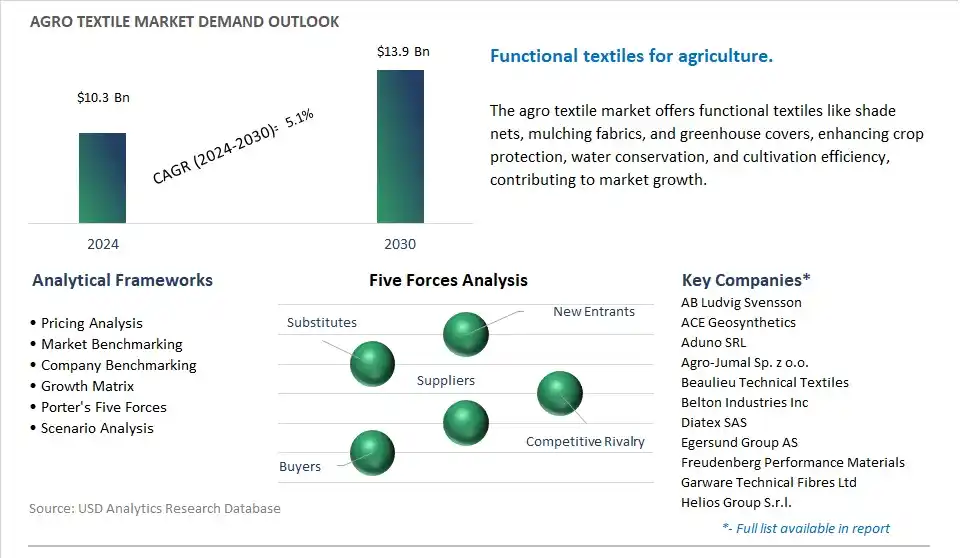
The global Agro Textile Market is poised to register a 5.1% CAGR from $10.3 Billion in 2024 to $13.9 Billion in 2030.
The global Agro Textile Market Study analyzes and forecasts the market size across 6 regions and 24 countries for diverse segments -By Material (Synthetic Fiber, Natural Fiber), By Type (Woven, Non-Woven, Knitted, Others), By End-User (Shade Nets, Mulch Mats, Anti-Hail and Bird Protection Nets, Anti-Insect Nets, Fishing Nets, Packing Materials, Root Ball Net, Others).
An Introduction to Global Agro Textile Market in 2024
The market for agro textiles is experiencing rapid growth driven by the demand for sustainable solutions to improve crop protection, water management, and soil health in agriculture. Key trends shaping the future of this industry include the development of innovative textile materials such as shade nets, mulch fabrics, and insect screens tailored to specific crop requirements and environmental conditions. Additionally, advancements in nanotechnology enable the production of smart textiles with functionalities such as UV protection, moisture management, and pest repellency, enhancing crop yield and quality while reducing reliance on chemical inputs. Moreover, the adoption of precision irrigation systems and soil moisture sensors enhances water efficiency and nutrient uptake, optimizing crop growth and minimizing environmental impact. As farmers increasingly prioritize sustainable and climate-resilient practices, the demand for agro textiles is expected to continue growing, driving innovation and market expansion in this sector.
Agro Textile Market Competitive Landscape
The market report analyses the leading companies in the industry including AB Ludvig Svensson, ACE Geosynthetics, Aduno SRL, Agro-Jumal Sp. z o.o., Beaulieu Technical Textiles, Belton Industries Inc, Diatex SAS, Egersund Group AS, Freudenberg Performance Materials, Garware Technical Fibres Ltd, Helios Group S.r.l., Hy-Tex Ltd, Karatzis Group of Companies, Meyabond Industry & Trading Co. Ltd, Mogul Co. Ltd, Morenot SAS, Phormium Ltd, Siang May Pte Ltd, Tama CE, TenCate Geosynthetics, Zhongshan Hongjun Nonwovens Co. Ltd.
Agro Textile Market Dynamics
Agro Textile Market Trend: Growing Demand for Sustainable Agriculture Practices
Adoption of textile-based solutions for crop protection, soil erosion control, and water management support the market outlook. Agro textiles offer a range of benefits such as weed suppression, moisture retention, temperature regulation, and protection against pests and diseases, thereby reducing the need for chemical inputs and promoting environmentally friendly farming practices. With increasing awareness of the environmental impact of conventional agricultural methods and the need for resource-efficient solutions, there is a rising demand for agro textiles that contribute to soil health, water conservation, and biodiversity preservation.
Agro Textile Market Driver: Rising Need for Improved Crop Yield and Quality
A key driver propelling the market for agro textiles is the rising need for improved crop yield and quality in the face of global food demand and changing climate conditions. Farmers are facing challenges such as soil degradation, water scarcity, extreme weather events, and pest infestations that impact crop productivity and profitability. Agro textiles offer solutions to these challenges by providing physical protection to crops, enhancing soil moisture retention, moderating temperature fluctuations, and reducing wind and water erosion. By implementing agro textiles in their farming operations, growers can mitigate risks, optimize growing conditions, and achieve higher yields and better quality produce, driving market demand for agro textile products and solutions.
Agro Textile Market Opportunity: Development of Advanced Functional Textiles
Agro textile companies are investing in the development of advanced functional textiles with tailored properties and functionalities to meet the specific needs of different crops, climates, and farming practices. Manufacturers aim to capitalize on this opportunity by investing in research and development to create innovative agro textiles with enhanced durability, UV resistance, moisture management, and pest repellent properties. Additionally, there is potential for the integration of smart technologies such as sensors, actuators, and communication systems into agro textiles to enable real-time monitoring of environmental conditions and crop health. By offering advanced functional textiles that address the evolving needs of modern agriculture, manufacturers aim to gain market shares in the industry in the agro textile sector.
Agro Textile Market Ecosystem
The Agro Textile Market involves a diverse range of stages and companies contributing to the production and distribution of specialized fabrics for agricultural applications. It begins with the production of raw materials, including natural fibers including cotton, and synthetic fibers including polypropylene, sourced from companies including Dow Chemical Company and BASF SE. Yarn manufacturing follows, where textile yarn manufacturers convert these raw materials into yarns suitable for agro-textile applications, typically tailored for specific properties including strength and UV resistance.
Fabric production involves weaving, knitting, or non-woven processes, characterized by the presence of companies including Trevira GmbH and Ahlstrom Corporation, with fabrics typically coated or laminated for enhanced functionalities. Treatment and finishing, including UV protection and water repellency, are applied by textile finishing companies, ensuring the fabrics meet the requirements of agricultural applications.
Distribution and sales channels, including industrial distributors and agro-textile manufacturers including Degania Industries Ltd., connect the products to end users, primarily farmers that utilize agro textiles for various purposes including greenhouses, frost protection, and soil erosion control.
Agro Textile Market Share Analysis: Natural Fiber is the fastest growing market segment over the forecast period to 2030
In recent years, the natural fiber segment of the agro-textile market has experienced remarkable growth, outpacing its synthetic counterpart. This surge is driven by growing environmental concerns and a shift toward sustainable agricultural practices have fueled the demand for natural fiber-based agrotextiles. Materials such as jute, cotton, and coir are biodegradable, renewable, and pose minimal environmental impact compared to synthetic alternatives, making them increasingly popular among eco-conscious farmers. Additionally, natural fibers offer superior breathability and moisture retention properties, crucial for maintaining soil health and promoting plant growth. As awareness of these benefits spreads and consumers prioritize environmentally friendly options, the natural fiber segment is expected to continue its rapid expansion, shaping the future of the agro-textile market.
Agro Textile Market Share Analysis: Non-Woven is the fastest growing market segment over the forecast period to 2030
The non-woven segment is the fastest-growing sector in the agro-textile market, and this growth trajectory is driven by diverse key factors. Non-woven textiles offer a multitude of advantages over traditional woven and knitted fabrics in agricultural applications. Firstly, non-wovens are highly versatile and can be engineered to possess specific properties such as UV resistance, moisture retention, and breathability, making them suitable for a wide range of agricultural purposes including crop protection, weed control, and soil stabilization. In addition, non-woven fabrics are cost-effective, lightweight, and easy to install, providing farmers with practical solutions to enhance crop yield and efficiency. Additionally, advancements in manufacturing technologies have enabled the production of non-woven materials with improved durability and performance, further driving their adoption in the agricultural sector. As farmers increasingly seek innovative solutions to address evolving challenges such as climate change and resource scarcity, the non-woven segment is poised to continue its rapid expansion, reshaping the landscape of the agro-textile market.
Agro Textile Market Share Analysis: Anti-Insect Nets is the fastest growing market segment over the forecast period to 2030
Among the diverse segments in the agro-textile market, anti-insect nets have emerged as the fastest-growing sector, and this surge is underpinned by diverse significant factors. With the escalating threat of pests and insects jeopardizing crop health and yield, farmers are increasingly turning to innovative solutions like anti-insect nets to safeguard their produce. These nets provide an effective barrier against a wide range of pests, including aphids, whiteflies, and thrips, thereby reducing the need for chemical pesticides and promoting sustainable agricultural practices. In addition, anti-insect nets help maintain optimal growing conditions by regulating temperature and humidity levels, fostering a conducive environment for plant growth while simultaneously protecting crops from insect damage. As awareness of the detrimental effects of chemical pesticides grows and consumers demand pesticide-free produce, the demand for anti-insect nets is expected to continue its rapid ascent, driving significant growth in the agro-textile market.
Agro Textile Market Report Scope-
By Material
Synthetic Fiber
Natural Fiber
By Type
Woven
Non-Woven
Knitted
Others
By End-User
Shade Nets
Mulch Mats
Anti-Hail and Bird Protection Nets
Anti-Insect Nets
Fishing Nets
Packing Materials
Root Ball Net
Others
Agro Textile Market Companies Profiled
AB Ludvig Svensson
ACE Geosynthetics
Aduno SRL
Agro-Jumal Sp. z o.o.
Beaulieu Technical Textiles
Belton Industries Inc
Diatex SAS
Egersund Group AS
Freudenberg Performance Materials
Garware Technical Fibres Ltd
Helios Group S.r.l.
Hy-Tex Ltd
Karatzis Group of Companies
Meyabond Industry & Trading Co. Ltd
Mogul Co. Ltd
Morenot SAS
Phormium Ltd
Siang May Pte Ltd
Tama CE
TenCate Geosynthetics
Zhongshan Hongjun Nonwovens Co. Ltd
*- List Not Exhaustive
TABLE OF CONTENTS
1 Introduction to 2024 Agro Textile Market
1.1 Market Overview
1.2 Quick Facts
1.3 Scope/Objective of the Study
1.4 Market Definition
1.5 Countries and Regions Covered
1.6 Units, Currency, and Conversions
1.7 Industry Value Chain
2 Research Methodology
2.1 Market Size Estimation
2.2 Sources and Research Methodology
2.3 Data Triangulation
2.4 Assumptions and Limitations
3 Executive Summary
3.1 Global Agro Textile Market Size Outlook, $ Million, 2021 to 2030
3.2 Agro Textile Market Outlook by Type, $ Million, 2021 to 2030
3.3 Agro Textile Market Outlook by Product, $ Million, 2021 to 2030
3.4 Agro Textile Market Outlook by Application, $ Million, 2021 to 2030
3.5 Agro Textile Market Outlook by Key Countries, $ Million, 2021 to 2030
4 Market Dynamics
4.1 Key Driving Forces of Agro Textile Industry
4.2 Key Market Trends in Agro Textile Industry
4.3 Potential Opportunities in Agro Textile Industry
4.4 Key Challenges in Agro Textile Industry
5 Market Factor Analysis
5.1 Value Chain Analysis
5.2 Competitive Landscape
5.2.1 Global Agro Textile Market Share by Company (%), 2023
5.2.2 Product Offerings by Company
5.3 Porter’s Five Forces Analysis
5.4 Pricing Analysis and Outlook
6 Growth Outlook Across Scenarios
6.1 Growth Analysis-Case Scenario Definitions
6.2 Low Growth Scenario Forecasts
6.3 Reference Growth Scenario Forecasts
6.4 High Growth Scenario Forecasts
7 Global Agro Textile Market Outlook by Segments
7.1 Agro Textile Market Outlook by Segments, $ Million, 2021- 2030
By Material
Synthetic Fiber
Natural Fiber
By Type
Woven
Non-Woven
Knitted
Others
By End-User
Shade Nets
Mulch Mats
Anti-Hail and Bird Protection Nets
Anti-Insect Nets
Fishing Nets
Packing Materials
Root Ball Net
Others
8 North America Agro Textile Market Analysis and Outlook To 2030
8.1 Introduction to North America Agro Textile Markets in 2024
8.2 North America Agro Textile Market Size Outlook by Country, 2021-2030
8.2.1 United States
8.2.2 Canada
8.2.3 Mexico
8.3 North America Agro Textile Market size Outlook by Segments, 2021-2030
By Material
Synthetic Fiber
Natural Fiber
By Type
Woven
Non-Woven
Knitted
Others
By End-User
Shade Nets
Mulch Mats
Anti-Hail and Bird Protection Nets
Anti-Insect Nets
Fishing Nets
Packing Materials
Root Ball Net
Others
9 Europe Agro Textile Market Analysis and Outlook To 2030
9.1 Introduction to Europe Agro Textile Markets in 2024
9.2 Europe Agro Textile Market Size Outlook by Country, 2021-2030
9.2.1 Germany
9.2.2 France
9.2.3 Spain
9.2.4 United Kingdom
9.2.4 Italy
9.2.5 Russia
9.2.6 Norway
9.2.7 Rest of Europe
9.3 Europe Agro Textile Market Size Outlook by Segments, 2021-2030
By Material
Synthetic Fiber
Natural Fiber
By Type
Woven
Non-Woven
Knitted
Others
By End-User
Shade Nets
Mulch Mats
Anti-Hail and Bird Protection Nets
Anti-Insect Nets
Fishing Nets
Packing Materials
Root Ball Net
Others
10 Asia Pacific Agro Textile Market Analysis and Outlook To 2030
10.1 Introduction to Asia Pacific Agro Textile Markets in 2024
10.2 Asia Pacific Agro Textile Market Size Outlook by Country, 2021-2030
10.2.1 China
10.2.2 India
10.2.3 Japan
10.2.4 South Korea
10.2.5 Indonesia
10.2.6 Malaysia
10.2.7 Australia
10.2.8 Rest of Asia Pacific
10.3 Asia Pacific Agro Textile Market size Outlook by Segments, 2021-2030
By Material
Synthetic Fiber
Natural Fiber
By Type
Woven
Non-Woven
Knitted
Others
By End-User
Shade Nets
Mulch Mats
Anti-Hail and Bird Protection Nets
Anti-Insect Nets
Fishing Nets
Packing Materials
Root Ball Net
Others
11 South America Agro Textile Market Analysis and Outlook To 2030
11.1 Introduction to South America Agro Textile Markets in 2024
11.2 South America Agro Textile Market Size Outlook by Country, 2021-2030
11.2.1 Brazil
11.2.2 Argentina
11.2.3 Rest of South America
11.3 South America Agro Textile Market size Outlook by Segments, 2021-2030
By Material
Synthetic Fiber
Natural Fiber
By Type
Woven
Non-Woven
Knitted
Others
By End-User
Shade Nets
Mulch Mats
Anti-Hail and Bird Protection Nets
Anti-Insect Nets
Fishing Nets
Packing Materials
Root Ball Net
Others
12 Middle East and Africa Agro Textile Market Analysis and Outlook To 2030
12.1 Introduction to Middle East and Africa Agro Textile Markets in 2024
12.2 Middle East and Africa Agro Textile Market Size Outlook by Country, 2021-2030
12.2.1 Saudi Arabia
12.2.2 UAE
12.2.3 Oman
12.2.4 Rest of Middle East
12.2.5 Egypt
12.2.6 Nigeria
12.2.7 South Africa
12.2.8 Rest of Africa
12.3 Middle East and Africa Agro Textile Market size Outlook by Segments, 2021-2030
By Material
Synthetic Fiber
Natural Fiber
By Type
Woven
Non-Woven
Knitted
Others
By End-User
Shade Nets
Mulch Mats
Anti-Hail and Bird Protection Nets
Anti-Insect Nets
Fishing Nets
Packing Materials
Root Ball Net
Others
13 Company Profiles
13.1 Company Snapshot
13.2 SWOT Profiles
13.3 Products and Services
13.4 Recent Developments
13.5 Financial Profile
AB Ludvig Svensson
ACE Geosynthetics
Aduno SRL
Agro-Jumal Sp. z o.o.
Beaulieu Technical Textiles
Belton Industries Inc
Diatex SAS
Egersund Group AS
Freudenberg Performance Materials
Garware Technical Fibres Ltd
Helios Group S.r.l.
Hy-Tex Ltd
Karatzis Group of Companies
Meyabond Industry & Trading Co. Ltd
Mogul Co. Ltd
Morenot SAS
Phormium Ltd
Siang May Pte Ltd
Tama CE
TenCate Geosynthetics
Zhongshan Hongjun Nonwovens Co. Ltd
14 Appendix
14.1 Customization Offerings
14.2 Subscription Services
14.3 Related Reports
14.4 Publisher Expertise
By Material
Synthetic Fiber
Natural Fiber
By Type
Woven
Non-Woven
Knitted
Others
By End-User
Shade Nets
Mulch Mats
Anti-Hail and Bird Protection Nets
Anti-Insect Nets
Fishing Nets
Packing Materials
Root Ball Net
Others
Countries Analyzed
North America (US, Canada, Mexico)
Europe (Germany, UK, France, Spain, Italy, Russia, Rest of Europe)
Asia Pacific (China, India, Japan, South Korea, Australia, South East Asia, Rest of Asia)
South America (Brazil, Argentina, Rest of South America)
Middle East and Africa (Saudi Arabia, UAE, Rest of Middle East, South Africa, Egypt, Rest of Africa)
