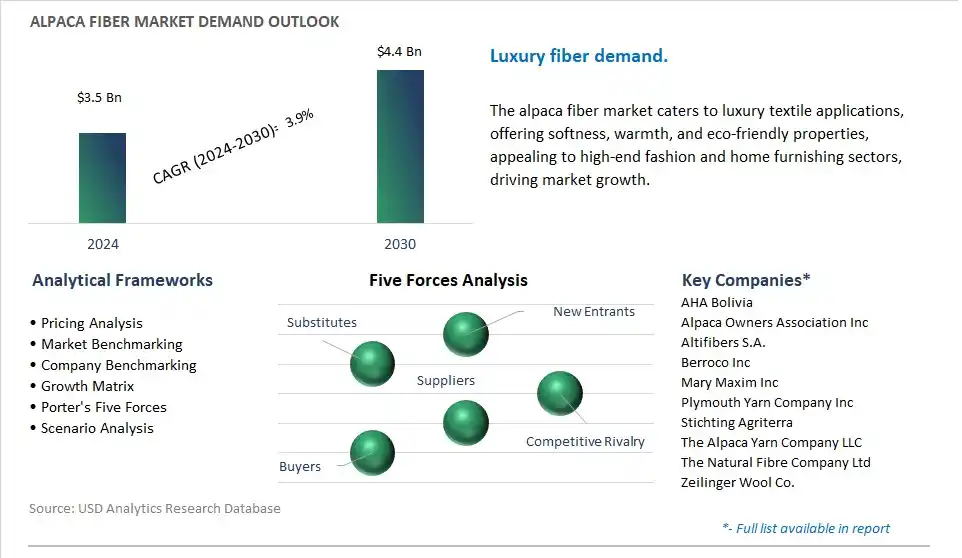
The global Alpaca Fiber Market is poised to register a 3.9% CAGR from $3.5 Billion in 2024 to $4.4 Billion in 2030.
The global Alpaca Fiber Market Study analyzes and forecasts the market size across 6 regions and 24 countries for diverse segments -By Application (Flooring, Textile, Industrial Felting, Others), By Type (Suri Fiber, Huacaya Fiber), By Grade (Ultra Fine, Superfine, Fine, Medium, Intermediate).
An Introduction to Global Alpaca Fiber Market in 2024
The market for alpaca fiber is experiencing steady growth driven by the increasing demand for luxury and sustainable textiles in fashion, apparel, and home furnishings. Key trends shaping the future of this industry include the development of innovative processing techniques and blends that enhance the softness, durability, and performance of alpaca fiber in textile applications. Additionally, advancements in sustainable farming practices and animal welfare standards promote ethical sourcing and production of alpaca fiber, ensuring traceability and transparency throughout the supply chain. Moreover, the growing consumer awareness of the environmental benefits of natural fibers and the demand for eco-friendly and cruelty-free products further drives the adoption of alpaca fiber as a premium and sustainable alternative to conventional textiles. As the textile industry continues to prioritize sustainability and luxury, the demand for alpaca fiber is expected to continue growing, driving innovation and market expansion in this sector.
Alpaca Fiber Market Competitive Landscape
The market report analyses the leading companies in the industry including AHA Bolivia, Alpaca Owners Association Inc, Altifibers S.A., Berroco Inc, Mary Maxim Inc, Plymouth Yarn Company Inc, Stichting Agriterra, The Alpaca Yarn Company LLC, The Natural Fibre Company Ltd, Zeilinger Wool Co..
Alpaca Fiber Market Dynamics
Alpaca Fiber Market Trend: Growing Demand for Sustainable and Ethical Fibers
Growing demand for sustainable and ethical fibers, driven by increasing consumer awareness of environmental and animal welfare issues in the textile industry is encouraging companies to invest in the fiber. Alpaca fiber is renowned for its softness, warmth, and hypoallergenic properties, making it an attractive alternative to conventional wool and synthetic fibers. Moreover, alpaca farming is considered more environmentally friendly and ethical compared to other livestock farming practices, as alpacas have a lower environmental footprint and are typically raised in humane conditions. As consumers prioritize sustainability and ethical sourcing in their purchasing decisions, there is a growing interest in alpaca fiber products.
Alpaca Fiber Market Driver: Growing Demand for High-Quality Textiles and Luxury Products
A key driver propelling the market for alpaca fiber is the growing demand for high-quality textiles and luxury products in the fashion and apparel industry. Alpaca fiber is prized for its superior softness, warmth, and durability, making it highly desirable for premium clothing, accessories, and home textiles. As consumers seek luxurious and sustainable alternatives to conventional materials, there is increasing demand for alpaca fiber products in high-end fashion brands, designer collections, and artisanal crafts. Additionally, the rise of online marketplaces and direct-to-consumer channels has expanded the reach of alpaca fiber products to a global audience, driving market demand for this luxury fiber.
Alpaca Fiber Market Opportunity: Expansion into Niche Markets and Sustainable Fashion
Expansion into niche markets and sustainable fashion segments, catering to environmentally conscious consumers and niche applications is supporting market outlook. Manufacturers and retailers aim to capitalize on this opportunity by developing innovative alpaca fiber blends, finishes, and designs tailored to meet the specific needs of niche markets such as eco-luxury fashion, outdoor apparel, and performance textiles. Additionally, collaborations with sustainable fashion brands, designers, and artisans to create exclusive collections and limited-edition products that showcase the unique properties of alpaca fiber.
Alpaca Fiber Market Ecosystem
The Alpaca Fiber Market begins with alpaca breeding and farming, where specialized farms and stud farms focus on raising alpacas for fiber production, emphasizing selective breeding to enhance fleece quality. Following this, fiber sorting and grading play a crucial role, with independent or cooperative grading houses ensuring raw fiber meets quality standards before processing.
The subsequent stage involves scouring and processing, where specialized wool scouring plants or integrated companies remove impurities from the fiber and prepare it for spinning. Yarn production follows suit, with spinning mills specializing in natural fibers or alpaca blends creating yarn of various counts and thicknesses, integrating processing facilities for a streamlined approach. Distribution and sales efforts target yarn retailers, textile manufacturers, and craft markets, facilitated by distributors, spinning mills, and online marketplaces. Further, end users, including luxury apparel brands and craft yarn retailers, utilize alpaca yarn for a range of products, emphasizing its luxurious softness and sustainability.
Key players include independent alpaca farms and stud farms for breeding, specialized grading houses for sorting and grading, and wool scouring plants including Geelong Wool Processing Pty Ltd for scouring and processing. Yarn spinning mills including Spintex and vertically integrated companies including KUNA by Susan handle spinning and yarn production, while distributors including Yarn Destash, and online marketplaces including Etsy cater to distribution and sales. End users encompass luxury apparel brands including Loro Piana and craft yarn retailers with a global presence.
Alpaca Fiber Market Share Analysis: Textile held the dominant revenue share in 2024
Within the Alpaca Fiber Market, the textile segment is the largest, driven by diverse pivotal factors. Alpaca fiber is highly prized in the textile industry for its exceptional qualities, including softness, warmth, and hypoallergenic properties. These attributes make alpaca fiber an ideal choice for luxury textiles such as scarves, shawls, sweaters, and blankets. Additionally, alpaca fiber possesses excellent insulating properties, making it suitable for use in both cold and warm climates. The growing demand for premium and sustainable textiles has further boosted the prominence of alpaca fiber in the textile industry. In addition, the increasing awareness of environmental sustainability and ethical sourcing practices has led consumers to seek out natural fibers like alpaca as alternatives to synthetic materials. As the textile industry continues to prioritize quality, sustainability, and innovation, the textile segment is expected to maintain its leading position in the alpaca fiber market.
Alpaca Fiber Market Share Analysis: Suri Fiber is the fastest growing market segment over the forecast period to 2030
In the Alpaca Fiber Market, the Suri fiber segment is the fastest-growing sector, driven by diverse significant factors. Suri fiber, characterized by its long, silky locks, is prized for its luxurious texture and lustrous sheen, making it highly sought after in the textile industry for premium garments and accessories. The unique properties of Suri fiber, including its strength, drape, and natural luster, set it apart from other types of alpaca fiber, contributing to its growing popularity among designers and manufacturers. In addition, advancements in breeding techniques and genetic selection have led to the production of higher-quality Suri fiber with improved uniformity and fineness, further driving its demand in the market. Additionally, the growing trend toward sustainable and ethical fashion has spurred interest in natural fibers like Suri alpaca, as consumers seek out environmentally friendly and socially responsible alternatives to conventional textiles. As a result, the Suri fiber segment is expected to continue its rapid growth trajectory, shaping the future of the alpaca fiber market.
Alpaca Fiber Market Share Analysis: Ultra Fine Grade is the fastest growing market segment over the forecast period to 2030
In the Alpaca Fiber Market, the ultra-fine grade segment is the fastest-growing sector, driven by diverse pivotal factors. Ultrafine alpaca fiber is renowned for its exceptional softness, fineness, and luxurious feel, making it highly coveted among discerning consumers and luxury textile manufacturers. The increasing demand for premium and high-quality textiles has propelled the growth of the ultra-fine grade segment as designers and brands seek out fibers that offer superior comfort and elegance. Additionally, advancements in breeding practices and genetic selection have enabled alpaca breeders to produce ultra-fine fibers with even finer micron counts, further enhancing their desirability in the market. In addition, the growing trend toward sustainable and ethically sourced materials has spurred interest in ultra-fine alpaca fiber as an environmentally friendly alternative to synthetic and conventional fibers. As consumer preferences continue to evolve toward quality, sustainability, and luxury, the ultra-fine grade segment is expected to maintain its rapid growth trajectory in the alpaca fiber market.
Alpaca Fiber Market Report Scope-
By Application
Flooring
Textile
Industrial Felting
Others
By Type
Suri Fiber
Huacaya Fiber
By Grade
Ultra Fine
Superfine
Fine
Medium
Intermediate
Alpaca Fiber Market Companies Profiled
AHA Bolivia
Alpaca Owners Association Inc
Altifibers S.A.
Berroco Inc
Mary Maxim Inc
Plymouth Yarn Company Inc
Stichting Agriterra
The Alpaca Yarn Company LLC
The Natural Fibre Company Ltd
Zeilinger Wool Co.
*- List Not Exhaustive
TABLE OF CONTENTS
1 Introduction to 2024 Alpaca Fiber Market
1.1 Market Overview
1.2 Quick Facts
1.3 Scope/Objective of the Study
1.4 Market Definition
1.5 Countries and Regions Covered
1.6 Units, Currency, and Conversions
1.7 Industry Value Chain
2 Research Methodology
2.1 Market Size Estimation
2.2 Sources and Research Methodology
2.3 Data Triangulation
2.4 Assumptions and Limitations
3 Executive Summary
3.1 Global Alpaca Fiber Market Size Outlook, $ Million, 2021 to 2030
3.2 Alpaca Fiber Market Outlook by Type, $ Million, 2021 to 2030
3.3 Alpaca Fiber Market Outlook by Product, $ Million, 2021 to 2030
3.4 Alpaca Fiber Market Outlook by Application, $ Million, 2021 to 2030
3.5 Alpaca Fiber Market Outlook by Key Countries, $ Million, 2021 to 2030
4 Market Dynamics
4.1 Key Driving Forces of Alpaca Fiber Industry
4.2 Key Market Trends in Alpaca Fiber Industry
4.3 Potential Opportunities in Alpaca Fiber Industry
4.4 Key Challenges in Alpaca Fiber Industry
5 Market Factor Analysis
5.1 Value Chain Analysis
5.2 Competitive Landscape
5.2.1 Global Alpaca Fiber Market Share by Company (%), 2023
5.2.2 Product Offerings by Company
5.3 Porter’s Five Forces Analysis
5.4 Pricing Analysis and Outlook
6 Growth Outlook Across Scenarios
6.1 Growth Analysis-Case Scenario Definitions
6.2 Low Growth Scenario Forecasts
6.3 Reference Growth Scenario Forecasts
6.4 High Growth Scenario Forecasts
7 Global Alpaca Fiber Market Outlook by Segments
7.1 Alpaca Fiber Market Outlook by Segments, $ Million, 2021- 2030
By Application
Flooring
Textile
Industrial Felting
Others
By Type
Suri Fiber
Huacaya Fiber
By Grade
Ultra Fine
Superfine
Fine
Medium
Intermediate
8 North America Alpaca Fiber Market Analysis and Outlook To 2030
8.1 Introduction to North America Alpaca Fiber Markets in 2024
8.2 North America Alpaca Fiber Market Size Outlook by Country, 2021-2030
8.2.1 United States
8.2.2 Canada
8.2.3 Mexico
8.3 North America Alpaca Fiber Market size Outlook by Segments, 2021-2030
By Application
Flooring
Textile
Industrial Felting
Others
By Type
Suri Fiber
Huacaya Fiber
By Grade
Ultra Fine
Superfine
Fine
Medium
Intermediate
9 Europe Alpaca Fiber Market Analysis and Outlook To 2030
9.1 Introduction to Europe Alpaca Fiber Markets in 2024
9.2 Europe Alpaca Fiber Market Size Outlook by Country, 2021-2030
9.2.1 Germany
9.2.2 France
9.2.3 Spain
9.2.4 United Kingdom
9.2.4 Italy
9.2.5 Russia
9.2.6 Norway
9.2.7 Rest of Europe
9.3 Europe Alpaca Fiber Market Size Outlook by Segments, 2021-2030
By Application
Flooring
Textile
Industrial Felting
Others
By Type
Suri Fiber
Huacaya Fiber
By Grade
Ultra Fine
Superfine
Fine
Medium
Intermediate
10 Asia Pacific Alpaca Fiber Market Analysis and Outlook To 2030
10.1 Introduction to Asia Pacific Alpaca Fiber Markets in 2024
10.2 Asia Pacific Alpaca Fiber Market Size Outlook by Country, 2021-2030
10.2.1 China
10.2.2 India
10.2.3 Japan
10.2.4 South Korea
10.2.5 Indonesia
10.2.6 Malaysia
10.2.7 Australia
10.2.8 Rest of Asia Pacific
10.3 Asia Pacific Alpaca Fiber Market size Outlook by Segments, 2021-2030
By Application
Flooring
Textile
Industrial Felting
Others
By Type
Suri Fiber
Huacaya Fiber
By Grade
Ultra Fine
Superfine
Fine
Medium
Intermediate
11 South America Alpaca Fiber Market Analysis and Outlook To 2030
11.1 Introduction to South America Alpaca Fiber Markets in 2024
11.2 South America Alpaca Fiber Market Size Outlook by Country, 2021-2030
11.2.1 Brazil
11.2.2 Argentina
11.2.3 Rest of South America
11.3 South America Alpaca Fiber Market size Outlook by Segments, 2021-2030
By Application
Flooring
Textile
Industrial Felting
Others
By Type
Suri Fiber
Huacaya Fiber
By Grade
Ultra Fine
Superfine
Fine
Medium
Intermediate
12 Middle East and Africa Alpaca Fiber Market Analysis and Outlook To 2030
12.1 Introduction to Middle East and Africa Alpaca Fiber Markets in 2024
12.2 Middle East and Africa Alpaca Fiber Market Size Outlook by Country, 2021-2030
12.2.1 Saudi Arabia
12.2.2 UAE
12.2.3 Oman
12.2.4 Rest of Middle East
12.2.5 Egypt
12.2.6 Nigeria
12.2.7 South Africa
12.2.8 Rest of Africa
12.3 Middle East and Africa Alpaca Fiber Market size Outlook by Segments, 2021-2030
By Application
Flooring
Textile
Industrial Felting
Others
By Type
Suri Fiber
Huacaya Fiber
By Grade
Ultra Fine
Superfine
Fine
Medium
Intermediate
13 Company Profiles
13.1 Company Snapshot
13.2 SWOT Profiles
13.3 Products and Services
13.4 Recent Developments
13.5 Financial Profile
AHA Bolivia
Alpaca Owners Association Inc
Altifibers S.A.
Berroco Inc
Mary Maxim Inc
Plymouth Yarn Company Inc
Stichting Agriterra
The Alpaca Yarn Company LLC
The Natural Fibre Company Ltd
Zeilinger Wool Co.
14 Appendix
14.1 Customization Offerings
14.2 Subscription Services
14.3 Related Reports
14.4 Publisher Expertise
By Application
Flooring
Textile
Industrial Felting
Others
By Type
Suri Fiber
Huacaya Fiber
By Grade
Ultra Fine
Superfine
Fine
Medium
Intermediate
Countries Analyzed
North America (US, Canada, Mexico)
Europe (Germany, UK, France, Spain, Italy, Russia, Rest of Europe)
Asia Pacific (China, India, Japan, South Korea, Australia, South East Asia, Rest of Asia)
South America (Brazil, Argentina, Rest of South America)
Middle East and Africa (Saudi Arabia, UAE, Rest of Middle East, South Africa, Egypt, Rest of Africa)
