Market Overview: Immersed Membrane Bioreactor Systems Market Expands with Municipal Wastewater Upgrades, Industrial Water Reuse and Compact Treatment Infrastructure
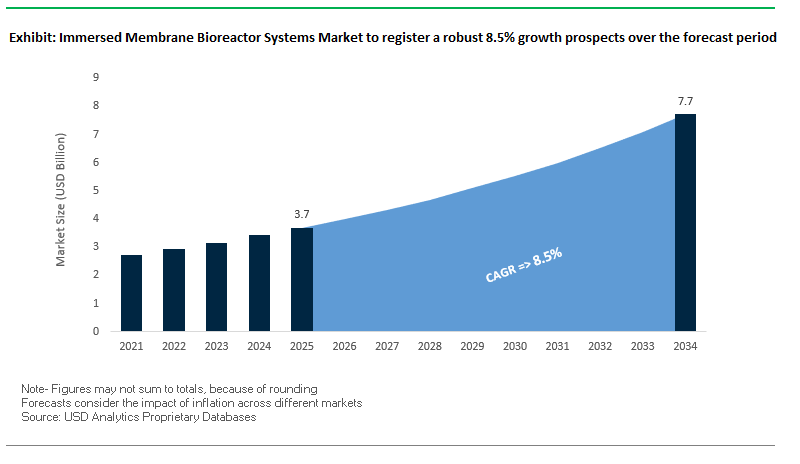
The global Immersed Membrane Bioreactor Systems Market is projected to increase from USD 3.7 billion in 2025 to USD 7.7 billion by 2034, registering a CAGR of 8.5% during the forecast period. Market expansion is supported by increasing demand for advanced municipal wastewater treatment, industrial effluent recycling, compact treatment infrastructure and higher-quality reclaimed water. Urban population growth, aging wastewater treatment facilities, water scarcity and increasingly stringent effluent discharge requirements are strengthening the commercial relevance of immersed membrane bioreactor (iMBR) systems across centralized and decentralized wastewater treatment applications.
Immersed membrane bioreactor systems integrate biological wastewater treatment with submerged microfiltration or ultrafiltration membranes, replacing conventional secondary clarification with membrane-based solids separation. This configuration allows biological treatment and membrane filtration to operate within a compact process arrangement, supporting wastewater treatment capacity expansion where land availability and construction constraints limit conventional infrastructure. Municipal wastewater utilities represent an important demand base, particularly for treatment plant modernization, nutrient removal, hydraulic capacity expansion and wastewater reclamation projects. The ability to produce consistently low-turbidity effluent also supports integration with downstream disinfection and advanced water reuse processes.
Industrial wastewater treatment represents an increasingly important application area, particularly across food and beverage, pharmaceuticals, biotechnology, chemicals, petrochemicals, textiles and pulp and paper manufacturing. Wastewater composition, production-cycle variability and discharge specifications influence the deployment of immersed membrane systems. Industrial applications frequently involve high organic loading, variable suspended-solids concentrations and fluctuations in influent flow, making biological process stability and membrane filtration reliability important operating characteristics. Modular and packaged iMBR systems are also used in commercial establishments, industrial parks and decentralized wastewater treatment installations where compact plant design and flexible treatment capacity are relevant.
Regionally, Asia Pacific represents a significant market for immersed membrane bioreactor systems, supported by municipal wastewater infrastructure development, industrial water recycling and urban treatment-capacity requirements in China, India, Japan and Southeast Asia. North America contributes demand from municipal treatment plant upgrades, decentralized treatment and industrial water reclamation. Europe represents an established market for advanced biological wastewater treatment, nutrient removal and water reuse technologies, while the Middle East has applications in municipal water reclamation, industrial wastewater treatment and water-scarce urban infrastructure. Across these regions, membrane technology suppliers, engineering contractors and integrated water treatment providers participate in new installations, replacement projects and long-term wastewater treatment services.
Key Insights: Immersed Membrane Bioreactor Systems Market
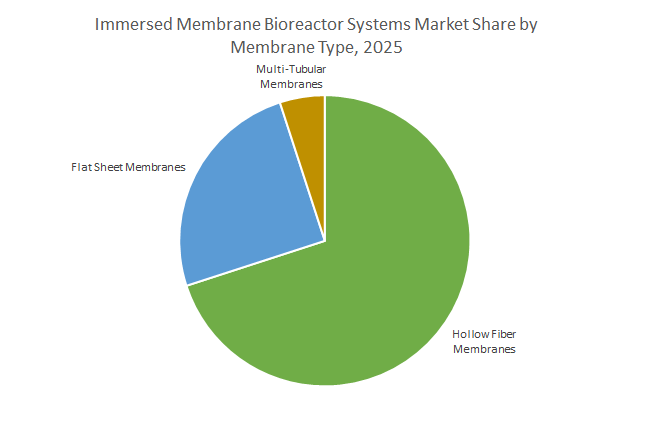
Hollow Fiber Membranes Dominate Technology Demand: Hollow fiber membranes account for 70% of the immersed MBR systems market in 2025, supported by high membrane packing density and broad deployment in municipal wastewater treatment. Flat sheet membranes represent 25%, while multi-tubular membranes contribute primarily across specialized wastewater treatment applications.
Internal Submerged Configurations Lead System Deployment: Internal submerged systems account for 85% of the market in 2025, compared with 15% for external submerged configurations. Internal configurations integrate membrane modules within the biological treatment tank, while external submerged arrangements provide greater separation between biological treatment and membrane filtration operations.
Municipal and Industrial Wastewater Applications Drive Demand: Municipal wastewater treatment remains an important application, supported by plant capacity expansion, effluent-quality requirements and infrastructure modernization. Industrial demand includes food and beverage processing, pharmaceuticals, biotechnology, chemicals, textiles, pulp and paper, and power generation, where compact biological treatment and consistent solids separation are commercially relevant.
Decentralized and Large-Scale Treatment Systems Support Diverse Capacity Requirements: The market includes small-scale systems below 1 million liters per day (MLD), medium-scale installations of 1–20 MLD and large-scale facilities exceeding 20 MLD. Packaged membrane bioreactors serve distributed treatment requirements, while large municipal installations incorporate multiple membrane trains and integrated biological treatment infrastructure.
Aeration and Membrane Maintenance Influence Treatment Economics: Air-scouring electricity consumption, membrane fouling, chemical cleaning frequency, membrane replacement and sludge management contribute to the operating-cost structure of immersed MBR systems. Higher membrane surface-area density, automated monitoring and improved aeration distribution influence treatment capacity, operating reliability and lifecycle expenditure.
Advanced Wastewater Reuse Expands Membrane Bioreactor Applications: Immersed MBR systems are incorporated into multistage water reclamation processes involving biological nutrient removal, membrane filtration, disinfection and reverse osmosis. Their ability to produce low-suspended-solids effluent supports downstream purification applications, with final water quality determined by the complete treatment process and intended reuse requirements.
Recent Developments in Immersed Membrane Bioreactor Systems and Advanced Wastewater Treatment
Recent developments in the immersed membrane bioreactor systems market demonstrate increasing deployment of high-capacity submerged membrane technologies in municipal wastewater treatment and water reclamation infrastructure. In August 2026, DuPont announced that its MemCor MBR system had been selected for the expansion of the Lower Molonglo Water Quality Control Centre in Canberra, Australia. The new membrane bioreactor installation is designed for approximately 97 million liters per day of wastewater treatment capacity, supporting one of Australia's largest wastewater treatment infrastructure upgrades. The DuPont Lower Molonglo membrane bioreactor project announcement reflects increasing deployment of submerged membrane technologies in large municipal treatment facilities where population growth and treatment reliability influence infrastructure requirements.
DuPont announced further MBR project activity during 2026. In June, its MemCor MBR technology was selected for the Riverstone Water Resource Recovery Facility upgrade in Sydney, incorporating 2,592 MemPulse B50 membrane modules for a plant designed to handle an average flow of 24.8 MLD and peak wet-weather flows of 86 MLD. Earlier, in February 2026, United Utilities selected DuPont's MemCor membrane bioreactor systems for wastewater treatment plant expansions at Eccles, Salford and Wigan in northwest England. According to the DuPont–United Utilities MBR project announcement, the Wigan facility, serving a population exceeding 437,000, is expected to become the United Kingdom's largest membrane bioreactor plant. These projects reflect demand for additional wastewater treatment capacity, improved effluent quality and compact process configurations within established municipal treatment networks.
Municipal-to-industrial water reclamation also represents an important application for advanced MBR technology. In July 2025, Veolia was selected to deliver the Vitória Water Reclamation Station in Brazil, integrating its memDENSE membrane bioreactor technology with ZeeWeed 500-EV ultrafiltration and PROflex reverse osmosis. The planned facility has a treatment capacity of 38,880 m³/day and is designed to reclaim 85% of municipal wastewater from the Camburi basin for industrial use. The Veolia Vitória wastewater reclamation project illustrates the integration of compact biological treatment, membrane-based solids separation and advanced purification within industrial water supply infrastructure.
Trends and Opportunities Driving Growth in the Immersed Membrane Bioreactor Systems Market
Stricter Regulations and Accelerating Push for Water Reuse
One of the defining trends shaping the immersed membrane bioreactor (iMBR) systems market is the global tightening of wastewater discharge norms and the prioritization of water reuse. Governments are mandating industries and residential complexes to treat and recycle water, creating an urgent demand for iMBRs due to their ability to consistently deliver high-quality effluent with low footprint. For example, India’s Ministry of Environment, Forest, and Climate Change recently mandated that bulk consumers treating more than 5,000 liters per day must reuse at least 20% of their wastewater by 2027–28, rising to 50% by 2031. The National Green Tribunal (NGT) has imposed penalties exceeding ₹80,000 crore on states and municipalities for failing to comply, accelerating the adoption of advanced solutions like iMBRs. These policy shifts are reinforcing iMBRs as the technology of choice for compliance and sustainable water management.
Breakthrough Innovations in Membrane Materials and Anti-Fouling Designs
Technological innovation is another major trend bolstering the iMBR systems market. Research in next-generation membranes including photocatalytic coatings and granular sludge integration is reducing fouling, one of the biggest operational challenges for bioreactors. Studies published in ACS Applied Materials & Interfaces show that photocatalytic membranes actively break down organic pollutants under light exposure, reducing chemical cleaning frequency and extending lifespan. Similarly, MDPI reported that integrating granular sludge reduces fouling significantly, lowering operating costs. These advancements are transforming iMBR economics, making them more durable, energy-efficient, and financially viable for both municipal utilities and industries.
Expansion of Decentralized and Modular Wastewater Treatment Systems
A major opportunity lies in the growing adoption of decentralized and modular wastewater treatment systems, particularly in urbanizing regions and remote communities. Immersed MBR systems, with their compact footprint and modular scalability, are ideally suited for decentralized treatment in industrial parks, hotels, and small municipalities that lack centralized sewer systems. A strong example is MANN+HUMMEL’s BIO-CEL M+ Series, a modular iMBR platform designed for decentralized applications. Its plug-and-play scalability allows capacity expansion without overhauling infrastructure, making it a cost-effective and flexible solution for emerging economies and urban areas under pressure.
Rising Adoption in High-Strength Industrial Wastewater Treatment
The industrial wastewater treatment segment presents another critical growth opportunity. Industries such as food and beverage, slaughterhouses, and textiles generate high-strength effluents with high organic loads that conventional systems struggle to treat. iMBRs, however, consistently deliver effluents well within regulatory limits. A study from a leading water technology company demonstrated that an immersed MBR deployed in a slaughterhouse achieved 97% COD removal and 96% TOC reduction, showcasing its ability to handle some of the most challenging effluents. This makes iMBRs indispensable for industries under pressure to comply with environmental laws while also pursuing water reuse and sustainability targets.
Market Share Analysis of the Immersed Membrane Bioreactor Systems Market
Market Share by Membrane Type
In terms of membrane type, hollow fiber membranes dominate the immersed MBR systems market with 70% projected share in 2025, largely due to their high packing density, which allows maximum membrane surface area in a compact footprint. This makes them the preferred choice for large-scale municipal wastewater treatment plants and space-constrained industrial projects. Flat sheet membranes account for about 25%, valued for their robustness and resistance to clogging from fibrous or stringy waste. They are commonly deployed in industrial wastewater treatment and smaller facilities where manual cleaning is feasible. Multi-tubular membranes, with only 5% share, are used in niche applications involving extremely high solids or complex industrial waste streams, where their clogging resistance outweighs their high cost and low packing density.
Market Share by System Configuration
By system configuration, the market is heavily dominated by internal submerged systems, projected to hold 85% share in 2025. These systems integrate membranes directly within the biological reactor, combining aeration for biological activity with air scouring to minimize fouling. Their energy efficiency, lower footprint, and simplified design make them the industry standard for both municipal and industrial plants. On the other hand, external submerged systems are expected to capture 15% share, catering to specialized use cases such as retrofitting existing wastewater treatment plants or treating highly variable industrial effluents. While they occupy a smaller share, their ability to offer independent control of biological and filtration processes makes them strategically important for industries with aggressive or inconsistent wastewater profiles.
Regulatory Framework and E-E-A-T: Wastewater Discharge Standards, Water Reuse Requirements and Immersed MBR Performance Validation
Regulatory requirements affecting immersed membrane bioreactor systems vary according to wastewater origin, discharge destination, treatment capacity and intended reuse application. In the European Union, the revised Urban Wastewater Treatment Directive (EU) 2024/3019 entered into force on January 1, 2025. The directive expands provisions addressing wastewater collection, treatment performance, nutrient removal, micropollutants and resource recovery. Member States must transpose specified provisions by July 31, 2027, while individual treatment obligations follow separate implementation schedules. The directive is technology-neutral and does not require membrane bioreactor systems as a universal treatment method.
The European Commission's Water Reuse Regulation (EU) 2020/741, applicable since June 26, 2023, establishes minimum quality, monitoring, permitting and risk-management requirements for treated urban wastewater used in agricultural irrigation. Immersed MBR systems can contribute biological treatment and membrane filtration within reclaimed-water treatment processes, although their permeate does not automatically satisfy every microbiological or chemical reuse requirement. Additional disinfection or polishing may be necessary depending on the intended application.
In the United States, municipal wastewater discharge is regulated under the Clean Water Act through the National Pollutant Discharge Elimination System (NPDES). The U.S. Environmental Protection Agency's municipal wastewater permitting framework establishes discharge requirements that may include biochemical oxygen demand, suspended solids, nutrients and receiving-water-specific conditions. Treatment performance requirements are implemented through applicable permits rather than a nationwide mandate for immersed membrane technology.
Technical assessment also draws on recognized water reuse standards. ISO 20426:2018, confirmed as current in 2023, provides guidance for assessing and managing pathogen-related health risks associated with nonpotable reclaimed water. In immersed MBR applications, performance verification commonly includes treated-effluent turbidity, suspended-solids removal, membrane integrity, transmembrane pressure, filtration reliability and microbiological treatment effectiveness. Membrane filtration provides a physical solids-separation barrier, while the complete treatment train determines compliance with applicable discharge and reuse-water specifications.
Competitive Landscape: Global Immersed Membrane Bioreactor Systems Market
The global Immersed Membrane Bioreactor Systems Market includes integrated wastewater treatment companies, submerged membrane manufacturers, engineering contractors and specialized biological treatment technology suppliers. Veolia participates through ZeeWeed membrane filtration and memDENSE MBR technologies incorporated into municipal wastewater treatment and water reuse infrastructure. DuPont de Nemours, Inc. supplies MemCor membrane bioreactor systems and MemPulse submerged hollow-fiber modules for municipal treatment upgrades and industrial wastewater applications. SUEZ participates through its Ultrafor membrane bioreactor technology and associated biological treatment and micropollutant-removal processes, including municipal and hospital wastewater treatment configurations.
Japanese membrane manufacturers maintain established positions in submerged filtration technology. Kubota Corporation supplies Submerged Membrane Unit (SMU) flat-sheet systems used in municipal and industrial MBR applications. Toray Industries, Inc. provides PVDF flat-sheet membrane modules, including its NHP and NHPA product families for biological wastewater treatment and reuse. Mitsubishi Chemical Group Corporation competes through STERAPORE hollow-fiber membranes applied in submerged wastewater treatment and membrane bioreactor systems. Alfa Laval supplies membrane bioreactor modules and flat-sheet membrane technologies for municipal and industrial wastewater treatment, with emphasis on compact filtration and operating efficiency.
Specialized membrane suppliers compete through module construction, fouling management and equipment integration. MANN+HUMMEL, through MICRODYN-NADIR and BIO-CEL membrane technologies, participates in submerged flat-sheet MBR systems for centralized and decentralized wastewater treatment. Kovalus Separation Solutions supplies PURON and PULSION submerged hollow-fiber MBR modules, including packaged and engineered systems used in municipal and industrial applications. HUBER SE participates through membrane bioreactor treatment systems, including flat-sheet membrane configurations and packaged wastewater treatment infrastructure. CERAFILTEC supplies submerged ceramic membrane technologies for municipal and industrial MBR applications, including wastewater streams requiring chemical-resistant membrane materials.
Engineering and process-integration companies provide additional competition across plant upgrades, industrial effluent treatment and long-term wastewater operations. VA TECH WABAG Ltd. supplies MARAPUR membrane bioreactor systems and integrated municipal and industrial wastewater treatment processes, including MBR-based water reclamation configurations. Ovivo participates through advanced wastewater treatment equipment, membrane pretreatment and silicon-carbide ultrafiltration technologies applicable to MBR treatment systems, particularly where variable wastewater characteristics and solids management influence membrane performance.
China: Regulatory Push and Advanced MBR Applications
The China immersed MBR systems market is experiencing robust growth driven by stringent industrial wastewater regulations and government-backed initiatives for water reuse. The Ministry of Ecology and Environment (MEE) enforces strict discharge standards, prompting industries to adopt advanced MBR technologies for compliance. Under the 14th Five-Year Plan, water reuse is a priority, with MBR systems playing a central role in achieving national targets for sustainable water management.
Technological advancements in 2024 include the development of hollow-fiber ultrafiltration membranes with enhanced antifouling properties, aimed at reducing maintenance costs and improving the long-term efficiency of immersed MBR systems. Key industrial applications span zero-liquid discharge (ZLD) systems in textile and petrochemical sectors, where MBRs are valued for their robustness and capacity to handle high-solids-content wastewater. A 2024 report highlighted the widespread adoption of immersed MBR technology in China to tackle water scarcity and industrial pollution.
United States: Federal Funding and Corporate Innovation Driving Adoption
The U.S. immersed MBR systems market benefits from significant government funding and innovation-driven R&D. The Bipartisan Infrastructure Law allocates over $50 billion to the EPA to enhance water infrastructure, with a focus on addressing emerging contaminants such as PFAS, which require advanced MBR filtration solutions.
Academic research funded by the National Science Foundation (NSF) further accelerates innovation in membrane technologies for water purification and chemical separation. Key corporate initiatives include Veolia Water Technologies and Evoqua Water Technologies, which deploy immersed MBR systems for regulated water treatment. In 2024, Koch Separation Solutions launched a new modular MBR product line, simplifying installation and maintenance in municipal and industrial wastewater treatment facilities.
India: Government Missions and Green Bonds Supporting MBR Growth
India’s immersed MBR systems market is expanding rapidly, fueled by government programs such as the Jal Jeevan Mission, which promotes clean water access in rural areas. The Department of Science & Technology (DST) also supports R&D in nano-material and filtration technologies, enhancing the adoption of advanced MBR systems.
Infrastructure investments underscore the market’s growth: the Ghaziabad Nagar Nigam issued India’s first Certified Green Municipal Bond, raising ₹150 crore to fund a Tertiary Sewage Treatment Plant (TSTP) employing immersed MBR technology. Additionally, VA TECH WABAG’s seven-year O&M contract for the 110 MLD SWRO Nemmeli Desalination Plant demonstrates strong financial commitment to maintaining membrane-based water treatment infrastructure, highlighting the increasing reliance on immersed MBR systems for industrial and municipal wastewater reuse.
Germany: Industrial MBR Leadership and Technological Expertise
Germany leads the immersed MBR systems market in Europe through a combination of regulatory compliance and industrial expertise. Companies like PWT Wassertechnik specialize in industrial wastewater treatment, leveraging immersed MBR technology to ensure efficient water reuse while adhering to strict EU environmental standards.
Technological developments are exemplified by Berghof Membranes, which in 2024 expanded its global supply of ceramic tubular membranes for MBR projects. Although tubular, this demonstrates Germany’s focus on robust membrane solutions. Corporate initiatives from MANN+HUMMEL further strengthen the market, combining advanced membrane systems with digital water management solutions to address industrial water challenges and promote green energy initiatives.
Japan: Academic and Corporate R&D Pioneering MBR Innovations
The Japan immersed MBR systems market is distinguished by cutting-edge academic and corporate research. In 2025, Toray introduced a next-generation hollow fiber membrane with 20% higher permeability and reduced fouling, designed to lower operational costs for MBR systems.
The Ministry of the Environment allocated USD 1.2 billion in 2024 to promote sustainable infrastructure, including wastewater treatment systems incorporating MBR technology. Japan’s extensive MBR applications over 3,000 full-scale plants span small-scale industrial and household systems to large municipal facilities. Metawater’s ceramic membrane filtration systems exemplify Japan’s capability in providing clean tap water while enhancing operational efficiency and reducing turbidity, demonstrating the country’s leadership in advanced immersed MBR solutions.
Australia: Water Stress Driving Recycling and Advanced MBR Research
Australia’s immersed MBR systems market is strongly influenced by national water scarcity challenges. The country is a global leader in water recycling and reuse, with initiatives such as the Australian Water Recycling Centre of Excellence funding projects that demonstrate the cost-effectiveness of ceramic membranes for secondary effluent containing high organic matter.
Technological adoption includes the Narromine Shire Council’s innovative water treatment system, featuring next-generation submerged flat-sheet ceramic membrane technology from Cerafiltec. Academic research by Victoria University’s Institute for Sustainable Industries and Liveable Cities (ISILC) is enhancing water recovery from desalination and minimizing fouling and scaling, tackling critical challenges for immersed MBR systems. This positions Australia as a key player in innovative and sustainable membrane-based water treatment solutions.
Immersed Membrane Bioreactor Systems Market Report Scope
Immersed Membrane Bioreactor Systems Market
Parameter
Details
Market Size (2025)
$3.7 Billion
Market Size (2034)
$7.7 Billion
Market Growth Rate
8.5%
Segments
By Membrane Type (Hollow Fiber Membranes, Flat Sheet Membranes, Multi-Tubular Membranes), By System Configuration (Internal Submerged Systems, External Submerged Systems), By Application (Municipal Wastewater Treatment, Industrial Wastewater Treatment), By Filtration Mode (Aerobic MBR Systems, Anaerobic MBR Systems), By End-User (Municipal Authorities, Industrial Facilities, Commercial Establishments), By Capacity (Small-Scale (Below 1 MLD), Medium-Scale (1–20 MLD), Large-Scale (Above 20 MLD))
Study Period
2020- 2025 and 2026-2034
Units
Revenue (USD)
Qualitative Analysis
Porter’s Five Forces, SWOT Profile, Market Share, Scenario Forecasts, Market Ecosystem, Company Ranking, Market Dynamics, Industry Benchmarking
Companies
SUEZ, Veolia, Kubota Corporation, Toray Industries, Inc., Pentair plc, Xylem Inc., Asahi Kasei Corporation, Mitsubishi Chemical Corporation, Evoqua Water Technologies, The Dow Chemical Company, MANN+HUMMEL, Koch Industries, V.A. TECH WABAG Ltd., Alfa Laval, DuPont de Nemours, Inc.
Countries
US, Canada, Mexico, Germany, France, Spain, Italy, UK, Russia, China, India, Japan, South Korea, Australia, South East Asia, Brazil, Argentina, Middle East, Africa
Immersed Membrane Bioreactor Systems Market Segmentation
By Membrane Type
Hollow Fiber Membranes
Flat Sheet Membranes
Multi-Tubular Membranes
By System Configuration
Internal Submerged Systems
External Submerged Systems
By Application
Municipal Wastewater Treatment
Industrial Wastewater Treatment
Food & Beverage Industry
Pharmaceutical & Biotechnology
Chemicals & Petrochemicals
Textile & Pulp & Paper
Power Generation
Other Industrial Applications
By Filtration Mode
Aerobic MBR Systems
Anaerobic MBR Systems
By End-User
Municipal Authorities
Industrial Facilities
Commercial Establishments
By Capacity
Small-Scale (Below 1 MLD)
Medium-Scale (1–20 MLD)
Large-Scale (Above 20 MLD)
Countries Analyzed
North America (US, Canada, Mexico)
Europe (Germany, UK, France, Spain, Italy, Russia, Rest of Europe)
Asia Pacific (China, India, Japan, South Korea, Australia, South East Asia, Rest of Asia)
South America (Brazil, Argentina, Rest of South America)
Middle East and Africa (Saudi Arabia, UAE, Rest of Middle East, South Africa, Egypt, Rest of Africa)
Leading Companies in the Immersed Membrane Bioreactor Systems Market
Veolia
DuPont de Nemours, Inc.
SUEZ
Kubota Corporation
Toray Industries, Inc.
Mitsubishi Chemical Group Corporation
Alfa Laval
MANN+HUMMEL
Kovalus Separation Solutions
HUBER SE
CERAFILTEC
VA TECH WABAG Ltd.
Ovivo
*- List not Exhaustive
Research Coverage
Produced by USDAnalytics, this report investigates the global Immersed Membrane Bioreactor (iMBR) Systems opportunity from demand drivers to bankability, integrating market sizing, performance benchmarking, and policy catalysts; the analysis reviews configuration choices (internal vs. external submerged), membrane form factors (hollow fiber, flat sheet, multi-tubular), and OPEX levers (aeration, CIP, solids management), and highlights recent breakthroughs in anti-fouling materials, digital monitoring, and hybrid integrations (e.g., FO-iMBR, anaerobic MBR). Leveraging vendor scorecards, deployment evidence, and sensitivity testing on energy and sludge costs, this report is an essential resource for utilities, EPCs, industrial owners, and investors seeking defensible forecasts to 2034, comparative TCO, and practical procurement guidance across municipal and high-strength industrial reuse applications. Scope Includes-
Segmentation: By Membrane Type (Hollow Fiber Membranes, Flat Sheet Membranes, Multi-Tubular Membranes); By System Configuration (Internal Submerged Systems, External Submerged Systems); By Application (Municipal Wastewater Treatment, Industrial Wastewater Treatment Food & Beverage, Pharmaceutical & Biotechnology, Chemicals & Petrochemicals, Textile & Pulp & Paper, Power Generation, Other Industrial Applications); By Filtration Mode (Aerobic MBR Systems, Anaerobic MBR Systems); By End-User (Municipal Authorities, Industrial Facilities, Commercial Establishments); By Capacity (Small-Scale (Below 1 MLD), Medium-Scale (1–20 MLD), Large-Scale (Above 20 MLD)).
Geographic Scope: Analysis spans 25+ countries across North America, Europe, Asia Pacific, Latin America, the Middle East & Africa.
Historic data from 2021 to 2024 and forecast data from 2025 to 2034.
Companies (Profiles of 15+ companies): SUEZ; Veolia; Kubota Corporation; Toray Industries, Inc.; Pentair plc; Xylem Inc.; Asahi Kasei Corporation; Mitsubishi Chemical Corporation; Evoqua Water Technologies; The Dow Chemical Company; MANN+HUMMEL; Koch Industries; V.A. TECH WABAG Ltd.; Alfa Laval; DuPont de Nemours, Inc.
Research Methodology
USDAnalytics evaluates the global Immersed Membrane Bioreactor Systems Market using a combined top-down and bottom-up market-sizing framework, covering membrane types, system configurations, municipal and industrial applications, filtration modes, end-user categories, treatment capacity and regional demand. The research framework incorporates more than 40 stakeholder interviews involving wastewater utilities, engineering contractors, membrane equipment manufacturers and treatment plant operators, supported by company disclosures, infrastructure project information, regulatory publications and technical literature.
Market estimates are triangulated using wastewater treatment capacity, membrane bioreactor installations, plant upgrade activity, membrane replacement requirements and technology-specific market data. The techno-economic assessment examines membrane flux, aeration requirements, cleaning frequency, electricity consumption, sludge management and lifecycle treatment costs across relevant immersed MBR configurations. The 2025–2034 forecast considers municipal wastewater infrastructure development, industrial water reuse activity, regulatory changes, membrane technology adoption and regional wastewater treatment requirements.
Deliverables:
Comprehensive Market Research Report (PDF and Excel) with detailed tables, charts, and interactive visualizations.
Country-Specific Forecasts & Analysis.
Segment-Wise Revenue Forecasts (2025–2034).
Competitive Analysis, Benchmarking, and SWOT Profiles.
Recent Developments & Innovation Tracker.
Executive Summary & Analyst Commentary.
Post-Purchase Analyst Support for Client-Specific Questions and Custom Data Requirements.
Table of Contents: Immersed Membrane Bioreactor (iMBR) Systems Market
1. Executive Summary
1.1. Market Highlights
1.2. Key Insights for Buyers and Industry Stakeholders
1.3. Global Market Snapshot
2. Immersed Membrane Bioreactor Systems Market Outlook (2025–2034)
2.1. Market Overview: Rising Demand for iMBR Systems Driving Growth
2.2. Market Valuation and Growth Projections (2025–2034)
2.2.1. Current Market Size (2025): USD 3.7 Billion
Internal submerged iMBR with hollow-fiber cassettes typically delivers the best footprint and energy profile for secondary/tertiary upgrades. Pairing fine-screening and smart aeration control minimizes fouling and blower loads. Utilities favor modular trains (1–20 MLD) that can be phased in without disrupting operations. Designed correctly, plants meet Class-A reuse with stable SDI for downstream polishing.
Flat sheets excel where influent contains fibers, fats, or stringy solids that risk lumen blockage common in food, textile, and slaughterhouse effluents. They tolerate abrasive cleaning and allow easy plate access for manual inspection. While packing density is lower than hollow fiber, uptime and cleaning simplicity can improve lifecycle economics in these duty conditions. Selection hinges on feed characterization and maintenance strategy.
Anaerobic iMBR cuts aeration energy, generates biogas, and manages very high COD streams with smaller footprints. Warm-temperature operations and gas handling add design complexity, but sludge yields are lower and energy recovery offsets OPEX. For breweries, F&B, and agro-industrial effluents, payback improves when biogas is used onsite and nutrient polishing is integrated. Proper sulfide control and membrane scouring are critical.
Leading municipal designs target 0.45–0.8 kWh/m³ total energy with optimized aeration and cyclic backwash; industrial high-strength streams may run higher. Chemicals should be specified by normalized clean-in-place frequency and dose envelopes rather than brands, with guarantees on recovery to ≥90–95% of baseline flux after cleaning. Include KPIs for MLSS control, air-to-cloth ratios, and automatic permeability normalization.
Engineer headroom for tertiary add-ons: GAC/PACT, ozonation, or AOP skids post-iMBR, with hydraulic and electrical allowances reserved. Specify permeate SDI and turbidity guarantees to protect downstream advanced treatments. Incorporate online sensing (DO, TMP, permeability, ammonia) and open protocols for digital twins to optimize operations as limits tighten. Designing modular trains eases capacity and treatment-train upgrades without major rebuilds.