Anti-Mold Kitchen Appliances Market Outlook – Technology-Driven Hygiene Solutions
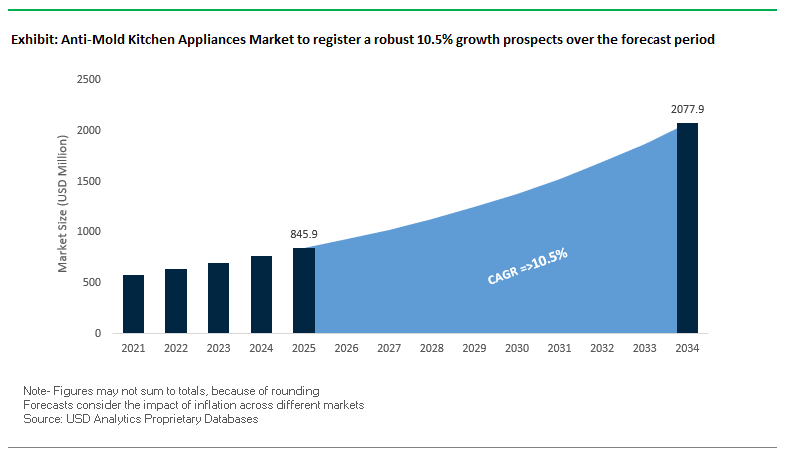
Global anti-mold kitchen appliances market is anticipated to grow from USD 845.9 million in 2025 to USD 2,077.7 million in 2034 at a CAGR of 10.5%. This rapid growth is a reflection of enhanced consumer concern for cleanliness in the home, combined with technological developments to handle mold problems in humid environments. Demand is being fueled by the intersection of health-conscious consumer behavior, advancements in material science, and integration into the smart home platform. Antimicrobial coatings, AI-driven monitoring, and self-drying technologies are being leveraged by manufacturers to prolong product lifespan, improve indoor air quality, and reduce maintenance. The market is also being fueled by rising convergence with sustainability efforts, as durable, mold-resistant appliances reduce waste due to premature replacement.
Key Insights for Industry Professionals
- Health-Driven Purchasing Decisions – Mold-prevention features are now a major buying consideration for households concerned about allergies, asthma, and hygiene.
- Smart Sensor Integration – IoT-enabled humidity control and AI-powered maintenance alerts are reshaping consumer expectations.
- Material Innovation – Stainless steel interiors, antimicrobial rubber seals, and advanced filtration systems are core product differentiators.
- Appliance Longevity as a Value Proposition – Durability and reliability directly support premium pricing and brand loyalty.
- Link to Smart Home Growth – Connected kitchen appliances align with the broader adoption of integrated home management systems.
Anti-Mold Kitchen Appliances Market Analysis – Innovation, Smart Features, and Brand Positioning
The market is moving toward a technology-led growth cycle, and mold prevention is being positioned as a health value and a premium value driver. In March 2025, GE Appliances, owned by Haier, communicated its commitment to "product leadership" in the US market with its latest generation dishwashers with stainless steel tubs offering higher mold resistance than the use of plastic tubs. Bosch, too, has supported its brand positioning with high-strength designs and drying technologies like the "CrystalDry" cycle, using mineral-based heat conversion to remove residual moisture.
Smart integration is becoming the norm. In August 2025, YEEDI launched the M14 PLUS cleaning robot with a "Temperature-Controlled Mop Washing 2.0" feature, utilizing hot water and 45°C heat drying to avoid bacteria and mold growth. LG Electronics' September 2024 launch of AI-driven Wi-Fi convertible refrigerators is part of a wider trend toward environmental balance in appliances, avoiding the risk of mold through usage-based cooling. Samsung's April 2024 launch of its Bespoke AI Home Appliances took this further with anti-mold features, such as "AutoRelease Dry" in dishwashers to minimize post-wash humidity.
Industry providers are also shaping market trends. Microban's antimicrobial additives, highlighted in August 2025, are increasingly being integrated into moisture-prone parts like washing machine seals. Combined with global expansion strategies from companies like Haier with operations in over 160 countries the industry is moving towards scalable, health-centered appliance ecosystems that integrate ruggedness, convenience, and smart connectivity.
Emerging Trends and Strategic Opportunities in the Anti-Mold Kitchen Appliances Market
Self-Healing Photocatalytic Nano-Coatings with Surfaces that Enhance Hygiene Levels
Application of photocatalytic nano-coatings to anti-mold kitchen appliances is a significant step towards long-term hygiene. Light-induced TiO₂-based coatings continuously generate reactive oxygen species that kill mold, bacteria, and viruses on contact with a self-cleaning cycle without any user action. Meta-analysis data show over 99.4% kill of bacteria on TiO₂-treated surfaces, further increasing its value for kitchen hygiene. In addition to antimicrobial activity, new hydrophobic versions repel water and grime, preventing the water buildup causing mold growth. Visual durability is also improved due to self-healing materials that automatically repair micro-scratches, maintaining both the visual look and durability of the coating. Despite having been widely studied in construction and automotive applications, application to kitchen appliances of self-healing, antimicrobial coatings is an untapped market opportunity for premium brands targeting low-maintenance, high-hygiene consumer segments.
Artificial Intelligence-Driven Mold Prediction Systems Transforming Preventive Maintenance
Artificial intelligence is shifting mold prevention from reactive cleaning to pre-emptive action. IoT sensors embedded in appliances can monitor humidity, temperature, and airborne spore counts in real-time. Machine learning algorithms applied to food safety monitoring can anticipate mold-susceptible conditions and initiate automatic cleaning cycles before contamination. Case studies such as IoT-based bread mold detection illustrate the scalability of the solution to coffee machines, refrigerators, and dishwashers. Smart home ecosystem integration allows cross-device communication for example, a high humidity refrigerator can instruct an exhaust hood to open more airflow. This networked, proactive solution offers convenience and peace of mind, a compelling selling point for high-end appliance brands.
Mold Detection Systems Built into Coffee Machines
Coffee maker water reservoirs are the perfect setting for mold growth from heat, water, and consumer neglect during cleaning. Research shows that Ochratoxin A a mycotoxin that harms the kidneys will be produced in poorly cleaned coffee, a serious health issue. Consumer research shows that most consumers rinse but do not deep-clean their machines, creating room for an opportunity for a hygiene gap to be filled by automated mold detection. Draft patents detail coffee makers with spore sensors and automatic cleaning programs, giving real-time notice when risk of contamination is detected. For manufacturers, adding this feature not only solves one specific health issue but also adds a premium differentiator in a crowded small appliance market.
Hospital-Grade Kitchen Ventilation Systems
Installing healthcare-grade ventilation technologies in the home kitchen represents a luxury path to mold prevention. EPA indoor air quality studies indicate that poor ventilation can make indoor air two to five times more polluted than outdoor air, with the high potential for mold. Energy Recovery Ventilation (ERV) systems, traditionally used in commercial settings, can be redirected to deliver constant fresh air flow in low-energy-loss kitchens. Integrating high-grade filtration with in-built climate control can remove airborne spores, allergens, and humidity simultaneously. Leading brands are now designing ventilation units that are directly linked to other smart appliances to automate moisture control making air management a cornerstone of mold prevention in the modern kitchen.
Anti-Mold Kitchen Appliances Market Share and Segmentation Insights
Refrigerators Leading Anti-Mold Technology in Food Preservation
Refrigerators with a 35% market share are the clear winners for the anti-mold kitchen appliances market, as per consumers' need for food preservation and hygiene, states a report. Manufacturers are incorporating UV-C sterilization, silver-ion antimicrobial linings, and humidity-balancing compartments to inhibit microbial growth. Dishwashers follow with 22%, where high-temperature wash cycles and antibacterial filtration systems are the norm in high-end models. Chimneys and exhaust hoods are being embraced at a quick pace as air quality awareness increases, and small appliances such as blenders and juicers currently with low base market are set to experience the most growth as miniaturized anti-mold technologies reach maturity. Combination models such as refrigerator-oven hybrids are becoming niche luxury products, combining space efficiency and high-end hygiene features.
.png)
Antimicrobial Coatings Pioneering the Technology Advantage
Antimicrobial coatings are in the lead with 40% technology share, with silver-ion and nano-based offerings highly prized for cost and broad-spectrum protection. UV-C sterilization, with 25%, is fast gaining popularity in high-end refrigeration and storage appliances owing to the chemical-free sanitizing advantage. High-end ventilation systems especially those integrated into range hoods and HVAC-linked appliances are growing as part of smart home systems, offering long-term mold protection in high-humidity locations. Self-cleaning technologies like pyrolytic ovens and auto dishwasher sanitizing functions are desirable for consumers seeking minimal maintenance. Integrated dehumidification is in the meantime emerging as a prime feature in high-end appliances in order to treat the root cause of mold growth excessive moisture providing a complete solution to appliance cleanliness.
Competitive Landscape – Leading Innovators in the Anti-Mold Kitchen Appliances Market
The market is dominated by multinational appliance leaders that combine innovation in mold prevention with strong global distribution networks. Key players included are BSH Home Appliances (Bosch, Siemens), Samsung Electronics Co., Ltd., LG Electronics, Whirlpool Corporation, Electrolux AB, GE Appliances, Haier Smart Home, Kaff, Faber, Propello, Danby Appliances, KitchenAid, Miele & Cie. KG, Panasonic Corporation, Others.
LG Electronics Inc. – Smart Innovation for Hygiene and Longevity
LG integrates antimicrobial coatings and self-cleaning technology into its consumer appliances, designed to inhibit mold at material and environmental levels. Remote monitoring of humidity levels and activation of cleaning cycles are possible through LG's ThinQ App, encouraging preventive maintenance. The premium product line includes high-end air filtration refrigerators and QuadWash dishwashers, which deliver thorough, sanitary cleanings.
Robert Bosch GmbH – Drying and Materials Excellence
Bosch has a premium reputation with stainless steel tubs and finely finished parts that are resistant to mold. Its 800 Series dishwashers have "CrystalDry" technology that gets dishware and interior surfaces absolutely dry. Its emphasis on durability, quiet operation, and premium looks further solidifies its grip on the hygiene-oriented home appliance market.
Haier Smart Home Co., Ltd. – Global Expansion by Product Leadership
With its US brand GE Appliances, Haier offers a complete line of mold-resistant and smart-enabled kitchen appliances. Its latest line of stainless steel tub dishwashers won industry awards, and the brand's global presence of over 160 countries allows for the easy adoption of hygiene-centric features in different markets.
Samsung Electronics Co., Ltd. – Hygiene and AI-Powered Personalization
Samsung's Bespoke series of appliances combines form and functionality, and AI and IoT connectivity to enhance appliance performance. Its AutoRelease Dry feature in its dishwashers releases steam automatically, a feature that is very important in preventing mold. Universal connectivity via the SmartThings app enables users to get notifications as well as remotely control settings to maintain optimal hygiene conditions.
United States: Material Innovation, Smart Humidity Control, and Dual-Market Opportunity
The U.S. anti-mold kitchen appliances market is advancing through material science innovation, with manufacturers integrating antimicrobial coatings, mold-resistant plastics, and non-porous surfaces into high-moisture appliances like dishwashers, refrigerators, and coffee makers. Guided by the EPA’s moisture control principles, these designs aim to minimize standing water and improve airflow for faster drying. Smart appliances are a key growth area, with AI-powered humidity and temperature zoning in refrigerators preventing condensation a prime contributor to mold growth while maintaining food freshness.
UV-C sterilization is emerging as a chemical-free sanitation method for internal components such as water dispensers, effectively disrupting microbial DNA and inhibiting mold and bacterial buildup. Touchless technologies motion-activated faucets and dishwashers are also on the rise, enhancing hygiene and reducing germ transfer. Beyond manufacturing, the U.S. has a strong aftermarket ecosystem for mold prevention, including specialty cleaners, compact dehumidifiers, and portable air purifiers, creating both primary and secondary revenue streams in the fight against kitchen mold.
China: Manufacturing Hub, AI-Enhanced Designs, and Regulatory Push for Hygiene
China’s position as a global manufacturing hub enables it to integrate anti-mold features at scale for both domestic consumption and export markets. Leading manufacturers are incorporating microbial growth-inhibiting plastics, enhanced sealing systems, and advanced coatings to meet rising hygiene expectations. AI integration is becoming a differentiator, with smart ovens, refrigerators, and cooking devices learning usage patterns to regulate moisture and prevent mold-friendly environments.
E-commerce plays a central role in consumer education, with brands using direct-to-consumer channels and livestream product demos to highlight mold risks and showcase product benefits. Regulatory emphasis on food safety and public health is reinforcing industry adoption of anti-mold features, ensuring that exported appliances comply with international hygiene standards while domestic consumers gain access to higher-quality, safer products.
India: Self-Cleaning and Filterless Technologies Tailored to Local Cooking Habits
In India, anti-mold innovation is closely tied to the kitchen chimney segment, where grease, smoke, and humidity create ideal mold conditions. The market is rapidly adopting self-cleaning chimneys with heat- or water-based cleaning cycles, led by brands such as Propello and Faber. Filterless chimney technology which eliminates the need for manual filter cleaning reduces maintenance and prevents oil buildup, directly cutting the risk of mold formation.
Product localization is critical, with designs optimized for the heavy oil, spice, and smoke output of Indian cooking styles. Beyond chimneys, humidity control devices, including smart dehumidifiers and air coolers, are gaining traction for kitchen mold prevention. This localized, functionality-focused approach is enabling Indian manufacturers to meet the dual demands of hygiene and cultural cooking preferences.
Germany: Precision Engineering, Eco-Design, and Sensor-Driven Moisture Control
Germany’s anti-mold kitchen appliance sector is defined by precision engineering and high durability, with products designed for seamless construction, easy cleaning, and advanced ventilation to reduce moisture accumulation. Energy efficiency is closely linked to mold prevention, as eco-designed dishwashers and refrigerators feature advanced drying cycles that leave no residual dampness preserving both appliance longevity and hygiene.
Technological innovation includes AI-assisted cooking appliances, such as Bosch smart ovens with integrated humidity sensors that adjust cooking times to avoid excess condensation. This fusion of engineering excellence, sustainability, and intelligent moisture management reflects Germany’s approach to building high-performance, mold-resistant kitchen appliances that meet both environmental and hygiene standards.
Anti-Mold Kitchen Appliances Market Report Scope
Anti-Mold Kitchen Appliances Market
|
Parameter
|
Details
|
|
Market Size (2025)
|
$845.9 Million
|
|
Market Size (2034)
|
$2077.7 Million
|
|
Market Growth Rate
|
10.5%
|
|
Segments
|
By Product (Refrigerators, Dishwashers, Ovens, Microwaves, Coffee Makers, Chimneys & Exhaust Hoods, Blenders & Juicers), By Technology (UV-C Sterilization, Antimicrobial Coatings, Self-Cleaning Mechanisms, Integrated Dehumidification, Advanced Ventilation), By End-Use (Residential, Commercial (Restaurants, Hotels)), By Distribution Channel (Online Retail, Specialty Stores, Department Stores, Direct-to-Consumer), By Material (Stainless Steel, Glass, Antimicrobial Plastics, Silicone Seals)
|
|
Study Period
|
2019- 2024 and 2025-2034
|
|
Units
|
Revenue (USD)
|
|
Qualitative Analysis
|
Porter’s Five Forces, SWOT Profile, Market Share, Scenario Forecasts, Market Ecosystem, Company Ranking, Market Dynamics, Industry Benchmarking
|
|
Companies
|
BSH Home Appliances (Bosch, Siemens), Samsung Electronics Co., Ltd., LG Electronics, Whirlpool Corporation, Electrolux AB, GE Appliances, Haier Smart Home, Kaff, Faber, Propello, Danby Appliances, KitchenAid, Miele & Cie. KG, Panasonic Corporation, Others.
|
|
Countries
|
US, Canada, Mexico, Germany, France, Spain, Italy, UK, Russia, China, India, Japan, South Korea, Australia, South East Asia, Brazil, Argentina, Middle East, Africa
|
Anti-Mold Kitchen Appliances Market Segmentation
By Product
- Refrigerators
- Dishwashers
- Ovens
- Microwaves
- Coffee Makers
- Chimneys & Exhaust Hoods
- Blenders & Juicers
By Technology
- UV-C Sterilization
- Antimicrobial Coatings
- Self-Cleaning Mechanisms
- Integrated Dehumidification
- Advanced Ventilation
By End-Use
By Distribution Channel
- Online Retail
- Specialty Stores
- Department Stores
- Direct-to-Consumer
By Material
- Stainless Steel
- Glass
- Antimicrobial Plastics
- Silicone Seals
Countries Analyzed
- North America (US, Canada, Mexico)
- Europe (Germany, UK, France, Spain, Italy, Russia, Rest of Europe)
- Asia Pacific (China, India, Japan, South Korea, Australia, South East Asia, Rest of Asia)
- South America (Brazil, Argentina, Rest of South America)
- Middle East and Africa (Saudi Arabia, UAE, Rest of Middle East, South Africa, Egypt, Rest of Africa)
Top Companies in Anti-Mold Kitchen Appliances Market
- BSH Home Appliances
- Samsung Electronics Co. Ltd.
- LG Electronics
- Whirlpool Corporation
- Electrolux AB
- GE Appliances
- Haier Smart Home
- Kaff
- Faber
- Propello
- Danby Appliances
- KitchenAid
- Miele & Cie. KG
- Panasonic Corporation
* List Not Exhaustive
Research Coverage
This report investigates the dynamic landscape of the Anti-Mold Kitchen Appliances Market, offering in-depth analysis reviews and highlighting groundbreaking innovations in mold-prevention technologies, material advancements, and AI-driven smart appliance solutions. It delivers expert insights into market drivers, competitive strategies, and emerging opportunities across diverse product segments and technology categories. By exploring breakthroughs such as photocatalytic nano-coatings, AI-powered mold prediction systems, and integrated dehumidification, this report positions itself as an essential resource for industry professionals seeking to understand both current trends and long-term growth potential. With a focus on brand positioning, consumer preferences, and technological adoption, USDAnalytics provides a comprehensive view that empowers stakeholders to make informed, strategic decisions in a fast-evolving hygiene-focused appliance market. Scope includes-
- Segmentation: By Product (Refrigerators, Dishwashers, Ovens, Microwaves, Coffee Makers, Chimneys & Exhaust Hoods, Blenders & Juicers), By Technology (UV-C Sterilization, Antimicrobial Coatings, Self-Cleaning Mechanisms, Integrated Dehumidification, Advanced Ventilation), By End-Use (Residential, Commercial), By Distribution Channel (Online Retail, Specialty Stores, Department Stores, Direct-to-Consumer), By Material (Stainless Steel, Glass, Antimicrobial Plastics, Silicone Seals)
- Geographic Scope: Analysis spans 25+ countries across North America, Europe, Asia Pacific, Latin America, the Middle East & Africa
- Historic Data & Forecasts: 2021–2024 (historic) and 2025–2034 (forecast)
- Companies: Analysis and profiles of 15+ leading market players
Methodology
The study follows a robust research methodology combining primary and secondary data sources to ensure accuracy and relevance. Primary research involved direct interviews with manufacturers, distributors, and industry experts to validate market trends, technological adoption, and consumer behavior patterns. Secondary research leveraged reputable industry databases, government publications, patent analyses, and company financial reports to gather quantitative and qualitative insights. Data triangulation was applied to reconcile market sizing and forecasting, while advanced statistical modeling and scenario analysis were employed to evaluate growth projections. This approach ensures that the report delivers a balanced, fact-driven view, reflecting both global macroeconomic factors and region-specific developments shaping the Anti-Mold Kitchen Appliances Market.
Deliverables:
- Comprehensive Market Research Report (PDF and Excel) with detailed tables, charts, and interactive visualizations.
- Country-Specific Forecasts & Analysis.
- Segment-Wise Revenue Forecasts (2025–2034).
- Competitive Analysis, Benchmarking, and SWOT Profiles.
- Recent Developments & Innovation Tracker.
- Executive Summary & Analyst Commentary.
- Post-Purchase Analyst Support for Client-Specific Questions and Custom Data Requirements.
