Antimicrobial Coatings Market Size and Growth Driven by Indoor Air Quality and Food Safety Applications
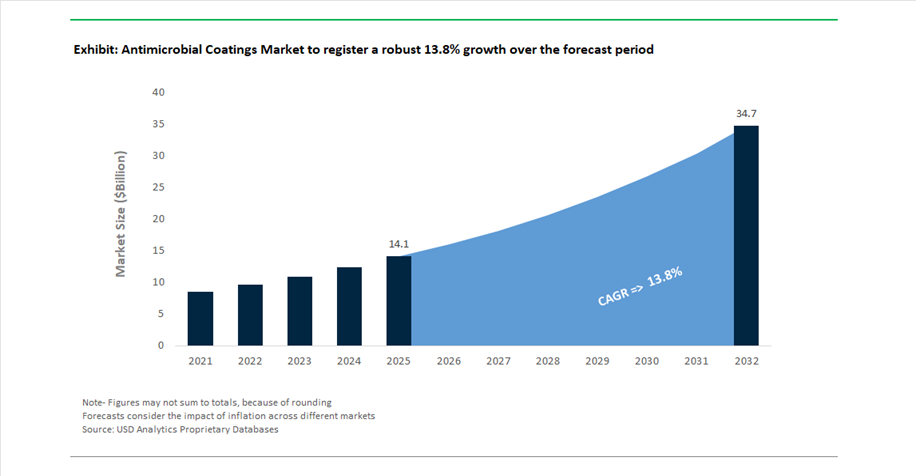
The Antimicrobial Coatings Market is experiencing accelerated expansion, projected to grow from USD 14.1 billion in 2025 to USD 34.85 billion by 2032, reflecting a strong CAGR of 13.8%. This high-growth trajectory is driven by increasing global emphasis on hygiene, indoor air quality, and contamination control, particularly across healthcare infrastructure, HVAC systems, food processing facilities, and high-traffic public environments.
Antimicrobial coatings are formulated with bioactive agents such as silver ions, photocatalysts, and organic antimicrobial compounds, designed to inhibit the growth of bacteria, mold, mildew, and other harmful microorganisms on coated surfaces. Their role has expanded beyond healthcare into commercial buildings, residential spaces, and industrial processing environments, where maintaining sterile and hygienic conditions is critical. In HVAC systems, these coatings help prevent microbial accumulation within ducts and air handling units, directly improving air quality and reducing the risk of airborne contamination.
The market is also benefiting from rising demand for multi-functional coatings that combine antimicrobial performance with low-VOC emissions, durability, and ease of cleaning, aligning with stringent environmental and safety regulations. Technological advancements are increasingly focused on visible-light-activated coatings, nano-enabled antimicrobial systems, and bio-based formulations, which provide continuous protection without relying on high concentrations of chemical agents.
Additionally, the growing adoption of smart building technologies and sustainable construction practices is driving the integration of antimicrobial coatings into architectural and industrial design specifications. Competitive dynamics are characterized by intensive R&D investment, strategic collaborations, and expansion into high-value applications, positioning antimicrobial coatings as a critical solution for next-generation hygiene and environmental control systems
AI-Driven Innovation, Strategic Consolidation, and High-Hygiene Applications Accelerating Market Evolution
The antimicrobial coatings market is undergoing rapid transformation driven by advanced material science, digital innovation, and strategic industry consolidation. Innovation is increasingly centered on AI-driven material development and advanced coating chemistries. In February 2026, Nippon Paint partnered with the University of Tokyo to launch Phase II of its co-creation initiative, focusing on leveraging generative AI to develop environmentally friendly antimicrobial coatings with reduced VOC emissions. This builds on the success of its PROTECTON® product line, which utilizes photocatalytic technology to provide long-lasting antimicrobial protection under ambient light conditions.
Product launches are reinforcing market expansion across high-hygiene applications. PPG’s Johnstone’s Trade Anti-Bacterial Matt utilizes silver-ion technology to inhibit bacteria such as MRSA and E. coli, targeting healthcare and educational facilities where durability and frequent cleaning resistance are essential. Similarly, Nippon Paint’s PROTECTON® Floor and Wall variants extend antimicrobial functionality to high-traffic surfaces, supporting hygiene in both commercial and residential environments.
Strategic investments and regional expansion are strengthening supply capabilities. RPM International’s January 2026 acquisition of a manufacturing facility in Malaysia enhances production capacity for antimicrobial coatings in Southeast Asia, particularly for food processing and healthcare markets. Meanwhile, AkzoNobel’s decision to retain its International Research Center in India (December 2025) underscores its focus on high-margin performance technologies, including advanced antimicrobial coatings.
Industry-wide premiumization trends are also shaping the competitive landscape. Axalta’s record earnings in February 2026 highlight the growing demand for high-functionality coatings, including antimicrobial solutions, as manufacturers shift toward value-added products.
Demand from institutional and healthcare sectors continues to surge. Sherwin-Williams reported strong growth in its healthcare coatings segment (January 2026), driven by increasing adoption of antimicrobial solutions in hospitals, surgical suites, and long-term care facilities.
EPA Re-Registration Mandates Elevating Efficacy Standards for Silver-Based Antimicrobial Coatings
The antimicrobial coatings industry is undergoing intensified regulatory scrutiny as the U.S. Environmental Protection Agency enforces stricter requirements under the FIFRA 15-year Registration Review cycle. Silver-based antimicrobial technologies, long considered a standard in surface protection, are now facing elevated performance validation thresholds, particularly for products seeking “public health” claims. Unlike copper, which maintains consistent regulatory acceptance, silver-based systems are increasingly evaluated for variability in wet-state versus dry-state efficacy, creating additional compliance complexity.
A critical regulatory shift is the enforcement of the two-hour efficacy benchmark. Coatings must now demonstrate a minimum 99.9% reduction in pathogens such as Staphylococcus aureus and Pseudomonas aeruginosa within a two-hour contact period, replacing earlier 24-hour testing frameworks used for treated articles. This requirement is significantly raising the bar for product validation, particularly for coatings designed for high-touch environments such as healthcare facilities and public infrastructure.
The regulatory landscape is also becoming more dynamic. In 2025, EPA registrations for disinfectants and antimicrobial products surged to 178 approvals, compared to just 45 in 2024, indicating a rapid acceleration in review throughput and a more competitive approval environment. Simultaneously, innovation in active ingredients is diversifying the market. Quaternary Ammonium Compounds and hybrid antimicrobial systems accounted for a significant portion of the 49 active ingredients approved in the latest cycle, reducing reliance on traditional silver-based chemistries.
Beyond federal approval, state-level registration requirements are emerging as a critical bottleneck. Manufacturers must now navigate multiple regulatory layers to achieve full commercialization, with state-level review timelines extending significantly into 2026. This multi-tiered compliance environment is driving investment in high-efficacy, multi-active formulations that can meet both federal and localized regulatory standards while maintaining consistent antimicrobial performance.
EU BPR Phase-Out of Zinc Pyrithione Driving Reformulation Across Industrial Coatings
The European antimicrobial coatings market is experiencing a major structural shift following the classification of Zinc Pyrithione as a CMR 1B substance under the Biocidal Products Regulation. This classification has triggered a mandatory phase-out of ZPT in coatings applications where safer alternatives are available, extending regulatory pressure beyond cosmetics into industrial and architectural coatings.
The impact on formulation strategies is significant. Approximately 30% of legacy antimicrobial coatings in Europe are currently undergoing reformulation to replace ZPT with compliant alternatives such as DCOIT and silver-glass hybrid systems. These substitutes must meet stringent safety and performance requirements while aligning with evolving regulatory expectations. The transition is particularly challenging for manufacturers that historically relied on ZPT for its broad-spectrum antimicrobial efficacy and cost-effectiveness.
Compliance complexity is further compounded by the enforcement of Article 58 under the BPR framework. Imported treated articles must now carry explicit labeling if the active substance used is not approved for the intended product type. This requirement is creating additional documentation and traceability burdens for global exporters, necessitating robust regulatory management systems and transparent supply chain reporting.
Pharmaceutical Cleanroom Coatings Driving Demand for High-Efficacy, Vapor-Resistant Antimicrobial Systems
The rapid expansion of advanced pharmaceutical manufacturing, particularly in cell and gene therapies, is creating strong demand for antimicrobial coatings designed for aseptic cleanroom environments. These facilities require coatings that not only inhibit microbial growth but also maintain vapor permeability and structural integrity under aggressive sterilization protocols.
High-performance antimicrobial coatings used in pharmaceutical cleanrooms are now achieving a 4-log (99.99%) reduction in E. coli within 24 hours, as validated under ISO 22196 testing standards. These coatings are engineered to withstand repeated exposure to vaporized hydrogen peroxide sterilization, a critical requirement for maintaining sterility in Grade A and Grade B cleanroom environments. Unlike conventional coatings, these advanced systems provide long-term antimicrobial protection without compromising airflow or moisture management, which are essential for maintaining controlled environmental conditions.
In addition to surface applications, antimicrobial coatings are being integrated into HVAC and air handling systems, where they act as a secondary barrier against microbial colonization in moisture-prone areas. This integration enhances overall contamination control and reduces the risk of biofilm formation, which can compromise cleanroom performance.
Operational longevity is another key driver. The industry is shifting toward coatings that guarantee antimicrobial efficacy for five to seven years, reducing the need for frequent recoating and minimizing costly facility shutdowns. As pharmaceutical manufacturing continues to scale globally, antimicrobial cleanroom coatings are becoming a critical component of facility design and operational efficiency.
Cruise Ship Interior Coatings Enhancing Hygiene Standards and Passenger Safety
The resurgence of the global cruise industry is driving renewed focus on hygiene and infection control, creating a strong demand for high-durability antimicrobial coatings in marine interiors. Vessel Sanitation Program standards have become increasingly stringent, with cruise operators prioritizing surface hygiene to maintain high inspection scores and passenger confidence.
Antimicrobial coatings are being widely deployed on high-touch surfaces such as handrails, elevator buttons, cabin fixtures, and dining areas, forming a continuous protective layer that complements routine cleaning protocols. These coatings play a critical role in reducing surface bioburden, particularly in controlling the spread of acute gastroenteritis, which remains a persistent risk in densely populated onboard environments. Surveillance data indicates a daily attack rate of approximately 0.45% for such infections, highlighting the need for proactive surface protection strategies.
Durability is a key requirement in this segment. Coatings must withstand constant physical contact from thousands of passengers, as well as exposure to harsh cleaning chemicals and saline marine environments. Next-generation UV-curable antimicrobial coatings are engineered to maintain performance under these conditions, ensuring long-term efficacy without degradation.
From a regulatory standpoint, compliance with CDC Vessel Sanitation Program guidelines now includes the implementation of Outbreak Prevention and Response Plans, where antimicrobial coatings are recognized as a critical preventive measure. This integration of coating technology into broader hygiene frameworks is positioning antimicrobial coatings as an essential component of modern cruise ship design and operation, supporting both safety and brand reputation objectives.
Metallic Antimicrobial Coatings Dominate with 58% Share Driven by Silver Ion Technology and Long-Term Efficacy
Active Agent Analysis: Silver and Copper-Based Coatings Lead with Non-Depleting Antimicrobial Mechanisms
Metallic antimicrobial coatings command a dominant 58.0% share of the global antimicrobial coatings market in 2025, led primarily by silver ions, silver nanoparticles, and copper-based coatings. These materials provide broad-spectrum antimicrobial protection against Gram-positive and Gram-negative bacteria, fungi, and enveloped viruses, making them the industry standard for high-performance applications. Unlike organic antimicrobial agents, metallic coatings operate via a catalytic, non-depleting mechanism, continuously disrupting microbial cell membranes and DNA without losing efficacy over time. This durability makes them ideal for long-life infrastructure such as HVAC systems, door hardware, elevator buttons, and public touch surfaces. Additionally, strong regulatory backing under EPA FIFRA and EU Biocidal Products Regulation (BPR) ensures widespread adoption, while innovations like copper-infused epoxy coatings and zinc-silver hybrids provide dual benefits of antimicrobial action and corrosion resistance, especially in food processing and industrial environments.
Medical & Healthcare Sector Leads with 34% Share Driven by HAI Prevention and Advanced Device Coatings
End-Use Industry Analysis: Hospital Infrastructure and Implantable Devices Fuel Market Growth
The medical and healthcare segment accounts for 34.0% of the antimicrobial coatings market in 2025, driven by increasing focus on hospital-acquired infection (HAI) prevention and stringent reimbursement policies from CMS (Centers for Medicare & Medicaid Services). Healthcare facilities are investing in continuous antimicrobial surface protection, applying coatings on bed rails, IV poles, door handles, overbed tables, and light switches to reduce microbial load between cleaning cycles. High-value applications include silver-alloy hydrogel coatings on central venous catheters (CVCs) and urinary catheters, which are now the standard of care for preventing CLABSI and CAUTI infections. Additionally, silver-doped hydroxyapatite coatings on orthopedic implants are increasingly adopted to mitigate periprosthetic joint infections (PJI). A key 2025 trend is the integration of antimicrobial coatings into evidence-based design (EBD) standards, where hospitals specify copper-nickel alloy surfaces and silver-ion infused paints during construction, ensuring long-term demand growth in the global antimicrobial coatings market.
Antimicrobial Coatings Market Competitive Landscape Driven by Functional Surfaces and Healthcare Demand
The antimicrobial coatings market is driven by silver-ion coatings, nanomaterial-based additives, and low-VOC formulations. Leading players are focusing on healthcare infrastructure, packaging, automotive, and public transit applications to enhance surface hygiene, durability, and regulatory compliance across high-touch environments.
AkzoNobel leads antimicrobial coatings with functional surface enhancement and powder coating innovation
AkzoNobel holds one-fifth share in the antimicrobial coatings market, supported by its Interpon® and Resicoat® powder coatings portfolio. The company is advancing “Functional Surface Enhancement” strategies by integrating antibacterial and self-cleaning properties into architectural coatings. Its 2025 waterborne basecoat systems achieved a 20% reduction in VOC emissions while maintaining 99.9% antibacterial efficacy for high-touch surfaces. Expansion into solar-absorbing wall technologies includes antimicrobial protection to prevent biofilm formation in renewable infrastructure. The company also extended antimicrobial coatings into deep-sea drilling vessels, demonstrating application across heavy-duty environments. Product development focuses on sustainable, high-performance antimicrobial coatings.
PPG Industries expands antimicrobial coatings with packaging innovation and automated dosing systems
PPG Industries continues to strengthen its antimicrobial coatings portfolio through high-performance industrial and packaging solutions. The company reported $15.9 billion in net sales in 2025, supported by aerospace and packaging coatings growth. Its HOBA® Pro 2848 coating provides non-BPA antimicrobial protection for aluminum beverage containers, addressing food safety and regulatory requirements. Expansion of manufacturing facilities in Thailand and North Carolina supports production of advanced antimicrobial coatings. The MOONWALK® automated mixing system enables precise dosing of antimicrobial additives in automotive refinish applications. Product development emphasizes sustainability, efficiency, and high-performance antimicrobial coatings.
Sherwin-Williams strengthens antimicrobial coatings with healthcare systems and infrastructure integration
Sherwin-Williams leverages its scale and distribution network to lead antimicrobial coatings in healthcare and institutional markets. The company supports a $23 billion+ revenue base with strong demand from hospital construction and renovation projects. Its antimicrobial wall coatings and FIRETEX® systems are designed for cleanrooms and surgical environments requiring high chemical and microbial resistance. Integrated solutions include coil coatings and structural primers that meet ISO 12944 C5 standards for extreme environments. Expansion into public transit coatings addresses hygiene requirements for high-touch surfaces in urban infrastructure. Product development focuses on durability, compliance, and large-scale application efficiency.
Nippon Paint drives APAC antimicrobial coatings growth through AI-driven innovation and nanomaterials
Nippon Paint Holdings is accelerating growth in antimicrobial coatings through research-driven innovation and regional expansion. The company launched Phase II of its collaboration with the University of Tokyo in 2026, focusing on AI-enabled design of eco-friendly antimicrobial coatings. It is scaling nanomaterial-based antimicrobial films for packaging and automotive sectors, building on earlier antiviral coating success. Its strategy aligns with reducing VOC and CO2 emissions, supporting green building initiatives in Asia. Strong growth in China and India is driven by increasing hospital construction and infrastructure development. Product development emphasizes advanced materials and sustainable coatings technologies.
Axalta advances antimicrobial coatings with mobility-focused innovations and high-margin coatings
Axalta Coating Systems continues to expand in antimicrobial coatings through its mobility and industrial coatings segments. The company reported $1.13 billion in adjusted EBITDA in 2025 with a 22.0% margin, reflecting strong performance in high-value coatings. Its antimicrobial clearcoats are gaining traction in mobility applications, particularly in EV and public infrastructure segments. The ENVIROCRON® Extreme Protection Edge Plus coating provides enhanced edge protection with integrated antimicrobial functionality for complex geometries. Strong cash flow supports ongoing investment in smart building materials and advanced coating technologies. Product development focuses on durability, safety, and long-term antimicrobial performance.
Bio-Gate leads medical antimicrobial coatings with implant-focused plasma technology
Bio-Gate AG specializes in antimicrobial coatings for medical devices and implants, targeting high-value healthcare applications. Its HyProtect™ plasma coating technology is under clinical evaluation for use in revision implants, aiming to prevent bacterial colonization in orthopedic procedures. The company targets the growing global aging population and the expanding orthopedic implant market. Laboratory results in 2026 confirmed effectiveness against multi-resistant bacteria, addressing critical healthcare challenges. Its commercial model includes customized antimicrobial implant solutions, with over 170 patients treated as of early 2026. Product development focuses on high-efficacy antimicrobial coatings for medical and clinical use.
United States Antimicrobial Coatings Market: Regulatory Breakthroughs and Healthcare Integration Driving Growth
The United States remains the global leader in antimicrobial coatings, supported by strong regulatory frameworks and rapid adoption across healthcare and public infrastructure. The introduction of EPA-registered microbicidal coatings, such as Paint Shield, has revolutionized the construction sector by enabling surfaces that actively eliminate bacteria within hours. Partnerships between major coating manufacturers and leading hospital networks are accelerating the use of copper-based antimicrobial coatings on high-touch surfaces like bed rails and IV poles, significantly reducing hospital-acquired infections.
Technological advancements are further strengthening the market, with innovations such as ultra-thin antimicrobial coatings offering easy-to-clean properties for medical plastics and ceramics. Public transit modernization programs are expanding the use of antimicrobial coatings in urban infrastructure, while aerospace applications are increasing demand for nanosilver coatings in aircraft interiors. Regulatory improvements under PRIA 5 are streamlining approvals for antimicrobial products, reinforcing the United States’ dominance in high-performance antimicrobial coating solutions.
China Antimicrobial Coatings Market: Smart City Integration and Nanotechnology Scaling
China dominates the antimicrobial coatings market in terms of production scale, driven by heavy investments in public health infrastructure and smart city initiatives. Large-scale government funding is accelerating the deployment of antimicrobial coatings across schools, airports, and hospitals, significantly expanding application scope.
Technological leadership in nanomaterials is a key driver, with extensive use of nano-silver and titanium dioxide coatings that provide both antimicrobial and self-cleaning properties. Building regulations mandating antimicrobial HVAC systems are improving indoor air quality in major cities. Additionally, the electronics sector is integrating antimicrobial coatings into smartphones and wearable devices, while food processing industries are adopting antibacterial materials to meet stricter hygiene standards. These developments position China as a dominant force in high-volume antimicrobial coating production.
Germany Antimicrobial Coatings Market: Bio-Based Innovation and Sustainable Chemistry Leadership
Germany’s antimicrobial coatings market is defined by its leadership in sustainable chemistry and regulatory compliance. The development of bio-based antimicrobial coatings, particularly those derived from chitosan, is aligning with strict EU environmental standards and promoting biodegradable, non-leaching solutions.
The automotive industry is a major driver, with luxury vehicle manufacturers integrating photocatalytic antimicrobial surfaces into interior components. Regulatory frameworks such as VDI standards are setting benchmarks for antimicrobial ventilation systems, while eco-labeling initiatives are encouraging the adoption of low-VOC coatings. Additionally, increased demand from hospitality and infrastructure sectors is expanding the use of antimicrobial coatings in furniture, fixtures, and public spaces, reinforcing Germany’s leadership in sustainable antimicrobial technologies.
Japan Antimicrobial Coatings Market: Advanced Nanotechnology and Aging Population Solutions
Japan’s antimicrobial coatings market is driven by high innovation and a strong focus on healthcare and urban infrastructure. Technologies such as VirusGuard coatings are widely deployed across transportation systems, including high-speed rail networks, to ensure high levels of hygiene in public spaces.
The country is also advancing nanoscale materials, including long-lasting copper-based antimicrobial coatings designed for extended durability. The development of soft-touch coatings for elderly care environments highlights Japan’s focus on user safety and comfort. Additionally, antimicrobial coatings are being integrated into electronics and textiles, expanding their application scope. Strict regulatory compliance with international standards ensures high-quality and globally competitive products, positioning Japan as a leader in advanced antimicrobial coating technologies.
India Antimicrobial Coatings Market: Public Health Initiatives and Infrastructure Expansion Fueling Growth
India is emerging as one of the fastest-growing markets for antimicrobial coatings, driven by strong government initiatives and expanding infrastructure. Programs such as Swachh Bharat 2.0 are promoting the widespread use of antimicrobial coatings in public sanitation facilities, improving hygiene standards across urban and rural areas.
The expansion of pharmaceutical manufacturing hubs is also increasing demand for antimicrobial coatings in production facilities, ensuring compliance with global quality standards. The adoption of antimicrobial coatings in packaging and smart city infrastructure is further expanding market opportunities. Additionally, government incentives under the PLI scheme are supporting domestic production of antimicrobial additives, strengthening supply chains and reducing dependency on imports. These factors are positioning India as a key growth market in the global antimicrobial coatings industry.
United Kingdom Antimicrobial Coatings Market: Graphene Innovation and Regulatory Evolution
The United Kingdom antimicrobial coatings market is advancing through innovation in graphene-based materials and evolving regulatory frameworks. The adoption of graphene-enhanced antimicrobial coatings in healthcare infrastructure is improving durability and performance, particularly in modular hospital constructions.
Post-Brexit regulatory developments are emphasizing lifecycle safety and environmental impact, influencing product development strategies. Applications in heritage preservation and public infrastructure are expanding, with antimicrobial coatings being used to protect historical sites and reduce microbial contamination. Additionally, investments in antimicrobial resistance research are driving innovation, positioning the UK as a leader in next-generation antimicrobial coating technologies.
South Korea Antimicrobial Coatings Market: Display Integration and Smart Surface Technologies
South Korea’s antimicrobial coatings market is evolving rapidly, driven by advancements in electronics and smart technologies. Leading manufacturers are integrating antimicrobial coatings directly into display substrates, enhancing durability and hygiene in consumer electronics.
Applications in public transportation systems and smart buildings are expanding, with antimicrobial coatings being used to improve safety and indoor air quality. The cosmetics industry is also adopting antimicrobial coatings in packaging to prevent contamination. Government incentives for developing smart sensors and biosensors are further driving innovation, while strong manufacturing capabilities are supporting large-scale production. These developments position South Korea as a leader in high-tech antimicrobial coating solutions.
Russia Antimicrobial Coatings Market: Industrial Applications and Extreme Environment Solutions
Russia’s antimicrobial coatings market is characterized by its focus on industrial applications and extreme environmental conditions. The development of metallic-based antimicrobial coatings using copper and silver ions is enabling long-term durability in infrastructure and industrial systems.
Applications in Arctic oil and gas infrastructure are particularly significant, where antimicrobial coatings are used to prevent microbial-induced corrosion. Government mandates supporting domestic production of antimicrobial coatings are strengthening the local industry. Additionally, large-scale retrofitting of public transportation systems and adoption in food storage infrastructure are driving demand. Regulatory alignment with updated hygiene standards is further ensuring product quality and performance, positioning Russia as a key player in specialized antimicrobial coating applications.
Antimicrobial Coatings Market Report Scope
Antimicrobial Coatings Market
Parameter
Details
Market Size (2025)
$14.1 Billion
Market Size (2032)
$34.9 Billion
Market Growth Rate
13.8%
Segments
By Active Agent (Metallic Coatings, Organic Coatings, Smart Systems), By Coating Technology (Water-borne, Solvent-borne, Powder Coatings, Surface Modifications, Radiation Curable Systems), By Mechanism of Action (Contact-Killing, Release-Based, Anti-Adhesion, Multi-modal), By End-Use Industry (Medical and Healthcare, Food and Beverage, Building and Construction, Electronics and Consumer Goods, Textiles and Apparel, Transportation, Water and Waste Treatment), By Performance Specification (Broad-Spectrum Efficacy, Pathogen-Specific, Renewable)
Study Period
2019- 2025 and 2026-2032
Units
Revenue (USD)
Qualitative Analysis
Porter’s Five Forces, SWOT Profile, Market Share, Scenario Forecasts, Market Ecosystem, Company Ranking, Market Dynamics, Industry Benchmarking
Companies
Akzo Nobel N.V., PPG Industries, Inc., The Sherwin-Williams Company, Axalta Coating Systems Ltd., BASF SE, Nippon Paint Holdings Co., Ltd., RPM International Inc., Sika AG, Lonza Group AG, Microban International, Ltd., BioCote Limited, Sciessent LLC, Hempel A/S, Jotun A/S, DSM-Firmenich
Countries
US, Canada, Mexico, Germany, France, Spain, Italy, UK, Russia, China, India, Japan, South Korea, Australia, South East Asia, Brazil, Argentina, Middle East, Africa
Antimicrobial Coatings Market Segmentation
By Active Agent
Metallic Coatings
Silver
Copper
Zinc
Titanium Dioxide
Organic Coatings
Polymeric
Bio-based
Smart Systems
By Coating Technology
Water-borne
Solvent-borne
Powder Coatings
Surface Modifications
Radiation Curable Systems
By Mechanism of Action
Contact-Killing
Release-Based
Anti-Adhesion
Multi-modal
By End-Use Industry
Medical and Healthcare
Food and Beverage
Building and Construction
Electronics and Consumer Goods
Textiles and Apparel
Transportation
Water and Waste Treatment
By Performance Specification
Broad-Spectrum Efficacy
Pathogen-Specific
Renewable
Leading Countries in the Industry
North America (United States, Canada, Mexico)
Europe (Germany, France, Spain, United Kingdom, Italy, Russia, Rest of Europe)
Asia Pacific (China, India, Japan, South Korea, Australia, South East Asia, Rest of APAC)
South and Central America (Brazil, Argentina, Rest of SCA)
Middle East and Africa (Saudi Arabia, UAE, MENA, Sub-Saharan Africa)
Top Companies in Antimicrobial Coatings Market
Akzo Nobel N.V.
PPG Industries, Inc.
The Sherwin-Williams Company
Axalta Coating Systems Ltd.
BASF SE
Nippon Paint Holdings Co., Ltd.
RPM International Inc.
Sika AG
Lonza Group AG
Microban International, Ltd.
BioCote Limited
Sciessent LLC
Hempel A/S
Jotun A/S
DSM-Firmenich
*- List not Exhaustive
Table of Contents: Antimicrobial Coatings Market
1. Executive Summary
1.1. Market Highlights
1.2. Key Findings
1.3. Global Market Snapshot
2. Antimicrobial Coatings Market Landscape & Outlook (2025–2032)
2.1. Introduction to Antimicrobial Coatings Market
2.2. Market Valuation and Growth Projections (2025–2032)
2.3. Role of Antimicrobial Coatings in Indoor Air Quality and Hygiene Control
2.4. Regulatory Impact: EPA, BPR, and Global Compliance Frameworks
2.5. Expansion Across Healthcare, HVAC, Food Processing, and Smart Buildings
3. Innovations Reshaping the Antimicrobial Coatings Market
3.1. Trend: AI-Driven Material Innovation and Photocatalytic Coatings
3.2. Trend: Nano-Enabled and Visible-Light Activated Antimicrobial Systems
3.3. Opportunity: High-Performance Cleanroom and Pharmaceutical Coatings
3.4. Opportunity: Marine and Cruise Ship Interior Hygiene Applications
4. Competitive Landscape and Strategic Initiatives
4.1. Mergers and Acquisitions
4.2. R&D and Material Innovation
4.3. Sustainability and ESG Strategies
4.4. Market Expansion and Regional Focus
5. Market Share and Segmentation Insights: Antimicrobial Coatings Market
5.1. By Active Agent
5.1.1. Metallic Coatings
5.1.1.1. Silver
5.1.1.2. Copper
5.1.1.3. Zinc
5.1.1.4. Titanium Dioxide
5.1.2. Organic Coatings
5.1.2.1. Polymeric
5.1.2.2. Bio-based
5.1.3. Smart Systems
5.2. By Coating Technology
5.2.1. Water-borne
5.2.2. Solvent-borne
5.2.3. Powder Coatings
5.2.4. Surface Modifications
5.2.5. Radiation Curable Systems
5.3. By Mechanism of Action
5.3.1. Contact-Killing
5.3.2. Release-Based
5.3.3. Anti-Adhesion
5.3.4. Multi-modal
5.4. By End-Use Industry
5.4.1. Medical and Healthcare
5.4.2. Food and Beverage
5.4.3. Building and Construction
5.4.4. Electronics and Consumer Goods
5.4.5. Textiles and Apparel
5.4.6. Transportation
5.4.7. Water and Waste Treatment
5.5. By Performance Specification
5.5.1. Broad-Spectrum Efficacy
5.5.2. Pathogen-Specific
5.5.3. Renewable
6. Country Analysis and Outlook of Antimicrobial Coatings Market
6.1. United States
6.2. Canada
6.3. Mexico
6.4. Germany
6.5. France
6.6. Spain
6.7. Italy
6.8. UK
6.9. Russia
6.10. China
6.11. India
6.12. Japan
6.13. South Korea
6.14. Australia
6.15. South East Asia
6.16. Brazil
6.17. Argentina
6.18. Middle East
6.19. Africa
7. Antimicrobial Coatings Market Size Outlook by Region (2025–2032)
7.1. North America Antimicrobial Coatings Market Size Outlook to 2032
7.1.1. By Active Agent
7.1.2. By Coating Technology
7.1.3. By Mechanism of Action
7.1.4. By End-Use Industry
7.1.5. By Performance Specification
7.2. Europe Antimicrobial Coatings Market Size Outlook to 2032
7.2.1. By Active Agent
7.2.2. By Coating Technology
7.2.3. By Mechanism of Action
7.2.4. By End-Use Industry
7.2.5. By Performance Specification
7.3. Asia Pacific Antimicrobial Coatings Market Size Outlook to 2032
7.3.1. By Active Agent
7.3.2. By Coating Technology
7.3.3. By Mechanism of Action
7.3.4. By End-Use Industry
7.3.5. By Performance Specification
7.4. South America Antimicrobial Coatings Market Size Outlook to 2032
7.4.1. By Active Agent
7.4.2. By Coating Technology
7.4.3. By Mechanism of Action
7.4.4. By End-Use Industry
7.4.5. By Performance Specification
7.5. Middle East and Africa Antimicrobial Coatings Market Size Outlook to 2032
7.5.1. By Active Agent
7.5.2. By Coating Technology
7.5.3. By Mechanism of Action
7.5.4. By End-Use Industry
7.5.5. By Performance Specification
8. Company Profiles: Leading Players in the Antimicrobial Coatings Market
8.1. Akzo Nobel N.V.
8.2. PPG Industries, Inc.
8.3. The Sherwin-Williams Company
8.4. Axalta Coating Systems Ltd.
8.5. BASF SE
8.6. Nippon Paint Holdings Co., Ltd.
8.7. RPM International Inc.
8.8. Sika AG
8.9. Lonza Group AG
8.10. Microban International, Ltd.
8.11. BioCote Limited
8.12. Sciessent LLC
8.13. Hempel A/S
8.14. Jotun A/S
8.15. DSM-Firmenich
9. Methodology
9.1. Research Scope
9.2. Market Research Approach
9.3. Market Sizing and Forecasting Model
9.4. Research Coverage
9.5. Data Horizon
9.6. Deliverables
10. Appendix
10.1. Acronyms and Abbreviations
10.2. List of Tables
10.3. List of Figures
Antimicrobial Coatings Market Segmentation
By Active Agent
Metallic Coatings
Silver
Copper
Zinc
Titanium Dioxide
Organic Coatings
Polymeric
Bio-based
Smart Systems
By Coating Technology
Water-borne
Solvent-borne
Powder Coatings
Surface Modifications
Radiation Curable Systems
By Mechanism of Action
Contact-Killing
Release-Based
Anti-Adhesion
Multi-modal
By End-Use Industry
Medical and Healthcare
Food and Beverage
Building and Construction
Electronics and Consumer Goods
Textiles and Apparel
Transportation
Water and Waste Treatment
By Performance Specification
Broad-Spectrum Efficacy
Pathogen-Specific
Renewable
Leading Countries in the Industry
North America (United States, Canada, Mexico)
Europe (Germany, France, Spain, United Kingdom, Italy, Russia, Rest of Europe)
Asia Pacific (China, India, Japan, South Korea, Australia, South East Asia, Rest of APAC)
South and Central America (Brazil, Argentina, Rest of SCA)
Middle East and Africa (Saudi Arabia, UAE, MENA, Sub-Saharan Africa)
The antimicrobial coatings market is valued at USD 14.1 billion in 2025 and is projected to reach USD 34.85 billion by 2032, growing at a CAGR of 13.8%. This rapid expansion is driven by rising hygiene standards across healthcare, food processing, and public infrastructure. Increasing awareness of indoor air quality and contamination control is further accelerating adoption globally.
Key drivers include increasing demand for infection prevention, improved indoor air quality, and stricter food safety regulations. Trends include AI-driven coating development, visible-light-activated antimicrobial systems, and nano-enabled coatings. The market is also shifting toward low-VOC, sustainable, and multi-functional coating technologies.
Regulations such as EPA’s FIFRA review cycle and EU Biocidal Products Regulation are raising efficacy and safety standards. Requirements like 99.9% pathogen reduction within two hours are pushing manufacturers toward high-performance formulations. Compliance complexity is also increasing due to multi-level regulatory approvals across regions.
Metallic antimicrobial coatings, especially silver and copper-based systems, dominate with a 58% market share due to their long-term efficacy. The healthcare sector leads with 34% demand, driven by hospital-acquired infection prevention. HVAC systems, food processing facilities, and smart buildings are also high-growth application areas.
Leading players include Akzo Nobel N.V., PPG Industries, Inc., The Sherwin-Williams Company, Axalta Coating Systems Ltd., BASF SE, Nippon Paint Holdings Co., Ltd., and RPM International Inc.. These firms are investing in advanced materials, sustainability, and high-performance antimicrobial solutions.