Growing Concerns over HAIs and Sustainable Agents Drive the Antimicrobial Medical Textile Market to USD 8.1 Billion by 2034
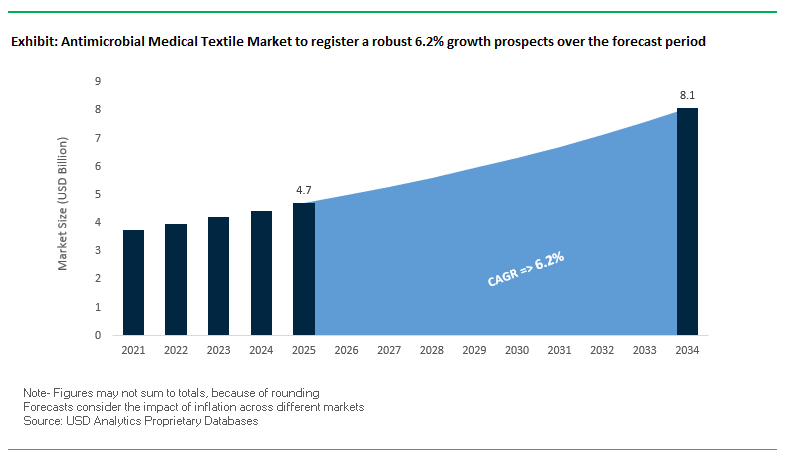
The global antimicrobial medical textile market is valued at USD 4.7 billion in 2025 and is projected to expand to USD 8.1 billion by 2034, advancing at a steady CAGR of 6.2%. The rise is strongly tied to the urgent need for infection control solutions in healthcare facilities, where healthcare-associated infections (HAIs) remain a persistent challenge. Antimicrobial medical fabrics ranging from hospital curtains and scrubs to bed linens play a critical role in reducing microbial contamination and ensuring safer environments for patients and healthcare staff.
Silver-based antimicrobial agents remain the cornerstone of this market due to their proven biocidal properties, broad-spectrum activity, and durability even after repeated laundering cycles. At the same time, manufacturers are moving toward sustainable antimicrobial agents, focusing on non-leaching solutions that minimize environmental impact while maintaining textile efficacy. Compliance with stringent regulatory standards such as the U.S. Environmental Protection Agency (EPA) guidelines and the European Biocidal Products Regulation (BPR) is shaping innovation strategies, making regulatory readiness a competitive differentiator for manufacturers.
Key Insights for Professionals
HAI prevention remains the biggest driver for adoption of antimicrobial medical textiles.
Silver ions dominate as the most effective active agent, with wide application in hospital apparel and linens.
Sustainable agents are gaining traction as hospitals demand eco-friendly, durable, and non-leaching alternatives.
Regulatory frameworks such as EPA and BPR dictate compliance, pushing companies toward safe, standardized solutions.
Market Analysis: Recent Innovations and Strategic Partnerships Accelerate Growth in Antimicrobial Medical Textiles
The antimicrobial medical textile market is evolving rapidly, driven by new technologies, sustainability ratings, and strategic collaborations. In August 2025, researchers at IIT Madras developed a low-cost chip-based device for rapid antibiotic susceptibility testing, a breakthrough that complements antimicrobial textiles in combating resistant pathogens. Similarly, in May 2025, Milliken & Company earned the EcoVadis Gold rating for sustainability, strengthening its positioning as a leader in eco-friendly textile practices.
Key product innovations include Sanitized’s Puretec (October 2024), a non-leaching and metal-free antimicrobial solution that works across all fiber types and maintains effectiveness for at least 75 washes. Likewise, Microban International launched Ascera (October 2024), a nature-inspired antimicrobial technology designed for olefinic polymers and coatings. These solutions reflect the market’s shift toward safer, long-lasting, and environmentally responsible formulations.
Partnerships and R&D collaborations are also shaping the industry. In September 2024, BASF partnered with Swiss research institute Empa to evaluate a new pathogen-killing antimicrobial textile coating for hospital curtains. Earlier in May 2024, the U.S. Army Combat Capabilities Development Command and the University of Akron developed a coating aimed at protecting soldiers’ uniforms from infectious agents. Start-ups are also contributing: Smartex Medical (November 2023) introduced antimicrobial scrubs and lab coats infused with silver technology to improve safety for healthcare workers.
Emerging Trends and Opportunities in the Antimicrobial Medical Textile Market
Strategic Shift Towards Intrinsic, Non-Leaching Biocidal Technologies
The global market is witnessing a decisive transition away from conventional leaching antimicrobials like triclosan and silver ions, which face mounting regulatory scrutiny due to environmental toxicity and microbial resistance. Instead, manufacturers are investing in non-migratory, contact-active solutions where antimicrobial functionality is permanently embedded within the fiber. These technologies such as permanently bound cationic polymers or photoactive agents disable pathogens upon contact without releasing chemicals into the environment.
This shift brings multiple benefits. First, it provides durability, with certain treatments achieving 99% microbial reduction even after 50+ washes, ensuring extended product lifespan in high-use healthcare environments. Second, the mechanism of action physical cell wall disruption rather than chemical poisoning minimizes the risk of resistance development. Third, it aligns with regulatory compliance, as bodies like the U.S. EPA and EU regulators intensify scrutiny of migratory antimicrobials. By adopting intrinsic, carbon-free solutions, manufacturers can market their products as safer for both patients and ecosystems, strengthening their competitive positioning in the global healthcare textile supply chain.
Integration of Smart Sensing and Monitoring Capabilities
The convergence of antimicrobial textiles with digital health technologies is redefining their role from passive protection to active medical devices. By integrating conductive yarns, microsensors, and data transmission capabilities, antimicrobial textiles are enabling real-time monitoring of patient vitals, wound healing progress, and pathogen presence.
Applications are already gaining traction. Smart hospital gowns and patient garments embedded with flexible microsensors allow continuous tracking of heart rate, respiration, and temperature, supporting the growth of remote patient care. Similarly, pH-sensitive wound dressings are being developed to detect early signs of infection, transmitting data wirelessly to clinicians for timely interventions. Hospitals are also trialing antimicrobial bed linens and staff uniforms with microbial detection features, offering a proactive defense against hospital-acquired infections such as MRSA. These developments illustrate a growing synergy between infection prevention, personalized healthcare, and smart monitoring, creating new value streams in the medical textile market.
Development of Advanced Anti-Biofilm Textiles for Chronic Wound Management
Biofilms represent one of the most pressing challenges in wound care, as they account for over 80% of chronic wound infections and exhibit resistance up to 1,000 times greater than planktonic bacteria. Antimicrobial medical textiles designed to disrupt biofilm formation and persistence present a significant market opportunity.
Research is advancing in two main directions: textiles that inhibit microbial adhesion to surfaces and those that actively dismantle biofilm matrices. Enzyme-infused fabrics, peptide-coated dressings, and nano-engineered fibers are being explored to break down the extracellular polymeric substances that protect biofilms. By making bacteria more susceptible to antimicrobials and immune defenses, these textiles could transform the management of diabetic ulcers, pressure sores, and post-surgical wounds. For manufacturers, this represents a high-value niche where innovation could significantly reduce healthcare costs and improve patient recovery outcomes.
Commercialization of Biodegradable and Biobased Substrates with Intrinsic Antimicrobial Properties
The growing push for sustainability in healthcare is creating strong demand for biodegradable and bio-based medical textiles that combine antimicrobial functionality with eco-friendly disposal. Natural materials like chitosan, derived from crustacean shells, exhibit inherent antimicrobial and hemostatic properties, making them ideal for wound dressings and surgical applications. Other biopolymers, such as lignin a byproduct of the pulp and paper industry are being repurposed to impart antibacterial properties to fabrics while reducing industrial waste.
By leveraging renewable resources, manufacturers can address both infection control and end-of-life concerns, positioning their products as part of a circular healthcare economy. These innovations also resonate with ESG-focused procurement strategies in hospitals, where sustainability is now a key purchasing criterion. The commercialization of bio-based antimicrobial textiles offers a pathway to differentiation, combining performance, regulatory compliance, and environmental responsibility in a single solution.
Competitive Landscape: Industry Leaders Compete Through Sustainable Innovations and Advanced Antimicrobial Solutions
The competitive landscape of the antimicrobial medical textile market is marked by established chemical and textile giants alongside specialized innovators. Companies are investing heavily in sustainable technologies, advanced antimicrobial formulations, and global expansion to secure their competitive positions.
Milliken & Company: Sustainability Recognition and Breakthrough BioSmart Technology
Milliken has become a frontrunner in antimicrobial medical textiles through innovations such as BioSmart technology, which binds chlorine during laundering to kill up to 99.9% of bacteria and viruses for at least 75 washes. In May 2025, the company was awarded the EcoVadis Gold rating for sustainability, reinforcing its eco-conscious leadership. With a strong product line including AlphaSan silver-based additives, Milliken combines textile expertise and chemical innovation to offer solutions for hospital garments, scrubs, and medical devices.
BASF SE: Leveraging Material Science for Next-generation Antimicrobial Coatings
BASF is actively expanding its antimicrobial textile portfolio with innovative coatings. In 2024, the company collaborated with Empa to evaluate a pathogen-killing coating for hospital curtains, aiming to reduce germ transmission in healthcare settings. BASF’s strength lies in its global R&D network and material science expertise, enabling rapid commercialization of advanced solutions. Its focus remains on delivering high-performance, sustainable products that meet stringent regulatory standards while addressing infection-control needs.
Dow Inc.: Enhancing Medical Textiles with Proprietary Silicone and Antimicrobial Solutions
Dow is driving innovation in healthcare-focused materials, with antimicrobial technologies integrated into its DOWSIL silicone solutions. These materials offer durability, anti-static benefits, and antimicrobial properties for medical textiles and devices. The company continues to leverage its broad materials expertise and global market presence to address evolving healthcare demands, with an emphasis on safety, product integrity, and long-term sustainability.
Life Threads LLC: Fashion-forward Medical Apparel with Built-in Protection
Life Threads stands out as a specialist in antimicrobial, fluid-repellent, and anti-fungal apparel for healthcare professionals. Its focus on comfort, fashion, and embedded protective technologies has gained traction in hospitals and clinics. The company is actively expanding production capacity and investing in new facilities to serve a global customer base. With its expertise in high-quality medical apparel manufacturing, Life Threads addresses both the safety requirements of healthcare environments and the comfort expectations of frontline workers.
Antimicrobial Medical Textile Market Share Insights
Surgical Drapes & Gowns Dominate Market Share by Product Type in Antimicrobial Medical Textiles
Surgical drapes and gowns account for the largest share of the antimicrobial medical textile market, commanding 30% due to their irreplaceable role in infection prevention during surgical procedures. These single-use sterile textiles form the primary barrier between patients and surgical staff, directly reducing the risk of Surgical Site Infections (SSIs), which remain one of the most costly and serious healthcare-associated infections (HAIs) globally. The premium demand for these products is supported by strict regulatory requirements from agencies such as the FDA and EMA, alongside hospital procurement policies that prioritize certified antimicrobial protection. Wound dressings follow closely, with 25% of market share, reflecting their critical role in modern wound care management for burns, diabetic ulcers, and chronic wounds. The integration of silver, iodine, and advanced polymer coatings into dressings drives innovation in this space, reducing infection rates while accelerating healing. Other segments, including scrubs, uniforms, bedding, and curtains, are growing steadily as healthcare systems adopt proactive infection control beyond the operating room. Though implants account for a smaller share, antimicrobial-coated meshes and grafts represent a high-value niche, addressing the severe risks of implant-associated infections in cardiovascular and orthopedic procedures.
Hospitals Command the Largest Share by End-Use in Antimicrobial Medical Textiles
Hospitals dominate the antimicrobial medical textile market with a projected 65% share, underpinned by their high patient volumes, diverse care settings, and strict infection prevention standards. The cost burden of HAIs estimated to add billions annually to healthcare expenditures makes investment in antimicrobial drapes, gowns, bedding, and uniforms a necessity rather than an option. Ambulatory Surgical Centers (ASCs) represent the fastest-growing end-use segment as healthcare continues shifting toward outpatient and minimally invasive procedures. Their reliance on antimicrobial single-use gowns and drapes mirrors hospital protocols, ensuring the same level of sterility and patient safety at lower operational costs. Clinics, particularly wound care centers and dialysis facilities, also drive demand for antimicrobial dressings and uniforms as they cater to immunocompromised patients outside of acute hospital environments. The “Others” category, comprising long-term care facilities, nursing homes, and even veterinary clinics, is expanding as antimicrobial textiles are adopted to safeguard vulnerable populations and reduce outbreaks in non-traditional healthcare environments.
United States: Regulatory Framework and Technological Innovations Driving Antimicrobial Medical Textiles
The U.S. antimicrobial medical textile market is strongly shaped by regulations from the Food and Drug Administration (FDA) and the Environmental Protection Agency (EPA), which govern the use of substances in medical textiles and antimicrobial additives. Technological advancements are revolutionizing the industry, with the integration of silver and copper nanoparticles directly into textile fibers to provide durable, long-lasting protection against pathogens. Corporate initiatives, such as Herculite® Products Inc.’s launch of a dedicated e-commerce platform for its Sure-Chek® antimicrobial fabrics, are making procurement more accessible for healthcare institutions.
The high prevalence of hospital-acquired infections (HAIs) is a key driver, pushing healthcare facilities to adopt antimicrobial textiles in surgical gowns, bed linens, and curtains to curb infection rates. The U.S. healthcare sector, backed by a $176 billion medical technology market and NIH-funded research, is investing heavily in advanced medical textiles. Antimicrobial medical textiles are also increasingly adopted in home healthcare settings, driven by the growing preference for at-home care solutions. Key applications span hospitals, clinics, and home care, with an emphasis on patient safety and sterile environments.
Germany: Stringent Regulations and Collaborative R&D Propel Market Growth
Germany’s antimicrobial medical textiles market operates under a stringent regulatory framework, primarily guided by the EU Biocidal Products Regulation (BPR), ensuring the safe use of biocidal agents in textiles. The country is at the forefront of research and development, with institutions like the German Institutes of Textile and Fiber Research (DITF) and companies like Heraeus developing textiles using catalytic redox reactions initiated by AGXX particles for long-lasting antimicrobial efficacy.
Governmental support, including funding from the Federal Ministry of Education and Research (BMBF) under programs like CARB-X, fuels innovation in infection control textiles. Applications are especially strong in hospitals, with products such as surgical drapes, gowns, masks, and patient apparel in high demand. Sustainability is emphasized, with companies investing in recyclable and eco-friendly antimicrobial fabrics. Collaborations between research institutions and private companies, exemplified by DITF and Heraeus, further reinforce Germany’s leadership in developing next-generation antimicrobial medical textiles.
China: Policy-Driven Growth and Mass Production Capabilities Strengthen Market
China’s antimicrobial medical textile industry is driven by governmental initiatives such as “Made in China 2025” and the dual carbon goal, which promote eco-friendly and reusable materials. Technological advancements, including AI and “5G plus industrial internet,” enhance production efficiency and enable flexible, large-scale manufacturing of antimicrobial textiles. Academic research, like the development of antibacterial nanocellulose sheets at South China University of Technology, reflects the country’s commitment to advanced antimicrobial materials.
The massive healthcare sector and population drive demand for large-scale production of antimicrobial medical textiles. The pharmaceutical and healthcare industries are the primary applications, requiring sterile environments for medical devices and protective textiles. Investments in infrastructure, including new manufacturing plants and production lines, support the rapid expansion of sterile and protective antimicrobial fabrics, making China a key global hub for production.
India: Government Initiatives and Innovative R&D Fuel Market Expansion
India’s antimicrobial medical textile market benefits from initiatives such as “Make in India” and “Zero Effect Zero Defect,” which promote domestic production and industrial quality. Regulatory oversight from the Ministry of Textiles and CDSCO ensures safety and quality compliance for medical textiles. Research and development are thriving, with startups like Medicfibers collaborating with AIIMS New Delhi to create Viroclog®, an antimicrobial solution for textiles that reduces virus, bacteria, and fungi survival.
Technological advancements include the use of natural halloysite nanotubes for enhanced barrier and antimicrobial properties, as well as automated production systems for improved traceability and quality. Biodegradable and compostable materials, such as micro-copper embedded films by startups like Nanosafe, are gaining traction. The healthcare sector is the primary driver of demand, requiring surgical gowns, masks, and bedding, as the expanding healthcare infrastructure intensifies the need for protective antimicrobial textiles.
Brazil: Regulatory Oversight and Technological Advancements Drive Market Adoption
Brazil’s antimicrobial medical textiles market is regulated by ANVISA, ensuring safety and quality for medical and pharmaceutical applications. Technological innovations, such as textiles capable of eliminating coronavirus in two minutes using silver particles embedded in polyester-cotton blends, are transforming the market. Sustainability is a growing focus, driving development of eco-friendly antimicrobial materials.
Strategic investments are fueled by Brazil’s emergence as a key player in pharmaceutical and medical markets, increasing demand for protective textiles like surgical gowns, masks, and bedding. ANVISA’s technical notes clarify regulatory requirements for antiviral and antibacterial textiles, providing a structured framework that supports industry growth and compliance. Key applications center on hospitals and healthcare facilities, emphasizing infection control and patient safety.
Japan: Precision Manufacturing and Smart Textiles Accelerate Market Growth
Japan’s antimicrobial medical textiles market leverages its leadership in precision manufacturing, with companies like Asahi Kasei producing high-performance nonwoven fabrics for surgical gowns and medical applications. Governmental focus on technological innovation and supply chain security drives adoption in healthcare and elder care sectors. The market is characterized by continuous innovation to produce textiles with high dimensional stability and resistance to deformation, catering to high-performance applications.
Corporate collaborations, such as Asahi Kasei’s focus on quality and innovation, strengthen the market’s capacity for advanced antimicrobial solutions. The aging population and increasing single-person households are driving demand for easy-to-use protective textiles in home care settings. Sustainability remains a priority, with eco-friendly and recyclable materials increasingly adopted. Key applications include hospitals, home healthcare, and elder care, where safe and durable antimicrobial textiles are critical for infection prevention.
Antimicrobial Medical Textile Market Report Scope
Antimicrobial Medical Textile Market
Parameter
Details
Market Size (2025)
$4.7 Billion
Market Size (2034)
$8.1 Billion
Market Growth Rate
6.2%
Segments
By Active Agent (Metallic Nanoparticles, QACs, Chitosan, Triclosan, Others), By Fabric (Cotton, Polyester, Polyurethane, Others), By Product Type (Surgical Drapes & Gowns, Scrubs & Uniforms, Bedding & Curtains, Implants, Wound Dressings, Others), By End-Use (Hospitals, Clinics, Ambulatory Surgical Centers, Others)
Study Period
2019- 2024 and 2025-2034
Units
Revenue (USD)
Qualitative Analysis
Porter’s Five Forces, SWOT Profile, Market Share, Scenario Forecasts, Market Ecosystem, Company Ranking, Market Dynamics, Industry Benchmarking
US, Canada, Mexico, Germany, France, Spain, Italy, UK, Russia, China, India, Japan, South Korea, Australia, South East Asia, Brazil, Argentina, Middle East, Africa
Antimicrobial Medical Textile Market Segmentation
By Active Agent
Metallic Nanoparticles
QACs
Chitosan
Triclosan
Others
By Fabric
Cotton
Polyester
Polyurethane
Others
By Product Type
Surgical Drapes & Gowns
Scrubs & Uniforms
Bedding & Curtains
Implants
Wound Dressings
Others
By End-Use
Hospitals
Clinics
Ambulatory Surgical Centers
Others
Countries Analyzed
North America (US, Canada, Mexico)
Europe (Germany, UK, France, Spain, Italy, Russia, Rest of Europe)
Asia Pacific (China, India, Japan, South Korea, Australia, South East Asia, Rest of Asia)
South America (Brazil, Argentina, Rest of South America)
Middle East and Africa (Saudi Arabia, UAE, Rest of Middle East, South Africa, Egypt, Rest of Africa)
Top Companies in Antimicrobial Medical Textile Market
Freudenberg Group
Herculite Products Inc.
Asahi Kasei Corporation
Milliken & Company
Life Threads LLC
ATEX Technologies, Inc.
Ahlstrom-Munksjö Oyj
PurThread Technologies, Inc.
Sanitized AG
Microban International, Ltd.
Sciessent LLC
Bally Ribbon Mills Inc.
Nanox
SterilTex Inc.
Noble Biomaterials
* List Not Exhaustive
Methodology
USDAnalytics employs a rigorous research methodology to deliver a comprehensive analysis of the global antimicrobial medical textile market. This approach integrates both primary and secondary research to ensure precision and actionable insights for industry professionals. Primary research includes interviews with key stakeholders such as textile manufacturers, healthcare facility managers, infection control experts, and regulatory authorities to capture real-time market trends, adoption drivers, and technological advancements. Secondary research incorporates verified sources, including company annual reports, patent filings, industry publications, regulatory guidelines such as U.S. EPA and EU BPR, and academic studies on antimicrobial agents and medical textiles. Market sizing and forecasting are conducted using quantitative models that combine historical trends, macroeconomic factors, healthcare infrastructure developments, and emerging technologies such as non-leaching biocidal agents, smart textiles, and biofilm-resistant fabrics. The study also evaluates competitive dynamics by profiling leading companies, analyzing mergers and strategic partnerships, and examining innovations in sustainable and biodegradable antimicrobial textiles. Triangulation methods ensure the reliability of insights, while regional analysis across markets such as the U.S., China, Germany, India, Japan, and Brazil highlights regulatory influences, technological adoption, and production capabilities. USDAnalytics provides an in-depth, professional perspective on growth opportunities, technological trends, and future market projections, supporting strategic decision-making in hospitals, clinics, and medical textile manufacturing sectors.
Deliverables:
Comprehensive Market Research Report (PDF and Excel) with detailed tables, charts, and interactive visualizations.
Country-Specific Forecasts & Analysis.
Segment-Wise Revenue Forecasts (2025–2034).
Competitive Analysis, Benchmarking, and SWOT Profiles.
Recent Developments & Innovation Tracker.
Executive Summary & Analyst Commentary.
Post-Purchase Analyst Support for Client-Specific Questions and Custom Data Requirements.
Table of Contents: Antimicrobial Medical Textile Market
2. Antimicrobial Medical Textile Market Landscape & Outlook (2025–2034)
2.1. Introduction to Antimicrobial Medical Textile Market
2.2. Market Valuation and Growth Projections (2025–2034)
2.3. Drivers: HAIs, Sustainability, and Regulatory Compliance
2.4. Technological Advancements and Innovations
2.5. Challenges and Market Restraints
3. Innovations Reshaping the Antimicrobial Medical Textile Market
3.1. Trend: Intrinsic, Non-Leaching Biocidal Technologies
3.2. Trend: Smart Sensing and Monitoring Capabilities
3.3. Opportunity: Advanced Anti-Biofilm Textiles for Chronic Wounds
3.4. Opportunity: Biodegradable and Bio-based Antimicrobial Substrates
4. Competitive Landscape and Strategic Initiatives
4.1. Mergers, Acquisitions and Strategic Alliances
4.2. R&D and Material Innovation
4.3. Sustainability and Eco-Friendly Strategies
4.4. Market Expansion and Regional Focus
5. Market Share and Segmentation Insights: Antimicrobial Medical Textile Market
5.1. By Active Agent
5.1.1. Metallic Nanoparticles
5.1.2. Quaternary Ammonium Compounds (QACs)
5.1.3. Chitosan
5.1.4. Triclosan
5.1.5. Others
5.2. By Fabric
5.2.1. Cotton
5.2.2. Polyester
5.2.3. Polyurethane
5.2.4. Others
5.3. By Product Type
5.3.1. Surgical Drapes & Gowns
5.3.2. Scrubs & Uniforms
5.3.3. Bedding & Curtains
5.3.4. Implants
5.3.5. Wound Dressings
5.3.6. Others
5.4. By End-Use
5.4.1. Hospitals
5.4.2. Clinics
5.4.3. Ambulatory Surgical Centers
5.4.4. Others
6. Country Analysis and Outlook of Antimicrobial Medical Textile Market
6.1. United States
6.2. Canada
6.3. Mexico
6.4. Germany
6.5. France
6.6. Spain
6.7. Italy
6.8. UK
6.9. Russia
6.10. China
6.11. India
6.12. Japan
6.13. South Korea
6.14. Australia
6.15. South East Asia
6.16. Brazil
6.17. Argentina
6.18. Middle East
6.19. Africa
7. Antimicrobial Medical Textile Market Size Outlook by Region (2025–2034)
7.1. North America Market Size Outlook to 2034
7.1.1. By Active Agent
7.1.2. By Fabric
7.1.3. By Product Type
7.1.4. By End-Use
7.2. Europe Market Size Outlook to 2034
7.2.1. By Active Agent
7.2.2. By Fabric
7.2.3. By Product Type
7.2.4. By End-Use
7.3. Asia Pacific Market Size Outlook to 2034
7.3.1. By Active Agent
7.3.2. By Fabric
7.3.3. By Product Type
7.3.4. By End-Use
7.4. South America Market Size Outlook to 2034
7.4.1. By Product Type
7.4.2. By Fabric
7.4.3. By End-Use
7.4.4. Others
7.5. Middle East and Africa Market Size Outlook to 2034
7.5.1. By Active Agent
7.5.2. By Fabric
7.5.3. By Product Type
7.5.4. By End-Use
8. Company Profiles: Leading Players in the Antimicrobial Medical Textile Market
8.1. Freudenberg Group
8.2. Herculite Products Inc.
8.3. Asahi Kasei Corporation
8.4. Milliken & Company
8.5. Life Threads LLC
8.6. ATEX Technologies, Inc.
8.7. Ahlstrom-Munksjö Oyj
8.8. PurThread Technologies, Inc.
8.9. Sanitized AG
8.10. Microban International, Ltd.
8.11. Sciessent LLC
8.12. Bally Ribbon Mills Inc.
8.13. Nanox
8.14. SterilTex Inc.
8.15. Noble Biomaterials
9. Methodology
9.1. Research Scope
9.2. Market Research Approach
9.3. Market Sizing and Forecasting Model
9.4. Research Coverage
9.5. Data Horizon
9.6. Deliverables
10. Appendix
10.1. Acronyms and Abbreviations
10.2. List of Tables
10.3. List of Figures
Antimicrobial Medical Textile Market Segmentation
By Active Agent
Metallic Nanoparticles
QACs
Chitosan
Triclosan
Others
By Fabric
Cotton
Polyester
Polyurethane
Others
By Product Type
Surgical Drapes & Gowns
Scrubs & Uniforms
Bedding & Curtains
Implants
Wound Dressings
Others
By End-Use
Hospitals
Clinics
Ambulatory Surgical Centers
Others
Countries Analyzed
North America (US, Canada, Mexico)
Europe (Germany, UK, France, Spain, Italy, Russia, Rest of Europe)
Asia Pacific (China, India, Japan, South Korea, Australia, South East Asia, Rest of Asia)
South America (Brazil, Argentina, Rest of South America)
Middle East and Africa (Saudi Arabia, UAE, Rest of Middle East, South Africa, Egypt, Rest of Africa)
The market is mainly driven by the need to prevent healthcare-associated infections (HAIs), growing adoption of sustainable antimicrobial agents, and stringent regulatory standards from bodies like the U.S. EPA and EU BPR. Rising healthcare infrastructure, technological advancements, and demand for safer hospital environments further fuel growth globally.
Silver-based nanoparticles dominate due to their broad-spectrum antimicrobial activity, durability, and wash-resistant properties. Emerging alternatives include non-leaching biocidal agents, quaternary ammonium compounds (QACs), chitosan, and nature-inspired antimicrobial coatings that offer eco-friendly and long-lasting protection.
Integration of sensors and conductive yarns enables real-time monitoring of patient vitals, wound status, and pathogen detection. Smart antimicrobial gowns, bed linens, and dressings enhance infection prevention, improve patient outcomes, and facilitate remote healthcare management, positioning textiles as active components in healthcare technology ecosystems.
Surgical drapes and gowns account for the largest share due to their critical role in preventing surgical site infections. Wound dressings, scrubs, uniforms, and bedding follow, while niche products such as implants and specialty textiles offer high-value opportunities for infection control and advanced patient care.
Key opportunities include the development of intrinsic, non-leaching biocidal fibers, anti-biofilm textiles for chronic wounds, biodegradable and bio-based substrates, and integration with smart sensing technologies. Hospitals, clinics, and ambulatory surgical centers increasingly prioritize sustainable and high-performance textiles to improve patient safety and meet regulatory compliance.