Antimicrobial Powder Coating Market Size and Growth Driven by High-Touch Surface Protection and Sustainable Coating Demand
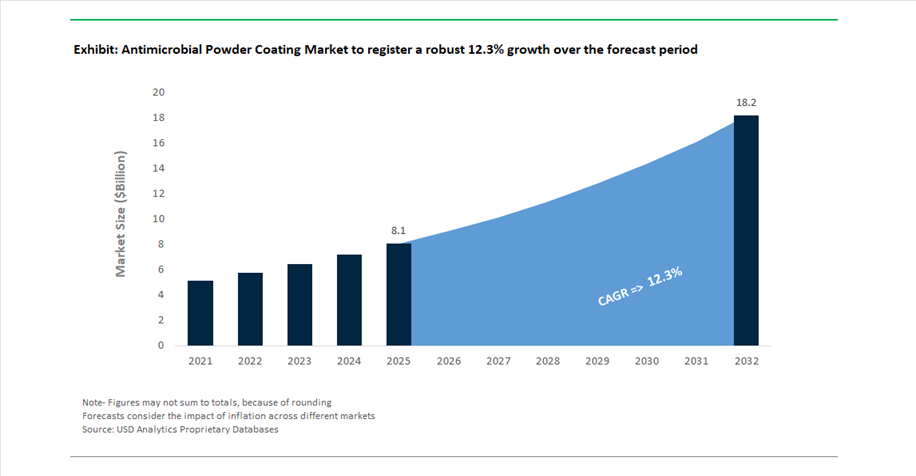
The Antimicrobial Powder Coating Market is projected to grow from USD 8.1 billion in 2025 to USD 18.24 billion by 2032, registering a strong CAGR of 12.3%. This rapid expansion is driven by increasing demand for durable, eco-friendly coating solutions that provide long-term antimicrobial protection across high-contact environments such as hospitals, schools, laboratories, public transport systems, and industrial facilities.
Powder coatings inherently offer advantages over liquid coatings, including zero or near-zero VOC emissions, high material utilization efficiency, and superior durability. When combined with antimicrobial agents such as silver-ion additives and bioactive compounds, these coatings become highly effective in inhibiting the growth of bacteria, fungi, and mold on metal and composite surfaces. This makes them particularly suitable for medical equipment, HVAC components, furniture, architectural facades, and transportation interiors, where hygiene and surface longevity are critical.
The market is also benefiting from increasing regulatory focus on infection control, indoor air quality, and sustainable construction practices. As industries shift toward low-emission and environmentally compliant coating technologies, antimicrobial powder coatings are gaining preference due to their solvent-free application process and long lifecycle performance. Additionally, the rise of smart buildings, healthcare infrastructure expansion, and electrification trends (such as EV battery systems) is further driving demand for coatings that combine functional performance with antimicrobial protection.
Technological advancements are focused on enhancing coating adhesion, curing efficiency, and compatibility with diverse substrates, while integrating multi-functional properties such as corrosion resistance, scratch resistance, and thermal stability. Competitive dynamics are shaped by innovation in resin chemistry, strategic investments in manufacturing capacity, and expansion into high-value application segments, positioning antimicrobial powder coatings as a critical solution in next-generation surface protection systems
The antimicrobial powder coating market is undergoing rapid transformation driven by technological innovation, strategic consolidation, and expansion into advanced industrial applications. A major industry milestone occurred in March 2026, when AkzoNobel and Axalta announced a merger of equals, creating a global coatings leader with enhanced R&D capabilities in bioactive and antimicrobial powder coatings. This consolidation integrates AkzoNobel’s Interpon AM portfolio with Axalta’s expertise in healthcare and mobility coatings, accelerating the development of next-generation high-performance solutions.
Product innovation is also extending into emerging sectors. Jotun’s EV Battery Solutions powder series (June 2025) integrates antimicrobial and anti-fungal properties into coatings designed for electric vehicle battery systems, addressing safety and durability challenges in high-voltage environments. Meanwhile, AkzoNobel’s Futura Collection (April 2026) demonstrates how design-oriented powder coatings can incorporate BioCote® antimicrobial technology, achieving up to 99.99% bacterial reduction while meeting modern architectural aesthetics.
Strategic corporate initiatives are further shaping the competitive landscape. Axalta’s record earnings in February 2026 reflect strong demand for premium, high-functionality coatings, including antimicrobial powder solutions. Similarly, Sherwin-Williams’ expansion into bio-based powder coating R&D underscores the shift toward sustainable raw materials combined with antimicrobial performance, aligning with ESG requirements.
Regional and technological positioning is also being strengthened through targeted investments. AkzoNobel’s decision to retain its International Research Center in India ensures continued leadership in powder coating innovation across Southeast Asia, while BASF’s expansion of biomass-balanced coatings supports the integration of renewable raw materials into antimicrobial-ready coating systems, reducing carbon footprints without compromising performance.
EPA Stability Testing and Efficacy Mandates Elevating Compliance Standards for Powder Coatings
The antimicrobial powder coating industry is entering a high-compliance phase as the U.S. Environmental Protection Agency strengthens its Antimicrobial Performance Evaluation Program. In 2026, coatings marketed with “public health claims” must meet stringent validation requirements, ensuring that antimicrobial efficacy is sustained throughout the product’s operational lifespan. This marks a shift from initial efficacy testing toward lifecycle-based performance verification, significantly raising the technical and regulatory bar for manufacturers.
To qualify for public health claims, antimicrobial powder coatings must demonstrate a minimum 99.9% reduction in pathogens such as MRSA and E. coli within a two-hour contact window. Crucially, this performance must be maintained even after simulated aging conditions, including repeated wash-down cycles and environmental exposure. The introduction of permanence testing further reinforces durability expectations, requiring coatings to retain at least 95% of their antimicrobial activity after 1,000 hours of UV exposure or salt spray testing.
Regulatory enforcement is intensifying alongside increased approval throughput. The EPA processed a record 729 pesticide registrations in 2025, reflecting improved review efficiency and a more competitive regulatory environment. At the same time, non-compliance penalties have escalated sharply. High-profile enforcement actions, including a $1.1 million penalty for misbranded antimicrobial claims, highlight the financial risks associated with inadequate testing or misleading product positioning.
This evolving regulatory landscape is compelling manufacturers to invest in advanced formulation science, robust validation protocols, and comprehensive documentation systems. Antimicrobial powder coatings that can demonstrate long-term efficacy, regulatory compliance, and durability are gaining a competitive advantage in sectors where hygiene and safety are critical performance parameters.
Zinc-Based and Hybrid Antimicrobials Driving Safer and Cost-Efficient Food Contact Coatings
The antimicrobial powder coating market is witnessing a strategic material shift as zinc-based and hybrid antimicrobial systems gain traction, particularly in food processing and food-contact applications. While silver-ion technology has historically dominated this segment, evolving regulatory and economic factors are accelerating the adoption of alternative active ingredients.
Zinc-based antimicrobials offer distinct performance advantages in high-humidity environments where fungal growth and biofilm formation are prevalent. These additives demonstrate superior antifungal and anti-mold properties compared to silver, making them particularly suitable for food processing equipment exposed to moisture and organic residues. Additionally, advanced zinc-organic hybrid systems utilize contact-active antimicrobial mechanisms rather than traditional ion-leaching approaches. This significantly reduces the risk of active ingredient migration into food products, aligning with stringent safety requirements set by regulatory bodies such as the FDA and the European Food Safety Authority.
Thermal stability is another key advantage. Zinc-based additives maintain structural integrity during the high-temperature curing processes typical of powder coating applications, which range between 180°C and 200°C. This ensures consistent performance without discoloration or degradation of antimicrobial functionality. From a cost perspective, zinc-based systems provide a 20% to 30% reduction in additive costs compared to silver, offering manufacturers greater pricing flexibility while maintaining compliance with hygiene standards.
Healthcare Equipment Coatings Enhancing Infection Control and Surface Durability
Healthcare-associated infections remain a critical challenge, driving strong demand for antimicrobial powder coatings in medical equipment and infrastructure. High-touch surfaces such as hospital bed frames, overbed tables, and mobile medical units are increasingly being specified with antimicrobial finishes to provide continuous protection between cleaning cycles.
Clinical data indicates that antimicrobial-coated medical surfaces can reduce bioburden levels by up to 90% between terminal cleaning procedures, offering a significant secondary layer of defense in infection control protocols. This capability is particularly valuable in high-acuity environments such as intensive care units and surgical wards, where contamination risks are elevated.
Durability is a key requirement in healthcare applications. Modern antimicrobial thermoset powder coatings are engineered to withstand more than 2,000 cleaning cycles using aggressive disinfectants, including quaternary ammonium compounds and bleach-based solutions. These coatings maintain surface hardness, color stability, and antimicrobial performance despite repeated exposure to harsh chemicals, ensuring long-term reliability in demanding environments.
Procurement trends reflect this growing demand. By 2026, more than 40% of healthcare infrastructure tenders in North America and Europe explicitly require antimicrobial finishes for both fixed and mobile medical furniture. This shift from optional specification to mandatory requirement underscores the increasing importance of antimicrobial coatings in healthcare facility design and operational standards.
Antimicrobial Powder Coatings for HVAC Systems Driving Indoor Air Quality Improvements
The growing focus on indoor air quality is creating a strong opportunity for antimicrobial powder coatings in HVAC air handling systems across educational institutions and commercial real estate. Internal HVAC components such as coils, fans, and drain pans are highly susceptible to microbial growth, which can degrade system performance and contribute to poor air quality.
Applying antimicrobial coatings to these components helps prevent the formation of mold, bacteria, and biofilms, reducing the risk of airborne contaminants that can trigger respiratory issues. This is particularly important in school environments, where IAQ has become a key priority for administrators and policymakers. Government-backed infrastructure programs introduced in 2025 and 2026 are supporting widespread upgrades to HVAC systems, with a focus on non-leaching antimicrobial coatings that do not release particulates into the air stream.
From an operational perspective, antimicrobial coatings contribute to improved energy efficiency by preventing biofouling on heat exchanger surfaces. Systems treated with these coatings can maintain up to 15% higher energy efficiency over a 10-year service life, reducing energy consumption and operational costs. Additionally, coated HVAC components require up to 50% fewer manual cleaning interventions, lowering maintenance expenses and minimizing system downtime.
Inorganic Antimicrobial Agents Dominate Powder Coatings Market with 67% Share Due to High Thermal Stability
Antimicrobial Agent Analysis: Silver-Based and Zinc Pyrithione Systems Lead High-Performance Powder Coatings
Inorganic antimicrobial agents hold a commanding 67.0% share of the antimicrobial powder coating market in 2025, primarily due to their exceptional thermal stability during high-temperature curing processes (160°C–200°C). Materials such as silver-based zeolites, silver glass, and zinc pyrithione (ZPT) remain chemically stable under these conditions, unlike organic agents that degrade, volatilize, or cause coating defects such as yellowing and cratering. This makes inorganic agents the preferred choice for durable powder-coated surfaces in healthcare, construction, and industrial applications. Additionally, powder coatings form a thick, homogeneous film (50–100 microns), ensuring long-lasting antimicrobial efficacy even under abrasion, as fresh active ions are continuously exposed over time. In 2025, zinc pyrithione-based coatings are gaining traction as a cost-effective antifungal solution for HVAC systems, electrical enclosures, and outdoor equipment, further strengthening inorganic dominance in the global antimicrobial powder coatings market.
Medical & Healthcare Sector Leads with 29.5% Share Driven by Durable Antimicrobial Metal Surfaces
End-Use Industry Analysis: Hospital Equipment and High-Touch Surfaces Accelerate Powder Coating Adoption
The medical and healthcare sector accounts for 29.5% of the antimicrobial powder coating market in 2025, driven by the widespread use of powder-coated metal equipment in hospitals and clinical environments. Critical applications include hospital bed frames, stretchers, IV stands, overbed tables, and mobile medical carts (COWs), all of which require chip-resistant, easy-to-clean, and antimicrobial surfaces capable of withstanding frequent use. A key growth factor is the superior chemical resistance of powder coatings, particularly silver-ion infused epoxy-polyester hybrids, which endure repeated exposure to harsh disinfectants such as hydrogen peroxide vapor and bleach solutions without degradation. This ensures long-term durability and hygiene compliance in high-risk environments. Additionally, 2025 trends highlight increased adoption in touchless infrastructure, including automatic door frames and antimicrobial bathroom fixtures, where coatings prevent biofilm formation and airborne contamination. These factors collectively drive strong demand in the healthcare antimicrobial powder coatings market.
Antimicrobial Powder Coating Market Competitive Landscape Driven by Silver-Ion Technologies and Energy-Efficient Powder Systems
The antimicrobial powder coating market is driven by silver-ion additives, UV-curable powders, and low-energy curing technologies. Leading players are focusing on healthcare devices, HVAC systems, EV batteries, and architectural applications to deliver durable, VOC-free antimicrobial protection with high efficiency and lifecycle performance.
AkzoNobel advances antimicrobial powder coatings with laser curing and EV battery solutions
AkzoNobel leads the antimicrobial powder coating market through its Interpon® and Resicoat® portfolios focused on durability and performance. At PaintExpo 2026, the company demonstrated laser-based curing technology in collaboration with IPG, enabling faster curing cycles and reduced energy consumption for antimicrobial powders. Its Interpon AM range integrates silver-ion technology directly into the coating matrix, delivering up to 99.9% microbial inhibition throughout the product lifecycle. The company reported €1.44 billion in adjusted EBITDA in 2025, supported by its Eco+ portfolio emphasizing thin-film and low-energy solutions. Expansion into EV battery coatings includes dielectric insulation powders with antimicrobial functionality for cleanroom environments. Product development focuses on energy-efficient, high-performance powder coatings.
PPG Industries expands antimicrobial powder coatings across healthcare and HVAC applications
PPG Industries continues to strengthen its antimicrobial powder coatings portfolio through industrial-scale manufacturing and application diversity. The company expanded its powder coating production capacity in North Asia and the U.S. in 2026 to address demand from medical devices and HVAC systems. Its antimicrobial powder coatings for food and beverage packaging meet FDA and EFSA compliance standards for active contact surfaces. The Envirocron® HeatSense line targets HVAC systems, preventing microbial growth in air-handling units and ventilation systems. PPG maintains strong financial performance with $15.9 billion in net sales in 2025, supported by operational excellence and workforce engagement. Product development focuses on regulatory compliance, scalability, and multifunctional coatings.
Sherwin-Williams drives sustainable antimicrobial powders with recycled materials and smart building integration
Sherwin-Williams leverages its Powdura® brand to lead antimicrobial powder coatings in architectural and institutional applications. The expansion of the Powdura ECO line introduces coatings formulated with recycled plastic (rPET), aligning with circular economy and sustainability goals. Its antimicrobial powders feature permanent silver-ion activity that remains effective even after repeated sterilization cycles. The company is a key supplier for smart building projects, providing antimicrobial coatings for high-touch surfaces such as handrails, elevator panels, and fixtures. The Colour Express Powder Programme enables rapid customization with 24-hour delivery for small-batch antimicrobial coatings. Product development focuses on sustainability, customization, and high-performance coatings.
Axalta strengthens antimicrobial powder coatings with medical-grade and UV-curable technologies
Axalta Coating Systems is expanding its antimicrobial powder coatings portfolio through its Alesta AM technology and advanced material innovations. The Alesta AM range utilizes silver zeolite technology and is compliant with EPA and FDA standards for medical and food-contact applications. The company reported a 22.0% adjusted EBITDA margin in 2025, supporting continued investment in high-growth antimicrobial coatings segments. Its Iconica SuprAnodic collection combines aesthetic finishes with durable antimicrobial protection for architectural and industrial applications. Axalta also leads in UV-curable acrylic powder coatings, enabling rapid curing and reduced energy consumption for temperature-sensitive substrates. Product development focuses on durability, compliance, and advanced coating performance.
Jotun expands antimicrobial powder coatings in energy storage and offshore applications
Jotun A/S continues to advance antimicrobial powder coatings through its focus on durability and energy infrastructure applications. The company reported revenues exceeding NOK 34 billion in 2025, supported by strong growth in antimicrobial coatings across APAC markets. Its EV Battery Solutions integrate antimicrobial protection with electrical insulation to ensure safety during battery manufacturing and maintenance. Participation in the EOLMED floating wind project highlights its capability in delivering antimicrobial coatings for offshore environments meeting ISO 12944 C5VH and CX standards. Jotun operates in over 100 countries with a technical support model designed to optimize coating application processes. Product development focuses on high-performance coatings for extreme environments and energy systems.
United States Antimicrobial Powder Coating Market: PFAS-Free Transition and Medical-Grade Innovation Driving Adoption
The United States antimicrobial powder coating market is leading globally, driven by stringent regulatory oversight and rapid innovation in medical-grade polymer integration. A major industry shift toward PFAS-free antimicrobial powder coatings has been completed by key players such as Sherwin-Williams and Axalta, aligning with evolving EPA regulations and state-level bans on “forever chemicals.” This transition is significantly reshaping product portfolios while accelerating demand for sustainable, non-toxic antimicrobial coatings across healthcare and infrastructure sectors.
Technological advancements are further strengthening the market, particularly with FDA approvals for antimicrobial-coated orthopedic instruments utilizing silver-zinc-zeolite thermoset powder technologies. Federal investments under the Infection Control Infrastructure Act have enabled large-scale retrofitting of public transit hubs with antimicrobial-coated surfaces, boosting adoption in high-touch environments. Innovations such as NEI Corporation’s NANOMYTE AM-100EC antimicrobial powder coatings are delivering enhanced abrasion resistance and easy-to-clean properties, making them ideal for hospital equipment. Additionally, the growing use of antimicrobial powder coatings in EV battery casings highlights expanding applications in advanced manufacturing, while the EPA’s PRIA 5 framework is accelerating commercialization timelines for new antimicrobial technologies.
China Antimicrobial Powder Coating Market: Smart City Integration and Graphene-Enhanced Powder Innovations
China dominates the antimicrobial powder coating market through large-scale production and rapid deployment across smart infrastructure and industrial sectors. Government-led initiatives are mandating the use of antimicrobial hybrid powder coatings in smart city developments, particularly in projects such as the Xiong’an New Area, where coatings are integrated into public kiosks and smart-pole systems to enhance hygiene and environmental performance.
The market is also driven by strong innovation in advanced materials. The commercialization of graphene-enhanced antimicrobial powder coatings is delivering up to 30% higher mechanical durability compared to traditional polyester coatings, making them suitable for high-performance industrial applications. Expansion of low-bake antimicrobial powder production for consumer electronics is strengthening China’s export capabilities. In healthcare infrastructure, silver-ion infused epoxy-polyester coatings are widely used in sterile-zone ventilation systems, aligning with the “Healthy China 2030” mandate requiring 99.9% bactericidal efficacy. Additionally, applications in agricultural storage systems are improving food safety by preventing microbial spoilage, reinforcing China’s leadership in high-volume antimicrobial coating technologies.
Germany stands at the forefront of sustainable antimicrobial powder coating technologies, driven by strong regulatory frameworks and advanced material science. The introduction of lignin-based compostable antimicrobial powder coatings is transforming the furniture and interior design sectors, aligning with Europe’s strict environmental standards and circular economy goals.
Regulatory compliance and industrial precision are key growth drivers. The implementation of VDI 6022 standards is mandating antimicrobial surface testing in HVAC systems, significantly increasing demand for antimicrobial coatings in industrial ventilation. Automotive manufacturers are integrating antimicrobial coatings into EV interiors to meet rising demand for hygienic cabin environments. Additionally, BASF’s dedicated R&D hub in Ludwigshafen is advancing non-leaching antimicrobial technologies, while the adoption of low-temperature cure (LTC) powder coatings is reducing energy consumption in industrial processes. Growth in pharmaceutical manufacturing equipment coated with antimicrobial powders further strengthens Germany’s position as a leader in high-performance, sustainable coating solutions.
India Antimicrobial Powder Coating Market: Infrastructure Expansion and Domestic Manufacturing Boost Driving Growth
India is emerging as one of the fastest-growing markets for antimicrobial powder coatings, supported by strong government initiatives and rapid industrial expansion. The Production Linked Incentive (PLI) scheme has attracted significant investments into domestic manufacturing of antimicrobial-grade resins, strengthening local supply chains and reducing import dependency.
The adoption of antimicrobial powder coatings is expanding across multiple sectors. Public infrastructure projects, including Vande Bharat high-speed trains and airport terminals under the National Infrastructure Pipeline, are increasingly incorporating antimicrobial-coated surfaces to enhance hygiene. The healthcare sector is also a major driver, with over 150 new hospitals specifying silver-based antimicrobial coatings for medical furniture and equipment. Innovations such as Berger Paints’ “Post-Pandemic Shield” antimicrobial powder coatings are targeting consumer durable markets, including appliances. Additionally, the development of cost-effective antimicrobial solutions for SMEs is improving accessibility, positioning India as a key growth hub in the global antimicrobial powder coating market.
Japan Antimicrobial Powder Coating Market: Smart-Release Technology and Ultra-High Purity Coating Innovation
Japan’s antimicrobial powder coating market is defined by its focus on advanced material innovation and precision engineering. The development of smart-release antimicrobial coatings represents a major breakthrough, enabling controlled release of antimicrobial ions only when moisture is detected, thereby enhancing efficiency and longevity.
Technological advancements are also expanding applications in electronics and public infrastructure. Dual-function coatings combining anti-glare and antimicrobial properties are being widely deployed in ATM kiosks and touch-enabled systems. National initiatives aimed at improving safety in elderly care facilities are driving demand for soft-touch antimicrobial coatings with ergonomic benefits. Additionally, innovations such as micro-texture coatings that physically eliminate bacteria without relying on chemical agents are redefining performance standards. Japan’s strong export capabilities in high-performance antimicrobial additives further reinforce its leadership in global coating technologies.
United Kingdom Antimicrobial Powder Coating Market: Graphene Innovation and Post-Brexit Regulatory Flexibility Driving Market Evolution
The United Kingdom antimicrobial powder coating market is advancing through strong innovation in graphene-based materials and evolving regulatory frameworks. The use of graphene-enhanced antimicrobial coatings in NHS infrastructure is improving both corrosion resistance and pathogen protection, particularly in modular hospital constructions.
Post-Brexit regulatory flexibility under the UK REACH framework is enabling faster testing and adoption of novel antimicrobial formulations, giving the country a competitive advantage in innovation. The expansion of antimicrobial coating applications in dental equipment, EV charging infrastructure, and heritage preservation projects highlights the market’s diversification. Collaborations between academic institutions such as Oxford and industry players are driving advancements in computational coating design, enabling the development of next-generation antimicrobial surfaces. These factors position the UK as a leader in high-performance, innovation-driven antimicrobial powder coating technologies.
Antimicrobial Powder Coating Market Report Scope
Antimicrobial Powder Coating Market
Parameter
Details
Market Size (2025)
$8.1 Billion
Market Size (2032)
$18.2 Billion
Market Growth Rate
12.3%
Segments
By Resin (Thermoset Powder Coatings, Thermoplastic Powder Coatings), By Antimicrobial Agent (Inorganic Agents, Organic Agents, Natural Agents), By Coating Technology (Electrostatic Spray Deposition, Fluidized Bed Coating, UV-Curable Powder Coatings, Heat-Curable Systems), By End-Use Industry (Medical and Healthcare, Food and Beverage, Building and Construction, Electrical and Electronics, Transportation and Automotive, Fitness and Consumer Goods), By Performance Specification (Broad-Spectrum Efficacy, Antiviral and Antifungal Specialized Coatings, High-Durability Grades, Chemical and Corrosion-Resistant Grades)
Study Period
2019- 2025 and 2026-2032
Units
Revenue (USD)
Qualitative Analysis
Porter’s Five Forces, SWOT Profile, Market Share, Scenario Forecasts, Market Ecosystem, Company Ranking, Market Dynamics, Industry Benchmarking
US, Canada, Mexico, Germany, France, Spain, Italy, UK, Russia, China, India, Japan, South Korea, Australia, South East Asia, Brazil, Argentina, Middle East, Africa
Antimicrobial Powder Coating Market Segmentation
By Resin
Thermoset Powder Coatings
Epoxy
Polyester
Epoxy-Polyester Hybrids
Polyurethane
Acrylic
Thermoplastic Powder Coatings
Nylon
Polyvinyl Chloride
Polyolefins
Fluoropolymers
By Antimicrobial Agent
Inorganic Agents
Silver-ion based
Copper-ion based
Zinc-based
Titanium Dioxide
Organic Agents
Quaternary Ammonium Compounds
Organic Biocides
Triclosan-free Synthetic Organics
Natural Agents
By Coating Technology
Electrostatic Spray Deposition
Fluidized Bed Coating
UV-Curable Powder Coatings
Heat-Curable Systems
By End-Use Industry
Medical and Healthcare
Food and Beverage
Building and Construction
Electrical and Electronics
Transportation and Automotive
Fitness and Consumer Goods
By Performance Specification
Broad-Spectrum Efficacy
Antiviral and Antifungal Specialized Coatings
High-Durability Grades
Chemical and Corrosion-Resistant Grades
Leading Countries in the Industry
North America (United States, Canada, Mexico)
Europe (Germany, France, Spain, United Kingdom, Italy, Russia, Rest of Europe)
Asia Pacific (China, India, Japan, South Korea, Australia, South East Asia, Rest of APAC)
South and Central America (Brazil, Argentina, Rest of SCA)
Middle East and Africa (Saudi Arabia, UAE, MENA, Sub-Saharan Africa)
Top Companies in Antimicrobial Powder Coating Market
Akzo Nobel N.V.
PPG Industries, Inc
The Sherwin-Williams Company
Axalta Coating Systems Ltd.
Jotun A/S
Nippon Paint Holdings Co., Ltd.
Kansai Paint Co., Ltd.
Hempel A/S
RPM International Inc
Tiger Coatings GmbH & Co. KG
IFS Coatings, Inc.
Diamond Vogel
Vee4 Paints Private Limited
Protective Coating Co.
Berger Paints India Limited
*- List not Exhaustive
Table of Contents: Antimicrobial Powder Coating Market
1. Executive Summary
1.1. Market Highlights
1.2. Key Findings
1.3. Global Market Snapshot
2. Antimicrobial Powder Coating Market Landscape & Outlook (2025–2032)
2.1. Introduction to Antimicrobial Powder Coating Market
2.2. Market Valuation and Growth Projections (2025–2032)
2.3. Role of Powder Coatings in Sustainable and Low-VOC Surface Protection
2.4. Regulatory Landscape: EPA Compliance and Antimicrobial Performance Standards
2.5. Demand Across Healthcare, HVAC, Smart Infrastructure, and EV Applications
3. Innovations Reshaping the Antimicrobial Powder Coating Market
3.1. Trend: Advanced Curing Technologies and Low-Energy Powder Systems
3.2. Trend: Zinc-Based and Hybrid Antimicrobial Additives for Food Safety
3.3. Opportunity: Healthcare Equipment and High-Touch Surface Coatings
3.4. Opportunity: HVAC Systems and Indoor Air Quality Enhancement
4. Competitive Landscape and Strategic Initiatives
4.1. Mergers and Acquisitions
4.2. R&D and Material Innovation
4.3. Sustainability and ESG Strategies
4.4. Market Expansion and Regional Focus
5. Market Share and Segmentation Insights: Antimicrobial Powder Coating Market
5.1. By Resin
5.1.1. Thermoset Powder Coatings
5.1.1.1. Epoxy
5.1.1.2. Polyester
5.1.1.3. Epoxy-Polyester Hybrids
5.1.1.4. Polyurethane
5.1.1.5. Acrylic
5.1.2. Thermoplastic Powder Coatings
5.1.2.1. Nylon
5.1.2.2. Polyvinyl Chloride
5.1.2.3. Polyolefins
5.1.2.4. Fluoropolymers
5.2. By Antimicrobial Agent
5.2.1. Inorganic Agents
5.2.1.1. Silver-ion based
5.2.1.2. Copper-ion based
5.2.1.3. Zinc-based
5.2.1.4. Titanium Dioxide
5.2.2. Organic Agents
5.2.2.1. Quaternary Ammonium Compounds
5.2.2.2. Organic Biocides
5.2.2.3. Triclosan-free Synthetic Organics
5.2.2.4. Natural Agents
5.3. By Coating Technology
5.3.1. Electrostatic Spray Deposition
5.3.2. Fluidized Bed Coating
5.3.3. UV-Curable Powder Coatings
5.3.4. Heat-Curable Systems
5.4. By End-Use Industry
5.4.1. Medical and Healthcare
5.4.2. Food and Beverage
5.4.3. Building and Construction
5.4.4. Electrical and Electronics
5.4.5. Transportation and Automotive
5.4.6. Fitness and Consumer Goods
5.5. By Performance Specification
5.5.1. Broad-Spectrum Efficacy
5.5.2. Antiviral and Antifungal Specialized Coatings
5.5.3. High-Durability Grades
5.5.4. Chemical and Corrosion-Resistant Grades
6. Country Analysis and Outlook of Antimicrobial Powder Coating Market
6.1. United States
6.2. Canada
6.3. Mexico
6.4. Germany
6.5. France
6.6. Spain
6.7. Italy
6.8. UK
6.9. Russia
6.10. China
6.11. India
6.12. Japan
6.13. South Korea
6.14. Australia
6.15. South East Asia
6.16. Brazil
6.17. Argentina
6.18. Middle East
6.19. Africa
7. Antimicrobial Powder Coating Market Size Outlook by Region (2025–2032)
7.1. North America Antimicrobial Powder Coating Market Size Outlook to 2032
7.1.1. By Resin
7.1.2. By Antimicrobial Agent
7.1.3. By Coating Technology
7.1.4. By End-Use Industry
7.1.5. By Performance Specification
7.2. Europe Antimicrobial Powder Coating Market Size Outlook to 2032
7.2.1. By Resin
7.2.2. By Antimicrobial Agent
7.2.3. By Coating Technology
7.2.4. By End-Use Industry
7.2.5. By Performance Specification
7.3. Asia Pacific Antimicrobial Powder Coating Market Size Outlook to 2032
7.3.1. By Resin
7.3.2. By Antimicrobial Agent
7.3.3. By Coating Technology
7.3.4. By End-Use Industry
7.3.5. By Performance Specification
7.4. South America Antimicrobial Powder Coating Market Size Outlook to 2032
7.4.1. By Resin
7.4.2. By Antimicrobial Agent
7.4.3. By Coating Technology
7.4.4. By End-Use Industry
7.4.5. By Performance Specification
7.5. Middle East and Africa Antimicrobial Powder Coating Market Size Outlook to 2032
7.5.1. By Resin
7.5.2. By Antimicrobial Agent
7.5.3. By Coating Technology
7.5.4. By End-Use Industry
7.5.5. By Performance Specification
8. Company Profiles: Leading Players in the Antimicrobial Powder Coating Market
8.1. Akzo Nobel N.V.
8.2. PPG Industries, Inc.
8.3. The Sherwin-Williams Company
8.4. Axalta Coating Systems Ltd.
8.5. Jotun A/S
8.6. Nippon Paint Holdings Co., Ltd.
8.7. Kansai Paint Co., Ltd.
8.8. Hempel A/S
8.9. RPM International Inc.
8.10. Tiger Coatings GmbH & Co. KG
8.11. IFS Coatings, Inc.
8.12. Diamond Vogel
8.13. Vee4 Paints Private Limited
8.14. Protective Coating Co.
8.15. Berger Paints India Limited
9. Methodology
9.1. Research Scope
9.2. Market Research Approach
9.3. Market Sizing and Forecasting Model
9.4. Research Coverage
9.5. Data Horizon
9.6. Deliverables
10. Appendix
10.1. Acronyms and Abbreviations
10.2. List of Tables
10.3. List of Figures
Antimicrobial Powder Coating Market Segmentation
By Resin
Thermoset Powder Coatings
Epoxy
Polyester
Epoxy-Polyester Hybrids
Polyurethane
Acrylic
Thermoplastic Powder Coatings
Nylon
Polyvinyl Chloride
Polyolefins
Fluoropolymers
By Antimicrobial Agent
Inorganic Agents
Silver-ion based
Copper-ion based
Zinc-based
Titanium Dioxide
Organic Agents
Quaternary Ammonium Compounds
Organic Biocides
Triclosan-free Synthetic Organics
Natural Agents
By Coating Technology
Electrostatic Spray Deposition
Fluidized Bed Coating
UV-Curable Powder Coatings
Heat-Curable Systems
By End-Use Industry
Medical and Healthcare
Food and Beverage
Building and Construction
Electrical and Electronics
Transportation and Automotive
Fitness and Consumer Goods
By Performance Specification
Broad-Spectrum Efficacy
Antiviral and Antifungal Specialized Coatings
High-Durability Grades
Chemical and Corrosion-Resistant Grades
Leading Countries in the Industry
North America (United States, Canada, Mexico)
Europe (Germany, France, Spain, United Kingdom, Italy, Russia, Rest of Europe)
Asia Pacific (China, India, Japan, South Korea, Australia, South East Asia, Rest of APAC)
South and Central America (Brazil, Argentina, Rest of SCA)
Middle East and Africa (Saudi Arabia, UAE, MENA, Sub-Saharan Africa)
The antimicrobial powder coating market is valued at USD 8.1 billion in 2025 and is projected to reach USD 18.24 billion by 2032, registering a CAGR of 12.3%. Growth is driven by rising demand for durable, VOC-free coatings in healthcare, infrastructure, and industrial applications. Increasing focus on hygiene and sustainability is accelerating adoption globally.
Key trends include the shift toward low-VOC and solvent-free coatings, integration of silver-ion and zinc-based antimicrobial agents, and development of UV-curable powder coatings. Innovations in EV battery coatings and smart building applications are also expanding market scope. Sustainability and bio-based resin adoption are becoming critical differentiators.
Regulatory frameworks such as EPA antimicrobial performance standards are raising efficacy benchmarks, requiring 99.9% pathogen reduction within two hours. Lifecycle durability testing and compliance with FDA and EFSA standards are becoming mandatory. These regulations are pushing manufacturers toward high-performance, validated coating systems.
Inorganic antimicrobial agents dominate with a 67% share due to high thermal stability during curing. The healthcare sector leads with 29.5% demand, driven by hospital equipment and high-touch surfaces. HVAC systems, EV battery components, and food processing equipment are emerging as high-growth application areas.
Key players include Akzo Nobel N.V., PPG Industries, Inc., The Sherwin-Williams Company, Axalta Coating Systems Ltd., Jotun A/S, and Nippon Paint Holdings Co., Ltd.. These companies focus on innovation in antimicrobial additives, sustainable powder technologies, and high-performance industrial coatings.