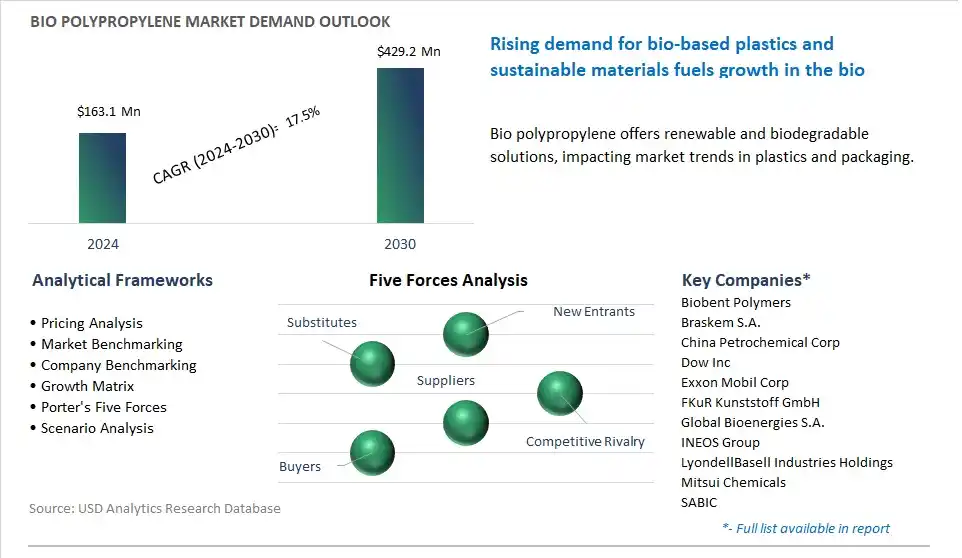
The global Bio Polypropylene Market is poised to register a 17.5% CAGR from $163.1 Million in 2024 to $429.2 Million in 2030.
The global Bio Polypropylene Market Study analyzes and forecasts the market size across 6 regions and 24 countries for diverse segments -By Source (Corn, Sugar Cane, Vegetable Oil, Others), By Application (Injection, Textile, Films, Others).
An Introduction to Global Bio Polypropylene Market in 2024
The bio polypropylene market is experiencing growth driven by the increasing demand for sustainable and renewable plastics in various industries such as packaging, automotive, consumer goods, and textiles. Key trends shaping the future of the industry include innovations in bio-based feedstocks, polymerization processes, and biodegradable additives to produce polypropylene with reduced environmental impact and improved end-of-life options. Advanced bio polypropylene offers similar mechanical properties, processability, and versatility as conventional polypropylene, making it suitable for a wide range of applications. Moreover, the integration of bio-based polypropylene into packaging films, injection-molded parts, and nonwoven fabrics addresses consumer preferences for eco-friendly and recyclable materials, supporting circular economy initiatives. Additionally, the growing emphasis on corporate sustainability goals, regulatory mandates, and consumer awareness drives market demand for bio-based plastics as alternatives to fossil fuel-derived polymers. As industries transition towards more sustainable materials and practices, the bio polypropylene market is poised for continued growth and innovation as a key contributor to the global transition towards a circular and bio-based economy.
Bio Polypropylene Market Competitive Landscape
The market report analyses the leading companies in the industry including Biobent Polymers, Braskem S.A., China Petrochemical Corp, Dow Inc, Exxon Mobil Corp, FKuR Kunststoff GmbH, Global Bioenergies S.A., INEOS Group, LyondellBasell Industries Holdings, Mitsui Chemicals, SABIC, Solvay S.A., Washington Penn Plastic Co. Inc.
Bio Polypropylene Market Dynamics
Bio Polypropylene Market Trend: Increasing Focus on Sustainable Alternatives
The most prominent trend in the bio polypropylene market is the growing emphasis on sustainable alternatives to traditional plastics, driven by environmental concerns and regulatory pressures to reduce carbon footprint. As businesses and consumers become more aware of the environmental impact of plastic pollution, there's a significant shift towards bio-based materials derived from renewable sources such as biomass, plants, or waste materials. Bio polypropylene offers a sustainable solution by providing similar properties and performance to conventional polypropylene while reducing dependency on fossil fuels and mitigating greenhouse gas emissions. This trend is driving investment in research and development to improve the production processes and expand the application capabilities of bio polypropylene across various industries, including packaging, automotive, and consumer goods.
Bio Polypropylene Market Driver: Regulatory Push towards Circular Economy
A key driver in the bio polypropylene market is the regulatory push towards a circular economy, characterized by the promotion of sustainable production, consumption, and waste management practices. Governments and regulatory bodies worldwide are implementing policies and initiatives aimed at reducing plastic waste and promoting the use of renewable and recyclable materials. Bio polypropylene aligns with these objectives by offering a viable alternative to traditional plastics that can be recycled, composted, or biodegraded at the end of its lifecycle. Regulations mandating the use of bio-based or biodegradable materials in certain applications further drive the demand for bio polypropylene, creating opportunities for manufacturers to capitalize on the growing market for sustainable packaging, textiles, and consumer products.
Bio Polypropylene Market Opportunity: Expansion into New Application Areas
The bio polypropylene market presents a significant opportunity for expansion into new application areas, driven by the versatility and sustainability of the material. While bio polypropylene is already widely used in packaging, automotive components, and textiles, there are emerging opportunities in sectors such as construction, electronics, and medical devices. As technological advancements improve the performance and processability of bio polypropylene, there's potential for it to replace traditional plastics in a wider range of applications, including durable goods, building materials, and electronic enclosures. Manufacturers can leverage this opportunity by investing in research and development to customize bio polypropylene formulations to meet the specific requirements of different industries, while also addressing concerns related to cost, performance, and end-of-life disposal. By tapping into these new application areas, companies can expand their market reach, diversify their product portfolio, and contribute to the transition towards a more sustainable future.
Bio Polypropylene Market Share Analysis: Corn source segment generated the highest revenue in the industry
The largest segment in the Bio Polypropylene Market is the Corn source segment. This dominance can be attributed to diverse factors. The corn-based polypropylene is one of the most widely utilized bio-based plastics due to the abundance and renewability of corn as a feedstock. Corn is a major crop worldwide, with large-scale cultivation and well-established agricultural infrastructure in many regions, making it a reliable and cost-effective source of bio-based materials. Additionally, advancements in biotechnology and fermentation processes have enabled the efficient conversion of corn-derived sugars into bio-based polypropylene through bio-based polymerization techniques. In addition, corn-based polypropylene offers comparable performance characteristics to petroleum-based polypropylene, making it suitable for a wide range of applications in industries such as packaging, automotive, textiles, and consumer goods. Further, increasing environmental concerns and regulatory initiatives aimed at reducing carbon emissions and promoting sustainable alternatives drive the demand for bio-based materials like corn-based polypropylene. As industries increasingly prioritize sustainability and seek alternatives to fossil fuel-derived plastics, the corn source segment continues to dominate the Bio Polypropylene Market due to its availability, performance, and environmental benefits.
Bio Polypropylene Market Share Analysis: Films application Segment is poised to register the fastest growth rate (CAGR) over the forecast period to 2030
The fastest-growing segment in the Bio Polypropylene Market is the Films application segment. This growth can be attributed to diverse factors. The bio polypropylene films offer a wide range of applications across various industries, including packaging, agriculture, automotive, and construction. As consumers and businesses increasingly prioritize sustainability and environmental responsibility, there is growing demand for bio-based materials in packaging applications, particularly flexible films used in food packaging, agricultural mulches, and compostable bags. Additionally, bio polypropylene films provide comparable performance characteristics to conventional polypropylene films, including excellent moisture resistance, heat sealability, and printability, making them suitable for a diverse range of packaging requirements. In addition, advancements in film extrusion technology and processing techniques have enabled the production of bio polypropylene films with enhanced mechanical properties, optical clarity, and barrier performance, further expanding their applicability in demanding packaging applications. Further, regulatory initiatives aimed at reducing plastic waste and promoting the use of sustainable packaging materials drive the adoption of bio-based films by brand owners, retailers, and consumers. As industries continue to innovate and invest in sustainable packaging solutions, the Films application segment is expected to experience rapid growth in the Bio Polypropylene Market.
Bio Polypropylene Market Report Segmentation
By Source
Corn
Sugar Cane
Vegetable Oil
Others
By Application
Injection
Textile
Films
Others
Regions Included
North America (US, Canada, Mexico)
Europe (Germany, UK, France, Spain, Italy, Russia, Rest of Europe)
Asia Pacific (China, India, Japan, South Korea, Australia, South East Asia, Rest of Asia)
South America (Brazil, Argentina, Rest of South America)
Middle East and Africa (Saudi Arabia, UAE, Rest of Middle East, South Africa, Egypt, Rest of Africa)
Bio Polypropylene Companies Profiled in the Market Study
Biobent Polymers
Braskem S.A.
China Petrochemical Corp
Dow Inc
Exxon Mobil Corp
FKuR Kunststoff GmbH
Global Bioenergies S.A.
INEOS Group
LyondellBasell Industries Holdings
Mitsui Chemicals
SABIC
Solvay S.A.
Washington Penn Plastic Co. Inc
*- List Not Exhaustive
TABLE OF CONTENTS
1 Introduction to 2024 Bio Polypropylene Market
1.1 Market Overview
1.2 Quick Facts
1.3 Scope/Objective of the Study
1.4 Market Definition
1.5 Countries and Regions Covered
1.6 Units, Currency, and Conversions
1.7 Industry Value Chain
2 Research Methodology
2.1 Market Size Estimation
2.2 Sources and Research Methodology
2.3 Data Triangulation
2.4 Assumptions and Limitations
3 Executive Summary
3.1 Global Bio Polypropylene Market Size Outlook, $ Million, 2021 to 2030
3.2 Bio Polypropylene Market Outlook by Type, $ Million, 2021 to 2030
3.3 Bio Polypropylene Market Outlook by Product, $ Million, 2021 to 2030
3.4 Bio Polypropylene Market Outlook by Application, $ Million, 2021 to 2030
3.5 Bio Polypropylene Market Outlook by Key Countries, $ Million, 2021 to 2030
4 Market Dynamics
4.1 Key Driving Forces of Bio Polypropylene Industry
4.2 Key Market Trends in Bio Polypropylene Industry
4.3 Potential Opportunities in Bio Polypropylene Industry
4.4 Key Challenges in Bio Polypropylene Industry
5 Market Factor Analysis
5.1 Value Chain Analysis
5.2 Competitive Landscape
5.2.1 Global Bio Polypropylene Market Share by Company (%), 2023
5.2.2 Product Offerings by Company
5.3 Porter’s Five Forces Analysis
5.4 Pricing Analysis and Outlook
6 Growth Outlook Across Scenarios
6.1 Growth Analysis-Case Scenario Definitions
6.2 Low Growth Scenario Forecasts
6.3 Reference Growth Scenario Forecasts
6.4 High Growth Scenario Forecasts
7 Global Bio Polypropylene Market Outlook by Segments
7.1 Bio Polypropylene Market Outlook by Segments, $ Million, 2021- 2030
By Source
Corn
Sugar Cane
Vegetable Oil
Others
By Application
Injection
Textile
Films
Others
8 North America Bio Polypropylene Market Analysis and Outlook To 2030
8.1 Introduction to North America Bio Polypropylene Markets in 2024
8.2 North America Bio Polypropylene Market Size Outlook by Country, 2021-2030
8.2.1 United States
8.2.2 Canada
8.2.3 Mexico
8.3 North America Bio Polypropylene Market size Outlook by Segments, 2021-2030
By Source
Corn
Sugar Cane
Vegetable Oil
Others
By Application
Injection
Textile
Films
Others
9 Europe Bio Polypropylene Market Analysis and Outlook To 2030
9.1 Introduction to Europe Bio Polypropylene Markets in 2024
9.2 Europe Bio Polypropylene Market Size Outlook by Country, 2021-2030
9.2.1 Germany
9.2.2 France
9.2.3 Spain
9.2.4 United Kingdom
9.2.4 Italy
9.2.5 Russia
9.2.6 Norway
9.2.7 Rest of Europe
9.3 Europe Bio Polypropylene Market Size Outlook by Segments, 2021-2030
By Source
Corn
Sugar Cane
Vegetable Oil
Others
By Application
Injection
Textile
Films
Others
10 Asia Pacific Bio Polypropylene Market Analysis and Outlook To 2030
10.1 Introduction to Asia Pacific Bio Polypropylene Markets in 2024
10.2 Asia Pacific Bio Polypropylene Market Size Outlook by Country, 2021-2030
10.2.1 China
10.2.2 India
10.2.3 Japan
10.2.4 South Korea
10.2.5 Indonesia
10.2.6 Malaysia
10.2.7 Australia
10.2.8 Rest of Asia Pacific
10.3 Asia Pacific Bio Polypropylene Market size Outlook by Segments, 2021-2030
By Source
Corn
Sugar Cane
Vegetable Oil
Others
By Application
Injection
Textile
Films
Others
11 South America Bio Polypropylene Market Analysis and Outlook To 2030
11.1 Introduction to South America Bio Polypropylene Markets in 2024
11.2 South America Bio Polypropylene Market Size Outlook by Country, 2021-2030
11.2.1 Brazil
11.2.2 Argentina
11.2.3 Rest of South America
11.3 South America Bio Polypropylene Market size Outlook by Segments, 2021-2030
By Source
Corn
Sugar Cane
Vegetable Oil
Others
By Application
Injection
Textile
Films
Others
12 Middle East and Africa Bio Polypropylene Market Analysis and Outlook To 2030
12.1 Introduction to Middle East and Africa Bio Polypropylene Markets in 2024
12.2 Middle East and Africa Bio Polypropylene Market Size Outlook by Country, 2021-2030
12.2.1 Saudi Arabia
12.2.2 UAE
12.2.3 Oman
12.2.4 Rest of Middle East
12.2.5 Egypt
12.2.6 Nigeria
12.2.7 South Africa
12.2.8 Rest of Africa
12.3 Middle East and Africa Bio Polypropylene Market size Outlook by Segments, 2021-2030
By Source
Corn
Sugar Cane
Vegetable Oil
Others
By Application
Injection
Textile
Films
Others
13 Company Profiles
13.1 Company Snapshot
13.2 SWOT Profiles
13.3 Products and Services
13.4 Recent Developments
13.5 Financial Profile
Biobent Polymers
Braskem S.A.
China Petrochemical Corp
Dow Inc
Exxon Mobil Corp
FKuR Kunststoff GmbH
Global Bioenergies S.A.
INEOS Group
LyondellBasell Industries Holdings
Mitsui Chemicals
SABIC
Solvay S.A.
Washington Penn Plastic Co. Inc
14 Appendix
14.1 Customization Offerings
14.2 Subscription Services
14.3 Related Reports
14.4 Publisher Expertise
By Source
Corn
Sugar Cane
Vegetable Oil
Others
By Application
Injection
Textile
Films
Others
Countries Analyzed
North America (US, Canada, Mexico)
Europe (Germany, UK, France, Spain, Italy, Russia, Rest of Europe)
Asia Pacific (China, India, Japan, South Korea, Australia, South East Asia, Rest of Asia)
South America (Brazil, Argentina, Rest of South America)
Middle East and Africa (Saudi Arabia, UAE, Rest of Middle East, South Africa, Egypt, Rest of Africa)
