Barrier Films for Pharmaceutical Packaging Market Overview: Drug Stability, Moisture Protection and Material Performance Define Demand
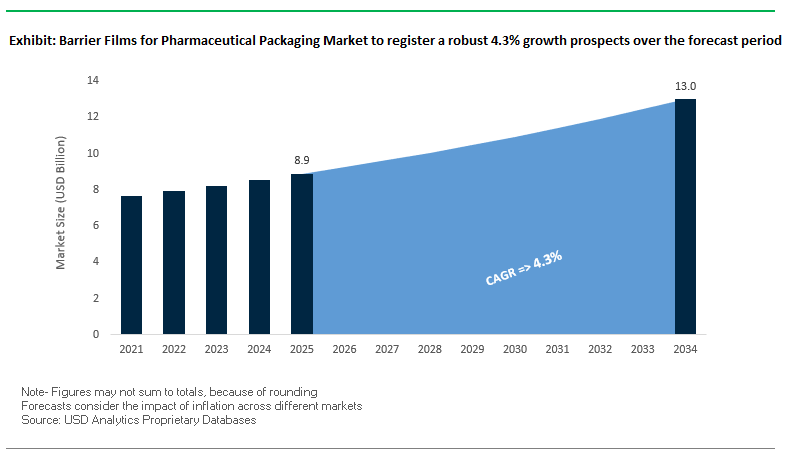
The global Barrier Films for Pharmaceutical Packaging Market is valued at USD 8.9 billion in 2025 and is projected to reach USD 13 billion by 2034, expanding at a CAGR of 4.3%. Barrier films are polymer, coated, laminated and foil-based packaging structures engineered to limit the transmission of moisture, oxygen and light that can affect the stability, potency and shelf life of pharmaceutical products. Blister packs account for approximately 35% of market demand by product type, while pharmaceutical manufacturing companies represent around 60% by end user.
The market is technically narrower than the broader Medical Packaging Films or Pharmaceutical Packaging markets. Its principal function is barrier control around pharmaceutical formulations, particularly oral solid dosage products whose chemical or physical stability can deteriorate through moisture uptake, oxidation or light exposure. High-barrier films are used in thermoformed blisters, strip packs, pouches, sachets and other container-closure configurations, while aluminum-based structures provide very high protection where transparent polymer systems do not provide sufficient barrier performance.
Barrier requirements vary substantially by formulation. Conventional PVC can provide established thermoforming characteristics for less moisture-sensitive products, while PVdC coatings, PCTFE laminates, EVOH-containing multilayers, polypropylene structures and aluminum cold-form systems provide progressively different combinations of moisture, oxygen and light protection. Stability performance is connected to the complete package configuration rather than to a film polymer in isolation.
The ICH Q1A stability framework specifies that drug-product stability testing is conducted using the container-closure system proposed for marketing, linking packaging selection directly with shelf-life evidence. ICH Q1A(R2) Stability Testing guideline This makes barrier-film performance a pharmaceutical-quality variable rather than simply a packaging-material characteristic.
Recent Developments and Company Strategies in Barrier Films for Pharmaceutical Packaging
Recent industry developments are concentrated around recyclable blister structures, higher-barrier mono-material systems, moisture-sensitive drug protection and combinations of PET, PP, COC, PCTFE and advanced coatings. Commercial activity increasingly differentiates between low-, medium-, high- and ultra-high-barrier applications rather than treating recyclable pharmaceutical films as a single material category.
Bayer and Liveo Research Commercialize PET One-Material Blister Packaging
In October 2024, Bayer and Liveo Research launched a PET one-material blister for Aleve in the Netherlands. Bayer reported a 38% reduction in packaging carbon footprint per unit, an 18% reduction in package weight, 78% lower water use and 53% lower land use compared with the previous packaging configuration. The system eliminates PVC from the blister structure.
The commercial launch demonstrates the movement of recyclable PET blister structures beyond pilot-scale development into marketed pharmaceutical products. It also illustrates the importance of preserving pharmaceutical forming and sealing performance while altering the material architecture of established blister formats.
Evertis Integrates Aclar Barrier Technology into PET Pharmaceutical Films
In June 2025, Evertis selected Honeywell's Aclar technology for its Evercare pharmaceutical packaging portfolio. The collaboration combines PET film and lamination technology with PCTFE-based Aclar barrier film to create medical-grade PET packaging with high moisture protection, thermoforming, sealing and optical properties. Honeywell stated that the new PET products were expected to enter the market during 2025.
The development represents a hybrid material route in which recyclable-oriented PET structures are combined with specialized high-barrier PCTFE technology. Following Honeywell's October 2025 spin-off of its Advanced Materials business, Aclar pharmaceutical films are now part of Solstice Advanced Materials.
TekniPlex Expands Pharmaceutical Barrier Portfolio Across PP-COC-PP and PVdC Structures
In September 2025, TekniPlex Healthcare presented an expanded portfolio of pharmaceutical barrier blister materials ahead of CPHI Frankfurt. The range included Aclar laminates, recyclable-oriented PP-COC-PP coextruded structures, and high- and ultra-high-barrier PFAS-free SBC PVdC-coated PVC films.
The portfolio demonstrates continued coexistence of multiple barrier technologies. Polyolefin and COC-based structures address recyclable-material development, while PVdC and PCTFE systems remain relevant where formulations require higher moisture or combined moisture-and-oxygen protection.
Liveo Research Introduces Higher-Barrier One-Material Blister Concepts
In October 2025, Liveo Research introduced two additional One-Material Blister concepts. BlisForm MP/BlisLid MP provides medium-range protection against water vapor, while BlisBa PCP/BlisLid PCP provides medium-to-high water-vapor protection and is available in several thicknesses. Both concepts use matching material families for the bottom and top films.
The launches extend mono-material blister development beyond low-barrier applications. They also show increasing differentiation of recyclable pharmaceutical structures according to actual drug-protection requirements rather than recyclability alone.
ACG Introduces Desiccant-Based Cold-Form Laminate for Moisture-Sensitive Drugs
In December 2025, ACG launched DryPod, a desiccant-based cold-form laminate designed for highly moisture-sensitive pharmaceutical products. The system incorporates moisture-management functionality within a cold-form blister architecture and targets applications where conventional barrier structures may not provide the required moisture control.
The development illustrates another technical direction in the market: active moisture management incorporated into the packaging structure itself. This is particularly relevant to formulations whose stability requires protection beyond the passive barrier available from conventional polymer films.
Klöckner Pentaplast Broadens Recyclable Barrier Films Across PET and Polyolefin Platforms
Klöckner Pentaplast currently markets pharmaceutical blister structures spanning PET, PP and high-barrier polyolefin systems. Its kpNext R1 platform is a PET-based thermoforming film designed for the RIC 1 recycling stream, while newer kpNext RB5.1 incorporates an EVOH layer within a polypropylene-based structure to provide enhanced oxygen barrier alongside moisture protection.
The portfolio reflects increasing segmentation between recyclable low-barrier and higher-barrier blister structures, with barrier chemistry selected according to formulation sensitivity and package configuration.
Regulatory and Quality Framework for Pharmaceutical Barrier Films
Pharmaceutical barrier films form part of the drug's container-closure system when they directly contact or protect the dosage form. Their regulatory relevance extends beyond mechanical packaging performance into stability, material characterization, protection, compatibility and pharmaceutical quality documentation.
FDA Updates the Container-Closure Evaluation Framework in 2026 Draft Guidance
In August 2026, FDA issued a new draft guidance on Container Closure Systems for Human Drugs and Biological Products covering principles for evaluating the quality of packaging systems used for human drugs and biological products. The document is explicitly a draft, not for implementation, and contains non-binding recommendations while FDA receives comments.
The framework reinforces the relationship between packaging components and the quality of the finished pharmaceutical product. Barrier films used in primary pharmaceutical packaging sit within a wider evaluation of container-closure suitability rather than being assessed solely on WVTR or OTR values.
ICH Stability Testing Links Packaging Directly with Shelf-Life Evidence
ICH Q1A(R2) states that stability testing of the drug product is conducted in the container-closure system proposed for marketing, including relevant secondary packaging.
This establishes the direct technical relationship between pharmaceutical formulation stability and barrier-film selection. Moisture-sensitive, oxidation-sensitive or light-sensitive drugs can generate different packaging requirements even when their dosage form and package geometry appear similar.
USP <671> Provides Moisture-Vapor Performance Testing for Packaging Systems
USP General Chapter <671>, Containers—Performance Testing, provides standards for functional properties of packaging systems used with solid and liquid oral dosage forms and includes measurement of moisture vapor transmission rates for plastic packaging systems.
For pharmaceutical barrier films, MVTR/WVTR testing provides a quantitative basis for differentiating package protection against environmental moisture.
EMA Guidance Covers Plastic Immediate Packaging Materials
The European Medicines Agency guideline on plastic immediate packaging materials applies to plastic packaging materials used in direct contact with active substances and medicinal products. It addresses material information and specifications relevant to pharmaceutical marketing-authorisation documentation.
The guideline is material-focused rather than a universal performance standard for the finished container-closure system, making its scope distinct from drug-stability studies and packaging-performance testing.
EU PPWR Contains Specific Pharmaceutical Packaging Exemptions
Regulation (EU) 2025/40 introduces extensive packaging circularity requirements but contains specific protections for healthcare packaging. Immediate packaging for medicinal products is excluded from specified recyclability requirements, while immediate pharmaceutical packaging and certain necessary outer packaging are also excluded from minimum recycled-content obligations.
Consequently, the transition toward PET-, PP- and other recyclable blister structures is occurring alongside pharmaceutical-quality requirements rather than through a blanket requirement that every pharmaceutical barrier film contain recycled material or follow the same timetable as conventional consumer packaging.
Pharmaceutical Barrier Performance Is Defined by Moisture, Oxygen and Light Protection
Barrier-film performance is commonly characterized through water vapor transmission rate (WVTR/MVTR), oxygen transmission rate (OTR), light transmission, package integrity and chemical compatibility. Different pharmaceutical formulations place different emphasis on these parameters.
Moisture is especially important for hygroscopic tablets, capsules, effervescent formulations and products in which water uptake can alter dissolution, hardness, chemical stability or physical appearance. Lower WVTR generally corresponds to greater resistance to moisture ingress, although the actual protection provided to the drug also depends on film thickness, thermoforming, cavity geometry, lidding and seal integrity.
Oxygen barrier becomes relevant where active ingredients or excipients are susceptible to oxidative degradation. EVOH, PVdC and foil-containing structures provide different levels of oxygen protection, while multilayer films can combine oxygen-barrier polymers with structural and sealing layers.
Light-sensitive medicines can require opaque, pigmented or foil-based packaging. Aluminum provides essentially opaque protection and very high barrier characteristics, while transparent polymer systems preserve product visibility at varying moisture- and oxygen-barrier levels. The complete package functions as a barrier system, forming-film performance alone does not determine stability if the lidding, seal interface or package geometry creates a weaker transmission pathway.
Barrier-film demand is closely linked to the stability profile of the pharmaceutical formulation. Products with low moisture sensitivity can use relatively simple thermoformed structures, while highly hygroscopic or oxidation-sensitive medicines can require coated films, PCTFE laminates, advanced coextrusions or cold-form aluminum.
ICH stability principles reinforce this relationship because drug-product shelf life is established in the proposed commercial package. Changes in barrier structure can therefore represent more than a packaging-design modification when they alter the environmental protection available to the dosage form.
Effervescent formulations provide a clear example because exposure to moisture can prematurely initiate reactions within the dosage form. High-barrier oral solids similarly include molecules whose potency, dissolution or impurity profile changes under humidity exposure.
Barrier requirements can also differ by intended shelf life and climatic distribution environment. A package intended for a product distributed across high-temperature and high-humidity markets can require different protection from a package supporting a shorter shelf life or more controlled distribution conditions.
This formulation-specific relationship explains the continuing coexistence of conventional PVC, PVdC, PCTFE, polyolefin, EVOH and aluminum systems despite ongoing material simplification programs.
PVC, PVdC, PCTFE, EVOH, PET, PP and Aluminum Provide Different Barrier Architectures
PVC Provides Established Thermoforming Performance
PVC remains widely associated with pharmaceutical thermoformed blisters because of its forming characteristics, transparency and established processing base. Its intrinsic moisture barrier is comparatively limited, so additional coatings or laminate layers are used when higher protection is required.
PVdC Coatings Increase Moisture and Oxygen Protection
PVdC-coated PVC and other PVdC structures increase barrier performance while retaining familiar thermoforming characteristics. Barrier performance varies with coating formulation and coating weight, allowing different protection levels within the same general material family.
TekniPlex's current pharmaceutical portfolio includes high- and ultra-high moisture- and oxygen-barrier PVdC-coated structures, demonstrating the continued commercial role of this technology alongside newer recyclable platforms.
PCTFE Supports High Moisture-Barrier Transparent Packaging
PCTFE is used in pharmaceutical packaging where high moisture protection and product visibility are required. Current Aclar products from Solstice Advanced Materials span mid-, high- and ultra-high-moisture-barrier grades for pharmaceutical thermoforming applications.
EVOH Adds Oxygen Barrier to Multilayer Polymer Structures
EVOH provides strong oxygen barrier and is incorporated into multilayer films with structural polymers such as PP. Its barrier behavior is influenced by moisture, making the surrounding layer structure important to final performance.
Klöckner Pentaplast's PP-based kpNext RB5.1, for example, incorporates EVOH to increase protection against oxidative degradation while retaining moisture-barrier functionality.
PET and PP Expand Recyclable-Oriented Pharmaceutical Film Platforms
PET and PP are increasingly used as the base materials for pharmaceutical blister concepts designed around simpler recycling streams. Bayer and Liveo Research's commercial PET blister, Liveo's later PP-based concepts and kp's PET and PP portfolio demonstrate this development.
Barrier level remains a key differentiator within these platforms because mono-material classification alone does not establish suitability for a specific drug formulation.
Aluminum Provides Very High Barrier for Sensitive Formulations
Cold-form aluminum structures provide very high protection against moisture, oxygen and light and remain important for highly sensitive oral solid dosage forms. Their principal trade-off relative to transparent thermoformed systems is the absence of product visibility and different forming and package-size characteristics.
Thermoforming, Lidding and Seal Compatibility Influence Barrier-System Performance
Barrier-film performance can change during conversion. Thermoforming stretches the forming web into cavities, altering thickness distribution across the blister geometry. Deep cavities and complex forming conditions can affect the effective barrier provided by polymer films.
The lidding layer forms the other major component of the blister system. Aluminum push-through foil, peelable lidding and polymer-based lids provide different combinations of sealability, opening characteristics, barrier performance and recyclability.
Heat-seal coatings and processing conditions influence the integrity of the film-lid interface. Seal temperature, pressure, dwell time and line speed affect the formation of a consistent package seal, while contamination or wrinkles within the seal area can create localized integrity defects.
Material transitions are therefore increasingly evaluated at complete-system level. Klöckner Pentaplast and PAXXUS, for example, have paired kpNext R1 PET forming film with StreamOne Px peelable lidding in a RecyClass-certified PET-oriented blister package designed for standard thermoforming equipment.
Compatibility with installed packaging equipment is also visible across current manufacturer portfolios. PET and PP-based systems are frequently positioned around use on established thermoforming lines, reflecting the importance of process continuity alongside material performance.
High-Barrier Blister Films Protect Moisture-Sensitive Oral Solid Dosage Forms
Oral solid dosage forms represent one of the principal applications for pharmaceutical barrier films because individual tablets and capsules can be packaged in discrete cavities while remaining protected until use.
High-barrier healthcare blister packaging structures are particularly relevant where moisture exposure affects chemical stability, dissolution, physical strength or appearance. PCTFE laminates, high-coat-weight PVdC systems, PP/COC structures and cold-form aluminum provide different protection ranges for these applications.
Blister selection also interacts with dose presentation. Transparent polymer structures support visual inspection of the dosage form, whereas aluminum cold-form systems provide opaque, very high barrier protection.
The development of desiccant-containing cold-form laminate adds another architecture for moisture-sensitive products. ACG's DryPod, introduced in 2025, integrates desiccant functionality within the cold-form structure rather than relying solely on passive film transmission resistance.
The resulting market is therefore segmented not simply between polymer and aluminum, but across different levels of barrier performance matched with formulation stability and packaging-process requirements.
Recyclable and Mono-Material Pharmaceutical Films Expand Across PET, PP and COC Platforms
Pharmaceutical blister sustainability is increasingly developing through PET-based mono-material systems, PP-based structures, COC-containing polyolefin films and compatible polymer lidding.
Commercial implementation remains application-specific. Bayer and Liveo's PET blister demonstrates use in an established OTC medicine, while Liveo's 2025 higher-barrier concepts extend one-material structures toward medicines requiring greater moisture protection.
Klöckner Pentaplast's portfolio similarly spans PET RIC 1 systems and PP-based RIC 5 structures, including configurations containing COC and EVOH for increased barrier. The development pattern demonstrates that recyclable pharmaceutical film platforms are evolving into multiple barrier tiers rather than replacing conventional blister structures through one universal polymer.
Hybrid structures are also emerging. The Evertis-Aclar development combines PET with PCTFE moisture-barrier technology, demonstrating a different route toward balancing PET-based packaging architecture with the protection required by pharmaceutical formulations.
EU PPWR adds a policy backdrop to this activity, although immediate medicinal-product packaging benefits from specific exemptions where health, safety and medicine-quality requirements apply.
Barrier Films for Pharmaceutical Packaging Market Share Insights
Blister Packs Hold Approximately 35% Share by Product Type
Blister packs account for approximately 35% of the Barrier Films for Pharmaceutical Packaging Market in 2025, representing the largest product-type segment.
Their position reflects extensive use across tablets and capsules, where forming films and lidding materials create individual cavities that protect doses until opening. The format supports multiple barrier architectures ranging from conventional PVC to PVdC-coated films, PCTFE laminates, PET and PP systems, and aluminum cold-form blisters.
Barrier requirements also create differentiated value within the blister segment. Standard thermoform films serve relatively stable products, while moisture- or oxygen-sensitive formulations use higher-performance laminates and multilayer structures.
Pharmaceutical Manufacturers Account for Approximately 60% of Demand by End User
Pharmaceutical manufacturing companies represent approximately 60% of market demand, making them the largest end-user group.
Their position reflects direct involvement in stability studies, commercial package qualification, material specifications and high-volume procurement of packaging components. Barrier films used for marketed pharmaceutical products form part of container-closure systems whose suitability is connected with the drug's established stability profile.
Contract manufacturing organizations provide another significant demand channel as pharmaceutical production and packaging operations are outsourced, while research laboratories, pharmacies and distributors form smaller segments within the existing market model.
Barrier Films for Pharmaceutical Packaging Market Analysis by Country and Region
United States: FDA Container-Closure Evaluation and USP Performance Testing Define the Technical Environment
The United States market is closely connected with pharmaceutical stability and container-closure requirements rather than generic smart-packaging adoption. FDA's August 2026 draft Container Closure Systems guidance provides updated principles for evaluating packaging quality, although it remains draft guidance and is not currently for implementation.
USP <671> provides another important technical reference through moisture-vapor transmission testing for plastic packaging systems used with oral dosage forms. These frameworks reinforce the role of measurable moisture protection and drug-package stability in pharmaceutical barrier-film qualification.
The corporate landscape has also changed. Aclar high-barrier pharmaceutical films, historically associated with Honeywell, are now operated by Solstice Advanced Materials following completion of the Advanced Materials spin-off in October 2025.
Germany and the European Union: Pharmaceutical Exemptions Shape PPWR Material Transitions
European pharmaceutical barrier-film development is influenced by both medicinal-product quality requirements and the wider Packaging and Packaging Waste Regulation. PPWR introduces design-for-recycling and recycled-content requirements across many packaging categories but specifically excludes immediate medicinal-product packaging from relevant recycled-content obligations and provides exemptions from specified recyclability requirements.
This distinction is particularly important for barrier films because pharmaceutical-grade material changes remain linked to product stability, compatibility and marketing-authorisation requirements.
European commercial development includes Bayer and Liveo Research's PET-based Aleve blister and Liveo's later medium- and medium-to-high-barrier one-material systems. These initiatives illustrate simultaneous development of pharmaceutical protection and simplified material architectures.
China: New Packaging-Materials GMP Annex Strengthens Quality-System Requirements
China introduced a significant pharmaceutical-packaging regulatory change through the NMPA's Pharmaceutical Packaging Materials Annex to the country's drug GMP framework. The requirements took effect on January 1, 2026 and cover quality-management systems, raw-material supplier assessment, batch inspection and release, documentation, change management and relationships between packaging-material manufacturers and drug marketing-authorisation holders.
This framework is directly relevant to barrier-film manufacturers serving pharmaceutical applications because films, coatings and laminates require controlled production and documented material consistency when used within registered drug-packaging systems.
China's market is consequently characterized less by generic AI or 5G themes than by pharmaceutical manufacturing scale, local packaging-material production and increasingly formalized quality-system requirements.
India: Large Generic Drug and Export Base Supports High-Volume Pharmaceutical Barrier Packaging
India's pharmaceutical manufacturing scale creates substantial demand for blister films and other barrier structures. The Department of Pharmaceuticals reports that India was the world's third-largest pharmaceutical producer by volume, with pharmaceutical exports of approximately USD 30.5 billion in FY2024–25 and significant generic-drug supply to regulated international markets.
Oral solid dosage manufacturing is particularly relevant to barrier films because tablets and capsules extensively use blister and strip packaging for domestic and export markets. Packaging structures can range from standard PVC-based systems to higher-barrier PVdC, PCTFE and aluminum configurations according to drug stability and destination-market requirements.
The country's role as an export manufacturing base also links barrier-film demand with packaging specifications used for medicines supplied to the United States, Europe and other regulated markets.
Japan: Pharmaceutical Stability Requirements Keep Moisture Protection Central to Packaging Selection
Japan implements the ICH pharmaceutical stability framework through PMDA, including ICH Q1A(R2), while PMDA has also participated in the ongoing ICH Q1 revision process.
Japanese pharmaceutical guidance recognizes the importance of selecting container-closure systems appropriate to product storage and transport conditions. MHLW materials also identify moisture-protective packaging as relevant where humidity affects finished-product quality.
This provides a more direct basis for pharmaceutical barrier-film demand than broad smart-packaging or bioplastic policy claims. Barrier selection remains connected to formulation stability, container-closure suitability and preservation of drug quality through the intended shelf life.
Competitive Landscape: High-Barrier Polymers, Blister Films and Flexible Pharmaceutical Packaging Define Competition
The Barrier Films for Pharmaceutical Packaging Market includes specialist pharmaceutical-film manufacturers, flexible-packaging companies, polymer-material suppliers and broader packaging groups. Companies include Amcor plc, Mondi Group, Berry Global Inc., DS Smith Plc, Huhtamäki Oyj, Tekni-Plex, Inc., Bilcare Limited, ACGFlexibles, Jindal Poly Films Limited, Uflex Limited, Winpak Ltd., Klöckner Pentaplast, Sealed Air Corporation, Honeywell International Inc., and TOYOBO Co., Ltd. Their activities span thermoforming films, coated and laminated barrier structures, pharmaceutical flexible packaging, PET and polyolefin films, PVdC systems, foil-based packaging and high-barrier specialty polymers.
Competition is associated with moisture- and oxygen-barrier performance, transparency, thermoformability, lidding compatibility, pharmaceutical-grade manufacturing, regulatory documentation and material-system development. Amcor completed its combination with Berry on April 30, 2025, placing current Berry operations within Amcor. Honeywell International remains in the historical market universe, while its former Advanced Materials business—including Aclar pharmaceutical barrier films, became independent Solstice Advanced Materials on October 30, 2025.
Barrier Films for Pharmaceutical Packaging Market Report Scope
Barrier Films for Pharmaceutical Packaging Market
Parameter
Details
Market Size (2025)
$8.9 Billion
Market Size (2034)
$13 Billion
Market Growth Rate
4.3%
Segments
By Material Type (Polyethylene, Polypropylene, Polyethylene Terephthalate, Ethylene-Vinyl Alcohol, Polyvinylidene Chloride, Aluminum, Biopolymers), By Product Type (Blister Packs, Pouches & Sachets, Vials & Ampoules, Bottles & Jars, Closures & Seals), By End-User (Pharmaceutical Manufacturing Companies, Contract Manufacturing Organizations, Research & Development Laboratories, Retail Pharmacies & Distributors), By Application (Solid Dosage, Liquid Dosage, Semi-Solid Dosage, Medical Devices, Diagnostic Kits)
Study Period
2020- 2025 and 2026-2034
Units
Revenue (USD)
Qualitative Analysis
Porter’s Five Forces, SWOT Profile, Market Share, Scenario Forecasts, Market Ecosystem, Company Ranking, Market Dynamics, Industry Benchmarking
Companies
Amcor plc, Mondi Group, Berry Global Inc., DS Smith Plc, Huhtamäki Oyj, Tekni-Plex, Inc., Bilcare Limited, ACGFlexibles, Jindal Poly Films Limited, Uflex Limited, Winpak Ltd., Klöckner Pentaplast, Sealed Air Corporation, Honeywell International Inc., TOYOBO Co., Ltd.
Countries
US, Canada, Mexico, Germany, France, Spain, Italy, UK, Russia, China, India, Japan, South Korea, Australia, South East Asia, Brazil, Argentina, Middle East, Africa
Barrier Films for Pharmaceutical Packaging Market Segmentation
By Material Type
Polyethylene
Polypropylene
Polyethylene Terephthalate
Ethylene-Vinyl Alcohol
Polyvinylidene Chloride
Aluminum
Biopolymers
By Product Type
Blister Packs
Pouches & Sachets
Vials & Ampoules
Bottles & Jars
Closures & Seals
By End-User
Pharmaceutical Manufacturing Companies
Contract Manufacturing Organizations
Research & Development Laboratories
Retail Pharmacies & Distributors
By Application
Solid Dosage
Liquid Dosage
Semi-Solid Dosage
Medical Devices
Diagnostic Kits
Countries Analyzed
North America (US, Canada, Mexico)
Europe (Germany, UK, France, Spain, Italy, Russia, Rest of Europe)
Asia Pacific (China, India, Japan, South Korea, Australia, South East Asia, Rest of Asia)
South America (Brazil, Argentina, Rest of South America)
Middle East and Africa (Saudi Arabia, UAE, Rest of Middle East, South Africa, Egypt, Rest of Africa)
Top Companies in Barrier Films for Pharmaceutical Packaging Market
Amcor plc
Mondi Group
Berry Global Inc.
DS Smith Plc
Huhtamäki Oyj
Tekni-Plex, Inc.
Bilcare Limited
ACGFlexibles
Jindal Poly Films Limited
Uflex Limited
Winpak Ltd.
Klöckner Pentaplast
Sealed Air Corporation
Honeywell International Inc.
TOYOBO Co., Ltd.
* List Not Exhaustive
Methodology
USDAnalytics employs a rigorous, multi-dimensional research methodology to analyze the global barrier films for pharmaceutical packaging market. Our approach combines primary research including interviews with packaging manufacturers, pharmaceutical companies, contract manufacturers, and R&D specialists with secondary research from verified corporate reports, regulatory documents, and industry publications. Market sizing and growth forecasts are determined using proprietary quantitative models that consider factors such as high-barrier polymer adoption, mono-material film transitions, intelligent and active packaging integration, sustainability initiatives, and anti-counterfeiting innovations. Competitive intelligence examines mergers and acquisitions, production expansions, and technological advancements by market leaders such as Amcor, Constantia Flexibles, Tekni-Plex, and Bilcare, alongside regional adoption trends in the U.S., Germany, China, India, and Japan. Regulatory frameworks, including FDA, EU PPWR, and MHLW standards, are incorporated to assess compliance-driven adoption and innovation strategies. By triangulating insights from multiple verified sources and validating trends with industry stakeholders, USDAnalytics provides actionable, high-quality intelligence tailored for pharmaceutical packaging professionals, supply chain strategists, and decision-makers seeking to navigate opportunities in barrier films.
Deliverables:
Comprehensive Market Research Report (PDF and Excel) with detailed tables, charts, and interactive visualizations.
Country-Specific Forecasts & Analysis.
Segment-Wise Revenue Forecasts (2025–2034).
Competitive Analysis, Benchmarking, and SWOT Profiles.
Recent Developments & Innovation Tracker.
Executive Summary & Analyst Commentary.
Post-Purchase Analyst Support for Client-Specific Questions and Custom Data Requirements.
Table of Contents: Barrier Films for Pharmaceutical Packaging Market
2. Barrier Films for Pharmaceutical Packaging Market Landscape & Outlook (2025–2034)
2.1. Introduction to Barrier Films for Pharmaceutical Packaging Market
2.2. Market Valuation and Growth Projections (2025–2034)
2.3. Drivers: Patient Safety, Drug Stability, and Sustainability
2.4. Industry Transformation: M&A, Facility Expansions, and Innovation
2.5. Regulatory Influence on Market Dynamics
3. Innovations Reshaping the Barrier Films for Pharmaceutical Packaging Market
3.1. Trend: Shift Toward High-Performance Mono-Material and Polymer-Based Structures
3.2. Trend: Integration of Active and Intelligent Packaging Features
3.3. Opportunity: Development of Ultra-High Barrier Films for Cell and Gene Therapy
3.4. Opportunity: Anti-Counterfeiting and Serialization Integration
4. Competitive Landscape and Strategic Initiatives
4.1. Mergers, Acquisitions, and Strategic Alliances
4.2. R&D and Material Innovation
4.3. Sustainability and Strategies
4.4. Market Expansion and Regional Focus
5. Market Share and Segmentation Insights: Barrier Films for Pharmaceutical Packaging Market
5.1. By Material Type
5.1.1. Polyethylene (PE)
5.1.2. Polypropylene (PP)
5.1.3. Polyethylene Terephthalate (PET)
5.1.4. Ethylene-Vinyl Alcohol (EVOH)
5.1.5. Polyvinylidene Chloride (PVDC)
5.1.6. Aluminum
5.1.7. Biopolymers
5.2. By Product Type
5.2.1. Blister Packs
5.2.2. Pouches & Sachets
5.2.3. Vials & Ampoules
5.2.4. Bottles & Jars
5.2.5. Closures & Seals
5.3. By End-User
5.3.1. Pharmaceutical Manufacturing Companies
5.3.2. Contract Manufacturing Organizations (CMOs)
5.3.3. Research & Development Laboratories
5.3.4. Retail Pharmacies & Distributors
5.4. By Application
5.4.1. Solid Dosage
5.4.2. Liquid Dosage
5.4.3. Semi-Solid Dosage
5.4.4. Medical Devices
5.4.5. Diagnostic Kits
6. Country Analysis and Outlook of Barrier Films for Pharmaceutical Packaging Market
6.1. United States
6.2. Canada
6.3. Mexico
6.4. Germany
6.5. France
6.6. Spain
6.7. Italy
6.8. UK
6.9. Russia
6.10. China
6.11. India
6.12. Japan
6.13. South Korea
6.14. Australia
6.15. South East Asia
6.16. Brazil
6.17. Argentina
6.18. Middle East
6.19. Africa
7. Barrier Films for Pharmaceutical Packaging Market Size Outlook by Region (2025–2034)
7.1. North America Market Size Outlook to 2034
7.1.1. By Material Type
7.1.2. By Product Type
7.1.3. By End-User
7.1.4. By Application
7.2. Europe Market Size Outlook to 2034
7.2.1. By Material Type
7.2.2. By Product Type
7.2.3. By End-User
7.2.4. By Application
7.3. Asia Pacific Market Size Outlook to 2034
7.3.1. By Material Type
7.3.2. By Product Type
7.3.3. By End-User
7.3.4. By Application
7.4. South America Market Size Outlook to 2034
7.4.1. By Material Type
7.4.2. By Product Type
7.4.3. By End-User
7.4.4. By Application
7.5. Middle East and Africa Market Size Outlook to 2034
7.5.1. By Material Type
7.5.2. By Product Type
7.5.3. By End-User
7.5.4. By Application
8. Company Profiles: Leading Players in the Barrier Films for Pharmaceutical Packaging Market
8.1. Amcor plc
8.2. Mondi Group
8.3. Berry Global Inc.
8.4. DS Smith Plc
8.5. Huhtamäki Oyj
8.6. Tekni-Plex, Inc.
8.7. Bilcare Limited
8.8. ACGFlexibles
8.9. Jindal Poly Films Limited
8.10. Uflex Limited
8.11. Winpak Ltd.
8.12. Klöckner Pentaplast
8.13. Sealed Air Corporation
8.14. Honeywell International Inc.
8.15. TOYOBO Co., Ltd.
9. Methodology
9.1. Research Scope
9.2. Market Research Approach
9.3. Market Sizing and Forecasting Model
9.4. Research Coverage
9.5. Data Horizon
9.6. Deliverables
10. Appendix
10.1. Acronyms and Abbreviations
10.2. List of Tables
10.3. List of Figures
Barrier Films for Pharmaceutical Packaging Market Segmentation
By Material Type
Polyethylene
Polypropylene
Polyethylene Terephthalate
Ethylene-Vinyl Alcohol
Polyvinylidene Chloride
Aluminum
Biopolymers
By Product Type
Blister Packs
Pouches & Sachets
Vials & Ampoules
Bottles & Jars
Closures & Seals
By End-User
Pharmaceutical Manufacturing Companies
Contract Manufacturing Organizations
Research & Development Laboratories
Retail Pharmacies & Distributors
By Application
Solid Dosage
Liquid Dosage
Semi-Solid Dosage
Medical Devices
Diagnostic Kits
Countries Analyzed
North America (US, Canada, Mexico)
Europe (Germany, UK, France, Spain, Italy, Russia, Rest of Europe)
Asia Pacific (China, India, Japan, South Korea, Australia, South East Asia, Rest of Asia)
South America (Brazil, Argentina, Rest of South America)
Middle East and Africa (Saudi Arabia, UAE, Rest of Middle East, South Africa, Egypt, Rest of Africa)
Barrier films protect drugs, vaccines, and medical devices from moisture, oxygen, light, and temperature fluctuations, preserving stability, efficacy, and shelf life. They also support unit-dose formats, reduce contamination risk, and integrate anti-counterfeiting features, ensuring patient safety and regulatory compliance across complex global supply chains.
The market is shifting toward mono-material polyolefin films, recyclable structures, and intelligent packaging with embedded sensors or moisture/oxygen scavengers. These innovations enhance drug protection, support sustainability mandates, and enable real-time monitoring of product integrity, particularly for biologics, vaccines, and cell/gene therapies.
Global regulations such as the EU PPWR, FDA tamper-evident requirements, and Japan’s bioplastic roadmap are driving adoption of recyclable, lightweight, and eco-friendly barrier films. Companies are transitioning from multi-layer laminates to single-polymer structures, reducing carbon footprints while maintaining high-performance drug protection.
Anti-counterfeiting elements such as digital watermarks, holograms, micro-text, and 2D data matrix codes embedded directly in films help combat counterfeit drugs. Integrated serialization ensures end-to-end traceability, aligning with DSCSA, EU FMD, and other regulatory requirements, while maintaining barrier properties and patient safety.
The U.S. drives innovation through FDA regulations and biologics expansion, Germany leverages EU PPWR and R&D for recyclable films, China focuses on dual carbon policies and smart manufacturing, India benefits from Make in India and PLI initiatives, and Japan advances bioplastic-based, smart packaging. These regions collectively shape global adoption trends and technology leadership in pharma barrier films.
More Healthcare and Pharmaceutical Packaging Reports