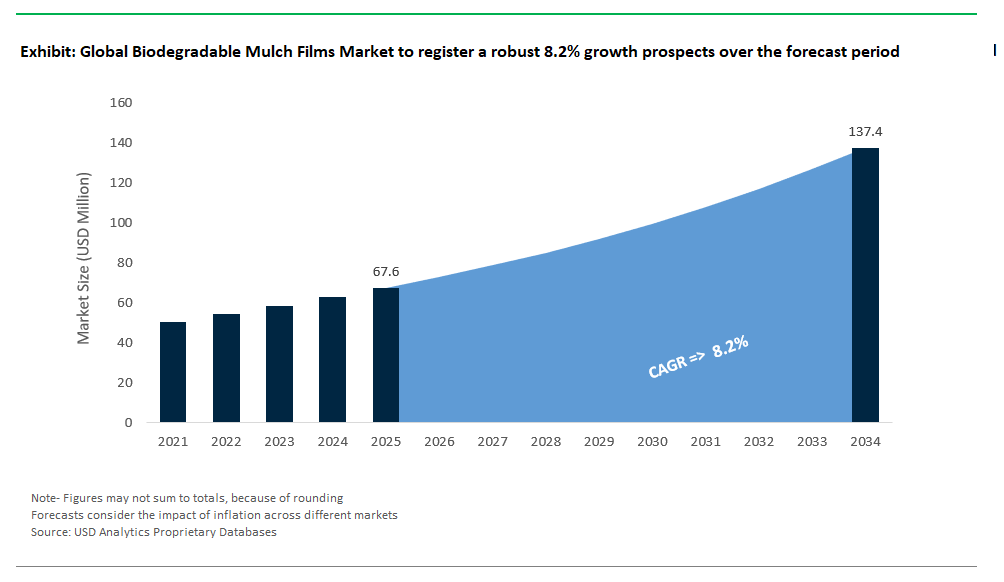
The Global Biodegradable Mulch Films Market is charting a path of steady expansion from 2025 through 2034, driven by growing global emphasis on sustainable farming practices, soil health, and environmental conservation. Industry projections indicate the market will grow from USD 67.6 million in 2025 to USD 137.4 million by 2034, achieving a healthy CAGR of 8.2%. This momentum reflects increasing adoption of biodegradable solutions over conventional polyethylene mulches, as farmers and agribusinesses seek to reduce plastic waste, lower disposal costs, and comply with tightening agricultural sustainability regulations worldwide.
Leveraging exclusive findings from USDAnalytics, this new report offers an extensive review and forward-looking analysis of the global Biodegradable Mulch Films Market, tracking activities in 21 countries and presenting profiles of over 20 key companies- By Raw Material (Thermoplastic Starch (TPS), Starch Blended with Polylactic Acid (PLA), Starch Blended with Polyhydroxyalkanoate (PHA), Aliphatic Aromatic Copolyesters (AAC), Others), By Crop Type (Fruits & Vegetables, Flowers & Ornamentals, Grains & Oilseeds, Others), By Farming System (Open-Field Cultivation, Greenhouse / High Tunnel Cultivation), By Sales Channel (Agricultural Dealers & Distributors, Co-operatives, Direct Sales to Large Farms/Agribusinesses, Direct-to-Farmer, E-commerce Platforms, Retailers for small-scale farmers/gardeners).
This research provides a thorough exploration of the global biodegradable mulch films sector, focusing on material innovations that enhance film durability, biodegradability rates, and crop performance benefits. It highlights the growing role of starch-based and PLA-based films in fruit and vegetable cultivation, the rise of hybrid polymer blends tailored for diverse climates, and the adoption of thinner yet effective films for sustainable cost management. The analysis delves into evolving sales channels, from direct-to-farm e-commerce models to specialized distributor networks serving smallholder and commercial farms alike. Supported by verified insights and practical intelligence, this report equips agricultural suppliers, polymer producers, distributors, policymakers, and agribusiness investors with the knowledge to navigate emerging opportunities in biodegradable mulch films and contribute to a more sustainable agricultural future through 2034.
Biodegradable Mulch Films Market Analysis: Green Solutions and Agricultural Transformation
The global biodegradable mulch films market is entering a period of robust growth, driven by environmental imperatives, regulatory support, and technological breakthroughs that are transforming agricultural practices. Traditionally reliant on conventional polyethylene films, agriculture is shifting decisively toward biodegradable alternatives to address the twin challenges of soil health degradation and plastic pollution. Recent market developments underscore how product innovation, capacity expansions, strategic partnerships, and regulatory mandates are reshaping the competitive landscape and accelerating adoption across diverse farming systems worldwide.
Innovative Product Launches Respond to Agricultural Performance Demands
Innovation in biodegradable mulch films has advanced significantly, with new products targeting critical performance gaps previously hindering widespread adoption. BASF’s ecovio® M2351, certified for soil biodegradability, breaks down safely across different crop cycles without leaving microplastics, meeting both farming needs and environmental rules. Novamont’s improved MATER-BI® films use enhanced starch-based formulations to boost durability, making them ideal for valuable crops like strawberries and tomatoes that require longer soil coverage while still biodegrading effectively. New biodegradable mulch films using advanced polymers like PHA are also emerging, offering better breakdown and reducing microplastic residue. These innovations are crucial as regulators and consumers increasingly expect genuine sustainability and full biodegradability from agricultural products.
Capacity Expansions Signal Scaling to Meet Growing Demand
The biodegradable films market is moving from niche supply to large-scale production as demand rises, especially in commercial agriculture. Leading manufacturers are investing in expanding their capacity, supported by EU green policies and subsidies that strengthen Europe’s role as a leader in sustainable agricultural films. Barbier Group is ramping up biodegradable film production to meet growing demand in Europe’s organic farming sector, driven by stricter regulations and retailer sustainability goals. Meanwhile, Plastika Kritis is offering biodegradable films tailored for different climates and crops, like Mediterranean vegetables, showing how producers are adopting regional strategies to ensure these films meet specific local farming needs. These capacity boosts are key to making biodegradable films more accessible and practical for widespread agricultural use.
Strategic Collaborations Bridge Technology and Equipment Integration
Collaboration between agricultural equipment makers and material innovators is essential for integrating biodegradable films into modern farming practices.
Addressing challenges in efficient mechanized film laying and retrieval is critical for labor-intensive agriculture, ensuring biodegradable films fit seamlessly into existing farming systems.
Pilot projects and research by major agricultural players are testing biodegradable films like Novamont’s MATER-BI® for uses such as weed control, helping reduce chemical inputs, and aligning with consumer demand for residue-free produce.
Industry consolidation and partnerships, including those involving Ginegar Plastic Products and its sustainable film portfolio, are embedding biodegradable mulch films into precision agriculture systems. This signals a future where mulch films become integrated parts of holistic farming solutions rather than stand-alone products.
Regulatory Frameworks Propel Market Transition
The European Union’s Common Agricultural Policy (CAP) 2023–2027 is boosting demand for biodegradable mulch by promoting environmental sustainability and encouraging farmers to choose eco-friendly practices. In the U.S., states like California are tightening rules on plastic waste in agriculture, signaling a likely phase-out of non-biodegradable mulches, especially in organic farming, which is pushing growers and suppliers to switch to sustainable alternatives quickly. Meanwhile, emerging markets are adopting biodegradable mulch films as part of sustainable agricultural programs aimed at improving yields and protecting the environment, particularly for smallholder farms. Together, these policy and regulatory shifts are accelerating the global move toward biodegradable solutions in agriculture.
Technological Breakthroughs Enhance Film Functionality and Sustainability
Breakthroughs in materials science, like nanocellulose-reinforced PBAT films, are delivering strong yet ultra-thin biodegradable films that use less material while still breaking down efficiently, lowering both costs and environmental impact per hectare. Researchers are also developing innovative biodegradable films that release nutrients as they degrade, helping boost crop growth and soil health. Another exciting area is multi-functional films that combine biodegradability with added benefits, such as pest-repellent properties using plant-based compounds. These advanced films could reduce the need for separate chemical treatments, offering big advantages for organic farming and integrated pest management. Together, these innovations are reshaping the future of sustainable agriculture.
Commercial Adoption Validates Market Readiness
Leading brands in high-value crops like berries are making sustainability central to their strategies, responding to retailers’ and consumers’ demand for eco-friendly sourcing. This shift is boosting the use of advanced biodegradable films, such as Novamont’s MATER-BI®, in farming operations. Global foodservice brands are also shaping agricultural practices to fit sustainability goals, increasing demand for biodegradable mulch films for crops like potatoes. In places like India, biodegradable films are gaining traction for water-intensive crops such as basmati rice, showing strong potential to reduce water use while delivering environmental benefits. These trends position biodegradable films as vital tools in climate-resilient and sustainable agriculture.
Trend: Regulatory Phase-Out of Polyethylene Mulch Accelerates Biodegradable Film Adoption
Growing concerns over microplastic pollution and soil health are driving regulatory changes that favor biodegradable solutions in agriculture. In the European Union, stricter biodegradability standards for agricultural films are taking shape, signaling a clear move away from traditional polyethylene mulches. Although outright bans and fines for polyethylene use vary by region, the overall trend points toward sustainable alternatives. This regulatory momentum, combined with rising awareness among growers, is boosting the use of biodegradable mulch films, especially in high-value crops like strawberries, tomatoes, and vineyards. The global biodegradable mulch film market saw notable growth from 2023 to 2024, reflecting this increasing shift, even though exact annual growth rates differ across market analyses.
Cost competitiveness is steadily improving for biodegradable mulch films, with advanced options like starch-PBAT blends becoming closer in price to conventional polyethylene films. While a price premium still exists, ongoing technological advances and larger-scale production are narrowing this gap, making these eco-friendly alternatives more accessible for growers. New biodegradable films featuring enzyme-embedded technology are also achieving faster degradation, breaking down completely in days or weeks under optimal conditions, compared to the centuries it takes for traditional plastics to decompose. This combination of regulatory pressure, innovative materials, and improving cost parity is positioning biodegradable mulch films as the emerging standard for sustainable and environmentally responsible crop production.
Opportunity: Specialty Crop Expansion and Premium Pricing Drive Market Growth
A major opportunity in the biodegradable mulch films market lies in expanding use among high-value specialty crops like berries, vineyards, and organic produce. Advanced biodegradable films, including UV-stabilized and PLA-based options, help manage soil moisture and temperature, which can boost crop quality and profitability in crops such as strawberries. While exact yield improvements vary by product and conditions, these films aim to enhance productivity and farm outcomes. For growers, biodegradable mulch films also eliminate the labor and costs involved in removing and disposing of plastic mulches, creating savings that help balance the higher upfront costs of sustainable materials, especially for mid-sized farms.
The market for biodegradable mulch films in high-value segments like berries and grapes holds significant untapped potential, signaling strong future growth. Although precise replacement volumes for these crops require deeper market data, the expanding fruits and vegetables sector highlights a clear opportunity for further adoption. Organic farms are leading the way in using biodegradable mulch films, driven by sustainability goals and their willingness to pay a premium for certified eco-friendly products. This demand from organic and specialty crop producers is fueling the growth of high-performance biodegradable films and helping to establish them as a preferred choice in sustainable agriculture.
Competitive Landscape of the Global Biodegradable Mulch Films Market
The global biodegradable mulch films market is experiencing strong growth in 2024, driven by tightening agricultural regulations against plastic waste, rising adoption of sustainable farming practices, and growing demand for eco-friendly solutions that reduce soil contamination and disposal costs. Innovations in PBAT, PLA, starch-based blends, and hybrid formulations are delivering films that match the durability and performance of conventional plastics while biodegrading safely in soil. Leading producers are scaling capacity, developing region-specific solutions, and partnering with agricultural machinery and equipment manufacturers to ensure seamless field adoption. The competitive landscape reflects an industry poised to transform sustainable agriculture and environmental stewardship worldwide.
BASF: Leading with ecovio® Portfolio for Soil Biodegradability
BASF (Germany) BASF leads the biodegradable mulch film sector through its ecovio® portfolio, a PBAT/PLA blend that offers high mechanical strength and soil biodegradability. ecovio® M2351 is a certified soil-biodegradable biopolymer for use in agriculture, certified according to the European standard EN 17033. This grade is designed to increase crop yield, reduce herbicide and water use, and biodegrade naturally in agricultural soil, leaving no persistent microplastics. Films made of ecovio® M 2351 can be manufactured with layer thicknesses of 8 to 25 µm and can be laid out with the same machines used for conventional mulch films. BASF’s global reach and regulatory certifications position it as a trusted partner for sustainable agriculture solutions worldwide.
Novamont: Dominant Force in Starch-Based Mater-Bi® Mulch Films
Novamont (Italy) Novamont is a dominant force in starch-based biodegradable mulch films with its Mater-Bi® technology. Novamont produces Mater-Bi® resins used to manufacture agricultural mulch film, which can be plowed back into the soil where it will biodegrade at the end of the growing season. Novamont's new Mater-Bi plant at Patrica has increased its bioplastics production capacity to 200 ktons (as per its 2021 Sustainability Report), enabling it to meet growing market demand. Novamont's commitment to using renewable resources is evident, with around 58% of its raw materials being renewable. The company continues to offer compelling advantages for farmers seeking sustainable, residue-free alternatives.
BioBag World: Expanding Reach in Agricultural Markets
BioBag World (USA/Novamont Subsidiary) BioBag World, as a subsidiary of Novamont, is strategically expanding its reach in agricultural markets. BioBag, as part of Novamont, leverages its parent company's expertise in starch-based biodegradable materials to provide sustainable solutions for diverse agricultural environments. The company is known for its certified compostable products, which include solutions relevant to agricultural applications.
Armando Alvarez: Offering Innovative Biodegradable Mulch Films
Armando Alvarez (Spain) Armando Alvarez offers innovative biodegradable mulch films within its comprehensive range of agricultural plastics. The company provides biodegradable sheeting for soil cover, showcasing its commitment to sustainable solutions. Armando Alvarez emphasizes its focus on sustainability and circular economy principles across its operations. The company's diverse portfolio of agricultural films, including plastic thermal biodegradable greenhouse sheeting and weed control sheeting, highlights its role as a competitive player in regions transitioning to sustainable agriculture practices.
RKW Group: Making Strides in Sustainable Agricultural Films
RKW Group (Germany) RKW Group makes significant strides in sustainable agricultural films. RKW Group will be presenting its film and net solutions as well as nonwovens for the entire supply chain, from plant cultivation to packaging and transport, at Fruit Logistica in Berlin from February 5-7, 2025. This includes early harvesting films and greenhouse films. RKW's commitment to sustainability is further evidenced by its Sustainability Report 2023, published in August 2024, which highlights a 61% reduction in CO2 emissions and a 30% reduction in water consumption in 2023 compared to the 2017 baseline. RKW Group's focus on balancing affordability with environmental responsibility makes it a strong player in the mulch films market
Segmentation Insights: Biodegradable Mulch Films Market
By Raw Material: Aliphatic Aromatic Copolyesters (AAC) Lead Market Share, Starch-PHA Blends Grow Fastest
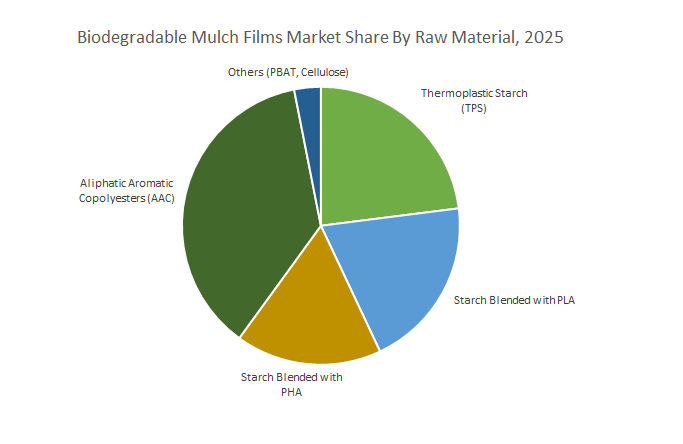
In 2025, aliphatic aromatic copolyesters (AAC) command a 36.9% share of the biodegradable mulch films market, underpinned by their widespread use in durable, soil-biodegradable solutions such as BASF’s Ecovio®. Their high durability makes AACs the preferred choice for multi-season crop protection. Starch blended with PHA is the fastest-growing segment, thanks to its marine-degradable properties that support safe use in coastal and flood-prone agricultural regions. Thermoplastic starch (TPS) remains a key, cost-effective solution, but is best suited for short-lifecycle crops due to its rapid degradation timeline. Starch blends with PLA and niche materials like PBAT and cellulose also contribute to market diversity and performance flexibility.
Flowers and ornamentals represent a significant and growing segment with a CAGR of 8.9%, as export-focused industries in Colombia and Kenya adopt starch-PHA blends to meet EU environmental standards. Fruits and vegetables are the leading crop segment in 2025. High-value produce, such as tomatoes and strawberries in Europe, justifies the investment in biodegradable solutions that boost yield and reduce soil contamination. Grains, oilseeds, and other specialty crops also leverage biodegradable mulch for sustainability and soil health, particularly in the US Midwest, Ukraine, and Southeast Asia.
China Leading Global Biodegradable Mulch Films Production and Policy Implementation
China dominates the global biodegradable mulch films industry, accounting for 580,000 tons of annual production, around 60% of global output. Market leaders like Kingfa Science, known for PBAT mulch films, and Sinopec, developing PBS-based solutions, are spearheading innovation and scaling up production to meet national sustainability goals. In 2025, China's biodegradable mulch film market size will have reached approximately USD 65.06 million, indicating continued strong growth and a significant contribution to the overall biodegradable films market. Government subsidies now cover up to 30% of biodegradable mulch film costs, significantly lowering adoption barriers for farmers. The implementation of the national standard GB/T 35795-2023 for biodegradable agricultural films ensures uniform quality and accelerates market growth. The GB/T 35795-2023 standard, implemented from July 1, 2018 (with updates likely in force), continues to be a crucial driver for quality and market acceleration in 2025, ensuring product reliability and farmer trust. With regulatory backing, significant manufacturing capacity, and aggressive policy incentives, China is cementing its position as the global leader in biodegradable mulch films.
Italy: Pioneering Technological Advances in Compostable Mulch Films
Italy has established itself as a technology leader in biodegradable mulch films, driven by Novamont’s innovative Mater-Bi® materials. The company’s 4th-generation starch-based mulch films degrade completely within 90 days, aligning with both EU compostability standards and agricultural requirements. These films are 100% bio-based and carry compostable certification, making them ideal for organic farming. As of June 2025, Novamont has reiterated its commitment to sustainable agricultural solutions, indicating ongoing advancements in its Mater-Bi® film technology for agricultural applications, including efforts to ensure its products align with evolving EU environmental policies. In regions like Emilia-Romagna, the use of biodegradable mulch films is mandatory for organic producers, driving domestic demand and reinforcing Italy’s reputation as a hub for sustainable agricultural technologies. Italy's proactive regulatory stance, including regional mandates for biodegradable mulch in organic farming, continues to drive demand in 2025, leading to significant market growth for biodegradable films. Italy’s contributions are critical for advancing performance standards and expanding the European biodegradable mulch film market.
The United States is Experiencing Rapid Growth in Biodegradable Mulch Film Adoption
The United States is emerging as the fastest-growing market for biodegradable mulch films, posting an impressive CAGR of 28% from 2023 to 2025. Federal support, including a $25 million USDA grant program, is fueling research and field trials to accelerate adoption. California’s “Healthy Soils Initiative” is actively promoting biodegradable alternatives to traditional plastic mulch, underscoring the environmental and economic benefits of soil health improvements. The California Department of Food and Agriculture (CDFA) continues to promote the Healthy Soils Program in 2025, with mulching practices being a key component for soil health improvements, thereby encouraging the use of biodegradable alternatives. Companies like BioBag Americas and Organix Solutions are key domestic players introducing new product lines tailored for diverse crop systems. BioBag Americas continues to offer its BioAgri Mulch Film, emphasizing its soil biodegradability and benefits for sustainable agriculture in 2025, with no major new product line announcements specific to 2025, but a consistent focus on its existing certified biodegradable offerings. With growing regulatory momentum and rising sustainability commitments from the agriculture sector, the U.S. is quickly transitioning toward broader commercial use of biodegradable mulch films.
Germany Serving as Europe’s R&D Hub for Smart Biodegradable Mulch Films
Germany plays a pivotal role as Europe’s research and development hub for advanced biodegradable mulch film technologies. BASF’s Ecovio® mulch films deliver durable in-field performance with a lifespan of up to 120 days before degradation, meeting the operational requirements of many crops while reducing plastic pollution. BASF continues to promote its Ecovio® M2351, a certified soil-biodegradable grade specifically developed for mulch films, highlighting its benefits for sustainable agriculture and its ability to be ploughed back into the ground after harvest in 2025. The Fraunhofer Institute has introduced sensor-embedded smart mulch films capable of monitoring soil conditions, offering precision agriculture benefits alongside biodegradability. Regulatory frameworks, particularly the EU Soil Strategy, are pushing toward mandatory biodegradable mulch usage by 2026, positioning Germany as a central player in shaping the future of sustainable agriculture across Europe. The impending EU Soil Strategy, with its proposed mandatory biodegradable mulch usage by 2026, is a significant driver for the German market in 2025, encouraging producers and farmers to prepare for the shift, especially in controlled environments like greenhouses.
Japan Innovating Ultra-Thin and Precision-Focused Biodegradable Films
Japan is leading in specialized biodegradable mulch films designed for precision agriculture. Mitsubishi Chemical has developed ultra-thin biodegradable films just 15μm thick, offering reduced material use while maintaining field performance. Mitsubishi Chemical continues to be a key player in the biodegradable plastics market in 2025, with ongoing development in advanced film technologies, including ultra-thin films for various agricultural and packaging applications. Photodegradable films tailored to specific crop cycles further highlight Japan’s innovative approach to sustainable agriculture. Adoption rates are climbing quickly, with about 45% of strawberry farms having converted to biodegradable mulch, showcasing both market acceptance and environmental stewardship. This high adoption rate in strawberry farms underscores Japan's rapid transition to biodegradable solutions in specific high-value crops, and similar trends are expected to continue in other precision agriculture segments in 2025. As Japan’s agricultural sector continues to modernize, its role as a technology innovator in biodegradable mulches is increasingly significant.
Spain: Developing Biodegradable Mulch Films for Mediterranean and Arid Climates
Spain has carved out a unique niche in the biodegradable mulch films market by focusing on solutions tailored to Mediterranean and arid conditions. Innovations such as algae-based mulch films offer 60-day degradation even under high temperatures, providing both soil health benefits and rapid breakdown in warm climates. Spanish research institutions and companies are actively engaged in pilot projects and further development of algae-based and other bio-based mulch films in 2025, aiming to optimize their performance and cost-effectiveness for hot, arid climates. Spain’s adoption rates are high, with about 70% of tomato greenhouse operations now relying on biodegradable mulch films to meet environmental regulations and boost operational efficiency. This regional specialization positions Spain as a leader in adapting biodegradable solutions to challenging agricultural environments.
Brazil Pioneering Sugarcane-Based Biodegradable Mulch Films for Tropical Agriculture
Brazil is advancing biodegradable mulch film technology using its abundant agricultural resources, especially sugarcane. Braskem has developed sugarcane-based mulch films with enhanced UV resistance, addressing the harsh sunlight and high temperatures typical of tropical climates. Braskem continues to invest in its I'm green™ bio-based PE, derived from sugarcane, and in 2025, it is focusing on expanding the range of applications for these films, including more robust mulch films with improved UV resistance for demanding tropical agricultural conditions. The Brazilian government is supporting the industry through a 25% tax credit for sustainable agriculture inputs, incentivizing adoption across diverse crops. Brazil's focus on sustainable agriculture is evident in its increased private financing for the agribusiness sector, with a 28% increase in private securities to finance agribusiness by February 2025 compared to the previous year, which indirectly supports the adoption of sustainable inputs like biodegradable mulch films. As global brands seek renewable alternatives and sustainability certifications, Brazil’s innovations are positioning the country as a significant player in the biodegradable mulch films market, especially in tropical agriculture.
India Emerging as a Key Market for Biodegradable Mulch Films with Localized Innovations
India is rapidly emerging as a significant market for biodegradable mulch films, driven by both government policy and local innovation. The Indian government has banned conventional plastic mulch in eight states, creating a strong push toward biodegradable alternatives. By mid-2025, the Indian government's ongoing focus on reducing plastic pollution, as evidenced by events like the National Expo on eco-alternatives to banned single-use plastics in June 2025, continues to drive policy support for biodegradable alternatives, including mulch films, across various states. Subsidies covering up to 40% of the cost further reduce barriers for farmers. Government initiatives and schemes in 2025 are increasingly prioritizing sustainable farming and eco-friendly practices, including financial support for inputs like biodegradable mulch films, aiming to boost adoption rates. Local R&D is also thriving, with IIT Madras developing banana fiber-reinforced films tailored for Indian crop systems. Research from institutions like IIT Madras, focusing on natural fiber-reinforced films, continues in 2025, indicating ongoing efforts to develop localized, cost-effective biodegradable mulch film solutions suited to India's diverse agricultural landscape. India’s market potential is immense, as biodegradable mulch films align with national goals for sustainable agriculture and plastic waste reduction.
Biodegradable Mulch Films Market Report Scope
Biodegradable Mulch Films Market
Parameter
Details
Market Size (2025)
$67.6 Million
Market Size (2034)
$137.4 Million
Market Growth Rate
8.2%
Segments
By Raw Material (Thermoplastic Starch (TPS), Starch Blended with Polylactic Acid (PLA), Starch Blended with Polyhydroxyalkanoate (PHA), Aliphatic Aromatic Copolyesters (AAC), Others), By Crop Type (Fruits & Vegetables, Flowers & Ornamentals, Grains & Oilseeds, Others), By Farming System (Open-Field Cultivation, Greenhouse / High Tunnel Cultivation), By Sales Channel (Agricultural Dealers & Distributors, Co-operatives, Direct Sales to Large Farms/Agribusinesses, Direct-to-Farmer, E-commerce Platforms, Retailers for small-scale farmers/gardeners)
Study Period
2019- 2024 and 2025-2034
Units
Revenue (USD)
Qualitative Analysis
Porter’s Five Forces, SWOT Profile, Market Share, Scenario Forecasts, Market Ecosystem, Company Ranking, Market Dynamics, Industry Benchmarking
Companies
BASF SE (Germany), Novamont S.p.A. (Italy), NatureWorks LLC (U.S.), Kingfa Sci. & Tech. Co., Ltd. (China), BioBag International AS (Norway), Green Dot Bioplastics (U.S.), FKuR Kunststoff GmbH (Germany), AB Rani Plast Oy (Finland), Armando Alvarez Group (Spain), RKW SE (Germany), Symphony Environmental Technologies Plc (UK), Al Pack Enterprises Ltd. (Canada), Organix Ag (U.S.), Growit India Private Limited (India), Vrunda Vitthal Polynet Ltd. (India), and Others.
Countries
US, Canada, Mexico, Germany, France, Spain, Italy, UK, Russia, China, India, Japan, South Korea, Australia, South East Asia, Brazil, Argentina, Middle East, Africa
Biodegradable Mulch Films Market Segmentation
By Raw Material
Thermoplastic Starch (TPS)
Starch Blended with Polylactic Acid (PLA)
Starch Blended with Polyhydroxyalkanoate (PHA)
Aliphatic Aromatic Copolyesters (AAC)
Others
By Crop Type
Fruits & Vegetables
Flowers & Ornamentals
Grains & Oilseeds
Other Specialty Crops
By Farming System
Open-Field Cultivation
Greenhouse / High Tunnel Cultivation
By Sales Channel
Agricultural Dealers & Distributors
Co-operatives
Direct Sales to Large Farms/Agribusinesses
Direct-to-Farmer
E-commerce Platforms
Retailers for small-scale farmers/gardeners
Countries Analyzed
North America (US, Canada, Mexico)
Europe (Germany, UK, France, Spain, Italy, Russia, Rest of Europe)
Asia Pacific (China, India, Japan, South Korea, Australia, South East Asia, Rest of Asia)
South America (Brazil, Argentina, Rest of South America)
Middle East and Africa (Saudi Arabia, UAE, Rest of Middle East, South Africa, Egypt, Rest of Africa)
Top Companies in the Biodegradable Mulch Films Market
BASF SE (Germany)
Novamont S.p.A. (Italy)
NatureWorks LLC (US)
Kingfa Sci. & Tech. Co., Ltd. (China)
BioBag International AS (Norway)
Green Dot Bioplastics (US)
FKuR Kunststoff GmbH (Germany)
AB Rani Plast Oy (Finland)
Armando Alvarez Group (Spain)
RKW SE (Germany)
Symphony Environmental Technologies Plc (UK)
Al Pack Enterprises Ltd. (Canada)
Organix Ag (US)
Growit India Private Limited (India)
Vrunda Vitthal Polynet Ltd. (India)
* List Not Exhaustive
Methodology:
The research methodology for the Global Biodegradable Mulch Films Market integrates comprehensive primary interviews with industry stakeholders including resin manufacturers, film producers, agricultural cooperatives, distributors, farmers, and policymakers to gather direct insights on market trends, innovations, regulatory impacts, and adoption patterns. This primary research is rigorously complemented by detailed secondary analysis leveraging corporate sustainability reports, agricultural policy documents (e.g., EU CAP 2023–2027, California’s Healthy Soils Initiative), scientific publications, patent databases, and data from credible sources like the European Bioplastics Association, USDA, FAO, and national agricultural ministries. Advanced data triangulation techniques ensure the consistency and accuracy of market sizing, segmental shares, and forecast models. This robust approach provides reliable, actionable insights and validates market figures, enabling a clear projection of the global biodegradable mulch films market outlook through 2034.
Research Coverage:
Geographic Scope: Analysis spans 25+ countries across North America, Europe, Asia Pacific, Latin America, the Middle East & Africa.
Segmentation: Detailed segmentation by:
Raw Material: Thermoplastic Starch (TPS), Starch Blended with Polylactic Acid (PLA), Starch Blended with Polyhydroxyalkanoate (PHA), Aliphatic Aromatic Copolyesters (AAC), Others.
Farming System: Open-Field Cultivation, Greenhouse / High Tunnel Cultivation.
Sales Channel: Agricultural Dealers & Distributors, Co-operatives, Direct Sales to Large Farms/Agribusinesses, Direct-to-Farmer, E-commerce Platforms, Retailers for small-scale farmers/gardeners.
Competitive Landscape: Profiles and strategic analysis of 15+ leading global and regional producers, technology providers, and specialty film manufacturers.
Trends & Disruptions: In-depth analysis of advanced biodegradable film formulations, integration with precision agriculture, sustainability certification trends, and the impact of evolving agricultural policies worldwide.
Industry Dynamics: Drivers, restraints, investment trends, capacity expansions, cost dynamics, regulatory impacts, and supply chain analysis.
Historic data from 2021 to 2024 and forecast data from 2025 to 2034.
Deliverables:
Full Market Research Report (PDF, Excel): Complete data tables, market charts, and visual insights.
Country-Level Forecasts & Analysis.
Segment-wise Revenue Projections (2025–2034).
Competitive Benchmarking & SWOT Analysis.
Recent Developments & News Tracker.
Executive Summary & Analyst Insights.
Post-Purchase Analyst Support for Client-Specific Questions and Custom Data Requirements.
Table of Contents: Biodegradable Mulch Films Market Analysis: Sustainable Agriculture Trends & Growth Forecast (2025–2034)
1. Executive Summary
1.1. Market Highlights
1.2. Key Findings
1.3. Global Market Snapshot
2. Biodegradable Mulch Films Market Landscape & Outlook (2025-2034)
2.1. Introduction to Biodegradable Mulch Films
2.2. Market Valuation and Growth Projections (2025-2034)
2.2.1. Current Market Size (2025): USD 67.6 Million
2.2.2. Forecasted Market Size and CAGR (2025-2034): USD 137.4 Million at 8.2% CAGR
2.3. Driving Factors for Market Growth
2.3.1. Growing Global Emphasis on Sustainable Farming Practices
2.3.2. Soil Health and Environmental Conservation
2.3.3. Reduction of Plastic Waste and Disposal Costs
2.3.4. Compliance with Tightening Agricultural Sustainability Regulations
The global biodegradable mulch films market is forecasted to grow from USD 67.6 million in 2025 to USD 137.4 million by 2034, achieving a robust CAGR of 8.2%. Rising sustainability mandates and demand for eco-friendly farming solutions are fueling this expansion.
Materials like starch blends with PLA or PHA, thermoplastic starch (TPS), and aliphatic aromatic copolyesters (AAC) are leading innovation, offering strong durability, soil biodegradability, and enhanced crop performance for diverse agricultural conditions.
Biodegradable mulch films help prevent soil pollution, reduce plastic waste disposal costs, and improve soil health. Farmers are adopting these eco-friendly solutions to meet regulatory requirements and improve sustainability practices in agriculture.
Manufacturers like BASF, Novamont, and Barbier Group are expanding capacity and launching region-specific products. Partnerships with agricultural equipment makers ensure biodegradable films integrate smoothly into modern farming operations worldwide.
Italy leads in compostable mulch film technology with Novamont’s Mater-Bi® films, which fully degrade in soil and meet EU standards. Regional mandates and strong organic farming adoption are driving Italy’s growth in sustainable agricultural films.