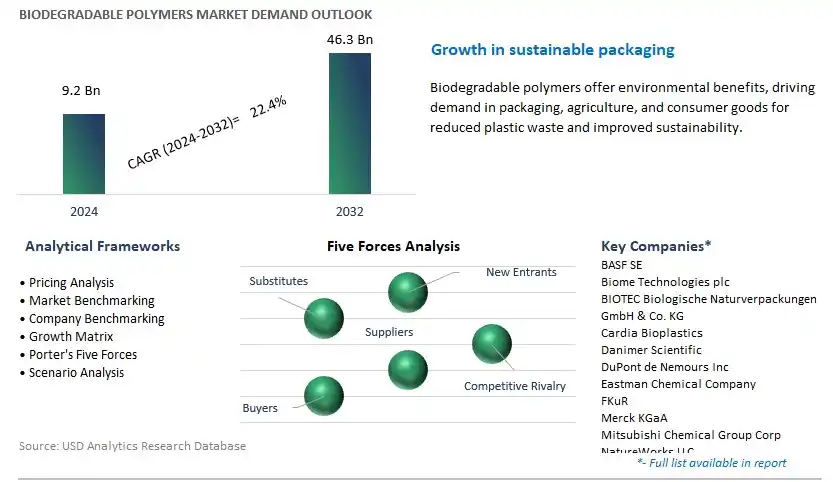
Global Biodegradable Polymers Market Size is valued at $9.2 Billion in 2024 and is forecast to register a growth rate (CAGR) of 22.4% to reach $46.3 Billion by 2032.
The global Biodegradable Polymers Market Study analyzes and forecasts the market size across 6 regions and 24 countries for diverse segments -By Type (Starch-based Plastics, Polylactic Acid (PLA), Polyhydroxy Alkanoates (PHA), Polyesters, Cellulose Derivatives), By End-User (Agriculture, Textile, Consumer Goods, Packaging, Healthcare, Others).
An Introduction to Biodegradable Polymers Market in 2024
Bio-degradable polymers, also known as bioplastics, are a type of polymer that can undergo degradation by biological processes such as bacteria, fungi, or enzymes, returning to natural elements in the environment in 2024. These polymers are derived from renewable biomass sources such as plant starches, cellulose, or vegetable oils and offer a sustainable alternative to conventional plastics derived from fossil fuels. Bio-degradable polymers are used in various applications, including packaging, agriculture, textiles, and medical devices, where they provide similar performance and functionality to traditional plastics but with the added benefit of reduced environmental impact. Examples of bio-degradable polymers include polylactic acid (PLA), polyhydroxyalkanoates (PHA), and starch-based polymers. These polymers can be composted under controlled conditions or degraded in natural environments, contributing to the reduction of plastic pollution and waste. With increasing concerns about plastic pollution and environmental sustainability, bio-degradable polymers are gaining traction as a viable solution for addressing the challenges of plastic waste and advancing towards a more circular economy.
Biodegradable Polymers Market Competitive Landscape
The market report analyses the leading companies in the industry including BASF SE, Biome Technologies plc, BIOTEC Biologische Naturverpackungen GmbH & Co. KG, Cardia Bioplastics, Danimer Scientific, DuPont de Nemours Inc, Eastman Chemical Company, FKuR, Merck KGaA, Mitsubishi Chemical Group Corp, NatureWorks LLC, Novamont S.p.A., Teijin Ltd, and others.
Biodegradable Polymers Market Dynamics
Market Trend: Increasing Demand for Environmentally Friendly Packaging Solutions
A prominent trend in the biodegradable polymers market is the increasing demand for environmentally friendly packaging solutions, driven by growing environmental awareness, regulatory pressures, and consumer preferences for sustainable products. Biodegradable polymers, also known as compostable or bio-based plastics, offer a sustainable alternative to conventional petroleum-based plastics, as they can degrade naturally in the environment, reducing pollution and waste. This trend is reshaping the packaging industry, with brands, retailers, and consumers increasingly opting for biodegradable polymer packaging materials that are recyclable, compostable, and biodegradable, aligning with circular economy principles and sustainability goals.
Market Driver: Regulatory Initiatives and Consumer Preferences
The primary driver fueling the growth of the biodegradable polymers market is regulatory initiatives and consumer preferences promoting the use of environmentally friendly materials in packaging and consumer goods. Governments worldwide are implementing policies and standards to reduce plastic pollution, increase recycling rates, and incentivize the adoption of biodegradable polymers as alternatives to conventional plastics derived from fossil fuels. Additionally, consumers are becoming more conscious of the environmental impact of their purchasing decisions and are increasingly seeking out products and packaging solutions that are biodegradable, compostable, and eco-friendly. As regulatory pressures and consumer preferences continue to drive demand for biodegradable polymers, the market is expected to experience significant growth and expansion.
Market Opportunity: Innovation in Material Development and Applications
An emerging opportunity within the biodegradable polymers market lies in innovation in material development and applications, leveraging advancements in biopolymer technologies to create new products and enter new markets. While biodegradable polymers are already widely used in packaging, food service ware, and agricultural applications, there is untapped potential in sectors such as textiles, electronics, and automotive, where the demand for sustainable materials is growing. By investing in research and development initiatives, collaboration with industry partners, and market-driven innovation, manufacturers of biodegradable polymers can unlock opportunities to expand their product portfolios, penetrate new markets, and drive sustainable growth in the evolving landscape of polymer materials.
Bio-degradable Polymers Market Share Analysis: Polylactic Acid (PLA) segment generated the highest revenue in 2024
Polylactic Acid (PLA) is the largest segment in the Bio-degradable Polymers Market by Type, owing to its versatile properties, widespread applications, and increasing demand across various industries. PLA is a bio-based polymer derived from renewable resources such as corn starch or sugarcane. It is biodegradable, compostable, and exhibits excellent mechanical and thermal properties, making it suitable for a wide range of applications, including packaging, textiles, medical devices, and consumer goods. The growing awareness of environmental sustainability and the shift towards eco-friendly alternatives to conventional plastics have propelled the demand for PLA-based products. Moreover, technological advancements in PLA production processes, such as improved polymerization techniques and the development of novel additives, have further enhanced its performance and applicability in diverse end-use sectors. As regulatory pressures mount and consumer preferences increasingly prioritize sustainable materials, the demand for PLA is expected to continue its upward trajectory, reinforcing its position as the largest segment in the Bio-degradable Polymers Market.
Bio-degradable Polymers Market Share Analysis: Packaging is poised to register the fastest CAGR over the forecast period
The Packaging segment is the fastest-growing segment in the Bio-degradable Polymers Market by End-User. With increasing concerns about plastic pollution and environmental sustainability, there is a growing demand for eco-friendly packaging solutions. Bio-degradable polymers offer a promising alternative to conventional plastics, as they are derived from renewable resources and can degrade naturally, reducing environmental impact. Moreover, stringent regulations and policies aimed at curbing single-use plastics have spurred the adoption of biodegradable packaging materials across various industries. Additionally, advancements in polymer technology have led to the development of bio-based polymers with improved properties, such as enhanced strength, flexibility, and barrier properties, making them suitable for a wide range of packaging applications. As consumer preferences shift towards sustainable packaging options and companies prioritize environmentally friendly practices, the Packaging segment is expected to experience significant growth in the Bio-degradable Polymers Market.
Biodegradable Polymers Market
By Type
Starch-based Plastics
Polylactic Acid (PLA)
Polyhydroxy Alkanoates (PHA)
Polyesters
Cellulose Derivatives
By End-User
Agriculture
Textile
Consumer Goods
Packaging
Healthcare
Others
Countries Analyzed
North America (US, Canada, Mexico)
Europe (Germany, UK, France, Spain, Italy, Russia, Rest of Europe)
Asia Pacific (China, India, Japan, South Korea, Australia, South East Asia, Rest of Asia)
South America (Brazil, Argentina, Rest of South America)
Middle East and Africa (Saudi Arabia, UAE, Rest of Middle East, South Africa, Egypt, Rest of Africa)
Biodegradable Polymers Companies Profiled in the Study
BASF SE
Biome Technologies plc
BIOTEC Biologische Naturverpackungen GmbH & Co. KG
Cardia Bioplastics
Danimer Scientific
DuPont de Nemours Inc
Eastman Chemical Company
FKuR
Merck KGaA
Mitsubishi Chemical Group Corp
NatureWorks LLC
Novamont S.p.A.
Teijin Ltd
*- List Not Exhaustive
TABLE OF CONTENTS
1 Introduction to 2024 Biodegradable Polymers Market
1.1 Market Overview
1.2 Quick Facts
1.3 Scope/Objective of the Study
1.4 Market Definition
1.5 Countries and Regions Covered
1.6 Units, Currency, and Conversions
1.7 Industry Value Chain
2 Research Methodology
2.1 Market Size Estimation
2.2 Sources and Research Methodology
2.3 Data Triangulation
2.4 Assumptions and Limitations
3 Executive Summary
3.1 Global Biodegradable Polymers Market Size Outlook, $ Million, 2021 to 2032
3.2 Biodegradable Polymers Market Outlook by Type, $ Million, 2021 to 2032
3.3 Biodegradable Polymers Market Outlook by Product, $ Million, 2021 to 2032
3.4 Biodegradable Polymers Market Outlook by Application, $ Million, 2021 to 2032
3.5 Biodegradable Polymers Market Outlook by Key Countries, $ Million, 2021 to 2032
4 Market Dynamics
4.1 Key Driving Forces of Biodegradable Polymers Industry
4.2 Key Market Trends in Biodegradable Polymers Industry
4.3 Potential Opportunities in Biodegradable Polymers Industry
4.4 Key Challenges in Biodegradable Polymers Industry
5 Market Factor Analysis
5.1 Value Chain Analysis
5.2 Competitive Landscape
5.2.1 Global Biodegradable Polymers Market Share by Company (%), 2023
5.2.2 Product Offerings by Company
5.3 Porter’s Five Forces Analysis
5.4 Pricing Analysis and Outlook
6 Growth Outlook Across Scenarios
6.1 Growth Analysis-Case Scenario Definitions
6.2 Low Growth Scenario Forecasts
6.3 Reference Growth Scenario Forecasts
6.4 High Growth Scenario Forecasts
7 Global Biodegradable Polymers Market Outlook by Segments
7.1 Biodegradable Polymers Market Outlook by Segments, $ Million, 2021- 2032
By Type
Starch-based Plastics
Polylactic Acid (PLA)
Polyhydroxy Alkanoates (PHA)
Polyesters
Cellulose Derivatives
By End-User
Agriculture
Textile
Consumer Goods
Packaging
Healthcare
Others
8 North America Biodegradable Polymers Market Analysis and Outlook To 2032
8.1 Introduction to North America Biodegradable Polymers Markets in 2024
8.2 North America Biodegradable Polymers Market Size Outlook by Country, 2021-2032
8.2.1 United States
8.2.2 Canada
8.2.3 Mexico
8.3 North America Biodegradable Polymers Market size Outlook by Segments, 2021-2032
By Type
Starch-based Plastics
Polylactic Acid (PLA)
Polyhydroxy Alkanoates (PHA)
Polyesters
Cellulose Derivatives
By End-User
Agriculture
Textile
Consumer Goods
Packaging
Healthcare
Others
9 Europe Biodegradable Polymers Market Analysis and Outlook To 2032
9.1 Introduction to Europe Biodegradable Polymers Markets in 2024
9.2 Europe Biodegradable Polymers Market Size Outlook by Country, 2021-2032
9.2.1 Germany
9.2.2 France
9.2.3 Spain
9.2.4 United Kingdom
9.2.4 Italy
9.2.5 Russia
9.2.6 Norway
9.2.7 Rest of Europe
9.3 Europe Biodegradable Polymers Market Size Outlook by Segments, 2021-2032
By Type
Starch-based Plastics
Polylactic Acid (PLA)
Polyhydroxy Alkanoates (PHA)
Polyesters
Cellulose Derivatives
By End-User
Agriculture
Textile
Consumer Goods
Packaging
Healthcare
Others
10 Asia Pacific Biodegradable Polymers Market Analysis and Outlook To 2032
10.1 Introduction to Asia Pacific Biodegradable Polymers Markets in 2024
10.2 Asia Pacific Biodegradable Polymers Market Size Outlook by Country, 2021-2032
10.2.1 China
10.2.2 India
10.2.3 Japan
10.2.4 South Korea
10.2.5 Indonesia
10.2.6 Malaysia
10.2.7 Australia
10.2.8 Rest of Asia Pacific
10.3 Asia Pacific Biodegradable Polymers Market size Outlook by Segments, 2021-2032
By Type
Starch-based Plastics
Polylactic Acid (PLA)
Polyhydroxy Alkanoates (PHA)
Polyesters
Cellulose Derivatives
By End-User
Agriculture
Textile
Consumer Goods
Packaging
Healthcare
Others
11 South America Biodegradable Polymers Market Analysis and Outlook To 2032
11.1 Introduction to South America Biodegradable Polymers Markets in 2024
11.2 South America Biodegradable Polymers Market Size Outlook by Country, 2021-2032
11.2.1 Brazil
11.2.2 Argentina
11.2.3 Rest of South America
11.3 South America Biodegradable Polymers Market size Outlook by Segments, 2021-2032
By Type
Starch-based Plastics
Polylactic Acid (PLA)
Polyhydroxy Alkanoates (PHA)
Polyesters
Cellulose Derivatives
By End-User
Agriculture
Textile
Consumer Goods
Packaging
Healthcare
Others
12 Middle East and Africa Biodegradable Polymers Market Analysis and Outlook To 2032
12.1 Introduction to Middle East and Africa Biodegradable Polymers Markets in 2024
12.2 Middle East and Africa Biodegradable Polymers Market Size Outlook by Country, 2021-2032
12.2.1 Saudi Arabia
12.2.2 UAE
12.2.3 Oman
12.2.4 Rest of Middle East
12.2.5 Egypt
12.2.6 Nigeria
12.2.7 South Africa
12.2.8 Rest of Africa
12.3 Middle East and Africa Biodegradable Polymers Market size Outlook by Segments, 2021-2032
By Type
Starch-based Plastics
Polylactic Acid (PLA)
Polyhydroxy Alkanoates (PHA)
Polyesters
Cellulose Derivatives
By End-User
Agriculture
Textile
Consumer Goods
Packaging
Healthcare
Others
13 Company Profiles
13.1 Company Snapshot
13.2 SWOT Profiles
13.3 Products and Services
13.4 Recent Developments
13.5 Financial Profile
BASF SE
Biome Technologies plc
BIOTEC Biologische Naturverpackungen GmbH & Co. KG
Cardia Bioplastics
Danimer Scientific
DuPont de Nemours Inc
Eastman Chemical Company
FKuR
Merck KGaA
Mitsubishi Chemical Group Corp
NatureWorks LLC
Novamont S.p.A.
Teijin Ltd
14 Appendix
14.1 Customization Offerings
14.2 Subscription Services
14.3 Related Reports
14.4 Publisher Expertise
By Type
Starch-based Plastics
Polylactic Acid (PLA)
Polyhydroxy Alkanoates (PHA)
Polyesters
Cellulose Derivatives
By End-User
Agriculture
Textile
Consumer Goods
Packaging
Healthcare
Others
Countries Analyzed
North America (US, Canada, Mexico)
Europe (Germany, UK, France, Spain, Italy, Russia, Rest of Europe)
Asia Pacific (China, India, Japan, South Korea, Australia, South East Asia, Rest of Asia)
South America (Brazil, Argentina, Rest of South America)
Middle East and Africa (Saudi Arabia, UAE, Rest of Middle East, South Africa, Egypt, Rest of Africa)
