Photocatalytic Coatings Market Size, Air-Purification Demand, and Smart Surface Technologies
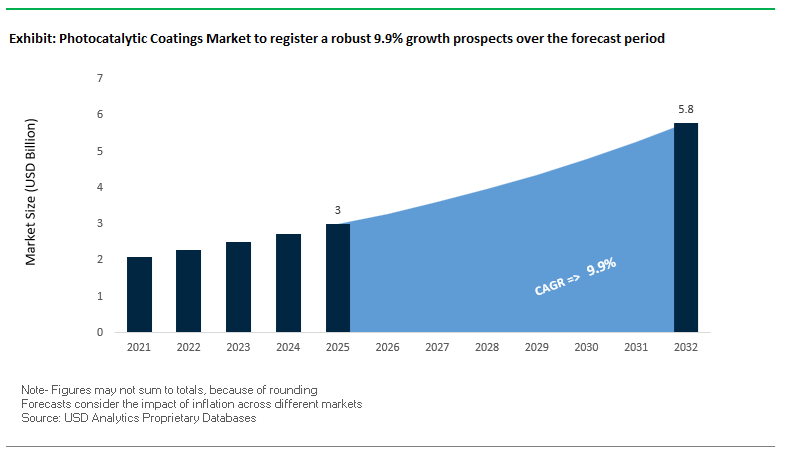
The global Photocatalytic Coatings Market was valued at $3 billion in 2025 and is projected to expand at a CAGR of 9.9% through 2032, reaching $5.8 billion by 2032. This strong growth trajectory reflects increasing adoption of self-cleaning, air-purifying, and antimicrobial surface technologies across construction, healthcare, transportation, and marine sectors.
A primary market driver is the intensifying global focus on urban air quality management and pollution mitigation, particularly in high-density cities. Photocatalytic coatings, typically based on titanium dioxide (TiO₂), enable the passive breakdown of pollutants such as nitrogen oxides (NOx), volatile organic compounds (VOCs), and microbial contaminants when exposed to light. This positions them as a critical technology within smart city infrastructure and green building initiatives, where coatings actively contribute to environmental improvement rather than serving purely protective or decorative functions.
The market is also benefiting from the growing demand for antimicrobial and self-disinfecting surfaces, particularly in healthcare and public infrastructure. Photocatalytic coatings offer continuous surface sterilization through oxidative reactions, reducing reliance on chemical disinfectants and lowering the risk of hospital-acquired infections (HAIs). Additionally, their self-cleaning properties, driven by hydrophilic surface behavior, are reducing maintenance costs for large-scale infrastructure such as facades, transit hubs, and commercial buildings.
Technological advancements are further accelerating adoption. Innovations in visible-light-responsive photocatalysts, nano-engineered TiO₂ structures, and AI-optimized formulations are overcoming traditional limitations related to UV dependency and efficiency. These advancements are expanding application potential into indoor environments, shaded urban areas, and energy-efficient buildings, significantly broadening the addressable market.
Market Analysis: Urban Air Quality Projects, Visible-Light Innovation, and AI-Driven Material Optimization Driving Market Expansion
Recent developments in the Photocatalytic Coatings Market highlight rapid progress in real-world deployment, advanced material science, and regulatory-driven adoption. In March 2026, a large-scale pilot project in New Delhi introduced “smog-eating” photocatalytic coatings on public infrastructure, targeting the reduction of NO₂ emissions along high-traffic corridors. This initiative demonstrates the growing role of coatings as active environmental remediation tools in urban planning.
R&D innovation is focusing on expanding functional performance under diverse conditions. Nippon Paint China’s collaboration with ECUST (January 2026) is advancing visible-light-responsive photocatalytic coatings, enabling air purification under standard indoor lighting conditions. Similarly, specialty chemical companies have commercialized nano-enhanced photocatalysts that function effectively in low-UV environments, addressing a key limitation of earlier technologies.
Artificial intelligence is emerging as a transformative tool in material development. Research initiatives leveraging machine learning for photocatalyst optimization (June 2025) are accelerating the identification of high-efficiency doped TiO₂ structures, improving pollutant degradation rates while minimizing harmful by-products. This is significantly reducing development cycles and enabling rapid commercialization of next-generation coatings.
Commercial adoption is expanding across infrastructure and construction. PURETi’s milestone of over 500,000 m² of treated surfaces (March 2026) highlights the increasing integration of photocatalytic coatings into LEED-certified green building projects, while the EU Renovation Wave initiative is targeting large-scale façade retrofits to improve urban air quality across European cities.
Sector-specific applications are also gaining traction. In healthcare, procurement standards are increasingly mandating antimicrobial photocatalytic coatings for high-touch surfaces, while in transportation, Japan’s MetroGrid initiative is deploying these coatings across transit hubs to enhance air quality and reduce maintenance. In the marine sector, new field data demonstrating 80% biofilm reduction is driving interest in non-toxic antifouling solutions, offering an alternative to traditional biocide-based coatings.
The photocatalytic coatings industry is advancing through the adoption of nitrogen-doped titanium dioxide technologies in architectural precast concrete and urban infrastructure applications. Traditional anatase TiO₂ coatings, which rely primarily on ultraviolet activation, are being replaced by N-doped TiO₂ systems that enable photocatalytic activity under visible light conditions. This transition is critical for densely built urban environments where direct UV exposure is limited due to shading from high-rise structures.
Nitrogen doping modifies the electronic structure of TiO₂ by reducing its bandgap from approximately 3.2 eV to around 2.5 eV. This enables activation under wavelengths up to 500 nm, significantly broadening the operational spectrum of photocatalytic coatings. As a result, these coatings maintain continuous pollutant degradation activity even in low-light or indirect-light conditions typical of urban corridors and transportation infrastructure.
Field performance data from 2026 indicates that precast concrete panels treated with N-doped TiO₂ coatings can achieve nitrogen oxide reduction rates ranging from 15% to 25% in high-traffic urban zones. This level of performance represents a substantial improvement over conventional UV-dependent systems, positioning doped photocatalysts as a viable passive air purification technology for smart city initiatives.
In addition to air purification, these coatings provide self-cleaning functionality through superhydrophilic surface behavior, characterized by water contact angles below 5 degrees. This property prevents the accumulation of organic contaminants and particulate matter, reducing façade maintenance costs by approximately 30% over a 10-year lifecycle. The dual benefit of environmental remediation and maintenance efficiency is accelerating adoption across urban infrastructure projects.
The healthcare sector is emerging as a high-growth application area for visible-light-activated photocatalytic coatings designed for continuous antimicrobial protection. These coatings utilize modified photocatalysts such as nitrogen-doped TiO₂, carbon-doped TiO₂, and tungsten oxide to enable activation under standard indoor lighting conditions, including LED and fluorescent sources.
Unlike traditional UV-dependent systems, visible-light-activated coatings provide round-the-clock antimicrobial activity without requiring specialized light sources. Under typical indoor illumination levels of approximately 500 lux, these coatings achieve pathogen inactivation rates of 99.9% to 99.99% within 2 to 4 hours. This corresponds to a 3-log to 4-log reduction in common healthcare-associated pathogens such as methicillin-resistant Staphylococcus aureus and Escherichia coli.
Clinical evaluations also indicate significant reductions in viral persistence. Surfaces treated with visible-light photocatalytic coatings demonstrate approximately 90% lower viral loads for enveloped viruses compared to untreated surfaces, supporting infection control protocols in high-touch environments such as hospital wards, operating rooms, and outpatient facilities.
Durability has improved with the integration of advanced inorganic binders that preserve photocatalytic activity despite repeated exposure to aggressive cleaning agents. Modern formulations maintain antimicrobial performance for more than 24 months under routine hospital sanitation cycles. These characteristics are positioning visible-light-activated coatings as a strategic solution for infection prevention and environmental hygiene in healthcare infrastructure.
Market Opportunity: Tightening NO₂ Air Quality Standards Driving Demand for Photocatalytic Infrastructure Coatings
Evolving air quality regulations in the United States are creating a strong opportunity for photocatalytic coatings in urban infrastructure. The ongoing review of nitrogen dioxide standards is expected to introduce stricter limits, potentially reducing the annual threshold from 53 parts per billion to approximately 50 parts per billion.
A reduction in permissible NO₂ levels would shift a significant portion of urban regions into non-attainment status, creating immediate demand for passive emission reduction technologies. Photocatalytic coatings applied to building facades, road barriers, and tunnel linings offer a scalable solution for continuous pollutant degradation without requiring active energy input.
Infrastructure funding programs are increasingly prioritizing technologies that deliver measurable environmental benefits. Projects incorporating photocatalytic materials are gaining preference in urban air quality improvement initiatives, particularly in high-density metropolitan regions. This alignment between regulatory pressure and funding availability is expected to accelerate adoption of air-purifying coatings in public infrastructure.
Market Opportunity: China GB/T 39789-2026 Standard Accelerating Commercialization of High-Performance Photocatalytic Coatings
China’s implementation of GB/T 39789-2026 is establishing a structured regulatory framework for photocatalytic coatings used in air purification applications. The standard introduces mandatory performance criteria for nitrogen oxide and volatile organic compound degradation, as well as durability requirements based on long-term weathering stability.
Manufacturers are required to provide certified testing data demonstrating retained photocatalytic activity after extended exposure conditions, typically benchmarked at 500 hours of artificial weathering. This requirement is favoring high-purity, dopant-stabilized TiO₂ formulations that maintain consistent performance over time.
The standard is also influencing public procurement policies. Photocatalytic coatings are increasingly specified for use in large-scale infrastructure projects, including transportation tunnels, noise barriers, and urban construction in cities with populations exceeding five million. In some regions, their use is transitioning from recommended to mandatory status under national environmental initiatives.
China’s scale in infrastructure development and urbanization creates a substantial demand base for compliant photocatalytic technologies. Suppliers capable of meeting performance certification requirements and delivering durable, high-efficiency coatings are positioned to capture significant market share in this rapidly expanding segment.
Photocatalytic Coatings Market Share and Segmentation Insights
TiO₂ Accounts for 68.6% Share as the Benchmark Material for Self-Cleaning and Air-Purifying Coatings
The photocatalytic coatings market by material is led by titanium dioxide (TiO₂), commanding a significant 68.6% market share in 2025, owing to its superior photocatalytic activity, chemical stability, and cost-effectiveness. Primarily used in its anatase crystalline form, TiO₂ enables efficient degradation of organic pollutants, bacteria, and airborne contaminants, making it the industry standard for self-cleaning coatings, antimicrobial surfaces, and air-purifying building materials. Its non-toxic nature and long-term durability further enhance its appeal across construction, infrastructure, and environmental remediation applications. Although TiO₂ coatings are predominantly UV-activated, limiting indoor efficiency, they remain highly effective in outdoor environments such as building facades, tunnels, and pavements exposed to sunlight. As demand for sustainable coatings and pollution-reducing technologies rises, TiO₂ continues to anchor growth in the global photocatalytic coatings market.
Outdoor Segment Holds 72.7% Share Driven by Sunlight Activation and Infrastructure Demand
In the photocatalytic coatings market by environment, outdoor applications dominate with a 72.7% market share in 2025, driven by the availability of natural UV and visible light required for photocatalytic activation. These coatings are widely applied on building exteriors, roofs, pavements, and tunnel linings, where they actively break down NOₓ, SOₓ, VOCs, and organic dirt, contributing to improved air quality and surface cleanliness. A major growth driver is the adoption of self-cleaning façade coatings in high-rise buildings, which significantly reduce maintenance costs, cleaning frequency, and water usage over extended lifecycles. Additionally, governments and urban planners are increasingly incorporating photocatalytic materials into smart city and green building initiatives, further boosting demand. As sustainability and pollution control become critical priorities, outdoor applications continue to dominate the eco-friendly coatings and environmental coatings market.
Photocatalytic Coatings Market Competitive Landscape Driven by Multifunctional Surface Innovation and Advanced TiO₂ Technologies
The global photocatalytic coatings market is highly competitive, driven by continuous R&D, visible-light catalyst innovation, and demand for self-cleaning, antimicrobial, and air-purifying coatings across construction, healthcare, and infrastructure sectors. Leading players are leveraging titanium dioxide (TiO₂) advancements, sustainability strategies, and smart-surface integration to strengthen market positioning.
TOTO Ltd. Expands Hydrotect Leadership with Visible-Light Photocatalytic Innovations
TOTO Ltd. continues to dominate the photocatalytic coatings market through its proprietary Hydrotect technology, enabling advanced self-cleaning coatings and air-purifying surfaces. The company’s portfolio focuses on photocatalytic ceramic tiles and façade coatings utilizing titanium dioxide (TiO₂) to decompose organic pollutants and enhance superhydrophilicity. In 2025-2026, TOTO expanded aggressively into Europe and North America, targeting healthcare infrastructure and high-footfall commercial buildings requiring antimicrobial coatings. A major innovation in 2026 includes visible-light-responsive photocatalytic coatings, significantly improving indoor air purification performance under low-light conditions. This advancement broadens applications from exterior building facades to interior environments, aligning with indoor air quality regulations. Its vertically integrated manufacturing model and strong patent portfolio reinforce its leadership in functional architectural coatings.
Nippon Paint Strengthens VOC-Reducing and Anti-Viral Photocatalytic Coatings Portfolio
Nippon Paint Holdings Co., Ltd. is leveraging its Global Green Growth strategy to expand high-performance photocatalytic coatings across Asia-Pacific markets. The company is prioritizing VOC-reducing interior paints and eco-friendly coatings to comply with stringent indoor air quality regulations in China and Japan. In late 2025, Nippon Paint introduced advanced anti-viral photocatalytic coatings for public transportation systems, featuring hybrid catalysts activated under LED lighting. Its ability to integrate photocatalytic layers into conventional automotive coatings and construction workflows provides a strong competitive edge. Additionally, production expansion in India and Vietnam positions the company to capture rising demand from smart city infrastructure projects. This strategic alignment with sustainability and urbanization trends strengthens its global coatings market share.
Kansai Paint Co., Ltd. is advancing its presence in the photocatalytic coatings market through eco-friendly formulations and emerging market expansion. The company’s Ales Shikkui product line combines traditional lime-based coatings with modern photocatalytic functionality for CO₂ absorption and air purification. In 2026, Kansai Paint committed approximately JPY 100 billion toward acquisitions in Southeast Asia and the Middle East, strengthening its functional coatings portfolio. It has also developed innovative thermal-management photocatalytic coatings for electric vehicles (EVs), improving solar reflectivity while maintaining surface cleanliness. These coatings are widely used in hospitals, schools, and public housing for antimicrobial and aesthetic benefits. This dual focus on sustainability and EV coatings innovation positions Kansai Paint as a key player in next-generation surface technologies.
BASF SE Drives Photocatalytic Innovation Through Advanced Catalysts and Circular Economy Integration
BASF SE plays a foundational role in the photocatalytic coatings market by supplying advanced catalysts and pigment-grade titanium dioxide (TiO₂). Under its “Winning Ways” strategy, BASF is accelerating green transformation initiatives by developing sustainable photocatalytic additives for cement and concrete applications. Its Environmental Catalyst division has introduced new materials that enable self-cleaning concrete surfaces for urban infrastructure. The company is also incorporating recycled raw materials into catalyst production to reduce carbon emissions and enhance sustainability metrics. BASF’s integrated “Verbund” system allows efficient scaling of innovative photocatalytic intermediates across global markets. This strong R&D ecosystem and chemical expertise position BASF as a critical enabler of next-generation functional coatings.
Kronos Worldwide Focuses on High-Performance TiO₂ Photocatalysts for Air-Purifying Coatings
Kronos Worldwide, Inc. is a leading supplier of titanium dioxide (TiO₂), a core material in photocatalytic coatings. Its KRONOClean product line is specifically engineered for nitrogen oxide (NOx) reduction and urban air purification applications, including smog-eating coatings and pavements. In response to TiO₂ market volatility in 2025, the company restructured operations to prioritize high-margin specialty photocatalysts. A key 2026 innovation includes high-surface-area TiO₂ particles that enhance catalytic efficiency while maintaining coating durability in water-based systems. Kronos is also focusing on supply chain optimization and cost efficiency to remain a preferred global supplier. This specialization in advanced photocatalytic powders strengthens its strategic importance within the coatings value chain.
PPG Industries Advances AI-Driven Photocatalytic Coatings for Aerospace and Green Buildings
PPG Industries, Inc. is leveraging digital transformation and advanced materials science to enhance its position in the photocatalytic coatings market. The company offers high-performance self-cleaning glass coatings and exterior finishes that reduce maintenance and chemical usage. PPG is utilizing AI-driven molecular modeling to accelerate the discovery of efficient photocatalytic crystal structures, improving coating performance. Its product portfolio aligns with sustainability certifications such as LEED and WELL, supporting green building initiatives globally. Additionally, PPG is expanding applications in aviation and maritime sectors, where photocatalytic coatings help reduce biofouling and improve aerodynamic efficiency. This integration of AI, sustainability, and high-performance coatings positions PPG at the forefront of industrial photocatalytic innovation.
Japan Photocatalytic Coatings Market: Smart City Innovation and Advanced Antimicrobial Surfaces
Japan continues to set the global benchmark in the photocatalytic coatings market, driven by decades of innovation and a strong national focus on smart city infrastructure and public health applications. The integration of photocatalytic filters in commercial HVAC systems across Tokyo in 2025 has enabled passive decomposition of VOCs and allergens without additional energy consumption, reinforcing Japan’s leadership in energy-efficient indoor air purification technologies.
Advanced material innovations such as tungsten-oxide (WO₃)-doped visible-light photocatalytic coatings are enabling high-performance functionality even in low-light environments like hospitals and underground facilities. Government-backed mandates for elderly care facilities have accelerated the adoption of antimicrobial photocatalytic panels, contributing to a notable reduction in healthcare-associated infections. Furthermore, widespread deployment of anti-fogging and self-cleaning coatings in public transit systems and the standardization of photocatalytic interior treatments in EVs highlight Japan’s commitment to hygiene, sustainability, and consumer safety. Updated standards such as JIS R 1703-1:2024 ensure enhanced performance validation and global export competitiveness.
China Photocatalytic Coatings Market: Large-Scale NOx Reduction and Industrial Expansion
China’s photocatalytic coatings industry is expanding rapidly, supported by government-driven environmental initiatives and large-scale industrial deployment. Under the Dual-Carbon policy (2025–2026), photocatalytic coatings are being widely applied on highways to actively reduce NOx emissions from vehicle exhaust, positioning China as a leader in pollution-mitigating infrastructure coatings.
Regulatory frameworks such as GB 30981.1-2025 are accelerating the transition to waterborne TiO₂-based photocatalytic formulations, driving demand for environmentally compliant coating systems. Innovations like aerogel-photocatalyst hybrid coatings are enhancing industrial energy efficiency by reducing surface temperatures significantly. Additionally, China’s shipbuilding sector is adopting photocatalytic anti-fouling coatings as a sustainable alternative to heavy-metal-based systems. The growing semiconductor ecosystem is further boosting demand for ultra-high purity (UHP) self-cleaning coatings in cleanroom environments, while urban development programs are incentivizing the use of lightweight, durable photocatalytic materials in modern construction.
United States Photocatalytic Coatings Market: Healthcare Innovation and Infrastructure Growth
The U.S. photocatalytic coatings market is witnessing strong growth driven by healthcare applications, infrastructure modernization, and regulatory shifts toward PFAS-free solutions. The expansion of semiconductor manufacturing under the CHIPS Act is increasing demand for anti-static photocatalytic coatings in cleanroom environments, ensuring contamination-free production.
Healthcare remains a major growth segment, with hospitals adopting continuous-action antimicrobial coatings that neutralize pathogens such as MRSA and C. difficile using ambient light. Infrastructure investments under the Infrastructure Investment and Jobs Act (IIJA) are fueling the use of self-cleaning cementitious coatings in bridges and tunnels, reducing maintenance costs. In the renewable energy sector, photocatalytic nano-coatings for solar panels are improving efficiency by preventing dust accumulation. Additionally, the development of energy-curable photocatalytic coatings is enabling faster manufacturing cycles and reduced energy consumption, strengthening the U.S. position in advanced coating technologies.
Germany Photocatalytic Coatings Market: Circular Economy Leadership and VOC-Free Innovation
Germany is leading the European photocatalytic coatings market through its commitment to circular economy principles, sustainability, and regulatory compliance. The updated EU Ecolabel 2026 standards are driving the adoption of VOC-free, water-based photocatalytic coatings, particularly in aerosol spray applications.
Strict compliance with BS EN 13501 fire safety standards ensures that photocatalytic coatings used in construction contribute zero flame spread, enhancing safety in high-rise buildings. German R&D is also pioneering digital tracer integration, enabling efficient recycling and material identification in automated facilities. Investments such as BASF’s Münster technical hub are advancing aqueous-based dispersions for TiO₂, reducing reliance on solvent-heavy formulations. Additionally, innovations in hydrogen infrastructure coatings and photocatalytic pavement systems for urban pollution control are positioning Germany as a leader in sustainable, high-performance coating technologies.
India Photocatalytic Coatings Market: Urbanization, Solar Growth, and Local Manufacturing
India’s photocatalytic coatings market is experiencing rapid expansion, driven by urbanization, renewable energy growth, and government initiatives such as the Smart Cities Mission. Innovations like Trinano Technologies’ nano-coatings for solar panels are improving energy efficiency while reducing surface temperatures, highlighting the country’s focus on sustainable energy solutions.
The establishment of large-scale manufacturing facilities, such as Pellucere Technologies’ plant in Maharashtra, is strengthening domestic production capacity for self-cleaning and anti-soiling coatings. The adoption of nanotechnology-based antimicrobial coatings, including Rossari Biotech’s solutions, is increasing across healthcare infrastructure. Strategic developments like the JSW Paints–Akzo Nobel India consolidation are streamlining supply chains for high-performance photocatalytic materials. Government housing programs such as PMAY-U 2.0 are further driving demand for cost-effective, durable coatings, while industrial expansion projects like the HPCL refinery are boosting the use of photocatalytic coatings in harsh environments.
South Korea Photocatalytic Coatings Market: Semiconductor Precision and Marine Innovation
South Korea’s photocatalytic coatings industry is closely tied to its dominance in semiconductors, OLED displays, and marine technologies. The country is a major producer of plasma-resistant coatings required for advanced fabrication processes such as 3D NAND and FinFET technologies.
Innovations in low-voltage PACVD-compatible photocatalytic coatings are enabling applications on flexible and heat-sensitive substrates, critical for next-generation electronics. In the maritime sector, the adoption of biocide-free anti-fouling coatings using light-activated binders is enhancing environmental sustainability. South Korea is also advancing Thin-Film Encapsulation (TFE) technologies for foldable displays, improving UV protection and durability. The country’s leadership in packaging solutions is evident in retort pouch coatings that withstand extreme sterilization, while the K-beauty sector is driving demand for premium, sensory-effect coatings with enhanced resistance to essential oils.
Norway Photocatalytic Coatings Market: Subsea Applications and Decarbonization Technologies
Norway is emerging as a niche but highly advanced market in photocatalytic coatings, focusing on subsea engineering, decarbonization, and extreme environment applications. The electrification of offshore platforms is increasing demand for non-conductive photocatalytic coatings that prevent galvanic corrosion in high-voltage environments.
Projects such as Northern Lights (CCS) are driving innovation in CO₂-resistant photocatalytic linings for injection wells, supporting carbon capture initiatives. Norwegian companies are also integrating digital twin technologies, embedding sensors within coating matrices to monitor performance in real time. Strict environmental regulations have resulted in the complete adoption of biocide-free anti-fouling systems in offshore vessels. Additionally, R&D advancements in low-temperature-resistant TiO₂ coatings and hydrogen-compatible photocatalytic layers are positioning Norway as a leader in sustainable and high-performance industrial coatings.
Photocatalytic Coatings Market Report Scope
Photocatalytic Coatings Market
Parameter
Details
Market Size (2025)
$3 Billion
Market Size (2032)
$5.8 Billion
Market Growth Rate
9.9%
Segments
By Material (Titanium Dioxide, Zinc Oxide, Tungsten Trioxide, Graphitic Carbon Nitride, Doped and Mixed Oxide Composites), By Light Activation Technology (UV-Light Activated, Visible-Light Activated, Dual-Activated), By Substrate Material (Concrete and Cementitious Materials, Glass, Metals, Ceramics, Plastics and Polymers, Textiles and Fabrics), By Function (Self-Cleaning, Air Purification, Anti-Microbial, Water Purification and Treatment, Anti-Fogging, Odor Control), By End-Use Industry (Building and Construction, Healthcare, Automotive and Transportation, Consumer Goods, Energy and Utilities, Agriculture and Aquaculture), By Coating Method (Spray Coating, Dip Coating, Roll Coating, Magnetron Sputtering and PVD, Sol-Gel Processing), By Environment (Outdoor, Indoor)
Study Period
2019- 2025 and 2026-2032
Units
Revenue (USD)
Qualitative Analysis
Porter’s Five Forces, SWOT Profile, Market Share, Scenario Forecasts, Market Ecosystem, Company Ranking, Market Dynamics, Industry Benchmarking
Companies
TOTO Ltd., PPG Industries, Inc., Saint-Gobain S.A., Akzo Nobel N.V., PureTi Group, Nippon Paint Holdings Co., Ltd., BASF SE, Ishihara Sangyo Kaisha, Ltd., Evonik Industries AG, KMEW Co., Ltd., Shin-Etsu Chemical Co., Ltd., Photocat A/S, Cristal, Advanced Materials-JTJ s.r.o., Sto SE and Co. KGaA
Countries
US, Canada, Mexico, Germany, France, Spain, Italy, UK, Russia, China, India, Japan, South Korea, Australia, South East Asia, Brazil, Argentina, Middle East, Africa
Photocatalytic Coatings Market Segmentation
By Material
Titanium Dioxide
Zinc Oxide
Tungsten Trioxide
Graphitic Carbon Nitride
Doped and Mixed Oxide Composites
By Light Activation Technology
UV-Light Activated
Visible-Light Activated
Dual-Activated
By Substrate Material
Concrete and Cementitious Materials
Glass
Metals
Ceramics
Plastics and Polymers
Textiles and Fabrics
By Function
Self-Cleaning
Air Purification
Anti-Microbial
Water Purification and Treatment
Anti-Fogging
Odor Control
By End-Use Industry
Building and Construction
Healthcare
Automotive and Transportation
Consumer Goods
Energy and Utilities
Agriculture and Aquaculture
By Coating Method
Spray Coating
Dip Coating
Roll Coating
Magnetron Sputtering and PVD
Sol-Gel Processing
By Environment
Outdoor
Indoor
Leading Countries in the Industry
North America (United States, Canada, Mexico)
Europe (Germany, France, Spain, United Kingdom, Italy, Russia, Rest of Europe)
Asia Pacific (China, India, Japan, South Korea, Australia, South East Asia, Rest of APAC)
South and Central America (Brazil, Argentina, Rest of SCA)
Middle East and Africa (Saudi Arabia, UAE, MENA, Sub-Saharan Africa)
Top Companies in Photocatalytic Coatings Industry
TOTO Ltd.
PPG Industries, Inc.
Saint-Gobain S.A.
Akzo Nobel N.V.
PureTi Group
Nippon Paint Holdings Co., Ltd.
BASF SE
Ishihara Sangyo Kaisha, Ltd.
Evonik Industries AG
KMEW Co., Ltd.
Shin-Etsu Chemical Co., Ltd.
Photocat A/S
Cristal
Advanced Materials-JTJ s.r.o.
Sto SE & Co. KGaA
*- List not Exhaustive
Table of Contents: Photocatalytic Coatings Market
1. Executive Summary
1.1. Market Highlights
1.2. Key Findings
1.3. Global Market Snapshot
2. Photocatalytic Coatings Market Landscape and Outlook (2025–2034)
2.1. Introduction to the Photocatalytic Coatings Market
2.2. Market Valuation and Growth Projections (2025–2034)
2.3. Market Drivers
2.4. Market Restraints and Challenges
2.5. Market Opportunities
2.6. Regulatory and Sustainability Landscape
2.7. Value Chain Analysis
2.8. Pricing Analysis
2.9. Technology Roadmap and Future Outlook
3. Innovations Reshaping the Photocatalytic Coatings Market
3.1. Trend: Nitrogen-Doped TiO₂ Coatings Expanding NOₓ Mitigation Capabilities in Urban Infrastructure
3.2. Trend: Visible-Light-Activated Photocatalytic Coatings Enabling Continuous Antimicrobial Protection in Healthcare
3.3. Opportunity: Tightening NO₂ Air Quality Standards Driving Demand for Photocatalytic Infrastructure Coatings
3.4. Opportunity: China GB/T 39789-2026 Standard Accelerating Commercialization of High-Performance Photocatalytic Coatings
4. Competitive Landscape and Strategic Initiatives
4.1. Visible-Light Catalyst Innovation and Smart Surface Development
4.2. Sustainability and Circular Economy Integration
4.3. Capacity Expansion and Regional Manufacturing
4.4. Strategic Partnerships and Urban Infrastructure Projects
4.5. AI-Driven Material Optimization and RandD Acceleration
5. Market Share and Segmentation Insights: Photocatalytic Coatings Market
5.1. By Material
5.2. By Light Activation Technology
5.3. By Substrate Material
5.4. By Function
5.5. By End-Use Industry
5.6. By Coating Method
5.7. By Environment
6. Country Analysis and Outlook
7. Regional Market Size Outlook (2025–2034)
8. Company Profiles
TOTO Ltd.
PPG Industries, Inc.
Saint-Gobain S.A.
Akzo Nobel N.V.
PureTi Group
Nippon Paint Holdings Co., Ltd.
BASF SE
Ishihara Sangyo Kaisha, Ltd.
Evonik Industries AG
KMEW Co., Ltd.
Shin-Etsu Chemical Co., Ltd.
Photocat A/S
Cristal
Advanced Materials-JTJ s.r.o.
Sto SE and Co. KGaA
9. Methodology
10. Appendix
Photocatalytic Coatings Market Segmentation
By Material
Titanium Dioxide
Zinc Oxide
Tungsten Trioxide
Graphitic Carbon Nitride
Doped and Mixed Oxide Composites
By Light Activation Technology
UV-Light Activated
Visible-Light Activated
Dual-Activated
By Substrate Material
Concrete and Cementitious Materials
Glass
Metals
Ceramics
Plastics and Polymers
Textiles and Fabrics
By Function
Self-Cleaning
Air Purification
Anti-Microbial
Water Purification and Treatment
Anti-Fogging
Odor Control
By End-Use Industry
Building and Construction
Healthcare
Automotive and Transportation
Consumer Goods
Energy and Utilities
Agriculture and Aquaculture
By Coating Method
Spray Coating
Dip Coating
Roll Coating
Magnetron Sputtering and PVD
Sol-Gel Processing
By Environment
Outdoor
Indoor
Leading Countries in the Industry
North America (United States, Canada, Mexico)
Europe (Germany, France, Spain, United Kingdom, Italy, Russia, Rest of Europe)
Asia Pacific (China, India, Japan, South Korea, Australia, South East Asia, Rest of APAC)
South and Central America (Brazil, Argentina, Rest of SCA)
Middle East and Africa (Saudi Arabia, UAE, MENA, Sub-Saharan Africa)
The global Photocatalytic Coatings Market was valued at $3 billion in 2025 and is projected to reach $5.8 billion by 2032, expanding at a CAGR of 9.9%. Market growth is being fueled by increasing adoption of self-cleaning, air-purifying, and antimicrobial coating technologies across smart city infrastructure, healthcare facilities, transportation systems, and green building projects.
Visible-light-activated photocatalytic coatings are gaining traction because they provide continuous antimicrobial and pollutant-degrading performance under standard indoor and low-light conditions. Nitrogen-doped TiO₂ and tungsten oxide technologies enable effective NOx reduction, VOC degradation, and pathogen inactivation in hospitals, transit hubs, and densely populated urban areas without requiring constant UV exposure, significantly expanding application possibilities.
Tightening NO₂ air quality standards, green building mandates, and urban sustainability initiatives are accelerating the deployment of photocatalytic coatings in public infrastructure. Regulatory frameworks such as China’s GB/T 39789-2026 and evolving U.S. air quality standards are driving demand for certified air-purifying coatings capable of reducing pollutants, improving façade cleanliness, and supporting long-term environmental remediation goals in smart cities.
Major companies operating in the photocatalytic coatings market include TOTO Ltd., PPG Industries, Nippon Paint Holdings Co., Ltd., BASF SE, and Saint-Gobain S.A.. These companies are investing in visible-light-responsive TiO₂ coatings, AI-driven photocatalyst optimization, self-cleaning façade technologies, antimicrobial coatings, and smart surface innovations to strengthen their positions in sustainable infrastructure and healthcare applications.
Titanium dioxide (TiO₂) dominates the market with a 68.6% share due to its strong photocatalytic activity, durability, and cost-effectiveness in air-purifying and self-cleaning applications. Outdoor applications account for 72.7% market share because sunlight exposure maximizes photocatalytic efficiency in facades, pavements, and tunnel linings. Regionally, China, Japan, the United States, Germany, India, and South Korea are emerging as major investment markets driven by smart city development, healthcare modernization, renewable energy expansion, and sustainable infrastructure initiatives.