Dimethylaminopropylamine Market to Reach $20.6 Million by 2034 at 4.8% CAGR Amid Capacity Expansion and Biomass-Balanced Innovations
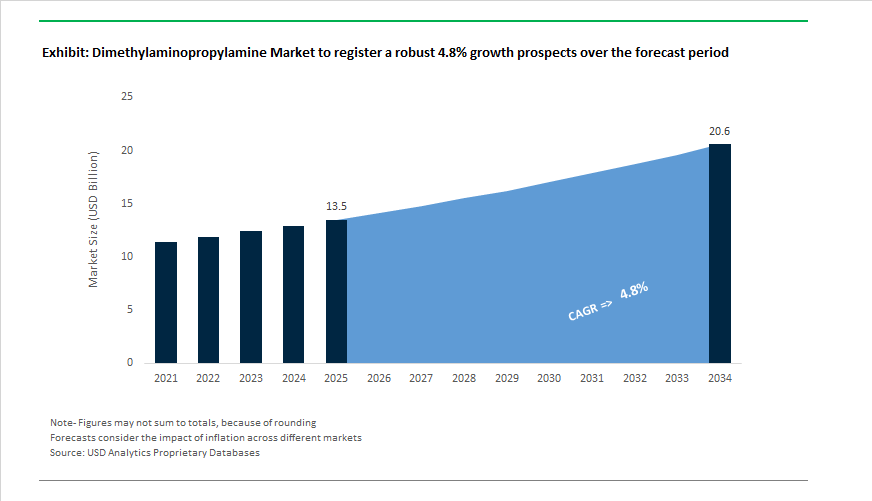
The Dimethylaminopropylamine (DMAPA) Market is projected to grow from $13.5 Million in 2025 to $20.6 Million by 2034, registering a CAGR of 4.8%. Market expansion is underpinned by rising demand for surfactants, epoxy curing agents, water treatment chemicals, and personal care intermediates such as cocamidopropyl betaine (CAPB). DMAPA remains a critical building block in amidoamine chemistry, enabling the production of mild amphoteric surfactants widely used in shampoos, liquid soaps, and industrial cleaners. The market structure has increasingly shifted toward integrated producers leveraging mass-balance renewable feedstocks, renewable electricity, and downstream surfactant integration to reduce carbon intensity across the value chain.
Pricing volatility defined late 2024 market conditions. Trade data in October 2024 showed Chinese DMAPA prices declining nearly 18% year-over-year to approximately $2,209 per ton due to temporary oversupply in the surfactant sector and weakened demand from construction-related epoxy systems. During the same period, structural shifts were underway globally. Following its spin-off in December 2023, Syensqo spent 2024 establishing itself as a pure-play specialty chemical entity, assuming stewardship of Solvay’s advanced DMAPA portfolio and redirecting focus toward electrification, high-performance materials, and specialty amines. In November 2024, Alkyl Amines Chemicals Limited announced board approval for a new specialty chemicals plant at Dahej, Gujarat, reinforcing India’s domestic amine manufacturing ecosystem to serve pharmaceutical and personal care markets. These developments marked a transition from volume-driven commodity cycles toward higher-margin specialty positioning.
Sustainability-driven product innovation accelerated in 2025. In April 2025, Eastman Chemical Company launched DMAPA ES at its St. Gabriel, Louisiana facility, utilizing renewable raw materials and a mass-balance approach to reduce global warming potential by up to 50% compared to conventional grades. This followed the product’s initial commercial rollout in Ghent, Belgium during 2024. In September 2025, BASF delivered its first shipment of BMBCert™ biomass-balanced DMAPA in Asia-Pacific to Galaxy Surfactants Ltd., enabling the production of Galaxy CAPB SB for lower-carbon personal care formulations. BASF further consolidated its sustainability leadership by transitioning its entire amine portfolio at the Nanjing site to 100% renewable electricity in 2025, reducing annual CO₂ emissions by approximately 9,800 tons and directly lowering Scope 3 emissions for customers in the surfactant and coatings industries.
Capacity expansion and vertical integration defined the second half of 2025 and early 2026. In July 2025, BASF completed a major capacity expansion at its Nanjing site, formally inaugurated in October 2025, nearly doubling DMAPA output and increasing global capacity by over 20% to approximately 85,000 metric tons per year. Complementing this network, BASF announced in November 2025 that a new Alkyl Polyglucosides (APG) production line in Cincinnati, Ohio, would come online in 2026, securing downstream bio-based surfactant supply chains frequently integrated with DMAPA derivatives. In January 2026, Eastman signed a Memorandum of Understanding with Kolmar to advance sustainable personal care formulations, accelerating the adoption of DMAPA ES in low-irritation cosmetic systems across North America and Asia. Meanwhile, Huntsman implemented a comprehensive restructuring program through 2025–2026 targeting over $100 million in cost savings by optimizing specialty amine and epoxy hardener production, reinforcing operational efficiency across DMAPA-dependent value chains.
Trends and Opportunities Shaping the Dimethylaminopropylamine (DMAPA) Market
Demand Resilience Anchored to CAPB Purity and Sensitive-Skin Formulation Standards
The global shift toward ultra-mild personal care formulations has made DMAPA purity a central issue in surfactant chemistry. Cocamidopropyl betaine production is under intense scrutiny following dermatological evidence that trace amidoamine and residual DMAPA impurities are the primary drivers of allergic contact dermatitis. Peer-reviewed European dermatology studies released in early 2025 confirmed that even sub-ppm impurity levels can trigger reactions in sensitive skin populations, pushing formulators toward high-purity CAPB grades with tightly controlled amine feedstocks.
This trend is translating directly into sustained DMAPA demand, particularly from global hygiene and personal care leaders such as Unilever and Reckitt, both of which reported 7 to 10% revenue growth in their hygiene and personal care portfolios during 2024–2025. Liquid hand soaps, sulfate-free shampoos, and dermatologically tested body washes are among the fastest-growing categories. Asia-Pacific remains the demand epicenter, accounting for more than 40% of global amine consumption in 2025, supported by urbanization, rising disposable incomes, and expanding local surfactant manufacturing capacity.
Structural Importance in Corrosion Inhibition for Deep-Water and High-CO₂ Energy Assets
Beyond consumer markets, DMAPA plays a critical role in corrosion management for modern energy infrastructure. DMAPA-derived imidazolines are essential corrosion inhibitors in environments characterized by elevated temperatures, high pressures, and aggressive acid gases such as hydrogen sulfide and carbon dioxide. As of mid-2025, the global corrosion inhibitors market was valued at approximately USD 9.5 billion, with organic, amine-based inhibitors representing more than 72% of total demand.
Enhanced Oil Recovery operations and deep-water production systems rely heavily on these chemistries to protect pipelines, downhole tubing, and processing equipment. Despite feedstock volatility driven by disruptions in acrylonitrile and dimethylamine supply routes, DMAPA demand in power generation, pipeline transport, and offshore energy projects has proven price-inelastic. Strategic inventory buildup by energy operators in the first quarter of 2025 further stabilized industrial-grade DMAPA demand, underscoring its classification as an operational necessity rather than a discretionary input.
Advanced Epoxy Curing Systems for Wind Energy and EV Battery Encapsulation
DMAPA’s dual amine functionality is opening high-margin opportunities in epoxy curing systems for renewable energy and electric mobility. In July 2025, BASF expanded its polyetheramine and DMAPA production assets to support rising demand for Baxxodur® curing agents. These systems are critical for wind turbine blade manufacturing, offshore structures, and marine-grade coatings, where rapid cure kinetics and long-term chemical resistance directly affect asset lifespan and maintenance costs.
The epoxy curing agents market, valued at approximately USD 3.6 billion, is witnessing rapid growth in low-temperature cure formulations, which are projected to account for nearly 63% of demand by late 2025. DMAPA is a key crosslinker in these systems, particularly for lithium-ion battery encapsulation and module potting. Its ability to enable fast curing without compromising thermal stability is supporting safer, more efficient battery pack designs as electric vehicle production volumes continue to scale globally.
High-Adhesion Cationic Systems for Agriculture and Technical Textiles
Quaternary ammonium compounds derived from DMAPA are finding renewed relevance in agriculture and advanced textiles. In crop protection, DMAPA-based cationic surfactants are increasingly used as adjuvants to enhance adhesion and rainfastness of agrochemical sprays. Industry data from August 2025 shows that improved deposition efficiency can significantly reduce reapplication frequency, aligning with the European Union’s Farm to Fork strategy to lower overall chemical usage while maintaining crop yields.
In parallel, the technical textiles sector is adopting DMAPA-derived conditioning agents for antistatic and performance-enhancing finishes. The rise of smart workwear, protective clothing, and recycled industrial fabrics is driving demand for softeners that deliver durable antistatic behavior without compromising sustainability credentials. Studies published in October 2025 indicate that DMAPA-based textile auxiliaries meet Global Recycled Standard biodegradability and performance benchmarks, positioning them as preferred solutions for manufacturers balancing functionality with environmental compliance.
Dimethylaminopropylamine (DMAPA) Market Share and Segmentation Insights
DMAPA Market Share by Application : Surfactant Intermediates Anchor Demand Across Personal and Home Care
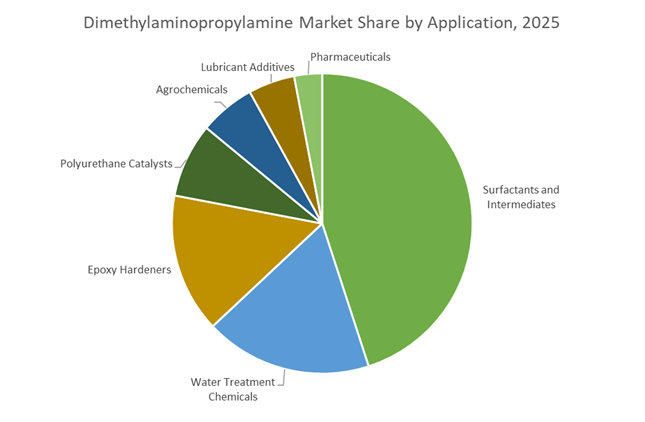
Surfactants and intermediates dominate the Dimethylaminopropylamine (DMAPA) market in 2025 with 45% share, primarily driven by its role as a key precursor for cocamidopropyl betaine (CAPB), one of the most widely used amphoteric surfactants in personal care and household formulations. CAPB’s mildness, foam stability, and viscosity-building properties make DMAPA indispensable in sulfate-free shampoos, body washes, and liquid soaps. Water treatment chemicals represent a significant secondary segment, where DMAPA is used in corrosion inhibitors and biocides for cooling towers and boiler systems. Epoxy hardeners incorporate DMAPA as a curing agent or modifier to enhance adhesion, flexibility, and chemical resistance in coatings and composites. Polyurethane catalysts form a niche application, while agrochemicals maintain steady demand as intermediates in pesticide synthesis. Lubricant additives and pharmaceuticals remain smaller segments, constrained by cost and regulatory requirements but offering specialized performance advantages.
DMAPA Market Share by End-Use Industry : Personal Care Drives Volume While Water Treatment and Construction Expand
Personal care and cosmetics lead DMAPA consumption with 42% market share, reflecting strong global demand for mild surfactant systems in shampoos, facial cleansers, and liquid soaps. The trend toward sulfate-free and skin-friendly formulations continues to support CAPB production and downstream DMAPA demand. Home care and industrial cleaning represent a major segment, using DMAPA-derived surfactants in dishwashing liquids, laundry detergents, and surface cleaners that balance foam performance and cleaning efficiency. Water treatment follows as a significant industrial application, driven by infrastructure protection needs in cooling and process water systems. Building and construction uses DMAPA in epoxy floor coatings and structural adhesives, while agriculture and crop protection show steady growth in adjuvant and pesticide intermediate applications. Automotive, transportation, and oil and gas remain niche end-users, utilizing DMAPA derivatives in specialty coatings, lubricant additives, and corrosion inhibitors.
Competitive Landscape of the Dimethylaminopropylamine (DMAPA) Market
The Dimethylaminopropylamine (DMAPA) market in 2026 is shaped by capacity expansions in Asia-Pacific, rapid adoption of sustainable amine chemistry, and rising demand from CAPB surfactants, personal care formulations, polyurethane catalysts, epoxy hardeners, and eco-label detergents. Market leadership is increasingly defined by vertical integration, renewable feedstocks, ISCC PLUS certification, and low-carbon DMAPA production.
BASF SE dominates global DMAPA supply through Verbund integration and APAC expansion
BASF SE is the world’s largest DMAPA producer, holding an estimated ~25% global market share in 2026 with total capacity near 85,000 metric tons per year. In late 2025, BASF doubled DMAPA production at its Nanjing, China site to capture high-growth Asia-Pacific personal care and home care surfactant demand. Since 2023, the entire amines portfolio at Nanjing has operated on 100% renewable electricity, cutting product carbon footprints by ~4% and saving 9,800 tons of CO2 annually. BASF’s fully backward-integrated chain, including acrylonitrile and methylamines, shields margins from 2026 feedstock volatility, reinforcing its leadership in CAPB intermediates, mild surfactants, and specialty amines.
Eastman Chemical Company accelerates sustainable DMAPA with mass-balance renewable production
Eastman Chemical Company has repositioned itself as a leader in circular and sustainable amines, launching large-scale DMAPA ES production in April 2025 at its St. Gabriel, Louisiana facility using renewable feedstocks via mass-balance accounting. Eastman expanded global DMAPA capacity by 15% to 20% between 2024 and 2026, targeting the fast-growing eco-label surfactant and green personal care markets in North America and Europe. Its low-carbon DMAPA reportedly cuts the global warming potential of CAPB formulations by up to 50% versus fossil-based alternatives. ISCC PLUS-certified operations in Ghent and St. Gabriel enable a fully traceable supply chain, strengthening Eastman’s position with premium, sustainability-driven consumer brands.
Huntsman Corporation leverages DMAPA derivatives for PU catalysts and high-performance coatings
Huntsman Corporation focuses on high-value DMAPA applications across polyurethane foams, epoxy hardeners, electronics encapsulation, and construction materials. While remaining a key surfactant supplier, Huntsman dominates PU catalyst systems, where DMAPA derivatives enable energy-efficient building insulation and automotive seating. In late 2025, the company partnered with specialty formulators to develop non-irritant cleansing agents for sensitive-skin and baby-care products. Innovation efforts in 2026 center on DMAPA-based amine curing agents for semiconductor encapsulants, protecting next-generation electronics from moisture and thermal degradation. Huntsman’s strong North American manufacturing footprint supports just-in-time delivery for industrial coatings, adhesives, and advanced materials customers.
Syensqo advances circular DMAPA chemistry for cosmetics and water treatment
Syensqo, spun off from Solvay, operates as an innovation-driven supplier of specialty amidoamines and high-purity DMAPA derivatives for EU eco-label cosmetics and niche industrial markets. In late 2025, its China facility achieved advanced ISCC sustainability certification, supporting the company’s “For Generations” roadmap to cut site-level CO2 emissions by 30% by 2030. Syensqo is actively developing circular chemistry platforms, including wastewater sludge recycling and bio-based precursors for biodegradable surfactants. Beyond personal care, the company maintains strong positions in water treatment flocculants and lubricant additives, where DMAPA-based chemistries are essential for modern wastewater detoxification in Europe and Latin America.
Alkyl Amines Chemicals Ltd. scales cost-competitive DMAPA for South Asia and APAC exports
Alkyl Amines Chemicals Ltd. is the regional cost leader in South Asia, holding an estimated 5% to 10% global DMAPA market share with dominance in India’s textile auxiliaries and agrochemical intermediates. In 2025, the company commissioned a new multi-purpose plant in Maharashtra to scale aliphatic amines including DMAPA, supporting rapid export growth. Early 2026 saw record APAC shipments, driven by proximity to Chinese and South Korean cosmetic manufacturing hubs and structurally lower production costs. Alkyl Amines is also diversifying beyond surfactants into pharmaceutical synthesis, positioning DMAPA as a building block for specialized drug delivery compounds and expanding its relevance across high-margin applications.
China: Capacity Leadership Anchored in Green Energy and Surfactant Demand
China continues to define global competitive dynamics in the dimethylaminopropylamine market through aggressive capacity expansion and cost optimization. In July 2025, BASF officially commenced operations at its expanded Nanjing facility, nearly doubling site-level DMAPA capacity and lifting BASF’s global output to approximately 85,000 metric tons per year. This expansion materially strengthens China’s position as the primary global supply base for DMAPA, particularly for export-oriented surfactant and personal care value chains across Asia-Pacific. Since late 2023, BASF has also transitioned its entire amine portfolio at Nanjing to 100% renewable electricity, achieving an estimated 4% reduction in Product Carbon Footprint. This decarbonization advantage is increasingly relevant as downstream customers pursue green certification and low-PCF sourcing.
Pricing dynamics in China have reflected the impact of new supply. Between Q4 2024 and Q1 2025, DMAPA spot prices corrected sharply to around $2,209 per metric ton, representing an 18% year-over-year decline as domestic competition intensified and feedstock costs stabilized. Structurally, China remains the world’s largest consumer of DMAPA due to its dominant role in Cocamidopropyl Betaine production. In 2025 alone, the expansion of cosmetics and personal care manufacturing in the Pearl River Delta generated an estimated 8 kilotons of incremental DMAPA demand. At the same time, integrated chemical parks continue to improve supply chain efficiency. Wanhua Chemical has reported technical upgrades across MDI and formaldehyde units, optimizing upstream integration for amine-based intermediates used in polyurethane catalysts and reinforcing China’s cost leadership.
United States: Reshoring-Driven Demand and Sustainability-Linked Formulation Standards
In the United States, the DMAPA market is shaped more by downstream demand growth and regulatory positioning than by large-scale capacity additions. Feedstock economics shifted in January 2026 when Eastman Chemical Company implemented price increases across its Oxo and Ester portfolios, directly influencing the cost structure of amine derivatives. In response, U.S. producers are accelerating investments in continuous production technologies to reduce energy intensity and wastewater discharge, aligning operational efficiency with tightening environmental expectations.
Demand momentum is strongest in adhesives, sealants, and advanced materials. The construction and aerospace sectors have driven an estimated 12% annual increase in incremental demand for DMAPA-based epoxy hardeners, supported by manufacturing reshoring under the CHIPS and Science Act. Sustainability considerations are further shaping purchasing behavior. Following the U.S. EPA’s 2025 updates on safer chemical ingredients, formulators are prioritizing high-purity DMAPA to ensure residual free amine levels remain below thresholds required for Safer Choice labeling in household cleaners. This has elevated the importance of consistent impurity control and pharmaceutical-grade process discipline in the U.S. market.
Germany and the European Union: Regulatory Precision and High-Performance Coatings Growth
Germany represents the regulatory and technology benchmark for DMAPA consumption in Europe. Effective June 23, 2025, Commission Regulation (EU) 2025/1090 tightened restrictions under REACH Annex XVII, indirectly impacting DMAPA by imposing stricter residual impurity limits on its downstream derivatives. For cosmetic and personal care formulations, impurity thresholds below 50 ppm are increasingly mandated, shifting demand toward higher-purity DMAPA grades and favoring producers with advanced purification capabilities.
At the same time, industrial demand is expanding rapidly. Germany remains a global hub for high-performance automotive coatings, and in 2025 demand for DMAPA as an epoxy curing agent grew by an estimated 30% as OEMs accelerated the adoption of lightweight composite materials for electric vehicles. Decarbonization strategies are reinforcing this trend. Major European specialty chemical players such as Solvay (Syensqo) and Evonik have accelerated energy transition projects, with Solvay reporting in Q3 2025 that portfolio-level CO2 optimization is freeing capital for investments in electronic-grade and circular intermediates that rely on amine chemistry.
India: Localization Push and Infrastructure-Led Consumption
India’s DMAPA market trajectory is closely linked to policy-led localization and infrastructure expansion. The Production Linked Incentive scheme, which reached an estimated $55 billion valuation milestone in 2025, has encouraged domestic manufacturers to scale up DMAPA production as a critical pharmaceutical intermediate. This aligns with India’s broader strategy to reduce import dependence in API synthesis while strengthening its position as a global supplier of generic medicines.
Beyond pharmaceuticals, infrastructure investment is a key demand driver. Government spending on urban water treatment facilities during 2025–2026 has boosted consumption of DMAPA-derived ion-exchange resins and flocculants, embedding the amine into long-term municipal projects. Supply chain resilience has also become a strategic priority. Following regional disruptions in late 2024, domestic producers such as Alkyl Amines Chemicals Limited expanded storage capacity and secured long-term feedstock contracts to stabilize pricing for personal care and water treatment customers. This shift toward contractual stability is reshaping procurement patterns across the Indian DMAPA value chain.
Dimethylaminopropylamine Market County Level Snapshot
Country / Region
Strategic Focus
Primary Demand Driver
Market Implication
China
Capacity expansion and green energy
Personal care surfactants, CAPB
Global supply leadership with price pressure
United States
Reshoring and purity standards
Epoxy hardeners, cleaners
Premium demand for high-purity DMAPA
Germany / EU
Regulatory tightening and EV materials
Automotive coatings, cosmetics
Shift toward ultra-low impurity grades
India
Localization and infrastructure build-out
APIs, water treatment
Reduced import reliance and stable domestic demand
Dimethylaminopropylamine Market Report Scope
Dimethylaminopropylamine Market
Parameter
Details
Market Size (2025)
$13.5 Billion
Market Size (2034)
$20.6 Billion
Market Growth Rate
4.8%
Segments
By Purity Grade (High Purity Grade, Industrial Grade), By Production Process (Catalytic Amination, Reductive Amination), By Application (Surfactants and Intermediates, Epoxy Hardeners, Polyurethane Catalysts, Water Treatment Chemicals, Agrochemicals, Lubricant Additives, Pharmaceuticals), By End-Use Industry (Personal Care and Cosmetics, Home Care and Industrial Cleaning, Building and Construction, Automotive and Transportation, Agriculture and Crop Protection, Oil and Gas)
Study Period
2019- 2025 and 2026-2034
Units
Revenue (USD)
Qualitative Analysis
Porter’s Five Forces, SWOT Profile, Market Share, Scenario Forecasts, Market Ecosystem, Company Ranking, Market Dynamics, Industry Benchmarking
Companies
BASF SE, Eastman Chemical Company, Huntsman International LLC, Syensqo SA, Alkyl Amines Chemicals Limited, Wanhua Chemical Group Co., Ltd., Evonik Industries AG, Arkema S.A., Merck KGaA, Hefei TNJ Chemical Industry Co., Ltd., Prasol Chemicals Limited, Air Products and Chemicals, Inc., Realet Chemical Technology Co., Ltd., Tianjin Zhonxin Chemtech Co., Ltd., The Chemours Company
Countries
US, Canada, Mexico, Germany, France, Spain, Italy, UK, Russia, China, India, Japan, South Korea, Australia, South East Asia, Brazil, Argentina, Middle East, Africa
Dimethylaminopropylamine Market Segmentation
By Purity Grade
High Purity Grade
Industrial Grade
By Production Process
Catalytic Amination
Reductive Amination
By Application
Surfactants and Intermediates
Epoxy Hardeners
Polyurethane Catalysts
Water Treatment Chemicals
Agrochemicals
Lubricant Additives
Pharmaceuticals
By End-Use Industry
Personal Care and Cosmetics
Home Care and Industrial Cleaning
Building and Construction
Automotive and Transportation
Agriculture and Crop Protection
Oil and Gas
By Region
North America (United States, Canada, Mexico)
Europe (Germany, France, United Kingdom, Spain, Italy, Rest of Europe)
Asia Pacific (China, India, Japan, South Korea, Australia, Rest of APAC)
South and Central America (Brazil, Argentina, Rest of SCA)
Middle East and Africa (Saudi Arabia, UAE, South Africa, Rest of Middle East, Rest of Africa)
Top Companies in the Dimethylaminopropylamine Industry
BASF SE
Eastman Chemical Company
Huntsman International LLC
Syensqo SA
Alkyl Amines Chemicals Limited
Wanhua Chemical Group Co., Ltd.
Evonik Industries AG
Arkema S.A.
Merck KGaA
Hefei TNJ Chemical Industry Co., Ltd.
Prasol Chemicals Limited
Air Products and Chemicals, Inc.
Realet Chemical Technology Co., Ltd.
Tianjin Zhonxin Chemtech Co., Ltd.
The Chemours Company
*- List not Exhaustive
Table of Contents: Dimethylaminopropylamine Market
2. Dimethylaminopropylamine Market Landscape & Outlook (2026–2034)
2.1. Introduction to Dimethylaminopropylamine Market
2.2. Market Valuation and Growth Projections (2026–2034)
2.3. Capacity Expansion, Vertical Integration, and Feedstock Optimization
2.4. Sustainability Transition: Biomass-Balanced DMAPA and Renewable Electricity Adoption
2.5. Pricing Volatility, Regional Supply Shifts, and Specialty Positioning
3. Innovations Reshaping the Dimethylaminopropylamine Market
3.1. Trend: CAPB Purity Standards and Sensitive-Skin Formulation Compliance
3.2. Trend: Corrosion Inhibition Demand in Deep-Water and High-CO₂ Energy Assets
3.3. Opportunity: Advanced Epoxy Curing Systems for Wind Energy and EV Battery Encapsulation
3.4. Opportunity: High-Adhesion Cationic Systems in Agriculture and Technical Textiles
4. Competitive Landscape and Strategic Initiatives
4.1. Mergers and Acquisitions
4.2. R&D and Material Innovation
4.3. Sustainability and ESG Strategies
4.4. Market Expansion and Regional Focus
5. Market Share and Segmentation Insights: Dimethylaminopropylamine Market
5.1. By Purity Grade
5.1.1. High Purity Grade
5.1.2. Industrial Grade
5.2. By Production Process
5.2.1. Catalytic Amination
5.2.2. Reductive Amination
5.3. By Application
5.3.1. Surfactants and Intermediates
5.3.2. Epoxy Hardeners
5.3.3. Polyurethane Catalysts
5.3.4. Water Treatment Chemicals
5.3.5. Agrochemicals
5.3.6. Lubricant Additives
5.3.7. Pharmaceuticals
5.4. By End-Use Industry
5.4.1. Personal Care and Cosmetics
5.4.2. Home Care and Industrial Cleaning
5.4.3. Building and Construction
5.4.4. Automotive and Transportation
5.4.5. Agriculture and Crop Protection
5.4.6. Oil and Gas
5.5. By Region
5.5.1. North America
5.5.2. Europe
5.5.3. Asia Pacific
5.5.4. South and Central America
5.5.5. Middle East and Africa
6. Country Analysis and Outlook of Dimethylaminopropylamine Market
6.1. United States
6.2. Canada
6.3. Mexico
6.4. Germany
6.5. France
6.6. Spain
6.7. Italy
6.8. UK
6.9. Russia
6.10. China
6.11. India
6.12. Japan
6.13. South Korea
6.14. Australia
6.15. South East Asia
6.16. Brazil
6.17. Argentina
6.18. Middle East
6.19. Africa
7. Dimethylaminopropylamine Market Size Outlook by Region (2026–2034)
7.1. North America Dimethylaminopropylamine Market Size Outlook to 2034
7.1.1. By Purity Grade
7.1.2. By Production Process
7.1.3. By Application
7.1.4. By End-Use Industry
7.2. Europe Dimethylaminopropylamine Market Size Outlook to 2034
7.2.1. By Purity Grade
7.2.2. By Production Process
7.2.3. By Application
7.2.4. By End-Use Industry
7.3. Asia Pacific Dimethylaminopropylamine Market Size Outlook to 2034
7.3.1. By Purity Grade
7.3.2. By Production Process
7.3.3. By Application
7.3.4. By End-Use Industry
7.4. South America Dimethylaminopropylamine Market Size Outlook to 2034
7.4.1. By Purity Grade
7.4.2. By Production Process
7.4.3. By Application
7.4.4. By End-Use Industry
7.5. Middle East and Africa Dimethylaminopropylamine Market Size Outlook to 2034
7.5.1. By Purity Grade
7.5.2. By Production Process
7.5.3. By Application
7.5.4. By End-Use Industry
8. Company Profiles: Leading Players in the Dimethylaminopropylamine Market
8.1. BASF SE
8.2. Eastman Chemical Company
8.3. Huntsman International LLC
8.4. Syensqo SA
8.5. Alkyl Amines Chemicals Limited
8.6. Wanhua Chemical Group Co., Ltd.
8.7. Evonik Industries AG
8.8. Arkema S.A.
8.9. Merck KGaA
8.10. Hefei TNJ Chemical Industry Co., Ltd.
8.11. Prasol Chemicals Limited
8.12. Air Products and Chemicals, Inc.
8.13. Realet Chemical Technology Co., Ltd.
8.14. Tianjin Zhonxin Chemtech Co., Ltd.
8.15. The Chemours Company
9. Methodology
9.1. Research Scope
9.2. Market Research Approach
9.3. Market Sizing and Forecasting Model
9.4. Research Coverage
9.5. Data Horizon
9.6. Deliverables
10. Appendix
10.1. Acronyms and Abbreviations
10.2. List of Tables
10.3. List of Figures
Dimethylaminopropylamine Market Segmentation
By Purity Grade
High Purity Grade
Industrial Grade
By Production Process
Catalytic Amination
Reductive Amination
By Application
Surfactants and Intermediates
Epoxy Hardeners
Polyurethane Catalysts
Water Treatment Chemicals
Agrochemicals
Lubricant Additives
Pharmaceuticals
By End-Use Industry
Personal Care and Cosmetics
Home Care and Industrial Cleaning
Building and Construction
Automotive and Transportation
Agriculture and Crop Protection
Oil and Gas
By Region
North America (United States, Canada, Mexico)
Europe (Germany, France, United Kingdom, Spain, Italy, Rest of Europe)
Asia Pacific (China, India, Japan, South Korea, Australia, Rest of APAC)
South and Central America (Brazil, Argentina, Rest of SCA)
Middle East and Africa (Saudi Arabia, UAE, South Africa, Rest of Middle East, Rest of Africa)
The Dimethylaminopropylamine Market is valued at $13.5 million in 2025 and is expected to reach $20.6 million by 2034, growing at a CAGR of 4.8%. Expansion is supported by resilient CAPB surfactant demand, rising epoxy curing applications in EVs and wind energy, and sustainability-driven biomass-balanced grades. Capacity additions in China and India are reshaping global supply dynamics.
Surfactants and intermediates account for nearly 45% of total demand, primarily through cocamidopropyl betaine production for sulfate-free shampoos and liquid soaps. Tight impurity specifications in sensitive-skin formulations are increasing preference for high-purity DMAPA grades. Asia-Pacific remains the largest demand hub, supported by expanding personal care manufacturing capacity.
Mass-balance renewable DMAPA grades are gaining traction among global FMCG brands seeking Scope 3 carbon reductions. Producers are transitioning to renewable electricity and ISCC PLUS-certified feedstocks to lower product carbon footprint. These initiatives are strengthening supplier relationships in Europe and North America, where ESG-linked procurement criteria are increasingly decisive.
DMAPA plays a structural role in corrosion inhibitors for oil and gas, where price elasticity is low due to operational criticality. High-growth opportunities are emerging in epoxy curing systems for wind turbine blades and lithium-ion battery encapsulation. Water treatment and agricultural adjuvants also provide stable long-term consumption linked to infrastructure and food security.
Major players include BASF SE, Eastman Chemical Company, Huntsman International LLC, Syensqo SA, and Alkyl Amines Chemicals Limited. Competition centers on vertical integration, renewable feedstock adoption, impurity control, and downstream surfactant and epoxy system integration.