Market Overview: Amphoteric Surfactants Market to Reach $22.2 Billion by 2034 as Sulfate-Free Formulations, Bio-Based Inputs, and Circular Chemistry Drive Growth
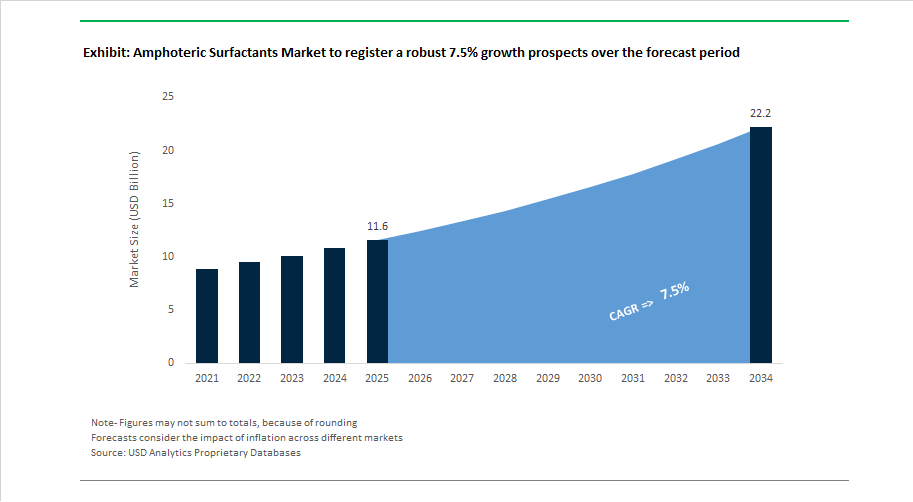
The global amphoteric surfactants market is projected to grow from $11.6 billion in 2025 to $22.2 billion by 2034, registering a 7.5% CAGR driven by rising demand for mild, pH-adaptive, and biodegradable surfactant systems across personal care, home care, and institutional cleaning. Amphoteric surfactants such as cocamidopropyl betaine, amine oxides, and imidazolines are valued for their low irritation profile, foam stabilization, and compatibility with sulfate-free formulations. Market growth is supported by consumer preference for clean label shampoos, sensitive skin cleansers, baby care products, and eco-labeled detergents, alongside regulatory pressure to reduce aquatic toxicity. Industry development is linked to green chemistry initiatives, bio-based feedstock integration, and carbon-reduced manufacturing processes.
Innovation in mild surfactant systems began advancing in April 2024 when Nouryon launched Structure M3, a biodegradable co-surfactant enhancing amphoteric-based cleansing systems. Feedstock strengthening followed in August 2024 as BASF expanded alkyl polyglycoside capacity, supporting bio-based intermediates used in amphoteric blends. Circular chemistry initiatives advanced in October 2024 through a collaboration between Dow and LanzaTech to develop carbon-derived surfactants. Sustainability credentials strengthened in January 2025 when Galaxy Surfactants achieved ISCC PLUS certification. Product performance innovations continued in April 2025 as Nouryon introduced Armocare Aqua 12 for conditioning and mild cleansing. Market consolidation expanded in May 2025 with Solenis completing integration of Diversey and NCH assets for institutional cleaning solutions.
Sustainability investments accelerated in August 2025 as BASF launched green chemistry programs targeting carbon reduction in betaine and amine oxide production. Regional innovation hubs expanded in November 2025 with Nouryon’s Shanghai Innovation Center focusing on sulfate-free surfactant systems, followed by a Brazilian innovation center opening in December 2025 to serve South American formulators. Raw material developments connected to ammonia-based amine synthesis were reinforced in January 2026 as Topsoe validated ammonia cracking technologies that support amine supply chains. In February 2026, Nouryon introduced a fully bio-based CMC polymer designed to work synergistically with amphoteric surfactants in biodegradable detergents.
Trends and Opportunities Transforming the Amphoteric Surfactants Market
Reformulation Acceleration for CAPB Driven by Purity, Regulatory, and Allergy Controls
Reformulation is now a commercial necessity for amphoteric surfactants, particularly Cocamidopropyl Betaine (CAPB), as dermatological and regulatory bodies highlight allergen risks arising from its synthesis impurities. A 2025 dermatology review confirmed that the main sensitizers in CAPB products are Dimethylaminopropylamine (DMAPA) and amidoamine, impurities that in commercial-grade surfactants can reach up to 3%. The market is shifting toward Ultra-High-Purity (UHP) CAPB engineered to meet sub-ppm impurity levels for baby care and facial-use applications. The FDA FY 2025 OTC Monograph Order enforces new listing updates for drug-listed cleanser categories, triggering higher demand for USP-grade amphoterics with <0.01% total impurities. In parallel, the U.S. EPA’s 2024 exemption for CAPB residue limits in agricultural uses (Reg. No. 2024-10182) reflects a dual-tiered structure: strict purity for consumer-facing products and relaxed regulatory conditions for industrial/agri surfactants, shaping supply prioritization and price segmentation.
Rise of “Primary Amphoteric” Systems Replaces Boosting-Only Role
The market is transitioning away from amphoterics being used as secondary foam boosters toward “Primary Amphoteric Surfactant Systems”, engineered from proprietary blends of betaines, amphoacetates, and sultaines. Technical evaluations from 2025 briefings indicate that pairing amphoacetates with non-ionics such as APGs reduces skin irritation scores by 30% against SLES-based baselines while delivering viscosity and foam structure comparable to sulfate systems. The August 2024 commercial launch of Galaxy Surfactants’ zwitterionic cleansing base—designed to support microbiome-friendly claims—demonstrates a performance-oriented pivot where amphoterics allow brands to achieve tear-free, pH-balanced cleansing without thickening polymers. This shift is highly consumer-driven, supported by 2025 witnessing 70% of global consumers view sulfate-free credentials as a hygiene and wellness benchmark.
Pharmaceutical Ionizable Amphoteric Lipids as Critical Components of LNP Delivery
Amphoteric derivatives are gaining relevance in drug-delivery pipelines as ionizable lipids, where they function as pH-switchable carriers within Lipid Nanoparticles (LNPs). Their charge-neutral behavior at physiological pH minimizes cytotoxicity, while internal protonation inside endosomes enables mRNA cargo release. A 2025 industry dossier specifies that ionizable lipids typically make up ~50% of an LNP composition, placing amphoterics at the economic core of vaccine-grade lipid systems. The $220 million Evonik pharmaceutical lipid facility in Lafayette, Indiana (coming online in 2025), backed by $150 million federal BARDA support, validates the scaling trajectory. Structural shifts such as Evonik’s divestment of legacy keto-acid lines at Ham and Wuming also demonstrate a move toward high-margin amphoteric lipid excipients for oncology, cancer immunotherapy, and protein-replacement therapies.
Low-VOC Amphoterics for Industrial & Institutional Cleaning and Oilfield Systems
The Industrial and Institutional (I&I) sector is increasingly a performance-led commercialization avenue. As of late 2024, updated U.S. and EU facility permits require Near-Zero VOC cleaning chemistries, which elevates demand for amphoterics such as amine oxides and amphoacetates that maintain stability in acidic to highly alkaline ranges (pH 2–12). Technical formulation data from 2024-2025 reveals that ~30% of new I&I cleaning SKUs are leveraging amphoteric-anionic blends to prevent precipitation in hard-water and saline environments, enabling ultra-high dilution concentrates for food-grade and industrial Clean-in-Place (CIP) cleaning frameworks. Beyond cleaning, amphoterics are gaining traction in enhanced oil-recovery (EOR) applications, where their pH-adaptive surface activity supports interfacial tension reduction without relying on PFAS-based foams—an attribute that aligns with oilfield decarbonization and ESG disclosure requirements.
Amphoteric Surfactants Market Share and Segmentation Insights
Market Share by Type: Betaines Lead Volume While Sultaines Deliver Premium Expansion
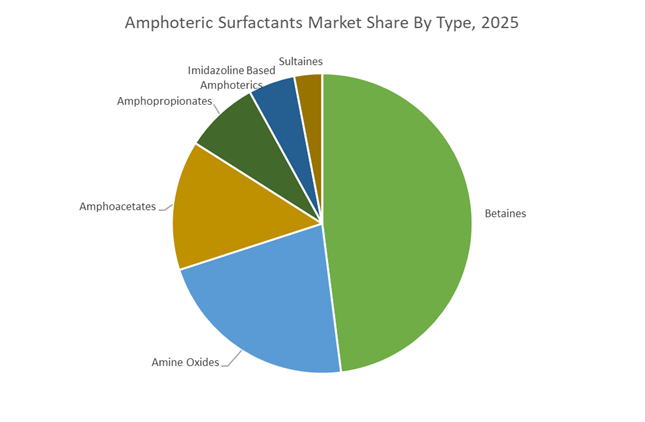
Betaines account for approximately 48% of the global amphoteric surfactants market in 2025, led by cocamidopropyl betaine (CAPB), the industry-standard co-surfactant for viscosity building, foam stabilization, and mildness enhancement in shampoos and liquid soaps. Despite periodic impurity scrutiny related to amidoamine and 3-DMA, CAPB remains unmatched in cost-performance. Coco-betaine variants are gaining traction in premium purity formulations. Amine oxides rank second and are expanding at +7.8% YoY, supported by strong grease-cutting performance and hypochlorite compatibility in household and institutional cleaners. Amphoacetates and amphopropionates serve high-mildness and alkaline-stable niches respectively, with steady demand in baby care and industrial systems. Imidazoline-based amphoterics are mature and declining. Sultaines are the fastest-growing segment, driven by superior mildness and high-electrolyte stability in sulfate-free, natural-certified personal care formulations where premium pricing is justified.
Market Share by Application: Personal Care Dominates While PFAS-Free Foams Create High-Growth Niche
Personal care and cosmetics represent roughly 52% of amphoteric surfactant consumption in 2025, anchored by shampoos, body washes, facial cleansers, and baby products. The global shift toward sulfate-free systems remains the primary growth catalyst, with amphoterics delivering foam, viscosity, and irritation reduction in SLS/SLES-free formulations. Home care ranks second, dominated by amine oxides in dishwashing liquids and hard surface cleaners. Industrial and institutional cleaning remains volume-driven, leveraging amphoteric stability in caustic and acid environments. Oilfield chemicals represent a cyclical, high-value niche tied to enhanced oil recovery and drilling fluids. Agrochemicals show steady 5 to 6% growth as wetting agents and compatibility adjuvants. Firefighting foams form the smallest but most transformative segment, as regulatory phase-outs of fluorinated surfactants accelerate adoption of PFAS-free fluorine-free foam systems, driving double-digit growth from a low base.
The global amphoteric surfactants market is shaped by sustainability-driven reformulation, rapid growth in sulfate-free personal care, and rising demand from Industrial & Institutional (I&I) cleaning, baby care, and agrochemical applications. Leading manufacturers are competing on bio-based feedstocks, carbon transparency, cold-process manufacturing, and sensory performance. Capacity expansions across Asia-Pacific and North America, combined with digital formulation tools and backward oleochemical integration, are redefining supply chains. Market leadership increasingly depends on mildness profiles, pH stability, and multifunctional blends that reduce water usage and energy consumption while meeting clean-label and regulatory compliance requirements for global FMCG, cosmetics, and hygiene brands.
Bio-based scale leadership positions BASF SE at the forefront of amphoteric innovation
BASF leads the amphoteric surfactants market through its Verbund infrastructure and aggressive expansion of bio-based capacity. In late 2025, BASF inaugurated a major surfactant expansion in Bangpakong, Thailand, strengthening its footprint in the high-growth APAC personal care market. The launch of Lamesoft® OP Plus in early 2026 introduced a biodegradable opacifier alternative to synthetic acrylates for sulfate-free systems. A new APG and amphoteric blends line in Cincinnati comes online mid-2026, targeting North America’s clean-label trend. BASF further differentiates through its Surfactant Navigator digital tool, enabling rapid simulation of skin-lipid interactions and accelerating product development for premium beauty brands.
Evonik has repositioned its Care Solutions portfolio toward biotechnology and custom-engineered amphoteric surfactants under its Tailor Made efficiency program. Its TEGO® Betain series remains a benchmark for ultra-low residual by-products, supporting non-irritating formulations for baby care and medical-grade hygiene. In 2025, Evonik expanded specialty amine derivatives capacity to serve sultaines for high-salinity oilfield applications. Early 2026 marked a strategic pivot toward Superforce green chemistry projects, backed by a new dividend and investment policy. Evonik’s competitive edge lies in high-purity production, specialty customization, and circularity-focused R&D that targets high-margin applications across healthcare, energy, and sensitive skin care.
Amphoacetate leadership defines Syensqo in ultra-mild formulations
Following its separation from Solvay, Syensqo operates as a pure-play science company with strong positioning in amphoacetates through its Miranol® platform. These surfactants are widely regarded as among the mildest available, making them essential for tear-free pediatric and ocular products. In 2025, Syensqo launched AgRHEA LifeXtend Plus, extending amphoteric technology into agricultural adjuvants to improve bio-pesticide rain-fastness. Its Value Chain Resilience strategy introduced localized sourcing to mitigate tariff volatility. Deep integration into guar and natural polymer chains enables Syensqo to offer fully plant-based cleansing and conditioning systems, supporting clean beauty and sustainable home care markets.
Purpose-driven design strengthens Clariant AG’s global amphoteric portfolio
Clariant’s amphoteric strategy centers on Purposeful Design, focusing on reduced rinse-off water consumption and high sensory performance. The GlucoTain® and GlucoPure® ranges scaled in 2025, leveraging sugar and amino acid chemistry to replicate creamy and voluminous foam without synthetic additives. Clariant dominates I&I cleaning with amphoteric surfactants stable across extreme pH conditions, from acidic to highly alkaline systems. Expansion of its Cangzhou site in late 2025 localized production for Asian textile and personal care markets. As a Renewable Carbon Initiative member, Clariant now delivers batch-level CO2-equivalent data, aligning its portfolio with global CPG sustainability mandates.
Lubrizol specializes in sensory science, combining amphoteric surfactants with advanced polymers to engineer differentiated textures. Its Chembetaine™ and Schercoteric™ brands, particularly Schercoteric™ MS-2 50, are widely adopted in premium shampoos for superior wet-comb performance. After divesting commodity assets in 2024–2025, Lubrizol consolidated high-value surfactant production in Texas and Europe. The company excels in synergistic formulations, blending amphoterics with Carbopol® polymers to create clear, suspended-particle body washes. In 2025, Lubrizol introduced cold-processable amphoteric blends, enabling manufacturers to bypass heating steps and reduce energy consumption by up to 25%.
Value-added green chemistry accelerates growth for Galaxy Surfactants Ltd.
Galaxy Surfactants has emerged as a global force by targeting value-added green solutions for mass and mass-prestige markets. Its Galsoft® range supports mild cleansing, while the Galseer® Tresscon solid shampoo base scaled in 2025 to meet rising demand for waterless beauty formats. Galaxy focuses on enabling sulfate-free transitions in emerging economies across India, Africa, and Southeast Asia. Strong backward integration into oleochemicals stabilizes Cocamidopropyl Betaine supply amid palm oil volatility. In 2025, Galaxy achieved Water Positive status at major Indian facilities, strengthening partnerships with sustainability-focused FMCG leaders and reinforcing its role in affordable, eco-conscious amphoteric surfactants.
China Amphoteric Surfactants Market: Scale Leadership Meets Clean Beauty and Export Momentum
China remains the most influential production and consumption hub for amphoteric surfactants, combining large-scale capacity with rapid innovation cycles. In November 2025, Clariant commissioned expanded facilities at its Daya Bay site following an CHF 80 million investment. The upgraded multi-purpose plant is dedicated to mild surfactants, directly addressing domestic demand from the fast-growing clean beauty and sulfate-free facial cleanser segments.
Local champions such as Tinci Materials and Sino Lion have pivoted toward amino acid-based amphoterics since late 2024, targeting premium skincare formulations. China also remains the largest consumer of amine oxides, driven by industrial detergents and household cleaning. Policy support is reinforcing sustainability, with the Shanghai Green Chemical Innovation Hub offering incentives for PFAS-free firefighting foams using amphoteric blends, while Yangtze River Delta mandates pushed major producers to adopt closed-loop water systems, cutting effluent volumes by 22%. Export competitiveness strengthened further in 2025 as cocamidopropyl betaine shipments to Southeast Asia rose under the RCEP framework.
Slovakia has emerged as a strategic innovation node for next-generation amphoteric-compatible biosurfactants. In May 2024, Evonik inaugurated the world’s first industrial-scale rhamnolipid biosurfactant plant in Slovenská Ľupča. This facility, representing a triple-digit million-euro investment, produces fermentation-derived glycolipids designed to work synergistically with conventional amphoterics.
The plant’s reliance on renewable corn feedstocks and biocircular processes establishes a new global benchmark for sustainable surfactant manufacturing. By early 2025, the site became the primary launch platform for Evonik’s REWOFERM® series, which is now being integrated into premium global personal care brands seeking ultra-mild, low-irritation cleansing systems.
India Amphoteric Surfactants Market: Policy-Led Scale-Up of Green Amphoterics
India’s amphoteric surfactants industry is benefiting from strong regulatory tailwinds and domestic demand growth. The BioE3 Policy, operationalized in late 2024, has provided a clear framework for scaling bio-based chemicals, enabling companies such as Galaxy Surfactants to expand amphoteric production aligned with sustainability goals. In 2025, Galaxy reported a marked increase in its green surfactant portfolio, driven by shampoos, baby-care products, and mild cleansing formulations.
Infrastructure incentives have accelerated this momentum. A 20% Capex subsidy introduced by the Ministry of Chemicals in 2025 supported new green chemistry units, particularly sulfobetaine expansion in the Gujarat corridor. At the same time, stricter import purity norms enforced by the Directorate General of Foreign Trade in early 2025 encouraged domestic synthesis of high-grade amphoteric technicals, strengthening India’s position as a regional supply base.
United States Amphoteric Surfactants Market: Regulatory Purity and Pet Care Drive Premium Demand
In the United States, amphoteric surfactant demand is being reshaped by regulatory scrutiny and diversification into pet care. In March 2025, Evonik entered an exclusive distribution agreement with Sea-Land Chemical Company to scale its mild cleaning solutions across the U.S. market.
The Kansas Animal Health Corridor emerged as a notable demand center in 2025, as pet grooming brands increasingly adopted amphopropionates for tearless and hypoallergenic formulations. Regulatory drivers are equally important. Proposed FDA labeling requirements targeting 1,4-dioxane-free certifications in rinse-off products have boosted demand for high-purity betaines. On the supply side, Stepan Company completed modernization at its Pasadena, Texas facility in late 2024, integrating advanced alkoxylation technologies to deliver low-VOC amphoteric surfactants.
Germany Amphoteric Surfactants Market: Responsible Sourcing and Natural-Based Innovation
Germany is setting benchmarks for sustainability and traceability in amphoteric surfactants. In 2025, BASF launched its Longevity Ecosystem at in-cosmetics Global, highlighting natural-based amphoterics such as Lamesoft® OP Plus, a wax-based opacifier developed to replace synthetic acrylates in mild cleansing systems.
Regulatory pressure from the Supply Chain Due Diligence Act has forced a rapid shift toward RSPO-certified palm and coconut oil feedstocks across German amphoteric production. Innovation is further supported by industry recognition, with Evonik receiving the 2024 European Responsible Care® Award for its glycolipid technology, now increasingly blended with conventional amphoterics to create ultra-mild, bio-based personal care products.
Japan Amphoteric Surfactants Market: Precision Manufacturing for Aging and Premium Skincare
Japan’s amphoteric surfactants industry reflects its focus on precision, automation, and demographic-driven innovation. In 2025, Ajinomoto and Kao Corporation completed automation upgrades of their specialty surfactant lines, concentrating on glycinate-amphoteric blends tailored for premium skincare.
An aging population has become a key innovation driver. Japanese formulators launched geriatric skincare cleansers in 2025 that rely on high-bioavailability amphoterics to preserve skin barrier integrity, reinforcing Japan’s leadership in high-performance, skin-compatible cleansing technologies.
Country-Level Strategic Positioning in Amphoteric Surfactants
Amphoteric Surfactants Market County Level Snapshot
Country
Strategic Focus
Industry Implication
China
Scale expansion and clean beauty alignment
Dominant producer with growing exports and sustainability compliance
Slovakia
Industrial biosurfactant commercialization
Global benchmark for bio-based, ultra-mild amphoterics
India
Policy-driven green chemistry scale-up
Rising regional supplier of bio-based amphoterics
United States
Regulatory purity and pet care demand
Strong pull for high-purity, low-contaminant surfactants
Germany
Responsible sourcing and natural innovation
Leadership in traceable, eco-certified amphoterics
Japan
Automation and age-specific skincare
Precision-driven premium amphoteric formulations
Amphoteric Surfactants Market Report Scope
Amphoteric Surfactants Market
Parameter
Details
Market Size (2025)
$11.6 Billion
Market Size (2034)
$22.2 Billion
Market Growth Rate
7.5%
Segments
By Type (Betaines, Amine Oxides, Amphoacetates, Amphopropionates, Sultaines, Imidazoline Based Amphoterics), By Form (Liquid, Powder, Granular and Paste), By Source (Natural Based, Synthetic Based, Bio Fermented), By Application (Personal Care and Cosmetics, Home Care, Industrial and Institutional Cleaning, Oilfield Chemicals, Agrochemicals, Firefighting Foams)
Study Period
2019- 2025 and 2026-2034
Units
Revenue (USD)
Qualitative Analysis
Porter’s Five Forces, SWOT Profile, Market Share, Scenario Forecasts, Market Ecosystem, Company Ranking, Market Dynamics, Industry Benchmarking
Companies
BASF SE, Evonik Industries AG, Clariant AG, Ajinomoto, Stepan Company, Kao Corporation, Galaxy Surfactants Limited, Nouryon, Croda International Plc, Solvay SA, Innospec Inc, Lubrizol Corporation, Sino Lion, Tinci Materials Technology, Enaspol
Countries
US, Canada, Mexico, Germany, France, Spain, Italy, UK, Russia, China, India, Japan, South Korea, Australia, South East Asia, Brazil, Argentina, Middle East, Africa
Amphoteric Surfactants Market Segmentation
By Type
Betaines
Amine Oxides
Amphoacetates
Amphopropionates
Sultaines
Imidazoline Based Amphoterics
By Form
Liquid
Powder
Granular and Paste
By Source
Natural Based
Synthetic Based
Bio Fermented
By Application
Personal Care and Cosmetics
Home Care
Industrial and Institutional Cleaning
Oilfield Chemicals
Agrochemicals
Firefighting Foams
By Region
North America (United States, Canada, Mexico)
Europe (Germany, France, United Kingdom, Spain, Italy, Rest of Europe)
Asia Pacific (China, India, Japan, South Korea, Australia, Rest of APAC)
South and Central America (Brazil, Argentina, Rest of SCA)
Middle East and Africa (Saudi Arabia, UAE, South Africa, Rest of Middle East, Rest of Africa)
2. Amphoteric Surfactants Market Landscape & Outlook (2025–2034)
2.1. Introduction to Amphoteric Surfactants Market
2.2. Market Valuation and Growth Projections (2025–2034)
2.3. Key Growth Drivers: Sulfate-Free Cleansing, Bio-Based Inputs, and Circular Chemistry
2.4. Regulatory Environment: Aquatic Toxicity Limits, Impurity Controls, and Clean-Label Standards
2.5. Technology Developments: Ultra-High-Purity Betaines, Bio-Fermentation, and Cold-Process Manufacturing
2.6. Supply Chain Dynamics: Oleochemical Integration, Regional Capacity Expansion, and Carbon Reduction
3. Strategic Market Trends and High-Value Opportunities
3.1. CAPB Reformulation Driven by Purity and Allergy Controls
3.2. Transition Toward Primary Amphoteric Surfactant Systems
3.3. Amphoteric Lipids in LNP Drug Delivery Platforms
3.4. Low-VOC Amphoterics for Industrial, Institutional, and Oilfield Applications
3.5. PFAS-Free Firefighting Foams and Sustainable Wetting Systems
4. Competitive Landscape and Strategic Developments
4.1. Capacity Expansion in Asia-Pacific, Europe, and North America
4.2. Product Innovation: Sultaines, Amphoacetates, and Bio-Based Blends
4.3. Digital Formulation Tools and Sensory Engineering
4.4. ESG Strategy, ISCC PLUS Certification, and Renewable Feedstocks
5. Amphoteric Surfactants Market Share and Segmentation Insights
5.1. By Type
5.1.1. Betaines
5.1.2. Amine Oxides
5.1.3. Amphoacetates
5.1.4. Amphopropionates
5.1.5. Sultaines
5.1.6. Imidazoline Based Amphoterics
5.2. By Form
5.2.1. Liquid
5.2.2. Powder
5.2.3. Granular and Paste
5.3. By Source
5.3.1. Natural Based
5.3.2. Synthetic Based
5.3.3. Bio Fermented
5.4. By Application
5.4.1. Personal Care and Cosmetics
5.4.2. Home Care
5.4.3. Industrial and Institutional Cleaning
5.4.4. Oilfield Chemicals
5.4.5. Agrochemicals
5.4.6. Firefighting Foams
6. Country Analysis and Outlook
6.1. United States
6.2. Canada
6.3. Mexico
6.4. Germany
6.5. France
6.6. United Kingdom
6.7. Spain
6.8. Italy
6.9. China
6.10. India
6.11. Japan
6.12. South Korea
6.13. Australia
6.14. Brazil
6.15. Argentina
6.16. Saudi Arabia
6.17. United Arab Emirates
6.18. South Africa
6.19. Rest of World
7. Amphoteric Surfactants Market Size Outlook by Region (2025–2034)
7.1. North America Market Size Outlook
7.1.1. By Type
7.1.2. By Form
7.1.3. By Source
7.1.4. By Application
7.2. Europe Market Size Outlook
7.2.1. By Type
7.2.2. By Form
7.2.3. By Source
7.2.4. By Application
7.3. Asia Pacific Market Size Outlook
7.3.1. By Type
7.3.2. By Form
7.3.3. By Source
7.3.4. By Application
7.4. South and Central America Market Size Outlook
7.4.1. By Type
7.4.2. By Form
7.4.3. By Source
7.4.4. By Application
7.5. Middle East and Africa Market Size Outlook
7.5.1. By Type
7.5.2. By Form
7.5.3. By Source
7.5.4. By Application
8. Company Profiles
8.1. BASF SE
8.2. Evonik Industries AG
8.3. Clariant AG
8.4. Ajinomoto
8.5. Stepan Company
8.6. Kao Corporation
8.7. Galaxy Surfactants Limited
8.8. Nouryon
8.9. Croda International Plc
8.10. Solvay SA
8.11. Innospec Inc
8.12. Lubrizol Corporation
8.13. Sino Lion
8.14. Tinci Materials Technology
8.15. Enaspol
9. Methodology
9.1. Research Scope
9.2. Market Research Approach
9.3. Market Sizing and Forecasting Model
9.4. Research Coverage
9.5. Data Horizon
9.6. Deliverables
10. Appendix
10.1. Acronyms and Abbreviations
10.2. List of Tables
10.3. List of Figures
Amphoteric Surfactants Market Segmentation
By Type
Betaines
Amine Oxides
Amphoacetates
Amphopropionates
Sultaines
Imidazoline Based Amphoterics
By Form
Liquid
Powder
Granular and Paste
By Source
Natural Based
Synthetic Based
Bio Fermented
By Application
Personal Care and Cosmetics
Home Care
Industrial and Institutional Cleaning
Oilfield Chemicals
Agrochemicals
Firefighting Foams
By Region
North America (United States, Canada, Mexico)
Europe (Germany, France, United Kingdom, Spain, Italy, Rest of Europe)
Asia Pacific (China, India, Japan, South Korea, Australia, Rest of APAC)
South and Central America (Brazil, Argentina, Rest of SCA)
Middle East and Africa (Saudi Arabia, UAE, South Africa, Rest of Middle East, Rest of Africa)
The global Amphoteric Surfactants Market was valued at $11.6 billion in 2025 and is projected to reach $22.2 billion by 2034, expanding at a 7.5% CAGR. Growth is fueled by accelerating adoption of sulfate-free personal care products, eco-labeled detergents, PFAS-free foams, and mild, biodegradable surfactant systems across cosmetics, home care, and industrial cleaning.
Betaines account for approximately 48% of global consumption in 2025, led by cocamidopropyl betaine (CAPB) used for foam stabilization and viscosity building in shampoos and body washes. Amine oxides rank second, driven by grease-cutting performance in dishwashing and I&I cleaners. Sultaines are the fastest-growing segment, favored for premium sulfate-free formulations due to superior mildness and electrolyte stability.
Heightened scrutiny of CAPB impurities such as DMAPA and amidoamine is driving a shift toward Ultra-High-Purity (UHP) grades, especially for baby care and facial cleansers. New FDA OTC cleanser listings and EU allergen controls are pushing brands to adopt USP-grade amphoterics with sub-ppm impurity levels, while industrial and agrochemical applications continue to use standard grades, creating clear price and purity segmentation.
Beyond cosmetics, strong growth is coming from Industrial & Institutional cleaning, PFAS-free firefighting foams, oilfield chemicals, and pharmaceutical lipid nanoparticles (LNPs). Amphoteric derivatives are increasingly used as ionizable lipids in mRNA delivery, while low-VOC amphoterics are enabling near-zero-emission CIP systems and hard-surface cleaners. These performance-led applications are expanding amphoterics from foam boosters into primary functional surfactants.
Key global players include BASF SE, Evonik Industries AG, Clariant AG, Galaxy Surfactants Limited, Nouryon, and Lubrizol Corporation. These suppliers differentiate through bio-based feedstocks, high-purity betaines, sultaine expansion, cold-process manufacturing, and circular chemistry initiatives supporting sulfate-free, low-irritation, and low-carbon formulations.