Ethyl Ascorbic Acid Market to Reach $292.3 Million by 2034 at 8.3% CAGR Amid Next-Gen Vitamin C Demand Surge
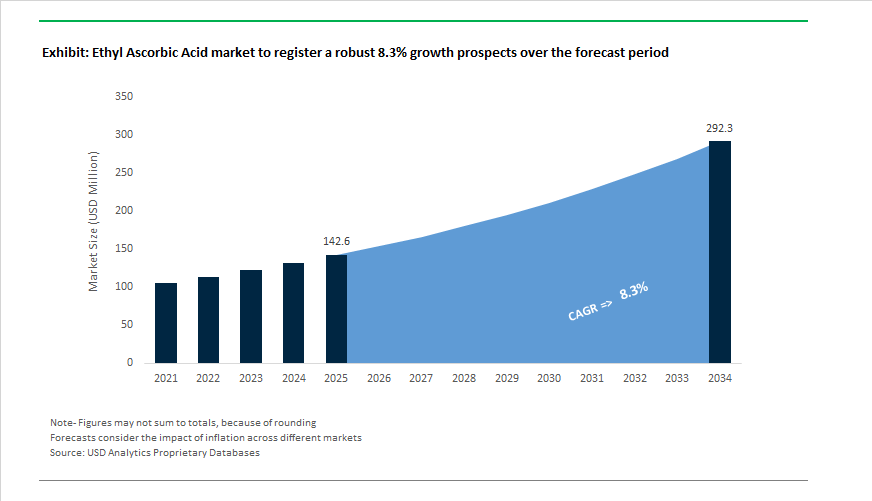
The Ethyl Ascorbic Acid Market is projected to expand from $142.6 Million in 2025 to $292.3 Million by 2034, registering a strong CAGR of 8.3%. Market acceleration is being driven by premium skincare innovation, pharmaceutical-grade purity requirements, and a structural shift toward stabilized Vitamin C derivatives in both cosmetic and dermaceutical applications. As 3-O-Ethyl Ascorbic Acid offers superior thermal stability, oxidation resistance, and enhanced dermal penetration compared to L-ascorbic acid, it has emerged as a preferred active in brightening serums, anti-aging formulations, and advanced wound-care products.
Capacity expansion and upstream consolidation defined 2024. Spec-Chem Group announced a 30% production capacity increase at its Nanjing facility in Q1 2024, responding to strong forward orders from North American and European prestige skincare brands preparing 2025 product launches. Bisor Corporation completed a large-scale expansion in March 2024, reaching a 20,000-ton milestone while pivoting toward ≥99.5% pharmaceutical-grade purity. This transition reflects the industry’s movement from commodity volume supply toward high-margin clinical and dermaceutical applications, including collagen stimulation and wound healing systems.
Strategic repositioning among multinational suppliers has reshaped competitive dynamics. dsm-firmenich divested its DSM Jiangshan Pharmaceutical facility in March 2024 to exit commodity Vitamin C exposure and concentrate on premium derivative platforms such as Quali-C and stabilized ascorbate technologies in Europe. Meanwhile, Northeast Pharmaceutical Group acquired a 70% stake in Beijing Dingcheng Peptide Source Biotechnology in November 2024, integrating peptide R&D with Vitamin C derivative manufacturing to support synergistic anti-aging systems targeting 2025–2026 launches.
Technological innovation has elevated formulation performance benchmarks. MCBIOTEC introduced a microencapsulated Ethyl Ascorbic Acid platform in May 2024 delivering up to 36 months of shelf stability and approximately 40% enhanced skin penetration. This advancement supports the rapid growth of waterless beauty and single-dose ampoule systems where oxidation control is critical. In October 2025, Skya Transdermic launched its 2nm absorption delivery system, emphasizing deeper dermal transport with reduced irritation, aligning with consumer demand for gentle yet high-efficacy Vitamin C solutions.
Regulatory scrutiny and sustainability initiatives are shaping the next phase of growth. The Cosmetic Ingredient Review included antioxidant reassessments in its May 2025 draft 2026 priority list, prompting global manufacturers to update concentration-of-use data for leave-on formulations. Concurrently, Shandong Luwei Pharmaceutical received a High-quality Development Benchmark Enterprise Award in February 2025 after implementing closed-loop waste recycling in Vitamin C synthesis, highlighting China’s push toward greener derivative production standards.
Industry trend reports in April 2025 identified Ethyl Ascorbic Acid as the leading Next-Gen Vitamin C active for 2025, accelerating adoption in powder-to-liquid concentrates and solid serum sticks. Pricing volatility that persisted for 18 months began stabilizing by January 2026 as Chinese producers shifted from oversupply to disciplined contract strategies, supporting gradual margin recovery.
Diversification beyond cosmetics is emerging as a structural growth lever. In early 2026, Beiersdorf incorporated high-purity Ethyl Ascorbic Acid into its Hansaplast/Elastoplast wound-care line, signaling the ingredient’s expansion into functional dermatology and post-inflammatory hyperpigmentation repair.
Transformative Trends and High-Growth Opportunities Shaping the Ethyl Ascorbic Acid Market
The Asia-Pacific anti-pollution skincare boom is emerging as a primary structural growth driver for the global Ethyl Ascorbic Acid market. Rapid urbanization, rising PM2.5 exposure, and increasing consumer awareness of skin barrier damage have catalyzed strong demand for stable Vitamin C derivatives capable of maintaining efficacy in high-humidity climates. Anti-Pollution Skincare 2025 projections indicate that APAC will command a 35.2% share of the global anti-pollution skincare market, while urban markets such as India and China are witnessing a 15% annual rise in consumer spending on barrier-repair serums and antioxidant formulations. Unlike conventional L-ascorbic acid, which oxidizes quickly in humid environments, 3-O-Ethyl Ascorbic Acid demonstrates superior oxidative stability, making it a preferred active ingredient in climate-resilient skincare formulations.
Commercial performance metrics reinforce this regional trend. L’Oréal reported a 12.6% like-for-like sales increase in its Consumer Products Division during 2024 to 2025, citing stable Vitamin C serums as a key contributor to growth in urban Asia. Simultaneously, Shiseido and Amorepacific are expanding multifunctional cream portfolios, a segment projected to hold 38.8% of the anti-pollution skincare market by 2026. These formulations integrate Ethyl Ascorbic Acid to deliver combined UV and HEV protection alongside antioxidant barrier restoration, positioning EAA as a critical ingredient in next-generation urban skincare solutions.
Regulatory Scrutiny on Heavy Metal Contaminants Driving Demand for High-Purity Ethyl Ascorbic Acid
Global regulatory tightening on heavy metal contaminants is reshaping procurement standards across the Ethyl Ascorbic Acid market. The California Toxic-Free Cosmetics Act, effective January 1, 2025, alongside similar mandates in Washington and Maryland, prohibits intentionally added mercury and intensifies scrutiny on trace lead levels, with Washington enforcing a stringent 1 ppm threshold. These state-level regulations are compelling cosmetic manufacturers to source high-purity EAA with validated contaminant controls to mitigate recall risks and regulatory penalties.
In Europe, the EU Rapid Alert System recorded thousands of cosmetic non-compliance alerts in 2025, with heavy metals such as lead, cadmium, and antimony remaining key triggers for product withdrawals. This has elevated the industry benchmark toward ≥99.5% purity Ethyl Ascorbic Acid. In December 2025, National Medical Products Administration introduced a Three-Year Action Plan for 2026 to 2028 focused on raw material safety control, reinforcing a ≤10 ppm lead threshold for cosmetic inputs. These compliance pressures are structurally favoring pharmaceutical-grade, high-stability Ethyl Ascorbic Acid suppliers capable of meeting global safety harmonization standards.
The clean label movement is extending into high-performance skincare, creating a differentiated growth pathway for fermentation-derived Ethyl Ascorbic Acid. Global consumer surveys from early 2026 reveal that 64% of Gen Z consumers, representing 40% of global discretionary spending, actively seek clean label claims, enabling verified non-GMO and plant-derived actives to command a 20 to 30% price premium. This shift is accelerating demand for bio-based Vitamin C derivatives positioned within sustainable and transparent supply chains.
Ingredient manufacturers are strategically pivoting to meet this demand. DSM-Firmenich and CSPC Pharmaceutical Group, which holds approximately 15% of global Vitamin C production share, are expanding natural-source portfolios. As of 2025, natural-source Vitamin C derivatives account for 44% of total market share and are growing nearly 9% faster annually than synthetic alternatives. Mid-2025 fermentation technologies have reduced the carbon footprint of EAA production by 30% compared to traditional etherification methods, reinforcing sustainability narratives that enhance brand positioning in the premium antioxidant skincare segment.
Encapsulated and Time-Release Delivery Systems Enhancing Stability and Bioavailability
Advanced encapsulation technologies are addressing the final performance constraints of Ethyl Ascorbic Acid, particularly skin penetration and shelf stability. Research and industrial data from mid-2025 demonstrate that microencapsulated 3-O-Ethyl Ascorbic Acid achieves 40% greater dermal penetration than standard aqueous formulations, enabling sustained collagen stimulation and antioxidant activity over a 12-hour time-release cycle. These controlled-release systems enhance bioavailability while minimizing oxidation during application.
Supply chain resilience is another critical benefit. Conventional high-purity EAA can degrade at rates of 15 to 20% annually under suboptimal temperature conditions, increasing logistical costs for climate-controlled storage. Encapsulation technologies extend stable shelf life to 36 months, even in warmer climates, significantly reducing cold-chain dependency. Patent filings for Vitamin C encapsulation increased by 28% year-over-year, with companies such as MCBIOTEC and Bisor Corporation leading innovation. The encapsulated Vitamin C segment is projected to expand 2.9 times in market value between 2025 and 2035, positioning time-release Ethyl Ascorbic Acid as a high-growth technological frontier within the global EAA market.[1]
Powder-Based Ethyl Ascorbic Acid Leads Formulation Flexibility and Shelf Stability
Powder ethyl ascorbic acid accounts for 68% of total market share in 2025, driven by its superior stability, extended shelf life, and ease of incorporation into customized skincare formulations. Cosmetic manufacturers favor the powder format for serums, creams, and lotions because it enables precise concentration control, typically ranging from 2% to 20%, supporting both mass-market and premium product positioning. Liquid solutions represent a significant secondary segment, gaining traction among contract manufacturers and turnkey formulators seeking pre-dissolved actives that streamline processing and ensure uniform distribution in ready-to-use cosmetic bases. Encapsulated ethyl ascorbic acid is emerging as a high-value premium category, utilizing advanced delivery systems to protect the active from oxidation while enabling controlled release into targeted skin layers. This format is increasingly specified in luxury anti-aging products, reinforcing performance claims related to brightening, collagen stimulation, and long-term antioxidant protection.
Skin Care Dominates Demand as Brands Prioritize Stable Vitamin C Derivatives
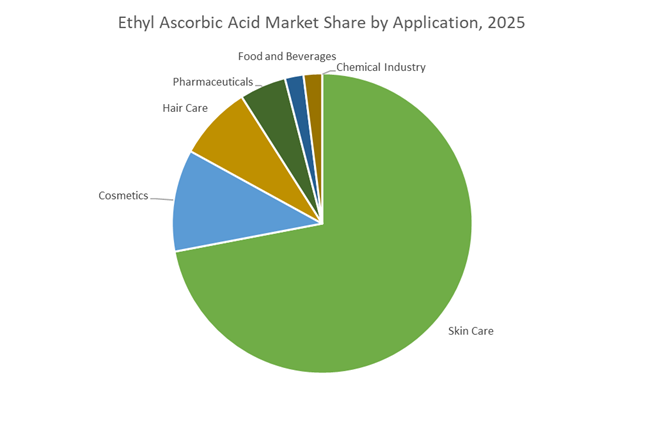
Skin care represents nearly 78% of global ethyl ascorbic acid consumption in 2025, making it the overwhelmingly dominant application segment. The ingredient is extensively used in anti-aging serums, brightening creams, sunscreens, and moisturizers due to its superior stability and deeper skin penetration compared to traditional L-ascorbic acid. Cosmetics form a meaningful secondary segment, incorporating ethyl ascorbic acid into foundations, BB creams, and concealers to deliver antioxidant and tone-evening benefits alongside coverage. Hair care is a growing niche, with shampoos and treatments leveraging the ingredient for scalp health and protection against oxidative stress. Pharmaceutical usage remains limited but strategic, focused on topical therapies for hyperpigmentation disorders requiring high-purity actives. Food, beverage, and chemical industry applications are currently minimal, though future regulatory approvals could unlock functional nutrition opportunities.
Competitive Landscape of the Ethyl Ascorbic Acid Market
The global ethyl ascorbic acid (EAA) market in 2026 is shaped by ultra-high purity standards, vertical integration, and rapid innovation in stabilized Vitamin C derivatives, driven by surging demand from premium skincare, clean beauty, and multifunctional cosmetic actives across Asia-Pacific, North America, and Europe.
Spec-Chem strengthens global EAA leadership through vertical integration and stabilized formulations
Spec-Chem Group stands as one of the dominant producers in the ethyl ascorbic acid market, leveraging deep vertical integration and a broad international distribution network. Its flagship Spec-White® VCE delivers ≥99.5% purity, enabling formulators to avoid the yellowing commonly associated with Vitamin C derivatives. Spec-Chem manufactures key intermediates in-house, ensuring tight impurity control and consistent batch quality for global cosmetic brands. In 2025, the company introduced a liquid-stabilized EAA that eliminates the heating step during formulation, reducing energy costs while preserving ingredient integrity. By 2026, Spec-Chem together with Nippon Fine Chemical commands roughly 25% to 28% of global EAA revenue, reinforcing its leadership in high-purity cosmetic actives.
Corum drives multifunctional skincare innovation with clinically backed Et-VC technology
Corum Inc. is widely recognized for shaping the ethyl ascorbic acid market through patented Et-VC® technology and performance-driven cosmetic actives. Beyond skin brightening, Corum released new clinical data in late 2025 demonstrating Et-VC®’s ability to stimulate natural hyaluronic acid production, expanding claims into deep hydration. The company differentiates through synergistic kits that combine EAA with proprietary peptides and azelaic acid derivatives to address inflammatory hyperpigmentation. Its 2026 strategy centers on “Full-Spectrum Protection,” positioning ethyl ascorbic acid as a defense against blue light and urban pollution. Corum’s innovation-led model continues to attract premium skincare brands seeking multifunctional Vitamin C derivatives with strong clinical substantiation.
Nippon Fine Chemical sets the ultra-purity benchmark for luxury EAA formulations
Nippon Fine Chemical represents the “Japan Quality” standard in ethyl ascorbic acid, supplying ultra-high-purity grades to J-Beauty, K-Beauty, and North American luxury skincare brands. The company is preferred for applications requiring zero odor and zero color shift over a 24-month shelf life, especially in premium serums using EAA concentrations up to 5%. In 2025, Nippon expanded its specialized Japanese manufacturing facility to meet rising 2026 demand for clean beauty compliant actives. The company also partnered with major Western distributors to provide traceable and ethically sourced certification. Its focus on purity, stability, and dermatologist-grade performance secures a strong position in the high-end Vitamin C derivatives segment.
Greaf accelerates next-gen EAA adoption with encapsulation and regional R&D expansion
Greaf Specialty Chemical is a fast-growing innovator in the ethyl ascorbic acid market, known for rapid commercialization of advanced brightening technologies. In 2026, Greaf launched VCE-Encaps, a microencapsulated EAA designed for timed release over 8 to 12 hours, improving dermal delivery and long-term efficacy. Its E-Ascor™ line targets the fast-expanding masstige skincare segment across India and Southeast Asia. To strengthen regional formulation support, Greaf opened a new international R&D hub in Singapore in early 2026. The company emphasizes scientific claims support, providing in-vitro and ex-vivo datasets to help brands comply with stricter EU and U.S. cosmetic advertising standards.
Sino Lion advances bio-based EAA for sensitive skin and hybrid color cosmetics
Sino Lion USA bridges Western formulation expertise with Eastern manufacturing efficiency in the ethyl ascorbic acid market. Its Everwhite™ Vc-Et is engineered for stability alongside mineral sunscreens, making it a preferred ingredient for hybrid color cosmetics such as CC creams and tinted moisturizers. In late 2025, Sino Lion introduced a bio-based synthesis route for EAA, replacing petroleum-derived etherifying agents with plant-based alternatives to support green chemistry goals. The company also positions its ethyl ascorbic acid for anti-inflammatory performance, targeting sensitive skin applications. This sustainability-driven, multifunctional approach strengthens Sino Lion’s relevance among clean beauty and conscious cosmetic brands in 2026.
China: Scale-Led Leadership and Regulatory Normalization of Vitamin C Ethers
China continues to anchor the global Ethyl Ascorbic Acid supply chain through scale, purity upgrades, and regulatory formalization. In late 2024, Bisor Corporation completed a world-scale 20,000-ton expansion for 3-O-Ethyl-L-Ascorbic Acid, with phased ramp-up across 2025–2026. This capacity is strategically oriented toward the clinical skincare segment, emphasizing 99.5% and above purity grades demanded by dermatology-led brands. Parallel innovation is reinforcing China’s export competitiveness. In 2025, MCBIOTEC introduced microencapsulated Ethyl Ascorbic Acid with a validated shelf life of up to 36 months, directly addressing thermal degradation challenges in tropical and high-humidity export markets.
Regulatory maturity is emerging as a differentiator rather than a constraint. The China National Institutes for Food and Drug Control issued a June 2025 consultation covering nine new cosmetic technical standards, modernizing physicochemical testing protocols for Vitamin C derivatives under the IECI framework. This aligns domestic production with global audit expectations. Leading suppliers such as Spec-Chem Group secured pharma-grade certification in 2025, enabling a 15–20% pricing premium in medically positioned skincare channels. On the sustainability front, Zhejiang chemical clusters reported early 2026 adoption of green etherification routes, materially reducing hazardous solvent use. Meanwhile, NMPA Announcement No. 61 of 2025 placed Ethyl Ascorbic Acid under dynamic safety monitoring, standardizing INCI nomenclature and removing legacy usage ambiguity, further de-risking global brand adoption.
Japan: Precision Formulation Science and High-Purity Differentiation
Japan’s Ethyl Ascorbic Acid market is defined by formulation science, impurity control, and intellectual property depth rather than capacity scale. In 2025, Nippon Fine Chemical published peer-reviewed research demonstrating that synergistic solvent systems combining propylene glycol and propylene glycol monolaurate increased Ethyl Ascorbic Acid skin penetration by up to 70.9% in validated porcine models. This work reinforces Japan’s leadership in efficacy-driven formulation rather than raw ingredient commoditization. Vertically integrated manufacturing allows Japanese suppliers to guarantee batch-to-batch stability, a critical requirement for luxury J-Beauty and global prestige brands planning multi-year product lifecycles into 2026.
Regulatory expectations in Japan are tightening rather than relaxing. Industrial standards moving into 2026 emphasize a zero-impurity threshold for p-phenetidine-related byproducts, reflecting heightened sensitivity around aromatic amine residues in leave-on formulations. At the innovation frontier, late-2025 patent filings by Japanese majors focus on synergistic systems combining Ethyl Ascorbic Acid with engineered ferulic acid derivatives. These combinations reportedly enhance melanogenesis inhibition efficacy by up to eightfold, positioning Japan as the intellectual property benchmark for next-generation brightening actives rather than a volume supplier.
India: Supply Chain Diversification and Compliance-First Export Strategy
India is rapidly positioning itself as a strategic secondary manufacturing base for Ethyl Ascorbic Acid as global brands seek supply chain diversification beyond China. In 2025, domestic producers such as Swadesh India Chemical Pvt Ltd and Fine Organics expanded high-purity production capabilities, directly targeting North American and European customers prioritizing dual-sourcing strategies. This expansion is reinforced by the Production Linked Incentive scheme for specialty chemicals, which is actively supporting localization of advanced Vitamin C derivative synthesis through 2026 under the broader Make in India framework.
Beyond cosmetics, Indian manufacturers are exploring adjacent applications. Industry outlooks for 2026 indicate pilot use of Ethyl Ascorbic Acid as a stabilizer in premium dyeing processes and niche chemical intermediates, broadening demand optionality. Critically, Indian suppliers have standardized export-facing documentation including TDS, COA, and MSDS formats during 2025 to align with EU REACH and U.S. FDA Inactive Ingredient Database expectations. This compliance-first positioning is reducing onboarding friction with regulated brand owners and contract manufacturers.
United States: Regulatory Certainty and Clinical Skincare Pull
The U.S. market is primarily demand-driven, shaped by regulatory clarity and the convergence of skincare and pharmaceutical positioning. The U.S. FDA maintained Ethyl Ascorbic Acid’s listing in the Inactive Ingredient Database through 2025, supporting its use at concentrations exceeding 5% in OTC topical drug products and anti-aging treatments. This regulatory certainty has accelerated adoption in hybrid skincare-pharma formulations, where stability and reproducibility outweigh raw potency considerations.
Launch data from 2024–2025 indicate a decisive shift in formulation strategy. Approximately 82% of new U.S. skincare launches featuring Vitamin C selected ethylated derivatives over pure L-ascorbic acid to secure 24-month retail stability under ambient conditions. Retail policy is reinforcing this shift. Late-2025 updates to Clean at standards by major specialty retailers favored Ethyl Ascorbic Acid due to its plant-based etherification pathways and lower irritation potential. Distribution infrastructure is scaling accordingly, with Willow Birch Pharma and Rochem International expanding networks for clinical-grade Vitamin C ethers to serve the rapidly growing doctor-led skincare segment.
Strategic Snapshot: Ethyl Ascorbic Acid Market by Country (2025–2026)
Ethyl Ascorbic Acid Market County Level Snapshot
Country
Primary Strategic Driver
Key Industrial Focus
Market Direction
China
Scale and regulatory standardization
Pharma-grade purity, microencapsulation, green synthesis
Global supply leadership
Japan
Efficacy science and impurity control
Skin penetration research, IP-driven formulations
Premium differentiation
India
Supply chain diversification
PLI-backed localization, export compliance
Alternative sourcing hub
United States
Regulatory certainty and demand pull
Clinical skincare, clean beauty alignment
Demand-led expansion
Ethyl Ascorbic Acid Market Report Scope
Ethyl Ascorbic Acid market
Parameter
Details
Market Size (2025)
$142.6 Million
Market Size (2034)
$292.3 Million
Market Growth Rate
8.3%
Segments
By Product Type (Powder, Liquid Solutions, Encapsulated Forms), By Application (Skin Care, Hair Care, Cosmetics, Pharmaceuticals, Food and Beverages, Chemical Industry), By Distribution Channel (Direct Sales, Chemical Distributors, Online B2B Platforms)
Study Period
2019- 2025 and 2026-2034
Units
Revenue (USD)
Qualitative Analysis
Porter’s Five Forces, SWOT Profile, Market Share, Scenario Forecasts, Market Ecosystem, Company Ranking, Market Dynamics, Industry Benchmarking
Companies
Nippon Fine Chemical Co., Ltd., Spec-Chem Group, Bisor Corporation, MCBIOTEC Inc., Corum Inc., Greaf Biotech, Swadesh India Chemical Pvt. Ltd., GfN-Selco, Yantai Aurora Chemical Co., Ltd., Hangzhou Lingeba Technology, CosMol, Mederi Chemicals, Bio-Hera Chemical, Baoji Guokang Bio-Technology, Sytheon Ltd.
Countries
US, Canada, Mexico, Germany, France, Spain, Italy, UK, Russia, China, India, Japan, South Korea, Australia, South East Asia, Brazil, Argentina, Middle East, Africa
Ethyl Ascorbic Acid Market Segmentation
By Product Type
Powder
Liquid Solutions
Encapsulated Forms
By Application
Skin Care
Hair Care
Cosmetics
Pharmaceuticals
Food and Beverages
Chemical Industry
By Distribution Channel
Direct Sales
Chemical Distributors
Online B2B Platforms
By Region
North America (United States, Canada, Mexico)
Europe (Germany, France, United Kingdom, Spain, Italy, Rest of Europe)
Asia Pacific (China, India, Japan, South Korea, Australia, Rest of APAC)
South and Central America (Brazil, Argentina, Rest of SCA)
Middle East and Africa (Saudi Arabia, UAE, South Africa, Rest of Middle East, Rest of Africa)
2. Ethyl Ascorbic Acid Market Landscape & Outlook (2026–2034)
2.1. Introduction to Ethyl Ascorbic Acid Market
2.2. Market Valuation and Growth Projections (2026–2034)
2.3. Premium Skincare Expansion and Dermaceutical Convergence
2.4. Upstream Capacity Consolidation and Purity Benchmark Shift
2.5. Regulatory Scrutiny, Heavy Metal Compliance, and Sustainability Transition
3. Innovations Reshaping the Ethyl Ascorbic Acid Market
3.1. Trend: Asia-Pacific Anti-Pollution Skincare and Barrier Repair Acceleration
3.2. Trend: High-Purity and Fermentation-Derived Clean Label Vitamin C Derivatives
3.3. Opportunity: Encapsulated and Time-Release Delivery Systems
3.4. Opportunity: Expansion into Clinical Dermatology and Wound-Care Applications
4. Competitive Landscape and Strategic Initiatives
4.1. Mergers and Acquisitions
4.2. R&D and Stabilized Vitamin C Technology Innovation
4.3. Sustainability and Green Chemistry Initiatives
4.4. Market Expansion and Regional Production Diversification
5. Market Share and Segmentation Insights: Ethyl Ascorbic Acid Market
5.1. By Product Type
5.1.1. Powder
5.1.2. Liquid Solutions
5.1.3. Encapsulated Forms
5.2. By Application
5.2.1. Skin Care
5.2.2. Hair Care
5.2.3. Cosmetics
5.2.4. Pharmaceuticals
5.2.5. Food and Beverages
5.2.6. Chemical Industry
5.3. By Distribution Channel
5.3.1. Direct Sales
5.3.2. Chemical Distributors
5.3.3. Online B2B Platforms
5.4. By Region
5.4.1. North America
5.4.2. Europe
5.4.3. Asia Pacific
5.4.4. South America
5.4.5. Middle East and Africa
6. Country Analysis and Outlook of Ethyl Ascorbic Acid Market
6.1. United States
6.2. Canada
6.3. Mexico
6.4. Germany
6.5. France
6.6. Spain
6.7. Italy
6.8. UK
6.9. Russia
6.10. China
6.11. India
6.12. Japan
6.13. South Korea
6.14. Australia
6.15. South East Asia
6.16. Brazil
6.17. Argentina
6.18. Middle East
6.19. Africa
7. Ethyl Ascorbic Acid Market Size Outlook by Region (2026–2034)
7.1. North America Ethyl Ascorbic Acid Market Size Outlook to 2034
7.1.1. By Product Type
7.1.2. By Application
7.1.3. By Distribution Channel
7.1.4. By Region
7.2. Europe Ethyl Ascorbic Acid Market Size Outlook to 2034
7.2.1. By Product Type
7.2.2. By Application
7.2.3. By Distribution Channel
7.2.4. By Region
7.3. Asia Pacific Ethyl Ascorbic Acid Market Size Outlook to 2034
7.3.1. By Product Type
7.3.2. By Application
7.3.3. By Distribution Channel
7.3.4. By Region
7.4. South America Ethyl Ascorbic Acid Market Size Outlook to 2034
7.4.1. By Product Type
7.4.2. By Application
7.4.3. By Distribution Channel
7.4.4. By Region
7.5. Middle East and Africa Ethyl Ascorbic Acid Market Size Outlook to 2034
7.5.1. By Product Type
7.5.2. By Application
7.5.3. By Distribution Channel
7.5.4. By Region
8. Company Profiles: Leading Players in the Ethyl Ascorbic Acid Market
8.1. Nippon Fine Chemical Co., Ltd.
8.2. Spec-Chem Group
8.3. Bisor Corporation
8.4. MCBIOTEC Inc.
8.5. Corum Inc.
8.6. Greaf Biotech
8.7. Swadesh India Chemical Pvt. Ltd.
8.8. GfN-Selco
8.9. Yantai Aurora Chemical Co., Ltd.
8.10. Hangzhou Lingeba Technology
8.11. CosMol
8.12. Mederi Chemicals
8.13. Bio-Hera Chemical
8.14. Baoji Guokang Bio-Technology
8.15. Sytheon Ltd.
9. Methodology
9.1. Research Scope
9.2. Market Research Approach
9.3. Market Sizing and Forecasting Model
9.4. Research Coverage
9.5. Data Horizon
9.6. Deliverables
10. Appendix
10.1. Acronyms and Abbreviations
10.2. List of Tables
10.3. List of Figures
Ethyl Ascorbic Acid Market Segmentation
By Product Type
Powder
Liquid Solutions
Encapsulated Forms
By Application
Skin Care
Hair Care
Cosmetics
Pharmaceuticals
Food and Beverages
Chemical Industry
By Distribution Channel
Direct Sales
Chemical Distributors
Online B2B Platforms
By Region
North America (United States, Canada, Mexico)
Europe (Germany, France, United Kingdom, Spain, Italy, Rest of Europe)
Asia Pacific (China, India, Japan, South Korea, Australia, Rest of APAC)
South and Central America (Brazil, Argentina, Rest of SCA)
Middle East and Africa (Saudi Arabia, UAE, South Africa, Rest of Middle East, Rest of Africa)
The Ethyl Ascorbic Acid Market is forecast to grow from $142.6 Million in 2025 to $292.3 Million by 2034, registering a CAGR of 8.3%. Growth is fueled by premium skincare demand, pharmaceutical-grade purity upgrades, and stable Vitamin C derivative adoption. Margin recovery began in early 2026 as Chinese oversupply normalized.
Powder-based Ethyl Ascorbic Acid holds nearly 68% market share in 2025 due to superior shelf stability and formulation flexibility across 2% to 20% concentration ranges. Encapsulated forms are the fastest-growing premium category, offering up to 40% higher dermal penetration and 36-month stability. Skin care dominates with roughly 78% of total consumption.
Regulatory tightening on heavy metals under U.S. state laws and evolving EU cosmetic surveillance is pushing demand toward ≥99.5% pharmaceutical-grade EAA. China’s 2026–2028 safety monitoring framework and updated IECI standards are aligning export grades with global compliance norms. Brands are prioritizing validated contaminant controls and full traceability to avoid recall risks.
Asia-Pacific leads structural growth, supported by anti-pollution skincare trends and rising urban consumer spending in China and India. Japan differentiates through IP-driven penetration science and ultra-purity benchmarks. The United States shows strong demand pull from clinical skincare and OTC dermatology segments leveraging FDA-recognized ingredient listings.