Ethylene Tetrafluoroethylene (ETFE) Coatings Market Expansion Driven by Semiconductor Purity Requirements, EV Safety Applications, and Circular Fluoropolymer Innovation
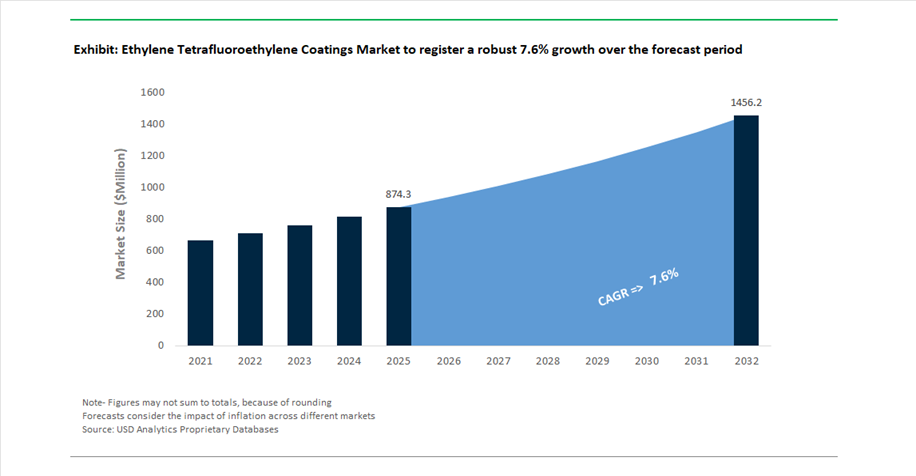
The global Ethylene Tetrafluoroethylene (ETFE) Coatings Market was valued at USD 874.3 million in 2025 and is projected to grow at a CAGR of 7.6% between 2025 and 2032, reaching USD 1,460 million by 2032. This above-average growth reflects the increasing adoption of high-performance fluoropolymer coatings across semiconductor manufacturing, electric vehicles (EVs), renewable energy infrastructure, and advanced architectural applications.
ETFE coatings are recognized for their exceptional chemical resistance, high dielectric strength, UV stability, and low surface energy, making them indispensable in environments exposed to aggressive chemicals, high temperatures, and electrical stress. A primary growth driver is the rapid expansion of semiconductor fabrication facilities, particularly at advanced nodes (2nm and 3nm), where ETFE coatings are used in chemical handling systems, piping, and process equipment to ensure zero contamination and long-term durability under highly corrosive conditions.
Another major demand catalyst is the evolution of the electric mobility ecosystem, where ETFE coatings are increasingly applied in battery packs, eAxle components, and high-voltage insulation systems. With the transition toward 800V+ architectures, OEMs require coatings that combine thermal stability, electrical insulation, and mechanical protection, positioning ETFE as a critical material in next-generation vehicle platforms.
Sustainability and regulatory compliance are also reshaping the market. Increasing scrutiny of PFAS and fluorinated surfactants is pushing manufacturers toward surfactant-free production processes and circular raw material sourcing, while maintaining the high-performance characteristics of ETFE. Additionally, the use of ETFE in lightweight architectural membranes and solar applications is gaining traction due to its durability and energy efficiency benefits.
The ETFE coatings market is undergoing rapid transformation driven by sustainability breakthroughs, high-purity material innovation, and strategic portfolio optimization. In December 2025, AGC Inc. achieved the world’s first UL2809 third-party verification for fluoropolymer resins produced using recycled fluorite, enabling the commercialization of “circular ETFE” coatings. This milestone allows manufacturers to offer sustainable ETFE solutions for green building facades and renewable energy infrastructure, addressing increasing ESG requirements.
Sustainability-led innovation is further reinforced by process advancements. In July 2025, AGC Inc. introduced surfactant-free fluoropolymer production technology, a development that is being extended to ETFE coatings. This innovation directly addresses regulatory pressures on PFAS-related substances, positioning next-generation ETFE products as compliant with evolving global environmental standards. Similarly, in December 2024, Solvay completed the phase-out of coal at key precursor production sites, enabling lower-carbon ETFE resin supply chains for aerospace, automotive, and electronics applications.
Semiconductor-driven demand is accelerating high-purity coating innovation. In July 2024, Daikin America introduced ETFE coatings for semiconductor chemical systems, designed for zero leaching and extreme resistance to aggressive acids used in advanced chip fabrication. This aligns with the industry’s transition toward ultra-clean manufacturing environments, where material purity directly impacts yield and device performance. Complementing this, The Chemours Company implemented global price increases in December 2025, signaling tightening supply-demand dynamics for high-performance fluoropolymers amid expanding semiconductor capacity.
Electric vehicle applications are emerging as a major growth frontier. In May 2025, Daikin Industries showcased ETFE-based thermal management and dielectric coatings for EV battery packs and eAxle components. These coatings enhance safety and performance in high-voltage systems. Further advancing this trend, in February 2026, Arkema presented ETFE-based battery protection coatings at Paint India, emphasizing impact resistance and corrosion protection for battery casings.
Strategic portfolio optimization is also influencing market structure. In January 2026, The Chemours Company divested its Kuan Yin site as part of its “Pathway to Thrive” strategy, reallocating capital toward advanced performance materials, including ETFE coatings for clean energy and electronics. Additionally, AGC Inc. marked the 50th anniversary of its ETFE innovation platform in August 2025, outlining a roadmap for “smart fluoropolymers”, including anti-fouling ETFE coatings utilizing nano-scale surface engineering.
ECHA PFAS Restriction Proposal Accelerating Low-Leach ETFE Coatings Development
The European Chemicals Agency’s (ECHA) proposed universal restriction on per- and polyfluoroalkyl substances (PFAS), expected to reach finalization in 2026, is fundamentally reshaping the ETFE coatings market. Although ethylene tetrafluoroethylene (ETFE) is categorized as a polymer of low concern, its upstream manufacturing processes rely on fluorinated processing aids that are increasingly scrutinized under EU REACH amendments. A critical compliance parameter emerging in 2026 is the Specific Migration Limit (SML) for residual PFAS-related substances, with new ETFE coatings required to demonstrate leachate levels below 25 ppb to qualify under “essential use” exemptions in industrial applications. This threshold is forcing manufacturers to adopt advanced purification and polymerization control technologies. Industry data indicates that approximately 85% of leading ETFE resin producers have transitioned to non-fluorinated polymerization aids (NFPA), signaling a structural shift in fluoropolymer supply chains. In parallel, ECHA’s Socio-Economic Analysis Committee (SEAC) estimates that these restrictions could reduce PFAS emissions from coatings by up to 90% over a 30-year horizon, necessitating a comprehensive redesign of ETFE spray coatings and electrostatic powder coating formulations. Certification frameworks are also tightening, with BfR and FDA compliance documentation now requiring explicit declarations of zero PFOA and PFOS content. This regulatory environment is accelerating innovation in low-emission ETFE coatings, enhancing their positioning in high-performance, compliant industrial coatings markets.
China’s GB/T 41648-2024 Standard Elevating Performance Benchmarks for Architectural ETFE Coatings
China’s implementation of GB/T 41648-2024 is establishing a new global benchmark for ETFE architectural coatings and membranes, particularly in infrastructure and façade applications. The updated regulation significantly raises performance requirements across thermal stability, UV durability, and mechanical strength, directly influencing material engineering strategies. ETFE coatings must now maintain a minimum tensile elongation of 200% at -30°C, ensuring structural resilience in extreme cold climates prevalent in Northern China. This requirement is driving advancements in polymer chain flexibility and crystallinity control. Additionally, UV resistance criteria have intensified, mandating 5,000 hours of Xenon arc weathering with a color variation threshold of ΔE less than 2.0 and gloss retention above 90%, effectively doubling prior durability standards. These specifications are pushing manufacturers toward ultra-stable fluoropolymer formulations with enhanced photochemical resistance. Optical performance is also under scrutiny, with a mandated visible light transmittance (VLT) of at least 90% for clear ETFE membranes, requiring ultra-high-purity resins devoid of catalyst residues or inclusions. Safety compliance has been strengthened through mandatory tear resistance thresholds of 40 N/mm, aligned with ASTM D1938 equivalents, to mitigate failure risks in high-wind urban installations. Collectively, these standards are elevating ETFE coatings into a premium performance segment within the architectural coatings market, favoring suppliers capable of delivering high-purity, mechanically robust, and optically optimized materials.
ETFE Anti-Stick and Anti-Corrosion Coatings for Lithium-Ion Battery Manufacturing Equipment
The rapid scale-up of electric vehicle battery giga-factories is creating a high-value application niche for ETFE-coated components, particularly in drying oven rollers used during electrode slurry processing. These environments involve continuous exposure to N-Methyl-2-pyrrolidone (NMP) solvents and elevated temperatures, where ETFE’s chemical inertness and thermal stability provide a competitive advantage over traditional fluoropolymers such as PTFE and FEP. Performance benchmarks for 2026-grade ETFE coatings demonstrate zero swelling or degradation after 1,000 hours of NMP exposure at 80°C, addressing a critical failure mode in legacy coatings under high mechanical tension. Surface engineering advancements have enabled ETFE coatings to achieve water contact angles exceeding 105°, significantly reducing slurry adhesion and lowering cleaning-related downtime by approximately 35%. This directly enhances operational efficiency in high-throughput battery manufacturing lines. Furthermore, the integration of carbon-fiber or ceramic reinforcements is improving thermal conductivity to around 0.25 W/m·K, enabling uniform heat distribution across battery foils without compromising non-stick performance. Industrial data indicates that the adoption of electrostatic ETFE powder coatings on conveyor systems has reduced slurry-drag defects by 22%, improving yield rates for high-energy-density anode and cathode materials. This positions ETFE coatings as a critical enabler of productivity and quality optimization in next-generation lithium-ion battery manufacturing ecosystems.
Ultra-High Purity ETFE Linings for Semiconductor Wet Processing Systems
The transition toward sub-5nm semiconductor nodes is intensifying the demand for ultra-high purity (UHP) materials in wet processing equipment, creating a strong growth opportunity for ETFE linings. Compared to conventional fluoropolymers such as PVDF, ETFE offers superior resistance to aggressive chemistries and significantly lower metallic ion leaching, which is critical for maintaining yield integrity in advanced lithography processes. In 2026, UHP-grade ETFE linings are certified to limit total trace metal contamination to below 10 parts per trillion across 25 key elements, including sodium, iron, and copper, even under exposure to 49% hydrofluoric acid. This level of purity is essential for preventing defect formation in high-density integrated circuits. Advances in rotational lining technologies are enabling internal surface roughness values below Ra 0.5 micrometers, minimizing microbubble formation and particle entrapment that can disrupt wafer processing. ETFE also demonstrates compatibility with over 98% of semiconductor wet chemicals, including highly corrosive solutions such as hot piranha etchants and concentrated nitric acid, while maintaining structural integrity at continuous operating temperatures up to 150°C. Lifecycle assessments from semiconductor fabrication facilities indicate that ETFE-lined tanks deliver 1.5 times longer service life compared to PFA and FEP alternatives under repeated thermal cycling conditions. This durability advantage, combined with ultra-low contamination performance, is positioning ETFE as a preferred material in next-generation semiconductor manufacturing infrastructure.
ETFE Powder Coatings Dominate Market with 68% Share Driven by High-Build Chemical-Resistant Linings
Form Analysis: Powder-Based ETFE Coatings Lead with Pinhole-Free Protection and Industrial Durability
ETFE powder coatings account for a dominant 68.0% share of the ETFE coatings market in 2025, driven by their ability to deliver thick, seamless, and pinhole-free fluoropolymer linings for the most demanding industrial environments. Applied באמצעות electrostatic spray deposition (ESD) or rotational lining (rotolining) and cured at 290–345°C, these coatings form a fully dense, non-porous barrier with exceptional resistance to acids, alkalis, solvents, and oxidizing agents across a full pH range (1–14). Compared to liquid ETFE coatings, powder systems enable high-build thicknesses (500–1,500 microns) without defects, making them indispensable for chemical processing equipment, semiconductor manufacturing, and pharmaceutical production systems. Their superior abrasion resistance, thermal stability (up to 150°C continuous use), and non-leaching properties position ETFE powder coatings as the gold standard for corrosion-resistant and ultra-high purity coating applications.
Interior Lining Applications Lead ETFE Coatings Market with 62% Share Driven by Chemical Containment and Process Purity Requirements
Interior lining applications dominate the ETFE coatings market with a 62.0% share in 2025, reflecting the critical role of ETFE in protecting process equipment and ensuring contamination-free operations. These coatings provide a chemically inert, impermeable barrier that isolates aggressive fluids from metal substrates, significantly extending the lifespan of reactors, storage tanks, pipelines, valves, and fittings. In high-value industries such as semiconductors and pharmaceuticals, ETFE linings prevent metal ion leaching, ensuring compliance with ultra-high purity (UHP) and GMP standards. A key enabling technology is rotolining, which allows uniform coating of complex internal geometries, producing seamless, joint-free linings that eliminate leak paths and corrosion initiation points. This combination of asset protection, process integrity, and advanced application techniques firmly establishes interior lining as the leading segment in the global ETFE coatings market.
Ethylene Tetrafluoroethylene Coatings Market Competitive Landscape Driven by Fluoropolymer Innovation and Semiconductor Demand
The global ethylene tetrafluoroethylene coatings market is highly consolidated, led by fluoropolymer giants focusing on semiconductor-grade ETFE coatings, hydrogen energy applications, and high-performance materials. Competitive intensity is defined by vertical integration, advanced R&D, sustainability strategies, and expansion across Asia-Pacific and emerging electronics manufacturing hubs.
The Chemours Company strengthens ETFE coatings leadership through Tefzel™ innovation and fluorospecialty investments
The Chemours Company retains its position as a global volume leader in the ethylene tetrafluoroethylene coatings market, driven by its Tefzel™ ETFE coatings portfolio. The company is projecting 3% to 5% net sales growth in 2026, with strategic prioritization of its Advanced Performance Materials segment following resolution of major litigation in late 2025. Chemours executed a $300 million divestment of its Kuan Yin TiO2 facility to reallocate capital toward high-growth fluorospecialties used in 5G infrastructure and hydrogen fuel cells. Its dual-use ETFE coatings are increasingly deployed in sub-2nm semiconductor fabrication equipment, combining electrical insulation with superior chemical resistance. Under its “Pathway to Thrive” strategy, the company is advancing PFOA-free fluoropolymers while targeting net leverage below 3x EBITDA. Increasing R&D investments further strengthen its positioning in next-generation high-performance ETFE coatings.
Daikin Industries commands leading share of the ETFE coatings market, supported by strong growth in the Asia-Pacific region, the fastest-expanding fluoropolymer coatings hub. In March 2026, the company established Daikin Chemical India Private Limited in Gurugram to provide localized sales and technical support for semiconductor and battery industries. Its Neoflon™ ETFE EP-Series introduces advanced powder coating solutions optimized for rotational lining of complex chemical storage tanks, offering primer-free adhesion to stainless steel. Daikin is leveraging the “Make in India” initiative to expand its footprint in air conditioning and electronics manufacturing sectors. The company’s vertical integration across refrigerants and fluoropolymers enables circular coating systems, improving resource efficiency. This integrated value chain enhances competitiveness in high-performance ETFE coatings for industrial and electronics applications.
AGC Inc. advances Fluon® ETFE coatings with smart-city and semiconductor-grade innovations
AGC Inc. continues to set benchmarks in the ethylene tetrafluoroethylene coatings industry through its Fluon® ETFE product line, widely adopted for smart-city architectural applications. Its Z-8820X and TL-081 grades are key specifications for 2026 global infrastructure projects emphasizing lightweight and weather-resistant materials. Under its AGC plus-2026 roadmap, the company is focusing on high-value-added fluoropolymer products through cross-divisional synergies. The commercialization of ZL-520N, a carbon fiber reinforced ETFE powder, enables crack-resistant thick-film coatings up to 1000 µm for chemical processing equipment. AGC also delivers integrated solutions for wire and cable applications, leveraging ETFE’s 150°C continuous service rating and high flex durability in robotics. The company is targeting strong growth in semiconductor manufacturing by supplying ultra-high purity ETFE coatings suited for Angstrom-scale chip fabrication environments.
Arkema accelerates specialty materials transition with ETFE coatings in battery and EV applications
Arkema is strengthening its position in the ETFE coatings market through its transition toward a specialty materials-focused portfolio. The company reported €1,251 million EBITDA and is targeting moderate growth in 2026 despite softness in Western architectural markets. It achieved 16% year-on-year sales growth in attractive segments such as batteries and fluorospecialties, where ETFE coatings are being explored for battery insulation and fire-resistant barriers. Arkema is aligning its R&D investments to reduce fluoropolymer production carbon intensity by 20% compared to 2021 levels. Its revised business segmentation integrates high-performance polymers into mobility and energy verticals, enhancing its exposure to the EV supply chain. This strategic repositioning supports long-term growth in advanced ETFE coatings for energy storage and electrification applications.
Solvay S.A. leverages specialty polymers and hydrogen applications to sustain ETFE coatings profitability
Solvay S.A. maintains strong profitability in the ETFE coatings market, achieving a 20.7% EBITDA margin in 2025/2026 driven by its Specialty Polymers division. The company is targeting €770 million to €850 million EBITDA in 2026, supported by €300 million in structural cost savings under its “For Generations” program. Solvay’s Halar® ECTFE and ETFE coatings are gaining traction in hydrogen electrolyzer applications, providing resistance to high-pressure hydrogen environments and preventing material degradation. Its early achievement of 100% living wage compliance reinforces its ESG leadership within the fluorochemical sector. The company continues to scale advanced fluoropolymer coatings for clean energy infrastructure. This positions Solvay as a key player in sustainable ETFE coatings for hydrogen and energy transition markets.
3M Company integrates AI-driven simulation and climate tech focus into advanced ETFE coatings portfolio
3M Company operates as a high-value niche player in the ethylene tetrafluoroethylene coatings market, focusing on ultra-thin coatings for aerospace and defense applications. In 2026, the company introduced an AI-powered material simulation platform that enables virtual testing of ETFE coatings under UV and chemical stress conditions. Following the spinoff of its healthcare business, 3M is intensifying its focus on Industrial and Safety segments, particularly climate tech coatings for solar panels and wind turbine blades. Its expertise in EMI shielding and thermal management enables integration of ETFE coatings into multi-layer films for 5G infrastructure. The company’s innovation-driven approach supports demand for lightweight, high-performance coatings in advanced electronics and renewable energy systems.
China ETFE Coatings Market: Industrial Self-Sufficiency and Solar Expansion Driving Global Dominance
China is the global leader in Ethylene Tetrafluoroethylene (ETFE) coatings, driven by strong policy backing under the 15th Five-Year Plan (2026–2030), which classifies ETFE as a strategic high-performance material. This has triggered a sustained push toward domestic fluoropolymer capacity expansion.
Key demand drivers include renewable energy and semiconductors. Large-scale investments in ETFE powder coatings for photovoltaic (PV) encapsulation are supporting solar megaprojects in desert regions, while new semiconductor “mega-fabs” are increasing demand for high-purity ETFE liners to handle aggressive chemicals. Additionally, infrastructure projects such as smart logistics hubs are adopting ETFE-coated roofing integrated with BIPV systems, and R&D is advancing ETFE coatings for battery busbars to improve insulation and thermal resistance. Regulatory pressure is also accelerating the shift to zero-emission powder coating systems, reinforcing China’s scale advantage.
United States ETFE Coatings Market: Infrastructure Modernization and High-Performance Applications Driving Growth
The United States market is focused on high-durability and specialty ETFE applications, supported by federal funding programs like the CHIPS Act and Inflation Reduction Act (IRA). Demand is rising for cleanroom-grade ETFE coatings in semiconductor fabrication facilities, particularly for chemical handling systems.
Innovation is expanding into multiple sectors. New low-friction ETFE formulations are being used in medical devices such as catheters and surgical robotics, while aerospace programs like NGAD are specifying ETFE for high-temperature wire insulation (>200°C). Infrastructure investments are also driving adoption of ETFE liners in municipal pipelines to prevent corrosion and contamination. Additionally, tax incentives tied to Solar Reflectance Index (SRI) are promoting use of reflective ETFE coatings in commercial roofing, improving energy efficiency.
Germany ETFE Coatings Market: Energy Transition and Precision Engineering Driving Sustainability Leadership
Germany is at the forefront of sustainable ETFE coatings, driven by the Energiewende and strict EU regulatory frameworks. The expansion of the North Sea Hydrogen Cluster is increasing demand for ETFE-coated electrolyzer components, ensuring durability in harsh chemical environments.
Technological innovation is a key differentiator. German manufacturers are implementing AI-driven real-time thickness monitoring, achieving ±1% coating uniformity in complex applications. Breakthroughs in low-temperature cure (LTC) ETFE powders are enabling coating of heat-sensitive materials like composites and MDF. Additionally, circular economy initiatives are advancing recycled-monomer ETFE resins, targeting ~20% recycled content, while ETFE-coated smart facades are supporting climate-neutral building targets.
Japan ETFE Coatings Market: High-Purity Materials and Electronics Miniaturization Driving Precision Innovation
Japan is a global leader in high-purity ETFE coatings, particularly for electronics and semiconductor applications. Japanese firms supply over 65% of ultra-high-purity ETFE granules, making them critical to global supply chains.
Innovation is centered on miniaturization and advanced applications. Developments include sub-500 nm ETFE release films for MLCC production and conductive ETFE coatings for surgical robotics, enabling both insulation and low-friction performance. Additionally, transparent ETFE window films are being deployed in buildings to reduce cooling loads by 15–20%, while shock-resistant ETFE materials are used to protect sensitive equipment in seismic environments. Government funding (~¥4 trillion) is further accelerating R&D in fluoropolymer durability and performance.
India ETFE Coatings Market: Infrastructure Expansion and Solar Energy Driving Rapid Growth
India is one of the fastest-growing markets for ETFE coatings, transitioning from import dependence to localized production under Make in India 2.0. Strong foreign investment is supporting development of a domestic ETFE market expected to reach ~$900 million by 2035.
Infrastructure development is the primary driver. Under the Gati Shakti master plan, ETFE-coated structural steel is being deployed in railways and airports, offering a 30-year maintenance-free lifecycle. Renewable energy expansion is also boosting demand, with high-transmission ETFE films widely used in solar installations across Rajasthan and Gujarat. Additionally, metro projects are adopting ETFE-based anti-carbonation coatings to protect reinforced concrete, while growth in pharmaceutical manufacturing is increasing demand for ETFE-lined reactors and valves. Emerging applications in nuclear energy—such as radiation-resistant insulation—are further expanding the market.
South Korea ETFE Coatings Market: EV Batteries and 6G Innovation Driving Advanced Applications
South Korea is leveraging ETFE technology to strengthen its leadership in EV batteries and next-generation communications. Government investment of $1.5 billion in 6G R&D (2026) is driving development of terahertz-transparent ETFE films for advanced communication modules.
The EV sector is a major growth driver. Adoption of high-dielectric ETFE coatings in cell-to-pack (CTP) battery architectures is improving both energy density and safety. Innovation is also expanding into maritime applications, with low-friction ETFE coatings for LNG carriers reducing fuel consumption. Additionally, ETFE is being integrated into smart-skin wearable electronics for military applications, while regulatory frameworks—such as fluoropolymer traceability systems—are ensuring lifecycle sustainability. These developments position South Korea at the forefront of high-tech ETFE applications.
By Form (Powder Coatings, Liquid Coatings), By Coating Technology (Electrostatic Powder Spraying, Fluidized Bed Dipping, Dispersion, Rotational Lining), By Substrate (Metals, Glass, Ceramics), By End-Use Industry (Chemical Processing, Semiconductor and Electronics, Aerospace and Defense, Pharmaceutical and Healthcare, Food and Beverage, Energy, Building and Architecture), By Functional Characteristic (Chemical and Corrosion Resistance, Thermal Insulation, Electrical Insulation, Non-stick, High-Purity), By Service Type (OEM, Aftermarket), By Application Category (Interior Lining, Exterior Surface Protection, Encapsulation and Insulation)
Study Period
2019- 2025 and 2026-2032
Units
Revenue (USD)
Qualitative Analysis
Porter’s Five Forces, SWOT Profile, Market Share, Scenario Forecasts, Market Ecosystem, Company Ranking, Market Dynamics, Industry Benchmarking
US, Canada, Mexico, Germany, France, Spain, Italy, UK, Russia, China, India, Japan, South Korea, Australia, South East Asia, Brazil, Argentina, Middle East, Africa
2. Ethylene Tetrafluoroethylene (ETFE) Coatings Market Landscape & Outlook (2025–2032)
2.1. Introduction to ETFE Coatings Market
2.2. Market Valuation and Growth Projections (2025–2032)
2.3. Growth Driven by Semiconductor, EV, and Renewable Energy Applications
2.4. Increasing Focus on PFAS Compliance and Circular Fluoropolymer Innovation
2.5. Expansion in High-Purity and Advanced Architectural Applications
3. Innovations Reshaping the Ethylene Tetrafluoroethylene (ETFE) Coatings Market
3.1. Trend: Circular Fluoropolymer Development and Surfactant-Free Production
3.2. Trend: Semiconductor-Grade Ultra-High Purity ETFE Coatings Innovation
3.3. Opportunity: ETFE Coatings in EV Battery Systems and Thermal Management
3.4. Opportunity: Advanced ETFE Linings for Chemical Processing and Semiconductor Equipment
4. Competitive Landscape and Strategic Initiatives
4.1. Mergers and Acquisitions
4.2. R&D and Material Innovation
4.3. Sustainability and ESG Strategies
4.4. Market Expansion and Regional Focus
5. Market Share and Segmentation Insights: Ethylene Tetrafluoroethylene (ETFE) Coatings Market
5.1. By Form
5.1.1. Powder Coatings
5.1.2. Liquid Coatings
5.2. By Coating Technology
5.2.1. Electrostatic Powder Spraying
5.2.2. Fluidized Bed Dipping
5.2.3. Dispersion
5.2.4. Rotational Lining
5.3. By Substrate
5.3.1. Metals
5.3.2. Glass
5.3.3. Ceramics
5.4. By End-Use Industry
5.4.1. Chemical Processing
5.4.2. Semiconductor and Electronics
5.4.3. Aerospace and Defense
5.4.4. Pharmaceutical and Healthcare
5.4.5. Food and Beverage
5.4.6. Energy
5.4.7. Building and Architecture
5.5. By Functional Characteristic
5.5.1. Chemical and Corrosion Resistance
5.5.2. Thermal Insulation
5.5.3. Electrical Insulation
5.5.4. Non-stick
5.5.5. High-Purity
5.6. By Service Type
5.6.1. OEM
5.6.2. Aftermarket
5.7. By Application Category
5.7.1. Interior Lining
5.7.2. Exterior Surface Protection
5.7.3. Encapsulation and Insulation
6. Country Analysis and Outlook of Ethylene Tetrafluoroethylene (ETFE) Coatings Market
6.1. United States
6.2. Canada
6.3. Mexico
6.4. Germany
6.5. France
6.6. Spain
6.7. Italy
6.8. UK
6.9. Russia
6.10. China
6.11. India
6.12. Japan
6.13. South Korea
6.14. Australia
6.15. South East Asia
6.16. Brazil
6.17. Argentina
6.18. Middle East
6.19. Africa
7. Ethylene Tetrafluoroethylene (ETFE) Coatings Market Size Outlook by Region (2025–2032)
7.1. North America ETFE Coatings Market Size Outlook to 2032
7.1.1. By Form
7.1.2. By Coating Technology
7.1.3. By Substrate
7.1.4. By End-Use Industry
7.1.5. By Functional Characteristic
7.1.6. By Service Type
7.1.7. By Application Category
7.2. Europe ETFE Coatings Market Size Outlook to 2032
7.2.1. By Form
7.2.2. By Coating Technology
7.2.3. By Substrate
7.2.4. By End-Use Industry
7.2.5. By Functional Characteristic
7.2.6. By Service Type
7.2.7. By Application Category
7.3. Asia Pacific ETFE Coatings Market Size Outlook to 2032
7.3.1. By Form
7.3.2. By Coating Technology
7.3.3. By Substrate
7.3.4. By End-Use Industry
7.3.5. By Functional Characteristic
7.3.6. By Service Type
7.3.7. By Application Category
7.4. South America ETFE Coatings Market Size Outlook to 2032
7.4.1. By Form
7.4.2. By Coating Technology
7.4.3. By Substrate
7.4.4. By End-Use Industry
7.4.5. By Functional Characteristic
7.4.6. By Service Type
7.4.7. By Application Category
7.5. Middle East and Africa ETFE Coatings Market Size Outlook to 2032
7.5.1. By Form
7.5.2. By Coating Technology
7.5.3. By Substrate
7.5.4. By End-Use Industry
7.5.5. By Functional Characteristic
7.5.6. By Service Type
7.5.7. By Application Category
8. Company Profiles: Leading Players in the Ethylene Tetrafluoroethylene (ETFE) Coatings Market
8.1. The Chemours Company
8.2. AGC Inc.
8.3. Daikin Industries, Ltd.
8.4. 3M Company
8.5. Solvay S.A.
8.6. Arkema S.A.
8.7. BASF SE
8.8. Oerlikon Group
8.9. Curtiss-Wright Corporation
8.10. Precision Coating Company, LLC
8.11. Orion Industries, Ltd.
8.12. Toefco Engineered Coating Systems, Inc.
8.13. Hubei Everflon Polymer Co., Ltd.
8.14. Gujarat Fluorochemicals Limited
8.15. Zeus Industrial Products, Inc.
9. Methodology
9.1. Research Scope
9.2. Market Research Approach
9.3. Market Sizing and Forecasting Model
9.4. Research Coverage
9.5. Data Horizon
9.6. Deliverables
10. Appendix
10.1. Acronyms and Abbreviations
10.2. List of Tables
10.3. List of Figures
The ETFE coatings market was valued at USD 874.3 million in 2025 and is projected to reach USD 1,460 million by 2032, growing at a CAGR of 7.6%. Growth is driven by increasing demand across semiconductor manufacturing, EV systems, and renewable energy infrastructure. The market is benefiting from rising adoption of high-performance fluoropolymer coatings in critical applications.
Advanced semiconductor nodes such as 2nm and 3nm require ultra-high purity materials, making ETFE coatings essential for chemical handling systems and process equipment. These coatings offer near-zero contamination and exceptional resistance to aggressive chemicals. Increasing global investments in semiconductor fabs are significantly boosting demand for high-purity ETFE linings.
The shift toward high-voltage EV architectures (800V+) is creating strong demand for ETFE coatings in battery packs, eAxles, and insulation systems. ETFE provides superior dielectric strength, thermal stability, and corrosion protection. These properties are critical for improving safety, durability, and performance in next-generation electric vehicles.
Regulatory pressure on PFAS and fluorinated surfactants is driving innovation in surfactant-free and low-leach ETFE coatings. Standards such as ECHA proposals and China’s GB/T 41648-2024 are pushing manufacturers toward higher purity and environmental compliance. Circular fluoropolymer production and recycled feedstocks are also gaining traction across global markets.
Key players include The Chemours Company, AGC Inc., Daikin Industries, Ltd., Solvay S.A., and Arkema S.A.. These companies are focusing on semiconductor-grade materials, EV applications, and sustainable fluoropolymer innovations to strengthen their global positioning.