Filter Coatings Market Growth Driven by Clean Air Regulations, Water Treatment Demand, and High-Purity Filtration Technologies
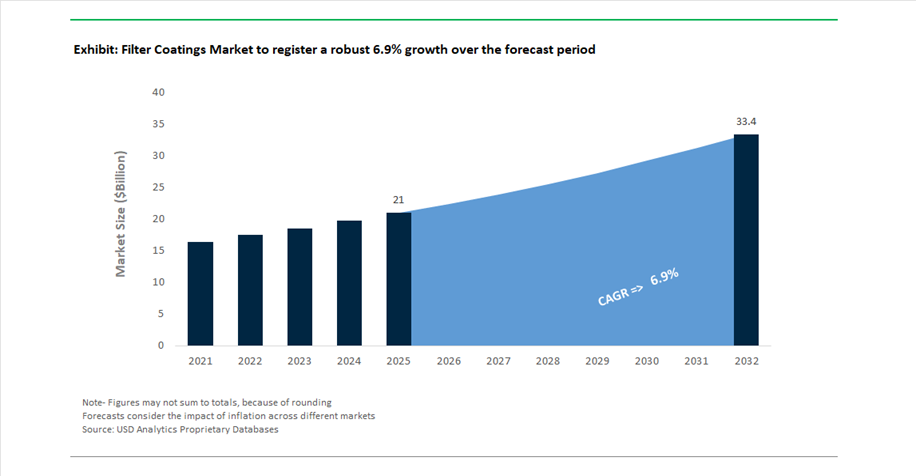
The global Filter Coatings Market was valued at USD 21 billion in 2025 and is projected to expand at a CAGR of 6.9% between 2025 and 2032, reaching USD 33.5 billion by 2032. This strong growth trajectory is driven by increasing demand for advanced filtration systems across automotive, industrial air purification, water treatment, life sciences, and semiconductor manufacturing sectors.
Filter coatings play a critical role in enhancing filtration efficiency, durability, chemical resistance, and functional performance, enabling filters to capture finer particulates, neutralize harmful gases, and resist fouling. A major growth driver is the tightening of global air quality standards and emission regulations, particularly in urban environments and industrial zones. This is accelerating the adoption of high-performance coated filtration media in HVAC systems, automotive cabin filters, and industrial air purification systems.
Water treatment and reuse are also key demand catalysts. The rising need for safe drinking water, wastewater recycling, and industrial process water purification is driving the adoption of antifouling, hydrophilic, and chemical-resistant filter coatings. Additionally, the rapid expansion of semiconductor fabrication facilities and biopharmaceutical manufacturing is creating demand for ultra-high-purity filtration coatings, where contamination control is critical for product quality and yield.
Sustainability is increasingly shaping innovation within the market. Manufacturers are transitioning toward PFAS-free, bio-based, and low-carbon coating technologies, addressing regulatory pressures and environmental concerns. At the same time, advancements in multi-layer filtration structures and functional coatings are enabling improved performance without reliance on hazardous substances.
The filter coatings market is undergoing a significant transformation driven by sustainability innovation, high-purity filtration requirements, and strategic investments in manufacturing capabilities. In August 2024, Hollingsworth & Vose launched its PlusZero PFAS-free filtration solutions, providing an environmentally compliant alternative to traditional fluorinated coatings used for oil and water repellency. This development aligns with increasing global regulatory scrutiny on PFAS substances and supports the transition toward safer filtration technologies.
Sustainability-driven material innovation is further reinforced by bio-based coating advancements. In March 2025, MANN+HUMMEL introduced lignin-based filter impregnation technology, partially replacing fossil-based phenolic resins. This innovation reduces crude oil usage by 27% and lowers the carbon footprint of filter production, particularly in automotive air and oil filtration applications. Complementing this, Ahlstrom reported that 66% of its portfolio now consists of “Safe and Sustainable by Design” solutions, with significant investments in PFAS-free and dual-layer filtration technologies.
High-purity applications are driving advanced coating development. In January 2025, Entegris expanded its production of ultra-high-purity filter coatings for semiconductor fabrication, particularly for 2nm and 3nm chip nodes, where contamination control is critical. Similarly, DuPont introduced antifouling ultrafiltration membranes in July 2025, utilizing superhydrophilic coatings to extend membrane lifespan and reduce maintenance in industrial water treatment systems.
Strategic capacity expansion and restructuring are also reshaping the competitive landscape. In March 2026, Ahlstrom completed the integration of its Stevens Point facility in the U.S., enhancing its coating and finishing capabilities for high-end filtration media. Meanwhile, Donaldson Company expanded its life sciences coating capabilities in August 2025, focusing on high-purity medical and biopharma filtration applications through localized manufacturing strategies.
Innovation in automotive and industrial filtration continues to accelerate. In March 2026, Freudenberg Filtration Technologies launched the micronAir neo cabin air filter series, featuring advanced coatings capable of neutralizing allergens and harmful pollutants, addressing rising demand for in-cabin air quality. Additionally, Freudenberg’s September 2025 partnership with W. L. Gore & Associates introduced specialized coated membranes for turbomachinery filters, designed to prevent moisture and salt ingress in extreme conditions.
Regulatory compliance is also influencing product adoption. In May 2025, Hollingsworth & Vose achieved compliance with Germany’s KTW drinking water standards, validating the safety of its coated filtration materials for potable water applications across the European market.
Shift Toward ePTFE-Based Hydrophobic and Lipophobic Filter Coatings for High-Efficiency Industrial Filtration
The filter coatings industry is undergoing a significant transformation with the accelerated adoption of expanded polytetrafluoroethylene surface coatings, driven by tightening environmental regulations and the phase-down of legacy PFAS chemistries. ePTFE coatings are emerging as a preferred solution in industrial filtration applications such as baghouse filters and cartridge systems due to their superior hydrophobic and lipophobic properties. These coatings enable the creation of non-stick filter surfaces that improve particulate release during cleaning cycles, thereby enhancing operational efficiency. High-purity ePTFE membranes developed in 2025 are capable of maintaining structural integrity at temperatures exceeding 260°C, delivering approximately 40% longer service life compared to conventional polyester-based filter media in chemically aggressive environments. In emissions control applications, PTFE-coated filters are achieving near-zero emissions standards by capturing up to 99.99% of PM2.5 particulates, aligning with increasingly stringent air quality regulations. Operational benefits are equally significant, with industry benchmarks from 2026 indicating a 15% to 20% reduction in compressed air consumption for pulse-jet cleaning systems due to reduced pressure drop across coated media. Additionally, hydrophobic performance metrics have reached advanced levels, with water contact angles exceeding 150° in hollow fiber membrane applications, ensuring complete repellency against oil-laden wastewater streams. These performance characteristics are positioning ePTFE coatings as a critical technology in next-generation industrial filtration systems focused on efficiency, durability, and regulatory compliance.
Graphene oxide-based coatings are transitioning from research-driven innovation to commercial deployment in ultrafiltration membranes, addressing persistent challenges related to membrane fouling and efficiency loss. The integration of graphene oxide into membrane surfaces enhances hydrophilicity and creates selective pathways for water molecules, significantly improving filtration performance. Recent research published in 2025 indicates that graphene-enhanced membranes achieve anti-fouling performance levels of approximately 91.32%, representing a 1.36-fold improvement over conventional membranes. These coatings also demonstrate high water permeation selectivity, maintaining salt rejection rates above 99% in saline separation processes, which is critical for industrial water treatment and desalination applications. Mechanical durability is another key advantage, with cross-linked reduced graphene oxide membranes exhibiting abrasion resistance of up to 95%, ensuring reliability under high-pressure backwashing conditions. Furthermore, advanced structural optimization of graphene coatings enables nearly 100% flux recovery through simple water flushing, reducing reliance on chemical cleaning agents and lowering operational costs. These innovations are positioning graphene-enhanced filter coatings as a high-performance solution in water treatment, wastewater recycling, and industrial ultrafiltration systems where efficiency, durability, and sustainability are paramount.
California Title 24 Driving Demand for Antimicrobial HVAC Filter Coatings in Commercial Buildings
The implementation of California’s updated Title 24 Building Standards Code in 2026 is creating a substantial growth opportunity for antimicrobial filter coatings in HVAC systems, particularly within commercial infrastructure. The revised standards mandate enhanced ventilation and air filtration performance in high-occupancy environments such as offices, educational institutions, and public facilities. This has accelerated the adoption of MERV-13 and higher efficiency filters integrated with antimicrobial surface coatings designed to inhibit bacterial and fungal growth. The shift is closely aligned with increasing awareness of indoor air quality and the prevention of sick building syndrome, driving demand for high-performance air filtration solutions. The regulation also mandates the replacement of end-of-life rooftop HVAC units with high-efficiency systems, triggering a wave of retrofits across California’s commercial building stock. This retrofit cycle is expected to sustain demand for advanced filter coatings through 2031. Market data indicates that the adoption of antimicrobial-coated filter media can reduce bio-loading on HVAC components by up to 30%, maintaining airflow efficiency and reducing maintenance requirements. Additionally, permit applications for new commercial construction in 2026 show a 25% increase in demand for filters with integrated antimicrobial functionality, highlighting a structural shift toward health-focused building design. These developments are positioning antimicrobial filter coatings as a key component in next-generation HVAC systems designed for energy efficiency and occupant well-being.
India NMCG Phase III Driving Adoption of Anti-Fouling Coated Ultrafiltration Membranes
India’s National Mission on Clean Ganga Phase III is significantly expanding the demand for advanced filter coatings in water treatment infrastructure, particularly for anti-fouling ultrafiltration membranes used in membrane bioreactor systems. The program prioritizes the installation of tertiary treatment systems capable of processing over 5,000 million liters per day of sewage across the Ganga basin, necessitating high-performance membranes with enhanced durability and efficiency. Procurement specifications increasingly mandate the use of PTFE or graphene-coated hollow fiber membranes to address the challenges posed by high organic loading in urban wastewater streams. These anti-fouling coatings play a critical role in maintaining membrane permeability and reducing cleaning frequency, directly improving operational efficiency of sewage treatment plants. Energy efficiency is a key focus area, with coated membranes enabling a reduction of approximately 12% in specific energy consumption during filtration processes, which is crucial for municipalities managing high operational expenditures. The scale of investment is reflected in record procurement orders secured by global manufacturers in 2025, signaling a rapid expansion of the industrial filter coatings supply chain in South Asia. These developments are positioning anti-fouling filter coatings as a foundational technology in large-scale water treatment and circular economy initiatives across emerging markets.
Filter Coatings Market Share 2025: PVD Technology and Air Filtration Applications Drive Growth
The physical vapor deposition (PVD) segment dominates the filter coatings market with a 48% market share in 2025, driven by its unmatched precision and efficiency in thin-film deposition. PVD technology is extensively used in optical filters, anti-reflective coatings, bandpass filters, and semiconductor applications, where uniform, pinhole-free coatings at nanometer scale are critical for performance. Its ability to deliver high-purity, defect-free layers makes it indispensable in advanced electronics and photonics industries. Additionally, PVD offers a strong eco-friendly advantage, as it eliminates the need for liquid chemicals and produces no hazardous effluent or VOC emissions, aligning with stringent environmental regulations across North America and Europe. This sustainability edge, combined with superior coating control, is accelerating adoption in high-tech manufacturing sectors, positioning PVD as the preferred technology in the global filter coatings market.
Filter Category Insights: Air and Gas Filters Dominate Amid Rising Air Quality Regulations
The air and gas filters segment holds the largest share at 44% in the filter coatings market in 2025, fueled by increasing global focus on air pollution control and indoor air quality standards. Stringent regulations such as the EPA guidelines and EU Industrial Emissions Directive are driving the demand for coated air filtration systems in HVAC units, cleanrooms, hospitals, and industrial exhaust applications. Coating technologies enhance filter efficiency by enabling hydrophobic, antimicrobial, and anti-fouling properties, which significantly extend filter lifespan and improve particle capture performance. The integration of coatings with HEPA and ULPA filters is particularly impactful, allowing efficient removal of sub-micron contaminants in pharmaceutical manufacturing and semiconductor fabrication facilities. As industries prioritize health, safety, and environmental compliance, coated air and gas filters will continue to lead market growth globally.
Filter Coatings Market Competitive Landscape Driven by High-Purity Filtration, Smart Coatings, and Energy-Efficient Technologies
The filter coatings market is evolving with strong competition centered on high-performance surface treatments, smart filtration systems, and sustainable coatings. Key players are investing in semiconductor-grade coatings, antimicrobial technologies, and AI-enabled monitoring systems to address demand across HVAC, biopharma, water treatment, and industrial filtration sectors.
PPG Industries leads advanced filter coatings with semiconductor-grade precision and digital integration
PPG Industries is strengthening its leadership in the filter coatings market through advanced powder coatings such as ENVIROCRON® Extreme Protection Edge Plus, now adapted for HVAC and industrial filter housings to prevent edge corrosion in high-moisture environments. The company dominates the optical filter coatings segment, supplying anti-reflective and bandpass coatings for aerospace and defense applications. Following its $2 billion divestiture of its architectural retail business, PPG has redirected R&D investments toward high-purity coatings for semiconductor fabrication facilities. Its PPG LINQ™ platform enables real-time monitoring of coating thickness and uniformity, reducing material waste by 15%. This integration enhances quality control for filtration OEMs. PPG’s focus on precision coatings positions it strongly in high-tech filtration markets.
3M advances filter coatings innovation with nanostructured surfaces and AI-driven simulation tools
3M Company holds a leading share in the medical and laboratory filter coatings segment, driven by its expertise in hydrophilic and fluorinated coatings for microporous membranes. The company introduced an AI-powered simulation tool that enables customers to model chemical interactions with filter coatings, improving product design efficiency. Its nanostructured electrostatic coatings significantly enhance capture efficiency for PM2.5 particles and viral pathogens without increasing airflow resistance. Following its strategic pivot toward climate technologies, 3M is focusing on low-pressure-drop coatings that improve HVAC energy efficiency, supporting market growth. The company continues to innovate in precision filtration and environmental applications. This positions 3M as a key player in high-performance and energy-efficient filter coatings.
AkzoNobel expands filter coatings capabilities through laser curing and sustainable resin technologies
AkzoNobel is enhancing its position in the filter coatings market through its Resicoat and Interpon portfolios, supported by the ongoing merger with Axalta that will create a dominant coatings entity. Its collaboration with IPG Photonics has enabled laser-curing technologies for filter coatings, allowing application on temperature-sensitive substrates that cannot withstand conventional curing processes. The company reported a strong 14.2% EBITDA margin, driven by its Eco+ portfolio of sustainable, bio-attributed resins for food-grade filtration systems. Its Resicoat epoxy coatings are increasingly used as dielectric layers in liquid-cooled server filters for AI data centers. These innovations expand its presence in high-tech and industrial filtration applications. AkzoNobel continues to lead in sustainable and advanced powder coating technologies.
Donaldson Company drives filtration coatings growth with IoT-enabled solutions and hydrogen-ready membranes
Donaldson Company is expanding rapidly in the filter coatings market through its Life Sciences segment, highlighted by the launch of Ultrapac™ Smart coatings with integrated IoT sensors that monitor coating performance in compressed air filtration systems. The company’s tetratex® ePTFE membrane coatings are being optimized for hydrogen fuel cell applications, ensuring protection of sensitive catalysts from airborne contaminants. Donaldson’s strategy focuses on delivering total filtration solutions where coatings are integrated with filter substrates. Its vertical integration in industrial air filtration enables superior dust-cake release properties, extending filter life by 30–50%. The company is also scaling its Asia-Pacific manufacturing footprint to capture growth in India and China. These capabilities position Donaldson as a leader in smart and next-generation filtration technologies.
Parker Hannifin strengthens high-purity filtration coatings with antifouling and sensor-enabled technologies
Parker Hannifin holds 17% of the global filtration coatings market, with strong emphasis on high-purity process filtration for biopharmaceutical applications. Its SciLog® and Domnick Hunter product lines utilize advanced antifouling coatings to prevent protein binding during biologics and vaccine filtration. The company is scaling digital monitoring platforms that use coated sensor strips to detect contamination or chemical breakthrough in industrial wastewater systems. Parker’s expertise in coalescer technology enables efficient oil-water separation in marine and power generation sectors, which are experiencing steady growth. Its coatings enhance filtration efficiency and reliability in critical applications. This positions Parker Hannifin as a key supplier in precision and industrial filtration coatings.
Sherwin-Williams expands filter coatings portfolio with sustainable Powdura® systems and antimicrobial solutions
The Sherwin-Williams Company is strengthening its filter coatings market presence through its Performance Coatings Group, supported by the acquisition of BASF’s Brazilian coatings business. Its Powdura® ECO series has been adapted for filter frames and housings, incorporating 25% recycled plastic to meet circular economy mandates. The company is benefiting from rising demand for antimicrobial epoxy coatings in food and beverage filtration systems. With projected 2026 earnings of $11.50 to $11.90 per share, Sherwin-Williams continues to demonstrate financial resilience. Its extensive distribution network enables localized supply of customized coatings for municipal water filtration infrastructure. This integrated approach reinforces its position in sustainable and high-performance filter coating solutions.
China Filter Coatings Market: Regulatory Enforcement and Graphene Innovation Driving Global Leadership
China dominates the global filter coatings market, driven by strict environmental regulations under the Dual-Carbon strategy and Air Pollution Prevention Action Plan (2026). The government now mandates low-resistance filter coatings across heavy industries to reduce energy consumption in air-handling systems.
Innovation is a major differentiator. The commercialization of graphene-doped filter coatings has improved PM2.5 capture efficiency by ~18% without increasing pressure drop. Semiconductor expansion is also driving demand for PTFE-based ultra-fine filtration coatings for sub-10 nm particle control. Additionally, smart city initiatives are deploying photocatalytic TiO₂ coatings in urban filtration towers to break down pollutants, while advancements in electrostatic hybrid coatings are enabling capture of viral particles in public ventilation systems.
United States Filter Coatings Market: Biodefense and Semiconductor Purity Driving High-Value Growth
The U.S. market is focused on high-performance, health-driven, and semiconductor-grade filtration coatings. Regulatory expansion under the EPA “Safer Choice” program (2026) is accelerating the shift toward PFAS-free hydrophobic coatings for HVAC systems.
Biosecurity is a major growth driver. Following the Federal Biosafety Initiative (2025), demand has surged for silver and copper-based antimicrobial coatings applied to HEPA filters for rapid viral inactivation. Semiconductor fabs are also driving innovation, with ultra-low outgassing (ULO) coatings preventing contamination during chip manufacturing. Additionally, new standards under ASHRAE 241 (2026) are setting durability benchmarks for antimicrobial filter layers, while automotive applications are adopting anti-reflective and hydrophobic coatings for ADAS sensors.
Germany leads in high-performance and sustainable filter coatings, particularly for industrial and energy applications. The development of palladium-based coatings is enabling purification of hydrogen streams in pipeline networks, supporting the country’s energy transition.
Technological innovation is centered on durability and compliance. Advanced atomic layer deposition (ALD) coatings allow ceramic filters to operate at temperatures exceeding 250°C, while biocide-free mineral coatings meet strict EU REACH regulations. Additionally, smart factory integration is advancing sensor-embedded filter coatings that monitor saturation levels in real time, improving maintenance efficiency. Applications in automotive sectors—such as hydrophobic cabin air filters for EVs—further highlight Germany’s leadership in precision engineering.
India Filter Coatings Market: Clean Air Mandates and Water Infrastructure Driving Rapid Growth
India is one of the fastest-growing markets for filter coatings, driven by environmental policies and infrastructure investment. Under the National Clean Air Programme (NCAP 2026), the government has mandated a 40% reduction in PM10 levels, significantly increasing demand for PTFE-coated filter bags in thermal power plants.
Water treatment is another major driver. Programs like the Jal Jeevan Mission are deploying nanocomposite coatings (silver and carbon nanotubes) in community water filtration systems to remove contaminants. Policy support through the PLI scheme (2026 expansion) is encouraging domestic production of fluoropolymer and acrylic-based coatings, reducing import dependency. Additionally, innovations such as Ayurvedic-derived antimicrobial coatings for household purifiers and dedicated Filtration Tech Parks in Gujarat are strengthening local capabilities.
Japan Filter Coatings Market: Ultra-Purity and Photocatalytic Innovation Driving High-End Applications
Japan is a global leader in high-purity and precision filter coatings, particularly for electronics and healthcare. The development of sub-500 nm release coatings is enabling advanced manufacturing of MLCC components and high-performance filters.
Innovation is focused on multifunctionality. Japanese companies have pioneered visible-light-responsive (VLR) photocatalytic coatings, allowing air purification without UV exposure. Additionally, demand is rising for odor-absorbing carbon filters with antiviral silver coatings, particularly in elderly care facilities. Japan also dominates the supply of high-purity zirconia feedstocks (~70% global share) used in optical and anti-reflective filter coatings, reinforcing its leadership in advanced materials.
South Korea Filter Coatings Market: EV Battery Manufacturing and 6G Innovation Driving Next-Gen Demand
South Korea is leveraging filter coating technologies to strengthen its leadership in EV batteries and next-generation communications. Government investments of $1.5 billion in 6G R&D (2026) are driving development of terahertz-transparent filter coatings for communication modules.
The EV sector is a major driver. Battery manufacturing facilities now mandate ESD-safe filter coatings in dry rooms to prevent contamination during electrode production. Semiconductor expansion under the K-Belt strategy is also increasing demand for ultra-low particulate filtration coatings, while maritime applications are adopting oleophobic coatings to meet emission standards. Additionally, innovations in conductive polymer-coated filters for wearable devices are expanding the application scope of filter coatings.
Filter Coatings Market Report Scope
Filter Coatings Market
Parameter
Details
Market Size (2025)
$21 Billion
Market Size (2032)
$33.5 Billion
Market Growth Rate
6.9%
Segments
By Coating Type (Optical Filter Coatings, Functional), By Material Type (Dielectric Materials, Metals and Metallic Alloys, Conductive Polymers, Nanocomposites, Ceramic Coatings), By Technology (Physical Vapor Deposition, Chemical Vapor Deposition, Liquid Phase Processing), By Substrate (Glass, Polymers, Metals and Woven Meshes, Non-woven Fabrics, Ceramics and Crystals), By Application (Consumer Electronics, Healthcare and Life Sciences, Automotive, Telecommunications, Industrial and Environmental, Aerospace and Defense, Solar Energy), By Filter Category (Air and Gas Filters, Liquid Filters, Optical and Photonic Filters)
Study Period
2019- 2025 and 2026-2032
Units
Revenue (USD)
Qualitative Analysis
Porter’s Five Forces, SWOT Profile, Market Share, Scenario Forecasts, Market Ecosystem, Company Ranking, Market Dynamics, Industry Benchmarking
US, Canada, Mexico, Germany, France, Spain, Italy, UK, Russia, China, India, Japan, South Korea, Australia, South East Asia, Brazil, Argentina, Middle East, Africa
Filter Coatings Market Segmentation
By Coating Type
Optical Filter Coatings
Anti-Reflective
High-Reflective
Dichroic
Notch Filter Coatings
Shortpass and Longpass Coatings
Beam Splitter Coatings
Functional
Hydrophobic and Oleophobic Coatings
Hydrophilic Coatings
Anti-Microbial Coatings
Anti-Static
Heat-Resistant
By Material Type
Dielectric Materials
Metals and Metallic Alloys
Conductive Polymers
Nanocomposites
Ceramic Coatings
By Technology
Physical Vapor Deposition
Chemical Vapor Deposition
Liquid Phase Processing
By Substrate
Glass
Polymers
Metals and Woven Meshes
Non-woven Fabrics
Ceramics and Crystals
By Application
Consumer Electronics
Healthcare and Life Sciences
Automotive
Telecommunications
Industrial and Environmental
Aerospace and Defense
Solar Energy
By Filter Category
Air and Gas Filters
Liquid Filters
Optical and Photonic Filters
Leading Countries in the Industry
North America (United States, Canada, Mexico)
Europe (Germany, France, Spain, United Kingdom, Italy, Russia, Rest of Europe)
Asia Pacific (China, India, Japan, South Korea, Australia, South East Asia, Rest of APAC)
South and Central America (Brazil, Argentina, Rest of SCA)
Middle East and Africa (Saudi Arabia, UAE, MENA, Sub-Saharan Africa)
2. Filter Coatings Market Landscape & Outlook (2025–2032)
2.1. Introduction to Filter Coatings Market
2.2. Market Valuation and Growth Projections (2025–2032)
2.3. Growth Driven by Clean Air Regulations and Emission Standards
2.4. Rising Demand from Water Treatment, Semiconductor, and Life Sciences Applications
2.5. Sustainability Transition Toward PFAS-Free and Bio-Based Coating Technologies
3. Innovations Reshaping the Filter Coatings Market
3.1. Trend: PFAS-Free Filtration Coatings and Bio-Based Material Innovation
3.2. Trend: High-Purity Semiconductor-Grade and Multi-Layer Filtration Coatings
3.3. Opportunity: ePTFE-Based Hydrophobic and Lipophobic Industrial Filter Coatings
3.4. Opportunity: Graphene-Enhanced Hydrophilic Coatings for Ultrafiltration Membranes
4. Competitive Landscape and Strategic Initiatives
4.1. Mergers and Acquisitions
4.2. R&D and Material Innovation
4.3. Sustainability and ESG Strategies
4.4. Market Expansion and Regional Focus
5. Market Share and Segmentation Insights: Filter Coatings Market
5.1. By Coating Type
5.1.1. Optical Filter Coatings
5.1.1.1. Anti-Reflective
5.1.1.2. High-Reflective
5.1.1.3. Dichroic
5.1.1.4. Notch Filter Coatings
5.1.1.5. Shortpass and Longpass Coatings
5.1.1.6. Beam Splitter Coatings
5.1.2. Functional Coatings
5.1.2.1. Hydrophobic and Oleophobic Coatings
5.1.2.2. Hydrophilic Coatings
5.1.2.3. Anti-Microbial Coatings
5.1.2.4. Anti-Static
5.1.2.5. Heat-Resistant
5.2. By Material Type
5.2.1. Dielectric Materials
5.2.2. Metals and Metallic Alloys
5.2.3. Conductive Polymers
5.2.4. Nanocomposites
5.2.5. Ceramic Coatings
5.3. By Technology
5.3.1. Physical Vapor Deposition
5.3.2. Chemical Vapor Deposition
5.3.3. Liquid Phase Processing
5.4. By Substrate
5.4.1. Glass
5.4.2. Polymers
5.4.3. Metals and Woven Meshes
5.4.4. Non-woven Fabrics
5.4.5. Ceramics and Crystals
5.5. By Application
5.5.1. Consumer Electronics
5.5.2. Healthcare and Life Sciences
5.5.3. Automotive
5.5.4. Telecommunications
5.5.5. Industrial and Environmental
5.5.6. Aerospace and Defense
5.5.7. Solar Energy
5.6. By Filter Category
5.6.1. Air and Gas Filters
5.6.2. Liquid Filters
5.6.3. Optical and Photonic Filters
6. Country Analysis and Outlook of Filter Coatings Market
6.1. United States
6.2. Canada
6.3. Mexico
6.4. Germany
6.5. France
6.6. Spain
6.7. Italy
6.8. UK
6.9. Russia
6.10. China
6.11. India
6.12. Japan
6.13. South Korea
6.14. Australia
6.15. South East Asia
6.16. Brazil
6.17. Argentina
6.18. Middle East
6.19. Africa
7. Filter Coatings Market Size Outlook by Region (2025–2032)
7.1. North America Filter Coatings Market Size Outlook to 2032
7.1.1. By Coating Type
7.1.2. By Material Type
7.1.3. By Technology
7.1.4. By Substrate
7.1.5. By Application
7.1.6. By Filter Category
7.2. Europe Filter Coatings Market Size Outlook to 2032
7.2.1. By Coating Type
7.2.2. By Material Type
7.2.3. By Technology
7.2.4. By Substrate
7.2.5. By Application
7.2.6. By Filter Category
7.3. Asia Pacific Filter Coatings Market Size Outlook to 2032
7.3.1. By Coating Type
7.3.2. By Material Type
7.3.3. By Technology
7.3.4. By Substrate
7.3.5. By Application
7.3.6. By Filter Category
7.4. South America Filter Coatings Market Size Outlook to 2032
7.4.1. By Coating Type
7.4.2. By Material Type
7.4.3. By Technology
7.4.4. By Substrate
7.4.5. By Application
7.4.6. By Filter Category
7.5. Middle East and Africa Filter Coatings Market Size Outlook to 2032
7.5.1. By Coating Type
7.5.2. By Material Type
7.5.3. By Technology
7.5.4. By Substrate
7.5.5. By Application
7.5.6. By Filter Category
8. Company Profiles: Leading Players in the Filter Coatings Market
8.1. ZEISS Group
8.2. SCHOTT AG
8.3. Materion Corporation
8.4. PPG Industries, Inc.
8.5. DuPont de Nemours, Inc.
8.6. Jenoptik AG
8.7. Edmund Optics, Inc.
8.8. Thorlabs, Inc.
8.9. Coherent Corp.
8.10. Alluxa, Inc.
8.11. Nippon Sheet Glass Co., Ltd.
8.12. Chroma Technology Corp.
8.13. Semrock, Inc.
8.14. Hoya Corporation
8.15. Viavi Solutions Inc.
9. Methodology
9.1. Research Scope
9.2. Market Research Approach
9.3. Market Sizing and Forecasting Model
9.4. Research Coverage
9.5. Data Horizon
9.6. Deliverables
10. Appendix
10.1. Acronyms and Abbreviations
10.2. List of Tables
10.3. List of Figures
Filter Coatings Market Segmentation
By Coating Type
Optical Filter Coatings
Anti-Reflective
High-Reflective
Dichroic
Notch Filter Coatings
Shortpass and Longpass Coatings
Beam Splitter Coatings
Functional
Hydrophobic and Oleophobic Coatings
Hydrophilic Coatings
Anti-Microbial Coatings
Anti-Static
Heat-Resistant
By Material Type
Dielectric Materials
Metals and Metallic Alloys
Conductive Polymers
Nanocomposites
Ceramic Coatings
By Technology
Physical Vapor Deposition
Chemical Vapor Deposition
Liquid Phase Processing
By Substrate
Glass
Polymers
Metals and Woven Meshes
Non-woven Fabrics
Ceramics and Crystals
By Application
Consumer Electronics
Healthcare and Life Sciences
Automotive
Telecommunications
Industrial and Environmental
Aerospace and Defense
Solar Energy
By Filter Category
Air and Gas Filters
Liquid Filters
Optical and Photonic Filters
Leading Countries in the Industry
North America (United States, Canada, Mexico)
Europe (Germany, France, Spain, United Kingdom, Italy, Russia, Rest of Europe)
Asia Pacific (China, India, Japan, South Korea, Australia, South East Asia, Rest of APAC)
South and Central America (Brazil, Argentina, Rest of SCA)
Middle East and Africa (Saudi Arabia, UAE, MENA, Sub-Saharan Africa)
The global filter coatings market was valued at USD 21 billion in 2025 and is projected to reach USD 33.5 billion by 2032, growing at a CAGR of 6.9%. Growth is supported by rising demand across air purification, water treatment, and semiconductor industries. Increasing regulatory pressure on emissions and indoor air quality is accelerating adoption. High-purity filtration requirements in advanced manufacturing are also driving premium segment expansion.
The transition away from PFAS-based chemistries is a major structural shift, driven by tightening global regulations. Companies are introducing PFAS-free, bio-based, and lignin-derived coatings to reduce environmental impact. These solutions maintain oil and water repellency while ensuring compliance with safety standards. Sustainability is becoming a core differentiator, especially in water treatment and HVAC filtration applications.
Semiconductor fabrication at advanced nodes such as 2nm and 3nm requires ultra-clean environments, driving demand for high-purity filter coatings. These coatings prevent contamination, ensure yield stability, and meet stringent process requirements. Companies like Entegris are expanding production of ultra-high-purity coatings. This segment offers high margins and long-term growth potential due to ongoing chip industry expansion.
ePTFE-based hydrophobic coatings are gaining strong adoption due to their durability, chemical resistance, and ability to achieve near-zero emissions filtration. Graphene-enhanced coatings are also emerging, offering over 90% antifouling performance and improved permeability. Additionally, Physical Vapor Deposition (PVD) technology dominates high-precision applications, particularly in optical and semiconductor filters. These innovations are improving efficiency while reducing operational costs.
Leading players include PPG Industries, Inc., DuPont de Nemours, Inc., ZEISS Group, SCHOTT AG, and Hoya Corporation. These companies focus on high-performance coatings, semiconductor-grade filtration, and sustainable material innovation. Strategic investments in R&D and capacity expansion are strengthening their competitive positions globally.